Every Common Paint Failure: The Complete Diagnostic Guide
Paint failures fall into five buckets: adhesion, texture, discoloration, moisture, and color. Match your symptom here, then go straight to the fix that holds.

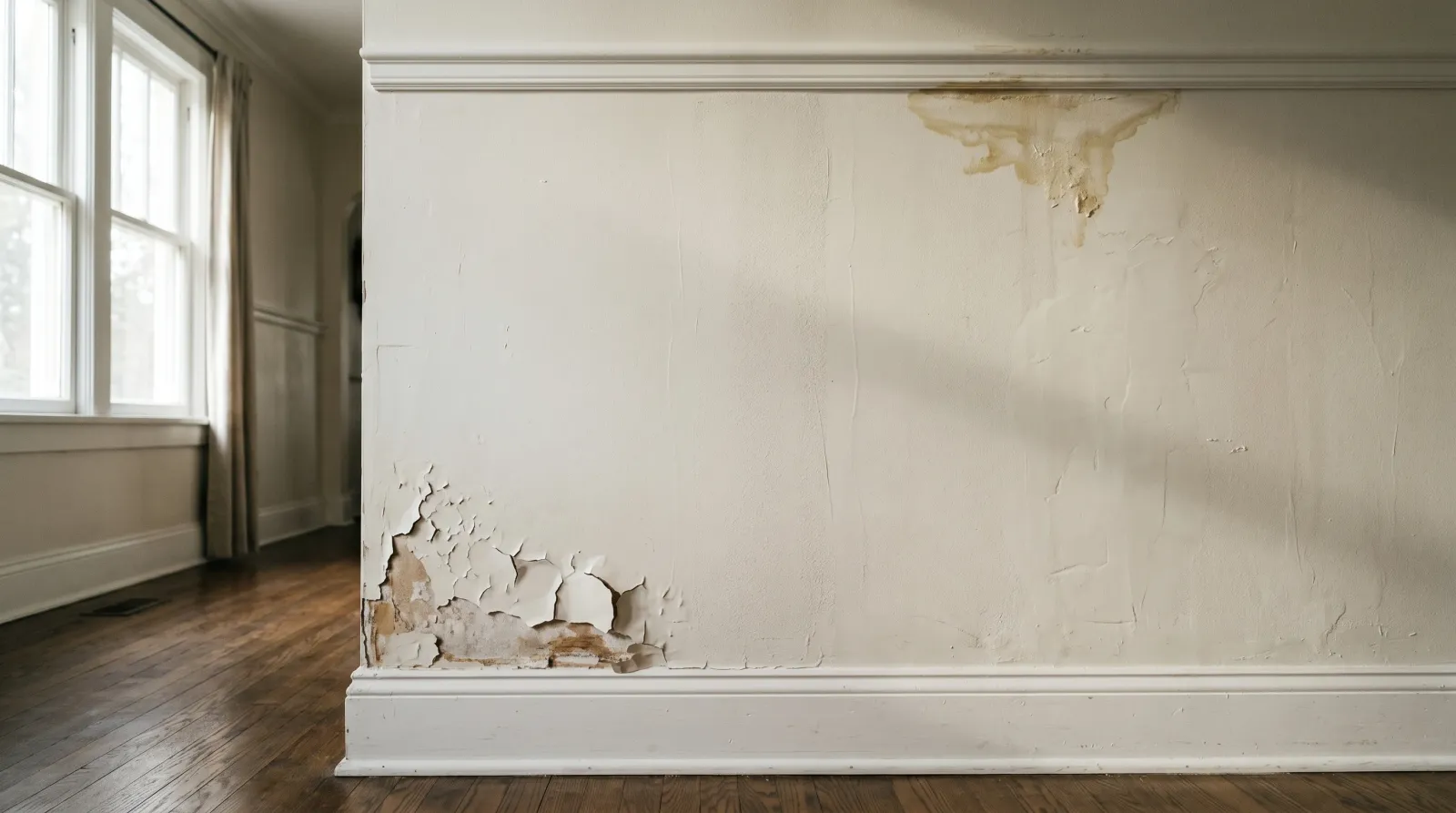
Paint doesn’t fail at random. Almost every problem on a wall, a ceiling, a door, or a piece of siding lands in one of five buckets: it won’t stick, the texture is off, something’s discoloring it, moisture is behind it, or the color’s wrong. Find your bucket, and the fix is one click away. This page is the triage desk. Match the symptom, then go to the page that actually solves it.
One rule before you scroll. The visible symptom is rarely the cause. Peeling isn’t a paint problem, it’s a moisture or prep problem wearing a paint costume. So don’t grab a brush yet. Diagnose first.
Start Here: What Are You Actually Seeing?
Stand back. Look at the surface under raking light from the side, where every flaw throws a shadow. Then sort it.
- It’s lifting, bubbling, chipping, or flaking off. Adhesion. The bond broke.
- The film is stuck but the surface looks wrong: bands, streaks, stipple, brush ridges. Texture. Application.
- There’s a color bleeding through, a yellow cast, a white powder, a brown ring. Discoloration. Something’s migrating up through the coat.
- Black or pink growth, water beading, a sticky film, sweating walls. Moisture. Water’s the real client here.
- The color’s just wrong: too dark, doesn’t match the chip, shifted from the can. Color. Not a failure of the film, a failure of expectation or mixing.
Below, each bucket breaks into the symptoms I see most, the cause behind each one, and the page that fixes it.
Adhesion Failures: When Paint Won’t Stay Put
This is the big one. If paint is leaving the surface, the bond underneath it failed. Recoating without fixing the bond just buys you 12 months.
- Paint peeling in long curling strips on exterior wood. Cause: vapor pushing out from behind, usually a bath fan venting into the soffit or a bad vapor barrier. Go to how to fix peeling paint.
- Peeling around a tub, shower, or bathroom ceiling. Cause: condensation the exhaust fan isn’t clearing. Go to peeling paint in a bathroom.
- Bubbles or blisters that pop and leave a crater. Cause: trapped moisture or solvent, often paint applied in direct sun or over a damp substrate. Go to paint blistering.
- Fresh latex sheeting off a glossy or old surface. Cause: no sanding, no bonding primer. Classic intercoat failure. Start with what a bonding primer does, then fix peeling paint.
- Paint flaking off trim and millwork. Cause: oil under latex with no deglosser, or no primer on bare wood. Go to adhesion failure on trim.
- Paint peeling off slick laminate or melamine furniture. Cause: nothing keyed into the slick face. Go to paint peeling off laminate.
The diagnostic test for any of these: press painter’s tape hard against the existing film and rip it off. If paint comes with the tape, the bond is already gone and you have a substrate problem, not a touch-up. For the why behind primer choice, read what primer actually does and when a shellac primer earns its place.
Texture Failures: The Film Sticks but Looks Wrong
The paint’s bonded. It just looks bad. These are application problems, and the fix is almost always sand the whole surface and recoat with better technique, not spot-patch.
- Faint bands every 3 to 4 feet under side light. Lap marks. The wet edge dried before the next pass overlapped it. Go to how to roll out lap marks.
- Even stipple or an orange-peel pattern across the wall. Roller marks from a nap too long or paint too thin. Go to fixing roller marks.
- Thin streaky lines from a foam roller on a door or cabinet. Foam can’t hold enough paint. Go to foam roller streaks.
- Visible brush ridges on trim or a door. Wrong brush, paint not leveling, no conditioner. Go to brush strokes that won’t level out.
- A pebbled orange-peel finish from a sprayer. Tip too small, pressure wrong, paint too thick. Go to orange peel from spraying.
If your bands only show in morning or afternoon sun and vanish at midday, that’s raking light finding a real thickness difference. The marks were always there. A whole-wall recoat is the fix, not a partial pass over the seam.
Discoloration: Something’s Bleeding Through
The film is fine, but a color you didn’t choose is coming through it. This is migration: tannin, rust, nicotine, or a chemical reaction pushing pigment up through the coat. A regular topcoat won’t stop it. You need a stain-blocking primer between the source and the paint.
- Brown or tan streaks bleeding up through fresh white paint on wood. Tannin. Go to block tannin bleed-through.
- Rusty brown spots over nail heads or metal. Rust bleeding through. Go to block rust stains.
- A yellow cast creeping over white trim months after painting. Oxidizing oil-based enamel, or sun starvation. Go to yellowing trim paint, and for cabinets specifically, yellowing painted cabinets.
- A dry white crystalline powder on brick or block. Efflorescence. Salts carried out by moisture, not a paint failure at all. Go to efflorescence on brick.
For the chemistry of why oil enamels yellow in the dark and why some primers block bleed that others can’t, the shellac primer explainer is worth five minutes. Shellac-based BIN blocks tannin, smoke, and water stains that water-based primers let through.
Moisture Failures: Water Is the Real Problem
If the symptom involves growth, sweating, or a sticky film, paint is the victim, not the cause. Fix the water or you’ll be back here every season.
- Black, green, or pink growth on a bathroom ceiling. Mold from condensation and poor airflow. Go to bathroom ceiling mold.
- Mold streaking down bathroom walls. Same cause, vertical surface. Go to mold on bathroom walls.
- Walls that bead water or stay damp to the touch. Condensation hitting a cold surface. Go to condensation on walls.
- A brown ring or halo on the ceiling. A leak from above, past or present. Go to water stains on the ceiling.
- A slimy or tacky clear-to-brown film, usually in a fresh-painted bathroom. Surfactant leaching, where humidity pulls the soaps out of new latex. Go to surfactant leaching, and read why surfactant leaching happens before you assume it’s a defect.
Mold above 10 square feet is an EPA threshold, not a paint job. When you see growth that wide, or the drywall behind it is soft, the fix is remediation first. The right topcoat after that is a mildew-resistant product. See the best mold-resistant paint round-up for what actually holds in a wet room.
Color Problems: The Film’s Fine, the Color’s Wrong
Not every complaint is a failure. Sometimes the paint did exactly what paint does and the surprise is on the expectation side.
- The wall looks darker than the chip. Color reads deeper at scale and at full sheen than on a tiny matte chip. Go to paint too dark after drying.
- It doesn’t match the sample you approved. Sheen, light, and number of coats all shift it. Go to color not matching the sample.
- The color shifted between the chip and the can, or between cans. A tint or base mismatch. Go to color shift in the can.
Most of this comes down to undertone, the hidden cast under a color that only shows on the wall. If you’re choosing rather than fixing, how undertones work saves you a redo.
How Serious Is My Paint Failure?
Severity sorts into three honest tiers, and it cuts across all five buckets.
Same-weekend fix. Cosmetic texture problems, a small bleeding stain, a yellowed section of trim, a color you can recoat. The film is sound and nothing structural is wrong.
Fix the cause first, then paint. Bathroom mold, recurring peel, condensation, efflorescence. The paint will fail again unless the moisture or the prep gets handled. Painting now wastes the paint.
Stop and get help. Mold over 10 square feet, soft or sagging drywall, water actively coming through, or any disturbed paint in a pre-1978 home. That last one is a health issue before it’s a cosmetic one.
Before You Touch Pre-1978 Paint
If the house went up before 1978, the paint under your problem is probably lead. Sanding, scraping, or heat-stripping it without containment is a real hazard, especially with kids in the house. This applies to peeling, flaking, alligatoring, any failure that makes you reach for sandpaper.
Test before you scrape. The best lead test kits are about $10 at any home center. If it’s positive, the pre-1978 lead test walkthrough and the RRP rule explained tell you what wet-scrape containment looks like. Heat guns volatilize lead, so the heat gun guide is for non-lead jobs only. When the area’s wide or you don’t own HEPA gear, hire a certified RRP contractor and read up on lead paint removal methods first.
No dry sanding, no power sanding, no heat. That rule overrides every fix on this site.
Prevention: How to Not Be Back Here
The pattern across all five buckets is the same. The failures repeat because the cause never got named. A few habits kill most of them before they start.
- Prep is 80% of the job. Sand glossy surfaces dull, deglossing where needed, clean off grease and chalk, and prime bare or repaired substrate. The primer explainer covers which primer for which problem.
- Move the moisture. Run the bath fan during and 20 minutes after every shower, target 1 CFM per square foot, and never vent a fan into a soffit. That single mistake rots north-facing exteriors from the inside.
- Match the product to the room. Mildew-resistant paint in wet rooms, a bonding primer over slick surfaces, a stain blocker over tannin or rust, a hard enamel on trim and doors.
- Two coats. Always two coats. One-coat coverage is a label claim, not a film thickness. Thin film fails at the edges first.
- Don’t paint in the wrong conditions. Direct sun, above 85°F, or below 50°F all wreck adhesion and leveling. The cold-weather painting guide covers the low end.
When to Call a Pro
- Pre-1978 home with widespread peeling, flaking, or alligatoring. Lead test first, then likely a certified contractor.
- Mold over 10 square feet, or any growth with soft drywall behind it.
- Active water intrusion: a live roof leak, plumbing leak, or sweating exterior wall.
- Failures above 12 feet on a two-story exterior or a stairwell.
- A whole-house repaint already fighting recurring failure. Diagnose the system before you buy more paint.
What’ll Bite You in Two Years
Whatever bucket you landed in, the trap is the same. You fix the symptom, skip the cause, and the paint comes back to collect 18 to 24 months later. Paint is the visible layer of a system. If the system leaks moisture, skips prep, or fights the wrong product, the paint shows it, every time, on schedule. Name the cause now and you only do the job once.
Ask a Question