How to Remove Mold from Bathroom Walls (and Keep It Gone)
Diagnose the ventilation problem first. Treat with RMR-86 or Concrobium, prime with Zinsser Mold Killing Primer, topcoat with Perma-White. The fix that actually holds.

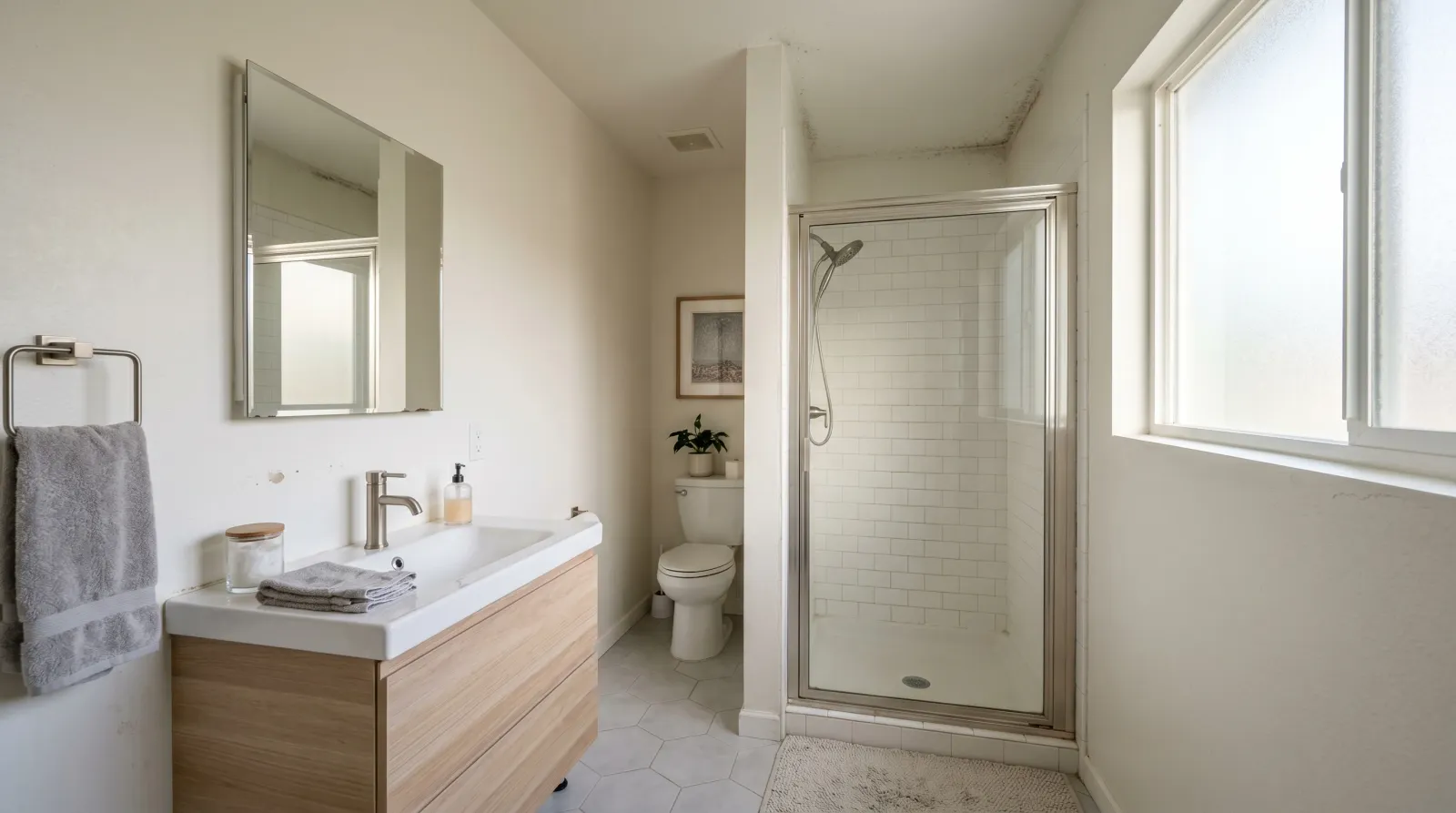
Dark spots above the showerhead. Fuzzy patches behind the toilet. A grey-black line creeping up the grout into the painted wall corner. You can paint over it tonight and it’ll be back by spring. The fix isn’t a fresh coat of paint. It’s ventilation first, biocide second, paint third, in that order.
Does This Match What You’re Seeing?
Confirm before you treat. Wrong diagnosis, wrong fix.
- Surface mildew. Small dark spots, dusty rather than slimy, mostly in the upper corner near the shower or behind the toilet. Wipes off with a damp cloth but comes back. This is the common bathroom case.
- Black mold (Stachybotrys). Larger dark patches, slimy or slick to the touch, sometimes with a musty smell. Often grows behind drywall around plumbing leaks. EPA threshold: above 10 square feet, call a pro.
- Soap scum / hard-water stain. Streaks that follow water flow, usually below the showerhead. Wipes clean with a real bathroom cleaner. Not mold.
- Yellowing on white paint. Often confused for mildew in low-light bathrooms. Uniform, no defined patches, doesn’t wipe off. That’s an oil-based-trim aging problem — see yellowing trim, not this page.
Confirm with a damp cloth. If a spot wipes clean and the wall behind it looks like fresh paint, it was soap scum. If it smears into a grey halo, that’s mildew and you’re in the right place.
How Serious Is This?
A few square feet of surface mildew in a working bathroom is a same-weekend fix. A wall section bigger than 10 square feet, visibly wet or sagging drywall, or growth that comes back inside 90 days of treatment is not a DIY job. The 10-square-foot line is the EPA’s.
If the mold came back through your last paint job, the can wasn’t the problem. The fan was.
Why This Is Happening (root Cause)
Mold needs three things. Moisture. Organic food (drywall paper, paint film). Temperature between 65 and 85 degrees, which is every bathroom in America. Take one of the three away and growth stops.
You’re not going to refrigerate the bathroom. The drywall paper is staying put. So the lever is moisture, and in a bathroom, moisture means ventilation.
Every 8-minute shower dumps roughly half a pound of water into the air. Some of it goes out the bathroom door. The rest condenses on the coldest surfaces in the room: the wall opposite the shower, the upper corner near the exhaust grille, the ceiling above the showerhead, and any wall section that shares a stud bay with an exterior wall. Same places the mildew shows up. The dew point is picking your trouble spots for you.
A bathroom fan rated at 1 CFM per square foot of floor space, running during the shower and for 20 minutes after, drops the post-shower RH peak from 80%+ down to about 50–55%. Mildew can’t establish below 55% RH. That’s the whole fix. If your fan can’t pull a single sheet of toilet paper against the grille, it’s undersized or worn out and no paint will save you. Replace the fan first.
The Fix
Five steps. Don’t skip step three.
Step 1 — Contain and Gear Up
Open the bathroom window if you have one. Run the exhaust fan. Wear an N95 mask, nitrile gloves, and eye protection. Even Concrobium kicks dust as you scrub. Drop a cheap canvas drop cloth at the base of the wall to catch overspray.
If the affected area is bigger than 10 square feet, or you can see soft, sagging, or visibly wet drywall, stop. Call a remediator.
Step 2 — Treat
Spray the affected wall with Concrobium Mold Control or RMR-86 Instant Mold Stain Remover. Concrobium for porous painted drywall (no rinse needed, it physically crushes spores as it dries). RMR-86 for tile, grout, and fiberglass surrounds (faster, harsher fumes, ventilate hard). Dwell 10 minutes. Wipe with a clean cloth.
If you’re treating both wall and grout, do the grout with RMR-86 first, rinse, then come back to the wall with Concrobium.
Safety rule. Never mix bleach with vinegar, ammonia, or hydrogen peroxide. Produces chlorine or chloramine gas, both toxic, both bad ideas in a closed bathroom. If you’re using a household bleach solution as a last resort (1 part bleach to 10 parts water), use it alone, ventilate hard, and rinse with plain water.
Step 3 — Dry Completely
This is the step most homeowners skip and then wonder why the mold came back through the paint. Run a fan or a dehumidifier on the wall for 24 to 48 hours until the substrate is bone-dry to the touch. A moisture meter is overkill for one bathroom, but the paint can won’t seal over a damp wall. Wait it out.
While the wall dries, check the fan. Pull a single sheet of toilet paper against the grille. If the fan doesn’t hold it, the fan is dead or undersized. Replace it before you finish the project.
Step 4 — Prime with a Stain Blocker
Zinsser Mold Killing Primer is the right call here. Water-based, contains an EPA-registered biocide, and blocks the grey halo that mildew leaves behind in the drywall paper. One coat. Brush the corners, roll the field. Dry per the label, typically 1 hour to recoat.
If the mildew left a dark shadow that’s still ghosting through Mold Killing Primer after one coat, swap to Zinsser BIN (shellac) for the stain block, then go back over with Mold Killing Primer for the biocide layer. Shellac kills the worst stains; the water-based primer carries the warranty chemistry.
Step 5 — Topcoat with a Warranted Film
Zinsser Perma-White in satin for the walls, semi-gloss for the splash zone above the sink and behind the tub. Two coats, recoat at 2 hours, full cure at 7 days, shower-ready at 24 hours. The Perma-White warranty is five years against mold and mildew growth on the film itself. The only number on the shelf in this category. That’s the chemistry call David Chen explains below.
For the picks-and-rankings version of this choice, see the best mold-resistant paint round-up.
Why “mildew-Resistant” Paint Fails — David Chen on the Chemistry
Most people buy a paint labelled “mildew-resistant” and assume the chemistry is the same as a warranted mold-and-mildew-proof film. It isn’t.
A standard bathroom-rated paint inhibits surface growth by keeping the film dense and the surface unfriendly. The biocide loading, where it exists, is low. That’s why the labels read “resistant” rather than “proof”: the manufacturer isn’t standing behind the film against active growth, only against casual surface establishment under normal conditions. The reason for that is cost. Real biocide systems are expensive, and most bathroom paint is sold to homeowners painting a bathroom that has never had mold.
A warranted mold-and-mildew-proof film (Zinsser Perma-White is the standard) carries a different biocide chemistry, loaded heavier and bound into the cured film through cross-linking with the acrylic binder. The biocide doesn’t wash out in the first wipe-down. It’s chemically tied to the binder, not riding on the surface, which is why Perma-White can publish a five-year warranty and Sherwin’s Emerald can’t. Emerald is a beautiful wall paint. It isn’t engineered for a bathroom that’s already lost the mold fight once.
Takeaway. If the bathroom has never had mold, mildew-resistant paint plus a working fan is enough. If it’s had mold once, the warranty film is the one you want. It’s the only chemistry rated for the failure mode you’ve already seen.
Recommended Product
Zinsser Perma-White Mold & Mildew-Proof Interior Paint. Five-year written warranty against mold and mildew growth on the film. Available in eggshell, satin, and semi-gloss, so you can spec satin walls plus semi-gloss splash zone with one product line. Self-priming over the Mold Killing Primer layer.
Prevention (the Part That Actually Matters)
Three things move outcomes more than the can you bought.
- Run the bathroom fan during every shower and for 20 minutes after. Forever. Get a timer switch if you keep forgetting. This is the single biggest fix on this page.
- Replace the fan if it’s underpowered. Target 1 CFM per square foot of bathroom floor area. A 50-square-foot bathroom needs a 50 CFM fan, minimum. Most builder-grade fans are 50 CFM and 12 years old; they’re not pulling 50 anymore.
- Make sure the fan exhausts outside, not into the attic. Attic discharge is a common builder shortcut. It dumps the bathroom moisture directly above your bedroom ceiling, where it condenses, soaks the insulation, and grows the next problem.
Smaller levers that still matter. Squeegee the shower walls. Leave the bathroom door open between showers. Caulk gaps around the tub and the trim where moisture migrates into the wall cavity. Keep indoor RH below 60% year-round; a $25 hygrometer tells you whether you’re winning.
When to Call a Pro
- Affected area larger than 10 square feet (EPA threshold).
- Visibly wet, soft, or sagging drywall. Water is in the cavity and paint won’t fix it.
- Mold came back through fresh paint inside 90 days. Spores are deeper than the topcoat can reach. Strip back to substrate.
- Suspected black mold (Stachybotrys: dark, slimy, often near a plumbing leak).
- Pre-1978 home with peeling paint near the mold. Test for lead before any sanding (RRP rule).
- Anyone in the house with severe asthma, immune compromise, or pregnancy.
What’s going to bite you in two years if you skip the diagnosis. You’ll repaint with the warranty film, the room will look perfect for a season, and then the same corner above the showerhead will start to grey out again because the fan never moved enough air to drop the RH peak. The can will get the blame. It shouldn’t. Run the fan. Then paint.
Ask a Question