How to Fix Efflorescence on Brick
White crystalline bloom on brick is salts pushed to the surface by moisture. Diagnose the water source first, dry-brush, acid-wash 1:10, then Loxon-prime so paint actually holds.

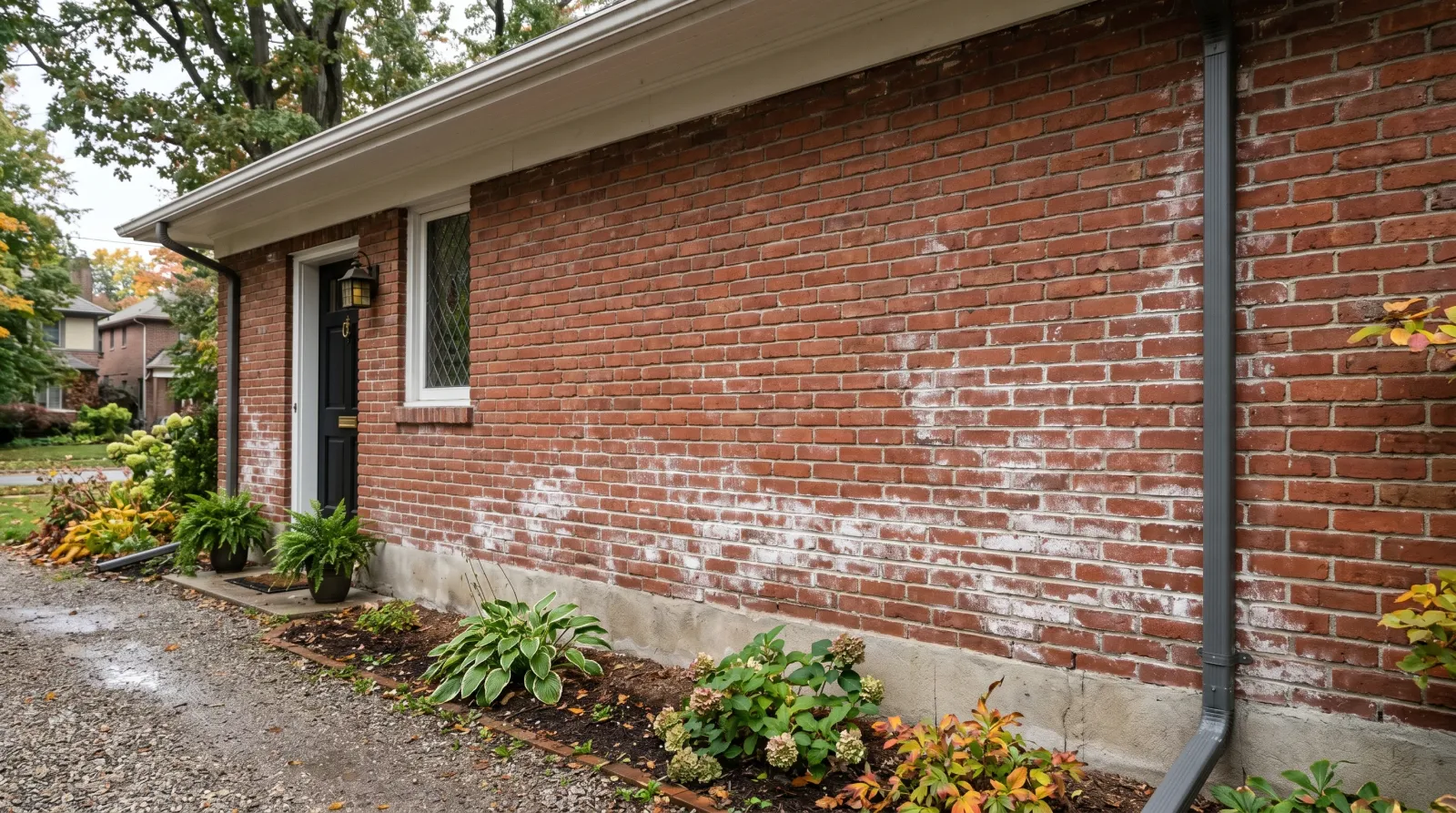
White powder on a brick wall looks like dirt and washes off like dirt and that’s where most homeowners stop. It’s not dirt. It’s mineral salts riding water out of the brick. Until you stop the water and bind the surface, anything you roll on top releases in patches.
Does This Match What You’re Seeing?
Wipe a finger across the bloom. What comes off tells you what you’re fighting.
- Efflorescence: white or pale gray, dry, crystalline. Dusts off on a rag. Heaviest along mortar joints, near grade, under window sills, behind downspouts.
- Brick chalking from old paint: powder over old brick paint, caused by UV-killed binder, not moisture. See the chalking fix.
- Lime run: hard, glassy white deposits streaking down from a mortar joint. Doesn’t dust on a rag. Needs sulfamic acid, not muriatic.
- Mortar wash-out: pale residue on new construction under 12 months old. Disappears with normal weathering; don’t acid-wash it.
- Mildew: dark, green-black, slimy when wet. Different chemistry. See bathroom mold walls for the bleach sequence.
If you can’t tell, mist a 6-inch patch with water. Efflorescence dissolves and re-blooms in 48 to 72 hours. Lime run wets and stays put.
How Serious Is This?
Three tiers.
- Light bloom on a garden wall or a single chimney face. Cosmetic. Dry-brush, 1:10 muriatic wash, rinse, done in an afternoon.
- Recurring bloom across a foundation course or under a window. Real water path. Find and fix the source first (gutter, flashing, regrade), then the cleaning sequence. A weekend or two.
- Heavy bloom plus spalling brick or damp interior walls. That’s a structural moisture problem behind the brick. Stop. Get a mason or a waterproofing assessment before you spend another hour on the surface.
Why This Is Happening (root Cause)
Brick is full of soluble salts left over from firing and the mortar bed: calcium sulfate, sodium carbonate, magnesium sulfate. They sit dormant until liquid water moves through. The water dissolves the salts, carries them to the face, evaporates, and the salts crystallize on the surface as bloom.
Water gets in three ways. Driving rain soaks the brick from outside. Capillary action wicks groundwater up from below grade through brick in soil contact. Interior moisture migrates outward through a poorly vented basement wall and condenses against the cold backside of the brick. On a 1920s Midwest house with no rain screen and a chimney that sees four sides of weather, you get all three.
Paint over an active cycle is doomed. The salts crystallize against the back of the film, break the bond, and the coating peels off in patches within a season. I’ve watched a homeowner repaint the same chimney three times in three years before he admitted the cricket flashing above it had been failing the whole time. Stop the water, then clean, then paint.
The Fix
Step 1. Find and Stop the Moisture Source
Walk the wall before you touch a brush.
- Gutters and downspouts. Clogged gutters curtain-wash the wall below. Extend downspouts to discharge 6 feet from the foundation.
- Flashing above the wall. Step, cricket, and head flashing. Failing flashing is the most common source on a chimney wall.
- Mortar joints. Tuckpoint cracked or missing mortar before you wash; otherwise the wash water just fills the joints.
- Grade and splashback. Soil should slope away at 6 inches over 10 feet. Splash off a hard surface drives salts up the first three courses.
- Interior humidity. A basement at 65% RH pushes vapor outward into the brick. Run a dehumidifier at 50%.
- Sprinklers. Rotor heads soaking the wall every morning ruin brick paint faster than any other variable I see in the field.
Don’t move on until the wall has been visibly dry for a week of decent weather.
Step 2. Dry Wire-Brush
Salts dissolve in water. If you wet a heavily bloomed wall before mechanical removal, you re-drive the salts into the brick and they re-bloom after every cleaning.
Hit the bloom dry with a stiff nylon or brass wire brush. Steel wire leaves rust streaks that telegraph through paint, so brass on visible-brick walls. Vacuum the dust off with a shop vac fitted with a HEPA bag if the wall is pre-1978 and might carry lead from an old coating.
PPE: N95 minimum, eye protection, gloves. Salts and brick dust are not lungs-friendly.
Step 3. Pre-Wet, Then Acid-Wash 1:10
Pre-wet the wall with a garden hose. A dry substrate sucks acid into the joints and burns them. A wet wall holds acid on the surface where you want it.
Mix muriatic acid 1 part to 10 parts water in a plastic pail. Always acid into water, never water into acid. The reverse causes a violent exothermic splash. Apply with a polypropylene brush or low-pressure pump sprayer, working from the bottom up so drips don’t streak unwashed brick. Dwell two to three minutes, scrub stubborn spots, don’t let it dry on the surface.
PPE non-negotiable: chemical-splash goggles, neoprene gloves, long sleeves, rubber boots, organic-vapor respirator if you’re working indoors. Cross-ventilate. Tarp shrubs below the wall; muriatic browns foliage on contact. For gentler chemistry, sulfamic acid powder or Prosoco Sure Klean 600 costs twice as much and saves you the off-gas headache indoors.
Step 4. Neutralize and Rinse Twice
Rinse top-down with a garden hose. Mix one cup of baking soda per gallon of water, slosh across the wall, rinse again. A drop of fresh water on the brick should no longer fizz. Two rinses minimum. Let the wall dry 72 hours before priming; moisture meter on a shaded face should read below 12%.
Step 5. Safety and Chemical Interactions
Never combine muriatic acid with bleach, ammonia, or any chlorine cleaner. Produces chlorine or chloramine gas; clears a basement of usable air in seconds. If you bleached mildew off the wall first, rinse thoroughly, dry 48 hours, then acid-wash. Never store mixed acid in a metal container; plastic pail only, dump leftover into a baking-soda slurry for disposal.
Step 6. Prime With Loxon Conditioner
Brick is alkaline. Standard latex primers saponify on alkaline substrates and bond poorly. Sherwin-Williams Loxon Conditioner is a penetrating water-based masonry conditioner that binds residual chalk after acid-washing and tames the surface chemistry. One coat, brushed into mortar joints, rolled with a 3/4-inch nap on the field. Recoat in two hours at 70°F. For severely bloom-prone walls, INSL-X TuffCrete Acrylic Primer adds a second layer of insurance under high-build masonry coatings.
Step 7. Two Coats of Elastomeric or 100% Acrylic
Two coats. Always two coats. The choice depends on what the wall has to do.
- Foundation course or chimney exposed to driving rain: elastomeric masonry coating like Sherwin-Williams ConFlex XL. Bridges hairline cracks, breathes outward.
- Interior brick fireplace surround: 100% acrylic flat or low-luster like Benjamin Moore Aura Exterior in eggshell.
- Garden walls and free-standing masonry: 100% acrylic exterior in flat. Cheaper and easier to recoat in five years.
Cut in with a 2.5-inch sash brush, roll the field while the cut-in is still wet, don’t stop mid-wall. Lap marks on a south-facing chimney show up at 8 a.m. the day after.
Recommended Product
Sherwin-Williams Loxon Conditioner. Penetrating water-based masonry conditioner that binds residual chalk after an acid wash and tames an alkaline brick surface before the topcoat. The product I reach for on chimney repaints and foundation-course brick where bloom is a pattern. About $45 a gallon, brushable and rollable, recoatable in two hours.
Loxon Conditioner at Sherwin-Williams
Prevention
- Fix the water path before you clean the wall. Gutter, flashing, regrade, splash zone. The cosmetic fix doesn’t hold without the structural one.
- Apply a breathable water repellent after paint cures. Silane or siloxane like ChimneySaver lets vapor escape outward while blocking driving rain. Don’t use a film-forming sealer; it traps moisture.
- Inspect mortar joints annually. A failing joint is the most likely root cause and the cheapest fix.
- Don’t pressure-wash brick. 2,000 PSI drives water deep into the joints and feeds the next bloom.
When to Call a Pro
- Bloom recurring within a season of a properly cleaned and primed wall.
- Visible spalling: brick faces popping off in chips. Freeze-thaw damage; painting over it accelerates the failure.
- Bloom plus damp interior walls on the same wall. Whole-envelope vapor problem.
- Pre-1978 painted brick with bloom and flaking. Test for lead first.
- Chimney work above 12 feet or anything requiring scaffold staging.
What’ll Bite You in Two Years
Skip the moisture diagnosis and the bloom comes back. Skip the Loxon and the topcoat releases at the mortar joints first because that’s where the alkalinity is highest. I’ve watched homeowners acid-wash the same chimney every March for six years and never fix the rusted-through cricket flashing six feet above it. Took a sheet metal shop an afternoon. The bloom hasn’t been back since.
Ask a Question