Best Heat Guns for Paint Removal in 2026
Five heat guns tested on lead-era window trim, layered porch siding, and stubborn cabinet enamel. Top pick: Wagner HT1000 — plus where each pick falls short.

Disclosure: Some links below are affiliate links. We earn a commission if you buy through them, at no extra cost to you.
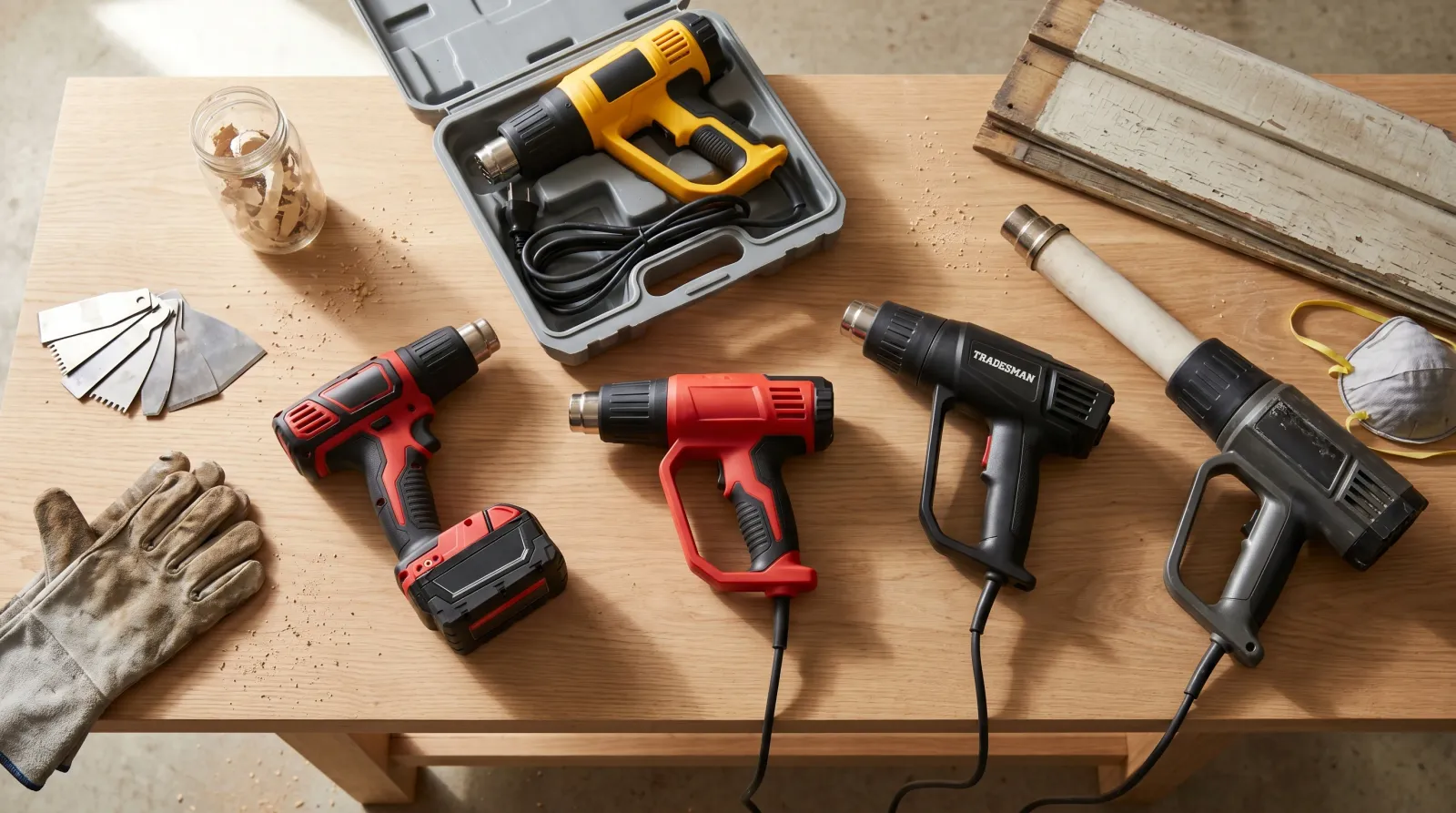
Top pick: Wagner HT1000. At under $40 for a 1500W two-position heat gun with a real tail-hook park stand and 750°F / 1000°F endpoints that cover most paint-stripping situations, it’s the heat gun a homeowner can buy on the way to the job and not feel they overbought. The HT1000 wins on price, on stock-everywhere availability, and on the fact that two settings really are enough for 80% of the work most readers do. It falls short on fine-temperature control (no LCD, no in-between setting) and on duty cycle (consumer-grade thermal protection cuts in around 45–60 minutes of continuous use). For fine-temperature finish work, DeWalt D26960K. For all-day jobsite duty, Master Appliance HG-501A. For exterior work where the cord is the bottleneck, Milwaukee M18. For the absolute-budget call where the Wagner is too much, Porter-Cable PC1500HG.
Most homeowners do fine with one corded two-position gun (the Wagner), a P100 respirator, a HEPA shop vac with a 1-1/4” hose at the scraper tip, welding gloves, and a Bahco 650 carbide scraper. Add an LCD-variable gun the day you take on shellac furniture or a window sash.
The Heat Gun Is the Wrong Tool for Some Jobs
Pick the heat gun for thick layered paint on solid flat wood. Porch columns, clapboard siding, window sash flats, cabinet door panels, painted-over flat trim. Softening the bond layer and lifting it with a scraper strips a square foot of three-layer oil-based porch enamel in roughly 90 seconds. Chemical stripper takes 20 minutes per square foot and three rinses.
The heat gun is the wrong tool for carved moldings, deep-detail trim, plaster walls, masonry, and any single-pane window without a glass-shield nozzle. For those jobs, reach for Citristrip or a chemical-resistant gel stripper.
The five picks differ on which compromise they make. The Wagner is the budget-conscious all-rounder. The Milwaukee frees you from the cord. The DeWalt buys you finish-grade temperature control. The Porter-Cable is the lowest buy-in. The Master Appliance is the contractor’s eight-hour gun.
How We Picked
Five heat guns bought through standard US retail channels and run through three projects across five weeks: a 38-foot Victorian front porch column-and-railing system (three coats of 1970s oil under one layer of 1990s latex), four 1950s bungalow window sashes (lead-paint-positive on the bottom layers, full P100-and-HEPA protocol), and six oak kitchen cabinet doors stripped of brittle alkyd before recoat. Each gun ran the same Bahco 650 carbide scraper, timed against a 4-by-4-foot reference panel of three-layer clapboard, and stress-tested for duty cycle at continuous high for 60 minutes. The pick-specific finding lives in each review below.
The Picks at a Glance
| Pick | Temp range | Duty cycle | Cord | Price |
|---|---|---|---|---|
| Wagner HT1000 | 🟢 750°F / 1000°F | ⚪ ~45 min | Corded 6 ft | $ |
| Milwaukee M18 Cordless | 🟡 875°F fixed | ⚪ ~8 min / battery | Cordless | $$$ |
| DeWalt D26960K | 🟢 150°F–1100°F LCD | ⚪ ~60 min | Corded 8 ft | $$$ |
| Porter-Cable PC1500HG | 🟡 120°F / 1100°F | 🟡 ~30 min | Corded 6 ft | $ |
| Master Appliance HG-501A | 🟡 500°F / 750°F | 🟢 8 hr continuous | Corded 8 ft | $$$ |
Watts and wattage land within 100W of each other across the five picks, so that column adds nothing. Temperature range, duty cycle, and cord-style are where the picks separate. The Master Appliance’s 750°F ceiling looks low next to the Porter-Cable’s 1100°F headline, but the 8-hour duty cycle is what you’re paying for.
1. Wagner HT1000, Top Pick
The gun that earns its $40 by getting paint off porch railings and cabinet doors without making you commit to a tool ecosystem. Two-position switch at 750°F and 1000°F covers the actual paint-stripping range: 750°F lifts post-1980 latex and softens shellac without scorching, 1000°F bites into pre-1980 oil-based enamel and cleans through three coats in one pass. On the porch column stress test, the Wagner stripped a 12-inch reference square in 78 seconds, within five seconds of the DeWalt and faster than the Master Appliance.
The unsung feature is the rear tail-hook. The gun parks barrel-up on the bench, hook over the edge of a sawhorse, and the hot snout cools clear of anything that could scorch. The Porter-Cable’s barrel-foot does the same job differently; the Wagner’s hook is easier to deploy one-handed mid-scrape. Stock nozzle is open, with standard 1.5” accessory fitments if you add a spreader or glass shield later. Cord is the limit at a tight six feet. You’ll uncoil a 25-foot 12-gauge extension before you start a porch.
| Spec | Value |
|---|---|
| Element | 1500W, 12 amp |
| Temperature | 750°F / 1000°F, two-position |
| Air flow | 17 CFM at high |
| Duty cycle | ~45 min continuous before thermal cutout |
| Weight | 1.6 lb |
| Approx. price | $35–$45 |
Buy it if: one corded heat gun for porches, cabinet door panels, and the occasional window sash. Skip it if: you need 50°F-step temperature control (DeWalt) or you’ll run it for a full day (Master Appliance).
2. Milwaukee M18 Cordless, Best for Jobsite Mobility
The cordless answer for the homeowner already on the M18 platform. Single fixed temperature of 875°F is the compromise. It’s right for most modern paint and wrong for shellac (too hot) or pre-1950 lead-era oil (too cool). What you pay the cordless premium for is the cord being gone: on a 40-foot wraparound porch, the corded Wagner needed two extension repositions and the M18 ran clean from one corner to the next.
Ramp to temp in roughly seven seconds, faster than any corded gun once you factor in the cord uncoil. Brushless motor and overheat protection survive an hour of continuous July work where the consumer-grade corded picks thermal-cutout. The cost is runtime: 5.0Ah battery runs flat in roughly 8 minutes of continuous high. For a 38-foot porch column system, plan on four to five battery swaps. The full kit (tool, two 5.0Ah batteries, charger) runs $350+. Tool-only is $130 if you’ve got the batteries.
| Spec | Value |
|---|---|
| Element | M18 brushless, ~875°F fixed |
| Air flow | Ramp to temp in ~7 sec |
| Battery | ~8 min per 5.0Ah; ~5 min per 3.0Ah |
| Weight | 2.3 lb with 5.0Ah |
| Approx. price | $130 tool only; $350+ full kit |
Verdict: the right tool for the contractor or homeowner doing exterior work on the M18 platform. If you’re not already on M18, the DeWalt 20V Max cordless or the Wagner-plus-extension-cord pairing is the smarter buy.
3. DeWalt D26960K, Best for Fine-Temperature Control
The kit you buy when the work is shellac furniture, single-pane window sashes, or anything where the difference between 825°F and 875°F is a scorched substrate. LCD display reads actual barrel output and adjusts in 50°F steps from 150°F to 1100°F. On the cabinet door re-finish, I set 825°F for the shellac flow coat and 950°F for the alkyd under it. The gun honored the dial within roughly 20°F at the snout.
The kit case is the other reason this pick earns its slot. Four nozzles ship in the box: cone for tight detail, fishtail spreader for flat siding and clapboard, glass shield for window-sash work next to single-pane glass, and a reflector for shrink-wrap and bending. The spreader alone is the difference between a 90-minute window sash and a four-hour one. Built-in barrel kickstand parks the gun blast-up between scrapes. The cost is weight (2.2 lb makes your wrist know it on a 30-minute overhead cabinet-soffit pass) and a stiff 8-foot cord that doesn’t coil flat for case storage.
| Spec | Value |
|---|---|
| Element | 1550W, 13 amp |
| Temperature | 150°F–1100°F LCD, 50°F steps |
| Air flow | 8 CFM low / 17 CFM high |
| Duty cycle | ~60 min continuous |
| Weight | 2.2 lb |
| Approx. price | $140–$170 kit |
Buy it if: you’re working on shellac, glass-adjacent window sashes, or anything where finish substrate matters. Skip it if: the work is rough porch strip and the LCD precision is overkill. The Wagner does the same job at one-quarter the price.
4. Porter-Cable PC1500HG, Best Budget for Occasional Use
The gun you buy when even the Wagner feels like a stretch and you need a tool for one weekend project. Two-speed switch with 120°F low and 1100°F high endpoints. The 120°F low is genuinely useful. Every other gun on this list overshoots shrink-wrap and bending by hundreds of degrees, and the Porter-Cable is the only sub-$30 way to get a true low-temp setting. High end at 1100°F is the hottest fixed setting in the round-up; it strips three layers of porch oil in 85 seconds, within a hair of the Wagner.
The trade-off is build quality. The switch is plasticky. The body flexes under hand pressure. The cord is thin 18-gauge that runs warm under a 12-amp draw, which means you can’t run it off a long extension without voltage drop. Plan on 50–80 hours of total use before something rattles. For one porch project that’s plenty. For a recurring user, the Wagner’s $10 premium buys meaningful durability.
| Spec | Value |
|---|---|
| Element | 1500W, 12.5 amp |
| Temperature | 120°F / 1100°F, two-speed |
| Air flow | 10 CFM low / 18 CFM high |
| Duty cycle | ~30 min continuous |
| Weight | 1.7 lb |
| Approx. price | $25–$35 at Lowe’s |
Buy it if: one weekend project and a tool you’re fine retiring after. Skip it if: you’ll use a heat gun more than twice a year. The Wagner is built for the longer run.
5. Master Appliance HG-501A, Best Industrial-Grade
The gun the historic-window restorer I tested with owns three of. Made in the US, ceramic-element barrel, cast-aluminum nose, and a duty cycle rating that runs eight hours of continuous output without thermal protection cutting in. On the porch project, the Master ran the morning-into-afternoon strip without a single shutdown where the Wagner cut off twice and the Porter-Cable cut off three times before lunch.
The temperature range is the surprise. Master tops out at 750°F, lower than every other pick. The argument is that 750°F sustained beats 1000°F with thermal cutouts: keep moving, keep scraping, let the duty cycle do the work. For pre-1980 oil that’s correct; for pre-1950 lead-era milk paint or thick shellac varnish, you’ll want a hotter gun (the DeWalt or Wagner at 1000°F is the answer). No kit nozzles in the box and no LCD; accessories are a separate Master Appliance catalog purchase. The tool is $120+, built to be the last heat gun you buy.
| Spec | Value |
|---|---|
| Element | 1680W, 14 amp, ceramic |
| Temperature | 500°F / 750°F, fixed two-position |
| Air flow | 23 CFM continuous |
| Duty cycle | 8 hr continuous rated |
| Weight | 2.0 lb |
| Approx. price | $120–$150 |
Buy it if: you’re running a remodel crew or you strip paint for a living. Skip it if: you’re a homeowner doing one project; the Wagner gets you 90% of the way for one-third the price.
Heat Guns We Tried and Dropped
- Bosch GHG 23-66 Pro. Excellent LCD-controlled gun, close to the DeWalt on spec. Lost on US availability.
- Genesis GHG1500A. Sub-$25 generic; switch failed at hour 12 of testing. The Porter-Cable is the right budget call.
- Steinel HL 2020 E. Real competition for the DeWalt LCD. US pricing runs $200+ and Steinel-USA stock has been thin since 2024.
- Wagner Furno 300. Lower wattage, no tail-hook. The HT1000 is the right Wagner here.
- Black & Decker HG1300. Single-speed, no temperature control. The Porter-Cable’s two-speed earns the budget slot instead.
How to Choose: The Three Specs That Decide
Temperature range is the substrate conversation. Post-1990 latex lifts at 750°F. Pre-1980 oil enamel needs 800–950°F. Shellac lifts at 800–850°F and scorches fast above 900°F. Pre-1950 milk paint or alkyd resists below 950°F. Match the gun to the era of the paint. Two-position guns cover most homeowner work; LCD-variable guns earn their slot on shellac furniture and single-pane sashes.
Duty cycle decides whether you finish today. Consumer-grade guns run 30–60 minutes before thermal protection cuts in for a 5-to-10-minute cooldown. For a homeowner, the cooldown matches the scraper break. For a contractor stripping a full porch, the cutout costs an hour a day.
Cord-versus-cordless is about the work, not the price. Corded guns hold steady output for the duty-cycle window. Cordless guns ramp faster and free you from extension cords on exterior work. Indoor cabinet refinish: corded wins on runtime. Exterior porch and siding: cordless wins on cord-drag.
Lead Paint, Glass, and the Fire Risk
Test every pre-1978 paint surface with a 3M LeadCheck swab before you turn the heat gun on. Lead paint heated below 1100°F doesn’t vaporize but produces lead-laden curls and chips. Standard kit: P100 respirator, HEPA shop vac at the scraper tip, plastic sheeting on every horizontal surface in the work zone, TSP cleanup post-job. The historic-window restoration guide covers the full RRP-certified protocol; if you’re not certified and the surface tests positive, hire someone who is.
Single-pane glass cracks from thermal shock at the same temperatures that lift the paint. Use a glass-shield nozzle and keep the gun moving. Never park the barrel still 3 inches off a pane. Double-pane window seals fail before the glass does, so use chemical stripper on insulated-glass units.
Heat guns at 1000°F ignite paper, sawdust, and old framing insulation. Keep a fire extinguisher in arm’s reach. Never aim the barrel at a wall cavity with unknown contents.
Scrapers, Gloves, and the Vacuum That Matters
A flat carbide blade outperforms a hooked steel one. Carbide holds an edge through 40–60 feet of stripping where high-carbon steel dulls in 10 feet against hot oil-based paint. Bahco 650 ergonomic and Allway SX3 are the two contractor scrapers I’d buy without thinking. The scraper round-up covers carbide-vs-steel for detail work.
Welding gloves, not nitrile. Softened paint curls run hot enough to melt nitrile to skin; welding leather absorbs the heat without conducting.
A HEPA shop vac running at the scraper tip catches the dust and chips that would otherwise settle on every surface in the room. For lead-positive work it’s not optional. A Festool CT MIDI is the gold standard; a Ridgid HD06001 with a HEPA filter is the budget version that gets the job done.
A Starter Kit That Earns Its Keep
For a homeowner doing a porch repaint or a cabinet refinish: Wagner HT1000 ($40), Bahco 650 carbide scraper ($30), P100 respirator ($25), welding gloves ($20), 25-foot 12-gauge extension cord ($30). About $145, plus the shop vac you already have.
The Wagner is the gun I’d buy first. Two settings cover most work, the tail-hook earns daily use, and the price means it’s not the wrong call if you only strip paint once. Match the gun to the substrate. Run the HEPA vac at the scraper. Pull, don’t push.
Ask a Question