How to Stop Condensation on Interior Walls
Cold-bridge corners, north-facing exterior walls, the patch behind the dresser. Diagnose ventilation and insulation first. Anti-condensation paint is a palliative, not a cure.

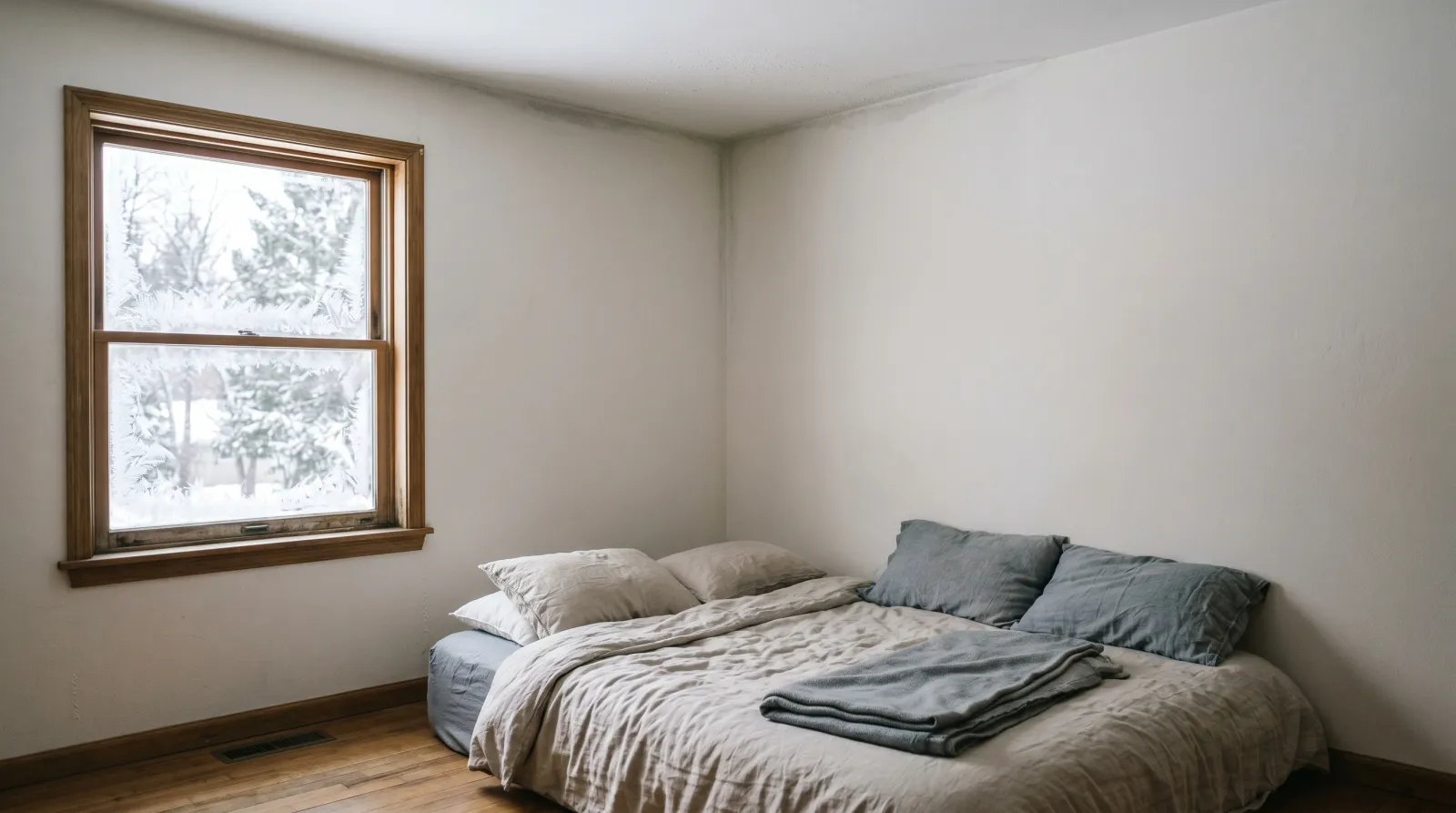
Water beads on the wall above the bed every January morning. The corner near the ceiling on the north side of the house goes grey by February. You pull the dresser off the exterior wall and the back of it is damp. None of this is a paint failure. It’s the dew point picking your trouble spots, and the fix is to move the wall surface above it.
Does This Match What You’re Seeing?
Confirm before you treat. Three things look alike from across the room and have three different fixes.
- Beaded water on a cold wall in winter. Clear droplets, usually upper corner, usually north or east exterior wall, worst on the coldest mornings. This is straight condensation. The wall surface is below dew point.
- Grey halo with no visible droplets. Soft, smudgy, no defined edge, hugs the upper corner. The wall went through dew point overnight, dried by mid-morning, and left a faint mildew shadow. Same root cause, one step later.
- Mildew bloom behind furniture. Darker speckle, often fuzzy to the touch, on the wall section behind a wardrobe, bed headboard, or sofa pressed against an exterior wall. Trapped still air over a cold surface. Treat it as condensation plus a furniture-placement problem, not a bathroom mildew problem.
- Straight wet line down a wall. Vertical, follows a stud or pipe path, doesn’t care what the weather’s doing outside. That’s a leak. Stop reading this page and check for a plumbing or roof problem first.
A $12 hygrometer and a $25 infrared thermometer settle the diagnosis in five minutes. Aim the IR gun at the cold corner. Subtract the surface temperature from the room temperature. If the corner is more than 7°F colder than the rest of the wall and the room RH is above 55%, you’re in dew-point territory and this page is the right one.
How Serious Is This?
A patch of beaded water that wipes off after the coldest morning of the month, on a wall that dries by lunchtime, is a same-weekend fix. Mostly a ventilation and furniture-placement problem.
A wall that’s wet every morning all winter, with a grey halo that’s now mildewed, is a cold bridge doing real work behind your paint. The drywall paper wicks water into the cavity. Left another season, the insulation loses R-value and the cycle accelerates. Fix it this winter.
A wall that’s visibly wet, soft, or sagging is not condensation anymore. That’s moisture intrusion. Call a contractor with a moisture meter and a thermal camera, not a painter.
Why This Is Happening (the Dew Point)
Indoor air at 70°F and 50% relative humidity has a dew point of about 50°F. Drop any surface in that room below 50°F and water condenses on it. That’s physics. The can on the shelf can’t beat physics.
Three common ways a wall surface gets cold enough.
Cold-bridge corners. Where two exterior walls meet, or an exterior wall meets a poorly-insulated ceiling, three pieces of framing converge in one bay. Studs are R-1 per inch. Fiberglass batt is R-3 to R-4. The framing column at the corner runs 10–15°F colder than the field of the wall on a January morning. The corner hits dew point first. Same place the grey halo shows up.
North-facing exterior walls. Walls that never see direct sun in winter, built with thin batts and no thermal break, run a few degrees below the rest of the room. In a tight, humid house those walls hit dew point overnight and dry by mid-morning. The grey haze you can’t quite wipe off is the record of that cycle.
Behind furniture pressed against a cold wall. A wardrobe flat against an exterior wall traps a still pocket of air. The pocket cools to dew point faster and stays there longer. The wall behind it gets wetter than the wall beside it. Pull the wardrobe out and the patch stops growing inside a month.
The lever is the same in every case. Drop the indoor humidity below the dew-point threshold, or warm the cold surface above it. Paint is the last knob to turn.
The Fix
Five steps. Don’t skip step two.
Step 1 — Measure Before You Touch the Wall
Buy a hygrometer and an infrared thermometer. Together they’re $40 and they tell you whether you have a humidity problem, a cold-wall problem, or both.
Read the room RH morning and evening for a week. Note the coldest corner temperature each morning. If indoor RH is over 55% in winter, drop it first. If the cold-corner surface is under 50°F, the wall needs warming.
Step 2 — Drop the Indoor Humidity Below 50%
Every hot shower, cooking pot, gas dryer, and houseplant dumps moisture into the air. Pull the air out.
Run the bathroom fan during every shower and for 20 minutes after. Vent the kitchen hood outside, not the recirculating kind. If the dryer vents inside the house, that’s wrong; vent it out. Crack a window for 10 minutes in the morning even in winter. In a tight house with too many people, run a $200 dehumidifier near the worst wall and watch the corner dry out inside a week.
Below 50% RH at 70°F, the dew point sits at 50°F. Most exterior corners can hold 50°F in winter. They cannot hold 60°F.
Step 3 — Warm the Cold Spot
The permanent fix is insulation. The cheap fix is air movement.
Cheap and immediate. Pull furniture three to four inches off every exterior wall. Don’t push beds, wardrobes, sofas, or bookcases against the cold side of the house.
Right but bigger. The corner that condenses is usually missing batt or has a compressed batt around the framing column. A blower-door audit finds it. A contractor with cellulose or closed-cell foam fixes it. Cost runs $800–$3,500 for the cold side of a room. R-value goes up, surface temperature goes up, the corner stops sweating. This is the real fix.
Safety rule. If you suspect the cavity is wet, do not seal it with foam. Trapped moisture rots framing inside two seasons. Dry the cavity first, find the source, then insulate.
Step 4 — Treat the Existing Damp Patch
If the wall already has a grey halo or a mildew shadow, treat it before you repaint. Spray Concrobium Mold Control on the corner. Dwell 10 minutes, wipe. Run a fan on the wall for 24 hours until it’s bone-dry to the touch.
Never mix bleach with vinegar, ammonia, or hydrogen peroxide. Wear an N95 and nitrile gloves. Ventilate hard.
Step 5 — Repaint With a Stain Block, Then a Sensible Topcoat
Prime the dried corner with Zinsser Mold Killing Primer. One coat, brush the corner, roll the field. Blocks the shadow and lays down the biocide layer the topcoat doesn’t carry.
Topcoat with a quality interior matte or eggshell. Benjamin Moore Aura or Sherwin-Williams Emerald are denser-film paints that handle a borderline-cold wall better than builder-grade emulsion. Two coats. Always two coats.
Anti-Condensation Paint — When It Earns the Money
Anti-condensation paint is an insulating-bead-loaded emulsion (the British market knows it better than the American one; Thermilate and Polycell Damp Seal are the common names). The dry film runs a couple of degrees warmer than standard paint because it traps a thin layer of still air against the wall.
On a corner that’s flirting with dew point (say, 51°F surface in a 70°F room at 50% RH), those two degrees can be enough to keep the wall above the threshold. The water stops beading.
On a corner that’s genuinely 45°F all morning, it doesn’t move the needle. The dew point is 50°F and you’re 5°F under it; a thicker film won’t bridge that gap. You’ll have a slightly warmer wet wall.
Treat it as a finishing touch on a corner you’ve already insulated. Not a substitute for the work.
Prevention (the Part the Can Won’t Solve)
Five levers move outcomes more than any paint you buy.
- Keep indoor RH below 50% in winter. Hygrometer on the nightstand. Dehumidifier in the basement. Fans vented outside.
- Pull furniture off exterior walls. Three to four inches. Forever.
- Vent every wet appliance outside. Dryer, bathroom fan, kitchen hood. Not the attic.
- Insulate the cold corner. Blower-door audit, then batt or foam.
- Crack a window in winter. Ten minutes of cross-ventilation a day drops indoor RH measurably and costs almost nothing in heat.
For the bathroom version of the same problem, see bathroom mold on walls.
When to Call a Pro
- Wall is visibly wet, soft, or sagging. That’s intrusion, not condensation.
- Condensation comes back inside 90 days of a real fix. The cavity is wet behind the paint.
- Mildew area larger than 10 square feet (the EPA threshold for self-remediation).
- Old house with thin or missing batts on an exterior wall. Get an audit before you spend.
- Pre-1978 home with peeling paint near the damp. Test for lead before any sanding.
What’ll bite you in two years if you skip the diagnosis. You’ll repaint the corner with the warranty primer and a good topcoat, the room will look perfect through spring, and the same wall will sweat again the first cold morning of November. The can will get the blame. It shouldn’t. Drop the humidity, warm the wall, then paint.
Ask a Question