How to Remove Mold From a Bathroom Ceiling
Black spots above the shower aren't a paint problem. Treat with Concrobium or RMR-86, prime with Zinsser Mold Killing Primer, topcoat Perma-White Ceiling. The fix that holds.

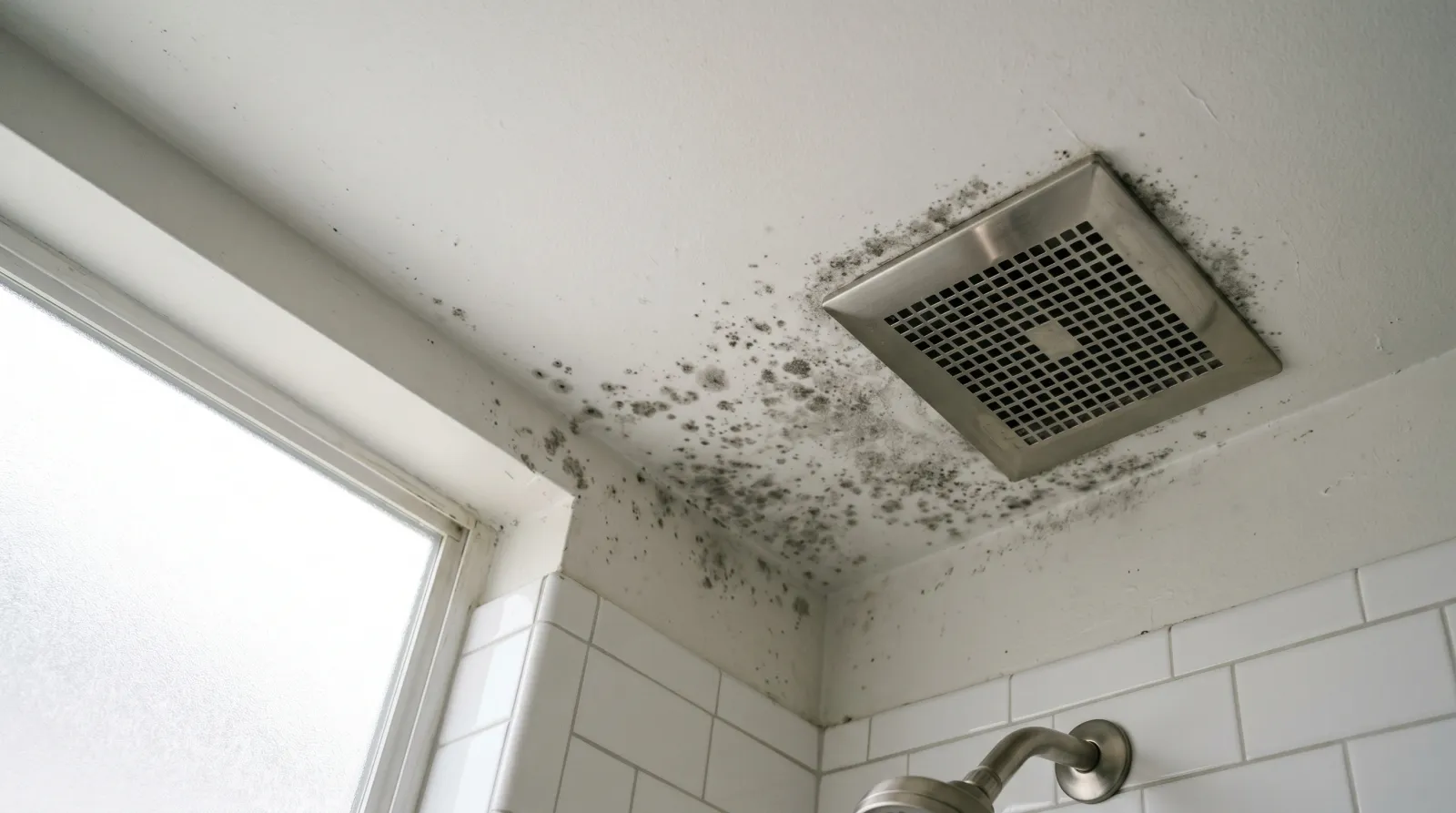
The ceiling is where bathroom mold lands first. Steam rises, hits the coldest surface in the room, condenses there every single shower. Paint over the spots tonight and they ghost back through by spring. The fix isn’t a fresh coat. It’s biocide, dry time, primer, warranted ceiling paint, and a fan that actually runs for 20 minutes after you towel off.
Does This Match What You’re Seeing?
Confirm before you treat. Wrong diagnosis, wrong fix.
- Surface mildew. Fine grey or black speckle across the ceiling field, often densest above the showerhead and fanning toward the vent grille. Dusty to the touch. Wipes partially clean but comes back. This is the standard bathroom case and the page you want.
- Mold halo around the vent grille. A defined dark ring tracing the grille edge. Means the duct is leaking warm wet air back into the ceiling cavity, or the fan stops pulling halfway through the shower. Same fix, plus a fan check.
- Yellow water ring with a hard edge. That’s a leak from the floor above, not mold. See blocking water stains on a ceiling. Stop the leak before any paint.
- Drywall paper lifting or sagging. Water is in the cavity. This is past DIY. Cut out, dry the framing, replace the rock.
Confirm with a damp cloth. If the spot smears into a grey halo, that’s mildew and you’re on the right page. If it smudges yellow and the ring underneath stays sharp, that’s a water stain and a different fix.
How Serious Is This?
A few square feet of surface mildew on a working bathroom ceiling is a same-weekend job. Above 10 square feet is the EPA threshold for calling a remediator. So is anything slimy, anything that smells musty, and anything that’s grown back inside 90 days of a previous repaint.
The other ceiling-specific tell: if the drywall is soft when you press on it from a ladder, the water isn’t on the ceiling. It’s in the ceiling. Stop reading and call somebody.
Why This Is Happening (Root Cause)
Mold needs moisture, organic food, and a temperature between 65 and 85. Bathroom ceilings hit all three, every shower, on a schedule. The lever is moisture, and on a ceiling, moisture is physics.
Hot shower air carries a lot of water. The ceiling is the coldest surface in the room because it’s losing heat upward into the attic or the joist bay above. Steam rises, hits that cold drywall, and the dew point dumps liquid water on the paint film. The spot above the showerhead gets the worst of it because that column of vapor rises straight up. The corner near the vent grille gets the second-worst because warm wet air pools there before the fan pulls it out.
A bathroom fan rated at 1 CFM per square foot of floor area, running during the shower and for 20 minutes after, drops post-shower RH from a peak above 80% down to 50–55%. Mildew can’t establish below 55%. That’s the whole prevention story. If the fan can’t hold a single sheet of toilet paper to the grille, it’s dead or it was always undersized. No ceiling paint outruns a fan that doesn’t pull.
One more ceiling-only trap. If the exhaust duct vents into the attic instead of through the roof or the soffit, you’re dumping bathroom moisture directly above the ceiling you just painted. The mildew comes back from the cavity side, and there’s nothing you can spray that fixes that. Check the duct before you climb the ladder.
The Fix
Five steps. The drying step is the one most homeowners cheat on.
Step 1 — Contain and Gear Up
Open the bathroom window if you have one. Run the exhaust fan. Wear an N95 mask, nitrile gloves, and safety glasses. Overhead spraying drifts straight into your eyes otherwise. Drop a cheap canvas cloth over the vanity, the toilet tank, and the tub edge. Cover the floor. Overspray on a tiled floor turns slick fast.
You’ll need a sturdy step stool or a short ladder. A roller pole helps for the prime and topcoat steps, but for treatment and inspection you want hands close to the surface.
If the affected area is bigger than 10 square feet, or you see soft, sagging, or visibly wet drywall, stop. Call a remediator.
Step 2 — Treat
Spray Concrobium Mold Control on the affected ceiling field with a pump sprayer or a trigger bottle set to a fine fan. Concrobium is no-rinse on porous painted drywall; it physically crushes spores as it dries. Dwell 10 minutes. Wipe gently with a clean cloth held flat. Don’t scrub a ceiling. You’ll abrade the paint film and feather edges into the field.
For the dark halo around a vent grille, where the staining is heaviest, switch to RMR-86 Instant Mold Stain Remover. It bleaches the stain out in under a minute and works harder on the grout-and-fiberglass mix near the vent. Ventilate aggressively. RMR-86 fumes are sharp in a closed bathroom. Rinse with plain water on a damp cloth, then come back over the field with Concrobium for the residual biocide layer.
Safety rule. Never mix bleach with vinegar, ammonia, or hydrogen peroxide. The reaction produces chlorine or chloramine gas, both toxic, both especially bad in an enclosed bathroom with the fan running on you from a ceiling vent. If you’re using a household bleach solution as a last resort (1 part bleach to 10 parts water), use it alone, ventilate hard, rinse with plain water, and walk away for 30 minutes before re-entering.
Step 3 — Dry the Ceiling Completely
This is the step most homeowners skip. The ceiling has to be bone-dry before any primer touches it, and a ceiling dries slower than a wall because the moisture has nowhere to fall. Run the bathroom fan plus a portable fan aimed at the ceiling for 24 to 48 hours. A small dehumidifier on the bathroom floor helps if you have one.
Bone-dry to the touch isn’t enough. The drywall paper holds water inside the gypsum core for days after the surface feels dry. Wait the full 48 if you’ve sprayed heavily.
While you wait, pull a single sheet of toilet paper against the fan grille while the fan runs. If the paper doesn’t hold, the fan isn’t pulling enough. Replace it before you climb back up to prime.
Step 4 — Prime With a Stain-Blocking Mold Killer
Use Zinsser Mold Killing Primer. Water-based, contains an EPA-registered biocide, blocks the grey ghost that mildew leaves in the drywall paper. One coat. Cut in around the vent grille and the wall line with a brush, then roll the field with a 3/8-inch nap microfiber roller on a pole. Recoat per the label, typically 1 hour.
If a dark shadow still ghosts through after the first coat, swap to Zinsser BIN (shellac primer) for the stain block, then come back over with Mold Killing Primer for the biocide layer. Shellac kills the worst stains. The water-based primer carries the warranty chemistry. Two thin coats of different chemistries beat one thick coat of either.
Watch for lap marks on overhead work. Keep a wet edge across the whole ceiling, work in one direction, and don’t stop in the middle of a roll. Stopping mid-ceiling is how you get a visible band that flashes under the vanity lights forever.
Step 5 — Topcoat With Perma-White Ceiling
Zinsser Perma-White Mold & Mildew-Proof Ceiling Paint in dead flat. Two coats. Recoat at 2 hours, full cure at 7 days, shower-ready at 24 hours per the label. Five-year written warranty against mold and mildew growth on the cured film. It’s the only number on the shelf in this category.
Apply with a 3/8-inch nap roller on a pole. Roll the cut-in line first so the brush and roller textures blend, then field-roll in 4-foot sections, keeping the wet edge moving. Back-roll each section once in the opposite direction to even the mil thickness. Don’t overload the roller. Overhead heavy loads sling spatter, and a thin even film cures harder than a thick wet one.
For the wall version of this picks-and-rankings call, see the best mold-resistant paint round-up.
Recommended Product
Zinsser Perma-White Mold & Mildew-Proof Ceiling Paint. Dead-flat ceiling formula, five-year written warranty against mold and mildew growth on the film. Hides lap marks on overhead work better than satin wall-rated paints, which flash badly under vanity lights. Self-priming over the Mold Killing Primer layer.
Prevention (the Part That Actually Matters)
Three levers move the outcome more than the can you bought.
- Run the bathroom fan during every shower and for 20 minutes after. Every time. Forever. A $20 timer switch solves the forgetting problem. This is the single biggest fix on this page.
- Replace the fan if it’s underpowered or worn. Target 1 CFM per square foot of bathroom floor area. A 60-square-foot bathroom needs at least a 60 CFM fan. Most builder-grade 50 CFM fans are 12 years old and pulling closer to 30 by now. Panasonic and Broom-Aire both make quiet 80–110 CFM replacements that drop in to the same housing.
- Make sure the duct vents outside, not into the attic. Attic discharge is a common builder shortcut and a guaranteed ceiling-mold loop. The fan blows steam into the attic, the steam condenses on the cold attic side of the ceiling drywall, and the mildew grows back through your fresh paint from the inside. Run the duct to a roof cap or a soffit vent.
Smaller levers that still help. Crack the bathroom door during the shower if the household allows it. Leave the door open between showers. Caulk any gap where the ceiling meets the tub surround so steam can’t migrate into the wall cavity. Keep house RH below 60% year-round; a $25 hygrometer tells you whether you’re winning.
When to Call a Pro
- Affected ceiling area larger than 10 square feet (EPA threshold).
- Visibly wet, soft, or sagging drywall. Water is in the joist bay and a topcoat won’t fix it.
- Mold came back through fresh paint inside 90 days. Spores are deeper than the topcoat can reach, or the cavity-side moisture loop hasn’t been broken.
- Suspected black mold (Stachybotrys: dark, slimy, often near a roof leak or upstairs plumbing).
- Pre-1980 popcorn ceiling. Possible asbestos. Don’t scrape or sand. Test or hire a licensed abatement crew.
- Pre-1978 home with peeling paint near the mold. Test for lead first under the RRP rule.
- Anyone in the house with severe asthma, immune compromise, or pregnancy.
What’ll bite you in two years if you skip the diagnosis. You’ll spray, prime, paint, the ceiling looks perfect for a season, and then the same halo creeps back around the vent grille because the duct still vents into the attic and the fan still doesn’t pull. The can will get the blame. It shouldn’t. Run the fan. Check the duct. Then paint.
Ask a Question