Painting in Cold Weather: Temperature Minimums and Dew Point
Painting in cold weather has hard limits. The temperature minimums for latex and oil, why the dew point matters more than the air temp, and what fails if you ignore them.

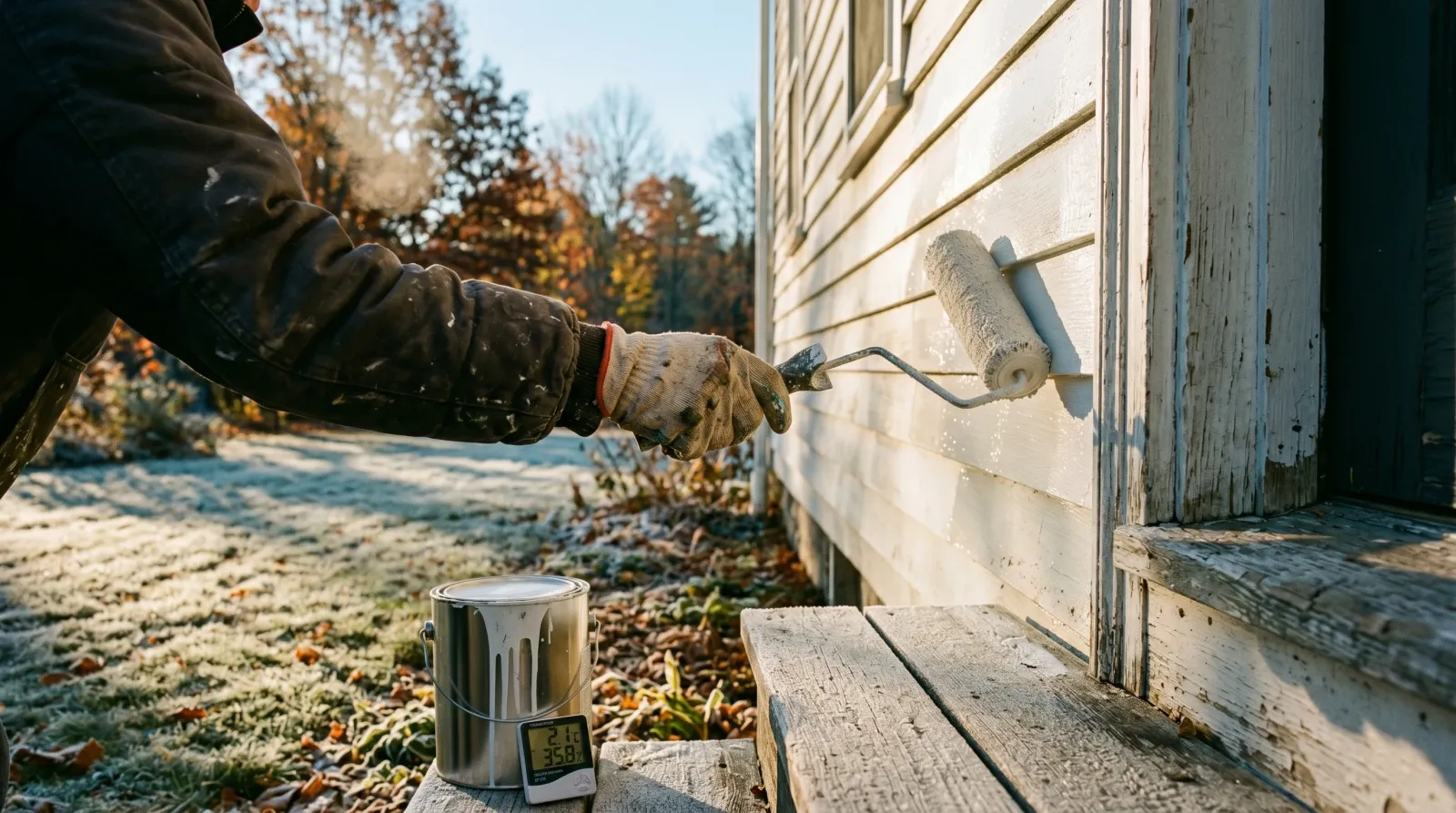
Don’t paint below the number on the back of the can. For standard latex that number is 50°F. For most oil-based and alkyd it’s 45°F. Cold-weather acrylics drop to 35°F. And the temperature that counts isn’t the air at noon, it’s the surface temperature and the overnight low, plus a margin above the dew point. Get any of those wrong and the film either never cures or peels off in sheets two springs later.
That’s the whole rule. The rest of this explains why, and where people get burned.
TL;DR
- Standard latex: 50°F minimum. Oil/alkyd: 45°F. Cold-weather acrylic (SW Resilient, BM Aura, Behr Marquee): 35°F. Read the back label.
- Surface temp, not air temp. A shaded north wall runs 10–15°F colder than the air. Masonry holds cold for hours.
- Stay 5°F above the dew point. Below that, water condenses on the surface and your paint floats on a film you can’t see.
- The overnight low matters too. Latex needs hours to coalesce. A frost before it cures wrecks the film.
- Dry times roughly double per 18°F drop. Don’t rush the recoat.
Why Cold Stops Latex From Curing
Latex doesn’t dry, it coalesces. The water carries tiny binder particles onto the wall, the water leaves, and then the particles have to soften and fuse into a continuous film. That fusing only happens above a temperature the chemists call the minimum film-formation temperature. Drop below it and the particles stay separate, like dry sand. The coat looks dry to the touch and is structurally junk underneath.
That’s the trap with cold latex. Touch-dry and cured are not the same thing. A wall painted at 42°F with a 50°F paint can feel dry by dinner and still be uncured when the frost hits at 2am. The frost freezes the trapped water, the binder never fuses, and you’ve got a powdery film that fails the first time water gets behind it.
Oil-based paint cures differently. It pulls oxygen out of the air and cross-links, so it tolerates colder temps, down to about 45°F for most alkyds. But oil cures slower in the cold, sometimes much slower, and a slow-curing oil film stays soft and tacky long enough to collect dust, bugs, and lap marks.
When You Can Paint in the Cold
Go ahead when:
- The product is rated for the temperature and you’ve read the back label, not the marketing on the front.
- The surface temperature is above the minimum, checked with an infrared thermometer on the actual wall.
- The forecast keeps both the surface and the overnight low above the minimum through the cure window, usually the first 24–48 hours.
- The surface sits at least 5°F above the dew point and stays there while you work.
- You’re using a true cold-weather acrylic for anything below 50°F. Sherwin-Williams Resilient, Benjamin Moore Aura, and Behr Marquee all carry 35°F ratings.
When NOT to Paint in the Cold
Walk away when:
- The surface is below the can’s minimum, even if the air hit 55°F at noon. The wall is what cures the paint.
- A frost or freeze is forecast within 24–48 hours of application on a latex coat.
- The surface is within 5°F of the dew point, or there’s dew, frost, or condensation on it. Cold metal and glass blush fast.
- You’re working a north or shaded wall in early morning. Wait for the surface to warm.
- It’s masonry or concrete that’s been cold for days. Stone and block hold cold long after the air warms, and they wick moisture. See the exterior brick guide for the moisture side of that.
The Dew Point Is the Part People Skip
Air temperature gets all the attention. Dew point is what actually ruins cold-weather jobs.
Dew point is the temperature at which the air can’t hold its moisture any longer and it condenses onto the nearest cold surface. When your siding cools to within about 5°F of the dew point, a film of water forms on it. You often can’t see it. Roll paint over that film and the paint never bonds to the substrate, it bonds to a layer of water that evaporates and leaves you with adhesion failure, blushing on oil, and peeling down the road.
This bites people in fall and spring, when the afternoon feels mild but the surface drops fast after the sun goes off the wall. By 5pm a wall that was 60°F at 2pm can be at dew point. Anything you applied in the last hour is now curing under condensation.
The math is simple. Check the forecast dew point. Point the infrared gun at the surface. Keep the surface number at least 5°F higher than the dew point number, through application and the first few hours after. When the gap closes, stop.
How Cold Weather Compares to the Other Wrong Conditions
| Condition | What goes wrong | The number to watch |
|---|---|---|
| Too cold | Latex won’t coalesce; film stays weak | Surface temp vs. can minimum |
| At/below dew point | Water film under the paint; no adhesion | Surface within 5°F of dew point |
| Too hot / direct sun | Skins over fast, lap marks, blistering | Surface above ~90°F |
| Too humid | Cure stalls, slow recoat, blushing | Relative humidity above ~85% |
Heat is the opposite failure but the same lesson: paint against the surface, not the air. A wall baking in direct sun flashes before you can lay off the edge, and you get lap marks and blistering. Cold and hot both come down to surface temperature.
Common Mistakes
- Reading the air thermometer instead of the wall. A 55°F afternoon doesn’t mean a 55°F surface. Shaded siding, metal, and masonry lag the air by 10–15°F. Buy a cheap infrared thermometer and point it at what you’re painting.
- Forgetting the overnight low. People paint at 3pm in 50°F air and never check that it’s dropping to 30°F by midnight. Latex needs the warmth to keep coalescing for hours after it’s touch-dry.
- Trusting “dry to the touch.” Touch-dry is solvent leaving the surface. Cured is the binder fully fused. In the cold the gap between them stretches from hours to days.
- Rushing the recoat. Cure roughly doubles per 18°F drop. Slap the second coat onto a cold first coat that still holds water and you trap moisture and get a soft, slow, weak film.
- Using standard latex because it was on the shelf. A 50°F-rated paint at 40°F is a guaranteed callback. Buy the cold-weather line for the conditions you actually have.
What to Look For When You Buy
You want a number on the back label that says “apply down to 35°F” or similar, and a line confirming the air and surface both have to hold above it. The major cold-weather acrylics are Sherwin-Williams Resilient, Benjamin Moore Aura Exterior, and Behr Marquee Exterior. All three hold a 35°F application rating, which buys you most of the spring and fall shoulder seasons in zones 5 and 6.
For oil and alkyd primers used to lock down chalky old siding, check the minimum too. Many run 45–50°F and cure painfully slow below that. For the full picture on cure and product choice, see the best exterior paint round-up and the exterior wood prep guide.
What’ll Bite You in Two Years
Cold-weather failure rarely shows the day you finish. The coat looks fine through winter. Then water gets behind a film that never fully fused, freeze-thaw works it loose, and one spring the paint is hanging off the wall in sheets. By then you don’t blame the temperature, you blame the paint. It wasn’t the paint. It was the 42°F surface and the frost that came through at 2am while the binder was still soft.
If the surface won’t hold above the can’s minimum through the cure window, and won’t stay clear of the dew point, the job waits. There’s no product that beats the chemistry. Paint the wall when the wall is warm enough to cure it.
Ask a Question