What Is Primer? The Chemistry, in Plain English
Primer is a paint engineered to bond and seal, not to be pretty. Here is what it actually does to your wall, and how to pick the right one for the substrate.

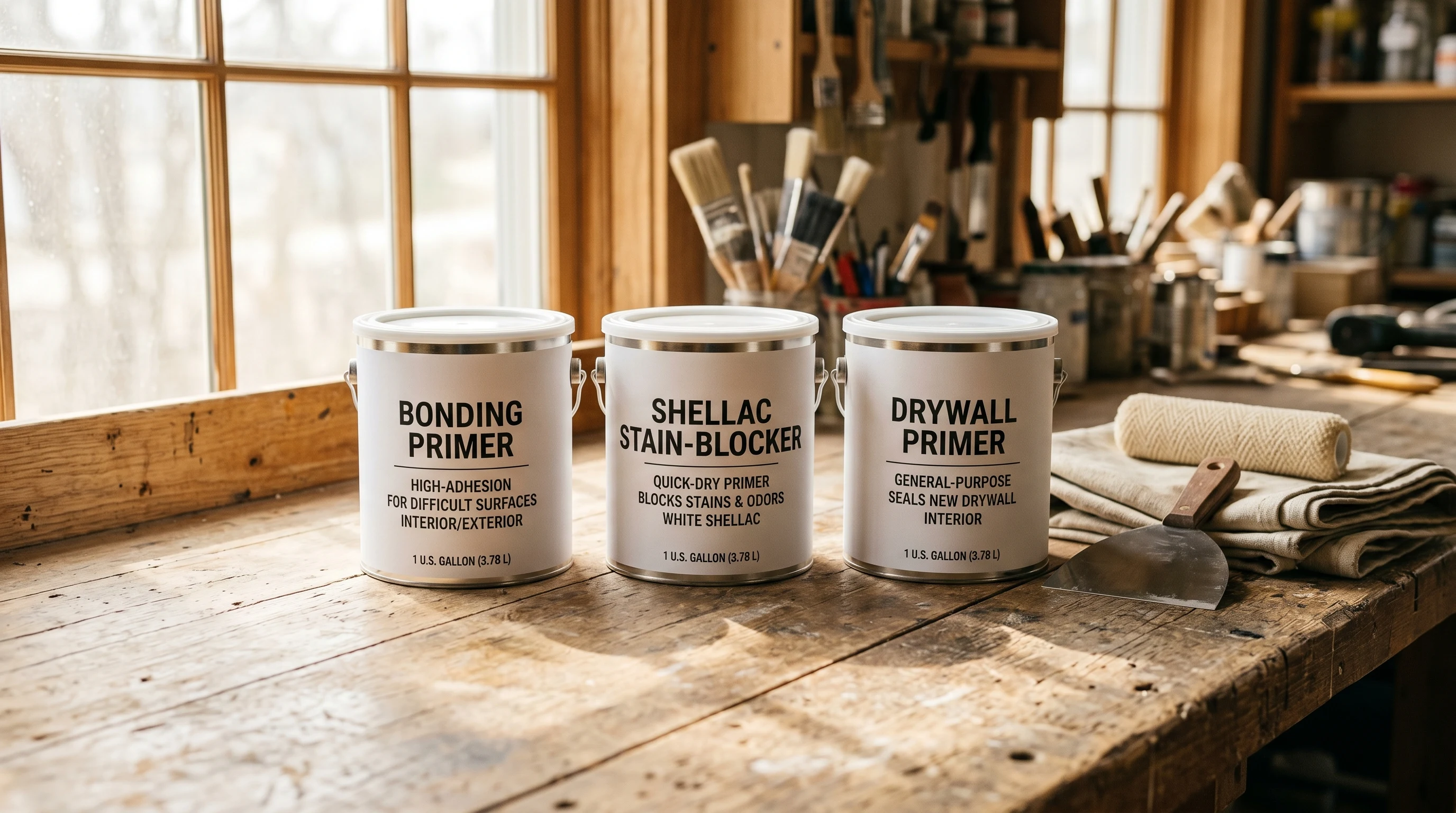
Most people meet primer as a tax. You wanted to paint the room, the can says self-priming on the front, and then a forum tells you to prime anyway. So you do, and you do not really know why. The reason for that is primer is not “paint that comes first.” It is a different product with a different job, and skipping it on the wrong substrate is what causes the topcoat failures people end up Googling six months later.
Here is the working definition. A primer is a coating engineered to bond to a difficult substrate and to seal it, so the finish paint above can do the only job it is good at — looking like the color on the chip. Numerically: a typical primer runs 35–50% pigment volume concentration, dries to recoat in about an hour, and covers around 200–300 square feet per gallon. It is less pretty than wall paint and more chemically aggressive on what is underneath.
What Primer Actually Does to the Wall
Three things, in roughly this order.
Adhesion. The binder in a primer is picked for grip, not for scrub resistance. Acrylic primers wet out porous substrates like drywall and bite into the gypsum face. Bonding primers go further — they contain resins (often modified acrylics or alkyds) that mechanically lock to slick surfaces a normal latex would slide off of. Glossy trim, melamine, glass, glazed tile. If you have ever rolled latex onto an oil-painted door and watched it peel up like a sticker in a month, that is the adhesion story.
Sealing. Bare drywall paper, old plaster patches, and weathered wood are wildly porous. They pull water out of a wet latex film before the binder particles get the time they need to coalesce. You get flashing — duller patches where the substrate stole the water, glossier patches where it did not. Primer fills that porosity so the topcoat film forms uniformly across the whole wall. The pigment volume concentration is high partly for this reason; the extra filler clogs the substrate’s open pores.
Stain-blocking. Some primers carry a second job, which is to lock down water-soluble stains, tannins, nicotine, marker bleed, and smoke residue so they do not migrate up into the finish coat. This is a barrier function, and the chemistry that delivers it is specific — shellac and certain oils. A standard acrylic primer cannot block a water stain. The stain dissolves into the wet primer, dries with it, and then dissolves again into the next wet coat. You can roll three coats of latex over a brown ceiling stain and watch the stain come back every time.
That third job is the one most people get wrong, and it is where primer family selection actually matters.
The Three Families, and Where Each One Bites
There are roughly three categories of household primer, named after the products that defined them. Knowing which one to grab is most of the battle.
| Primer family | Reference product | Carrier | Bonds to | Blocks stains | Recoat |
|---|---|---|---|---|---|
| General-purpose / sealing | Zinsser Bulls Eye 1-2-3 | Water | Drywall, prior latex, plaster, masonry | Light water stains only | ~1 hr |
| Bonding | Insl-X Stix | Water (urethane-acrylic) | Glossy oil, melamine, vinyl, glass, glazed tile | No | ~3–4 hr |
| Stain-blocking | Zinsser B-I-N | Shellac (alcohol) | Most substrates including knots | Water, tannin, smoke, marker, pet | ~45 min |
Each one is solving a different chemistry problem.
Zinsser 123 is the default — water-based acrylic, low-VOC, washes out of a brush. It seals porosity well and bonds to anything an ordinary latex would already bond to. If you are repainting an interior wall, patching, or covering fresh drywall with no stain history, this is the right pick. Where it fails is everything slick (oil-based trim, factory-finished cabinets) and everything stained.
Stix is the answer to “I sanded the cabinets and the new paint still peeled off.” It is a urethane-modified acrylic with adhesion promoters built into the resin. It bites to surfaces a normal acrylic cannot wet — high-gloss alkyd, melamine, PVC trim, even bare aluminum with the right prep. It is not a stain-blocker; if your slick surface also has a water stain, you need to spot-prime with shellac first and then Stix over it.
BIN is shellac in alcohol, a fundamentally different chemistry. Shellac is a natural resin (from the lac bug — yes, really) that forms a hard, glassy, almost impermeable film as the alcohol evaporates. That impermeability is why it blocks stains and odors that water-based primers cannot touch. It is what you want over a smoke-damaged ceiling, a knotty pine board that is bleeding tannin, a cat-urine subfloor, or a magic-marker mural a four-year-old made on the dining room wall. The trade-off is brittleness, smell, and the fact that you clean the brush with denatured alcohol.
There is a fourth family — oil-based bonding-and-stain primers like Cover Stain — that splits the difference between Stix and BIN. Slower dry, strong tannin block, decent adhesion, the smell of a 1990s garage. We cover it in the best primer round-up.
Common Mistakes
- Using 123 over a water stain. It looks fine wet, the stain telegraphs through within hours. Water-based primers cannot lock water-soluble pigments. Use BIN, or oil-based Cover Stain.
- Skipping primer on bare drywall paper. The first coat of finish paint flashes badly because the paper drinks the binder. Two coats does not fix it; the optical difference is locked in.
- Tinting BIN. Shellac primer takes tint poorly and the color is unreliable. Leave it white and let the topcoat cover it.
- Priming over chalky exterior siding without scrubbing. Primer bonds to whatever is on the substrate. If that is loose chalk, the primer bonds to the chalk and the chalk lets go. Wash first, then prime with an alkyd-modified bonding primer.
- Two thin coats of bonding primer instead of one full coat. Adhesion comes from film thickness in the wet stage; starving the film starves the bond.
A Substrate Decision Tree
This is the part to keep open while you are at the paint counter.
| Substrate | Use | Why |
|---|---|---|
| New drywall, taped and sanded | Zinsser 123 | Seals paper face, equalizes porosity, water-based cleanup |
| Previously painted wall, same color family | Self-priming finish paint, two coats | Existing film is the primer |
| Previously painted wall, big color change | 123, tinted toward topcoat | Hides faster; one less finish coat |
| Glossy oil-painted trim or doors | Stix | Bonds without sanding to bare wood |
| Melamine, laminate, factory-finished cabinets | Stix | Only acrylic family that bites melamine |
| Knotty pine, cedar, redwood | BIN | Blocks tannin and knot bleed; nothing else does it reliably |
| Water-stained ceiling | BIN spot-prime, then 123 over the rest | Shellac locks water-soluble stain |
| Smoke or nicotine damage | BIN wall-to-wall | Seals odor and yellow film |
| Bare exterior wood siding | Oil-based exterior primer (Cover Stain) | Penetrates weathered fiber, blocks tannin |
| Chalky exterior masonry or stucco | Acrylic masonry primer after pressure-wash | Bridges micro-cracks, alkali-resistant |
| Rusty metal | Rust-converting alkyd primer | Chemically converts iron oxide so the topcoat has something to grip |
Read that table and you have skipped two coats of finish paint and a callback. For specific SKUs in each category, see the best primer round-up. For the deeper chemistry on why oil and water-based topcoats behave differently over each of these primers, the oil vs water-based paint comparison is the next read.
The shortest way to think about primer is this. It is the layer that decides whether your topcoat is doing color work or bond work. Give it the bond work and your topcoat can just be paint.