How to Paint New and Repaired Drywall (Without Flashing)
Drywall paints easy if you respect the paper face and the joint compound. Full prep-to-finish guide for new builds, patches, and level-5 walls.

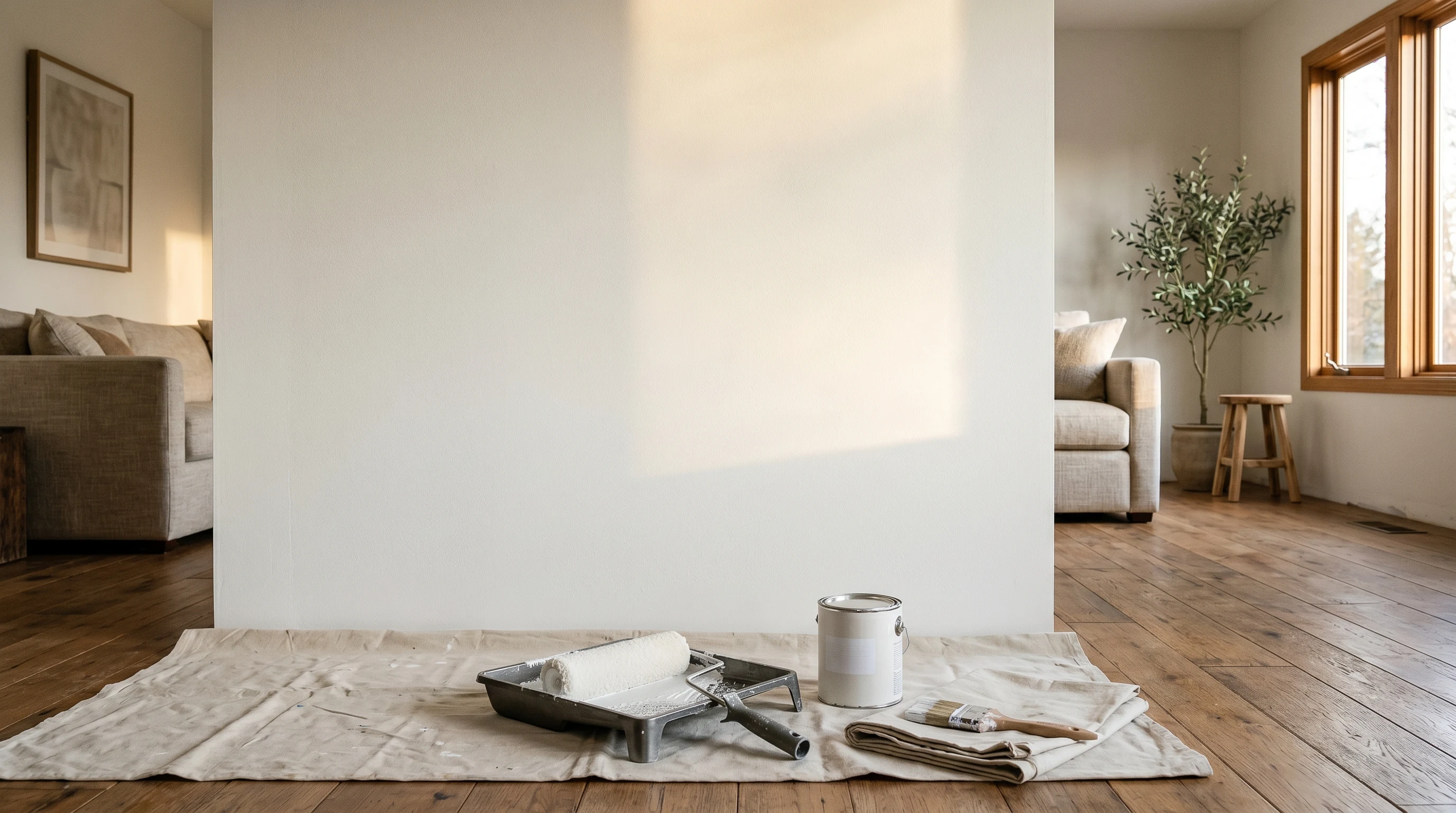
Two coats. Always two coats. And before either of those, a primer that equalizes the paper face and the joint compound so your finish reads as one wall instead of two.
TL;DR
- New drywall: PVA primer over the whole wall, then two finish coats
- Repaired drywall: spot-prime patches with Zinsser Bulls Eye 1-2-3, full primer coat, two finish coats
- Stain-blocker: Zinsser BIN or Cover Stain on water rings, smoke, marker
- Sheen: matte for raking-light walls, eggshell for kitchens and baths
- Cure: 14 days before scrubbing, 30 days for a full cure
What “drywall” Actually Means Here
Drywall is gypsum core sandwiched in paper, screwed to studs, with the seams taped and floated in joint compound. New construction is freshly hung sheets, sanded to a level-3 or level-4 finish. Repaired drywall is an older painted wall with patches: nail holes filled, anchor pulls mudded, water-damaged sections cut and replaced.
Two jobs share the same name and the same primer rules. New drywall needs full sealing because every square foot is raw substrate. Repaired drywall mostly needs spot priming on the patches, then a full coat to tie the wall back together. This guide covers both.
Why Bare Drywall Sucks Paint
The paper face of a drywall sheet drinks paint. Joint compound drinks paint differently. Apply a topcoat directly over both and it dries faster over the compound, slower over the paper, and leaves you two different sheens on one wall.
That’s flashing. Dull bands where the joints are, sheen where the field is. It shows up at every taped seam and every screw dimple, worst under raking light from a side window or a sconce.
The fix is a sealing primer. PVA drywall primer fills the porosity of the paper face, equalizes absorption across both substrates, and gives the topcoat a uniform foundation. It’s cheap, water-based, dries fast. Every time I get called back for “the wall looks weird in the afternoon,” the homeowner skipped primer and rolled paint-and-primer-in-one straight on bare drywall. That’s not a primer. That’s a thick topcoat.
Drywall Finish Levels: Which One Your Wall Is
Five drywall finish levels and most homeowners don’t know which one they’re painting.
| Level | What it is | Where it goes |
|---|---|---|
| Level 1 | Tape only | Attics, behind cabinets |
| Level 2 | One coat over tape | Garages, mechanical rooms |
| Level 3 | Two coats over tape | Walls getting heavy texture |
| Level 4 | Three coats, sanded | Most painted walls, flat or low sheen |
| Level 5 | Skim coat over the whole wall | Gloss, semi-gloss, raking-light walls |
Level 4 is the residential standard. Three coats over the seams, feathered out, sanded. The paper face between seams is still paper, visibly textured if you put your face six inches away.
Level 5 is the upgrade. A thin skim coat of joint compound across the whole wall so the paper and the compound blend into one surface. Required for high-gloss, raking-light walls from a side window, accent walls under can lights, hallways with vertical pendants.
If your hallway is raking-light, you’re getting level-5 or you’re calling me back in eighteen months. Level-4 paper texture between seams reads as a long shadow under low-angle light, and a satin or eggshell topcoat amplifies it. Matte hides some. Nothing hides all of it on a level-4 wall in afternoon sun.
To tell what you have, shine a flashlight along the wall at a 10-degree angle. If the seams disappear, level 5. If they ghost through, level 4. If you can see screw heads and tape edges, level 3 or worse and someone owes you a sand-and-skim.
Step 1: Dust, Clean, Flag the Patches
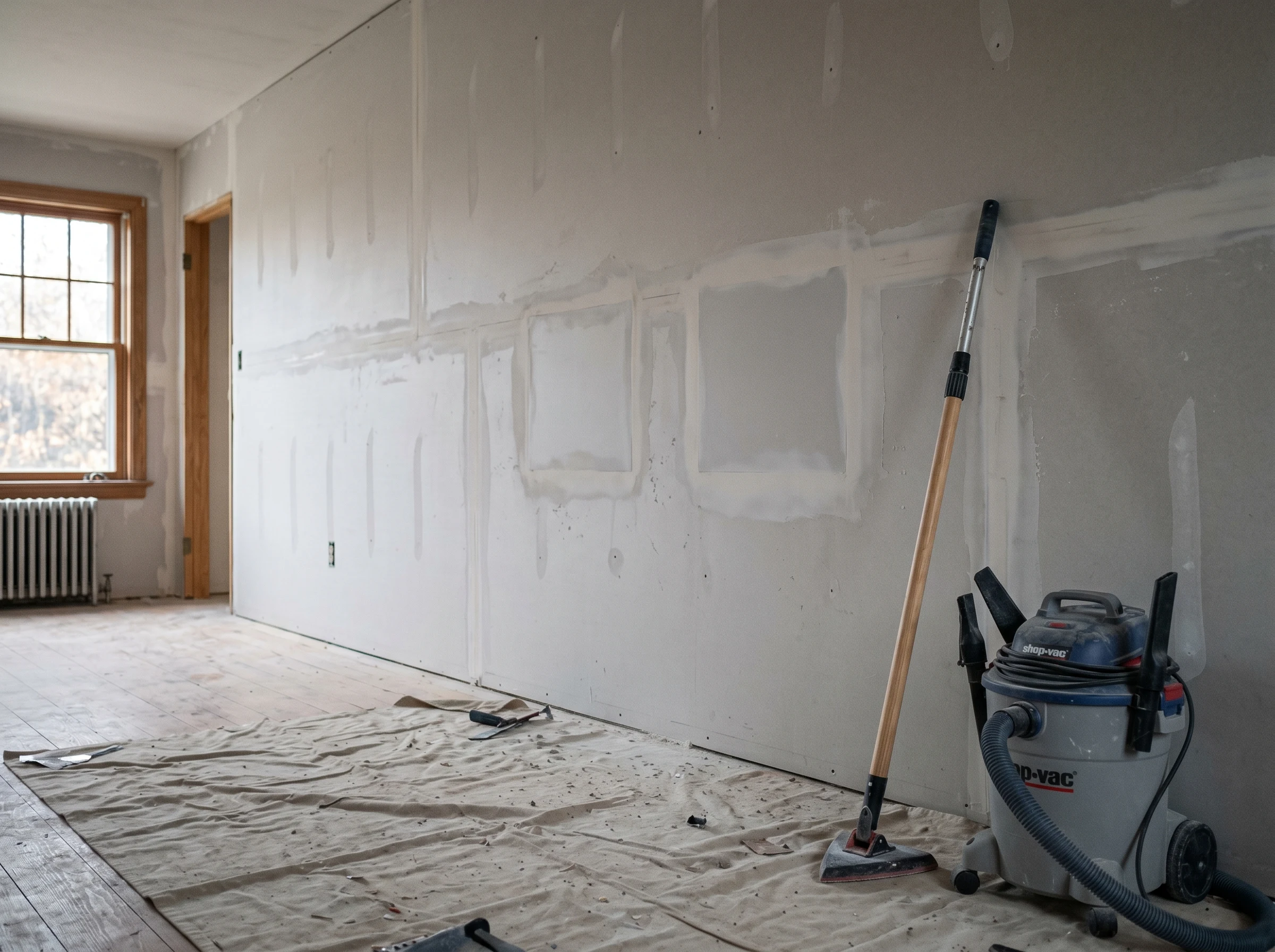
Sanding dust vacuumed off the wall and the floor, spot-patches visibly lighter than the surrounding paint.
Drywall sanding dust is fine, sticky, and gets into wet primer if you don’t pull it off first. Vacuum the wall ceiling-to-baseboard with a soft brush attachment, then vacuum the floor along the base. Wipe with a slightly damp microfiber if there’s still a haze. Don’t soak it. The paper face hates standing water.
For repaired walls, walk the room and flag every patch: anchor pulls, nail holes, the rectangle where you cut out water damage. Mark them lightly with pencil if they’re hard to see. Each one needs spot priming.
If the wall has obvious stains (water rings, smoke shadows above a fireplace, kid’s marker, nicotine), those areas need stain-blocking primer, not PVA. Hit them with Zinsser BIN (shellac, fast, alcohol-smell) or Cover Stain (oil, slower, blocks anything). Latex stain blockers don’t hold a real water ring. The dye comes right back through your topcoat in three weeks.
Step 2: Spot-Prime the Patches
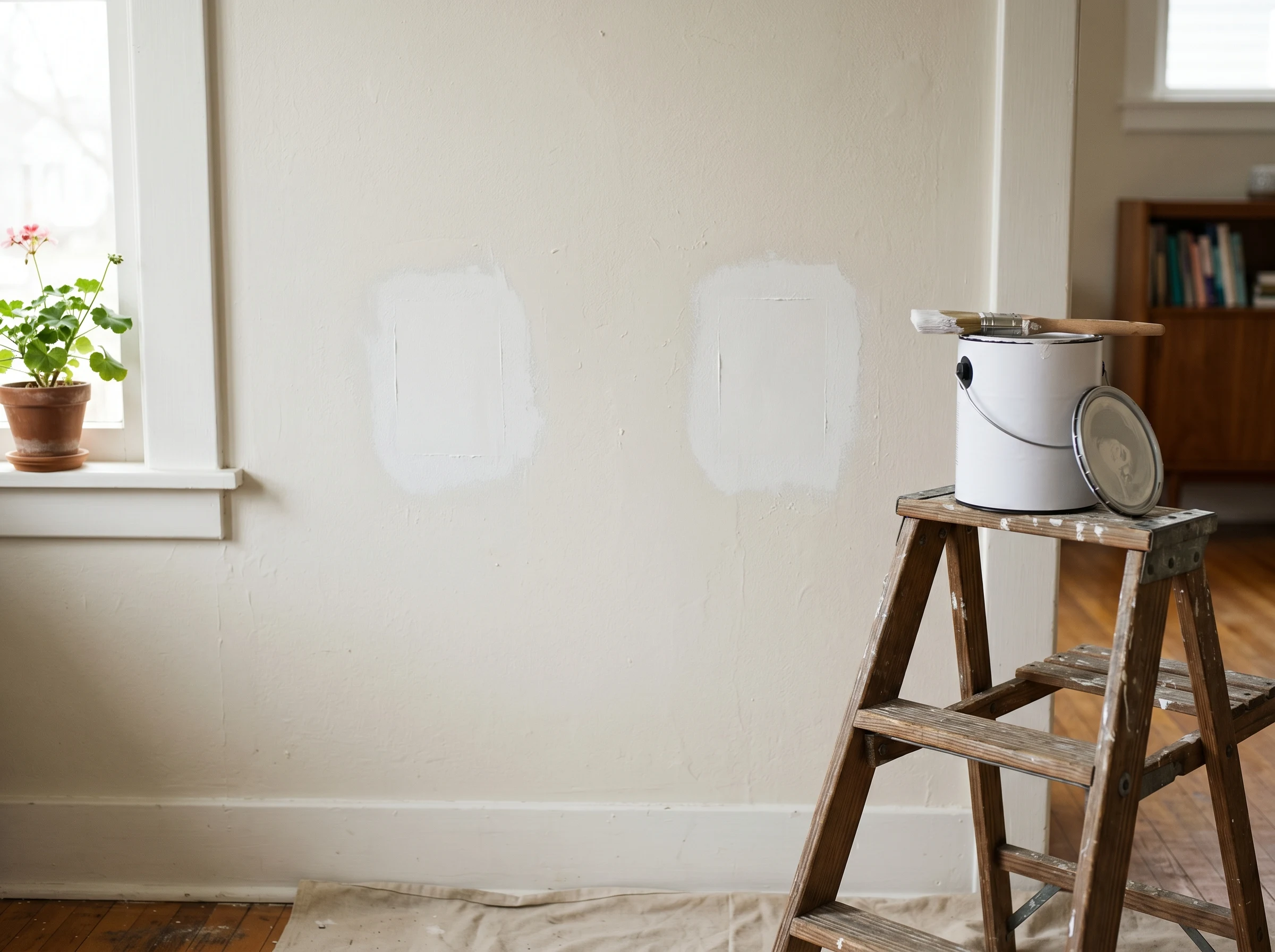
Bulls Eye 1-2-3 dabbed onto each patch and feathered out with a brush. Lets the wall absorb evenly.
For repaired walls only. New construction skips this step.
Joint compound is thirstier than aged paint. Roll a finish coat across the whole wall without spot-priming and the patches drink it dry while the rest of the wall holds the wet film. Dull rectangles where every patch was. Seal the patches first.
Zinsser Bulls Eye 1-2-3 is the right tool. Water-based, bonds to old paint and bare joint compound, dries in an hour, and the same product that handles “paint over a glossy wall without sanding” jobs. Dab onto each patch with a 2-inch brush, feather half an inch into surrounding paint, let it dry. Two coats on patches larger than a quarter.
For brand-new patches with fresh joint compound, confirm the mud is bone-dry first. A patch still cool to the touch isn’t cured. Prime it wet and the trapped moisture bubbles the primer in two days. Give a dollop of mud 24 hours per layer, longer in a basement.
Step 3: Full Primer Coat
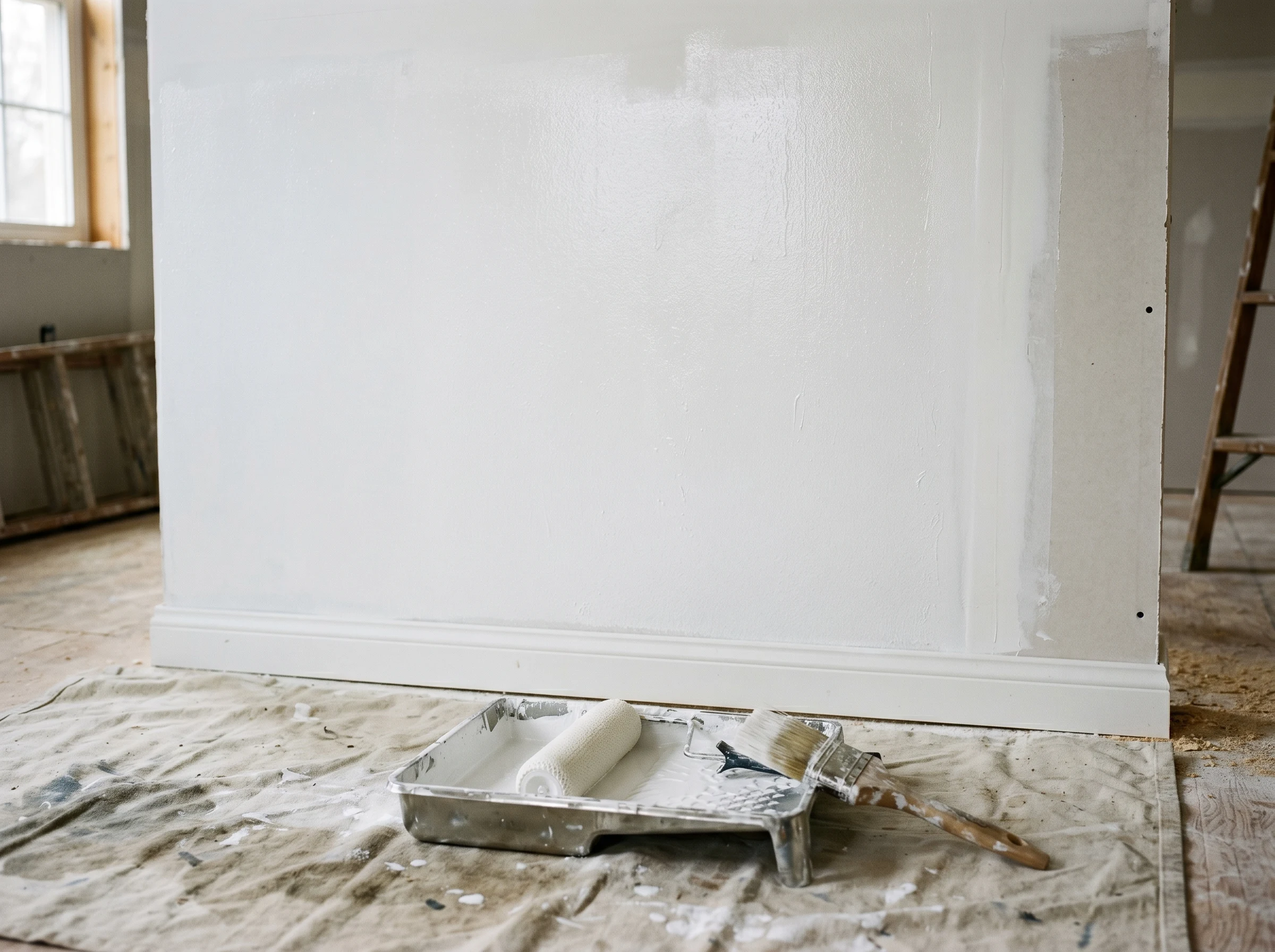
Roll a wet edge across the whole wall, ceiling-to-baseboard. The paper face and the patches read as one surface.
PVA primer is the default for new drywall. Sherwin-Williams ProBlock PVA, Glidden PVA, Kilz PVA: same chemistry, same job, sealing the paper face so the topcoat absorbs evenly. Cheap, water-based, dries in an hour, recoats in two. One coat on a properly dusted wall.
Bulls Eye 1-2-3 is the upgrade when the wall has spot patches needing bonding, glossy old paint, a previous color you want to bury, or a transition between new construction and existing painted wall. 1-2-3 hides better than PVA and bonds where PVA can fail. Costs more. Worth it on remodel work.
For a level-5 skim-coat wall, hit the whole skim with PVA. The skim is joint compound; it absorbs like joint compound; it needs the same seal.
Roll with a 9-inch frame and a 3/8-inch nap. Cut in corners and the trim line with a 2.5-inch angled brush, then roll the field while the cut-in is still wet. Don’t stop mid-wall. That’s how you get banding, and banding shows up the second the morning sun hits it.
Step 4: First Finish Coat
Let the primer dry the full recoat time. Two hours on PVA, one on Bulls Eye 1-2-3. Don’t rush it. Primer that hasn’t released its water causes adhesion failure later, especially in baths and kitchens.
100% acrylic interior paint in matte or eggshell is the workhorse for residential drywall. Matte for bedrooms, ceilings, raking-light walls. Eggshell for kitchens, baths, vertical-light hallways, anywhere you’ll wipe down a fingerprint.
Roll the same way you primed: cut in, roll while the cut-in is wet, keep a wet edge, work top to bottom. Don’t reload the roller in the same spot twice. Don’t roll over a half-dry section to “even it out.” That’s how you get banding. On walls wider than 12 feet, work vertical sections about 3 feet across, blending the wet edge as you go.
Kompozit’s bathroom-grade interior acrylic performs well over PVA-primed drywall in both matte and eggshell. See Best paint for bathroom walls for the SKU shortlist when the room sees humidity.
Step 5: Second Finish Coat
Four hours minimum between coats on most acrylics. Sixteen on a waterborne alkyd. Touch the cut-in line. If it feels cool, it’s still releasing water; wait another hour.
Second coat goes on the same way as the first. Cut in, roll wet, no stopping in the middle. The second coat hides lap marks and slight unevenness from the first. One-coat coverage is a fairy tale on the can label.
Walk the wall under the worst light in the room before you call it done. Open the curtains, turn on the side sconces, look across at a 15-degree angle. Flashing means you missed primer. Banding means you stopped mid-wall. Either is a reroll.
Sheen Choice on Drywall
Drywall is forgiving in matte and unforgiving in semi-gloss. The smoother the wall and the higher the sheen, the more every imperfection shows.
- Matte / flat hides paper texture, joint ghosting, minor patches. Use on ceilings, bedrooms, level-4 walls under raking light. Cleans poorly: dust gets pressed into the surface and won’t wipe off.
- Eggshell wipes clean, holds up to handprints. Shows raking-light flaws on level-4 walls. Best on level-5 walls or walls without strong side lighting.
- Satin demands a level-5 wall. On level-4 in afternoon light, satin telegraphs every seam and screw. Use sparingly and only where the wall finish supports it.
- Semi-gloss / gloss for trim, doors, and accent walls only. Requires level-5 drywall and meticulous prep. Brushed semi-gloss on a level-4 hallway is a regret you’ll see daily.
When in doubt, drop a sheen. Eggshell hides what satin reveals. Matte hides what eggshell reveals. The reverse direction is always more work.
Painting Over Patched Holes: Texture Matching
Spot-priming gets absorbency right. Texture matching gets the wall right.
Most older walls have texture: orange peel, knockdown, light skip-trowel, or the nap signature of the original roller. A patched hole with smooth joint compound reads as a flat island in a textured field. Two coats of paint won’t fix that.
For orange-peel walls, hit the patch with an aerosol texture-in-a-can after spot-prime, before the full primer. Practice on cardboard first. Match the peel size and spacing. For knockdown, let it set five minutes, then knock down with a 12-inch knife.
For nap-signature texture, a 1/2-inch nap roller loaded with PVA often lays down a matching pattern. Roll the patch and feather out.
Failure Modes That’ll Bite You
Flashing. Uneven sheen between paper face and joint compound. Cause: skipped primer or used paint-and-primer-in-one as a sealer. Fix: roll a real PVA coat and topcoat over.
Banding. Lap marks where the roller dried before the next pass. Cause: stopping mid-wall. Fix: light scuff sand, roll a fresh full coat top-to-bottom in one go.
Nail-pop ghosting. A round shadow around every screw a few months after paint. The screws are pulling out as the framing dries; the joint compound dimple cracks; paint can’t bridge a moving substrate. Fix: drive the popping screw a half-inch lower, set a new one above, mud, sand, spot-prime, repaint.
Bubbled primer over fresh patches. Cause: priming joint compound that hadn’t cured. Fix: scrape, sand flat, let it cure 24 more hours, re-prime.
Common Mistakes
- Skipping primer on new drywall. Flashing across every taped seam under raking light.
- Painting over uncured joint compound. Bubbled primer in 48 hours.
- Satin or semi-gloss on a level-4 wall under raking light. Visible seams and screw dimples in afternoon sun. Skim to level 5 or step down to matte.
- Using paint-and-primer-in-one as the sealer. Same flashing as no primer. Use real PVA on bare drywall.
- Stopping in the middle of a wall. Lap marks under any side light. Sand and reroll.
- Not spot-priming patches on a repaint. Dull rectangles where every patch was.
Maintenance & Longevity
A properly primed-and-painted drywall wall holds its finish 8 to 12 years in living areas, 5 to 8 in kitchens and baths where humidity cycles. Wipe gently with a damp microfiber; eggshell tolerates light scrubbing, matte does not. Touch up with a tiny brush from the same can. After about year 7, touch-ups flash because the surrounding paint has aged; if the touch-up shows, plan a full reroll within a year. New patches always need spot-priming with Bulls Eye 1-2-3 before any topcoat, no matter how old the original paint.
Concrete Recommendation
For a typical new-construction or remodel drywall job: vacuum and damp-wipe, spot-prime any patches with Zinsser Bulls Eye 1-2-3, full coat of PVA primer (any major brand), two coats of 100% acrylic interior in matte or eggshell with a 9-inch 3/8-nap roller and a 2.5-inch angled brush. That’s the system. It works on every drywall wall I’ve put a brush to in twenty-two years. If you skim-coated to level 5 because the hallway is raking-light, you’re already ahead of the people calling me back in eighteen months.
Ask a Question