How to Fix Orange Peel from Spraying
Orange peel from a spray gun means the paint flashed before it could level — too thin, too hot, or the wrong tip. Sand 600 wet, fix the viscosity, fix the air, respray.

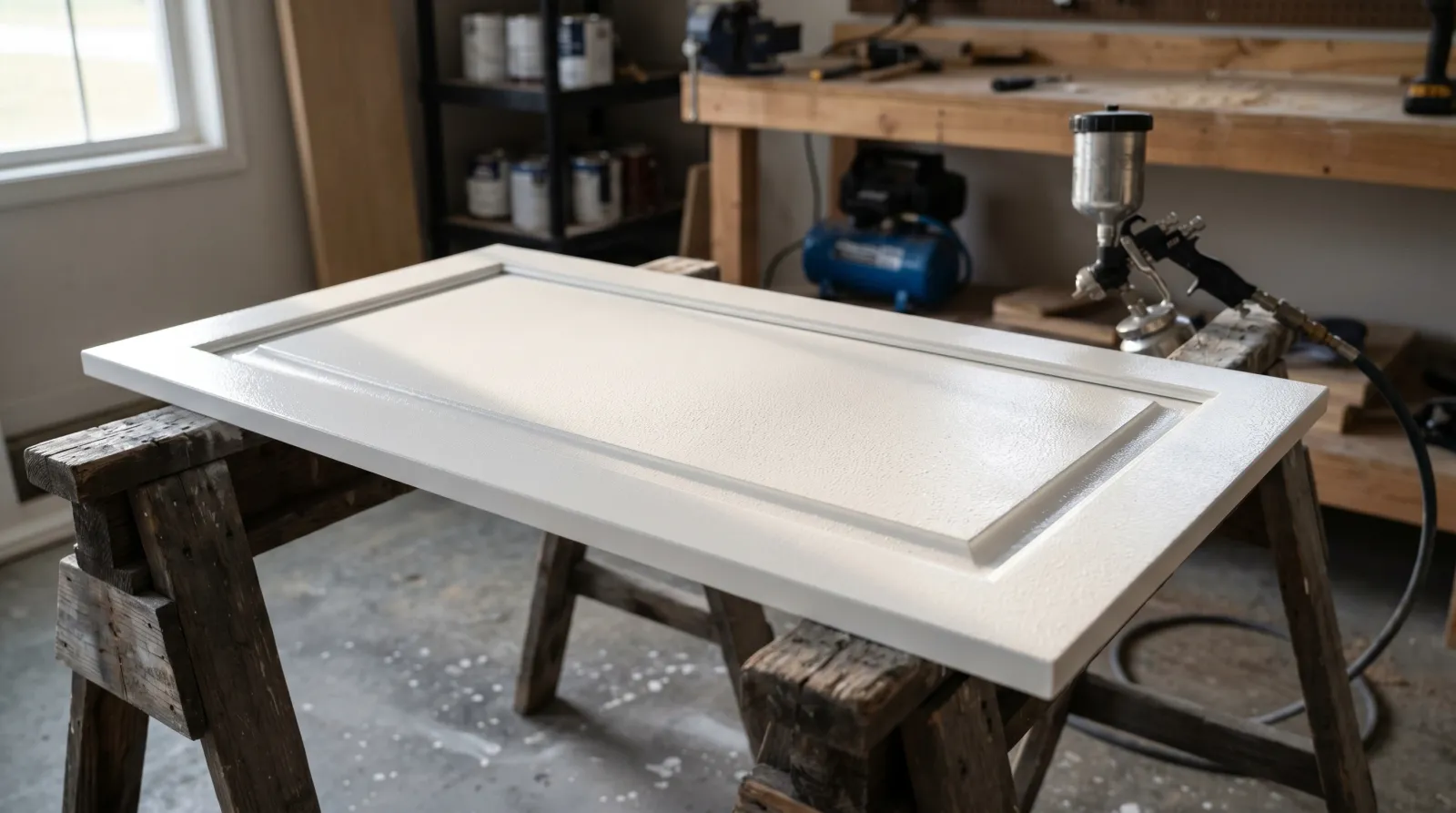
Orange peel out of a spray gun tells me the paint never made it to a wet film. It hit the door half-set, landed as soft droplets, and froze before surface tension could pull it flat. The fix is rarely the paint. It’s the viscosity, the air, the tip, or the room. Usually two at once.
Does This Match What You’re Seeing?
Hold the panel under raking light from a side window.
- Even citrus-rind dimples across the whole panel. Classic peel. Viscosity, tip, or air pressure.
- Heavier peel on the edges, smooth in the middle. You overlapped passes on the edge and flashed between coats.
- Peel only where the sun hit. Hot spot. That side flashed in 30 seconds.
- Peel plus a powdery haze at the edges. Gun held too far back. Paint dried in the air before it landed.
- Directional ridges, not even dimples. Not orange peel. That’s a worn tip or a partial clog. Pull and inspect.
- Peel on clear lacquer or shellac. Lacquer thinner trick applies here, and only here.
Dimples plus sags or runs means a heavy coat into too-thin paint. Different problem, partial overlap.
How Serious Is This
Cosmetic. The film is sealed and protective. People spray cabinets and doors because they want a factory-flat surface, and peel reads worse than a careful brush job because the eye expects sprayed to mean glassy.
Light peel on waterborne enamel sands and respray. Medium peel needs 600 wet, then 1500, then polish. Heavy peel on lacquer responds to a thinner wash-over. On anything else, strip and restart.
Why Orange Peel Shows (Root Cause)
Three causes, ranked by how often I see them.
1. Paint too thick for the tip. Half of every peeled panel I look at. A waterborne alkyd straight from the can runs a viscosity a fine-finish tip can’t atomize. The gun spits droplets instead of a fog, and the droplets hit, sit, and set. Two to four ounces of water or Floetrol per gallon drops the viscosity into the gun’s working range. No Zahn cup? Thin until the paint streams off a stir stick in a continuous thread, not in drips.
2. Room too hot, too dry, or too windy. Above 78°F or under 40 percent humidity, waterborne flash time collapses. Spray a door in an 85°F garage with the door open and a fan running and the paint is half-cured by the time it lands. Drop the room to 70°F, kill the fans, close the doors. Same paint, different result.
3. Wrong tip for the paint. A 0.013-inch airless tip blasts cabinet enamel into a heavy fan that doesn’t atomize fine enough. A 0.009 fine-finish tip atomizes the same paint into a fog that wets out flat. HVLP runs it the other way: 1.4mm for thick latex, 1.0 to 1.2mm for waterborne trim. The TDS names a tip range. Read it.
A fourth shows up. Air pressure off. Below 25 PSI at the gun, atomization breaks down. Above 45 PSI, dry-spray haze on the leading edge. Set 28 to 40 PSI for most cabinet work, gauge at the gun under flow.
The Right Spray Setup
Order matters more than the steps.
- 70°F, 50 to 65 percent humidity, no airflow. Inside, not in the garage. Close the door, kill the fans.
- Thin to spec. Two to four ounces of Floetrol or distilled water per gallon for most waterborne trim enamel. Check the TDS.
- Match tip to paint. 0.009 to 0.011 airless for fine-finish, 1.0 to 1.3mm HVLP for thinned waterborne trim. Egg-shaped orifice means replace.
- Set pressure under flow. HVLP guns drop 5 to 8 PSI when you pull the trigger. Set 32 PSI dynamic, not 32 PSI static.
- Test on cardboard first. A 12-inch panel at 8 inches, look at the fan, adjust before you touch the door.
- Gun 6 to 8 inches off the surface, 50 percent overlap, wrist locked. Walk the gun. Don’t fan from the elbow.
- Two medium coats, not one heavy. A heavy coat sags. A medium coat wets out, flows, stops short of running.
Safety
Eye pro and an organic-vapor respirator on any spray work, not a dust mask. Cartridge filters for lacquer thinner or oil-based. Cross-ventilate while spraying. Never mix lacquer thinner with bleach, ammonia, or hydrogen peroxide. Toxic gas. Never spray near pilot lights, water heaters, or open flame. Lacquer thinner and oil solvent are flammable as a fog. Pre-1978 furniture or trim: lead test before sanding, follow RRP rules.
Floetrol — Viscosity Fix in a Bottle
When the room is fighting you, condition the paint.
Floetrol is a latex paint conditioner from Flood (a PPG brand). Two to four ounces per gallon, stirred in cold. Drops viscosity without thinning solids, without color shift, without softening cured hardness. A small-tip HVLP atomizes finer and the wet film levels flatter. Around $15 a quart, treats six to eight gallons.
Penetrol is the same brand’s product for oil-based. Same dose, different chemistry. Don’t substitute one for the other.
Neither one fixes a worn tip or a hot garage. They widen the window where the right tip and the right room produce a flat finish.
The Lacquer Thinner Trick — Lacquer Only
Old furniture refinishers have a move that looks like magic the first time you see it. Spray a light wet pass of straight lacquer thinner over a peeled lacquer panel from 10 inches with the gun lean. The thinner re-dissolves the cured surface, the droplets melt back into each other, the texture flows flat as the thinner flashes. Five to ten minutes, peel is gone. Slight haze polishes out with wax.
Works on lacquer because lacquer is one-component reversible. It re-dissolves in its own solvent.
Does NOT work on waterborne acrylic, two-component urethane, oil-based enamel, or shellac under another topcoat. On any of those, the thinner lifts the film instead of re-flowing it, and you end up worse than peeled. Sand and respray.
Fix Existing Orange Peel
The repair sequence is the same for waterborne and oil-based.
Step 1. Let the Film Fully Cure
Sanding a soft film clogs paper and gouges the surface. Most waterborne enamels reach hard-cure at 7 days. Benjamin Moore Advance and INSL-X Cabinet Coat want 14 to 30 days. Read the TDS. If the can says 7 days, give it 7.
Step 2. Wet-Sand with 600 Grit
Half a sheet of 600 wet-or-dry, a rubber block, a bucket of water with two drops of dish soap. Soak the paper 5 minutes. Light pressure, straight lines along the long axis. Wipe the slurry every 30 seconds. Peel goes flat in three to four passes once the film is hard.
Stop at 600 for satin or semi-gloss. For high-gloss factory finish, continue to 1500, then 2000, then polish with a fine compound on a foam pad.
Step 3. Diagnose Before You Respray
The step everyone skips. Pull a few drops on a stir stick. Stream means thin enough, drops mean thin further. Check temperature, humidity, airflow. Inspect the tip. Check pressure at the gun under flow. Fix the cause.
Step 4. Respray Two Medium Coats
Thin to spec, room at 70°F, no airflow, correct tip, correct pressure. Two medium coats, 4 hours apart for most waterborne alkyd.
Recommended Product
Floetrol is the contractor cheat code on any cabinet, door, or trim spray job where the paint is too thick out of the can. Two to four ounces per gallon, no color shift, the fog atomizes finer, the surface flows flat.
For oil-based, the same brand sells Penetrol. For lacquer, use lacquer thinner per the lacquer TDS and a clean lacquer-rated tip.
Prevention
- Spec the tip to the paint. Read the TDS, not the can label. Most cabinet enamels list 0.009 to 0.011 airless or 1.0 to 1.3mm HVLP.
- Thin to the can spec, not to taste. A $15 Zahn cup pays for itself in three projects.
- 70°F, 50 to 65 percent humidity, no airflow. Spray inside, not in the garage.
- Set air pressure at the gun, under flow. 28 to 40 PSI HVLP for waterborne trim. 1800 to 2200 PSI airless for fine-finish.
- Two medium coats, 4 hours apart. Beats one heavy coat every time.
- Replace tips on a schedule. Cheaper than a respray.
When to Call a Pro
- Kitchen cabinet refinishing where the bar is sprayed-furniture quality and you don’t own a tuned HVLP setup. The gun, the booth, and the room conditions matter more than the brand of paint.
- Lacquer on antiques. The thinner window is narrow and the wrong move strips a finish that takes a week to rebuild.
- Two-component urethane (conversion varnish, automotive 2K). Respirator class jumps, cure chemistry is irreversible, booth requirement is hard.
- Pre-1978 cabinets or trim with peeling underneath. Lead test first. See the interior peeling paint fix for the RRP rules.
What’ll Bite You in Two Years
The orange peel you ignored doesn’t smooth out. It locks in. Every cleaning wipe grinds dirt and kitchen film into the dimples, and the door reads dingy under cabinet lighting in a way a flat panel never does. By year three you’re sanding anyway, cutting through a year of cured grease and food stain. Wet-sand at 600 the week you sprayed it, respray with a thinner mix and a clean tip. Ten years of factory-flat finish.
FAQ
Can I just paint over orange peel without sanding?
No. A fresh coat over peel copies the peel and usually amplifies it, because the new film floods into the dimples and dries thicker in the valleys. Wet-sand to 600, fix the cause, respray. The exception is straight lacquer, where a thinner wash-over re-flows the surface without sanding.
Will Floetrol fix orange peel by itself?
It widens the window where the right tip and the right room produce a flat finish. It doesn’t fix a worn tip, a hot garage, or air pressure 10 PSI off. Two to four ounces per gallon helps, but only as part of a setup that’s mostly right.
Why does my sprayed cabinet look smoother on the back than the front?
You sprayed the back first when the gun was clean and the paint was fresh. By the front you’d built paint in the tip, the fan had gone uneven, and your pace had slowed. Strip the tip, stir the paint, reset your stance.
Does cheap paint cause orange peel?
Sometimes, less than people think. Cheap paint runs higher viscosity at the same solids and atomizes worse, so it peels at a setting that handles premium paint fine. Most peeled cabinets I see are good paint sprayed wrong, not bad paint sprayed right.
Lacquer thinner on waterborne paint — what happens?
It lifts the film. Waterborne acrylic cures by water evaporation and resin coalescence, not by solvent. Lacquer thinner softens cured resin enough to pull it off the substrate but not enough to re-flow it. Strip and restart.
Ask a Question