How to Fix Peeling Interior Paint
Three reasons interior paint peels — bathroom humidity, kitchen grease, latex rolled over oil without bonding. Diagnose the pattern, then Cover Stain or BIN before you recoat.

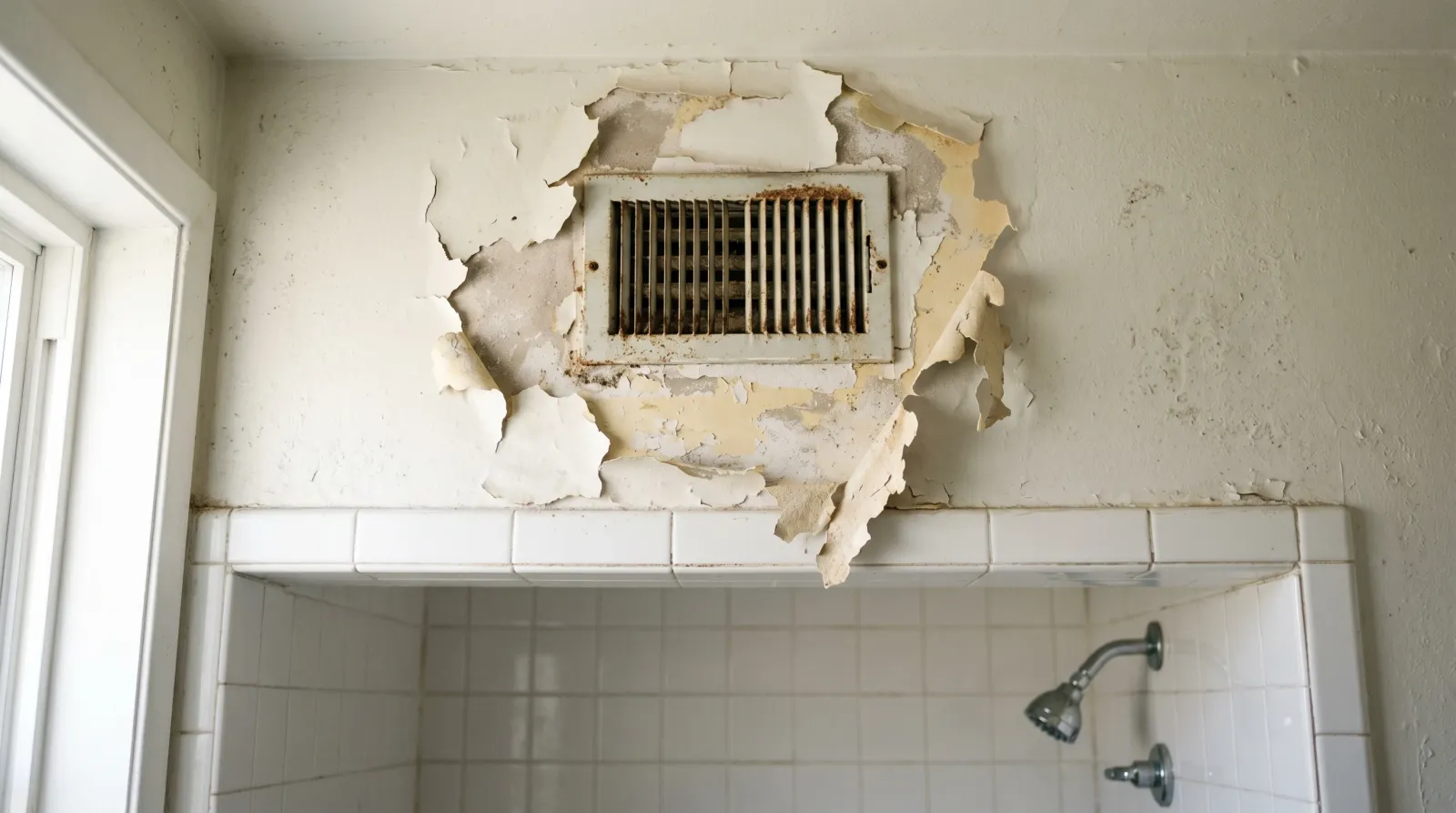
Interior paint doesn’t peel for fun. It peels because the bond underneath gave up — humidity pushing from behind, grease the topcoat never bonded to, or latex rolled over glossy oil without a bridge. Three patterns, three fixes. Read the pattern first, then scrape.
Does This Match What You’re Seeing?
How the paint comes off the wall tells you which fix to run. Look before you scrape.
- Curling sheets, near a shower or under a bath ceiling vent: humidity peel. The film lost adhesion from behind. Drywall paper sometimes comes with it.
- Small brittle flakes above the stove, near the range hood, or on a soffit: kitchen grease peel. The topcoat bonded to a layer of cooked-on oil, not the wall.
- Long flexible strips lifting cleanly off a glossy older surface, often trim or a door: latex over oil. The new latex never bit the slick alkyd underneath.
- Small dome blisters around windows and exterior walls in winter: vapor drive from inside. Same root cause as the bathroom pattern but slower.
- Powdery white film coming off with the paint on a basement wall: efflorescence, not peel. Different fix — see the efflorescence article.
Mixed patterns are common. A kitchen wall above the stove can carry both grease and latex-over-oil failure on the same patch.
How Serious Is This?
A few feet of bathroom ceiling is a Saturday. A whole kitchen wall is a long weekend. Three things push it to high severity.
- Pre-1978 home. Lead until tested. EPA RRP rules apply.
- Drywall paper coming off with the paint film. The substrate is failing, not the paint. Cut out the soft section, patch with new drywall, then prime.
- Same spot peeled within 12 months of the last repaint. The moisture or grease source is still active. Stop painting and start diagnosing.
Why This Is Happening (root Cause)
Three forces drive almost every interior peel.
Humidity from inside the room. Shower steam, kettle plumes, a kitchen dishwasher venting through a cracked door. Warm wet air hits a cool wall or ceiling, condenses, and water sits on the substrate side of the paint film. The film blocks the vapor out, the bond breaks from the back. Bathrooms with no exhaust fan or an undersized one do this every shower for a decade. The flat matte paint a builder rolled into a wet room was the wrong product on day one.
Grease the topcoat never bonded to. Kitchen walls, especially above a stove or near a vent hood, build a film of cooked oil over years. It looks like wall. It isn’t. A primer rolled over greasy substrate skins over, the topcoat goes on, and the entire stack lifts the first time the wall gets warm or wet. Degreaser before primer is the line between a fix that holds and one that peels by Thanksgiving.
Latex over oil without bonding. Older trim and doors are usually alkyd. New paint is almost always latex. Latex doesn’t stick to glossy alkyd. It dries, looks fine for a few weeks, then sheets off in long strips when the trim gets bumped or the room gets humid. The fix is a bonding primer or BIN, never a fresh coat of latex straight to the gloss.
Press painter’s tape against the existing film before you do anything else. Rip it off fast. If paint comes with the tape, your bond is failing wider than the visible peel.
The Fix
Step 1. Find and Stop the Source
Bathroom: check the exhaust fan. A 50-CFM fan can’t handle a real shower. You want 80 CFM minimum, vented through the roof, not into the soffit. Run it during the shower and 20 minutes after. If there’s no fan, install one before you prime anything.
Kitchen: range hood ducted outside, not recirculating. A recirculating hood pushes grease right back onto the wall. Wipe the affected zone with a TSP solution or Krud Kutter Original, two passes, rinse, dry overnight. Cooked grease doesn’t come off in one wipe.
Trim and doors: confirm the substrate is oil. Denatured alcohol on a cotton ball, rub hard for 30 seconds. Latex transfers, oil doesn’t. If it’s oil, you need a bonding primer in Step 3.
A moisture meter in the wall should read under 1% before priming. A hygrometer in the room should read under 50% RH.
Step 2. Scrape and Feather
A 1.5-inch flexible scraper, pulled toward you at a low angle. Get the loose stuff off. Don’t fight sound paint loose; you’ll tear drywall paper and add a skim-coat pass.
Scraping leaves a cliff: bare drywall or primer next to a hard edge of remaining paint. Top-coat over a cliff and you’ll see the transition through three coats. Sand each edge with 120, step to 220, until the perimeter feels flush under your fingertip. Random-orbit sander on the lowest setting, finish by hand. Drywall sands fast.
Vacuum dust before primer. A tack cloth picks up the rest.
Safety (read Before Step 3)
N95 minimum during any sanding. P100 for pre-1978 homes. Eye protection for overhead work. Never mix bleach with vinegar, ammonia, or hydrogen peroxide. Produces toxic chlorine gas. If you’re cleaning mildew off bathroom paint before scraping, use one cleaner. Rinse fully between products. Ventilate the room while shellac primer flashes off; it’s hot solvent.
Step 3. Prime — Cover Stain or BIN
Match the primer to what failed.
| Pattern | Primer | Why |
|---|---|---|
| Humidity peel, bare drywall | Zinsser Cover Stain (oil) | Bites raw drywall paper, blocks moisture, holds where latex won’t |
| Kitchen grease, after degrease | Zinsser Cover Stain (oil) | Locks any residual oil film and bridges to the topcoat |
| Latex over oil, glossy trim | Zinsser BIN (shellac) or INSL-X STIX | Bonds to slick alkyd without scuff-sanding to dull |
| Stain, tannin, or smoke bleeding through | Zinsser BIN (shellac) | Blocks anything from telegraphing into the topcoat |
| Drywall patch in an otherwise sound wall | PVA drywall primer | Cheaper, fine for non-wet rooms |
For most interior peel, the answer is Cover Stain for substrate problems and BIN for adhesion problems. One full coat, cut in the patched edges first, roll the rest. Dry to recoat: Cover Stain takes 2 hours at 70°F, BIN 45 minutes. Sand 220 lightly before the topcoat. Don’t skip the sand; primer texture telegraphs through finish paint.
If the bare patch drinks the first coat flat and dead, hit it again. Skim-coated drywall sometimes needs two.
Step 4. Spot-Skim, Caulk, Sand
Any gouge deeper than a credit card edge needs joint compound. Lightweight setting compound for a same-day patch, premixed for cosmetic only. Sand flush at 220. Spot-prime the filled area; compound absorbs paint differently than the wall around it.
Cracked caulk at the tub or backsplash gets cut out and replaced with a 100% silicone, not painter’s acrylic. Latex caulk in a wet zone fails in 18 months and the peel comes back along the joint.
Step 5. Two Coats of the Right Finish
Two coats. Always two coats. One-coat coverage on the can means one coat under perfect conditions, and your patched wall isn’t perfect conditions.
For the rooms most likely to peel:
- Bathrooms and laundry rooms: a true bathroom paint in satin or eggshell. Benjamin Moore Aura Bath & Spa, SW Emerald, or Behr Marquee. See the bathroom paint round-up for the full comparison.
- Kitchen walls and ceilings: scrubbable acrylic in eggshell or satin. BM Regal Select, SW Cashmere, or Behr Marquee.
- Trim and doors over BIN: acrylic alkyd hybrid like BM Advance or SW ProClassic. Brushes like oil, cleans like latex, holds up to door-handle traffic.
Cut in the edges, roll the field while the cut-in is still wet, don’t stop in the middle of a wall. Stopping mid-wall is how you get lap marks, and lap marks show up the second a side-window catches the wall in afternoon light.
Recommended Product
Zinsser Cover Stain for substrate peel, Zinsser BIN for latex-over-oil peel. Same brand, two formulas, two jobs. Cover Stain is oil and it bites raw drywall, plaster, bare wood, and chalky surfaces. BIN is shellac and it bites glossy alkyd, blocks tannin and smoke, and sands in under an hour. The two of them cover almost every interior peel I’ve ever fixed on a paying job.
Cover Stain on Amazon · BIN on Amazon
Prevention
- Bath fans, properly sized. 80 CFM minimum for a standard bath, 110 CFM for a master with a shower stall. Vent through the roof, not the soffit. Run during the shower and 20 minutes after.
- Range hoods ducted outside. Recirculating hoods are decoration. They don’t pull grease, steam, or smoke out of the room.
- Wipe-downs in kitchens. Once a quarter, a TSP wipe of the wall above the stove. Cooked grease that doesn’t build doesn’t peel paint.
- Bonding primer on every trim repaint. If you can’t confirm the trim isn’t oil, prime it like it is. Shellac primer or a real bonding primer; never raw latex on gloss.
- Two coats on every repaint. One coat is half the protection and twice the peel risk.
- Indoor RH 30 to 50% in winter. Above 60% and you’re feeding the same problem you just fixed.
Lead-Paint Warning (pre-1978 Homes)
If your house was built before 1978, assume the older paint layers are lead. Disturbing them indoors without containment is a real hazard, especially for kids. Test with 3M LeadCheck swabs; cut a notch through every layer, swab each one.
Positive means EPA RRP practices: wet-scrape only, 6-mil plastic on the floor and 10 feet out, P100 respirator, HEPA vacuum at cleanup, no dry sanding, no heat guns. If the area is more than a few square feet or you don’t own HEPA gear, hire a certified RRP contractor.
When to Call a Pro
- Pre-1978 home with widespread interior peel
- Drywall paper releasing with the paint film over more than a small patch
- Mold area larger than 10 sq ft alongside the peel (EPA threshold)
- Peeling on a textured plaster ceiling without a clear source
- Same spot peeling within 12 months of a proper repaint with primer
- Suspected hidden plumbing leak behind a bathroom wall
What’ll Bite You in Two Years
Skip the source and you didn’t fix the peel. You covered it. Two clean coats of Aura Bath & Spa on a bathroom with a 50-CFM fan will peel again by the second summer. Paint is the visible layer of a system. Fix the fan, the hood, the bond — then paint. Other order doesn’t work.
Ask a Question