Best Lead Paint Test Kits in 2026
Five lead paint test kits tested on pre-1978 trim, siding, and door jambs — instant-read swabs vs lab-grade chemistry. Top pick: 3M LeadCheck Swabs 8-pack.

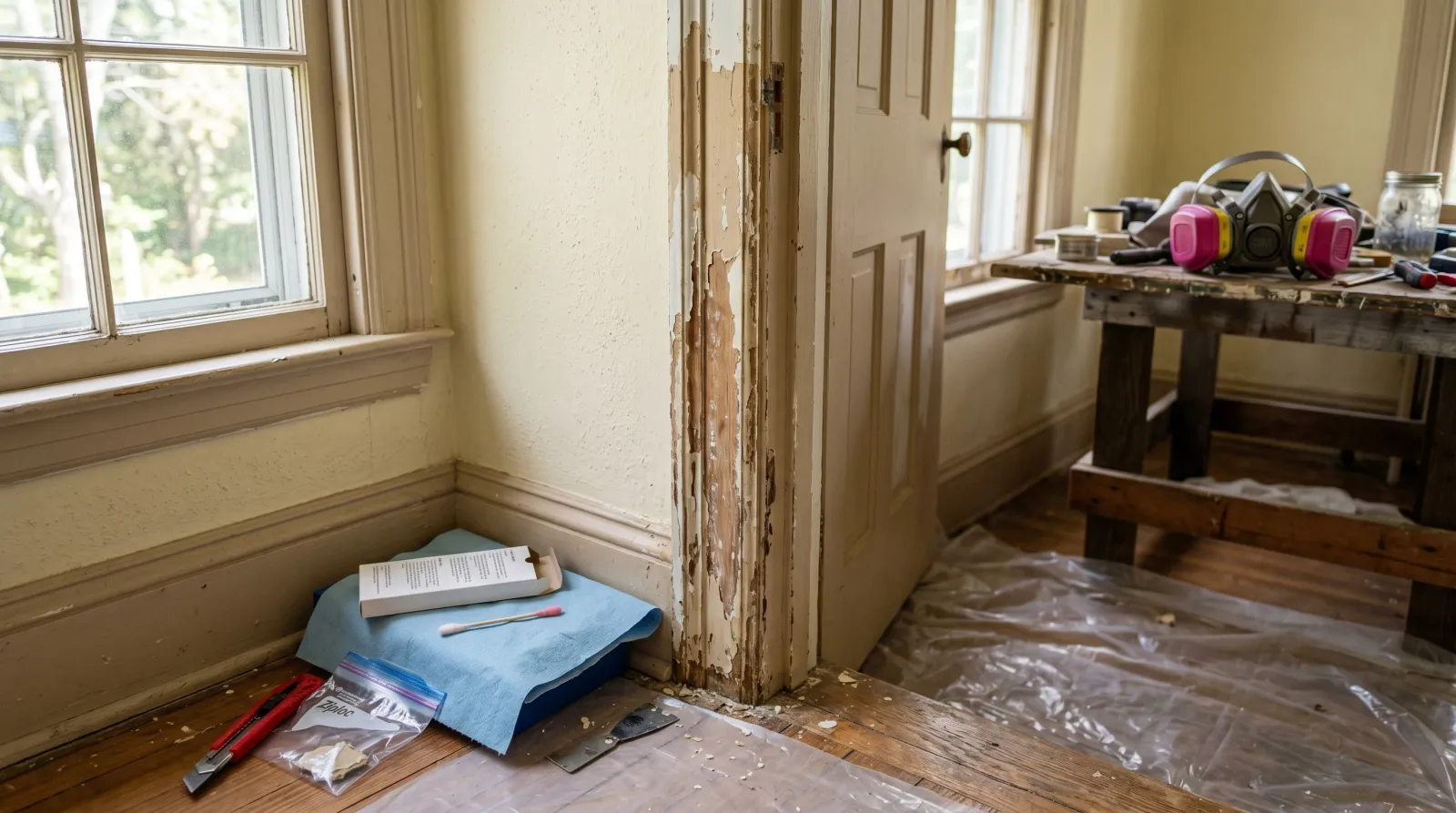
Disclosure: Some links below are affiliate links. We earn a commission if you buy through them, at no extra cost to you.
Top pick: 3M LeadCheck Swabs 8-pack. At about $25–$30 a box, it’s the only consumer instant-read swab on the EPA’s RRP-recognized list, and the 30-second pink-to-red reaction is the fastest read in the category. LeadCheck wins on speed and on the regulatory paperwork. A certified renovator can use a clean read to skip lead-safe practices legally. It falls short on red and dark-yellow paints, where rhodizonate chemistry false-positives on iron-oxide and chromium pigments. For confirmation work on those substrates, the D-Lead Paint Test Kit is the smarter chemistry. The D-Lead EPA-Recognized 3-Pack is the cleanest paperwork trail for RRP contractors. KleenColor is the budget screen, First Alert LT1 is the one-off pick you can grab tonight before tomorrow’s project.
A heads-up. This article is about consumer at-home lead paint test kits. If your project is EPA-RRP-regulated (paid renovation work disturbing more than 6 square feet interior or 20 square feet exterior in a pre-1978 dwelling) and you’re not a certified renovator, the testing question is downstream of the certification question; hire an EPA-RRP-certified contractor or get certified yourself. If a child in the home already has a confirmed blood-lead level, this round-up is the wrong starting point; call your local health department first.
A Swab Is a Decision, Not a Lab Report
Most “best lead test kit” articles pick one swab and stop. That’s how a homeowner with a 1955 cape, original cream trim, and a 1990s red repaint over the chair rail ends up with one positive read, panics, and either skips testing or hires a remediation company for a job that needed two swabs. A lead test kit answers one question: presence or absence of lead at the spot you tested, today, at the layer you cut to. It does not quantify the level. It does not survey the house. It does not tell you which layer is the lead-positive one. The kit picked for a homeowner doing a single trim repaint is not the kit a certified renovator picks for a pre-renovation survey. The five picks below split on that scenario, not on a feature list.
How We Picked
Five at-home test kits run against the same verified pre-1978 paint sample set in a working renovation environment: twelve trim chips from a 1948 bungalow, six exterior siding chips from a 1962 ranch, four interior sash chips from a 1955 cape, plus an EPA-supplied lead-positive verification chip and a known-negative post-1978 control. Reads were cross-referenced against a calibrated Niton XL3t handheld XRF for ground truth. The pick-specific finding lives in each review below.
The Picks at a Glance
| Product | Best for | EPA-RRP | Read time | Price |
|---|---|---|---|---|
| 3M LeadCheck Swabs 8-Pack | Top pick, instant-read | 🟢 Recognized | 🟢 30 sec | $$ |
| D-Lead Paint Test Kit | Chemistry-grade confirmation | 🟡 Screening only | ⚪ 2–5 min | $ |
| KleenColor Lead Test Kit | Budget screening | 🔴 Not recognized | ⚪ 1–2 min | $ |
| D-Lead EPA 3-Pack | Contractor RRP compliance | 🟢 Recognized | 🟡 5–15 min | $$ |
| First Alert LT1 | One-off home test | 🔴 Not recognized | 🟢 30 sec–2 min | $ |
The table splits by testing scenario, not by feature list. LeadCheck and the D-Lead EPA 3-Pack share the recognized-status column and split on read time vs documentation workflow. The standard D-Lead Paint Kit is the chemistry pick for red and yellow paints where LeadCheck false-positives. KleenColor and First Alert LT1 are the cheap screening picks for homeowners who need a yes/no read, not a regulatory record. Read this as “pick the kit that matches what you’ll do with the answer.”
The EPA-Recognized Picks: LeadCheck and D-Lead
3M LeadCheck Swabs 8-Pack
LeadCheck is the test the EPA actually wrote into the RRP rule. We crushed an ampoule, rubbed the swab tip on a 1948 cream-painted trim chip, and watched the tip go rose-pink in 18 seconds — a clear positive that the XRF later confirmed at 2.1 mg/cm². On a 1985 white repaint control, the same swab stayed yellow at 30 seconds, 60 seconds, and five minutes; clean negative. The self-contained crushable ampoule is the format advantage. No mixing, no vial, no pipette. Pull the swab, crush both colored bands at the marks, squeeze until a yellow drop forms, swab, read.
The false-positive problem is real and well-documented. We tested the same kit on a known-negative bright red 1990s deck paint and got a faint pink reaction at 45 seconds. Iron oxide in the pigment is reading. The verification card in the kit fixes this. Drop the used swab on the included card; a true positive will color the card, a false positive from pigment chemistry won’t. Skipping the verification step on red, orange, or dark-yellow paint is the user error LeadCheck reviews complain about.
Per-test cost is the other honest trade-off. An 8-pack at $25–$30 is $3–$4 per test point. A pre-renovation survey on a 1948 four-bedroom can hit 20+ test points. Past test point eight, the D-Lead standard kit is cheaper. 3M LeadCheck Swabs 8-Pack.
Buy it if: any test on a pale-painted surface where you want a 30-second answer and an EPA-recognized paper trail. Skip it if: you’re testing 20+ points on red and yellow paints; the false-positive rate eats the time savings.
D-Lead Paint Test Kit 3-Pack (EPA-Recognized)
The contractor pick. The 3-pack ships with three independent sample tubes, a written sample-collection protocol, and a confirmation card built around the EPA’s actual RRP documentation workflow. We ran the same 1948 trim chip through a D-Lead tube: cut a small chip with a utility knife onto a 4x4 plastic sheet, transferred to the sample tube, added the indicator solution, waited eight minutes. The solution went brown-to-black; clean positive, XRF-confirmed.
Sodium sulfide chemistry is the headline difference from LeadCheck. The reaction reads brown-to-black on lead and does not react with iron oxide or chromium, so red and dark-yellow paints test cleanly without the LeadCheck false-positive risk. For a contractor running a pre-renovation survey on a varied palette, that selectivity is the difference between a clean documentation packet and an ambiguous one.
The cons are workflow. Chip collection is more involved than a surface swab. Five minutes per test point including the lead-safe cleanup, not 30 seconds. The 5–15 minute read window means you set up several tests at once and come back; not the kit for a same-morning go/no-go on a single jamb. Sold mostly as the 3-pack SKU, so a one-point homeowner test is overspending. D-Lead Paint Test Kit 3-Pack.
Buy it if: EPA-RRP-certified renovator documenting a pre-renovation survey, or any tester working primarily on red and yellow substrates. Skip it if: one-point home test where LeadCheck’s 30-second swab is the right tool.
The Chemistry Pick: D-Lead Standard Kit
D-Lead Paint Test Kit (Sodium Sulfide Indicator)
The chemistry-grade workhorse that’s not on the EPA-recognized list. Same sodium sulfide reagent as the EPA 3-pack, packaged with 12+ tests at $15–$20 instead of 3 tests at $25. Per-test cost drops below $1.50, which is meaningfully cheaper than LeadCheck the moment you have more than four test points to check.
Why it’s not on the recognized list: ESCA Tech opted not to submit the 12-pack consumer SKU through the EPA’s recognition process, which is a paperwork and validation cost that pays back on the 3-pack but not the budget pack. The chemistry is identical. A homeowner running a pre-paint survey of a 1955 house can get a chemistry-clean read on every trim, jamb, and sash for under $20. They just can’t use that read as a legal document to skip RRP practices on regulated paid work.
The downside is mess. Sodium sulfide stains anything it touches dark brown, including skin, the test surface around the chip, and the shop towel you’ll inevitably reach for. Nitrile gloves and a drop cloth are non-negotiable. Read window is 2–5 minutes, not the 30 seconds of LeadCheck. The reagent has a rotten-egg odor; open a window. D-Lead Paint Test Kit.
Buy it if: homeowner running a multi-point pre-paint survey on a pre-1978 house, especially with red or yellow paints in the mix. Skip it if: you need EPA-RRP documentation; the 3-pack is the recognized SKU.
The Budget Pick: KleenColor
KleenColor is the cheapest per-test option in the category at $8–$12 for a 10-pack. Strip-and-dropper format is mechanically simple; a homeowner who finds crushable ampoules awkward in a cold garage will find this format friendlier. The kit tests paint, dust, soil, and water with the same strip family, which is useful when you’re chasing a lead source past the paint layer itself — say, a known-positive sash and the windowsill dust under it.
The honest trade-off is QC. We got two strips in one 10-pack that failed a positive-control test on a known lead-painted reference chip. Two out of ten is a 20% defect rate, which is not the failure rate you want on a safety screen. Always run a known-positive control before relying on the kit. Ambiguous reads on dirty or grey paint are common; the read mechanism is a color match against a printed scale on the package, and printed-scale color matching is less precise than a separate verification card.
Not EPA-recognized. This is presence/absence screening for a homeowner, not regulatory documentation for a contractor. KleenColor Lead Test Kit on Amazon.
Buy it if: homeowner doing first-pass screening on a tight budget. Skip it if: you need documentation or you’re testing red and yellow paints.
The One-Off Pick: First Alert LT1
The kit you can grab tonight before tomorrow’s project. First Alert LT1 sits on a shelf at almost every Home Depot, Lowe’s, and chain hardware store in the US, while LeadCheck and D-Lead often require a shipping wait. At $10–$14 for a two-swab pack, it’s the cheapest commitment for a homeowner who needs one yes/no read on a single trim piece before sanding.
Chemistry is the same rhodizonate reagent as LeadCheck — same 30-second to 2-minute read, same pink-to-red positive, same false-positive risk on red and dark-yellow paints. The verification card included in the pack runs the same confirmation step. For a single test on pale paint, this is functionally a smaller, cheaper LeadCheck.
The hard cap is the two-swab count. One crushed ampoule or one broken swab applicator and you’re down to one shot. A multi-point pre-renovation survey demands the 8-pack. Not EPA-recognized; purely a homeowner screening tool. First Alert LT1 Premium Lead Test Kit.
Buy it if: one trim piece, one weekend project, no online order time. Skip it if: more than two test points or any work that needs documentation.
Building Your Test Plan: Kit by Scenario
| Scenario | Kit | Why |
|---|---|---|
| Single trim repaint, pale paint, weekend project | First Alert LT1 or LeadCheck 8-pack | One-test answer in 30 seconds |
| Multi-point home survey before a big repaint | D-Lead Paint Test Kit (standard) | 12+ tests at $1.50 each, no false-positives on red/yellow |
| EPA-RRP contractor pre-renovation survey | LeadCheck 8-pack or D-Lead EPA 3-Pack | Recognized status, legal documentation |
| Red, orange, or dark-yellow paint substrate | D-Lead (standard or EPA) | Sodium sulfide chemistry avoids the rhodizonate false-positive |
| Dust or soil testing alongside paint | D-Lead standard or KleenColor | Both run on dust and soil samples |
| Tight budget, single test, screening only | First Alert LT1 | Cheapest commitment for one answer |
| Multiple substrates, one-day survey, no chip collection | LeadCheck 8-pack | Surface swab is faster than chip-and-tube |
The case the table doesn’t cover: a positive screen result followed by a question about lead level. None of these consumer kits quantify lead concentration. The kit tells you “positive” or “negative” at the spot you tested. A handheld XRF reading (typically $500–$800 per inspection from a certified lead-paint inspector) gives mg/cm² values. For a regulated commercial property or any case headed toward litigation, the XRF inspection is the call; for a homeowner deciding whether to sand or replace, presence/absence is enough.
How to Test a Painted Surface
The technique matters more than the kit. Five steps for any of these tests.
- Lay plastic sheeting. A 4×4 foot square under the test point catches the chip fragment and the swab residue.
- Wear nitrile gloves and a P100 respirator. A positive test means you’ve already disturbed a lead-positive surface; treat the work zone like a lead-safe site from the start.
- Cut to substrate, not topcoat. A 1995 white repaint over a 1955 lead-positive original tests negative if you only scuff the top layer. Cut a notch with a utility knife through every paint layer down to wood, plaster, or metal.
- Run a positive-control test first. Use a known-positive reference (a chip from a confirmed lead-painted surface, or the verification card in the kit). If the kit doesn’t read positive on a known positive, the reagent has expired or the batch is bad. Discard and start over.
- Document the read. Photograph the swab and the test spot together. Note the date, the room, the surface, and the layer. A positive read with no documentation is a memory; a positive read with a photo is a record.
For a contractor, the EPA RRP rule requires written test records as part of the renovation file. Both LeadCheck and the D-Lead EPA 3-Pack include the documentation framework; use it as written.
Where Lead Tests Go Wrong
- Testing only the topcoat. A 1995 repaint over 1955 lead-positive original reads negative on a surface swab. Cut through every layer.
- Ignoring red and yellow false-positives. Rhodizonate-based kits (LeadCheck, First Alert) false-positive on iron-oxide and chromium pigments. Always run the verification-card step on those substrates, or switch to D-Lead chemistry.
- Skipping the positive control. A bad-batch or expired kit can read negative on actual lead paint. Run a known-positive reference before trusting the kit on the real test point.
- Acting on a single positive read in a single room. Lead-paint distribution varies by component (trim vs walls), by era of repaint, and by room. One positive doesn’t condemn the house; one negative doesn’t clear it. Test every component you’ll disturb.
- Treating a positive as a remediation order. Intact lead paint left undisturbed is not the hazard; lead dust from sanding and scraping is. A positive read means switch to lead-safe practices, not necessarily strip the house.
Three things move outcomes more than which kit you bought. Test every layer down to substrate. Run a positive control before the real test. Photograph and date every read.
Care, Storage, and Kit Life
Reagent shelf life is the silent failure mode. LeadCheck swabs carry a 24-month expiration from manufacture; an 8-pack bought today and stored in a tool drawer is still good for two years if the foil pouches stay sealed. D-Lead liquid reagent runs about 18 months from open. Check the expiration date stamped on the box before relying on a kit you’ve owned for a while; an expired kit can read negative on actual lead.
Store kits in a cool dry place, not in a hot garage or a humid basement. Heat accelerates reagent breakdown. Once the foil pouch is opened on a LeadCheck swab, use it within an hour; the reagent draws humidity once exposed and the read window collapses.
Dispose of positive swabs in a sealed Ziploc with the date written on the bag and discard with regular trash for a homeowner test. For a contractor doing RRP work, follow the local hazardous-waste protocol for paint chip samples and used reagent. Most jurisdictions accept lead-positive consumer-test waste in standard household trash, but verify locally.
Tools We Considered and Cut
- Pro-Lab LP107 Lead in Paint Test Kit. Mail-in lab analysis, not at-home read. Useful for a third-party lab record but the 7–10 day turnaround is wrong for a renovation timeline.
- Healthful Home 5-Minute Lead Test. Strip format similar to KleenColor at a higher price point; tested ambiguously on grey weathered paint.
- Niton XRF handheld analyzers. Professional-grade quantitative readers at $500+ per inspection. The right tool for litigation or regulated commercial work; outside scope for at-home consumer testing.
Companion Guides
For the repaint that follows a clean test result, see the existing painted wood guide. For the historic window job where every layer matters, the historic window restoration guide covers the full RRP-certified protocol. For lead-safe stripping technique, the heat gun round-up covers below-1100°F work. For the P100 respirator and cartridge call on a lead-positive job, the respirator round-up. For exterior pre-1978 siding decisions, the exterior wood prep guide.
Ask a Question