Anew Gray
The greige people choose when Agreeable Gray looks washed out — reviewed honestly, including the purple flash, the rooms where it turns muddy, and what to pick instead.

Jessica has spec'd whites and neutrals for more than 300 rooms and keeps a sample wall of painted drawdowns in her studio. Every color review is checked against real reader rooms in the comments and re-tested when a formula changes. About the testing process →
- 1Anonymous20
- 2Dorian Gray39
- 3Anew Gray47
- 4Agreeable Gray60
- 5Pale Oak69
The Fast Verdict
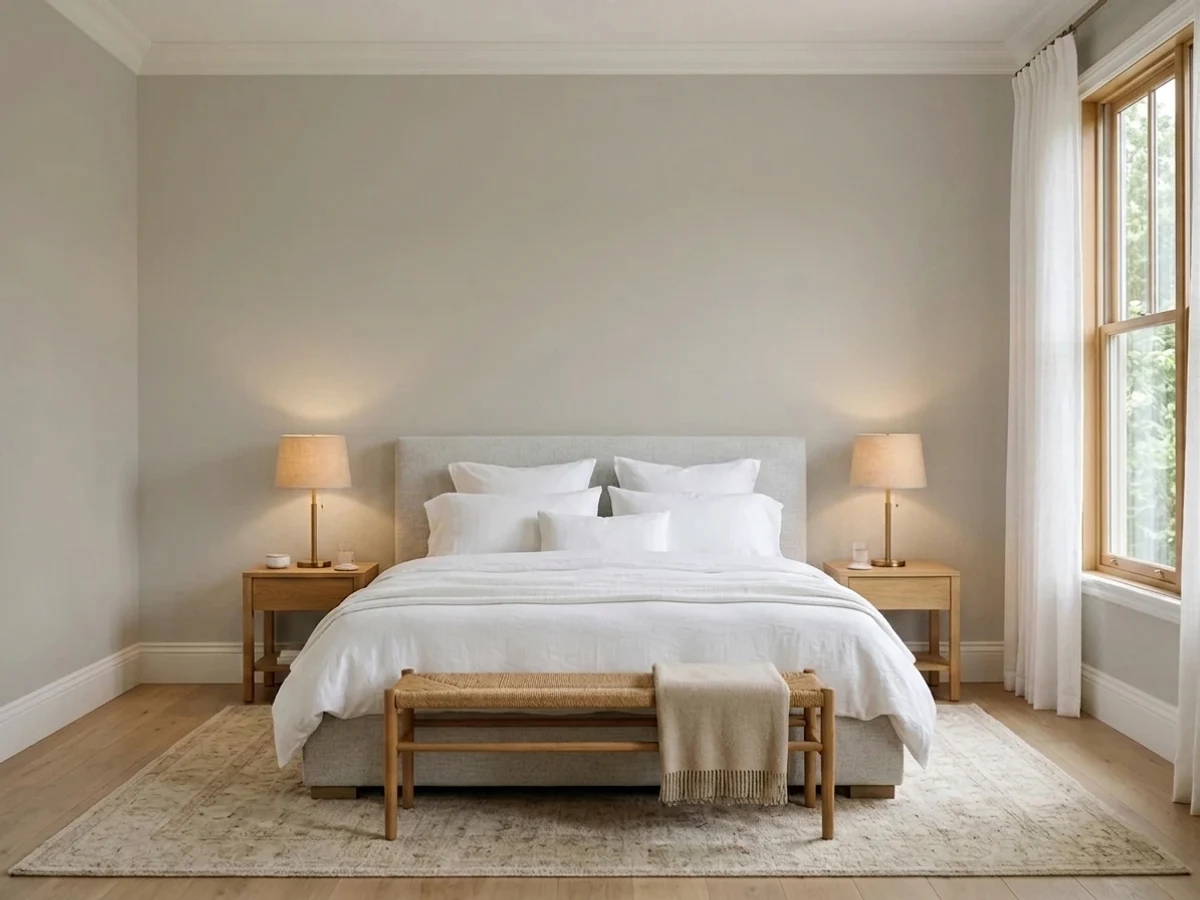
Anew Gray is the grown-up version of the greige everyone paints. It sits one step below Agreeable Gray on the same paint strip, so it keeps its color against white trim instead of fading into it, and it is one of the few neutrals that makes honey oak floors look intentional.
The catch is real: it comes from the yellow-red side of the color wheel, and under cool white bulbs or flat north light it can flash mauve. Give it sun and 3000K bulbs and it is superb; give it a dim basement and 4000K LEDs and you will hate it.
South and west rooms with real sun · homes with honey oak floors, trim or cabinets · exterior siding with white trim · anyone who found Agreeable Gray too pale
Your room faces north and stays dim · you are painting a windowless basement · your LED bulbs are 3500K or cooler · your floors are cool blue-gray LVP
- Bridges honey oak and orange-toned floors better than any true gray
- Deep enough to hold its own against bright white trim instead of fading into it
- Warm without ever tipping into yellow or butterscotch
- Exteriors: reads as warm stone in sun, never glaring, never washed out
- The obvious next step down when Agreeable Gray looks too pale on the wall
- Flashes mauve under 3500K and cooler LEDs — worst on satin cabinets
- Lands a full step darker on four walls than it looks on the chip
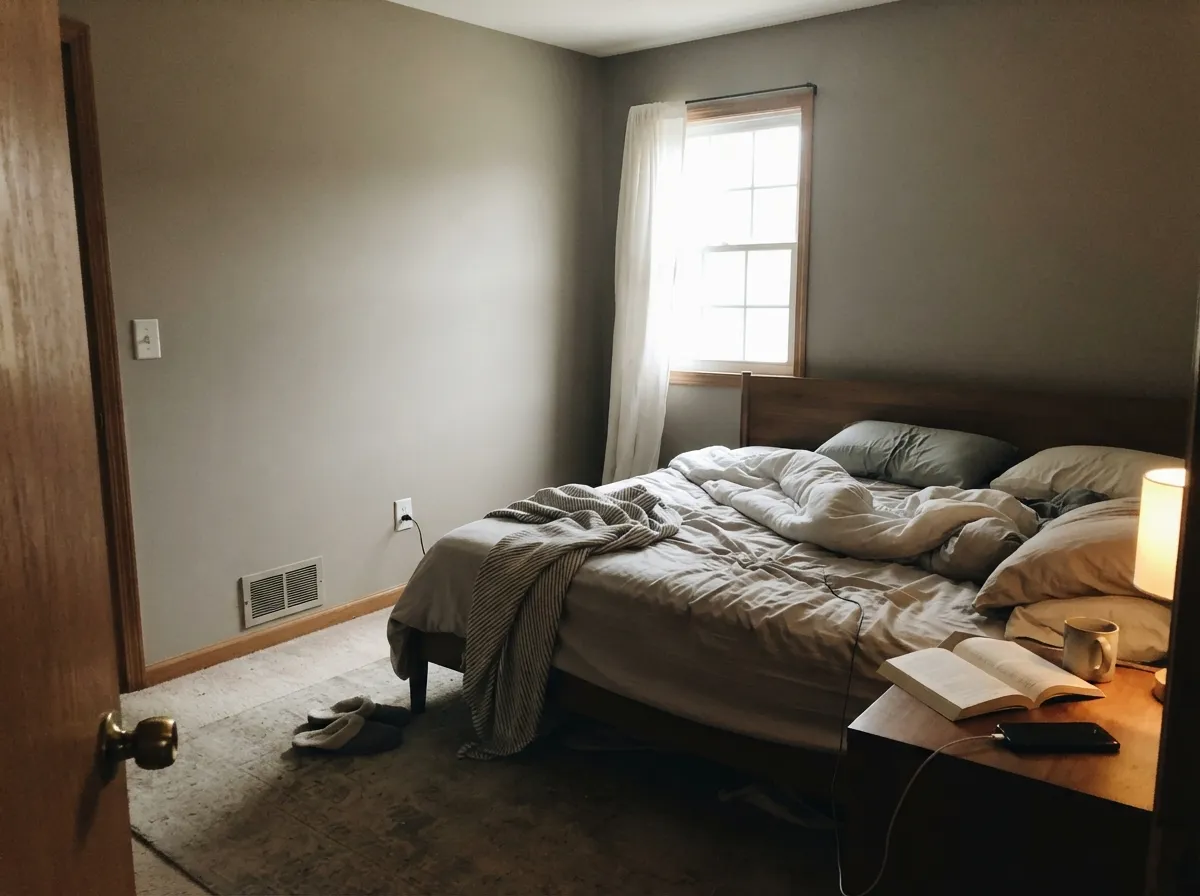
- Turns muddy brown-gray in north rooms, basements and windowless halls
- Touch-ups flash; you usually have to roll the whole wall corner to corner
What Color Is Anew Gray, Really?
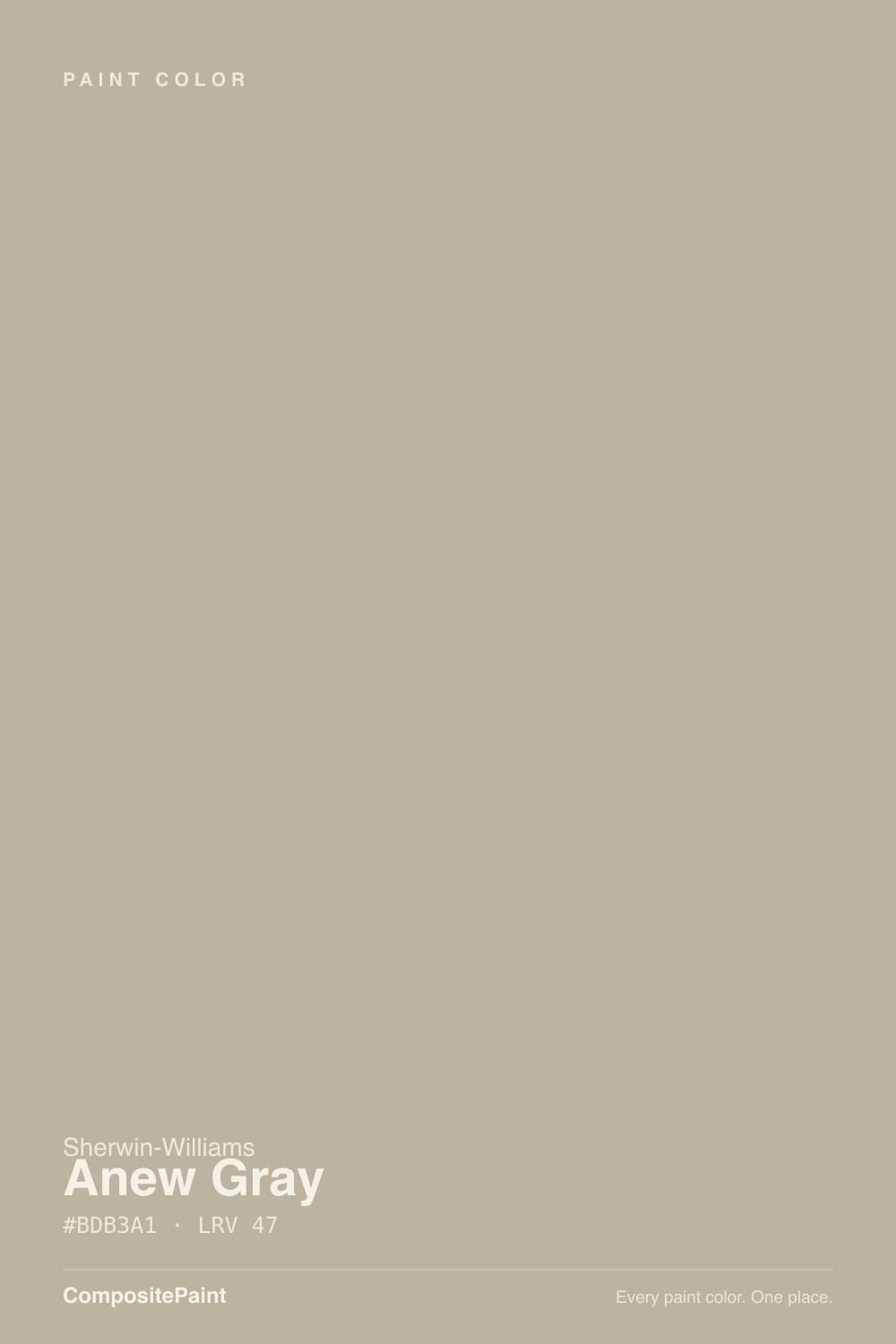
A warm greige built on the red-orange side of the wheel, not the yellow side — and that one fact explains everything people love and hate about it. The hex is #BDB3A1, a muddy warm tan, and the color sits in the yellow-red hue family with very little saturation behind it. Low-chroma warm colors have nothing to hold them steady, so when the light turns cool the beige drains out and what is left reads mauve. That is the purple people report on their walls and cabinets. There is no violet pigment in the can; there is just a warm color with no reserves.
At LRV 47 it reflects a moderate amount of light, and the honest comparison is its own strip: Agreeable Gray (SW 7029) sits at LRV 60, a full 13 points brighter, directly above Anew Gray on the same card. That gap is bigger in a room than it sounds on paper. Expect Anew Gray to land a clear step darker on four walls than it looked on the chip — light bounces between painted walls and gets absorbed each time, so corners read heavier than the swatch ever did. Most complaints that start "it's too dark" are really this.
Undertone in one line: warm gray-taupe with a red-orange base — never green, never butter-yellow. If it looks purple, your light is cool, not your paint.
Where It Shines
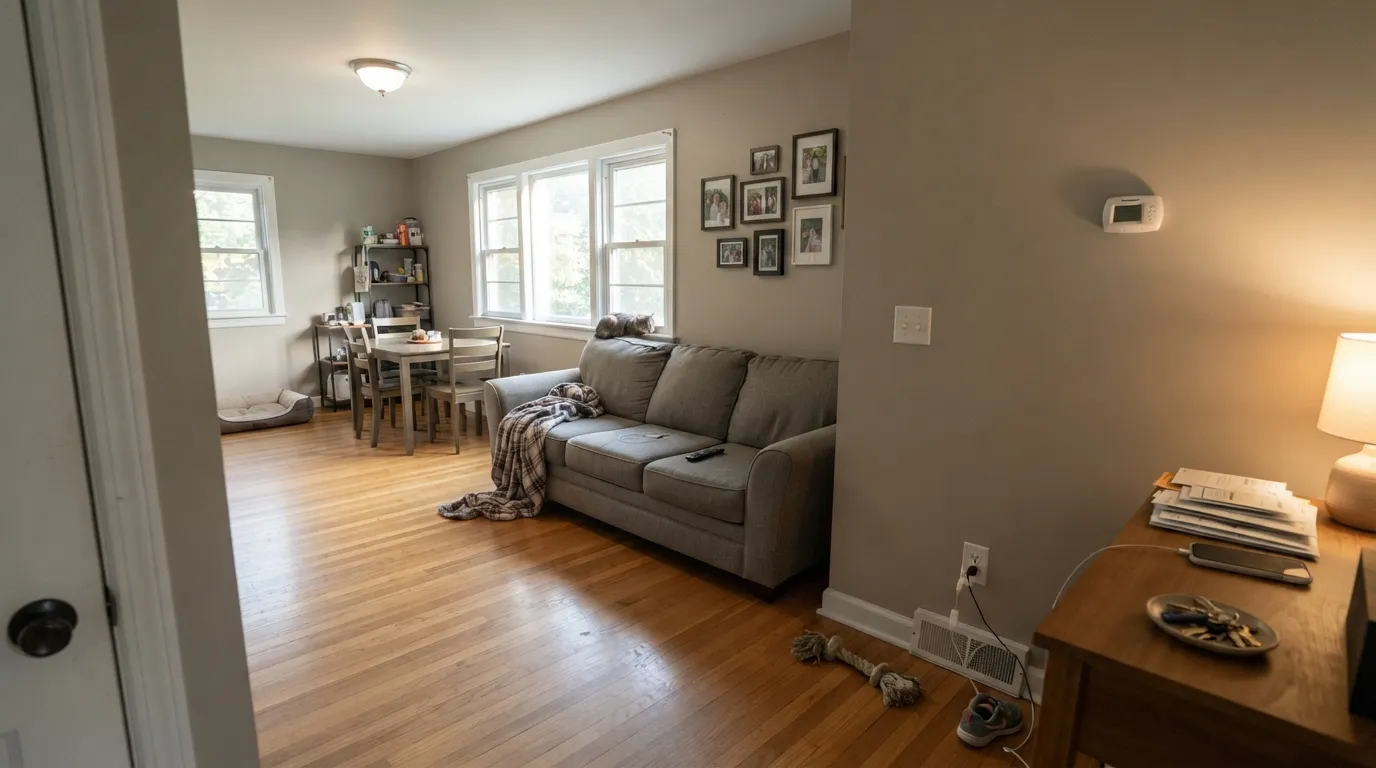
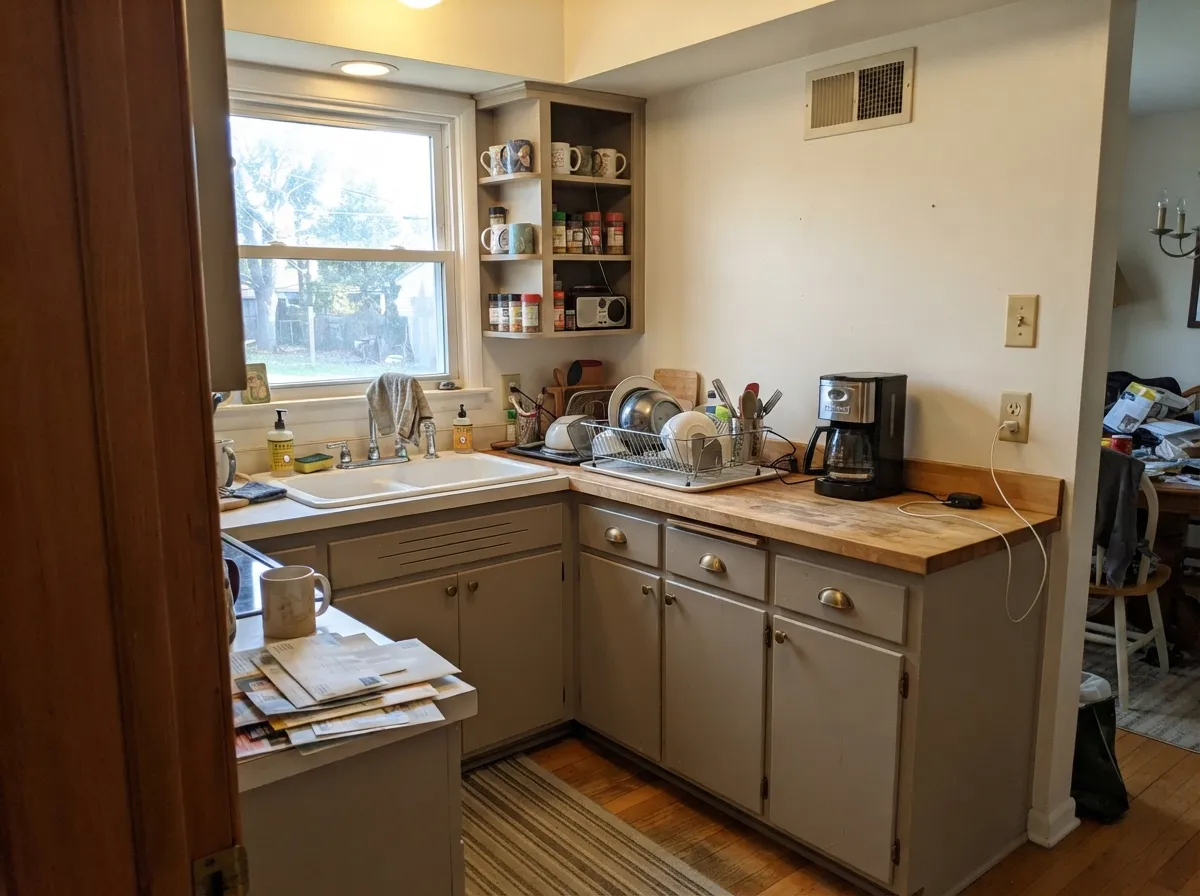
Give it afternoon sun and warm wood and it stops being a compromise color. It is the standard fix for orange-toned oak floors and honey oak trim, because its warmth meets the wood halfway instead of fighting it the way a true gray does. Outside, in full sun, it lifts into a soft warm stone that never glares.
Where It Fails
The bad reviews for Anew Gray are unusually consistent — three situations produce nearly all of them, and every one is predictable before you open a can. If your room matches, this is not your color, and a third coat will not save it.
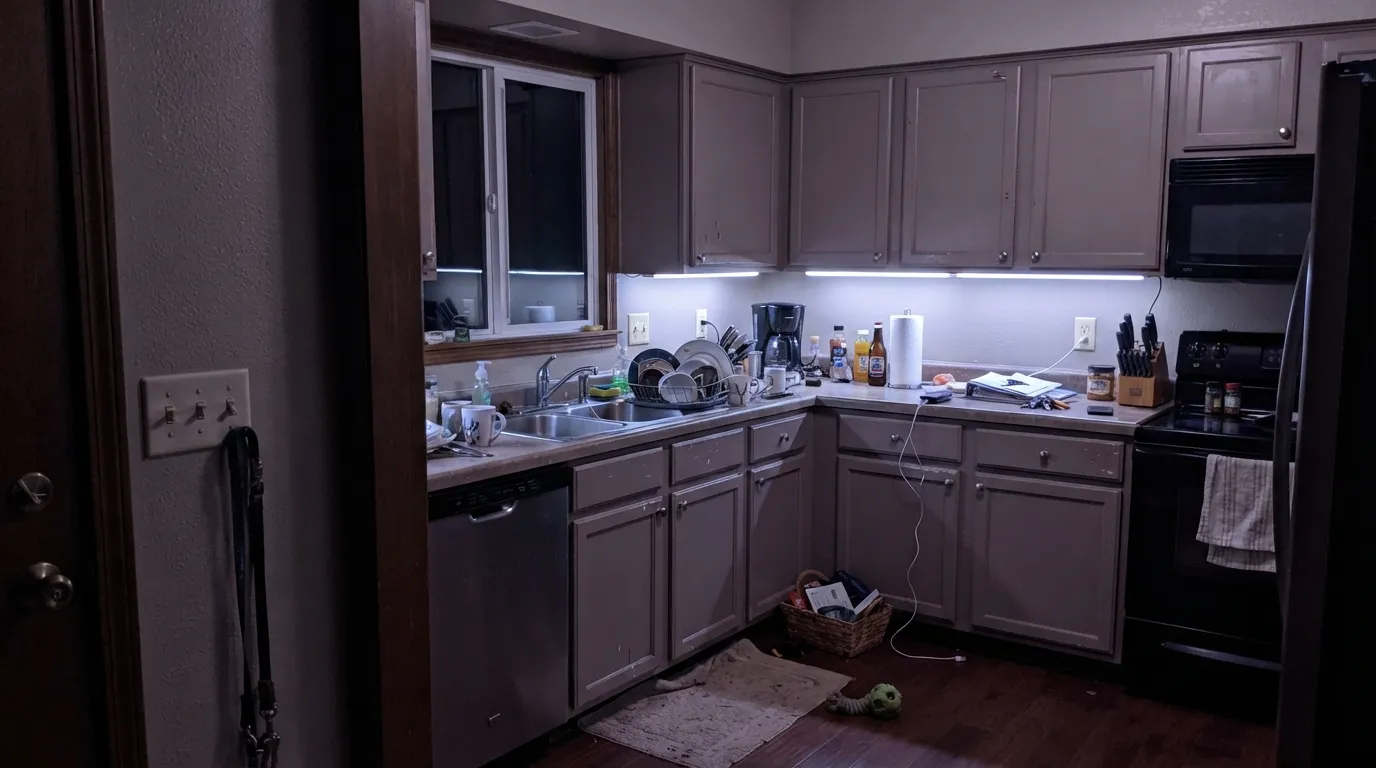
This is the signature Anew Gray complaint, and it hits cabinets hardest: 3500K to 4000K LED task lighting strips the warmth out and the doors read mauve or dusty purple, worse in satin because the sheen amplifies it. Swap to 3000K bulbs first. If you cannot change the lighting, use Amazing Gray (SW 7044) — same LRV 47, yellow base, no violet flash.
North light is cool and flat, and at LRV 47 there is not enough brightness in reserve. The color goes dull brown-gray and people describe the room as muddy or tunnel-like. Move up the same strip to Agreeable Gray (SW 7029) at LRV 60, or go warmer with Accessible Beige (SW 7036) at LRV 58.
Anew Gray saves orange oak floors, but pile tan builder carpet on top of the oak and the balance flips — now the walls are the coolest thing in the room and read gray and dirty next to all that warmth. With tan carpet staying put, pick a real beige like Kilim Beige (SW 6106) instead of a greige.
Room by Room
South or west exposure is where it earns the price of the paint: warm, grounded, still clean against white trim. Eggshell on the walls, Alabaster (SW 7008) or Pure White (SW 7005) on the trim. North-facing living room with two small windows? Go a step lighter.
On cabinets it gives warmth without the yellow of a beige, and it flatters brass, butcher block and warm quartz. Satin finish. Test it at night under your actual under-cabinet lights before you spray a single door — this is where the purple shift shows up.
The lower LRV works in your favor here; it wraps the room instead of bouncing light around. Alabaster (SW 7008) trim and 2700K to 3000K lamps. In a small bedroom with one window it can feel heavy at night, so keep lamps on both sides of the bed.
An open stairwell with daylight spilling in from the rooms it connects: excellent, and it hides scuffs better than anything at LRV 60. A narrow interior hallway with no window: it closes in. Ask the store to mix it at 75 percent for those runs.
Full sun reads it 20 to 30 percent lighter, so LRV 47 lands as warm stone rather than dark. Pair with Pure White (SW 7005) trim and an Iron Ore (SW 7069) door or garage. No purple problems outdoors — daylight is warm enough to hold it.
This is the one clear no. With no daylight at all it turns flat brown-gray, and cool overhead LEDs push it mauve on top of that. Use Agreeable Gray (SW 7029) or Accessible Beige (SW 7036) down there and save Anew Gray for upstairs.
Your Light Is the Risk
Warm steady sun cancels the violet completely and it reads as rich, calm greige all day.
Cool flat daylight drains the warmth: muddy taupe, sometimes mauve. Sample for a full week.
3000K lamps: warm and cozy. 3500K and cooler: the purple shows up. Change bulbs, not paint.
Exterior sun lifts it several steps — warm stone siding with zero undertone drama.
Most complaints about Anew Gray are a light mismatch. Upload a photo of your actual room and see it on your walls — then ask for the same wall in north light or evening lamps before you buy a single sample.
Need It From Another Brand?
Any paint counter can custom-tint Sherwin-Williams SW 7030 directly. If you would rather stay in one brand's own deck, these are the closest stock matches, measured as ΔE2000. Under 2 is a difference you will not see on the wall.
| Brand | Closest color | ΔE | LRV | |
|---|---|---|---|---|
| Behr | Grey MistHDC-CT-21 · Behr | 1.4 | 48 | Color page → |
| Benjamin Moore | ThunderAF-685 · Benjamin Moore | 2.0 | 48 | Color page → |
| Valspar | Luxe Gray8005-4C · Valspar | 0.0 | 47 | Color page → |
| PPG / Glidden | Ghost WriterPPG1007-3 · PPG / Glidden | 1.7 | 47 | Color page → |
| Glidden | Ghost WriterPPG1007-3 · Glidden | 1.9 | 48 | Color page → |
| Dutch Boy | Comfortable Gray443-2DB · Dutch Boy | 0.0 | 47 | Color page → |
Similar Sherwin-Williams Colors
The nearest shades to Anew Gray within Sherwin-Williams's own range, ranked by perceptual color distance — useful when you want the same look a touch lighter, darker, or warmer.
WCAG 2.1: AA is 4.5 : 1 for normal text, 3 : 1 for large text, AAA is 7 : 1.
Anew Gray vs the Colors You're Also Considering
Every Anew Gray sample board has the same rivals on it. The numbers show the real lightness gap — then it comes down to which risk you would rather live with.
Pick this when Agreeable Gray goes pale and washed out against white trim.
Sherwin-Williams SW 7029 · LRV 60Agreeable GrayPick this for dim rooms, small spaces, or a whole house — 13 more LRV points of safety.
Side-by-side comparison →Pick this for softer, cozier warmth when the light in the room is warm.
Sherwin-Williams SW 7044 · LRV 47Amazing GrayPick this if the purple flash scares you — same depth, yellow base, no violet.
Compared with its brand neighbors, Anew Gray is a mid-depth warm greige. Outrigger (SW 9517) at LRV 45 is nearly identical in depth and warmth, so the practical difference is almost invisible on a wall; choose whichever your store stocks. Balanced Beige (SW 7037) at LRV 46 sits at the same value but leans a little more clearly toward beige, so pick it if you want the warmth to read stronger and Anew Gray if you want it more restrained.
Against the two colors it is most often compared with, the gap is brightness. Agreeable Gray (SW 7029) at LRV 60 is noticeably lighter and airier, better when you want walls to feel open and pale. Worldly Gray (SW 7043) at LRV 57 is also lighter and a touch greener. Anew Gray is the deeper, cozier option of the three, best when you want more grounding and warmth on the wall.
Anew Gray Coordinating Colors
The rule with Anew Gray is to stay on its warm side and add one thing that is genuinely dark. Because it is a mid-tone, pale accents disappear against it and the room turns into one soft blur — the contrast has to come from a deep color or from the trim white, never from another mid-tone neutral.
The other half of the rule is corrective. Green partners are worth knowing about because green sits opposite Anew Gray's red-orange base, so a green cabinet, island or built-in quietly cancels any mauve reading in the walls. These are the partners that keep showing up in rooms that actually worked:
Anew Gray on Cabinets and Vanities
Cabinets are where Anew Gray produces both its best rooms and its angriest reviews, and the difference is almost always the lighting. Painted on doors and drawers in satin, it gives a warm mid-tone that flatters brass pulls, butcher block and warm quartz, and it hides fingerprints far better than a white cabinet ever will. Then the sun goes down, the under-cabinet task lights come on at 4000K, and the same doors read dusty purple across the whole run.
So test it in the exact place it will live, at night, with your real bulbs — a brushed-out sample board propped against the cabinet boxes, not a chip held up in daylight. If the flash appears, the cheap fix is 3000K bulbs, not new paint. The bathroom version of this problem is the tile: against white quartz and black hardware it looks sharp, but next to cream or travertine the warm stone pulls the pink right out of it.
One practical note: satin and semi-gloss exaggerate the shift more than a flat wall finish, because more light bounces off the surface toward your eye. If you want Anew Gray cabinets in a room with cool lighting you cannot change, drop to a matte cabinet enamel and the effect calms down noticeably.
The Anew Gray Ladder: Lighter and Darker
Anew Gray sits in the middle of one of the most-used strips in the Sherwin-Williams deck, and knowing its neighbors saves a lot of sampling. One step up is Agreeable Gray (SW 7029) at LRV 60 — same character, much more light, and the answer for nearly everyone who finds Anew Gray heavy. One step down is Mega Greige (SW 7031) at LRV 37, which is where you go if Anew Gray is not enough color and you want the walls to read as a real mid-tone.
Sideways moves matter just as much. Perfect Greige (SW 6073) at LRV 42 is a touch deeper and slightly more purple-leaning again, so it is not the fix for that problem. Amazing Gray (SW 7044) is the same LRV 47 with a yellow base — the true sideways swap when the undertone is what bothers you, not the depth. And Balanced Beige (SW 7037) at LRV 46 matches the depth while reading more openly beige, for anyone who wants the warmth to stop hiding.
Three Ready Palettes Built on Anew Gray
A color is never alone on the wall. These are complete combinations in the 60-30-10 pattern, with the reason each one holds together. Every one opens in the visualizer.
Alabaster at LRV 82 is warm enough that the trim never looks blue-white against the walls, which is the mistake that makes greige rooms look dirty. Urbane Bronze supplies the one dark note the scheme needs, and both share Anew Gray's warm base so nothing argues.
Try this palette in your roomPewter Green at LRV 12 is the accent that fixes Anew Gray's weakness — green sits opposite red-orange, so it pushes the walls back toward neutral and kills any mauve reading. Snowbound keeps the trim clean without the coldness of a bright white.
Try this palette in your roomSun lifts Anew Gray several steps, so the 60 percent surface reads as light warm stone rather than a mid-tone. Pure White trim keeps the edges crisp and Iron Ore at LRV 6 gives the hard contrast a facade needs to look designed instead of builder-default.
Try this palette in your roomAnew Gray FAQ
Why does my Anew Gray look purple?
Because it is a low-saturation color from the yellow-red family, and cool light strips the warmth out until only the red side is left, which reads mauve. It happens most under 3500K and cooler LEDs, in north light, and on satin cabinets where the sheen exaggerates it. Change to 3000K bulbs and it usually disappears in one evening.
Is Anew Gray too dark for a whole house?
It depends entirely on your windows. In a bright home with big openings and daylight reaching the middle of the house, it works beautifully as a whole-house color. In an average home with standard windows, most people who try it end up wishing they had used Agreeable Gray (SW 7029), which is the same color 13 LRV points brighter.
Anew Gray or Amazing Gray?
They are the same depth — both LRV 47 — but different families. Anew Gray is warm red-orange and can flash purple; Amazing Gray (SW 7044) is built on yellow and stays a cooler, greener neutral. Pick Anew Gray for coziness in warm light, Amazing Gray if your lighting is cool or your last greige surprised you.
Will it work with honey oak trim and floors?
Yes, and this is one of the best reasons to choose it. Its red-orange base meets orange oak halfway, so the wood reads warm and deliberate instead of dated. The exception is honey oak plus tan carpet in the same room — with that much warmth already on the floor, the walls turn cool and dingy, and a true beige works better.
Can I get it mixed lighter, at 75 percent?
Yes. Sherwin-Williams will mix any color at a reduced formula, and 75 percent Anew Gray is a common request for hallways and smaller rooms where the full strength feels heavy. Just have them write the custom formula on the lid, because you will need it for touch-ups and it is not in the system by name.
Which sheen should I use, and why do touch-ups show?
Eggshell on walls, semi-gloss on trim, satin on cabinets. Anew Gray is notorious for flashing on spot repairs — the patch dries at a slightly different sheen and the mid-tone depth makes the halo obvious under side light. Plan to roll from corner to corner rather than dab, and keep a labeled quart for the whole wall.
Does it work in a basement?
Not well. With no daylight, LRV 47 has nothing to reflect and the color settles into a flat brown-gray, and basement lighting is usually cool LED, which adds the mauve on top. Use Agreeable Gray (SW 7029) or Accessible Beige (SW 7036) below grade and save Anew Gray for the floors above.
Have you painted with Anew Gray?
Rate it — one tap helps the next reader decide.
Ask a Question