CP

Room Colors · Staircase

6 Best Staircase Paint Colors for 2026
ideas, combinations, and real rooms

6 curated picks from real staircases — with the exact colors, honest reasons why, and the combinations that hold the room together.

Jessica Williams
Jessica Williams· Color Stylist & Interior Editor

Former interior stylist who can spot a green undertone from across a room. Jessica writes the color and mood pieces — what to choose, what pairs, and why your "white" looks pink.

The Fast Answer

Don't want to read 6 picks? These four are the safe answers.

SW 7008 · LRV 82 · LRV 82
The gallery-wall white for stairs lined with family photos.
SW 7069 · LRV 6 · LRV 6
Softer near-black for spindles and newel posts.
SW 7029 · LRV 60 · LRV 60
The flow neutral — connects entry, stairs, and upstairs hall in one color.
BM OC-20 · LRV 69 · LRV 69
Warm light-multiplier for stairwells with no window.
Room painted in Agreeable Gray
Agreeable Gray
Try it in your room →
Top picks · see them in a room

Top Picks for the Staircase

Pick a color family, tap a shade to see the staircase in it, then try it on your own room.

Agreeable Gray
#D1CBC1

The flow neutral — connects entry, stairs, and upstairs hall in one color.

SEE IT IN YOUR ROOM →

Staircase Color Trends 2026 — What's In, What's Out

On the Way Out
  • Untouched Honey Oak BanistersThe orange oak rail against beige walls is the single most-cited thing people paint over — it dates a stairway faster than any wall color.
  • White-Painted HandrailsThe one rail color designers now warn against: it shows every scuff and hand mark on the most-touched surface in the house.
  • All-One Builder White StairwellsA single flat white on walls, rail, and risers reads unfinished, and the scuff zone along the stairs shows it worst.
  • High-Gloss Stair PartsShiny finishes highlight every dent and brush mark on treads and rails — the trade has moved to satin and matte for a reason.

The 6 Best Staircase Paint Colors

Every pick below is a real rendered staircase, not a chip. The lead color first; the swatches are the full scheme in the photo — walls, furniture, textiles, accent.

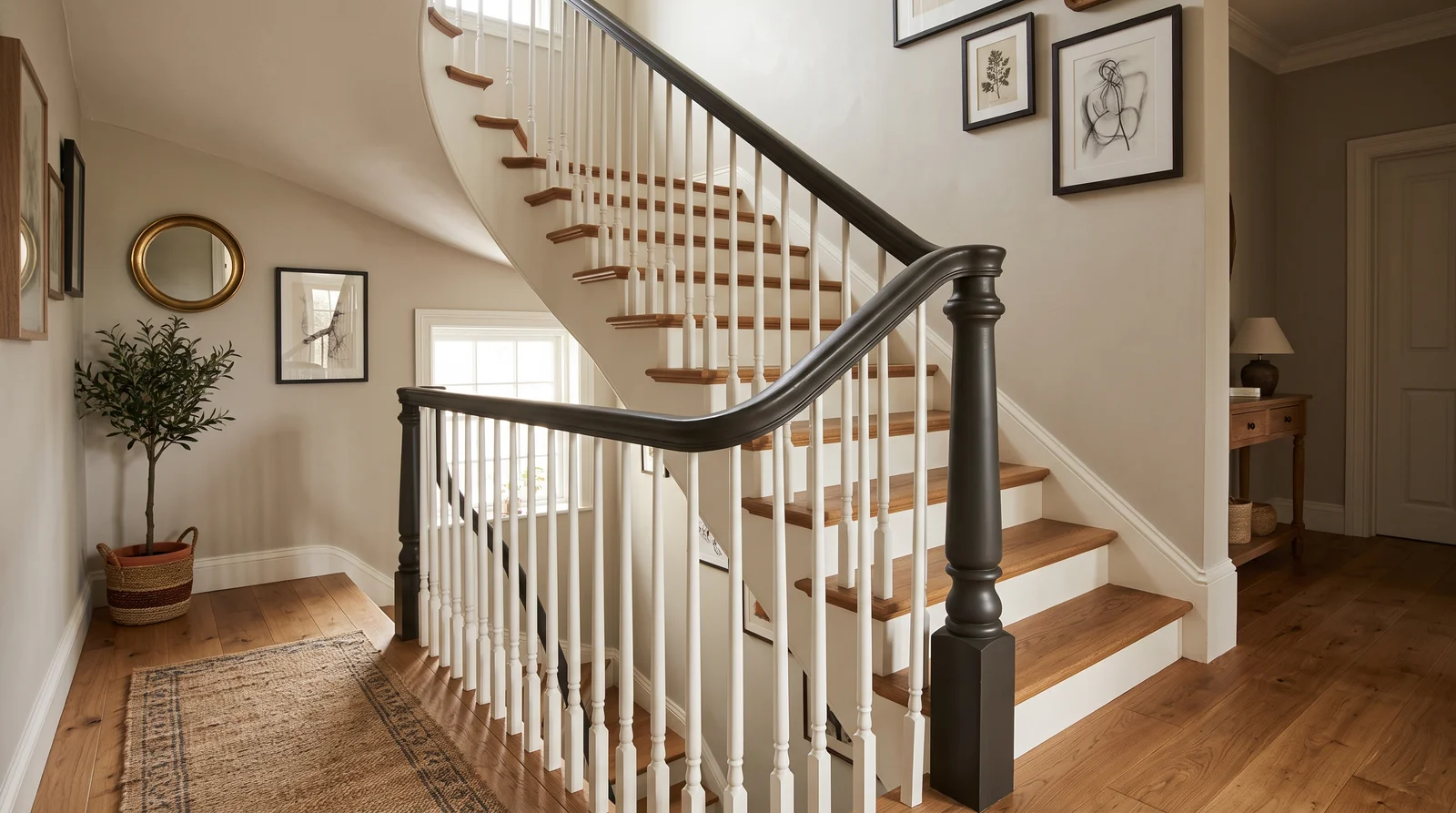
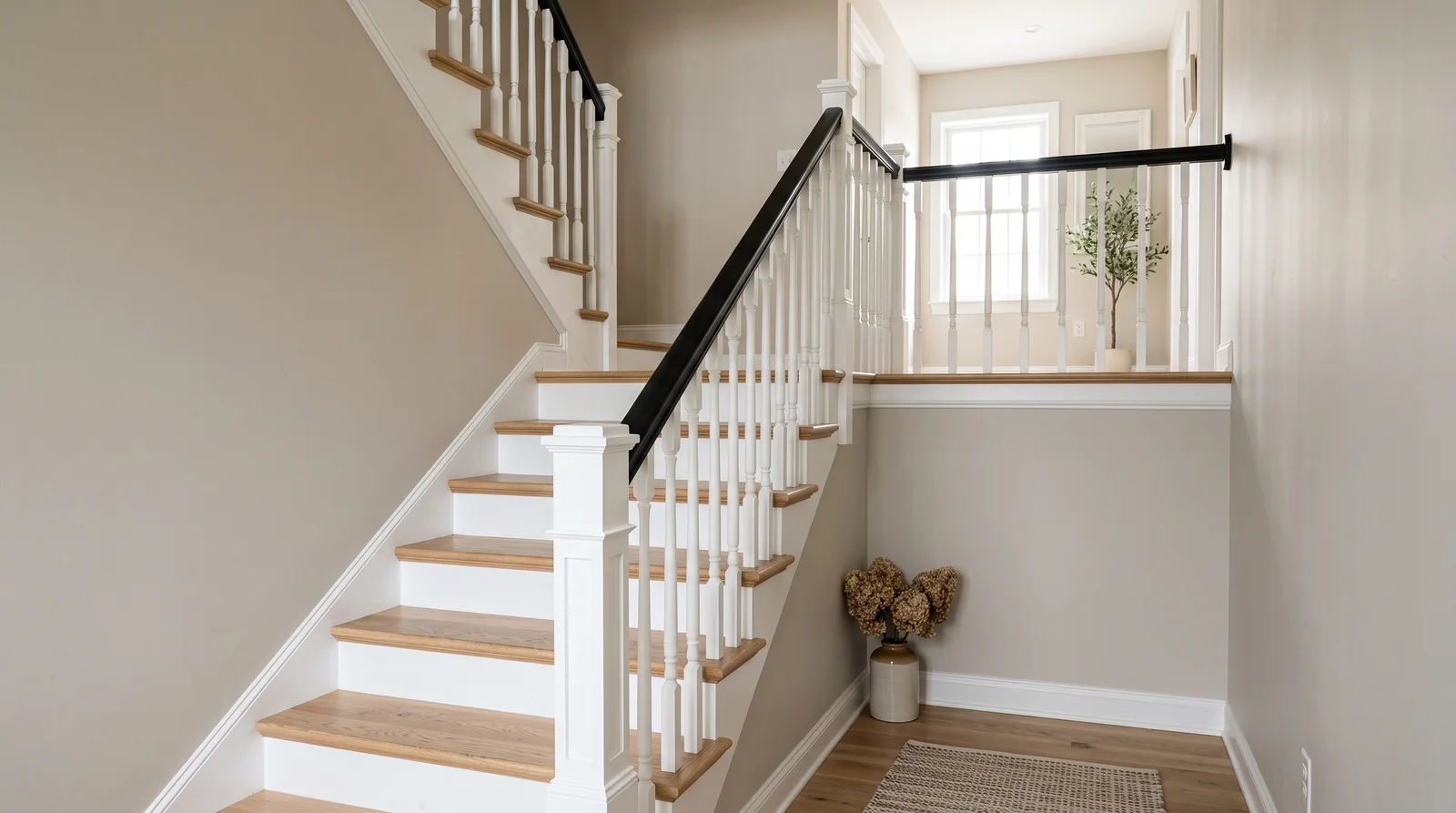
Black Rail Classic — staircase painted in Agreeable Gray
1Agreeable GraySherwin-Williams · Black Rail Classic

A calm greige stairway with a crisp black handrail — quiet walls, one confident line, and it works in almost any light.

Agreeable Gray (SW 7029, LRV 60) is the safest stairway wall there is because it flows into whatever rooms sit at the top and bottom without a jarring shift. The black handrail is what makes it feel finished — Tricorn Black is a true neutral black that reads sharp against warm greige and hides hand marks far better than a white rail ever will. Keep the spindles and risers in Pure White so the black stays one clean line instead of a heavy cage. If your stairway gets strong afternoon sun and the greige pulls beige, step to Repose Gray instead.

Walls · Sherwin-Williams
Handrail · Sherwin-Williams
Risers · Sherwin-Williams
Natural White Oak
Treads
SEE AGREEABLE GRAY ON YOUR WALLS →
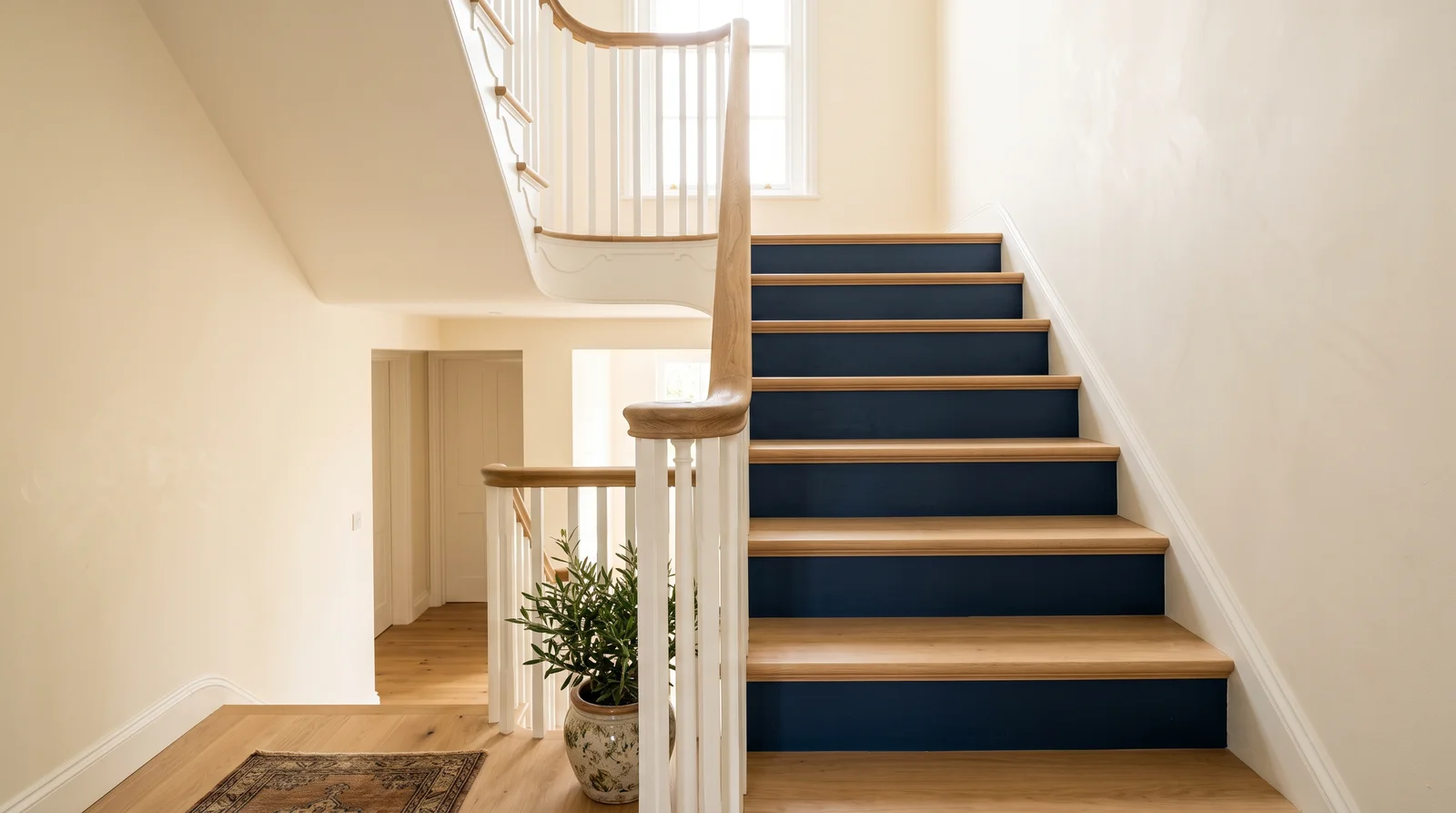
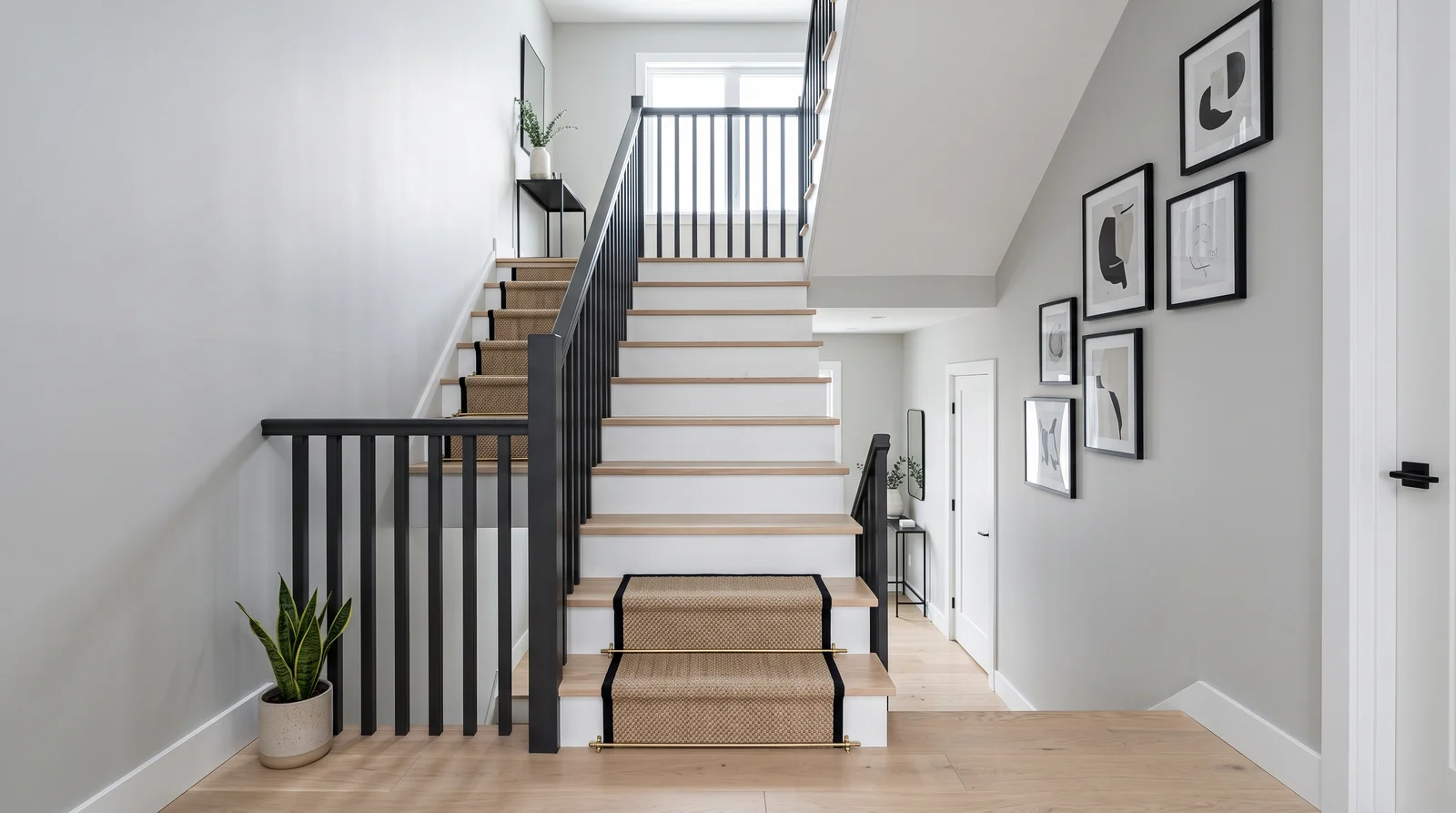
Navy Riser Steps — staircase painted in Alabaster
2AlabasterSherwin-Williams · Navy Riser Steps

Warm white walls with deep navy painted risers — each step draws a quiet stripe of color that feels tailored, not loud, in any daylight.

This is the two-tone stair done right: Alabaster (SW 7008, LRV 82) keeps the whole stairway bright, and Hale Navy (LRV 8) on just the risers gives you the drama without committing a single wall to a dark color. It pairs naturally with wood treads of any tone because navy flatters both red-leaning and pale oak. Risers take shoe scuffs constantly, so use a scrubbable enamel and the dark color will actually hide wear better than white ever did. If Alabaster feels too creamy against cool floor tile, Pure White is the cooler neighbor.

Walls · Sherwin-Williams
Risers · Benjamin Moore
Spindles · Sherwin-Williams
Natural Oak
Treads
SEE ALABASTER ON YOUR WALLS →
Bronze Rail Warmth — staircase painted in Edgecomb Gray
3Edgecomb GrayBenjamin Moore · Bronze Rail Warmth

Soft greige walls with a smoky bronze handrail — warmer and gentler than black, it glows in low evening light instead of disappearing.

Edgecomb Gray (HC-173, LRV 63) is the friendliest greige on a stairway wall — enough warmth to soften a windowless run, never so dark it closes it in. Urbane Bronze (LRV 8) on the handrail and newel gives you the dark-rail look with brown-gray depth, which sits better than pure black next to wood floors and brass hardware. White Dove on trim and risers bridges the two so nothing feels abrupt. If your hallway already runs cool gray, swap the walls to Repose Gray and keep the bronze — it still works.

Walls · Benjamin Moore
Handrail · Sherwin-Williams
Risers · Benjamin Moore
Mid-Tone Oak
Treads
SEE EDGECOMB GRAY ON YOUR WALLS →
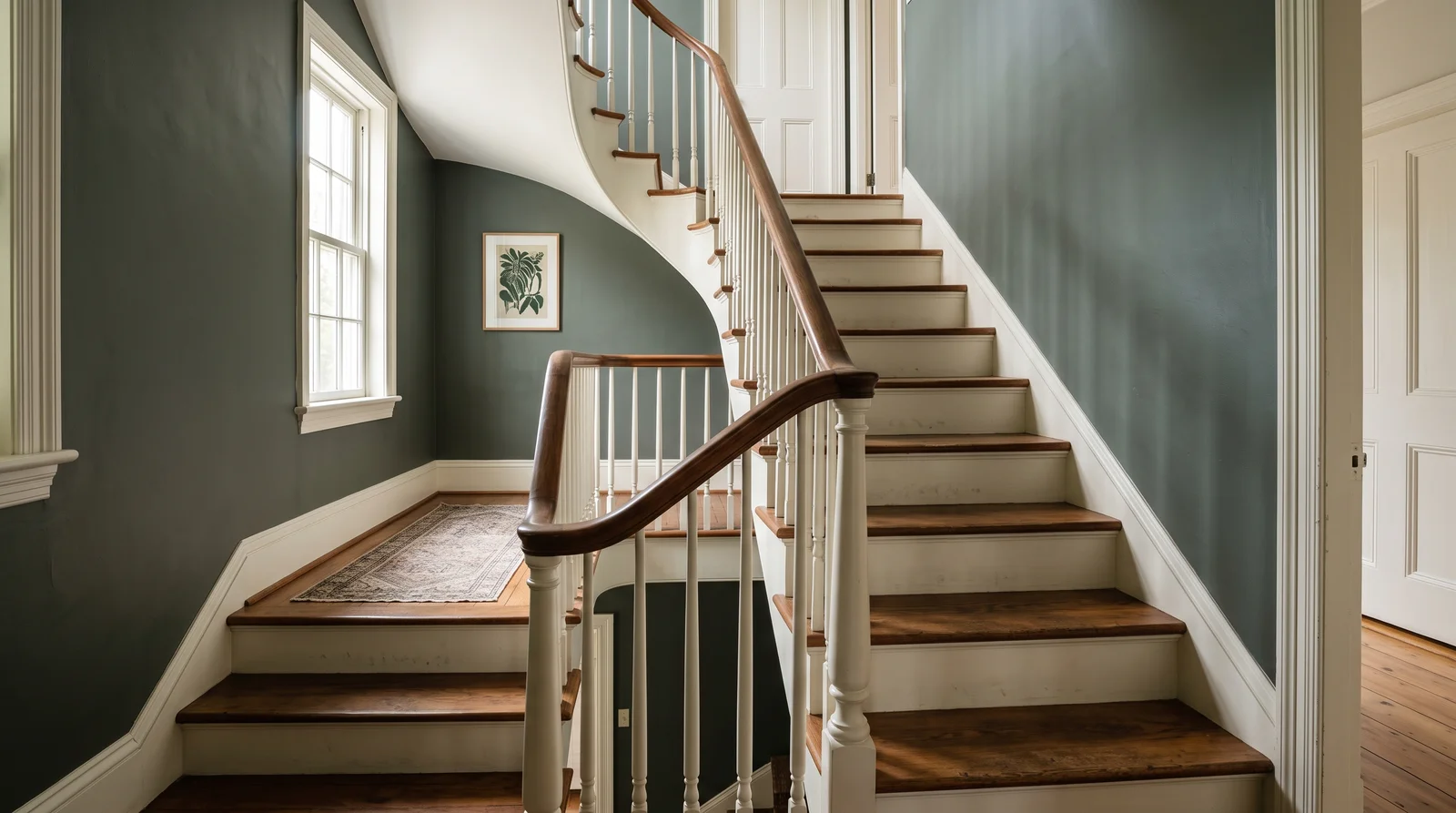
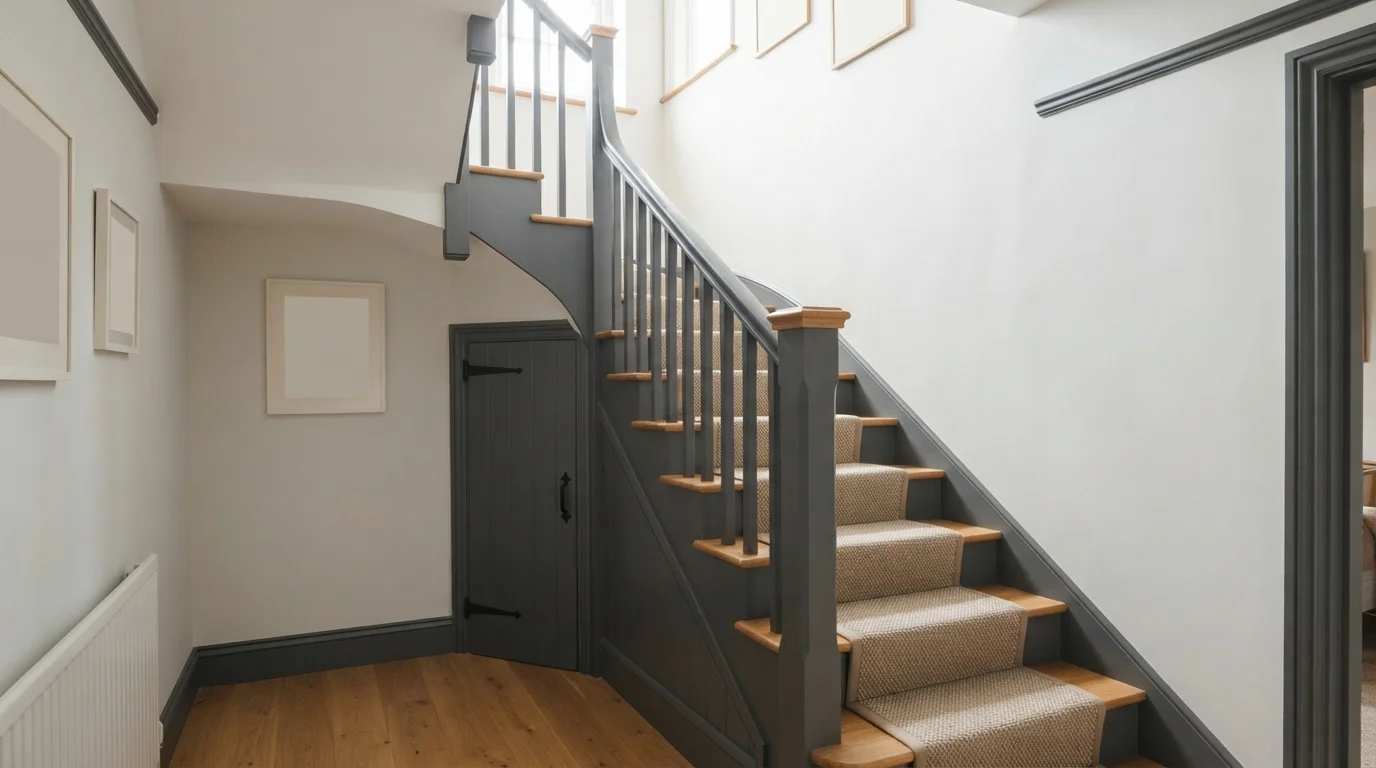
Pewter Green Statement — staircase painted in Pewter Green
4Pewter GreenSherwin-Williams · Pewter Green Statement

One deep gray-green stairwell wall that turns the climb into the best moment of the house — made for stairways that get real daylight.

Pewter Green (SW 6208, LRV 12) is the statement-stairwell color: a muted, earthy green that feels grown-up where brighter greens feel like a nursery. At LRV 12 it needs decent light from above or beside — in a dark enclosed stairwell it will read almost charcoal, which is only a problem if you were expecting green. Alabaster on the spindles, trim, and remaining walls keeps the green feeling deliberate instead of heavy, and warm wood treads stop the scheme going cold. Color-drenching the whole stairwell in it is the bolder 2026 move if your light can carry it.

Walls · Sherwin-Williams
Trim & Spindles · Sherwin-Williams
Warm Walnut
Treads
SEE PEWTER GREEN ON YOUR WALLS →
Iron and Mist — staircase painted in Repose Gray
5Repose GraySherwin-Williams · Iron and Mist

Cool pale gray walls with soft-black iron-tone spindles — a quiet, modern stairway that stays crisp in north light where warm greige goes muddy.

Repose Gray (SW 7015, LRV 58) is the cooler flow color — pick it over Agreeable Gray when your floors are cool-toned or the stairway faces north, because warm greige can turn muddy in blue light while Repose stays clean. Iron Ore on the spindles and handrail reads as soft black: all the definition of Tricorn Black with less harshness up close, and it forgives dust better than a true black. Chantilly Lace on risers and trim is the crispest white in this lineup, which suits the scheme's cooler temperature. This is the pairing for homes that lean modern rather than farmhouse.

Walls · Sherwin-Williams
Spindles & Handrail · Sherwin-Williams
Risers · Benjamin Moore
Light Ash Wood
Treads
SEE REPOSE GRAY ON YOUR WALLS →
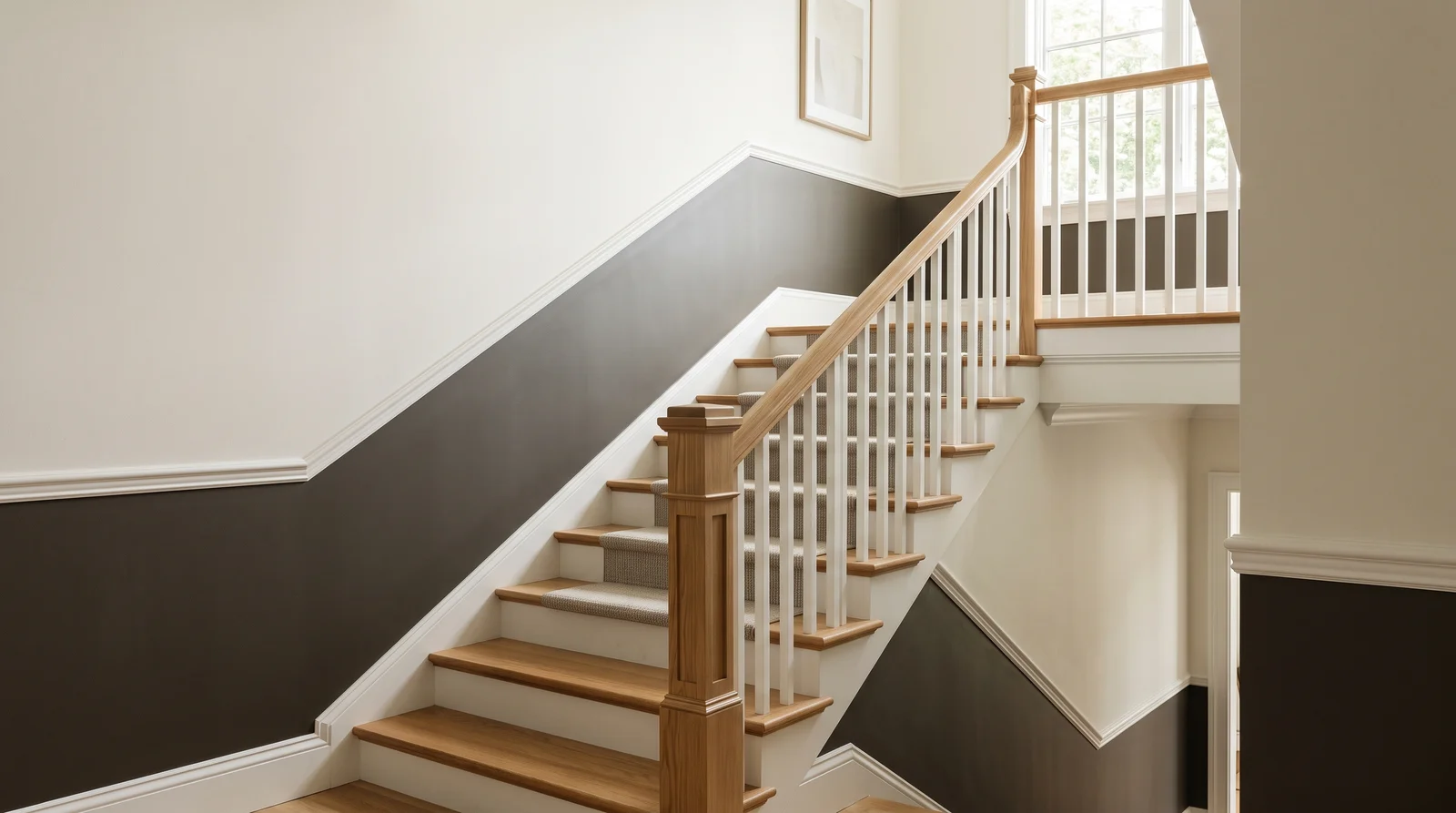
Pale Oak Two-Tone — staircase painted in Pale Oak
6Pale OakBenjamin Moore · Pale Oak Two-Tone

Luminous warm-white walls above a deep bronze lower wall — the two-tone split that protects the scuff zone and makes a plain stairway feel designed.

A stairway wall takes more knocks than any other wall in the house, and this split puts the dark, forgiving color exactly where the bags and shoulders hit. Pale Oak (OC-20, LRV 69) above keeps the whole run light and multiplies whatever daylight you have; Urbane Bronze below at rail height hides scuffs and gives the wall real architecture without any added trim. White Dove ties the handrail area together. Run the dividing line level with the handrail, not stepped with the stairs — it reads calmer. If bronze feels too heavy for your light, Pewter Green makes a greener lower band with the same practicality.

Walls · Benjamin Moore
Lower Wall · Sherwin-Williams
Trim · Benjamin Moore
Natural Oak
Treads
SEE PALE OAK ON YOUR WALLS →

Staircase Wall Color Combinations

A wall color never works alone. These are the full schemes from the rooms above — the lead color first, then the supporting colors that make the photo work.

Black Rail Classic
WallsAgreeable GrayHandrailTricorn BlackRisersPure White
Walls
Agreeable Gray · Sherwin-Williams · LRV 60
Handrail
Tricorn Black · Sherwin-Williams · LRV 3
Risers
Pure White · Sherwin-Williams · LRV 84

A calm greige stairway with a crisp black handrail — quiet walls, one confident line, and it works in almost any light.

TRY THIS PALETTE →
Navy Riser Steps
WallsAlabasterRisersHale NavySpindlesPure White
Walls
Alabaster · Sherwin-Williams · LRV 82
Risers
Hale Navy · Benjamin Moore · LRV 7
Spindles
Pure White · Sherwin-Williams · LRV 84

Warm white walls with deep navy painted risers — each step draws a quiet stripe of color that feels tailored, not loud, in any daylight.

TRY THIS PALETTE →
Bronze Rail Warmth
WallsEdgecomb GrayHandrailUrbane BronzeRisersWhite Dove
Walls
Edgecomb Gray · Benjamin Moore · LRV 65
Handrail
Urbane Bronze · Sherwin-Williams · LRV 8
Risers
White Dove · Benjamin Moore · LRV 85

Soft greige walls with a smoky bronze handrail — warmer and gentler than black, it glows in low evening light instead of disappearing.

TRY THIS PALETTE →
Pewter Green Statement
WallsPewter GreenTrim & SpindlesAlabasterTreadsWarm Walnut
Walls
Pewter Green · Sherwin-Williams · LRV 12
Trim & Spindles
Alabaster · Sherwin-Williams · LRV 82
Treads
Warm Walnut · · LRV 15

One deep gray-green stairwell wall that turns the climb into the best moment of the house — made for stairways that get real daylight.

TRY THIS PALETTE →

Staircase Color Ideas by Color

Set on a color family already? Each page has its own real rooms and picks.

Light or Dark Staircase Colors?

Go Light (LRV 60+) If…

The room is small, faces north, or has to work at every hour. Light warm colors make it feel bigger and stay calm in evening light — the light you actually live in.

Go Dark (LRV Under 20) If…

You want the cocoon effect and the room has real daylight. Dark works best on one feature wall — or fully color-drenched in a large room with good windows.

VISUALIZE YOUR SPACE

See It. Love It.
Paint It.

Upload one photo of your staircase and try every color on this page on your own walls — in your own light, before you buy a drop of paint.

Drag the slider to compare
staircase before paintingstaircase painted in Agreeable GrayAgreeable GrayBefore

About Staircase Paint Colors

A stairway is the one room that never gets to be its own thing. It touches the entry below and the hallway above, so its wall color has to agree with both rather than make its own statement. That is why stairway walls almost always land in the same light, flowing neutral that runs through the rest of the house, and the personality moves to the parts you actually touch: the handrail, the spindles, the risers.

The honest picks here split into two jobs. For the long run of wall, a light flowing neutral like Agreeable Gray, Repose Gray, Pale Oak, or Alabaster carries the color from room to room without a stopping line. For the rail and risers, a soft black like Tricorn Black or Iron Ore, a painted navy riser in Hale Navy, or a deeper statement wall like Pewter Green turns a builder-grade staircase into something worth photographing. Every one of these is mixed to order at the counter, so the exact shade cross-matches between brands if your painter or store stocks something different.

Below we cover the two-job color split, how stairwell light (usually dim) should steer the neutral, the right finish for walls versus rails and risers, how LRV keeps a windowless stairwell from feeling like a shaft, and the mistakes that show up most in stairways specifically.

The Best Color Directions For A Stairway

Start with the wall neutral, because it has to work with two other rooms, not just the stairs. Agreeable Gray is the safest flow color in the country for a reason: warm enough not to read cold, light enough to carry a dim stairwell, and it matches almost any trim white. Repose Gray does the same job with a cooler cast for houses already leaning gray. Pale Oak and Alabaster push warmer and brighter, which helps stairwells with little or no window.

Once the wall is settled, spend the real design energy on the handrail and risers. Tricorn Black on a handrail is the highest-impact gallon in most houses — it turns a plain rail into a piece of trim work. Iron Ore does the same in a softer near-black. Hale Navy painted risers under oak treads reads custom-built for almost no material cost. Pewter Green earns its keep as a full statement wall on a two-story stairwell drop, where a single flight of wall can carry more saturation than a normal room ever could.

Let The Room's Light Pick The Color

Most stairwells are light-starved by design — there is often one small window at a landing, if that, and the rest of the run is lit by whatever spills in from the rooms it connects. That makes LRV, not window direction, the first thing to check here. A high-LRV pick like Alabaster (LRV 82) or Pale Oak (LRV 69) does real work bouncing what little light exists up and down the stairs.

If your stairwell does get a skylight or a tall window at the top, you have more room to go moodier — Repose Gray's cooler cast will not go flat the way it might in a true windowless hall. Always test your neutral on the actual stair wall, not just the entry or the hallway, since a two-story run often gets shadowed differently at the bottom than at the top.

The Right Finish For Walls, Risers, And Handrails

The wall itself follows whatever the connecting hallway and entry use — typically eggshell, since stairwell walls get bumped by furniture moves and the occasional shoulder brushing past. Flat is too fragile for a surface this trafficked and this hard to touch up without a ladder.

Risers and handrails are a different story entirely. They take constant toe scuffs, hand oils, and daily contact, so they need a true enamel, not wall paint: something like BM Advance, SW Emerald Urethane, or Behr Urethane Alkyd. These level out smooth and survive scrubbing in a way eggshell never will. If you are painting spindles in Iron Ore or a rail in Tricorn Black, budget for the enamel — it is the difference between a rail that looks crisp in year three and one that is already chipping.

Using LRV To Keep A Stairwell From Feeling Dark

LRV (Light Reflectance Value) runs 0 to 100 and measures how much light a color bounces back, and it matters more in a stairwell than almost anywhere else in the house because stairwells so often lack their own light source. Alabaster sits at LRV 82, Pale Oak at 69, Agreeable Gray at 60, and Repose Gray at 58 — all safely in the range that keeps a dim stair run feeling open rather than tunnel-like.

The accent colors go the other direction on purpose. Tricorn Black is LRV 3, Iron Ore is 6, Hale Navy is 8, and Pewter Green is 12 — all deliberately low, because they are meant for a rail, a set of risers, or one statement wall, not the whole run. Keep the low-LRV colors confined to trim and accents unless your stairwell gets genuinely strong light from a skylight or tall window.

Pairing The Handrail, Risers, And Gallery Wall

The wall neutral and the rail color should read as a set, not a coincidence. A warm neutral like Pale Oak pairs naturally with a warmer near-black like Iron Ore or an Urbane Bronze rail against oak treads; a cooler Repose Gray or Agreeable Gray wall sits better with true Tricorn Black hardware and nickel or chrome fixtures.

Stairwells are also the classic gallery-wall location, and a bright neutral like Alabaster is the reason: it lets framed photos going up the wall stay the focus instead of competing with a busy wall color. If you are painting risers a color like Hale Navy, keep the treads themselves in a natural wood or a matching stain so the eye reads it as one designed staircase, not a patchwork of separate decisions.

Common Stairway Painting Mistakes

The most common mistake is treating the stairway as its own design project and picking a wall color that clashes with the entry or hallway it connects to. A stopping line mid-flight always looks like an afterthought, so pick one flowing neutral and run it through all three spaces.

The second mistake is painting the handrail or risers in regular wall paint instead of an enamel — it looks fine on day one and starts chipping within months under real hand and foot contact. People also go too dark on the main stair wall in a room with no window of its own, turning a two-story connector into a shaft. Keep the walls light, put the color in the rail and risers, and use a real enamel where hands and feet actually touch.

The Questions Everyone Asks

What color should I paint my staircase?

If you want one answer, start with the safe picks above — Alabaster, Iron Ore, Agreeable Gray, Pale Oak. They read well in any light and survive furniture changes. Then check the light: strong afternoon sun wants a step cooler, a north-facing room wants a step warmer.

What color should I paint a stairway?

The same light flowing neutral used in the connecting hallway and entry — Agreeable Gray, Repose Gray, Pale Oak, or Alabaster are the most reliable choices. Stairwells rarely have their own light source, so a high-LRV neutral keeps the run bright. Save real color for the handrail, spindles, or risers instead of the walls.

Should the stairway match the hallway color?

Yes, in almost every case. The stairway wall is visually continuous with the hall above and the entry below, and a color change partway up needs an awkward stopping point. Run one neutral through all three spaces and put contrast in the handrail or risers instead.

What color should I paint a stair handrail?

A soft black is the current default — Tricorn Black for true black, Iron Ore for a gentler near-black — against white spindles and wood treads. Whatever you pick, it needs to be a real enamel like BM Advance or SW Emerald Urethane, not standard wall paint, since rails take hands all day.

Can I paint stair risers a different color from the wall?

Yes, and it is one of the best-value updates in a house. A painted riser color like Hale Navy under natural wood treads reads custom-built for the cost of a small can of enamel. Keep the treads and rail in a complementary tone so the staircase reads as one finished design.

How do I keep a windowless stairwell from feeling dark?

Pick a high-LRV wall neutral — Alabaster (LRV 82) or Pale Oak (LRV 69) work harder than a mid-tone gray in a light-starved stairwell. Keep any darker accent colors confined to the handrail, spindles, or a single statement wall rather than the full run of wall.

What sheen should I use on stairway walls versus the rail?

Eggshell on the walls, matching whatever finish the connecting hallway uses. The handrail and risers need a harder enamel finish — semi-gloss or a true urethane like BM Advance — because they take constant hand contact and toe scuffs that eggshell wall paint cannot survive long-term.

What two-color combination works best in a staircase?

The reliable pattern is a quiet main color plus one deep accent on a single wall. Keep trim and ceiling in one warm white so the two colors are the only event in the room — the combination cards above show complete schemes from real rooms.

What colors make a staircase look bigger?

High-LRV, slightly warm colors — LRV 60–75 is the sweet spot. Paint the walls and trim close to the same light color so the corners blur, and keep the ceiling white. Stark cool white actually works against you; it creates hard shadows that show the room's edges.

Ask a Question

Jessica Williams

Not sure what's right for your staircase?

Ask Jessica below — every question gets a real reply, usually within a day.