Seapearl
The most argued-over off-white in the Benjamin Moore deck, reviewed honestly: the rooms where it glows, the rooms where it goes drab, and what to pick instead.

Jessica has spec'd whites and neutrals for more than 300 rooms and keeps a sample wall of painted drawdowns in her studio. Every color review is checked against real reader rooms in the comments and re-tested when a formula changes. About the testing process →
- 1Heirloom Shade63
- 2First Star69
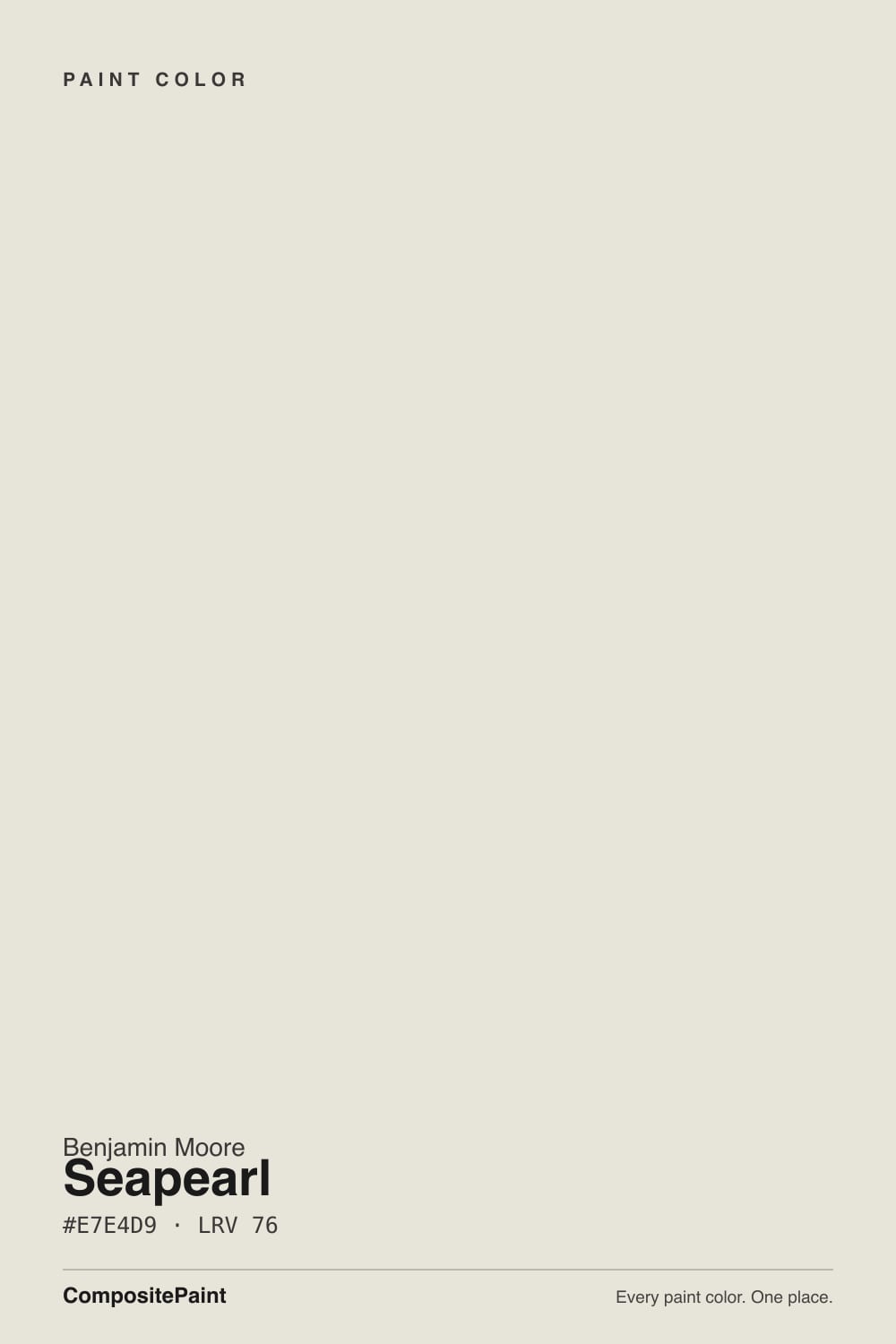
- 3Seapearl76
- 4Alabaster82
- 5Chantilly Lace91
The Fast Verdict
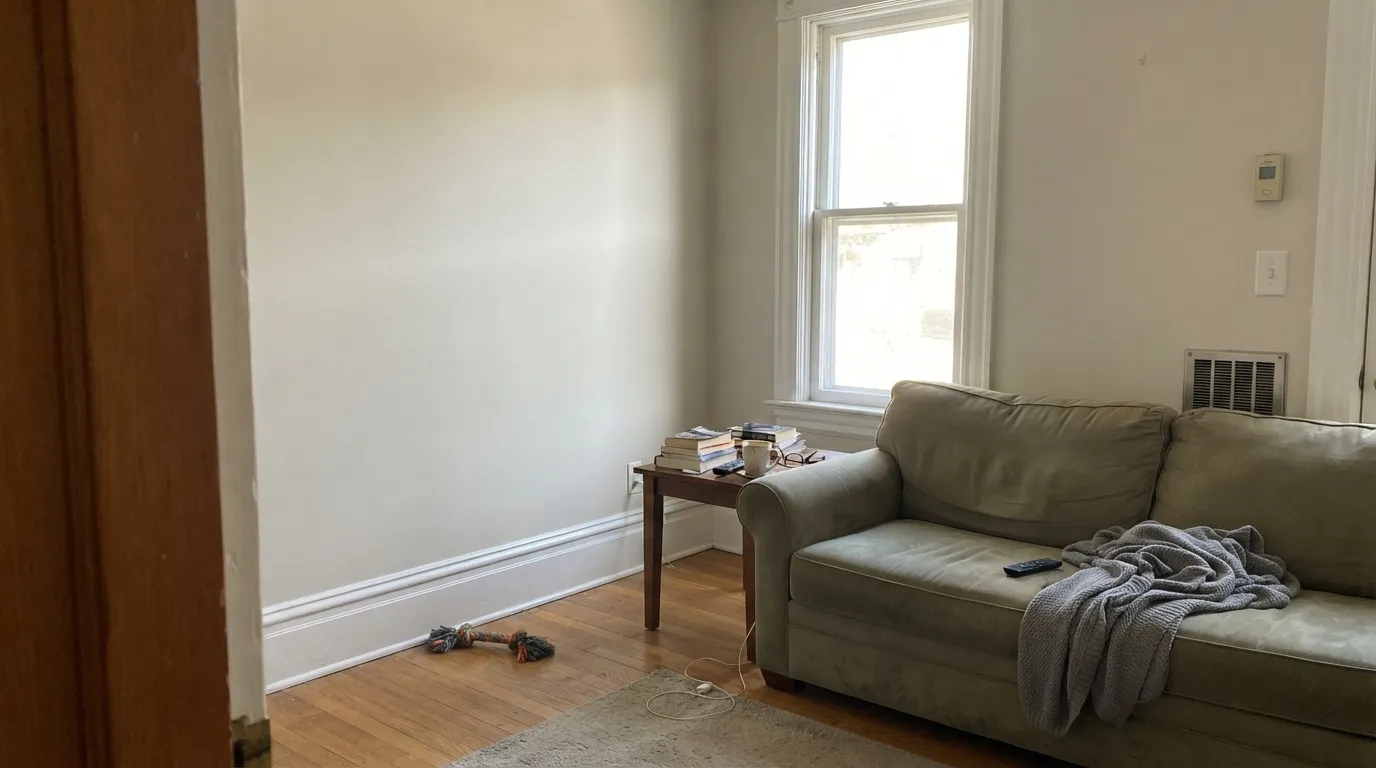
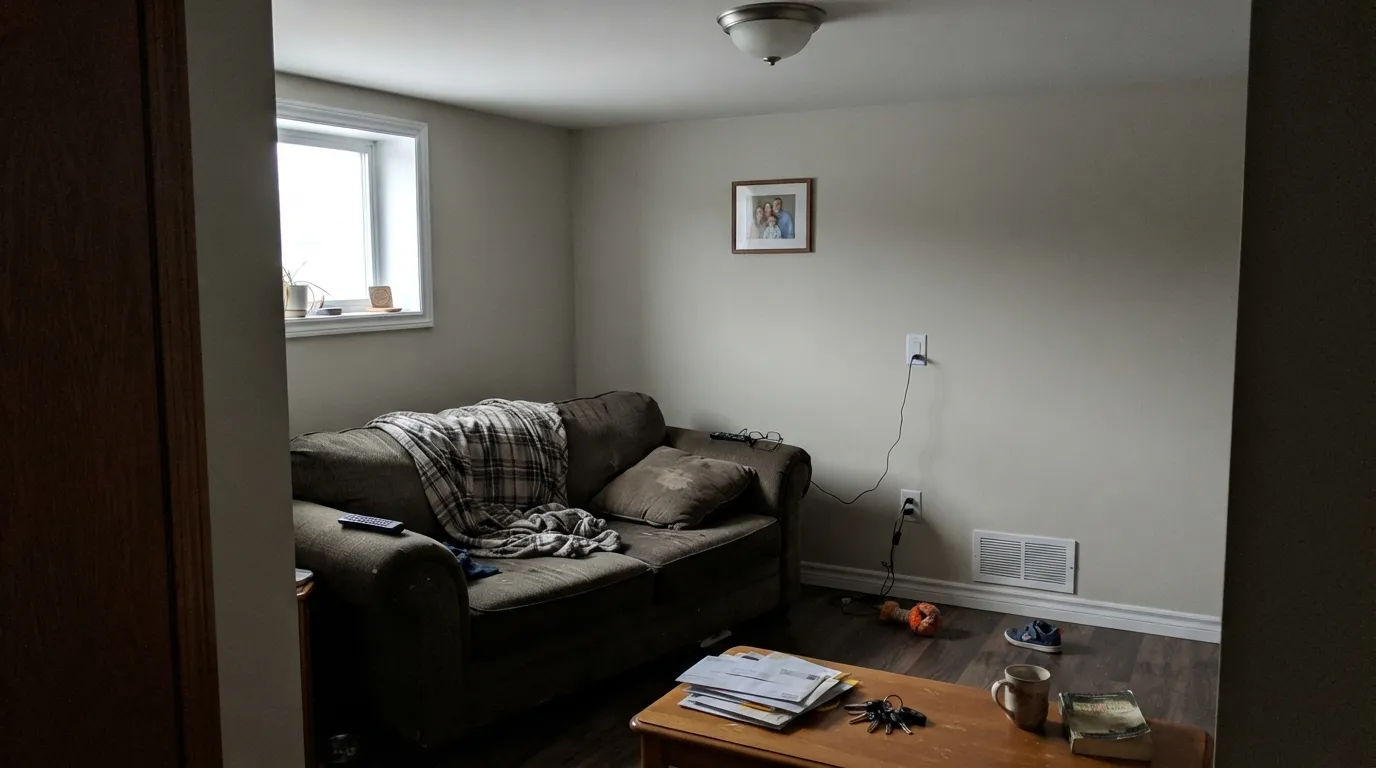
Seapearl is a warm off-white with real body — softer and more grounded than a bright white, lighter and cleaner than a greige. Its strength is also its problem: there is not much color in it, so the room decides what it becomes. In good daylight it is a calm, expensive-looking soft white that flatters old millwork and warm wood. In a dim north room, or under a bright builder-white ceiling, the warmth drains out and it reads flat and slightly dirty.
Older houses with wood floors and heavy millwork · south and west rooms with real daylight · exteriors with dark shutters · walls and trim painted the same color
Your room is dim and faces north · your ceiling stays builder-white · you already have cream cabinets or cream tile · you want one white for every room in the house
- Warm without ever tipping butter-yellow
- Enough body to look right against original wood and plaster
- Walls and trim in one color works beautifully
- Hides scuffs and wall flaws better than a bright white
- Excellent exterior body color with dark shutters
- Goes flat and gray in dim north rooms and dark hallways
- Looks tan and dirty under a bright builder-white ceiling
- Fights cream cabinets, cream tile, and cream-glazed finishes
- Shifts noticeably room to room, so whole-house use is a gamble
What Color Is Seapearl, Really?
Seapearl is a warm off-white, and it is the color paint people argue about most. Benjamin Moore's own chip description leans gray. Color consultants who put it on walls describe a soft warm greige with a faint green-gray edge. Both camps are right, and that is the honest answer: the hue sits at 47 degrees, squarely in cream territory, but the saturation is only about 23 percent. There is not enough color in the can to hold one identity, so the room takes over — the floor, the ceiling, the bulbs, and which way the windows face.
At LRV 76 it reflects plenty of light, but it is clearly not a bright white. Put it beside White Dove (LRV 83) and Seapearl shows its body immediately: White Dove still reads as a white, Seapearl reads as a very light warm neutral. That extra depth is the reason people like it on walls in old houses, where a bright white looks wrong against original wood, and the reason it disappoints anyone who expected a crisp white and got a soft one.
Undertone in one line: warm yellow, muted by gray, with a whisper of green — never blue. If it looks pink or peachy in your room, that is 2700K bulbs pushing the warmth; if it looks drab and gray, that is cool north daylight taking the warmth away.
Where It Shines
Give it real daylight, warm wood, and a room that is not competing with a stark white, and Seapearl is quietly excellent. It is at its best in older houses — walls and trim in the same color, a couple of sheen changes, and the millwork stops shouting. Outside, in full sun with dark shutters, it is one of the better warm body colors Benjamin Moore makes.
Where It Fails
Almost every bad Seapearl story comes down to three situations, and all three are predictable before you open the can. If your room matches one of them, no second coat is going to fix it.
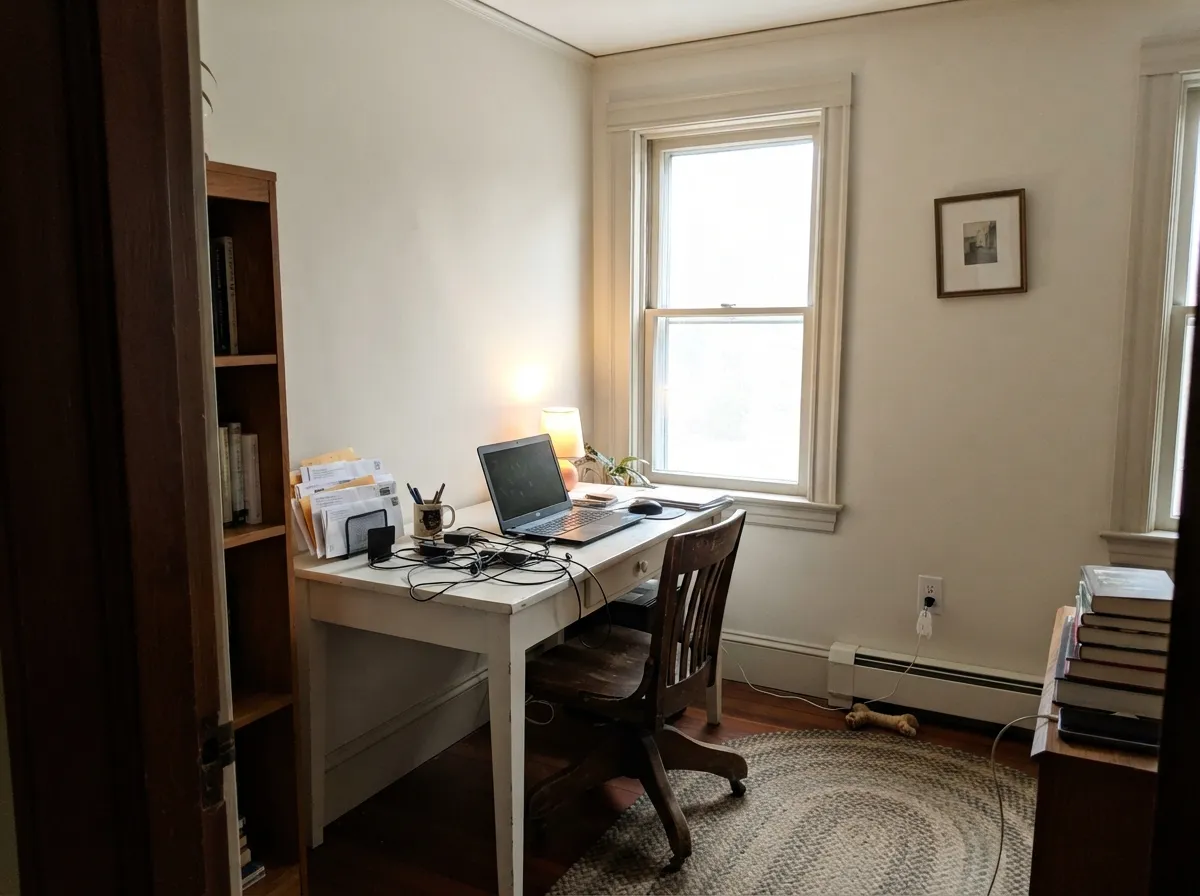
North light is cool and flat, and there is not enough warmth in Seapearl to survive it. The yellow drops away, the gray base takes over, and the walls read drab — people describe it as dull or slightly dirty. Go creamier with Benjamin Moore Swiss Coffee OC-45, which keeps glowing in the same light.
This is the most common pairing mistake. A flat contractor white overhead is far cleaner than LRV 76, so the ceiling wins and the walls look tan and unwashed. Either paint the ceiling Seapearl at 50 percent strength, or use a real trim white with intent — Benjamin Moore Chantilly Lace OC-65 gives crisp contrast instead of an accident.
Because it has so little chroma, Seapearl does not stay the same from room to room. The south living room goes buttery in the afternoon while the interior hallway goes gray and drab, and the two rooms look like different colors. If you need one white that behaves everywhere, Benjamin Moore White Dove OC-17 holds its character far better.
Room by Room
In a south or west room it settles into a soft, warm backdrop that makes oak, walnut, and leather look intentional. Eggshell on walls. Pair with Benjamin Moore Chantilly Lace OC-65 trim if you want edges, or the same color on trim if you want calm.
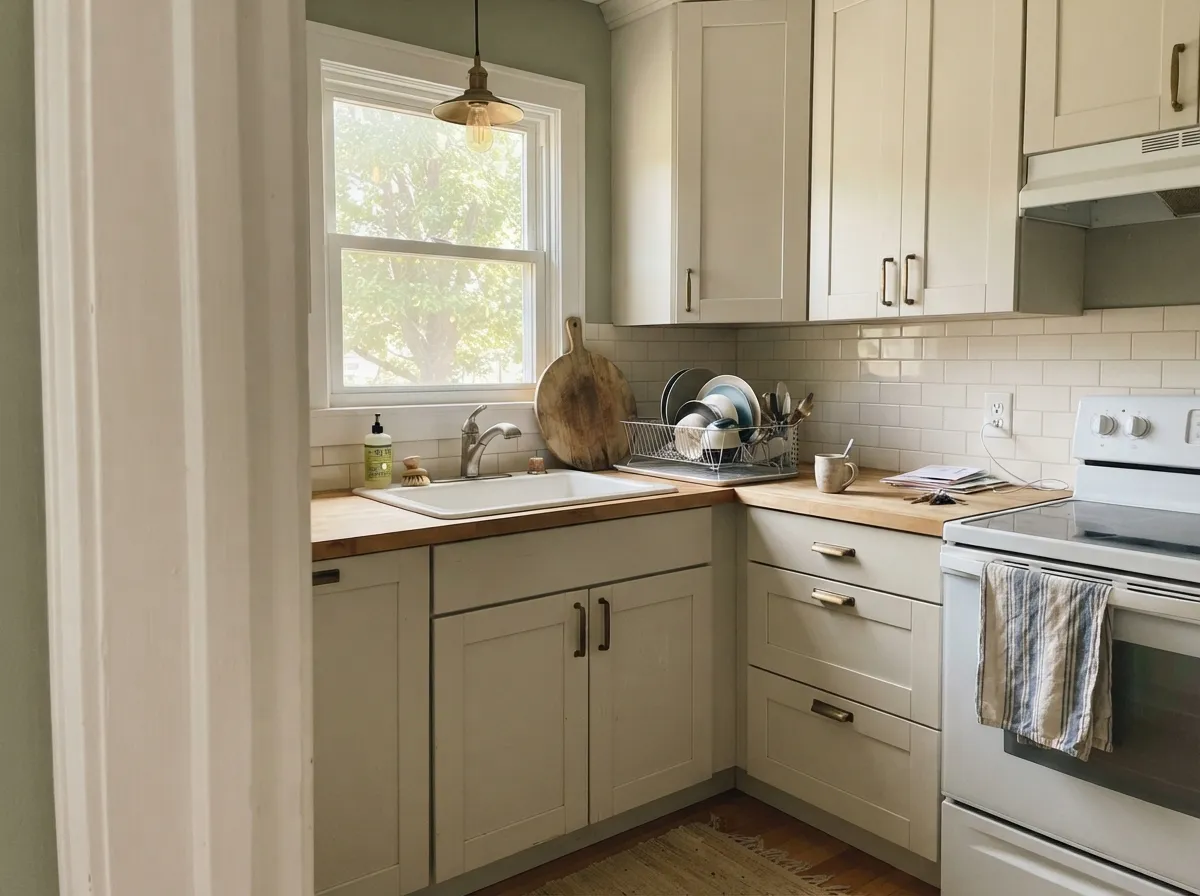
On cabinets it reads settled and custom rather than builder-grade, and satin wipes clean around handles. The deal-breaker is existing cream: cream tile, cream backsplash, or cream-glazed cabinetry turn Seapearl gray and sullen. Against warm quartz and brass it is lovely.
2700K bulbs push it creamy and slightly peachy at night, which most people read as cozy. If the bedroom faces north and gets little sun, it will look flat by day — step up to Benjamin Moore Swiss Coffee OC-45 instead.
In an old house with deep baseboards and casings, painting walls and trim both Seapearl and changing only the sheen is the move. Semi-gloss trim, eggshell walls. It looks like the woodwork was always meant to be painted, where a modern bright white looks bolted on.
Interior halls usually have borrowed light and no windows, and that is exactly where Seapearl goes gray and lifeless. If the hall is dark, either add warm lamps or run something with more color, like Benjamin Moore Manchester Tan HC-81.
Full sun evens the undertone out and the warmth stops it from glaring the way cheap whites do. With Benjamin Moore Kendall Charcoal HC-166 shutters it is a classic on older homes. Full pairings in the exterior section below.
Your Light Is the Risk
The warmth comes fully forward and the walls glow soft cream all afternoon.
Cool daylight strips the yellow and leaves the gray base. Sample before you commit.
Creamy at the sun hours, quiet and gray-ish after. Expect two different walls a day.
2700K reads creamy, sometimes faintly peachy. 3000–3500K holds it closest to neutral.
Most complaints about Seapearl are a light mismatch. Upload a photo of your actual room and see it on your walls — then ask for the same wall in north light or evening lamps before you buy a single sample.
Need It From Another Brand?
Any paint counter can custom-tint Benjamin Moore 961 directly. If you would rather stay in one brand's own deck, these are the closest stock matches, measured as ΔE2000. Under 2 is a difference you will not see on the wall.
| Brand | Closest color | ΔE | LRV | |
|---|---|---|---|---|
| Sherwin-Williams | Pearly WhiteSW 7009 · Sherwin-Williams | 1.2 | 77 | Color page → |
| Behr | White PepperPPU24-13 · Behr | 0.9 | 77 | Color page → |
| Valspar | Divine Cream7006-8 · Valspar | 1.2 | 77.1 | Color page → |
| PPG / Glidden | Oyster WhitePPG10-05 · PPG / Glidden | 0.5 | 78 | Color page → |
| Glidden | Oyster WhitePPG10-05 · Glidden | 0.5 | 78 | Color page → |
| Dutch Boy | Antiquated Lace017W · Dutch Boy | 1.5 | 79 | Color page → |
Similar Benjamin Moore Colors
The nearest shades to Seapearl within Benjamin Moore's own range, ranked by perceptual color distance — useful when you want the same look a touch lighter, darker, or warmer.
WCAG 2.1: AA is 4.5 : 1 for normal text, 3 : 1 for large text, AAA is 7 : 1.
Seapearl vs the Colors You're Also Considering
Every Seapearl sample board has the same rivals on it. The numbers show the real lightness gap — then it comes down to which risk you would rather live with.
Pick this for more body and a softer, older-house feel.
Benjamin Moore OC-17 · LRV 85White DovePick this for a lighter, steadier white that behaves in every room.
Pick this when real cream would read too sweet and yellow.
Benjamin Moore OC-45 · LRV 84Swiss CoffeePick this for dim north rooms, where the extra cream keeps glowing.
Inside the brand the nearest chips are effectively the same paint. China White OC-141 and Seapearl OC-19 both share Seapearl's hex #E7E4D9 and LRV 76. China White PM-20 sits at the same hex with LRV 78. Soft Chamois 969 and OC-13, hex #E8E5D8, are a shade brighter and slightly warmer, and Cascade Mountains 862 at #E5E6DC is a touch cooler and greener. None of these will look different across a room; the choice is about which deck you are ordering from.
Across brands the matches are unusually tight. Dunn-Edwards Watermist DE6240 has a deltaE of 0.22 and PPG Oyster White PPG10-05 is 0.45, so both are the same color for practical purposes. Kompozit White Fence 0027 at 0.5, Behr White Pepper PPU24-13 at 0.89 and Magnolia Home Shiplap JG-22 at 1.14 are all visually identical in normal room light, as are Sherwin-Williams Pearly White SW 7009 at 1.22 and Farrow and Ball Farrow's White No. 9812 at 1.37. Clare On Point at 2.55 is very close but worth sampling first, since it drops some of the yellow.
Seapearl Coordinating Colors
Seapearl needs partners with a clear point of view, because it does not have one of its own. Warm greiges and tans sit under it comfortably, deep navies and charcoals give it the contrast it cannot generate, and one muted green keeps the scheme from feeling flat. What it does not want is anything cream, and anything icy blue-gray — the first makes it look dirty, the second makes it look yellow.
These are the partners that keep showing up in rooms where Seapearl actually looks good:
Seapearl on Cabinets and Millwork
Cabinets are where Seapearl either looks expensive or looks like a mistake, and the deciding factor is not the paint. It is everything else in the room that is already almost-white. Cream tile, cream grout, an old cream-glazed island, a bone-colored farmhouse sink — put any of those beside Seapearl and the cabinets go gray and sullen. With warm quartz, butcher block, unlacquered brass, or matte black, the same doors read soft and custom.
The upside on cabinetry is real: at LRV 76 it forgives more than a bright white does. Knuckle marks around handles, small dings on a door edge, and the slight yellowing every painted cabinet gets over a few years all disappear into it. Use a satin urethane-fortified enamel and give it a proper cure week before you hang the doors hard.
On millwork the same logic applies indoors. In a house with heavy original casings, painting the trim Seapearl and the walls Seapearl at two sheens is the quietest, most period-correct thing you can do with an off-white.
Seapearl on Exteriors
Outside is where this color stops being unpredictable. Open daylight is broad and neutral compared to a room with one window, so the undertone stays put and Seapearl holds a steady, warm, slightly weathered white across the whole facade. It is a common pick on older homes for that reason — it looks like a house that has been painted well for a hundred years, not one that was just repainted.
Contrast does all the work. Charcoal or near-black shutters and trim frame it and make it read crisp; a warm bronze or dark green door does the same job with more color. What to avoid is a cool blue-gray accent, which makes the body look yellowed, and pure white trim on a Seapearl body, which reproduces the exact indoor problem at full scale. Walk the sample around the house before you order — the shaded north elevation will always read a step grayer than the sunny side.
Three Ready Palettes Built on Seapearl
A color is never alone on the wall. These are complete combinations in the 60-30-10 pattern, with the reason each one holds together. Every one opens in the visualizer.
Chantilly Lace is clean enough to keep Seapearl from ever looking dirty, which is the failure this color is famous for. The navy door gives the scheme its one dark note so the soft white reads as a choice, not a default.
Try this palette in your roomEdgecomb Gray sits about fifteen LRV points below Seapearl and shares the same warm-gray base, so the wall-to-cabinet step reads soft instead of striped. The charcoal island supplies the weight and loves brass or aged bronze pulls.
Try this palette in your roomOutside, Seapearl covers the 60 percent and full sun keeps its undertone steady, while the charcoal shutters do the framing a stark white body would not need. Wrought Iron on the door is nearly black up close but softer than true black from the curb.
Try this palette in your roomSeapearl FAQ
Is Seapearl warm or cool?
Warm, but only just. The hue is cream at 47 degrees and the saturation is low, so cool north daylight can pull it toward gray and make it look almost cool. In south or west light it is clearly a warm off-white. That swing is why so many people describe it differently.
Seapearl or White Dove — which should I pick?
White Dove at LRV 83 is lighter and behaves the same in almost any room. Seapearl at LRV 76 has more body and looks better against original wood, plaster, and stone. If you want one white for the whole house, White Dove. If you want walls that look a little older and softer in a room with good light, Seapearl.
What trim white goes with Seapearl walls?
Benjamin Moore Chantilly Lace OC-65 is the safe answer — clean enough to make Seapearl look intentional instead of dingy. White Dove OC-17 also works and gives a softer, closer contrast. Skip Swiss Coffee OC-45 as trim, since two creamy whites this close just look like a mistake.
Does Seapearl look green?
Sometimes, faintly. There is a gray-green edge under the warmth, and it shows most in rooms with green from a lawn or trees bouncing through the windows, or against cool tile. It never reads as an actual green wall — it just makes the warmth look muted rather than creamy.
Is Seapearl good for kitchen cabinets?
Yes, with one condition: nothing cream already in the room. Against cream tile or cream-glazed cabinetry Seapearl turns gray and looks dirty. With warm quartz, wood counters, brass, or black hardware it reads custom rather than builder-grade. Use a satin urethane-fortified cabinet enamel.
Will Seapearl look dirty next to my white ceiling?
If the ceiling is standard flat builder white, yes — that is the single most common complaint. Fix it by having the ceiling tinted to Seapearl at 50 percent strength, or by painting it Chantilly Lace OC-65 so the contrast looks deliberate. Leaving a raw contractor white overhead is what makes the walls read tan.
Does Seapearl work on exteriors?
It is arguably better outside than in. Full sun keeps the undertone stable, and the warmth stops the glare you get from bright whites on a big facade. Pair it with Kendall Charcoal HC-166 or Wrought Iron 2124-10 on shutters and trim, and check the shaded north wall before committing — it reads a step grayer there.
Have you painted with Seapearl?
Rate it — one tap helps the next reader decide.
Ask a Question