Baby Fawn
Benjamin Moore's quiet off-white greige, reviewed honestly: the rooms where it warms everything up, the afternoon wall where it flashes pink, and what to buy instead.

Jessica has spec'd whites and neutrals for more than 300 rooms and keeps a sample wall of painted drawdowns in her studio. Every color review is checked against real reader rooms in the comments and re-tested when a formula changes. About the testing process →
- 1Light French Gray53
- 2Accessible Beige58
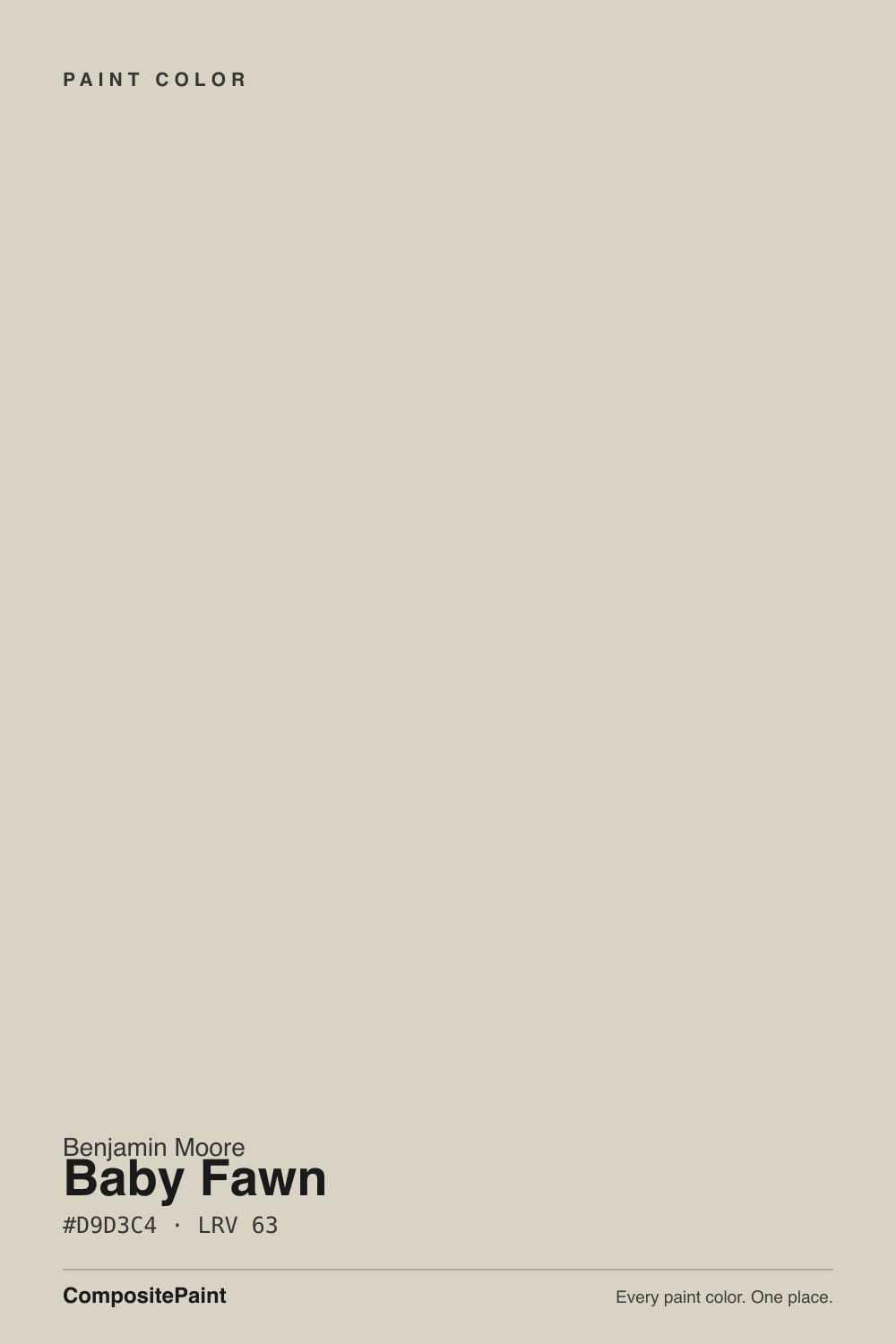
- 3Baby Fawn63
- 4Pale Oak69
- 5Shoji White74
The Fast Verdict
Baby Fawn is the color you pick when white feels bare and beige feels yellow. At LRV 63 it is light enough to keep a room open, warm enough that oak floors and brass stop looking accidental, and quiet enough to run through a whole house without a fight. The honest catch is the warmth: Benjamin Moore themselves describe a slight touch of pink in it, and on a big sunlit wall in the afternoon that pink shows up. It is a very good background color and a bad choice if you wanted crisp.
Whole-house walls in an open plan · rooms with oak, walnut or butcher block · kitchens with brass and stone · anyone who thinks gray walls look cold
Your room faces north and stays dim · your floors are cool gray LVP · you want a clean modern white · your trim is a bright builder white you are keeping
- Warm without reading yellow — the complaint most beiges get
- LRV 63 keeps rooms open but never clinical
- Handles an open plan with three different exposures
- Flatters oak, walnut, brass, stone and leather
- Hides scuffs and handprints better than any bright white
- Can flash pink on a big wall in afternoon sun
- Goes flat and dingy in dim north light
- Looks like dirty white next to bright builder trim
- Effectively identical to Edgecomb Gray HC-173 — easy to sample twice by accident
What Color Is Baby Fawn, Really?
A soft warm greige — gray enough to stay quiet, warm enough that nobody calls it gray. The important detail is which way the warmth leans. Most greiges lean yellow or green; Baby Fawn leans to the red-orange side, and Benjamin Moore's own copy admits to an ever-so-slight touch of pink. In most rooms that pink never surfaces and you just read the wall as soft and comfortable. In strong afternoon light on a wide wall, it can absolutely surface. That one trait explains almost every surprise people have with this color, good and bad.
At LRV 63 it sits in the sweet spot for whole-house walls: it gives light back without turning bright. Stand it next to Revere Pewter HC-172 (LRV 55) and Baby Fawn is clearly the lighter, calmer one — Revere Pewter is the color you choose when you want the walls noticed. Stand it next to White Dove OC-17 (LRV 83) and it stops behaving like a white at all; it becomes a soft tan-gray with real body. Pale Oak OC-20 (LRV 70) is the closest thing to a lighter version of the same idea, though Pale Oak's warmth reads more pink-taupe and less earthy.
Undertone in one line: warm, slightly red-orange, with a whisper of pink that only shows in strong sun — never yellow-green, never cold.
Where It Shines
Give it wood, daylight and warm metals and it does exactly what a background color should do: it disappears and makes everything in front of it look chosen. Open plans are its best job, because one warm neutral has to carry rooms with three different exposures and Baby Fawn is steady enough to manage it.
Where It Fails
The complaints about this color are not random. They come from three predictable situations, and in all three the paint is doing what a warm greige at LRV 63 always does. If your room matches one, another color will save you a repaint.
North light is cool and flat, and it cancels the warmth that makes this color work. What is left is the gray part, and the wall reads drab and slightly dirty instead of soft. Lamps help but do not fix daytime. If the room faces north, go warmer and yellower with Manchester Tan HC-81 — it holds its glow in cool light where Baby Fawn goes gray.
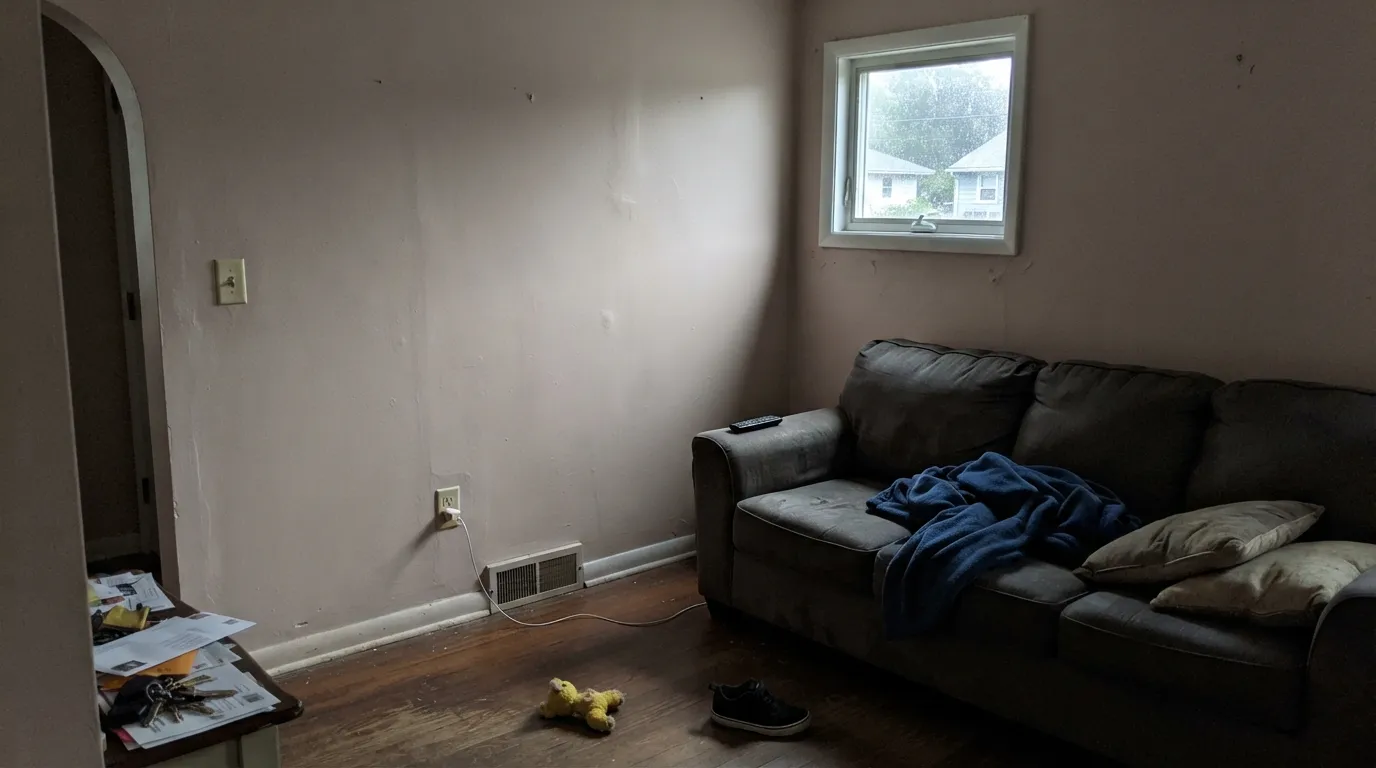
South and west rooms push the red-orange side forward, and on a large uninterrupted wall the pink Benjamin Moore mentions becomes visible — people describe it as suddenly looking tan, or blush, or dusty rose at 4 p.m. It is the same paint, just amplified by the light and the surface area. If your main living wall gets that sun and you want zero pink risk, use Accessible Beige SW 7036, which leans yellow-green and cannot go there.
This is the pairing mistake, not a paint problem. A bright contractor white sits around LRV 90 and makes a 63-LRV warm greige look like a white that needs washing. Either repaint the trim in a warm white — White Dove OC-17 is the standard answer — or accept that the walls will read as dirty white rather than as a color.
Room by Room
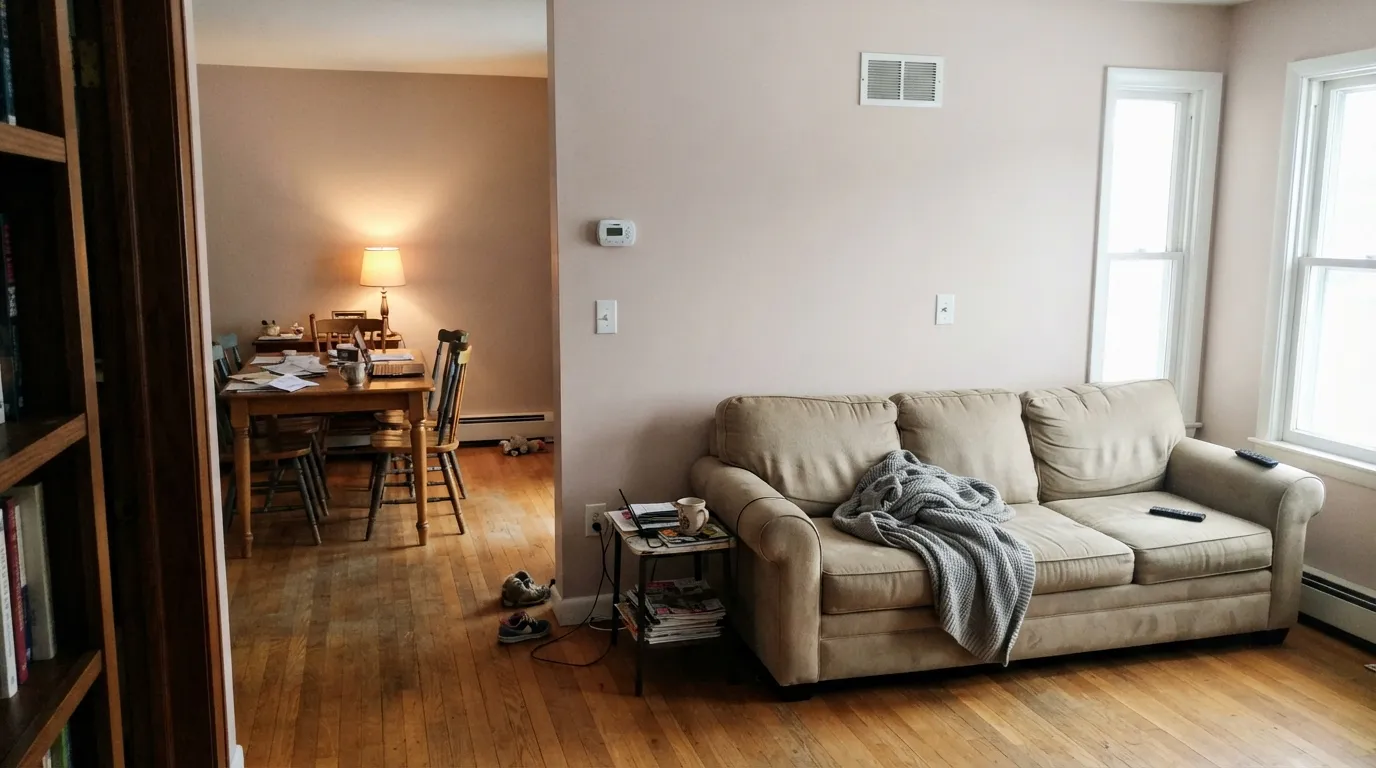
Its natural home, especially with oak or walnut furniture. Eggshell on the walls, White Dove OC-17 semi-gloss on the trim so the walls read as a color. Watch the wall that gets late sun — that is where the pink shows.
One neutral has to survive a north window, a south window and no window at all, and Baby Fawn does that without ever looking like two different colors. This is the reason it turns up in whole-house schemes and rentals.
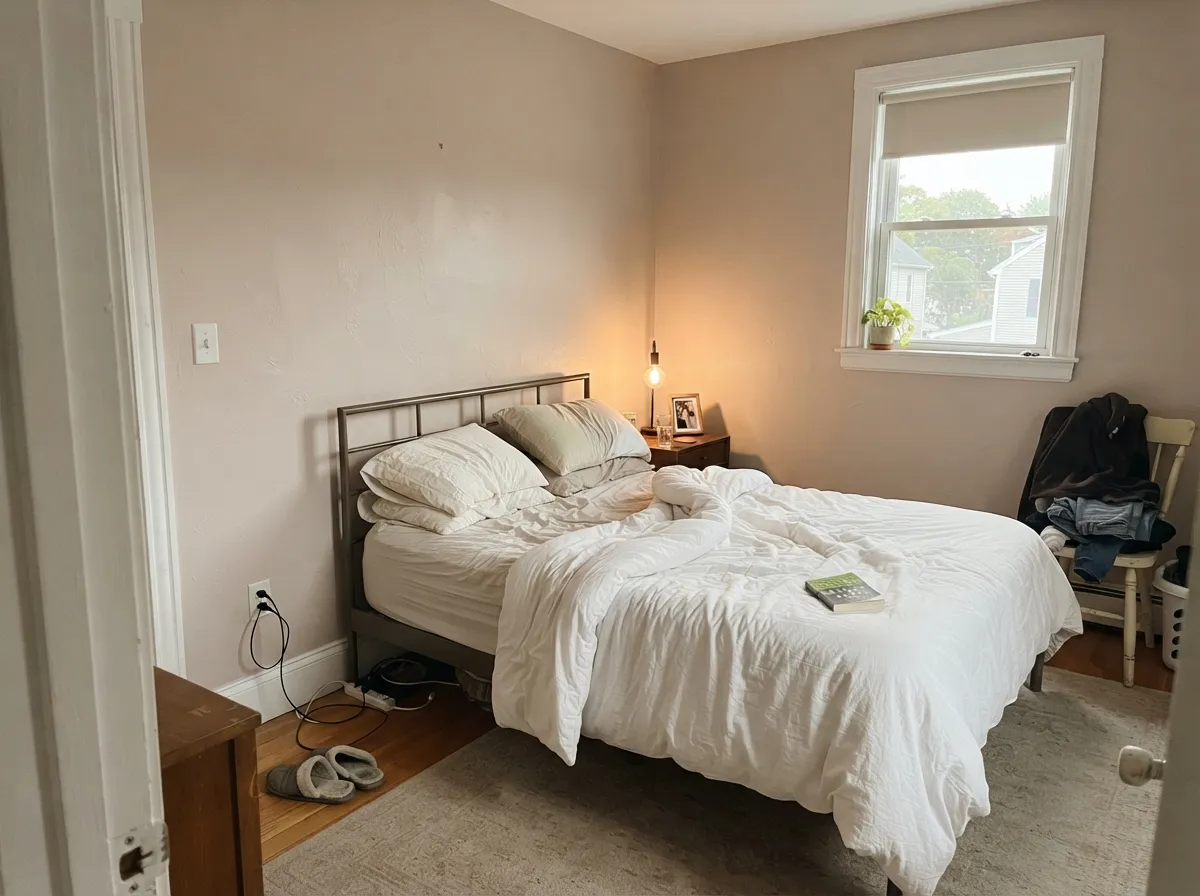
Under 2700K lamps it turns genuinely cozy at night. Pair with Swiss Coffee OC-45 trim and a muted green like October Mist 1495 behind the bed if you want one soft color in the room.
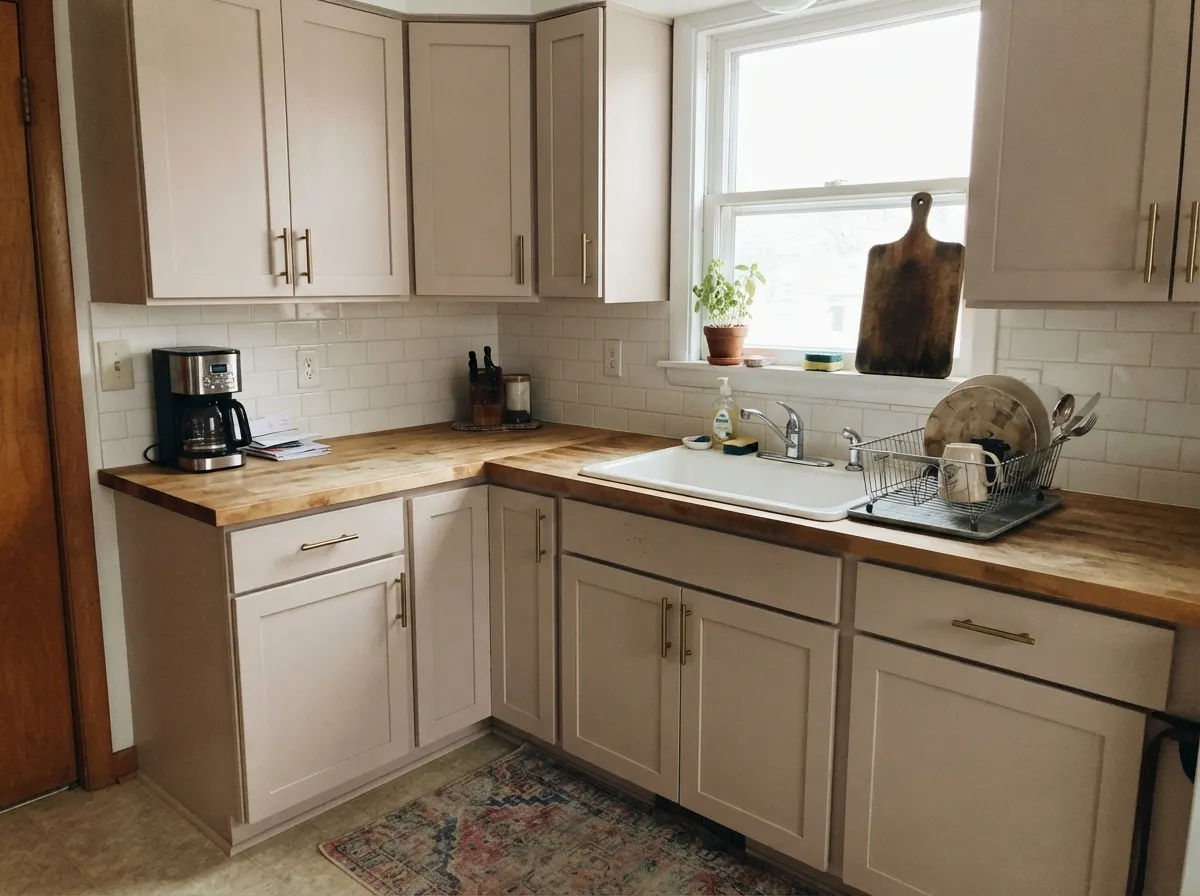
Satin on cabinets gives a low-contrast warm kitchen that hides knuckle marks far better than a bright white. It agrees with butcher block, soapstone, brass and honed granite. Against cool white quartz with gray veining it will look tan by comparison.
With travertine, wood vanities or cream subway tile it is lovely. With blue-gray porcelain or crisp white tile it looks muddy and out of date — use Classic Gray OC-23 there instead.
Full sun reads it lighter and sandier than the chip. It sits comfortably against brick, stone and cedar. Give it a hard dark edge with Kendall Charcoal HC-166 or Wrought Iron 2124-10 on the trim, or the whole house goes soft.
Your Light Is the Risk
Cool daylight strips the warmth and leaves the gray. Drab by day, fine by lamplight.
Steady, soft and warm most of the day. This is the exposure it was made for.
Late low sun pulls the red-orange forward. Big walls can read tan or faintly pink.
2700K lamps make it cozy and rich. 4000K LEDs flatten it to gray — change bulbs, not paint.
Most complaints about Baby Fawn are a light mismatch. Upload a photo of your actual room and see it on your walls — then ask for the same wall in north light or evening lamps before you buy a single sample.
Need It From Another Brand?
Any paint counter can custom-tint Benjamin Moore OC-15 directly. If you would rather stay in one brand's own deck, these are the closest stock matches, measured as ΔE2000. Under 2 is a difference you will not see on the wall.
| Brand | Closest color | ΔE | LRV | |
|---|---|---|---|---|
| Sherwin-Williams | Natural TanSW 7567 · Sherwin-Williams | 2.0 | 65 | Color page → |
| Behr | Traditional TanPPF-14 · Behr | 1.8 | 64 | Color page → |
| Valspar | Warm Putty6006-1A · Valspar | 1.6 | 64.8 | Color page → |
| PPG / Glidden | Gray BeigePPG14-30 · PPG / Glidden | 2.4 | 65 | Color page → |
| Glidden | Papyrus Paper50YY 65/071 · Glidden | 1.6 | 65 | Color page → |
| Dutch Boy | Existence420-1DB · Dutch Boy | 0.9 | 63 | Color page → |
Similar Benjamin Moore Colors
The nearest shades to Baby Fawn within Benjamin Moore's own range, ranked by perceptual color distance — useful when you want the same look a touch lighter, darker, or warmer.
WCAG 2.1: AA is 4.5 : 1 for normal text, 3 : 1 for large text, AAA is 7 : 1.
Baby Fawn vs the Colors You're Also Considering
Every Baby Fawn sample board has the same rivals on it. The numbers show the real lightness gap — then it comes down to which risk you would rather live with.
Pick this if your store has it on the shelf — on a wall they do not separate.
Benjamin Moore HC-173 · LRV 63Edgecomb GrayPick this if you already own a sample pot; the values are the same, so is the result.
Pick this for more body and a more earthy, grounded warmth on the wall.
Benjamin Moore OC-20 · LRV 67Pale OakPick this for a lighter, airier version — but its warmth reads pink-taupe.
Its closest relatives are genuinely close. In our data Alaskan Skies 972 and Edgecomb Gray HC-173 both carry the hex #D9D3C4 at LRV 63, the same values as Baby Fawn, so on a wall they will not separate. Elmira White HC-84 at #DBD3C3 and LRV 65 is very slightly lighter and warmer. Nature's Essentials 1521 at LRV 67 and Natural Cream OC-14 at LRV 65 share the hex #DAD5C6 and read a shade cleaner. Sweet Spring 1500 at #D4D3C3 and LRV 65 is the cool one of the group, with less red in it.
Across brands the matches are tight. C2 Parchment C2-915 at deltaE 0.42 and Dutch Boy Existence 420-1DB at 0.87 are the same color in practice. Kompozit Harrow Gate 0230 at 1.19, Valspar Warm Putty 6006-1A at 1.55 and Behr Traditional Tan PPF-14 at 1.83 are all visually identical in normal room light. Sherwin-Williams Natural Tan SW 7567 at 2.00 and Farrow and Ball Off-White No. 3 at 2.27 are very close but worth sampling first.
Baby Fawn Coordinating Colors
The rule with Baby Fawn is to stay warm and to make your contrast with light, not with temperature. Warm whites lift it, deep warm darks anchor it, and muted greens calm its red-orange lean. What fights it is anything cool and clean: icy whites, blue-grays, and pale cool blues all make the walls look tanned by comparison. These are the partners that keep turning up in real schemes:
Building the Baby Fawn Ladder
The single biggest mistake with this color is trying to build a scheme out of its immediate neighbors. Alaskan Skies 972, Edgecomb Gray HC-173, Natural Cream OC-14 and Elmira White HC-84 all live within a couple of LRV points of Baby Fawn, so putting two of them in the same room produces no contrast at all — just a vague feeling that something is off. A monochrome scheme needs real steps, not shades of the same step.
Going lighter, Pale Oak OC-20 at LRV 70 is the first genuine step up, and Swiss Coffee OC-45 at 83 or White Dove OC-17 at 83 are the trim-level jumps. Going darker, Revere Pewter HC-172 at 55 is the closest relative with visible depth, Kendall Charcoal HC-166 gives you a real mid-dark for an island or built-in, and Wrought Iron 2124-10 is the near-black for a door. Pick one from above and one from below and the room will finally have somewhere to look.
Baby Fawn on Exteriors
Outdoors it behaves better than its soft indoor reputation suggests. Full sun lightens it and sands off some of the warmth, so the pink risk that shows up on a big interior wall largely disappears on siding — the sky is doing the color-correcting for you. It sits naturally against red brick, fieldstone, cedar and copper, which is why it works so often on ranches, bungalows and stucco.
The trim decides everything. Charcoal or near-black — Kendall Charcoal HC-166, Wrought Iron 2124-10 — gives you a crisp modern frame and makes the siding read intentional rather than builder-default. A warm white trim like White Dove OC-17 goes softer and more traditional. What to skip outside: cool gray or blue-gray shutters, which strand Baby Fawn on the yellow side, and any trim within 10 LRV points of the siding, which just looks like you ran out of paint.
Three Ready Palettes Built on Baby Fawn
A color is never alone on the wall. These are complete combinations in the 60-30-10 pattern, with the reason each one holds together. Every one opens in the visualizer.
White Dove sits 20 LRV points above Baby Fawn, which is exactly enough separation to make the walls read as a color instead of a dirty white, and both share a warm base so the edge never looks stark. The navy door gives the whole scheme the one dark note it otherwise lacks.
Try this palette in your roomSimply White is bright enough to make the cabinets the crisp element while staying on the warm side, so it lifts Baby Fawn instead of dirtying it. The charcoal island anchors the room and is the piece that makes brass hardware look deliberate rather than dated.
Try this palette in your roomA muted sage sits opposite Baby Fawn's red-orange lean on the color wheel, so it steadies the warmth and quietly kills any pink flash. Swiss Coffee keeps the trim warm and creamy, which is what stops a low-contrast bedroom from feeling clinical.
Try this palette in your roomBaby Fawn FAQ
Is Baby Fawn pink?
Not usually, but the pink is real and it is in the formula — Benjamin Moore's own description mentions a slight touch of pink. In north light and average daylight you will never see it. On a wide wall hit by late afternoon sun, or under warm 2700K bulbs at night, it can lean faintly blush. Sample the sunniest wall in the room, not the chip.
Baby Fawn or Edgecomb Gray?
Honestly, either. In our color data both sit at hex #D9D3C4 and LRV 63, so painted side by side on the same wall you will not reliably tell them apart. Edgecomb Gray is the more famous name and gets stocked more often. Buy whichever your store has and do not spend a second more on the decision.
What white trim goes with Baby Fawn?
Go clearly lighter or the walls will look like unwashed white. White Dove OC-17 at LRV 83 is the safest partner — warm enough to match and about 20 points brighter. Simply White 2143-70 gives a crisper edge. Avoid a cold bright white like Chantilly Lace 2121-70, which makes Baby Fawn look tan and tired.
Does Baby Fawn work on kitchen cabinets?
Yes, and it is one of the better uses for it. Satin on the doors gives a soft warm kitchen that hides fingerprints around the handles far better than a bright white does. It loves butcher block, brass and honed stone. Cool gray-veined quartz is the one counter that will make it look tan.
Will it look dingy in a north-facing room?
It can. North light is cool and flat, and it cancels the warmth that makes this color pleasant, so a dim north room can read gray and slightly dirty by day. If that is your room, Manchester Tan HC-81 keeps more glow. If you love Baby Fawn anyway, plan on 2700K bulbs and lamps you actually turn on in the daytime.
Does Baby Fawn go with gray floors?
It is the hardest pairing it faces. Cool gray LVP and gray-washed wood sit at the opposite temperature and push Baby Fawn to look distinctly tan. It is not always a dealbreaker — warm rugs, wood furniture and brass pull it back — but tape a large sample right against the floor before you commit the whole room.
How many coats does it take?
Two over any existing light or white wall. Over a dark, red or saturated color, prime first with a gray-tinted primer; trying to cover a deep wall with three coats of a 63-LRV neutral costs more in paint than the primer would have.
Have you painted with Baby Fawn?
Rate it — one tap helps the next reader decide.
Ask a Question