Light French Gray
The gray people buy to avoid beige, reviewed honestly: why it flashes baby blue on so many walls, and the rooms where it is close to perfect.

Jessica has spec'd whites and neutrals for more than 300 rooms and keeps a sample wall of painted drawdowns in her studio. Every color review is checked against real reader rooms in the comments and re-tested when a formula changes. About the testing process →
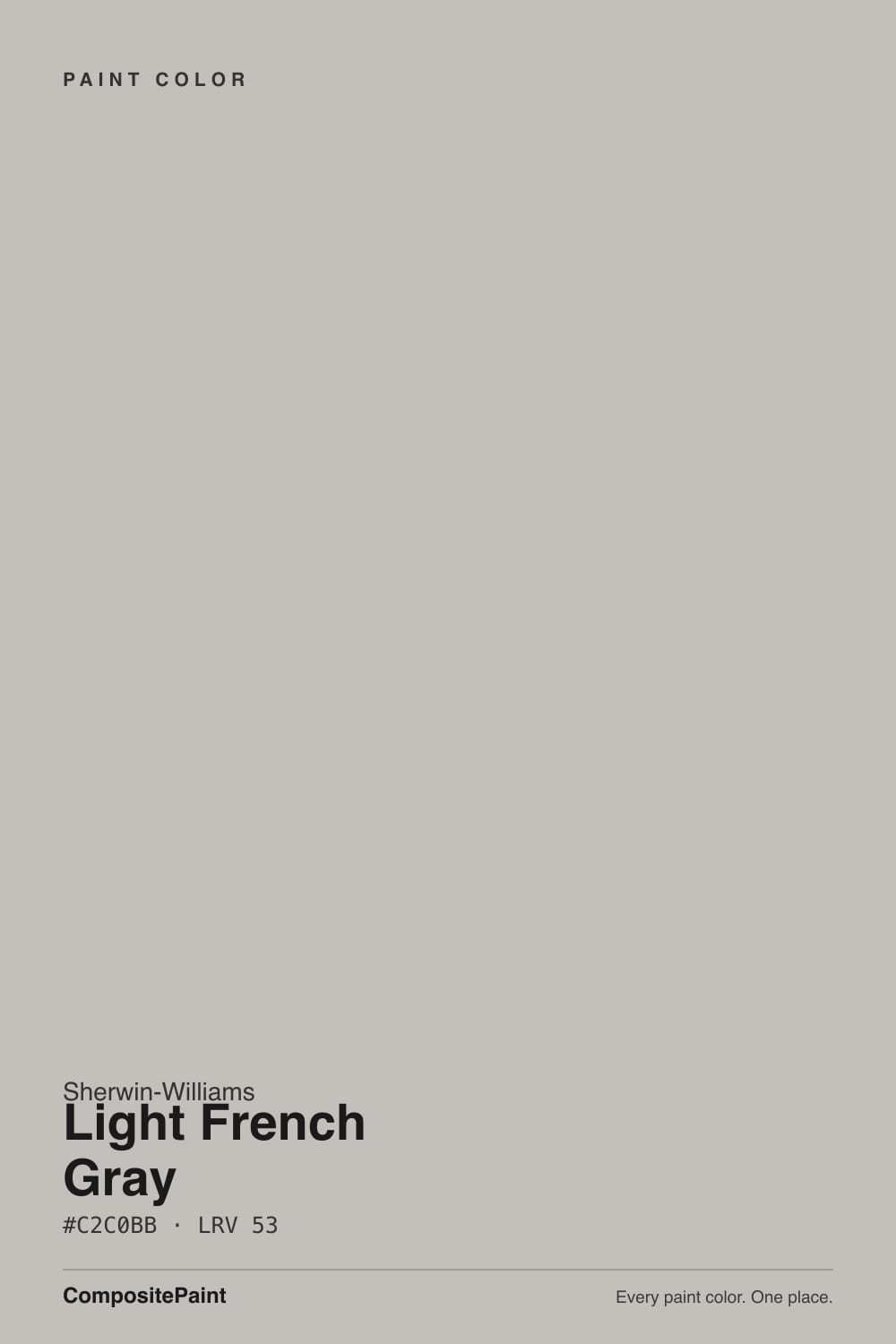
- 1Dorian Gray39
- 2Mindful Gray48
- 3Light French Gray53
- 4Agreeable Gray60
- 5Pale Oak69
The Fast Verdict
Light French Gray is what you pick when every other gray has let you down by turning beige, green or muddy. It has almost no pigment in it, which is the whole point and also the whole problem: with nothing of its own to say, it takes on whatever your room hands it. In good daylight that means a clean, honest mid-gray. In a dim north room, or next to honey oak, it goes baby blue and people repaint.
South- and west-facing rooms with real daylight · people who think all greige looks dirty · exterior siding with white trim and a black door · matching existing gray floors, tile or quartz
Your room faces north and stays dim · your trim or floors are honey oak, pine or cream · you run 4000K daylight bulbs · you want a gray that feels warm on its own
- One of the closest things Sherwin-Williams has to a genuinely un-tinted gray
- Does not drift beige, green or muddy the way most safe grays eventually do
- Sits quietly beside gray floors, gray quartz and gray-veined tile instead of fighting them
- Outside in full sun it is close to foolproof
- Reads calm and permanent on cabinets rather than like a trend color
- Flashes baby blue or lavender in north light and under 4000K bulbs
- Clashes hard with honey oak, golden pine and yellowed cream trim
- At LRV 53 it is darker than the name suggests — small dim rooms close in
- Has no warmth of its own; wood, brass and textiles have to supply all of it
What Color Is Light French Gray, Really?
On the chip it measures a hair warm — a red-orange hue at 5 percent saturation, which is about as close to no color as paint gets. That is technically true and it is why the color is sold as a balanced neutral. The wall tells a different story. Light French Gray is the gray people most often post about turning baby blue, and the missing pigment is exactly why. With almost nothing of its own, it borrows: set it near orange oak, cream trim or cool daylight and your eye supplies the opposite, and you get a soft blue-lavender cast that is not in the can but is absolutely on your wall.
At LRV 53 it sits just above the middle of the scale, which is darker than most people picture when they read the word light. Repose Gray (SW 7015) is 58 and Agreeable Gray (SW 7029) is 60 — five to seven points sounds like nothing, but across four walls of a small room it is the difference between airy and closed in. Enough people hit that wall that having it mixed at 75 or even 50 percent strength for windowless bathrooms and basements has become a normal request at the paint counter. It keeps the hue and buys back the light.
Undertone in one line: measurably a whisper warm, visually whatever the room gives it — clean gray in daylight, blue-lavender in cool light beside warm wood.
Where It Shines
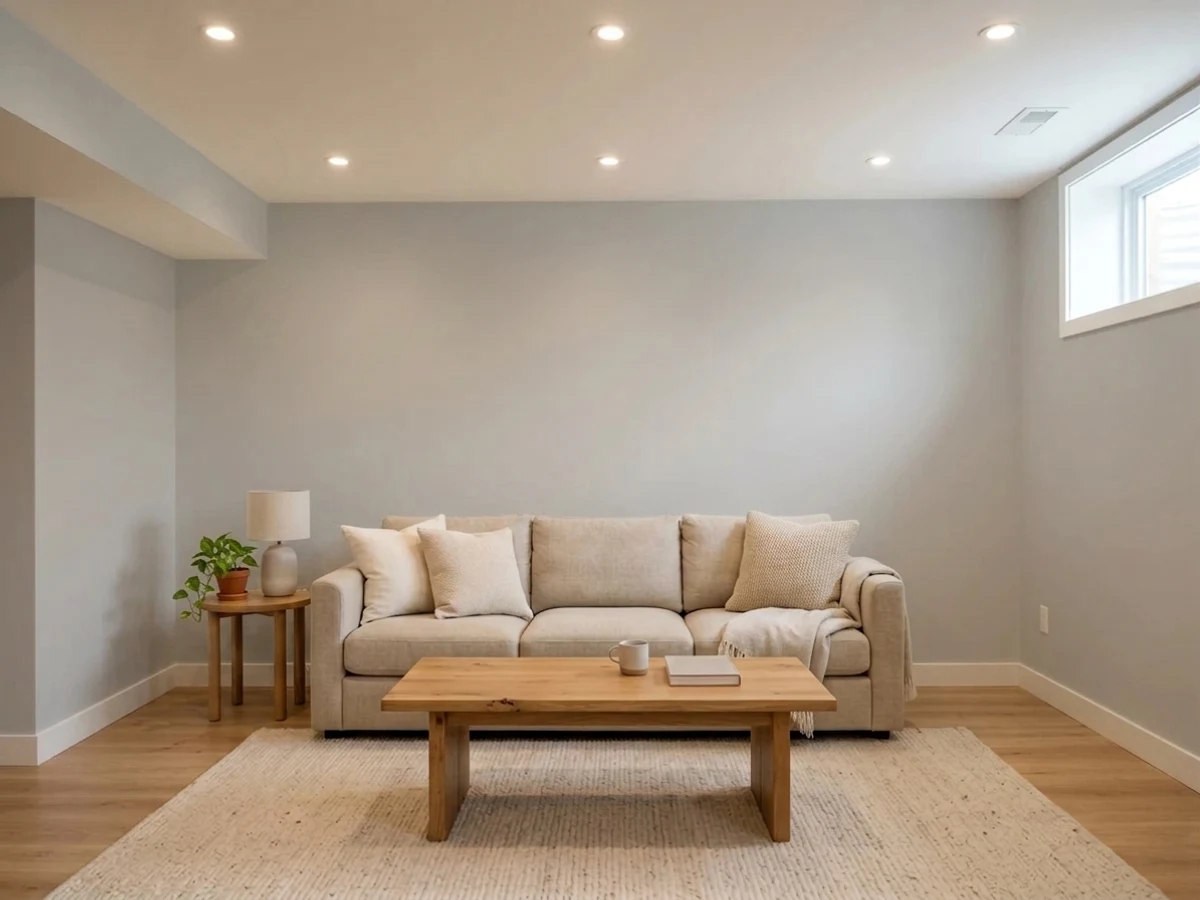
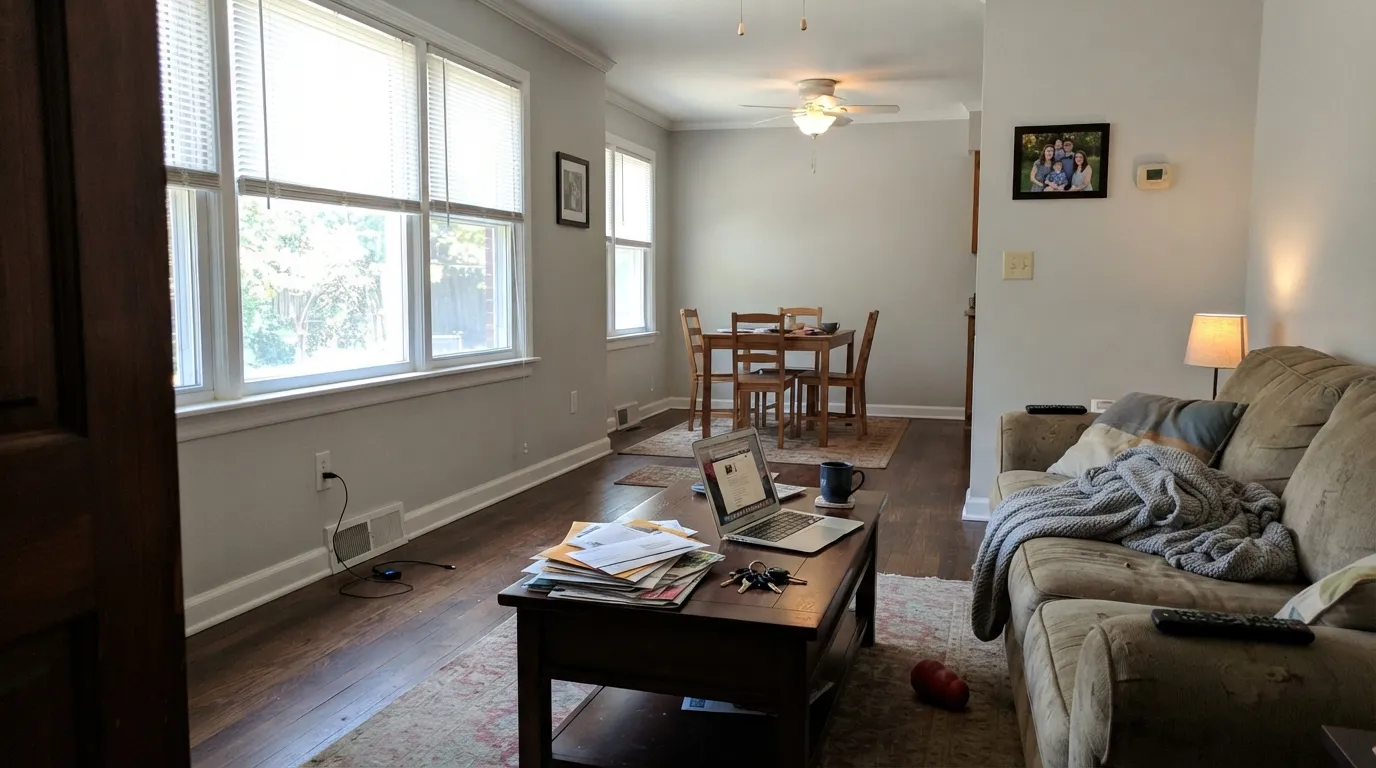
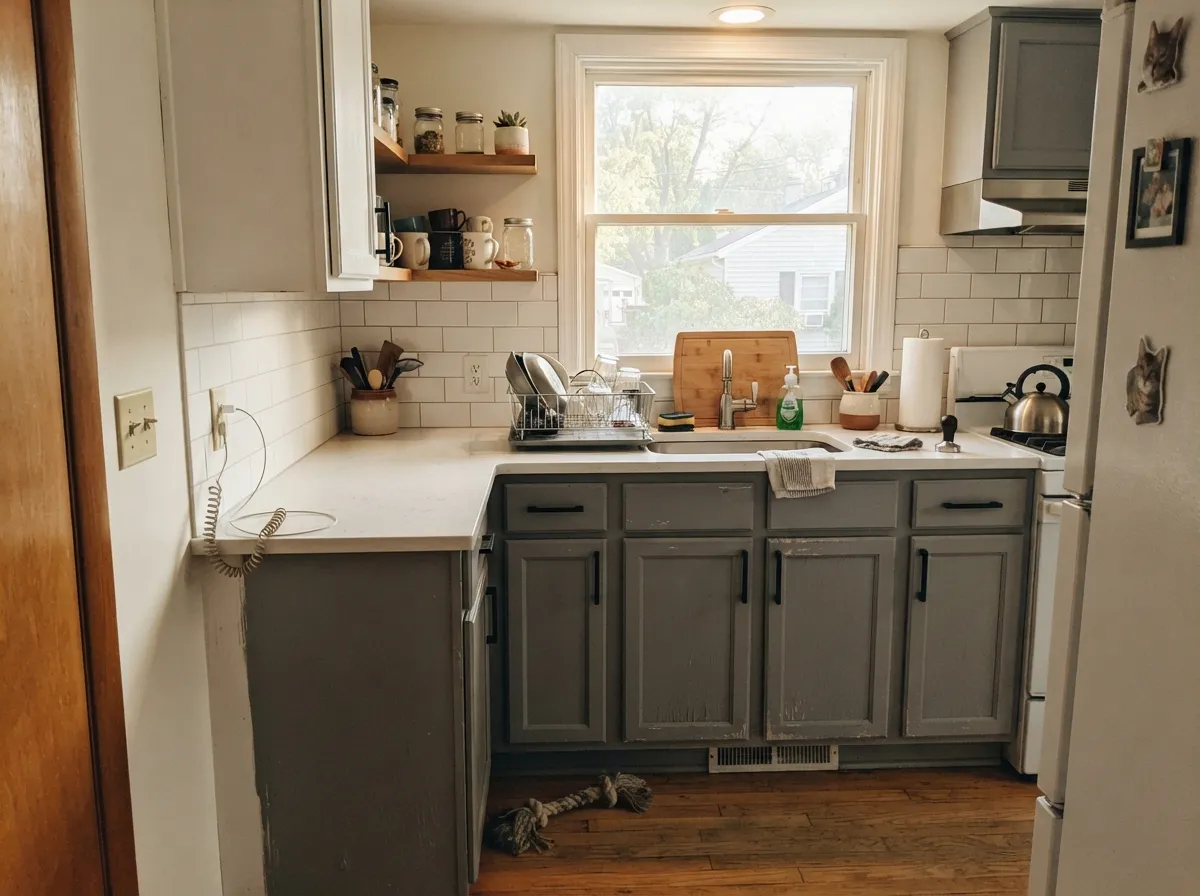
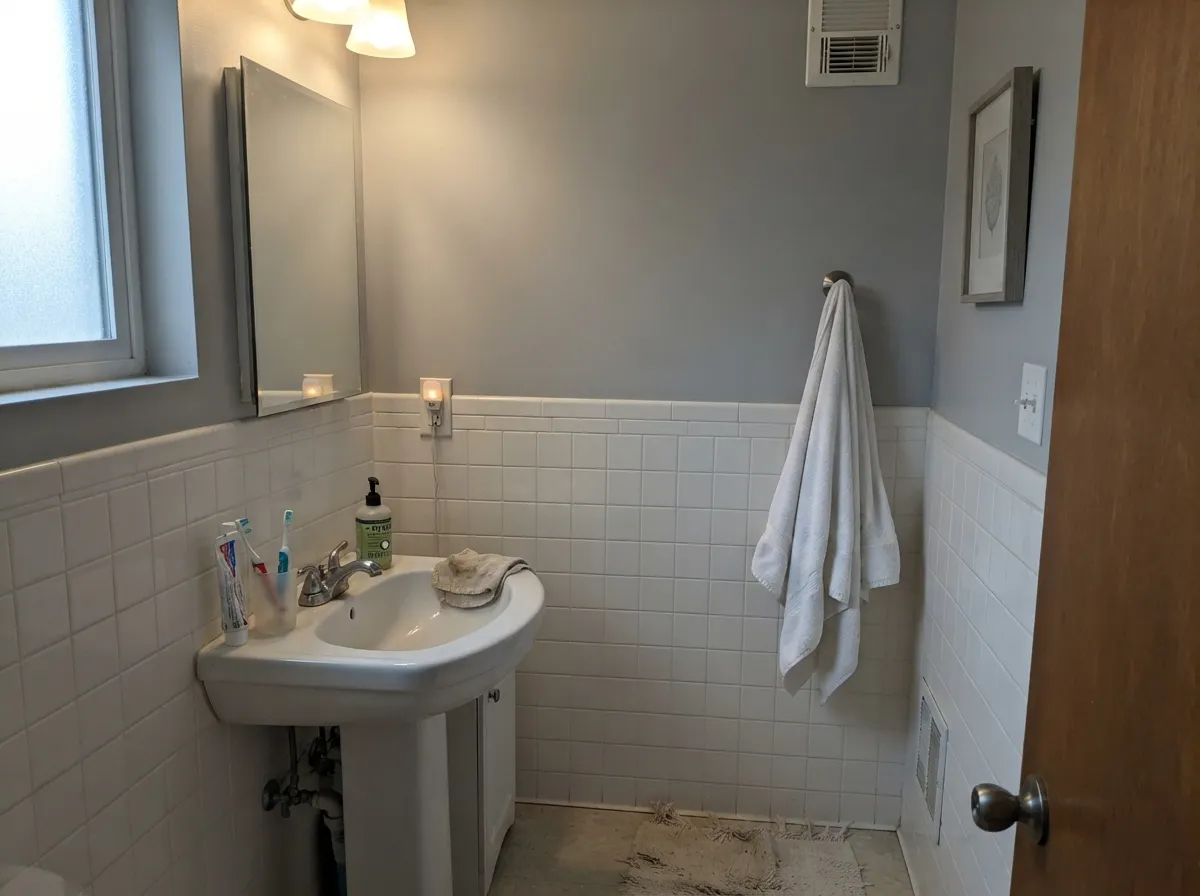
Give it daylight, white trim, and floors that are not orange, and it does the one thing most popular grays cannot: it stays gray. These are the rooms where that pays off.
Where It Fails
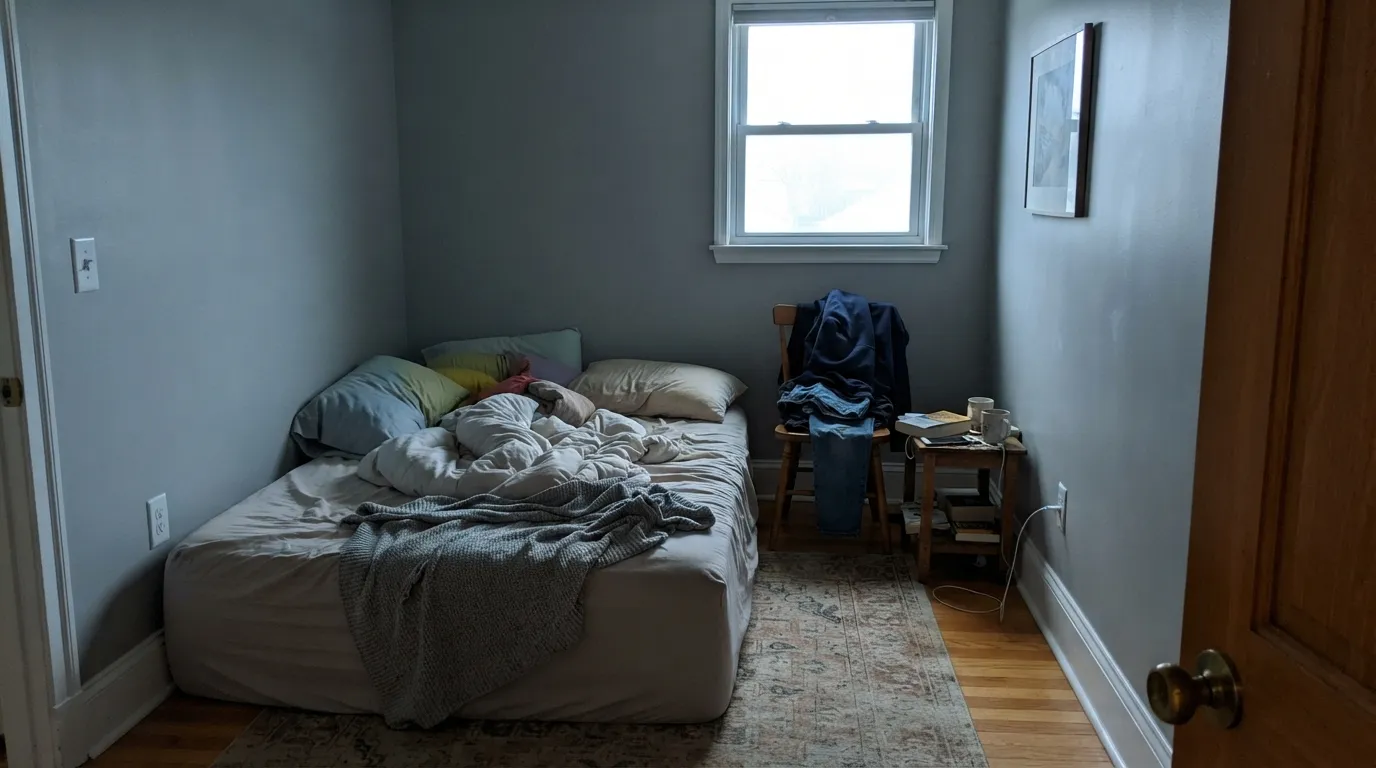
Nearly every repaint story about this color is the same story told three ways, and all three are predictable before you open the can. If your room matches one, more coats will not save it.
North light is cool and flat, and a color at 5 percent saturation has nothing to push back with. It reads baby blue or faintly lavender, and on an overcast day it looks like bare primer. Go warmer: Colonnade Gray (SW 7641) at the same depth, or Agreeable Gray (SW 7029) if you want it lighter too.
Orange and yellow sit opposite blue on the color wheel, so warm wood shoves Light French Gray straight into lavender — and the oak looks more orange in return. Either repaint the trim Pure White (SW 7005) and let the wall stand alone, or move the wall to Accessible Beige (SW 7036) and stop fighting the floor.
LRV 53 with no daylight and cool bulbs reads cold and cement-like, and a small room feels smaller. Ask for it mixed at 50 percent strength, or step up to First Star (SW 7646) at LRV 69, which keeps the crisp gray idea and gives the room its light back.
Room by Room
With south or west daylight it is a quiet gray that lets dark wood, black metal and art carry the room. Eggshell on the walls, Pure White (SW 7005) trim in semi-gloss. In a north-facing living room, tape up a large sample and look at it on a gray day before you buy a gallon.
On lower cabinets under white uppers it looks calm and expensive, especially with quartz counters and black or bronze hardware. Use a satin cabinet enamel. Then check your under-cabinet strips: 4000K LEDs will make the doors flash blue, 2700K to 3000K will not.
At 53 LRV it is restful rather than bright, and 2700K bedside lamps keep it from going cold after dark. Pair with Pure White (SW 7005) trim and bring the warmth in oak, linen and jute. Skip it if the bedroom is north-facing and short on windows.
Beautiful with white subway tile and gray-veined quartz when there is a window. In a small windowless bathroom, have it cut to 50 percent strength or the walls press in. Satin, or a bathroom-rated matte if you want less shine on the shower wall.
It is a favorite basement gray because it will not drift beige under LED lighting, but the bulb choice decides the whole room: 3000K keeps it gray, 5000K turns everything daylight-blue. Urbane Bronze (SW 7048) on laundry cabinets or a workshop door gives it something solid to sit against.
Full sun burns the lavender problem off completely, so outside it reads as a crisp classic mid-gray that never washes out to white. Pure White (SW 7005) trim, Peppercorn (SW 7674) or Tricorn Black (SW 6258) on shutters and the front door. Full pairings in the exterior section below.
Your Light Is the Risk
Cool flat daylight tips it blue-lavender. This is the complaint. Sample a big board first.
Warm sun cancels the blue and it reads as a clean, honest mid-gray all day.
2700K lamps keep it gray and settled. 4000K daylight LEDs turn the whole room blue.
Outside it lifts about a step lighter and the lavender never appears. Its most dependable use.
Most complaints about Light French Gray are a light mismatch. Upload a photo of your actual room and see it on your walls — then ask for the same wall in north light or evening lamps before you buy a single sample.
Need It From Another Brand?
Any paint counter can custom-tint Sherwin-Williams SW 55 directly. If you would rather stay in one brand's own deck, these are the closest stock matches, measured as ΔE2000. Under 2 is a difference you will not see on the wall.
| Brand | Closest color | ΔE | LRV | |
|---|---|---|---|---|
| Behr | Noble GrayHDC-WR15-3 · Behr | 1.3 | 52 | Color page → |
| Benjamin Moore | Smoke Embers1466 · Benjamin Moore | 0.3 | 51 | Color page → |
| Valspar | SleepyT678 · Valspar | 3.6 | 52.9 | Color page → |
| PPG / Glidden | Rabbit's EarPPG0999-2 · PPG / Glidden | 2.0 | 54 | Color page → |
| Glidden | Gray ShadowsPPG1005-3 · Glidden | 2.2 | 51 | Color page → |
| Dutch Boy | Scalloped Gray439-2DB · Dutch Boy | 2.6 | 53 | Color page → |
Similar Sherwin-Williams Colors
The nearest shades to Light French Gray within Sherwin-Williams's own range, ranked by perceptual color distance — useful when you want the same look a touch lighter, darker, or warmer.
WCAG 2.1: AA is 4.5 : 1 for normal text, 3 : 1 for large text, AAA is 7 : 1.
Light French Gray vs the Colors You're Also Considering
Every Light French Gray sample board has the same rivals on it. The numbers show the real lightness gap — then it comes down to which risk you would rather live with.
Pick this for a true gray that will not drift warm or taupe.
Sherwin-Williams SW 7015 · LRV 58Repose GrayPick this for a lighter, warmer room that forgives honey oak.
Side-by-side comparison →Pick this if beige and greige always look dirty to you.
Sherwin-Williams SW 7029 · LRV 60Agreeable GrayPick this if you have warm wood, cream trim, or dim north light.
Repose Gray (SW 7015) at LRV 58 is the usual comparison. It is five points lighter and its hex #CCC9C0 carries more warmth, so it reads as a greige where Light French Gray at #C2C0BB reads as a plain gray. Choose Repose Gray for a lighter, warmer room and Light French Gray when you want the color to stay neutral.
Inside the deck, Silverplate (SW 7649) at LRV 53 is a near twin at #C2C0BA. Colonnade Gray (SW 7641) at LRV 53 is warmer and more beige at #C6C0B6, and Silver Tipped Sage (SW 9642) at LRV 54 adds a green lean.
Across brands, Benjamin Moore Smoke Embers (1466), LRV 51, at deltaE 0.26 and Farrow and Ball Pavilion Gray (No. 242), LRV 53, at 0.56 are the same color for practical purposes. Behr Noble Gray (HDC-WR15-3), LRV 52, at 1.33 is visually identical in normal room light. PPG and Glidden Rabbit's Ear (PPG0999-2), LRV 54, at 2.0 is very close but worth sampling. Kompozit Ice Flow (0448), LRV 54, at 4.08 is close but visibly different side by side.
Light French Gray Coordinating Colors
The rule with this color is the opposite of the warm-white rule: keep the partners clean, not creamy. Anything with yellow in it — soft whites, tans, honey wood — pulls Light French Gray toward lavender, while crisp whites and true darks let it stay gray. Warmth still has to enter the room, but it should come from bronze, leather, oak and brass rather than from the paint next to it. These are the partners that actually hold up:
Light French Gray on Exteriors
Outside is where this color stops being risky. Direct sun is warm and strong enough to cancel the blue shift that ruins it in north-facing rooms, and exterior daylight reads any body color lighter than the chip — so the LRV 53 that feels heavy in a small bathroom lands as a comfortable mid-gray on siding. It also holds its color from the sunny side of the house to the shaded side better than warmer grays, which tend to go tan on the south face.
Pairings do the rest. Pure White (SW 7005) trim keeps the edges crisp; a creamy exterior white will do outdoors exactly what it does indoors and yellow the siding by comparison. For the dark note, Peppercorn (SW 7674) suits traditional and older elevations, Tricorn Black (SW 6258) suits farmhouse and modern ones. It also agrees with gray stone, slate, and standing-seam metal roofing, which is why it turns up so often on houses where the roof was chosen before the paint.
Light French Gray With Wood Floors and Cabinets
Flooring decides this color more than lighting does, because the floor is the biggest warm surface in most rooms. Dark walnut, espresso and true black-brown floors are its best partners — the contrast is high enough that nobody is looking for undertones. Natural white oak and gray-washed engineered wood are also safe, since neither has much orange to react against. Medium browns are fine as long as the stain is neutral rather than red.
Honey oak, golden pine and orange-red oak are the ones to walk away from. It is not a matter of taste: those floors are close to the exact complement of the blue cast this gray already leans toward, so each one makes the other look worse. If the floors are staying, the wall has to change. On cabinets the same logic applies to your counters and your bulbs rather than the floor — white or gray-veined quartz plus 2700K to 3000K light keeps painted doors reading gray, and warm brass or bronze hardware puts back the warmth the paint does not carry.
Three Ready Palettes Built on Light French Gray
A color is never alone on the wall. These are complete combinations in the 60-30-10 pattern, with the reason each one holds together. Every one opens in the visualizer.
Pure White is soft enough to stop the trim looking chalky against 53 LRV walls, and clean enough that it never adds the cream note that pushes this gray lavender. Black doors give the scheme the one dark anchor a near-neutral wall can never provide by itself.
Try this palette in your roomGray bases with Extra White above keeps the room bright while the counter line stays grounded, and the crisp white protects the gray from reading blue. Urbane Bronze on the island puts real warmth into the 10 percent slot, which is exactly what this color needs and cannot make on its own.
Try this palette in your roomSunlight reads the siding a step lighter than the chip, so the white trim needs to be clean rather than creamy to hold its edge. Peppercorn is dark enough to frame the house without the hard graphic snap of black, which suits older elevations better.
Try this palette in your roomLight French Gray FAQ
Why does my Light French Gray look baby blue on the wall?
Because there is almost no pigment in it to hold a direction. At 5 percent saturation the surrounding light and materials decide what you see, and cool north daylight, overcast skies or 4000K bulbs all read as blue. Warm wood and cream trim make it worse by pushing your eye toward the opposite color. Swap to 2700K bulbs first — that alone fixes it in a lot of rooms.
Is Light French Gray warm or cool?
On paper it is faintly warm, with a red-orange hue at only 5 percent saturation. In practice most people experience it as cool, because there is not enough warmth in it to survive cool light. Call it a true neutral that leans cool in the real world and plan for that.
Light French Gray or Repose Gray?
Repose Gray (SW 7015) is five points lighter at LRV 58 and clearly warmer — it is a greige. Light French Gray stays gray. Pick Repose if your room is dim, your trim is soft white, or your floors are warm. Pick Light French Gray if greige reads dirty to you and you want the wall to look like actual gray.
What trim white goes with Light French Gray?
Pure White (SW 7005) at LRV 84 is the standard answer and the right one for most houses — about 30 points of separation, clean but not harsh. Extra White (SW 7006) is the sharper, more modern option. Avoid creamy whites like Alabaster: the yellow in them is what makes this gray look lavender.
Does it work with honey oak floors or oak trim?
No, and this is the single most common regret with it. Orange-toned oak sits opposite blue on the color wheel, so the floor turns the wall lavender and the wall makes the floor look more orange. With honey oak, use Accessible Beige (SW 7036) or Agreeable Gray (SW 7029) instead. White oak and dark walnut are fine.
Can I have it mixed at 50 percent strength?
Yes, and it is a common fix. Any Sherwin-Williams store can tint it at 75 or 50 percent, which keeps the same hue but lifts the LRV well above 53. It is the usual move for windowless bathrooms, small basements and anyone who liked the color on the chip but found it heavy on four walls.
Is it good for kitchen cabinets?
Yes, on lower cabinets or an island under white uppers, in a satin cabinet enamel. It reads calm rather than trendy and does not fight gray-veined quartz. The one thing to check before you spray anything is your lighting: cool under-cabinet LEDs will make the doors flash blue and there is no fixing that with paint.
Have you painted with Light French Gray?
Rate it — one tap helps the next reader decide.
Ask a Question