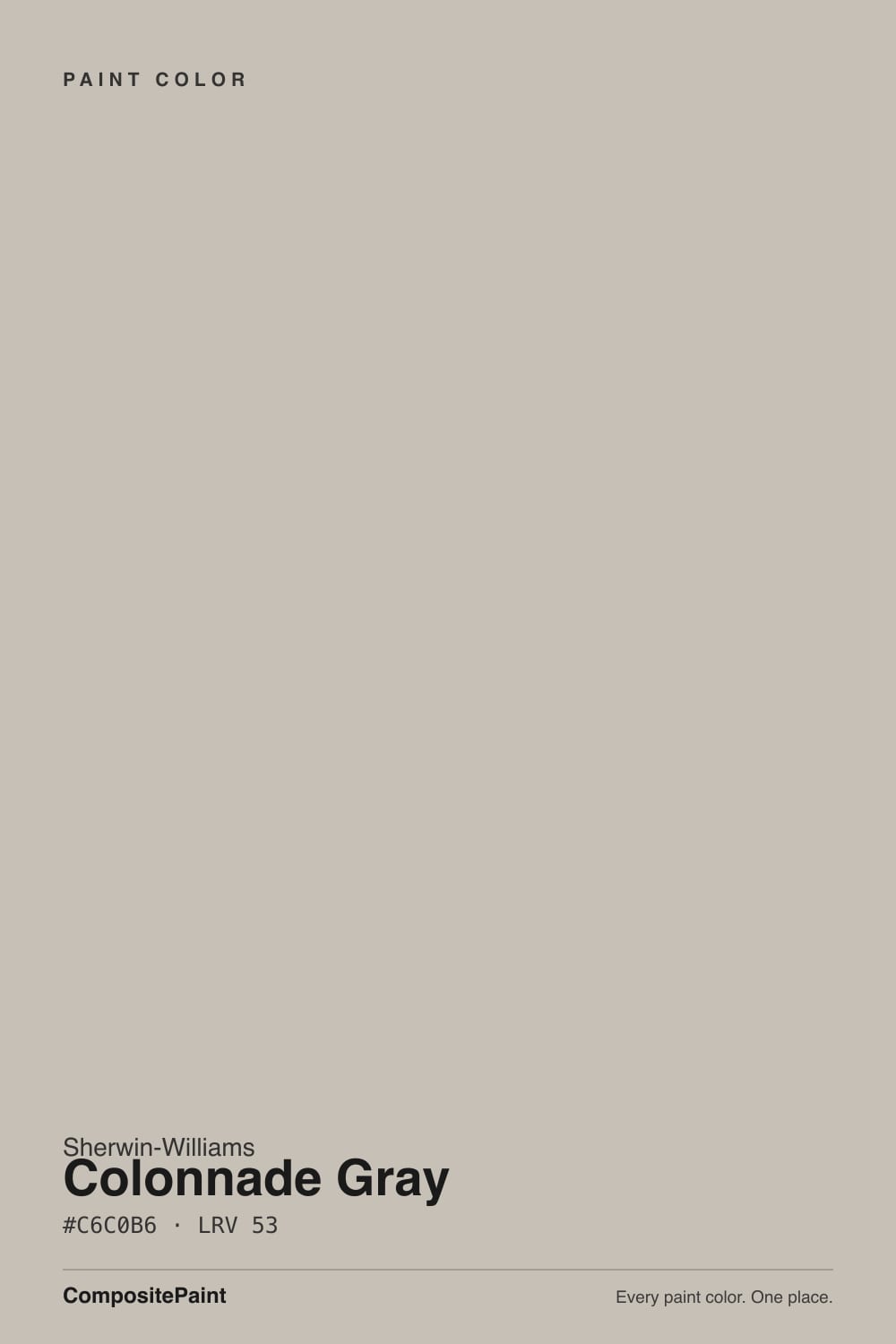
Colonnade Gray
SW 7641 · #C6C0B6 · LRV 53 — warm red-orange tone, light — bounces daylight without going clinical.
- 1Dorian Gray39
- 2Mindful Gray48
- 3Colonnade Gray53
- 4Agreeable Gray60
- 5Pale Oak69
What Color Is Colonnade Gray, Really?
Colonnade Gray (SW 7641) is a warm greige with hex value #C6C0B6 and an LRV of 53. That number puts it just above the middle of the light scale, so it returns about half the light that reaches it. The result is a wall color that stays light without being pale, and holds its color instead of bleaching out. The hue sits at 37 degrees with 12 percent saturation, which is a beige base pulled most of the way toward gray.
It gets picked when a lighter greige has proved too weak. In a bright room, very pale neutrals often read as dirty white and lose whatever undertone made them appealing. Colonnade Gray has enough depth to still look like a chosen color at noon, which is also why it turns up so often on siding and on whole-house interior schemes.
The catch is that it is darker than most people picture from the chip. On all four walls of an average room it reads as a soft mid greige, not a light neutral, and in cool north light it can drift toward a green-gray, especially next to a bright white trim. Roll a large sample on two different walls before you buy the gallons.
The base of Colonnade Gray is warm. Its hue sits at 37 degrees, in the beige range, and the hex #C6C0B6 has clearly more red than blue in it. Saturation of 12 percent keeps that warmth quiet, so the color behaves like a gray with a beige heart rather than an obvious tan.
What you notice depends entirely on the company it keeps. Against Light French Gray (SW 55), hex #C2C0BB at the same LRV of 53, Colonnade Gray looks distinctly beige, because Light French Gray is far more neutral. Against High Sierra (SW 9588), hex #C8C0B3 at LRV 53, the comparison flips and Colonnade Gray reads as the grayer of the two.
The undertone to watch for is green. In cool, indirect light, warm greiges at this saturation can pick up a faint green cast, which shows most against a stark white trim. Tape a sample beside your trim and check it on an overcast morning.
Best Rooms and Uses for Colonnade Gray
Colonnade Gray is a whole-home color. At LRV 53 it works across living rooms, hallways, bedrooms, and open-plan main floors without needing a different treatment in each space. It is especially useful in bright, south-facing rooms where lighter greiges bleach out and stop reading as a color at all.
On exteriors it is one of the more practical uses of this tone. As siding or stucco it holds its depth in full sun, pairs cleanly with a white trim, and gives dark shutters or a dark front door something solid to sit against.
Inside, it can also work on cabinetry when you want a soft mid-tone rather than a statement, and on built-ins against a lighter wall. It is too dark to serve as trim and generally too heavy for a full ceiling, so keep both in a lighter white. In a small, dim room, expect it to feel closer to a mid-tone than a light neutral.
How Lighting Changes Colonnade Gray
An LRV of 53 means Colonnade Gray reflects roughly half the light in the room, so it responds strongly to whatever that light is like. North-facing rooms cool it down. The beige recedes, the color reads grayer and slightly heavier, and this is where the faint green cast is most likely to appear.
South-facing rooms bring the warm side forward. In steady sun it looks like a soft, sandy greige and feels a good deal lighter than its chip. East rooms are warm early and settle gray by afternoon. West rooms hold flat and gray through the morning, then turn noticeably warm and golden late in the day.
Bulbs shift it just as much. Warm 2700K lamps pull the beige forward and make it cozy. Neutral 3500K to 4000K light strips warmth out and leaves it closer to a plain gray. Because the color changes character between the two, look at your sample under the fixtures you actually own.
Most complaints about Colonnade Gray are a light mismatch. Upload a photo of your actual room and see it on your walls — then ask for the same wall in north light or evening lamps before you buy a single sample.
Need It From Another Brand?
Any paint counter can custom-tint Sherwin-Williams SW 7641 directly. If you would rather stay in one brand's own deck, these are the closest stock matches, measured as ΔE2000. Under 2 is a difference you will not see on the wall.
| Brand | Closest color | ΔE | LRV | |
|---|---|---|---|---|
| Behr | Foggy LondonPPU25-09 · Behr | 2.6 | 54 | Color page → |
| Benjamin Moore | Cumulus Cloud1550 · Benjamin Moore | 1.0 | 52 | Color page → |
| Valspar | Clay FigurineM341 · Valspar | 1.0 | 54.2 | Color page → |
| PPG / Glidden | AshenPPG1023-3 · PPG / Glidden | 1.6 | 53 | Color page → |
| Glidden | AshenPPG1023-3 · Glidden | 2.0 | 53 | Color page → |
| Dutch Boy | Scalloped Gray439-2DB · Dutch Boy | 0.0 | 53 | Color page → |
Similar Sherwin-Williams Colors
The nearest shades to Colonnade Gray within Sherwin-Williams's own range, ranked by perceptual color distance — useful when you want the same look a touch lighter, darker, or warmer.
WCAG 2.1: AA is 4.5 : 1 for normal text, 3 : 1 for large text, AAA is 7 : 1.
Colonnade Gray vs Similar Colors
Agreeable Gray (SW 7029), hex #D1CABC at LRV 60, is the lighter and warmer of the pair. Seven LRV points is a visible gap: Agreeable Gray keeps a room feeling airy, while Colonnade Gray reads as a real mid-light color with more presence. Pick Colonnade Gray when a bright room washes Agreeable Gray out.
Repose Gray (SW 7015), hex #CCC9C0 at LRV 58, is lighter again and carries less warmth than either. Set side by side, Repose Gray looks like a gray, Colonnade Gray looks like a greige, and Agreeable Gray looks like the beige of the three.
Across brands, Behr's Armadillo (N230-3) at LRV 54 sits only 0.62 away, which is an effective match. Benjamin Moore's Cumulus Cloud (1550) at LRV 52 is 1.00 away and Farrow and Ball's Elephant's Breath (No. 229) at LRV 52 is 1.47 away, both visually identical in normal room light. Dunn-Edwards Gray Pearl (DEC795) at LRV 49 is 2.44 away, very close but worth sampling first.
Colors That Go With Colonnade Gray
Trim is the first decision. A crisp white sharpens the walls and makes the greige read cooler and more defined, while a warm white softens the transition and keeps the beige side visible. Whichever you choose, run it through every room you can see at once.
For a lighter partner in an open plan or a stairwell, Agreeable Gray (SW 7029) at LRV 60 is warmer and seven points lighter, which steps the scheme up without changing families. Repose Gray (SW 7015) at LRV 58 does the same job with less warmth in it, which suits homes leaning cooler and more modern.
For a same-depth contrast on a single wall or on cabinets, Light French Gray (SW 55) at LRV 53 is the cool counterpart and creates a quiet two-tone. Natural wood, rattan, leather, and both brass and matte black hardware all sit well against Colonnade Gray. Cool blue-gray textiles tend to fight the warm base.
Coordinated palette
Generated by hue-rotating #C6C0B6 in HSL space. Pair Colonnade Gray with one accent and one neutral — the swatches below are starting points, not final picks.
Colonnade Gray FAQ
Is Colonnade Gray warm or cool?
It is warm. The hue sits at 37 degrees, in the beige range, and the hex #C6C0B6 has clearly more red than blue in it. Saturation of only 12 percent keeps that warmth restrained, so it behaves like a gray with a beige base. In cool north light the warmth pulls back and it can look almost neutral.
What LRV is Colonnade Gray?
Colonnade Gray has an LRV of 53, on a scale where 0 is black and 100 is pure white. That means it returns about half the light hitting it, which is why it holds its color in bright rooms instead of bleaching out. It also means it is a mid-light color, not a pale one, so a full room of it will feel softer and deeper than the chip suggests.
Is Colonnade Gray too dark for a small room?
Usually not, but it will not brighten one either. At LRV 53 it reflects roughly half the available light, so a small room with good windows still feels open, while a small room with one north window will feel noticeably enclosed. If the space is both small and dim, a lighter greige will serve you better.
What white trim goes with Colonnade Gray?
Both a crisp white and a soft warm white work, and they give different results. A crisp white creates clear separation and makes the walls look cooler and more defined. A warm white blurs the line and keeps the beige side of Colonnade Gray visible. Test both taped directly against the wall, since the trim choice is what most often makes this color look green or not.
How is Colonnade Gray different from Agreeable Gray?
Agreeable Gray (SW 7029) has an LRV of 60 against Colonnade Gray's 53, so it is clearly lighter, and its hex #D1CABC is warmer as well. Agreeable Gray keeps a room airy. Colonnade Gray has more depth and reads as a proper mid-light greige, which is why it holds up better in bright, sunny rooms where lighter neutrals lose their character.
Is Colonnade Gray good for exteriors?
Yes, exteriors are one of its strongest uses. At LRV 53 it keeps its depth in full sun rather than flattening into an off-white, which is a common problem with lighter greiges on siding. It pairs cleanly with white trim and gives dark shutters, a dark roof, or a deep front door a solid background to sit against.
Have you painted with Colonnade Gray?
Rate it — one tap helps the next reader decide.
Ask a Question