Natural Almond
Behr's classic canvas beige, reviewed honestly: the yellow-tan that keeps an open plan light, the peachy afternoon, and why Polar Bear trim makes it look dated.

Jessica has spec'd whites and neutrals for more than 300 rooms and keeps a sample wall of painted drawdowns in her studio. Every color review is checked against real reader rooms in the comments and re-tested when a formula changes. About the testing process →
- 1Revere Pewter55
- 2Agreeable Gray60
- 3Natural Almond65
- 4Shoji White74
- 5Dover White83
The Fast Verdict
Natural Almond is the beige a builder picks when the house has to look light without being white. Behr files PPU4-12 in the yellow family; Home Depot calls it a canvas beige that can go medium peachy on the wall. Both are true. At LRV 65 it opens an open plan and still has enough tan to hide scuffs. Next to Polar Bear trim, on gray LVP, or in a dim north room, the same gallon looks like 1990s almond. If you wanted greige, this is the wrong chip.
Open-plan living rooms and hallways that should read light but not white · south-facing rooms with oak and brass · traditional kitchens with warm counters · anyone who actually wants a yellow-tan beige
You wanted greige or a grayed modern beige · trim stays Polar Bear or Ultra Pure White · floors or counters are cool gray · the room faces north and runs on cool LEDs
- LRV 65 — light enough to run an open plan without reading as white
- Unapologetic yellow-tan beige — the builder look people actually mean
- Flatters oak, brass, terracotta, and traditional rooms
- Stocked at every Home Depot, so touch-ups actually match
- Cottage White trim keeps the temperature honest without a brighter-white clash
- Reads yellow or peachy the moment you hoped for greige
- Looks dingy and dated next to Polar Bear or Ultra Pure White
- The almond name carries a 1990s-appliance association some people cannot unsee
- Fights gray LVP, gray quartz, Carrara-look stone, and cool LEDs
What Color Is Natural Almond, Really?
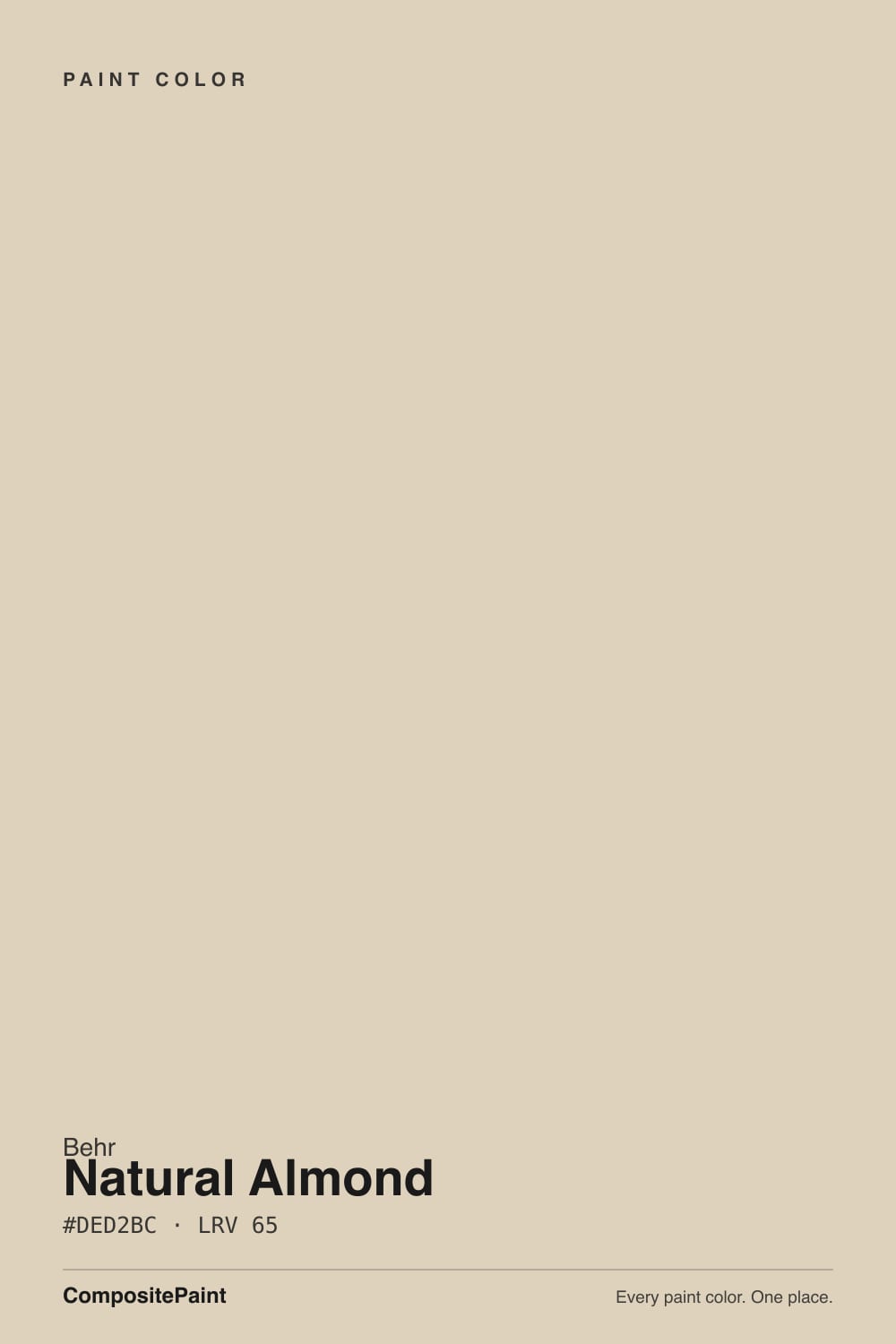
A soft warm beige with a faint yellow-tan cast — canvas beige, not greige, and not a white no matter how many Pinterest pins label it one. Behr puts PPU4-12 in the yellow family and describes it as a creamy tan; Home Depot's product line is more useful: canvas beige with a creamy undertone that, depending on the light, may appear as a medium-tone peachy beige on the walls. That is the whole personality. It is the classic builder wall color for open plans that need bounce without looking freshly primed. The name also carries baggage the chip cannot shake: almond was the appliance-and-builder-beige of the 1980s and 1990s, and four walls of this will remind some guests of that kitchen even if you never owned a harvest-gold stove.
At LRV 65 it sits in the useful light-beige band: seven points lighter than Accessible Beige (LRV 58), two points deeper than Natural Linen (LRV 67), and nine points deeper than Behr Navajo White (LRV 74). Put it next to Polar Bear (LRV 94) or Ultra Pure White (LRV 97) and the sandy body is obvious — those are whites, this is a color. That gap is useful on a whole main floor (it hides patches and roller marks a bright white would broadcast) and dangerous as soon as leftover builder-white trim sits next to it. Independent matches read it as a light, warm beige with a soft almond undertone and restrained saturation: slightly golden, never sharp cream, never gray.
Undertone in one line: yellow-tan first, a faint peach second — never gray, never pink in the can. A Home Depot reviewer who expected tan wrote that it is yellow, literally; a Reddit owner who painted their walls called it warm, neutral, and not yellow for a beige. Both can be right. Cool north light and a brighter white neighbor shove the yellow forward until it looks dated; south sun and oak keep it in the canvas-beige zone people meant. If the sample looks peachy at 4 p.m., that is the paint. If it looks dingy, look at the trim and the bulbs before you blame the gallon.
Where It Shines
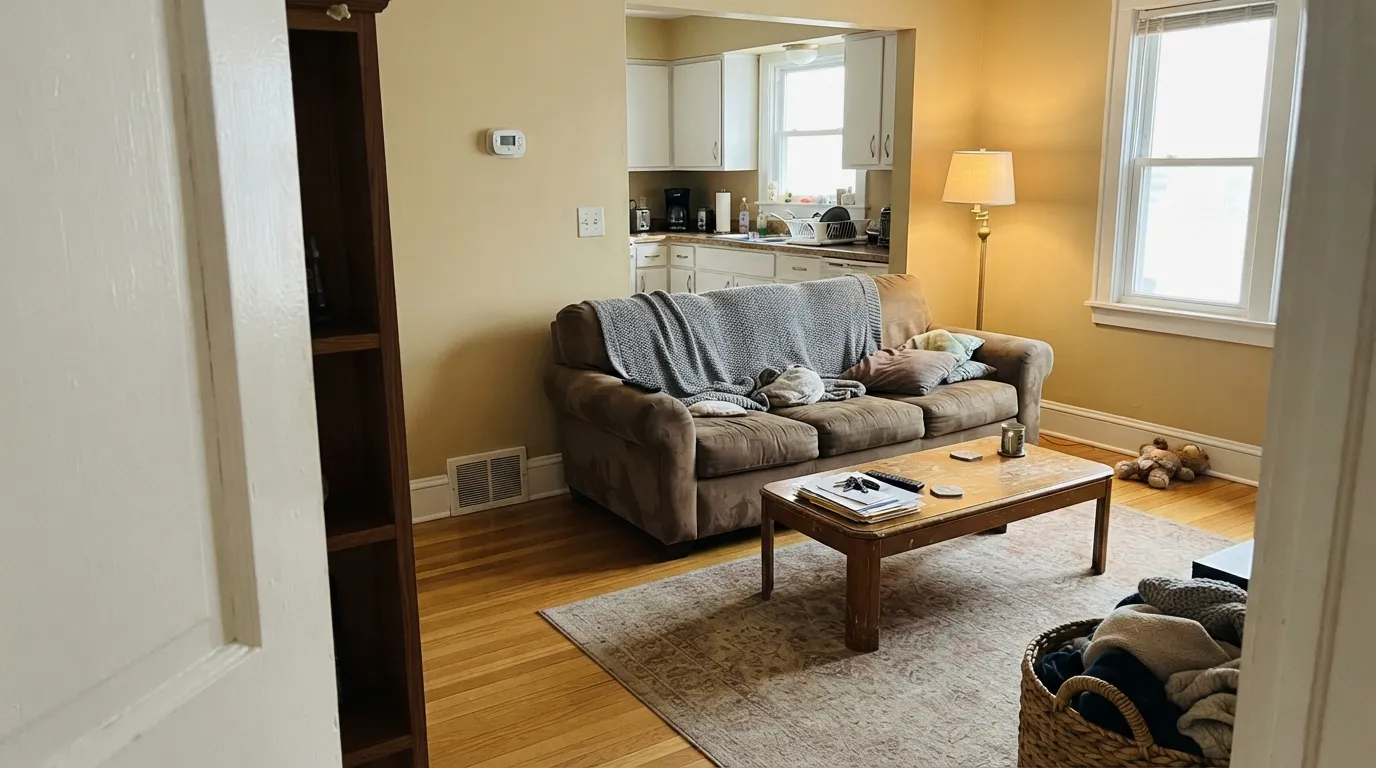
Give it real daylight, oak, and a cream trim that stays on the warm side and it does the job builders hired it for: the open plan reads finished instead of white-box, the floors stop looking leftover, and the yellow-tan stays quiet enough to live with. South and west living rooms are its home turf. Hallways that have to connect rooms are the second job — LRV 65 carries without washing out. Behr's own pairing list names Cottage White as the trim, which is the right instinct: a farmhouse cream that never learned to be neutral, so the wall and the woodwork stay in the same family.
Where It Fails
Almost every regret about Natural Almond is the same surprise told three ways: someone thought they bought a quiet greige, they parked a real white next to it, or the room had nothing warm to say back. The paint is consistent. What changes is the room.
On the chip it can pass as a light beige. On four walls the yellow-tan is the whole story — Home Depot files it beige/cream, Behr files it yellow, and a reviewer who wanted tan called it yellow, literally. If your goal was Accessible Beige's grayed tan or Agreeable Gray's greige, this is the wrong search. Those two stay more gray until the light goes cool; Natural Almond stays almond. Switch before you roll the whole floor.
Polar Bear (LRV 94) or Ultra Pure White (LRV 97) on trim, ceiling, or a door is the pairing that dates the room overnight. The bright white wins and Natural Almond looks dingy, peachy, and slightly dirty — the 1990s-almond look people paint over. Cottage White (LRV 82) is Behr's own trim pairing and stays warm enough that the wall still reads as a decision. If you want contrast, go darker (navy, charcoal), never brighter.
Gray LVP, gray-washed oak, and Carrara-look stone sit at the opposite temperature and shove the yellow-tan into peach. The floor looks colder; the wall looks like old enamel. Warm rugs will not rescue a whole-house gray-floor remodel. With cool hard finishes, pick Accessible Beige or a true greige and let warmth come from wood, not from a yellow-family wall.
Room by Room
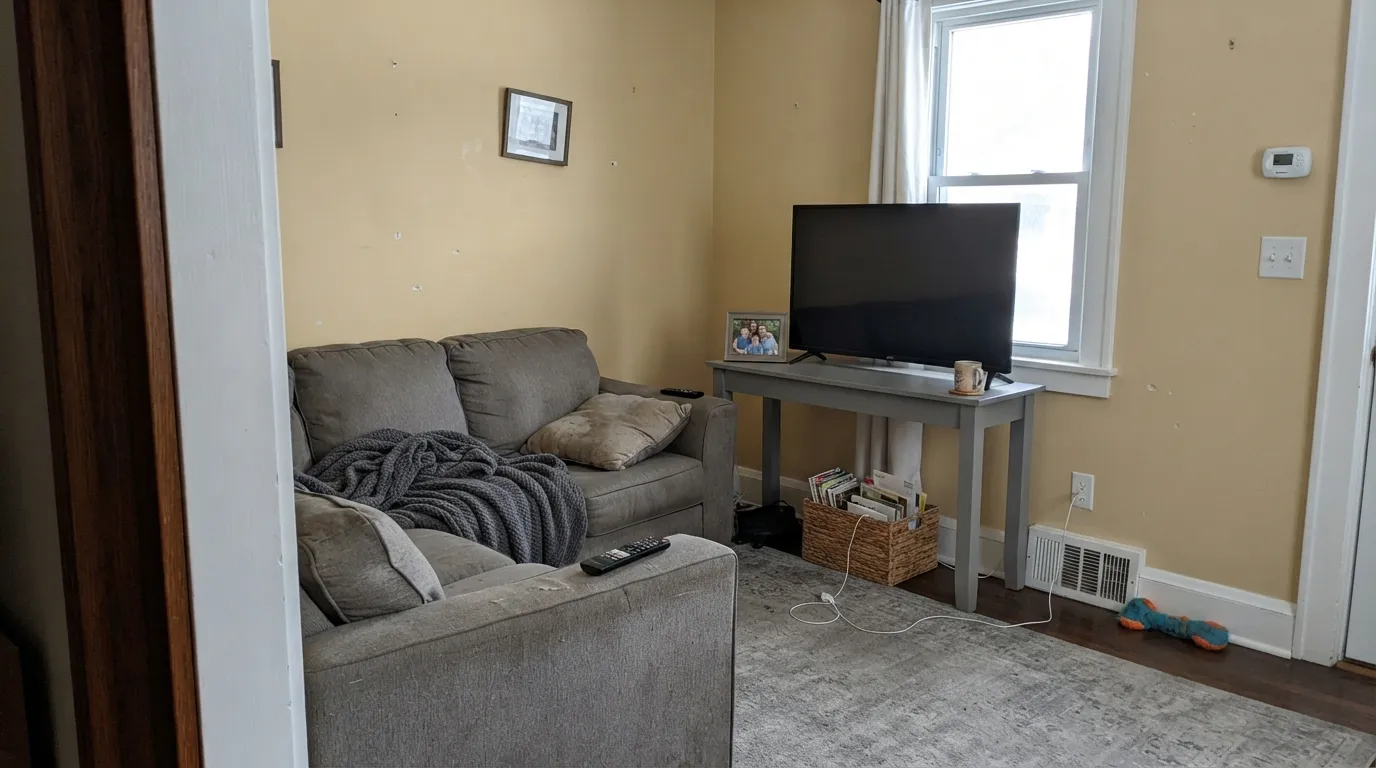
South or west daylight, oak floors, and cream furniture are where PPU4-12 looks like a decision instead of leftover builder beige. Eggshell on the walls; Cottage White or Behr Swiss Coffee on trim in semi-gloss. Check the west wall at 4 p.m. — that is when the peachy beige Home Depot warns about actually shows.
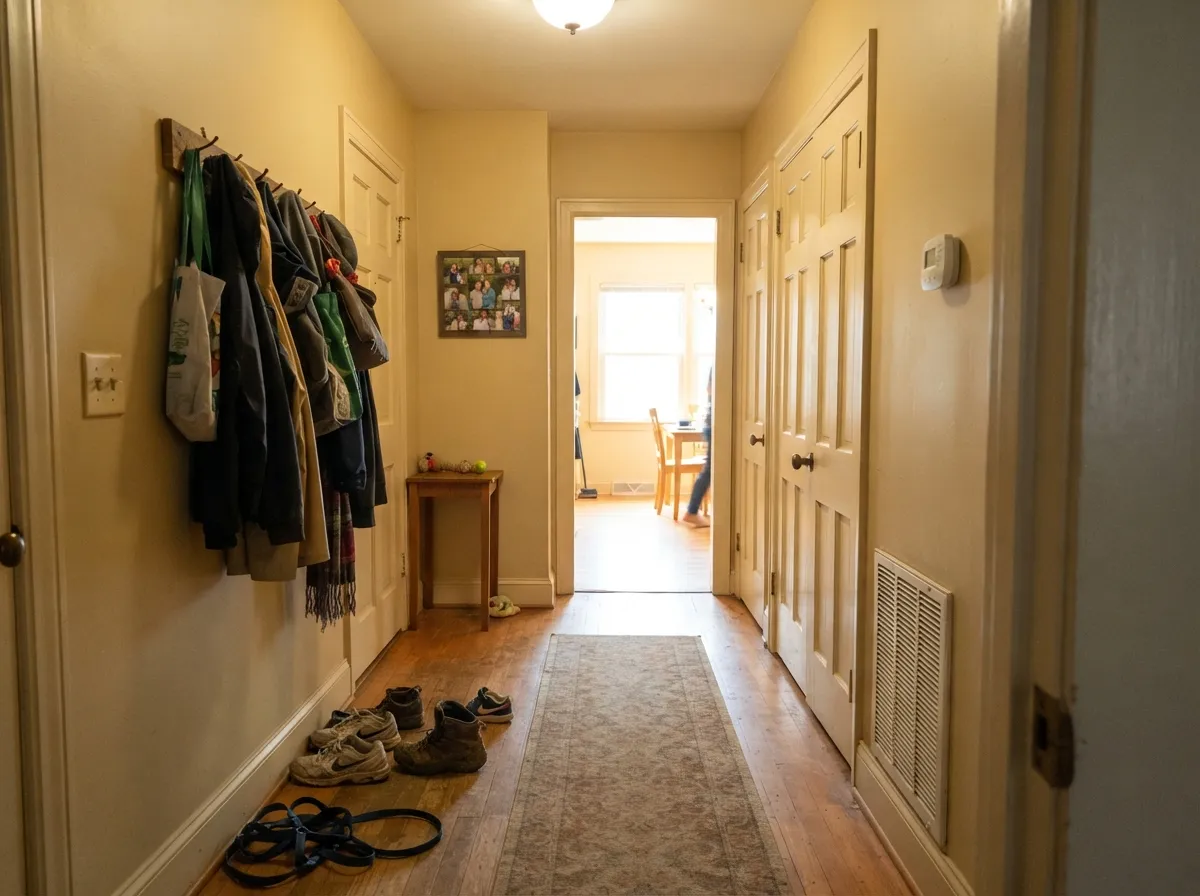
LRV 65 is why this color keeps getting specified: light enough to carry a main floor, deep enough that a long hall does not go hospital-white. Same color on the doors in semi-gloss so the handoff does not flash. Windowless stretches will look a step deeper and more tan than the living room — that is low light, not a bad batch.
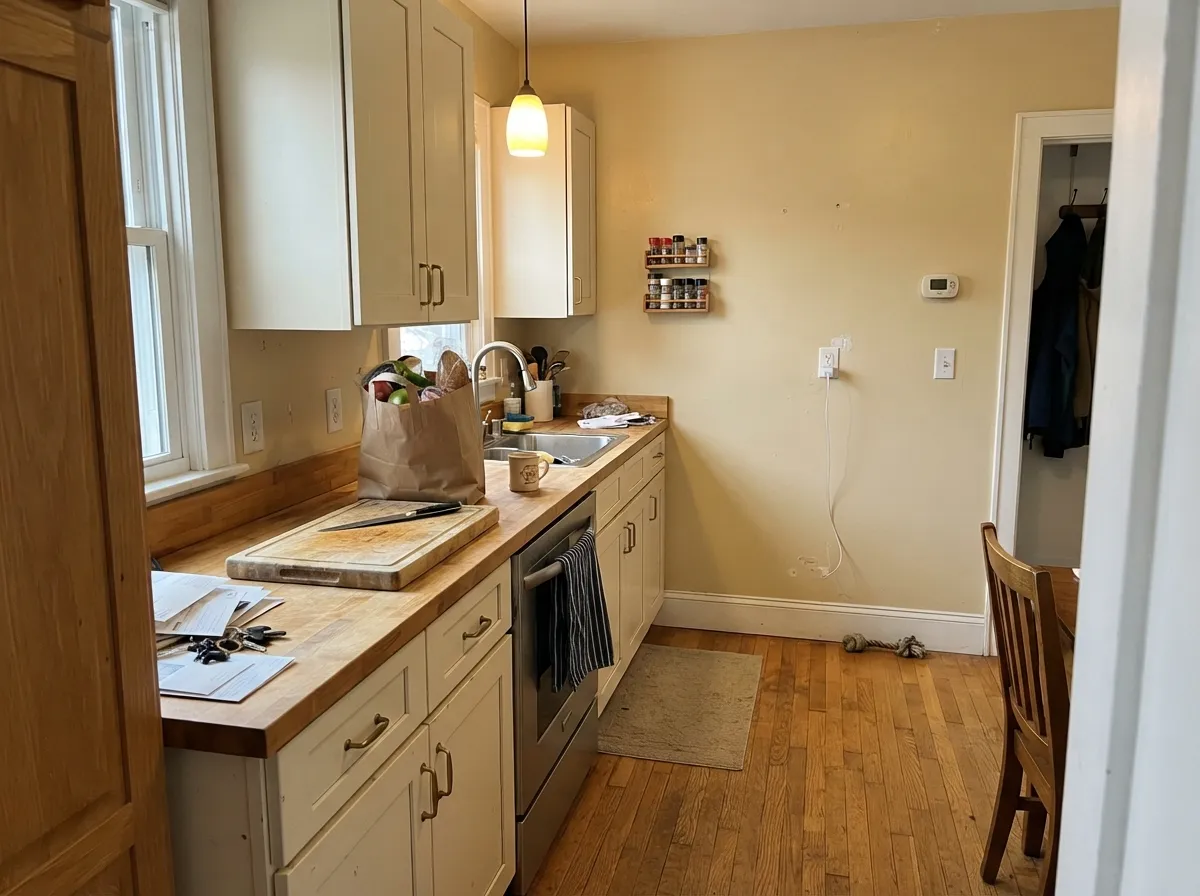
Butcher block, honey oak, brass, and cream or tan stone love it. Gray quartz and a wall of stainless shove the yellow forward until the walls look sour. Keep it on the walls and let Cottage White take the cabinets unless you specifically want beige doors; satin enamel either way.
At LRV 65 it stays light enough to wake up to and warm enough to settle at night. 2700K bulbs turn it creamier and slightly peachy; cool LEDs turn it dingy yellow. Cream or white bedding, not gray. If the bedroom faces north and stays dim, Accessible Beige is the safer beige.
Evening rooms flatter the tan. A walnut or oak table, cream linen, brass, one warm chandelier — the yellow-tan reads as candlelight on the wall. Eggshell, same cream trim as the rest of the floor so the handoff does not flash a brighter white.
Travertine, wood vanities, and brass: fine. Gray tile, cool marble, and chrome: it argues. Outside, full sun lifts a color this light toward pale stucco-tan, which can work on a sunny ranch with Iron Ore shutters; the shaded north elevation will read a full step creamier. Sample that wall. Do not put it on a gray-roof, gray-stone house and hope it modernizes.
Your Light Is the Risk
Warm daylight is where the canvas beige looks intentional — tan in a good way, not dingy. This is the light the color was built for.
Cool gray daylight strips the cream and leaves a dingy yellow-beige. Dim north rooms with no lamps are the rental-almond look people regret.
Morning holds it to a quiet canvas beige; west afternoon and golden hour push it toward the medium peachy beige Home Depot warns about. Sample the sunny wall at 4 p.m. before committing.
2700K lamps: creamier, cozier, slightly peach. Cool 4000K LEDs: sour gray-yellow. Swap the bulbs, not the paint.
Most complaints about Natural Almond are a light mismatch. Upload a photo of your actual room and see it on your walls — then ask for the same wall in north light or evening lamps before you buy a single sample.
Need It From Another Brand?
Any paint counter can custom-tint Behr PPU4-12 directly. If you would rather stay in one brand's own deck, these are the closest stock matches, measured as ΔE2000. Under 2 is a difference you will not see on the wall.
| Brand | Closest color | ΔE | LRV | |
|---|---|---|---|---|
| Sherwin-Williams | Maison BlancheSW 7526 · Sherwin-Williams | 1.5 | 66 | Color page → |
| Benjamin Moore | Dulce de LecheCSP-250 · Benjamin Moore | 0.2 | 66 | Color page → |
| Valspar | QuillV094-1 · Valspar | 0.4 | 65.3 | Color page → |
| PPG / Glidden | Almond BrittlePPG1095-3 · PPG / Glidden | 2.5 | 66 | Color page → |
| Glidden | Georgian Ivory40YY 62/134 · Glidden | 0.9 | 62 | Color page → |
| Dutch Boy | Barely Beige316-1DB · Dutch Boy | 2.4 | 66 | Color page → |
Similar Behr Colors
The nearest shades to Natural Almond within Behr's own range, ranked by perceptual color distance — useful when you want the same look a touch lighter, darker, or warmer.
WCAG 2.1: AA is 4.5 : 1 for normal text, 3 : 1 for large text, AAA is 7 : 1.
Natural Almond vs the Colors You're Also Considering
Every Natural Almond sample board has the same rivals on it. The numbers show the real lightness gap — then it comes down to which risk you would rather live with.
Pick this when you actually want the ungrayed builder beige: lighter, more yellow, and honest about being almond.
Sherwin-Williams SW 7036 · LRV 58Accessible BeigePick this if you wanted a grayed modern beige — the safest warm neutral until the light goes cool, and seven points deeper so it stays quieter than this yellow-tan.
Pick this when you need the lighter canvas beige for an open plan, not a creamier wall with more body.
Behr PPU5-12 · LRV 60Almond WispPick this if you want Behr's warmer cream in the almond neighborhood — five points deeper, a color the brand never bothered to market that still does the job.
Pick this when you want the yellow-tan to stay; Natural Tan will look too gray next to oak that wanted a builder beige.
Sherwin-Williams SW 7567 · LRV 65Natural TanPick this for the same LRV 65 with the yellow grayed out — a quiet tan between beige and greige, as long as you can live with a possible north-room blush.
Pick this when you mean beige, not cream. Navajo White still tries to pass as a warm white; Natural Almond does not.
Behr 22 · LRV 74Navajo WhitePick this if you want the lighter, sandier Home Depot cream — nine points brighter, more yellow-white than beige, still not a modern white.
Inside the Behr deck the neighbors are close enough that sampling side by side is the only way to tell. Spanish Sand OR-W07 at #DCD0BD and LRV 64 is a shade deeper and slightly grayer. Toasted Cashew PWN-66 at #E2D0B8 and LRV 65 pushes further into gold. Stone Wash QE-10 at #E4D2BE and LRV 66 is a step lighter and warmer, and Pale Lichen PPL-79 at #D8D4BF and LRV 65 trades some of the red-orange for a faint green, which reads cooler on a wall.
Across brands, several colors land in the same place. Sherwin-Williams Maison Blanche SW 7526 at LRV 66 has a deltaE of 1.47, close enough to be visually identical in normal room light. Farrow and Ball Off-White No. 3 at LRV 66 is a deltaE of 2.32, very close but worth sampling first. Portola Paints Figueroa at LRV 63 is a deltaE of 4.31, close but visibly different side by side, reading grayer and flatter than Natural Almond does.
Natural Almond Coordinating Colors
The rule for coordinating with PPU4-12 is simple: stay on the warm side, and never put a brighter white next to it. It flatters cream trim, oak, brass, deep navies, and mossy olives — and it argues with icy whites, cool grays, and blue-gray stone. Behr's own pairing list names Cottage White as the trim. When someone already has almond on cabinets and wants a grayed wall, Behr's named Greige is a mid-tone sandy gray — not an airy Instagram greige — which is why it can sit next to the millwork without washing out. These are the partners that keep showing up in rooms that work:
A Builder Beige, Not a Famous One
Natural Almond is not a Color of the Year and it is not a viral kitchen. It is a long-running Home Depot beige in Behr's yellow family, the kind of color contractors grab when an open plan needs to look light without a gallery white. The almond name does the rest of the work: for a generation of American houses, almond meant the builder package — appliances, laminate, wall paint — and that association is why some people love this chip on sight and why others will not live with it.
That is also why Pinterest pins calling it a white are doing you no favors. At LRV 65 it is a beige with body. Put a Polar Bear door next to it and the yellow-tan is the only thing anyone sees. If you fell in love with a grayed beige on a design blog, sample Accessible Beige or Natural Tan instead; if you actually want the ungrayed builder look, this is one of the honest cans for it. Walk a large board through south light, north light, and 4 p.m. west sun before you buy gallons.
Natural Almond With Wood Tones and Floors
This decision gets made at the floor. Honey oak, red oak, walnut, butcher block, and cedar all sit comfortably against PPU4-12 because the yellow-tan in the paint meets the yellow in the wood instead of amplifying a clash. Orange-leaning builder oak is the pairing people worry about with cool whites; this beige is one of the few light neutrals that absorbs that orange instead of spotlighting it.
The honest no is cool gray: gray LVP, gray-washed oak, blue-gray porcelain, Carrara-look quartz. Those surfaces pull the yellow-tan into relief until the wall looks peachy or dingy rather than canvas. A large warm rug helps a mixed room; it will not save a whole-house gray-floor remodel. Brass, bronze, and oil-rubbed hardware belong here; polished chrome is the metal that makes the almond look dated.
Three Ready Palettes Built on Natural Almond
A color is never alone on the wall. These are complete combinations in the 60-30-10 pattern, with the reason each one holds together. Every one opens in the visualizer.
Cottage White is Behr's own trim pairing for Natural Almond — a farmhouse cream that never learned to be neutral, so the 17-point LRV gap reads as woodwork, not as dingy walls. Hale Navy on the door is the one dark note a 65-LRV house needs so the beige does not float.
Try this palette in your roomSwiss Coffee is the warmest of the safe off-whites, and it shows — which is what beige walls need on the doors so the cabinets stay the lightest thing in the room. Secret Meadow is moss-olive island weight, not a gray-green wall, so it gives the beige a dark green note without going sage-gray. Keep the counters warm; cool quartz will push the almond yellow.
Try this palette in your roomOne cream trim through the room keeps the yellow-tan from flashing dirty against a brighter white. Cracked Pepper on the doors is a near-black that shifts with the light — the chameleon dark that gives a builder beige a contemporary edge without going cool-gray.
Try this palette in your roomNatural Almond FAQ
Is Natural Almond warm or cool?
Warm — yellow-tan, filed by Behr in the yellow family. It will not read gray except in cool north light or against gray floors, and even then the yellow is still there. If you want a beige that can pass for greige, this is the wrong one.
Will it look yellow or peach on my walls?
It can look both. Home Depot describes it as a canvas beige that may appear as a medium-tone peachy beige depending on the light, and a reviewer who expected tan called it yellow, literally. South light with oak keeps it in the beige zone. West sun, 2700K bulbs, and a brighter white trim push the peach and the yellow. Sample the sunniest wall and the north wall; they will not agree.
What trim white goes with Natural Almond walls?
Cottage White, in semi-gloss — that is Behr's own pairing, a farmhouse cream that stays on the warm side. Behr Swiss Coffee also works if you want a slightly lighter cream — the warmest of the safe off-whites, and it shows. Polar Bear and Ultra Pure White are the usual Home Depot defaults and the usual mistake: both are so much brighter that the walls look dingy. If you want contrast, go darker, never brighter.
Does it work with oak floors?
That is the reason to buy it. Honey oak, red oak, and older builder stain all meet this color halfway — the yellow-tan in the wall takes the orange so the floor looks calmer. Pale white oak is fine. Cool gray LVP is the one honest no.
Is it the same as Almond Wisp?
No. Same store, similar name, different job. Almond Wisp (PPU5-12, LRV 60) is a slightly deeper warm cream. Natural Almond (PPU4-12, LRV 65) is the lighter canvas beige with a clearer yellow-tan. If you landed on one because you searched almond, sample both; they will not read the same on four walls.
Can I paint a whole house this color?
An open main floor with decent south or west light, yes — that is the builder use. Skip the dim north bedroom, the gray-floor basement, and any room whose trim is staying Polar Bear. Hallways, living rooms, dining rooms, and a warm kitchen will carry. A north cave will look like rental almond.
Have you painted with Natural Almond?
Rate it — one tap helps the next reader decide.
Ask a Question