Secret Meadow
The deep olive-moss green specced for kitchen islands, reviewed honestly: where the gold comes forward, the light that turns it khaki, and what to pick instead.

Jessica has spec'd whites and neutrals for more than 300 rooms and keeps a sample wall of painted drawdowns in her studio. Every color review is checked against real reader rooms in the comments and re-tested when a formula changes. About the testing process →
- 1Essex Green6
- 2Vintage Vogue12
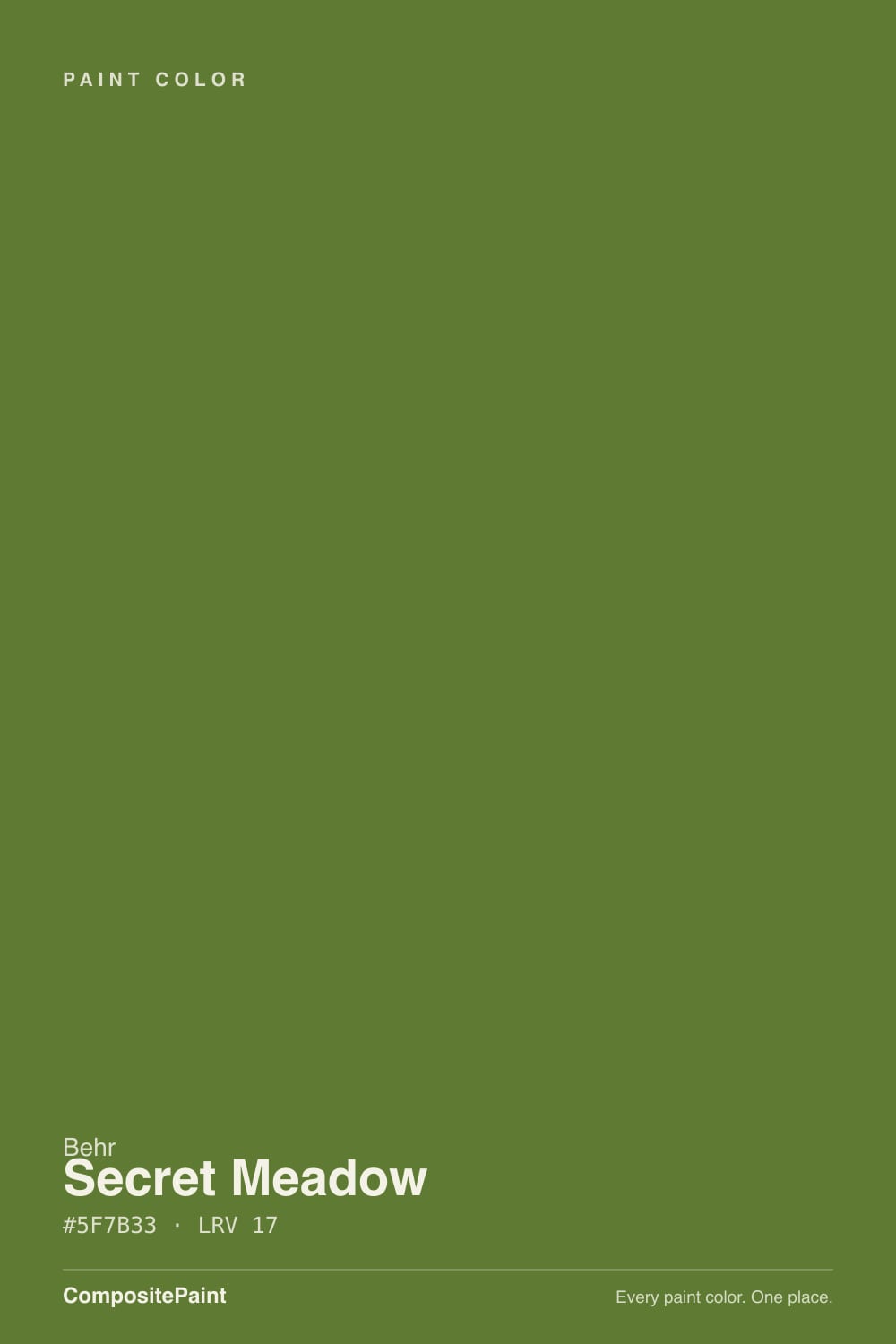
- 3Secret Meadow17
- 4Sage Green22
- 5Evergreen Fog30
The Fast Verdict
Secret Meadow is olive, not sage — a mossy, yellow-leaning green at LRV 17 that puts real weight on a kitchen island or a run of built-ins. In south light it reads green-gold and expensive; in a dim north room it collapses toward khaki-brown and people call it muddy. Buy it for furniture-like surfaces and shutters. Do not buy it hoping for a gray-green wall.
Kitchen islands and painted built-ins · dining rooms and studies with real windows · shutters and one committed accent wall · anyone who wants moss-olive, not sage-gray
You actually wanted sage or a gray-green · the room is dim, north, or windowless · your floors are cool gray LVP · you need a whole-house wall color
- Real olive-moss — not a gray pretending to be green
- Ideal depth for islands, built-ins, and shutters
- Flatters oak, walnut, brass, and aged bronze
- Holds its color in bright rooms where paler sages wash out
- Easy to sample and buy — a Home Depot staple, not a special-order mood
- Not sage — buyers expecting gray-green see khaki-olive by the second wall
- At LRV 17 it goes muddy brown in dim or north light
- Fights cool gray floors and icy bright whites
- Too dark and too chromatic for whole-house walls
What Color Is Secret Meadow, Really?
A muted olive-moss with a yellow cast and a grayed, weathered finish — grassland, not pine. Most dark greens people reach for on islands are either smoky gray-greens (Pewter Green) or dusty sage (Dried Thyme). Secret Meadow sits beside them and adds the yellow. That yellow is the whole personality: on the chip it can pass for a quiet moss; on an island or four walls it is unmistakably olive, the color of dried meadow grass after a dry summer. Behr made it Color of the Month in 2020, right as the olive-island kitchen took over, and it has lived in the Home Depot lane ever since as the earthy dark green you can actually buy on a Saturday.
At LRV 17 it is a genuine dark. That number is the review. Next to Dried Thyme (LRV 21) it looks a step deeper and noticeably more gold; next to Pewter Green (LRV 12) it looks the friendlier, more chromatic option — still dark, still a decision. Pale sages wash out in a bright kitchen; this one holds its moss in full sun and then sinks toward khaki-brown after dark. Plan for the large surface to read deeper and more yellow-olive than the chip. Depth multiplies undertone on every muted green, and this one is no exception.
Undertone in one line: yellow-olive first, gray-brown second — never blue, never mint, never cool sage. If the sample reads green-gold, that is south sun doing its job; if it reads khaki or muddy, the light is cool or the room is too dim. Both versions are the same paint being honest about the room.
Where It Shines
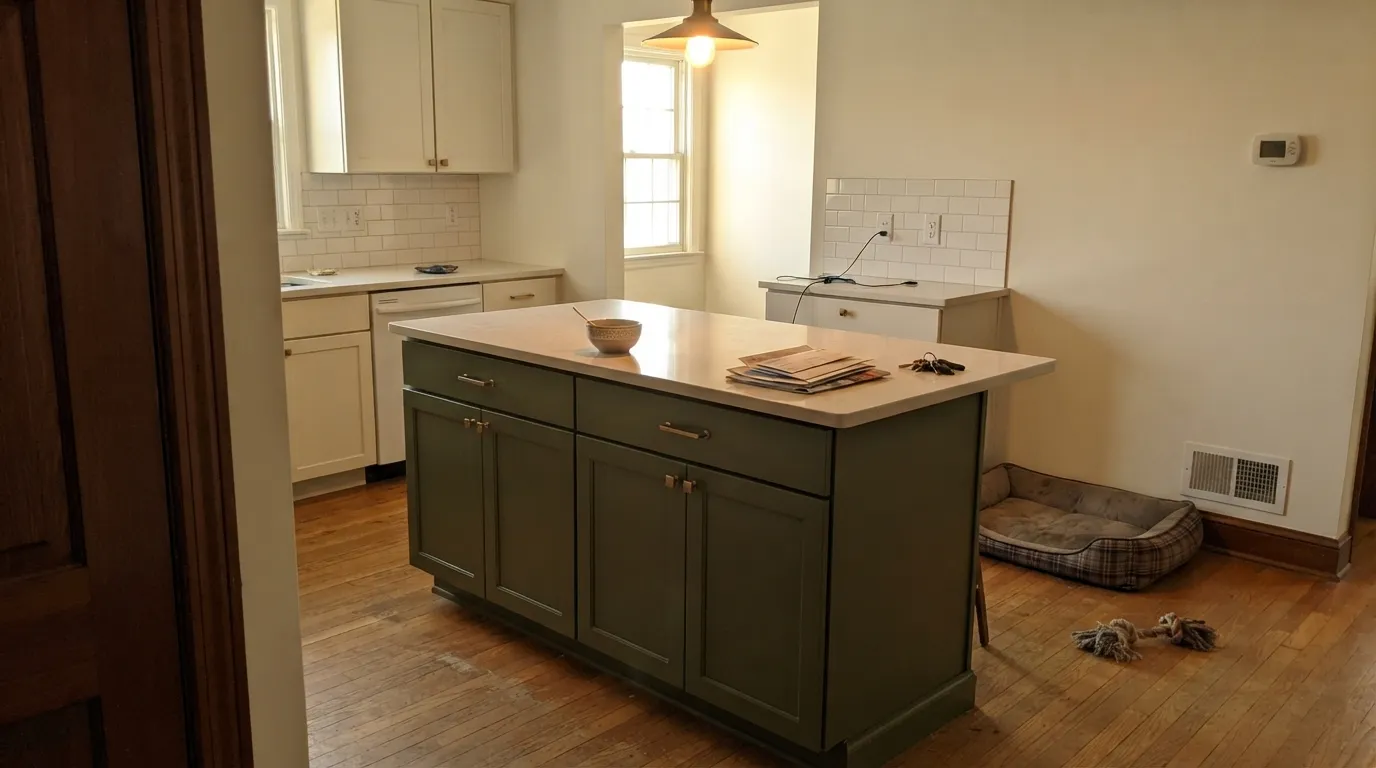
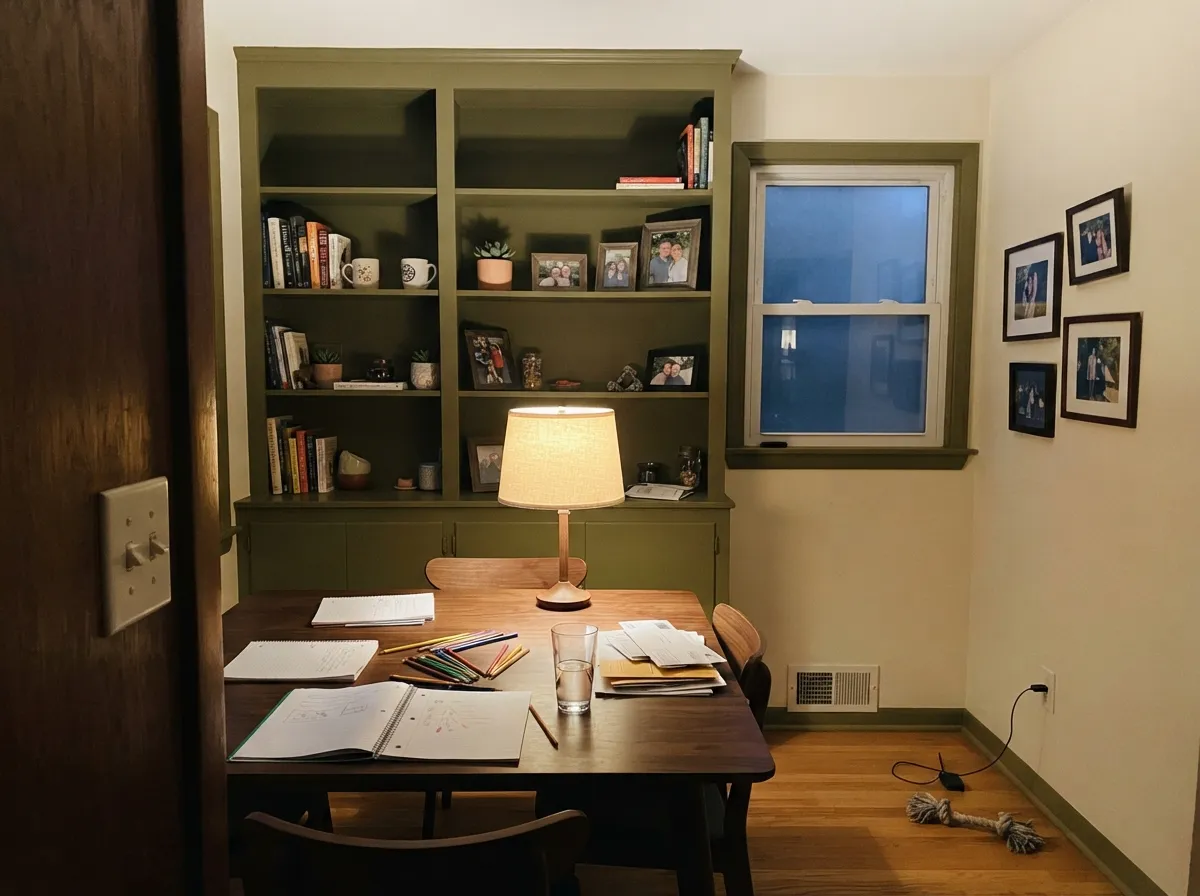
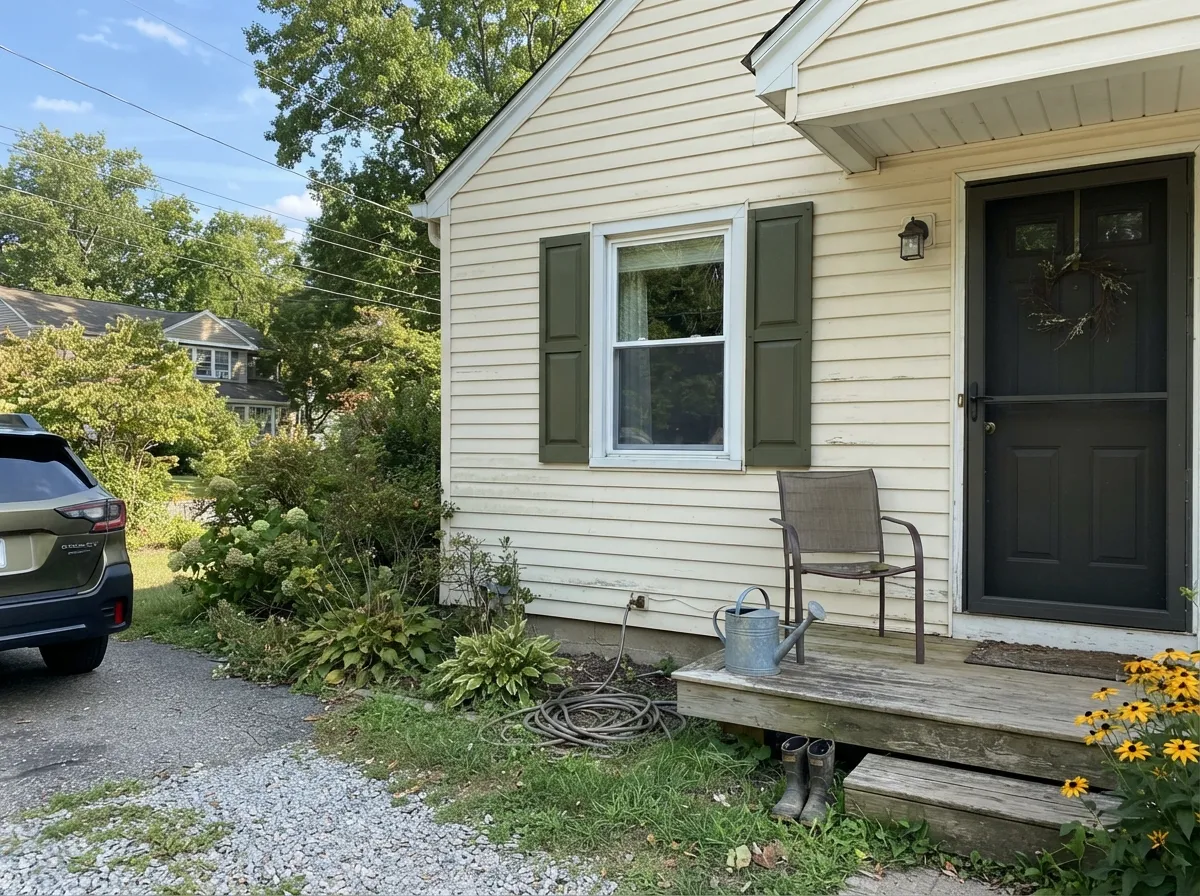
This color is built for surfaces that should feel like furniture. On a kitchen island, a wall of dining-room built-ins, or a study bookcase, LRV 17 reads as weight instead of gloom — especially with a light perimeter, oak or walnut, and brass. Its second home is the small outdoor commitment: shutters or a front door on a cream or warm-white house, where full sun pulls the meadow-gold out and the olive looks intentional from the street. Give it warm lamps at night and it stays mossy instead of going army-green.
Where It Fails
Almost every regret story about Secret Meadow follows one of three scripts, and all three are visible on the sample wall before you open a gallon. None of them are the paint's fault — but if your room matches one, this is not your green, and a third coat will not fix it.
On the chip it can pass for a grayed moss. On an island or four walls the yellow-olive is unmistakable — depth multiplies undertone, and this undertone is gold, not gray. If your goal is a dusty sage that behaves like a neutral, this is too much meadow; look at Evergreen Fog (LRV 30) or Dried Thyme (LRV 21) and let the green stay quieter.
Cool, weak light kills the gold and leaves a flat khaki-brown that readers describe as muddy or dirty. LRV 17 has almost nothing to bounce. The fix is not more paint: add 2700K lamps, or pick a lighter green that still reads as a color when the sun is gone. Windowless baths and interior halls are the worst version of this.
Yellow-olive sits across the wheel from blue-gray. Cool gray LVP, gray-washed wood, and a stark bright trim white all push Secret Meadow toward mustard while the floor goes colder. Both sides lose. It wants creamy or grayed warm whites — Alabaster, White Dove, Behr Swiss Coffee — and natural wood. Save the gallery white for a different green.
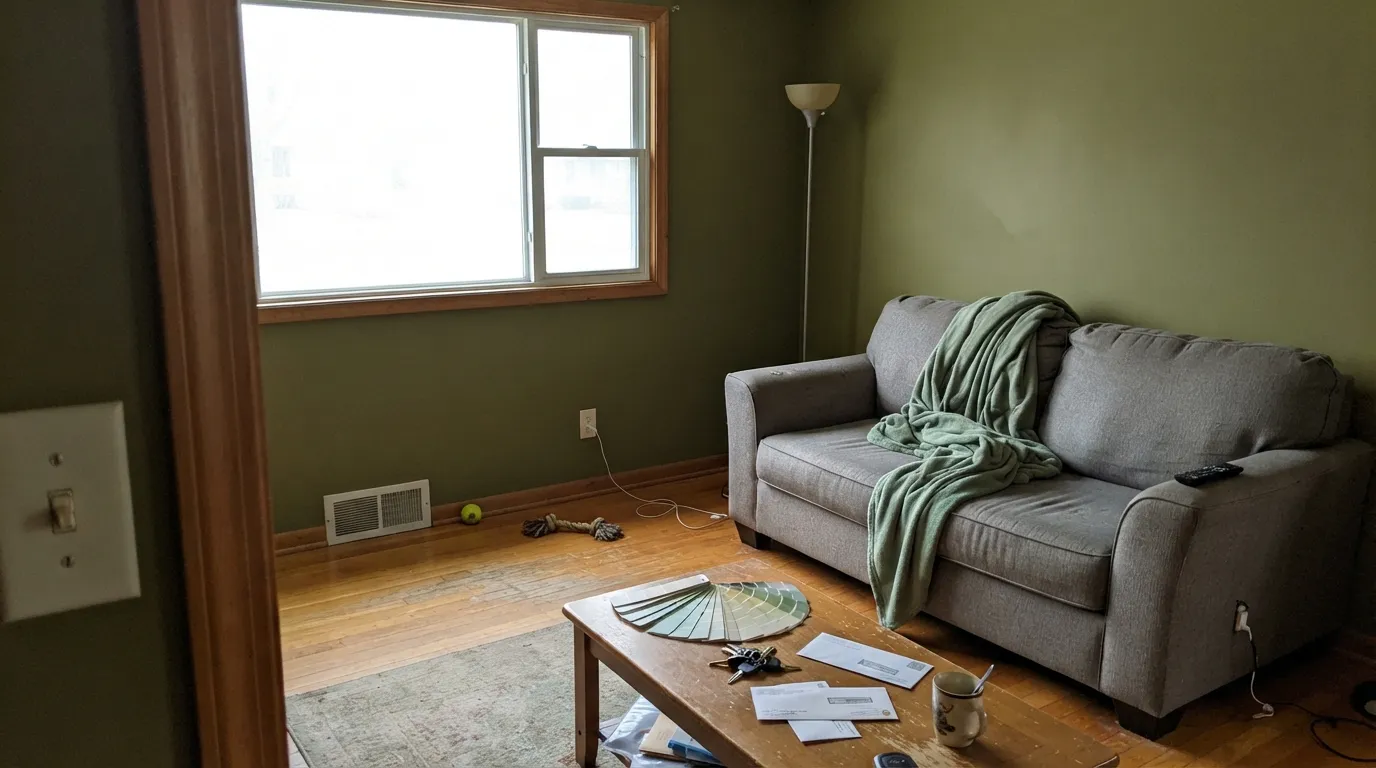
Room by Room
This is the surface the color was specced for. Satin on the island, a light perimeter in Alabaster or Behr Swiss Coffee, oak or walnut floors, brass or bronze pulls. At LRV 17 it anchors the room without the hardness of black. Full uppers and lowers in a small kitchen is the version that closes in — keep the perimeter light unless the space is large and south-facing.
A wall of painted shelves or a hutch is the designer move: the olive reads custom, the room stays bright, and books and pottery look settled. Four dining-room walls work if there is a real window and warm lamps at dinner. Eggshell on walls, satin on the millwork.
A study is allowed to feel enclosed, which is exactly what this depth delivers. Eggshell walls, trim in White Dove or Alabaster, one lamp on the desk. North-facing with a single window is the version that goes khaki by mid-afternoon — sample that wall at 4pm before committing.
Beautiful in a closed, daylit living room with cream upholstery, walnut, and brass. Riskier in open plans, where the yellow-olive has to negotiate with kitchen wood tones and whatever greige the adjacent rooms wear. Accessible Beige next door is a safe handoff — it stays on the warm, earthy side.
Behind the headboard it is restful and takes cream bedding well. All four walls in an average bedroom, especially a north one, tips from cozy to cave. If you love the look but the light is average, keep three walls in a warm white and let one wall carry the moss.
Full sun does what a dim interior cannot: it lifts the gold-green out and the olive reads rich from the curb. Excellent as shutters or a door on a cream, stucco, or warm-white body. A whole house in Secret Meadow is a bolder bet and will read much more yellow-olive in southern exposure than the chip suggests — walk the sample around the house at noon.
Your Light Is the Risk
Strong sun wakes the yellow-olive and the color reads green-gold moss all day. This is the light the island photos were taken in — the reason to buy it.
Cool, weak daylight kills the gold and leaves a flat khaki-brown. Fine if you half-wanted a muddy olive; disappointing if you wanted meadow green.
Morning east light is the most honest moss-green read; west afternoon flushes it gold for an hour. Sample on the actual wall at 8am and 5pm before committing.
2700K bulbs keep the olive warm and mossy after dark. Cool 4000K LEDs — including a lot of under-cabinet strips — strip the gold and leave army-khaki. Swap bulbs before you swap paint.
Most complaints about Secret Meadow are a light mismatch. Upload a photo of your actual room and see it on your walls — then ask for the same wall in north light or evening lamps before you buy a single sample.
Need It From Another Brand?
Any paint counter can custom-tint Behr S360-6 directly. If you would rather stay in one brand's own deck, these are the closest stock matches, measured as ΔE2000. Under 2 is a difference you will not see on the wall.
| Brand | Closest color | ΔE | LRV | |
|---|---|---|---|---|
| Sherwin-Williams | Garden SpotSW 6432 · Sherwin-Williams | 3.4 | 17 | Color page → |
| Benjamin Moore | Shady Lane497 · Benjamin Moore | 1.8 | 17 | Color page → |
| Valspar | Farm FreshV058-6 · Valspar | 2.4 | 17.3 | Color page → |
| PPG / Glidden | Gratefully GrassPPG1115-7 · PPG / Glidden | 1.9 | 16 | Color page → |
| Glidden | Gratefully GrassPPG1115-7 · Glidden | 1.9 | 16 | Color page → |
| Dutch Boy | Ferned Green324-5DB · Dutch Boy | 1.4 | 17 | Color page → |
Similar Behr Colors
The nearest shades to Secret Meadow within Behr's own range, ranked by perceptual color distance — useful when you want the same look a touch lighter, darker, or warmer.
WCAG 2.1: AA is 4.5 : 1 for normal text, 3 : 1 for large text, AAA is 7 : 1.
Secret Meadow vs the Colors You're Also Considering
Every Secret Meadow sample board has the same rivals on it. The numbers show the real lightness gap — then it comes down to which risk you would rather live with.
Pick this when you want the moss and the gold, not a dusty sage.
Sherwin-Williams SW 6186 · LRV 21Dried ThymePick this if you want the same cabinet depth with less yellow — a gray-sage that behaves more like a muted green-neutral.
Pick this when you want people to actually see green, with meadow instead of smoke.
Sherwin-Williams SW 6208 · LRV 12Pewter GreenPick this if you want the famous island green that reads smoky gray first and green second — cooler, deeper, less olive.
Tree Hugger S340-7 at #677C2D and LRV 17 is the closest sibling in the Behr deck. It is the same lightness but noticeably more yellow, so it reads as a brighter chartreuse-olive where Secret Meadow stays a little deeper and greener. Egyptian Nile 420F-6 at #5C7D46 and LRV 17 goes the other way, with more true green and less yellow, which makes it calmer. Truly Olive S350-6 at #657439 and LRV 16 is browner and more muted.
Across brands, the nearest match on file is Dutch Boy Yellowed Green 225-6DB at #647630 and LRV 16, with a deltaE of 2.76. That is very close, but sample it first rather than assuming a swap. Valspar Shepherd's Green 8002-30G at LRV 17 has a deltaE of 3.55, and Sherwin-Williams Paradise SW 6720 at LRV 18 is 3.7. Both are close but visibly different side by side, with Paradise reading yellower.
Secret Meadow Coordinating Colors
The rule for coordinating with Secret Meadow: warm whites, earthy greiges, and near-blacks — and keep cool gray and icy white at arm's length. It pairs with cream far better than with beige-gone-yellow, loves walnut and brass, and layers with quieter sages if you want more than one green in the house. These are the partners that keep showing up in rooms that work:
Color of the Month, Not Color of the Year
Behr named Secret Meadow Color of the Month in 2020 — a grassland olive pushed during the same years Pewter Green and Dried Thyme were landing on every kitchen island in the country. It was never Color of the Year, never a viral paint-chip moment, and that is useful information. You are not buying a trend stamp. You are buying the Home Depot version of the olive-island look: mossier and more yellow than the Sherwin-Williams celebrities, easier to get on a Saturday, and just as dependent on daylight.
Here is why it still earns a review: at LRV 17 it does a job paler sages cannot. It puts weight on millwork. If the olive-island era cools off, a muted moss on an island or a shutter ages closer to a classic dark green than to a dated accent. If you paint four living-room walls, you are making a louder bet than the Color of the Month ever asked you to make.
Secret Meadow With Wood Tones and Floors
This decision gets made at the floor, not the paint desk. Walnut and espresso are the color's best friends — the red-brown depth makes the olive read mossy and expensive. Medium oak and white oak are safe and keep the room from going lodge. Cream carpet is fine.
The honest maybe is orange honey oak: the yellow in the stain and the yellow in the paint can stack, and the room tips mustard. A large rug helps; a sample board on the actual floor at 3pm is cheaper than a repaint. The honest no is cool gray LVP and blue-gray tile. Yellow-olive and blue-gray exaggerate each other — the floor goes colder, the walls go khaki, and no sheen change fixes the geometry.
Metals are the easy part: unlacquered brass, antique bronze and matte black all work; polished chrome is the one that leans cold against it.
Three Ready Palettes Built on Secret Meadow
A color is never alone on the wall. These are complete combinations in the 60-30-10 pattern, with the reason each one holds together. Every one opens in the visualizer.
Alabaster keeps the kitchen from closing in and gives the island a clean, warm edge without stacking yellow on yellow. Accessible Beige is the earthy handoff into the living room so the olive reads like the same house getting quieter, not a color change.
Try this palette in your roomBehr Swiss Coffee is the warmest of the safe off-whites, and that cream is what makes olive millwork look vintage instead of lodge. White Dove trim stays a step quieter than the walls so the built-ins keep the spotlight. Sample the Swiss Coffee next to the olive in afternoon sun — two warms can stack.
Try this palette in your roomWarm-white siding lets the olive shutters read as meadow, not camouflage. Urbane Bronze on the door is the single dark note — a warm near-black that stays in the same earth family. Walk the shutter sample onto the north and south walls; south sun will show more gold.
Try this palette in your roomSecret Meadow FAQ
Is Secret Meadow sage or olive?
Olive — yellow-moss, not dusty sage. In cool or dim light it can pass for a weathered khaki, and in south sun it turns green-gold, but on a large surface nobody will call it sage. If sage is what you actually want, Dried Thyme or Evergreen Fog is the better lane; that mismatch is behind most of the bad reviews.
Is it good for a kitchen island?
That is its best job. Satin cabinet enamel, a light perimeter, wood floors, brass or bronze hardware. Keep the counters light — a dark slab against LRV 17 kills the contrast and the kitchen goes murky. Full perimeter cabinets in a small kitchen is a bigger commitment than the island alone.
What trim white goes with Secret Meadow?
A grayed warm white, not a gallery white. Alabaster and White Dove are the defaults; Behr Swiss Coffee if you want the cream-and-olive vintage look and you have sampled them together in afternoon sun. Ultra Pure White and other near-100 LRV trims make the olive look tired and khaki by comparison. Semi-gloss on the trim, eggshell or satin on the color.
Can I paint four walls Secret Meadow?
Only in a room that has real daylight and a job that is allowed to feel enclosed — a dining room, a study, a south-facing sitting room. An average living room or a north bedroom will go cave-khaki by late afternoon. If you love the color but the light is ordinary, put it on built-ins or one wall and keep the rest light.
Does Secret Meadow work with oak floors?
Walnut and medium oak are excellent — the brown depth makes the olive read mossy and deliberate. Pale white oak is safe and a little more modern. Orange honey oak is the one to sample in place: the yellow in the floor and the yellow in the paint can stack toward mustard. Cool gray LVP is the hard no.
Secret Meadow or Pewter Green for an island?
Pewter Green if you want smoky gray-green that most guests will not name as green. Secret Meadow if you want them to see olive. Pewter Green is deeper (LRV 12) and cooler; Secret Meadow is a step lighter (LRV 17) and much more yellow. Same job, different personality — sample both on the actual doors.
Have you painted with Secret Meadow?
Rate it — one tap helps the next reader decide.
Ask a Question