Dried Thyme
The dark sage everyone wants on kitchen cabinets, reviewed honestly: where it earns the hype, the rooms where it turns flat gray, and what to pick instead.

Jessica has spec'd whites and neutrals for more than 300 rooms and keeps a sample wall of painted drawdowns in her studio. Every color review is checked against real reader rooms in the comments and re-tested when a formula changes. About the testing process →
- 1Essex Green6
- 2Vintage Vogue12
- 3Dried Thyme21
- 4Evergreen Fog30
- 5Clary Sage41
The Fast Verdict
Dried Thyme is the green people choose when black feels too hard and a true sage feels too sweet. On cabinets it is close to perfect: deep enough to anchor a kitchen, muted enough that it never looks like a color trend.
The catch is LRV 21. In a dim or north-facing room the green quietly drains out and you are left with a heavy dark gray, so this color lives or dies on your light and your bulbs.
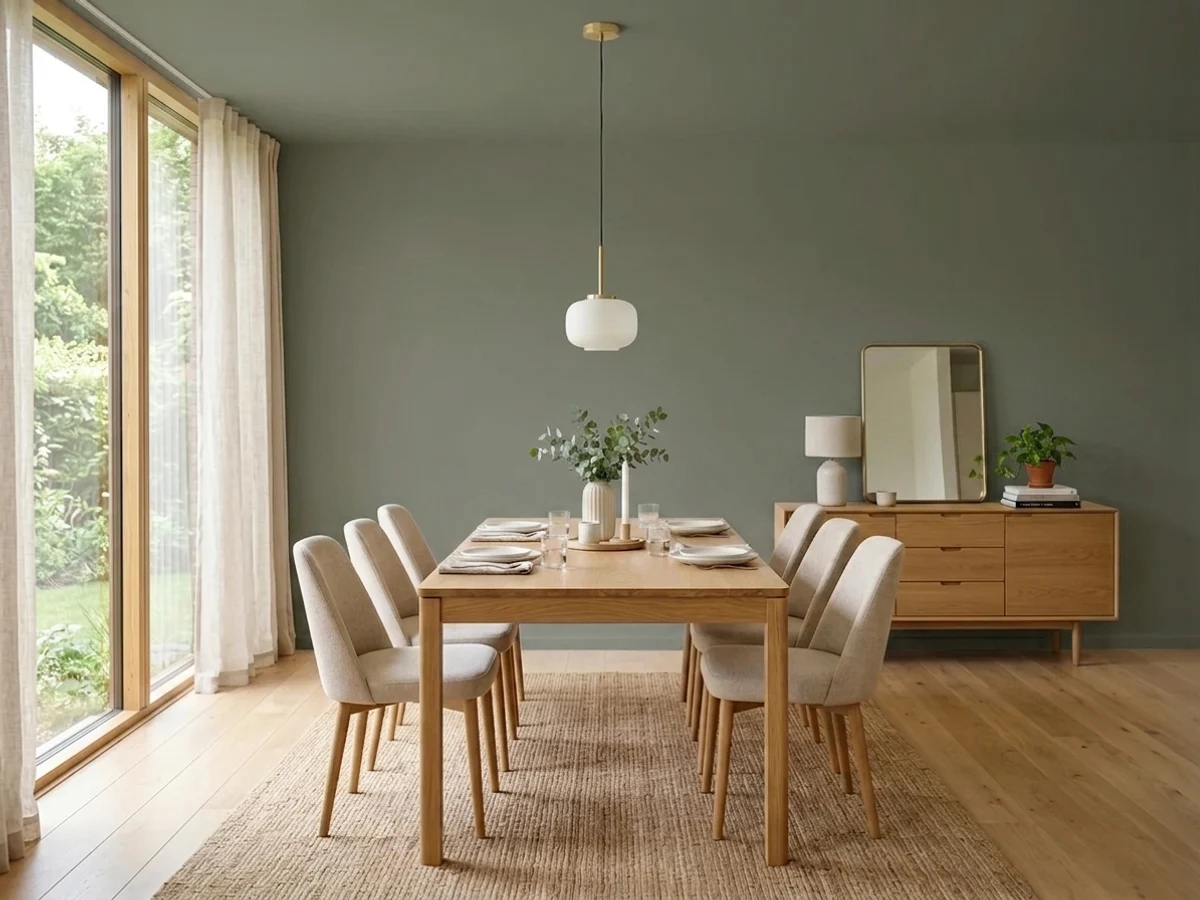
Kitchen cabinets and islands with wood floors and brass · bathroom vanities and built-ins · a study or dining room you want to feel enclosed · front doors, shutters, and houses set among trees
Your room faces north and has one small window · your cabinets or trim are cream · you want the walls to stay light and airy · your only lighting is cool 4000K LED
- One of the best cabinet greens made — depth without the harshness of black
- Muted enough that it reads timeless, not trendy
- Flatters oak, walnut, brass, and aged bronze
- Hides fingerprints and scuffs that would show on white cabinets
- Works outside as a door, shutter, or whole-body color
- At LRV 21 it loses its green and goes flat gray in dim or north light
- Fights cream trim and cream cabinets
- Shifts noticeably between cool LEDs and warm bulbs — can look olive at night
- Too dark for whole-room use in a small space with one window
What Color Is Dried Thyme, Really?
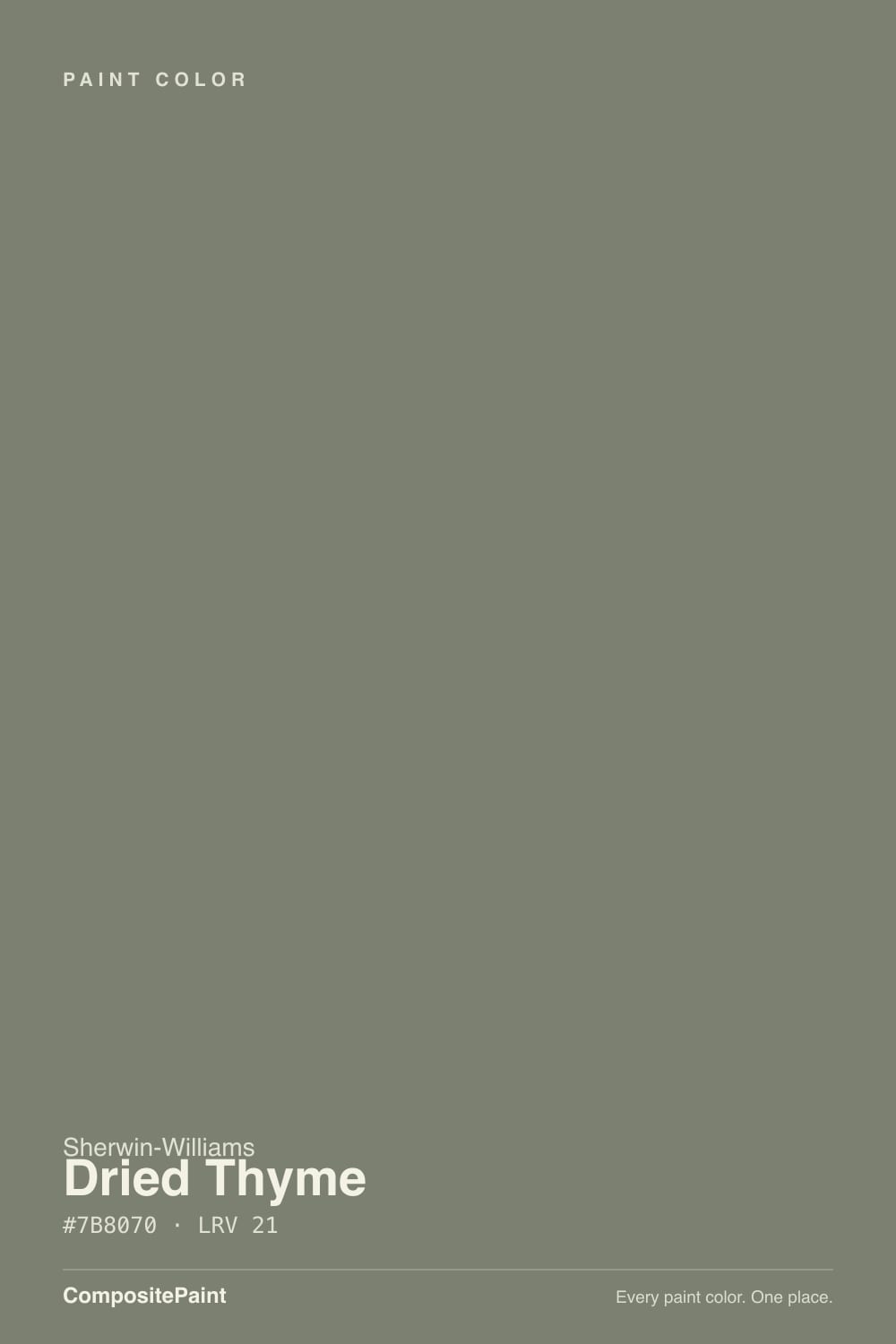
A dark, dusty green with the color turned almost all the way down. Most greens people love on cabinets are either clearly green (Basil SW 6194) or basically black-green (Pewter Green SW 6208). Dried Thyme sits between them and adds a lot of gray, which is exactly why it reads as calm instead of decorated. On a two-inch chip that gray takes over and the color looks like a warm charcoal. Painted across a full run of doors it turns clearly sage. This is why so many people are surprised by the sample pot: the chip undersold it.
At LRV 21 it is a genuinely dark color, and that number is the whole review. Put it next to Evergreen Fog SW 9130 at LRV 30 and the difference is not subtle — Evergreen Fog stays a soft light sage that behaves like a warm gray, while Dried Thyme is dark enough that the room reads it as a decision. Go the other way to Pewter Green SW 6208 at LRV 12 and Dried Thyme suddenly looks like the light, friendly option. It is the middle rung of the SW dark-green ladder, and for cabinets that middle rung is usually the right one.
Undertone in one line: gray-green with a faint yellow lean — it can drift olive under warm bulbs and drift cool gray in weak north light, but it is never blue-teal and never mint.
Where It Shines
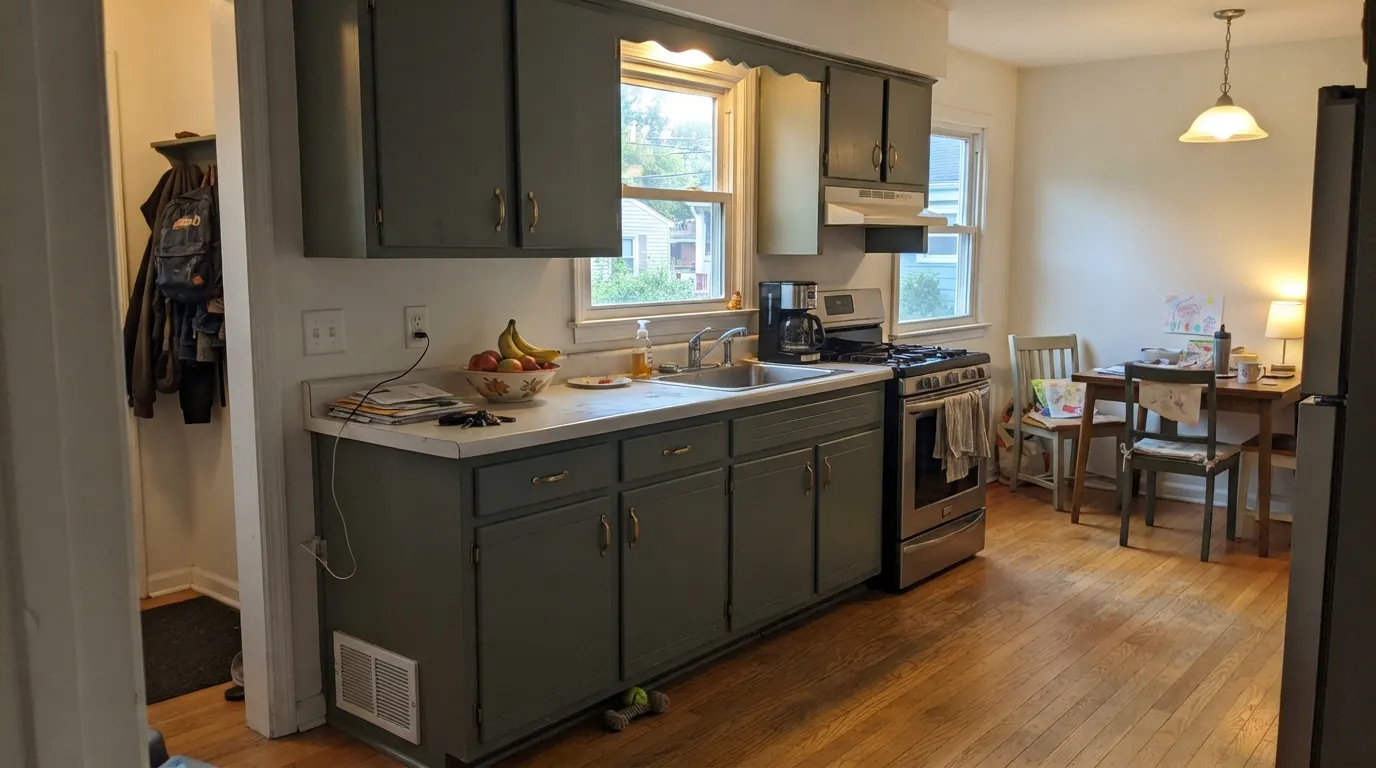
Give it daylight, wood, and warm metal and it is one of the best cabinet colors Sherwin-Williams sells. Kitchens are its home turf — full perimeter, uppers only, or just the island — and it does the same job on a bathroom vanity, a mudroom bench, or a wall of built-in shelves. It looks settled next to oak and walnut instead of styled.
Where It Fails
The bad stories about Dried Thyme are all the same three stories, and every one of them is predictable before you open a can. If your room matches one, this is not your green, and a third coat will not fix it.
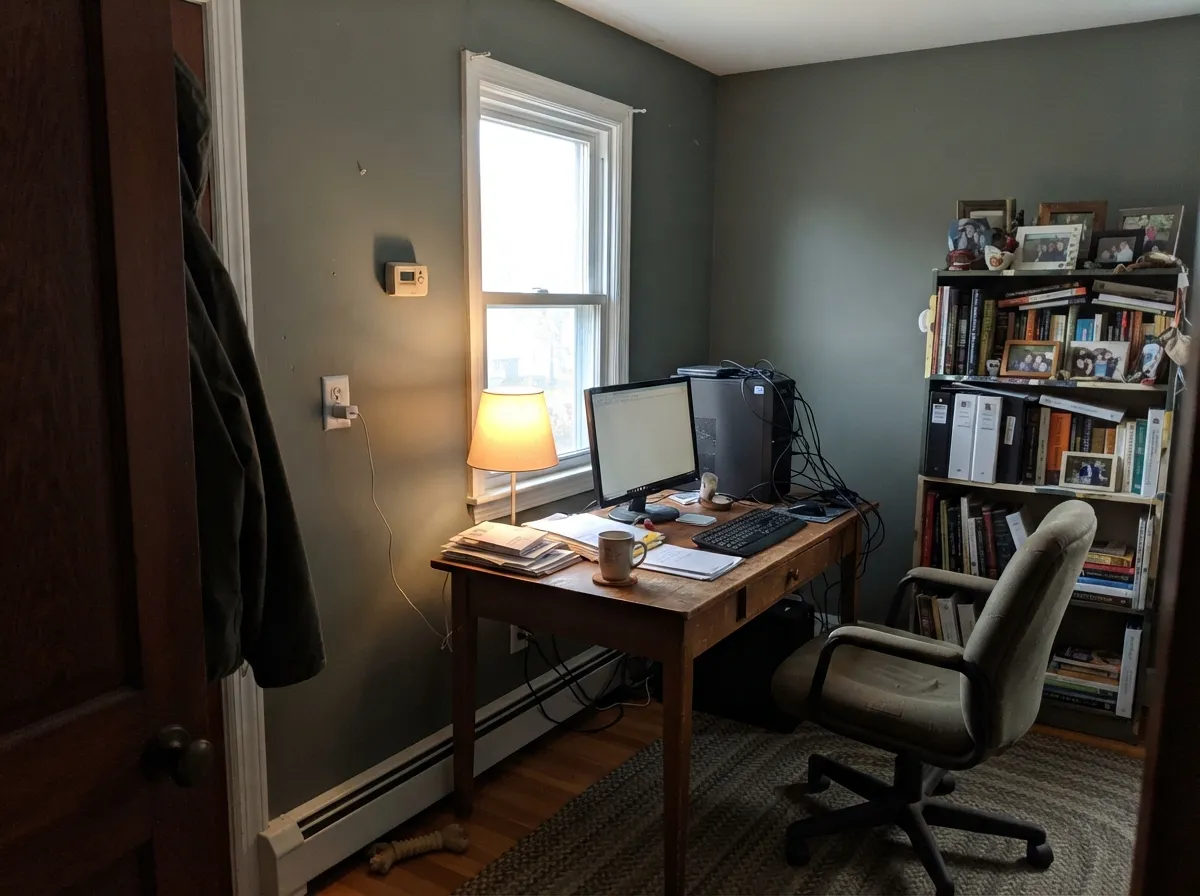
North light is cool and weak, and with only a trace of pigment in this color there is nothing to hold the green up. The walls go flat, heavy, and gray — people describe it as looking like dirty charcoal. If you want sage in a north room, go lighter so the color survives: Evergreen Fog SW 9130 at LRV 30 keeps reading green where Dried Thyme quits.
The most common pairing mistake. Cream is built on yellow, Dried Thyme leans faintly yellow-green, and side by side the two push each other — the cream looks dirty and the green looks sharper and more colorful than you wanted. Trim it in a soft white with no yellow in it, like Alabaster SW 7008, and the problem disappears.
This color is bulb-sensitive in both directions. 3500K to 4000K LEDs, including most under-cabinet strips, strip the warmth and leave a cold gray-green. Very warm 2700K bulbs do the opposite and can tip it toward army olive after dark. If you want a dark green that barely moves at night, Retreat SW 6207 at the same LRV 21 is the steadier pick.
Room by Room
Satin cabinet enamel, wood floors, a warm white counter, brass or bronze pulls. At LRV 21 it gives the doors real weight without the hardness of black, and it hides fingerprints far better than a white cabinet. Perimeter walls in Alabaster SW 7008 keep the room from closing in.
If the kitchen is short on windows, put Dried Thyme on the island and leave the perimeter light. You get the color without losing the room's brightness, and it reads deliberate rather than half-committed. Pair with Shoji White SW 7042 uppers.
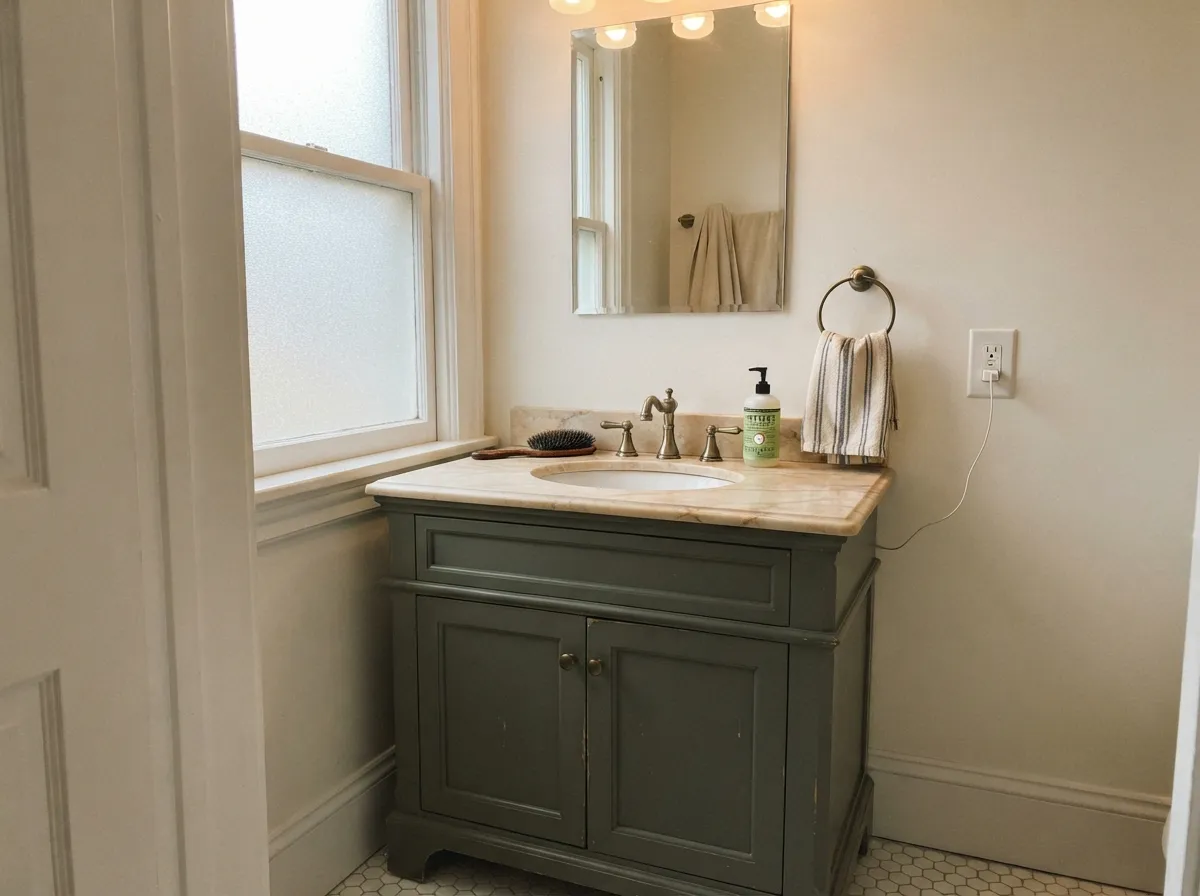
A small vanity is the lowest-risk way to use it, and the darkness is an advantage around water and toothpaste. Satin finish. With warm marble or a wood top it looks expensive; with cool gray tile it can go a little muddy, so check the tile first.
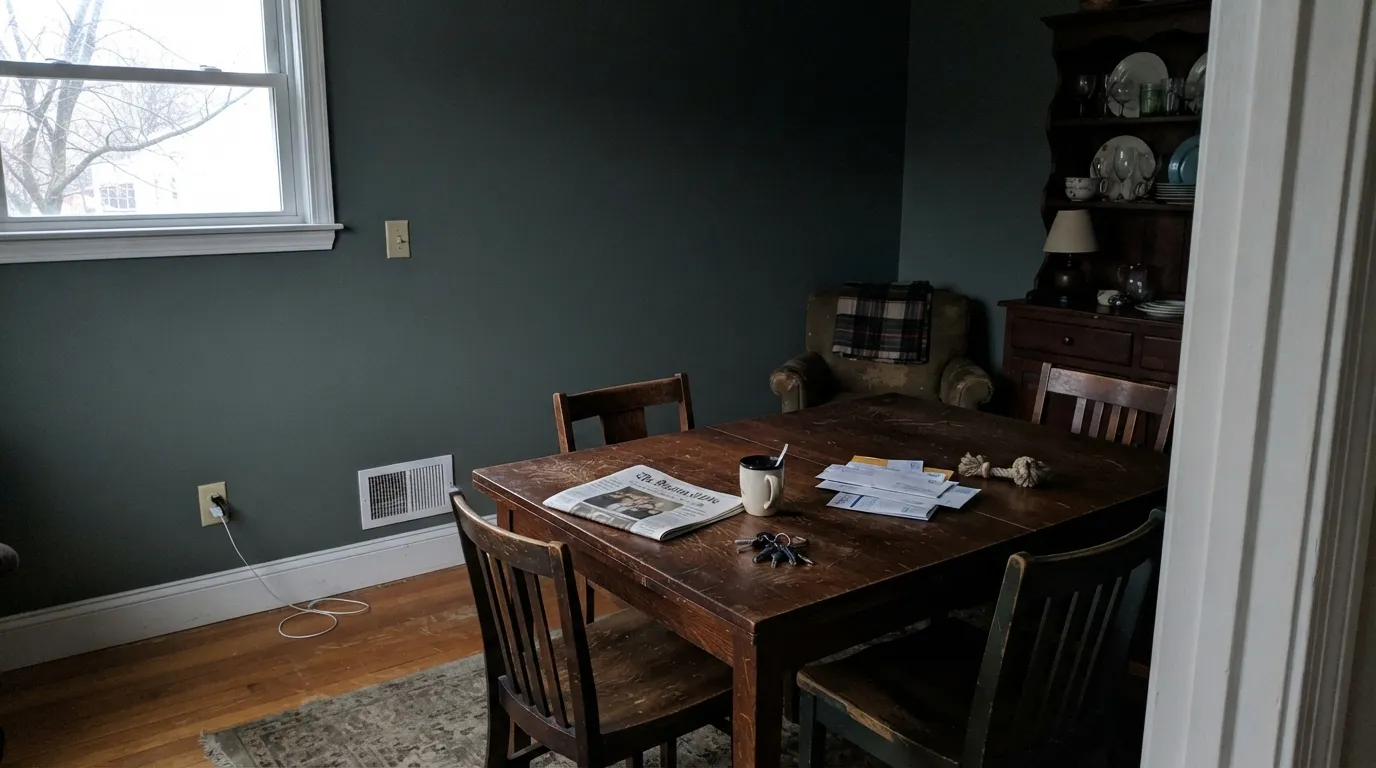
These are rooms you want to feel enclosed, which is exactly what LRV 21 delivers. Eggshell on walls, trim in Alabaster SW 7008 or Shoji White SW 7042. Plan two or three warm lamps at the same time as the paint, not after.
In a bedroom with decent windows it is genuinely restful and forgiving at night. In a dim bedroom it goes gray and heavy by 4 p.m. If you love the look but the light is poor, use it on one wall behind the bed and keep the other three light.
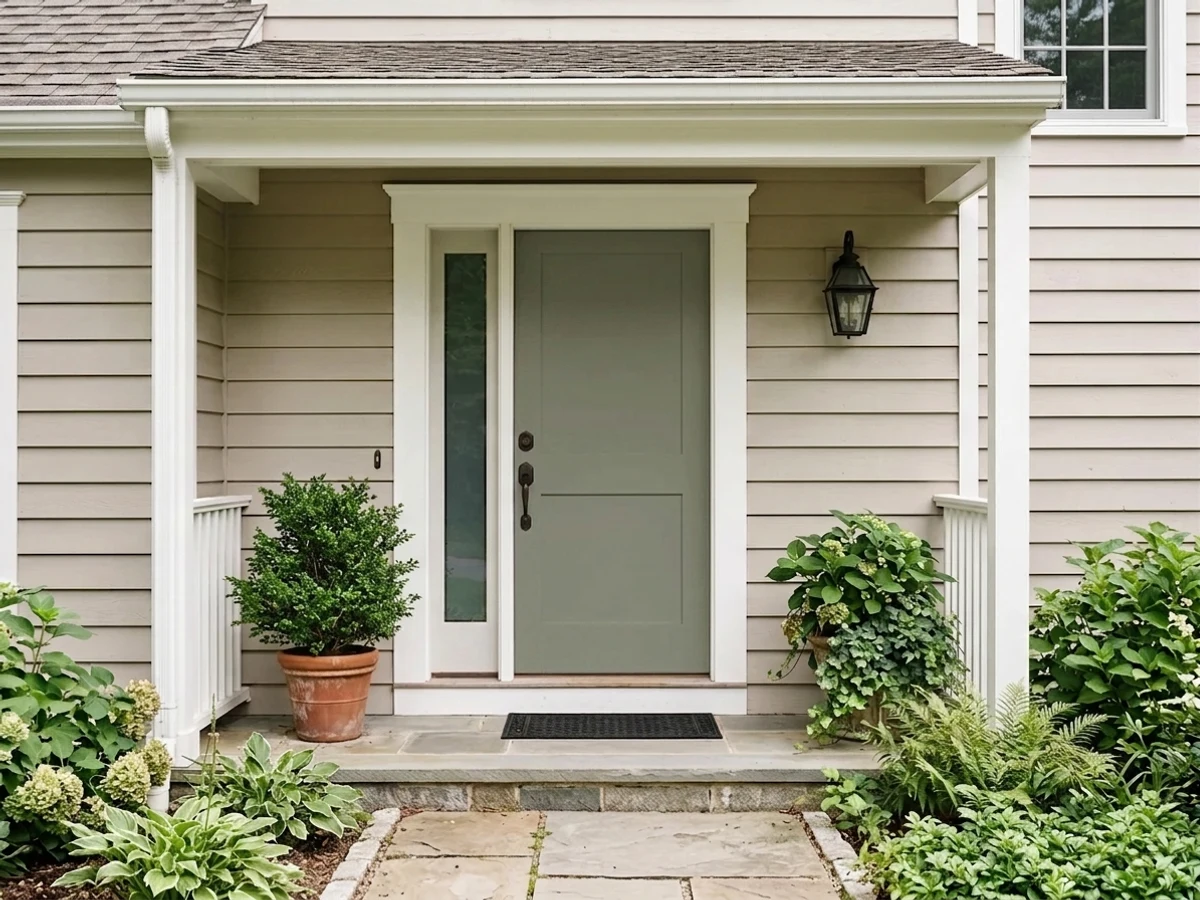
Full sun brings the green back out, so this color is easier outside than inside. Excellent as a front door or shutters, and it can carry a whole body on a house surrounded by trees. Trim it in a separate white — Pure White SW 7005 — never the same color.
Your Light Is the Risk
Strong sun brings out the yellow-green side and the color reads clearly sage all day.
Cool, weak daylight drains the green and leaves a heavy flat gray. Sample before you commit.
2700K lamps keep it green and warm; anything cooler turns it muddy. Change bulbs, not paint.
4000K strips wash the warmth out of the doors. Match them to your room bulbs at 2700K.
Most complaints about Dried Thyme are a light mismatch. Upload a photo of your actual room and see it on your walls — then ask for the same wall in north light or evening lamps before you buy a single sample.
Need It From Another Brand?
Any paint counter can custom-tint Sherwin-Williams SW 6186 directly. If you would rather stay in one brand's own deck, these are the closest stock matches, measured as ΔE2000. Under 2 is a difference you will not see on the wall.
| Brand | Closest color | ΔE | LRV | |
|---|---|---|---|---|
| Behr | Cactus GardenPPU11-18 · Behr | 2.0 | 22 | Color page → |
| Benjamin Moore | LushAF-475 · Benjamin Moore | 3.5 | 21 | Color page → |
| Valspar | Warm Eucalyptus8004-28F · Valspar | 1.1 | 21 | Color page → |
| PPG / Glidden | Autumn GrayPPG1028-5 · PPG / Glidden | 3.0 | 21 | Color page → |
| Glidden | Autumn GrayPPG1028-5 · Glidden | 3.5 | 21 | Color page → |
| Dutch Boy | Sweetbrier425-5DB · Dutch Boy | 0.0 | 21 | Color page → |
Similar Sherwin-Williams Colors
The nearest shades to Dried Thyme within Sherwin-Williams's own range, ranked by perceptual color distance — useful when you want the same look a touch lighter, darker, or warmer.
WCAG 2.1: AA is 4.5 : 1 for normal text, 3 : 1 for large text, AAA is 7 : 1.
Dried Thyme vs the Colors You're Also Considering
Every Dried Thyme sample board has the same rivals on it. The numbers show the real lightness gap — then it comes down to which risk you would rather live with.
Pick this when you want weight and a real color decision, not a soft neutral.
Sherwin-Williams SW 9130 · LRV 30Evergreen FogPick this for walls, small rooms, and any north-facing space — nine LRV points of insurance.
Side-by-side comparison →Pick this when you still want to read the color as green, not as dark.
Sherwin-Williams SW 6208 · LRV 12Pewter GreenPick this for near-black cabinets with high drama and a moodier, deeper kitchen.
Evergreen Fog SW 9130 (#A0A38E, LRV 30) is the usual comparison. It is nine points lighter, so it stays a soft sage that behaves like a warm gray, while Dried Thyme at LRV 21 is dark enough to feel like a color decision. Use Evergreen Fog when you want the room to stay light, and Dried Thyme when you want weight.
Within the deck, Retreat SW 6207 (#7A8076) and Taiga SW 9654 (#768078) are cooler at the same LRV of 21, and Link Gray SW 6200 (#7F7E72) drops most of the green.
Across brands, Dutch Boy Sweetbrier 425-5DB and HGTV Home by Sherwin-Williams Farm to Table HGSW 3263 both share the identical hex at a difference of 0. Valspar Warm Eucalyptus 8004-28F (LRV 21) at 1.10 is visually identical in normal room light. Behr Cactus Garden PPU11-18 (LRV 22) at 2.03 and Benjamin Moore Lush AF-475 (LRV 21) at 3.49 are very close but worth sampling first.
Dried Thyme Coordinating Colors
The rule with Dried Thyme is to stay warm but stay away from yellow. Soft warm whites, greige, warm brown-grays, and one deep anchor color all work; cream, mint, and icy blue-gray do not. These are the partners that come up again and again in real kitchens and studies:
Dried Thyme on Kitchen Cabinets
This is what most people are actually here for, and it is where the color is at its best. On cabinet doors the green finally has enough surface to show itself, so the gray-brown you saw on the chip turns into a soft, settled sage. It is dark enough to anchor a kitchen and forgiving about fingerprints in a way white cabinets never are. Brass, unlacquered brass, and aged bronze all look right on it. Polished chrome looks cold.
The two decisions that make or break it are the counter and the walls. Warm white quartz, honed marble, and butcher block all sit comfortably with it; stark cool-white quartz with gray veining makes the green look duller than it is. Above the cabinets, keep the walls light — Alabaster SW 7008 or Shoji White SW 7042 — because two dark surfaces in one kitchen is where people start regretting the choice. If you only want a partial commitment, green base cabinets with a lighter upper run is the pairing that has aged best.
One practical note: use a real cabinet enamel in satin and let it cure. A dark color on a horizontal surface like an island shows imperfections that would vanish on white, so surface prep matters more here than the paint brand does.
The Green Ladder Above and Below It
Dried Thyme has close relatives in both directions, and most people who are unhappy with it actually wanted a neighbor. One step lighter is Evergreen Fog SW 9130 at LRV 30 — the same muted sage family, but light enough for four walls in an average room and much safer in north light. That nine-point gap is bigger in practice than it sounds on paper.
One step darker is Rosemary SW 6187 at around LRV 14, a richer green that holds its own next to real greens in tile or fabric, and then Pewter Green SW 6208 at LRV 12, which most eyes read as near-black. Sideways at the same depth sit Retreat SW 6207 and Basil SW 6194 — Retreat cooler and steadier, Basil greener and more saturated. If your sample of Dried Thyme looked almost right but slightly off, one of those four is usually the color you were after.
Three Ready Palettes Built on Dried Thyme
A color is never alone on the wall. These are complete combinations in the 60-30-10 pattern, with the reason each one holds together. Every one opens in the visualizer.
Alabaster is warm without any yellow, so it lifts the room without fighting the green the way a cream would. Iron Ore gives the scheme one near-black note that makes the green look intentional rather than isolated.
Try this palette in your roomShoji White has enough body to sit next to a dark green without looking chalky, and the contrast against LRV 21 is strong whichever way you cut it. Urbane Bronze on the shelving adds a warm brown-gray that keeps the room from turning into one flat block of green.
Try this palette in your roomOutdoors the sun does the work Dried Thyme needs indoors, so the body stays clearly green and Pure White keeps the trim crisp against it. The navy door is the 10 percent — deep enough to hold its own against the green without turning the facade into two competing colors.
Try this palette in your roomDried Thyme FAQ
Is Dried Thyme green or gray?
Both, depending on scale and light. On a chip it looks gray-brown because there is so much gray mixed in. Across a full run of cabinets or a whole wall the green comes forward clearly, and good daylight or 2700K bulbs are what keep it there.
Is Dried Thyme too dark for a small kitchen?
For all four walls plus cabinets, usually yes. At LRV 21 it swallows light, and a small kitchen with one window will feel closed in. The fix most people land on is cabinets only, or island only, with light walls above.
Dried Thyme or Pewter Green for cabinets?
Pewter Green SW 6208 at LRV 12 is nearly black-green — dramatic, but in most kitchens you stop seeing the green and start seeing dark. Dried Thyme at LRV 21 stays readable as a color. If your kitchen has big windows and you want drama, Pewter Green; otherwise Dried Thyme is the safer of the two.
What white trim goes with Dried Thyme?
A soft white with no yellow in it. Alabaster SW 7008 and Shoji White SW 7042 both work, and Benjamin Moore White Dove OC-17 is the standard cross-brand answer. Avoid cream — cream and this green push against each other and both end up looking off.
Does Dried Thyme work with honey oak floors?
Yes, and it is one of the few dark colors that does. The gray in it calms the orange in older oak instead of amplifying it. Warm-toned white oak and walnut are even easier partners.
What sheen should I use on Dried Thyme cabinets?
Satin, in a cabinet-grade urethane enamel. Semi-gloss on a dark color shows every roller mark and every ripple in the door. Satin still wipes clean and looks far more like factory finish.
Is Dried Thyme a good exterior color?
It is one of its strongest uses. Direct sun restores the green that dim interiors take away, so the color looks better outside than most people expect. Use it on a front door, shutters, or the whole body of a house surrounded by trees, always with separate white trim.
Have you painted with Dried Thyme?
Rate it — one tap helps the next reader decide.
Ask a Question