Van Deusen Blue
The softer navy that isn't Hale Navy, reviewed honestly: where it reads confident blue-gray, the light where it goes almost black, and what to pick instead.

Jessica has spec'd whites and neutrals for more than 300 rooms and keeps a sample wall of painted drawdowns in her studio. Every color review is checked against real reader rooms in the comments and re-tested when a formula changes. About the testing process →
- 1Naval4
- 2Van Deusen Blue12
- 3Charcoal Blue19
- 4Resolute Blue40
The Fast Verdict
Van Deusen Blue is Benjamin Moore's answer for buyers who want navy without the weight: a gray-based blue with a faint green edge, pulled from the company's 1976 Historical Collection rather than any current trend. At LRV 12 it is meaningfully lighter than Hale Navy on paper. In a bright room that gap shows — confident, collected, never inky. In a dim one it disappears, and more than one homeowner has painted a north wall Van Deusen Blue only to report it looks exactly like Hale Navy, just as dark. Read the room before you read the chip.
Kitchen islands under white or cream cabinets · front doors on white clapboard or weathered cedar shingle · library built-ins with brass and leather · anyone who wants navy but finds Hale Navy too heavy
Your room is dim and north-facing · you specifically want a color you can tell apart from Hale Navy at night · you want a true saturated blue, not a grayed one · your stone is warm gold-veined and already fighting green
- Softer, lighter navy than Hale Navy — confident without the visual weight
- Historical Collection pedigree: a documented period blue, not a trend color
- Flexible undertone works with both warm brass and cool stainless
- The classic choice for kitchen islands, front doors, and built-ins
- With real daylight it never tips into true navy-black
- Sinks to near-black in dim or north-facing rooms — loses the whole reason to pick it over Hale Navy
- Can flash brighter, more saturated blue than the chip in strong direct sun
- Sits close enough to Hale Navy in low light that the distinction can disappear entirely
- Faint green undertone can look muddy next to warm gold-veined stone
What Color Is Van Deusen Blue, Really?
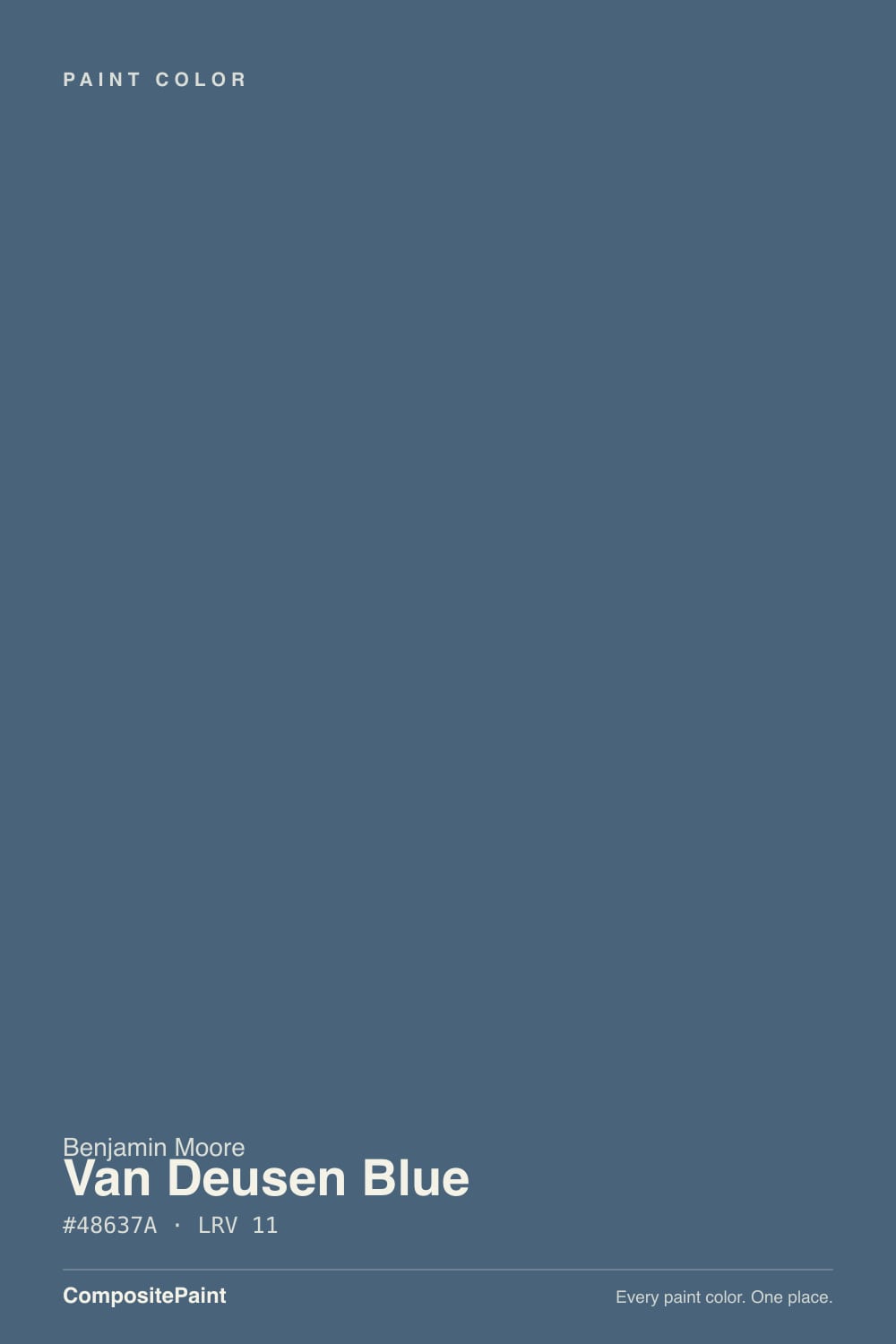
Van Deusen Blue belongs to Benjamin Moore's Historical Collection, one of 191 colors the company pulled from restored landmarks and historic homes for the 1976 bicentennial. That pedigree matters: this was never built as a trend color, it is a documented period blue, and that is exactly why designers reach for it when a client says "navy" but does not want this year's Pinterest navy. The undertone is a gray-based blue with a faint whisper of green — not enough to call it teal, but enough that it never tips toward violet the way some navies do. That flexibility is the real selling point: it sits comfortably next to warm brass and next to cool stainless without arguing with either.
At LRV 12 it is genuinely lighter than the navy most people picture. Hale Navy, the site's other reviewed navy, sits at LRV 6 — roughly half the light reflectance — and on paper that gap should be obvious on the wall. In practice it often is not: put Van Deusen Blue in a room that does not get much daylight and it sinks toward the same near-black weight as Hale Navy. Homeowners on Houzz have reported exactly that — a first-floor, north-facing coat that "looked like Hale Navy, too dark," when the whole reason they picked Van Deusen over Hale Navy was to avoid that exact weight. This is a color whose personality depends on daylight actually showing up.
Undertone in one line: blue-gray with a faint green edge, never violet. In strong direct sun it can flash noticeably brighter and more saturated than the chip promised — there are Houzz threads complaining it reads "too bright, too light" on a sunny wall — while in shade or evening light it goes quiet and moody. Both readings are the same paint; the light in your specific room decides which one you actually own.
Where It Shines
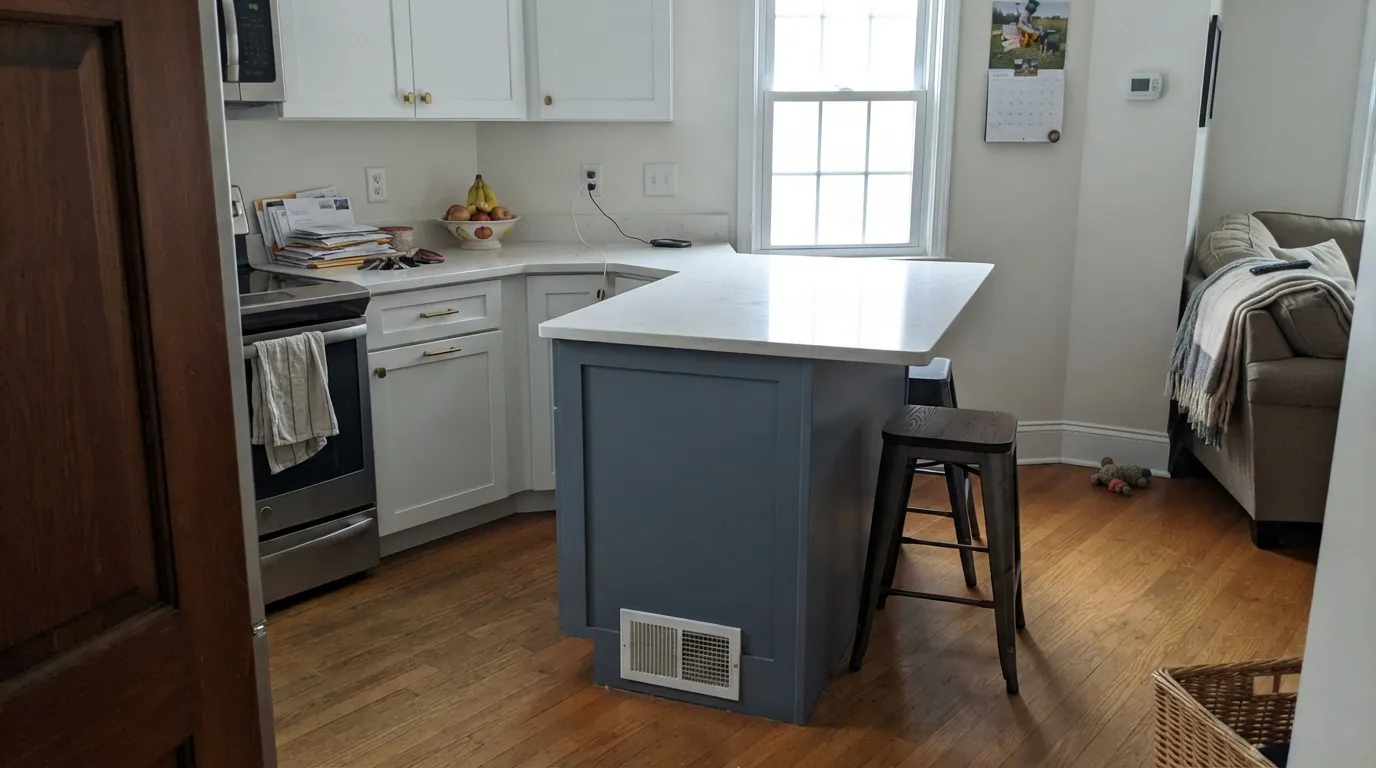
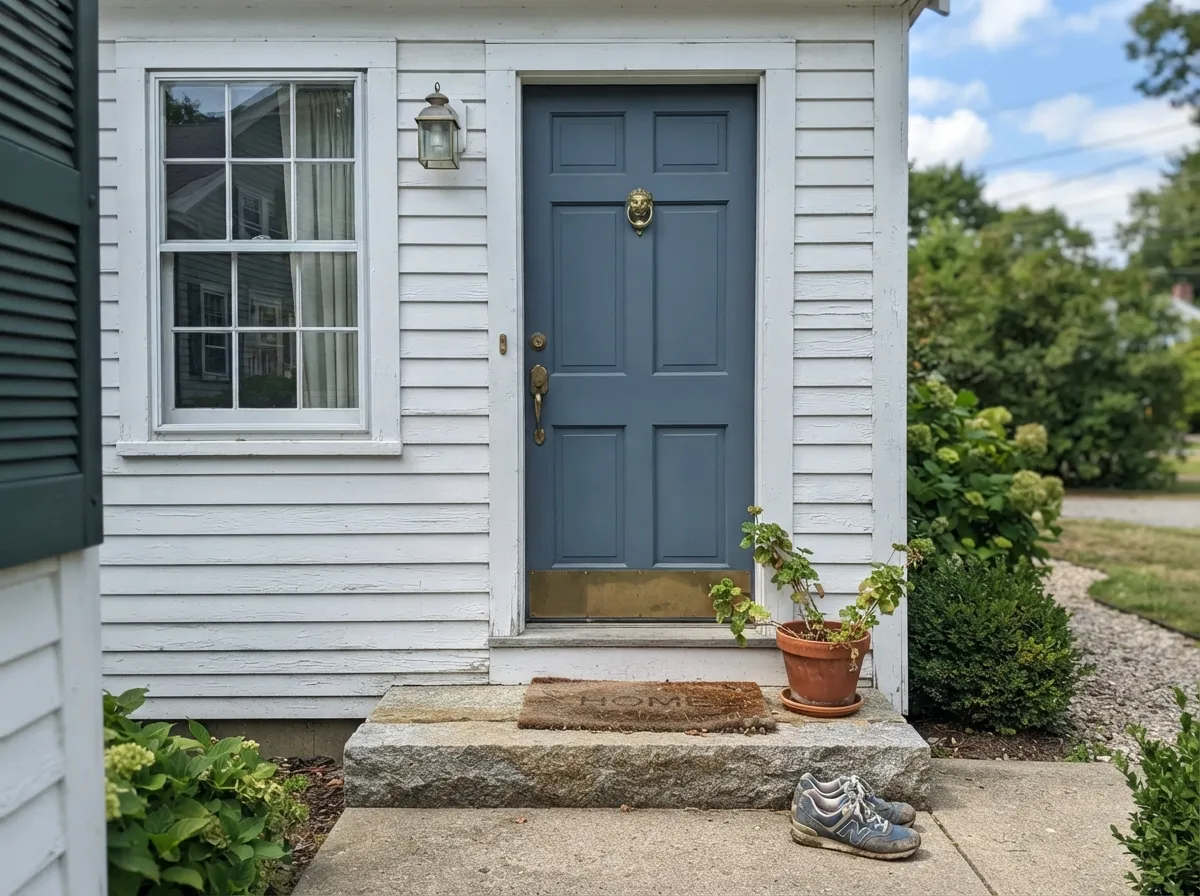
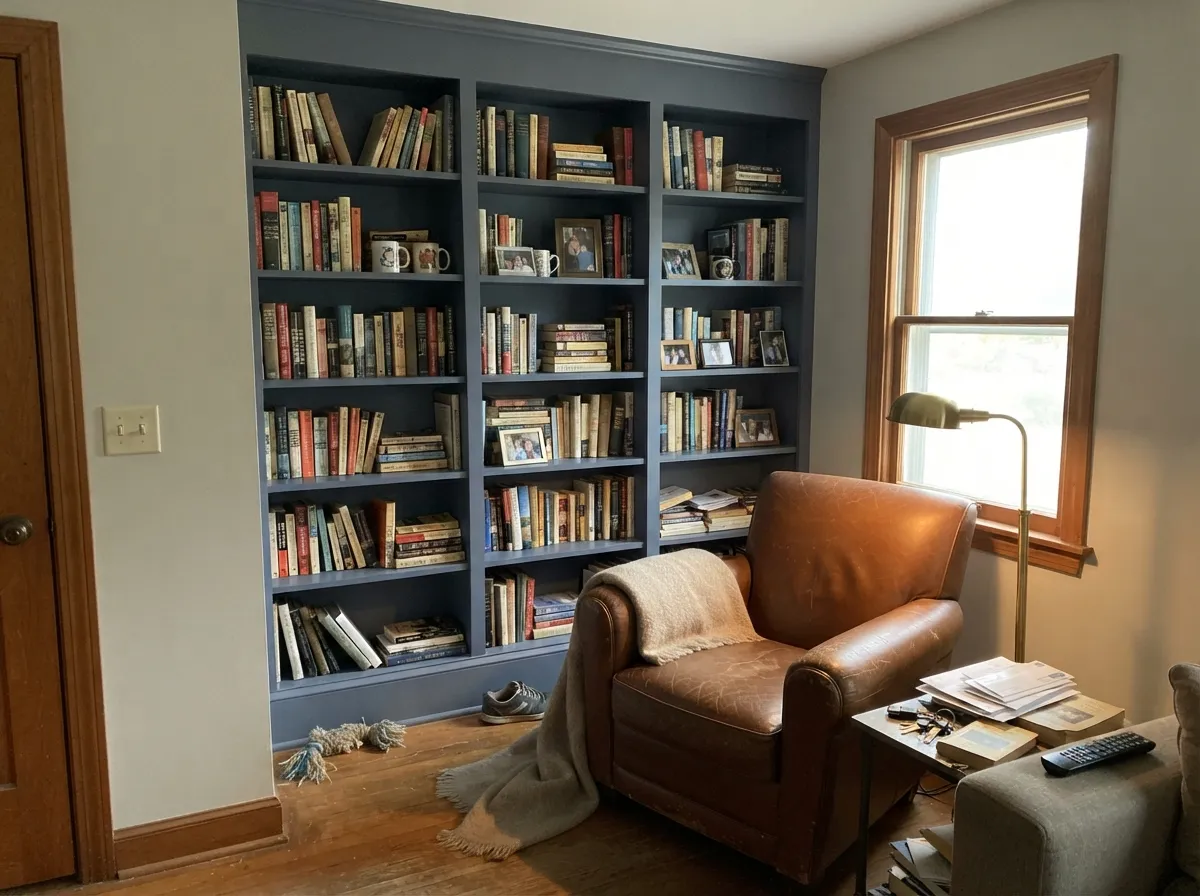
Give it a kitchen island, a front door, or a run of built-ins with real daylight, and it does exactly what a navy is supposed to do without swallowing the room the way a true navy-black would. It is the classic pick for a white-cabinet kitchen with one blue island, for a cape-style front door against white clapboard or weathered gray cedar shingle, and for library built-ins that need to look substantial next to brass hardware and leather. Because it stops short of true navy-black, it plays better with both warm brass and cool stainless than most of the deck's darker blues.
Where It Fails
Almost every regret story about Van Deusen Blue traces back to one of three situations, and all three are predictable before the first coat. None of them are the paint's fault — but if your room or your plan matches one, this is not your color, or at least not yet.
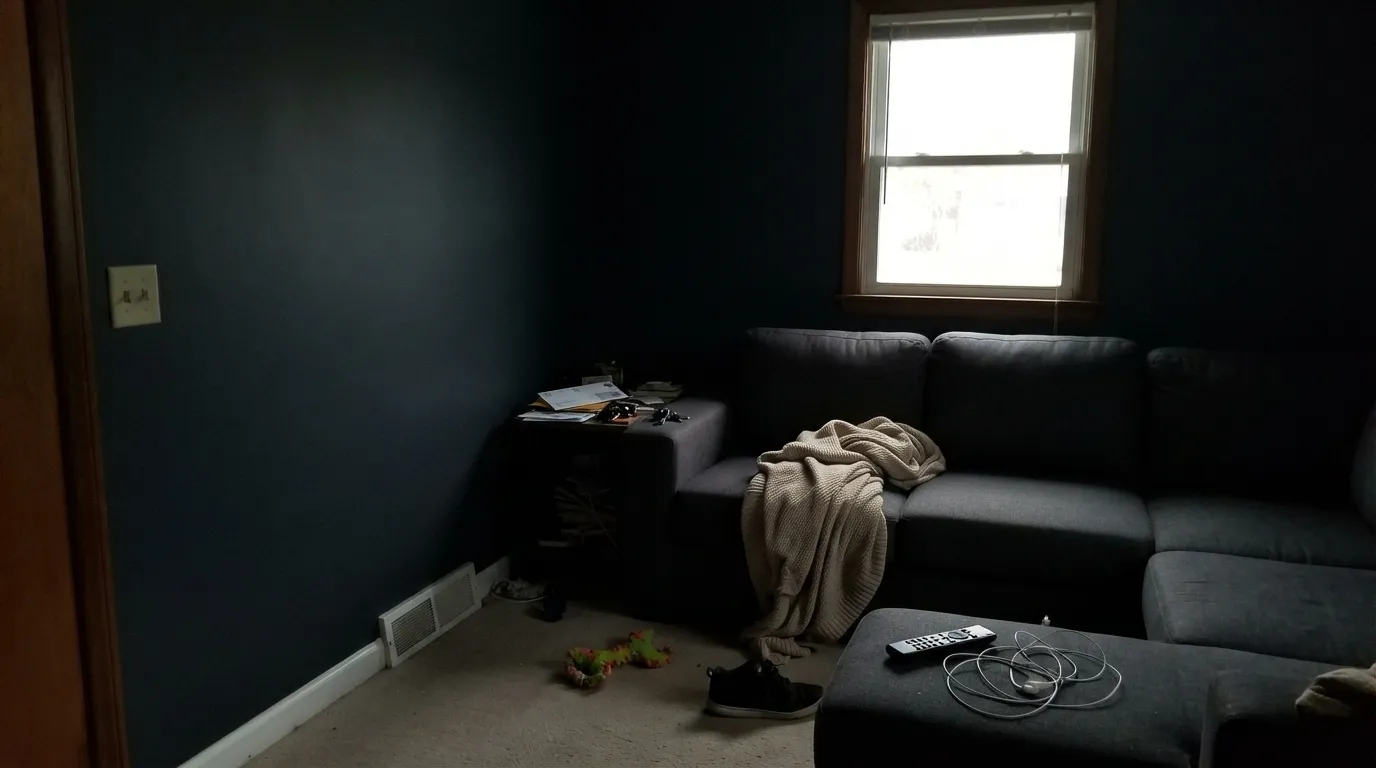
This is the exact complaint from Houzz: a first-floor, north-facing wall painted Van Deusen Blue "looked like Hale Navy, too dark." LRV 12 only reads lighter than Hale Navy's LRV 6 when there is daylight to reflect. Without it, the two colors collapse into the same weight — which defeats the entire reason most people choose Van Deusen over Hale Navy in the first place.
The opposite complaint also exists: on a bright, sun-facing wall it can flash brighter and more saturated blue than the chip suggested — readers have called it "too bright, too light" in exactly this light. If you wanted a moody, restrained navy and got a punchier blue instead, this is why. Sample on the actual wall, at the actual hour.
Because the difference is a matter of degree, not category, putting Van Deusen Blue in the same sightline as a more saturated navy — Hale Navy on an adjacent wall, or a punchier blue like SW Naval on a neighboring door — can make it read like a faded, less confident version of the same color rather than an intentional lighter choice. Pick one navy per sightline.
Room by Room
The signature use: white or cream perimeter cabinets, a Van Deusen Blue island, white quartz or butcher block on top, brass or unlacquered pulls. It adds color without darkening the whole kitchen. Satin or semi-gloss cabinet enamel, never flat.
A cape-style house in white clapboard or weathered gray cedar shingle is its natural home — traditional, a little coastal, never trendy. Semi-gloss, and prime any bare wood first; south-facing doors will read noticeably brighter than a north-facing one.
Bookcases, window seats and paneled dens take it well when there is brass hardware, leather, and warm wood nearby to keep it from reading cold. Satin finish stands up to handling on shelf edges and cabinet doors.
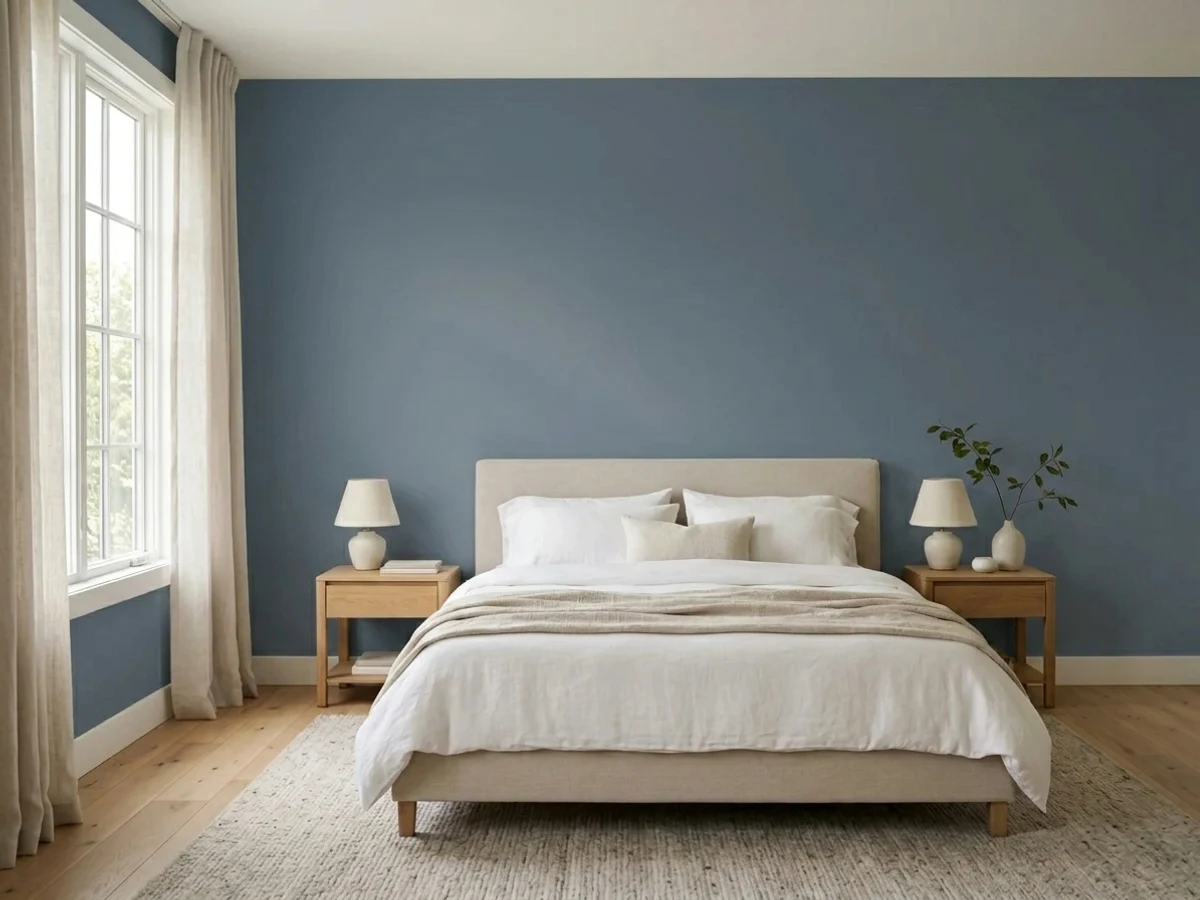
On a wall with a window it reads calm, collected blue-gray. In a dim or north-facing bedroom, budget for warm 2700K lamps or it will read near-black by evening — which some readers want and some do not.
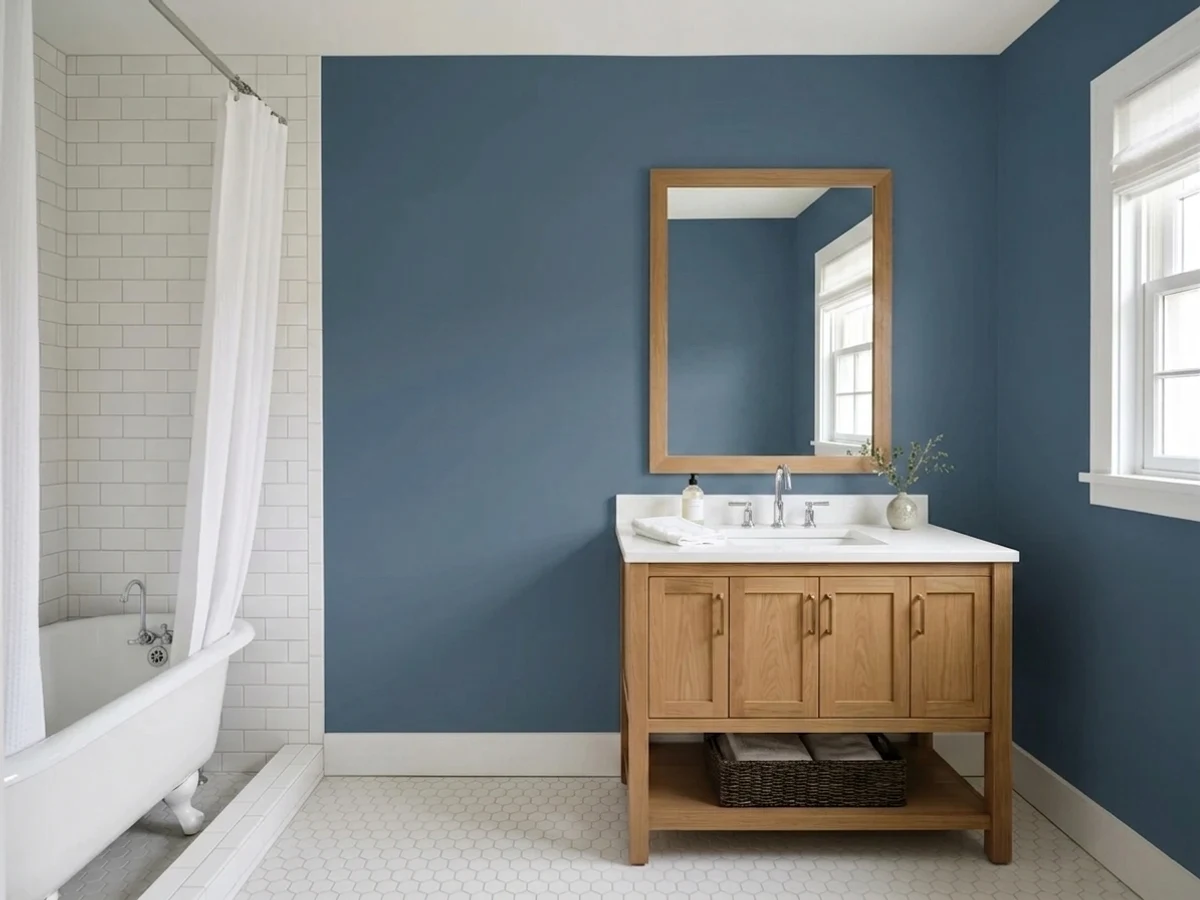
Coastal and traditional at once; pairs well with white or marble-look counters and brass or nickel fixtures. Satin, urethane-fortified cabinet paint for durability near water.
It shows up far more often as an accent — door, shutters — than as full body color. On a whole house it needs consistent sun exposure to avoid the north-side-vs-south-side mismatch that dogs every dark exterior color.
Your Light Is the Risk
Reads exactly as intended: a confident, gray-based navy, clearly lighter and calmer than Hale Navy. This is the light that justifies picking it.
Sinks toward near-black and starts reading like Hale Navy — the documented Houzz complaint. Test on the actual wall before committing a whole room.
Deep and quiet in the off hours, noticeably bluer and brighter at the sun's peak through that exposure. The swing is real — most owners like it.
Warm 2700K bulbs keep some blue visible after dark; cool LEDs push it toward flat black. Aim a lamp at the wall if you want the color to survive the evening.
Most complaints about Van Deusen Blue are a light mismatch. Upload a photo of your actual room and see it on your walls — then ask for the same wall in north light or evening lamps before you buy a single sample.
Need It From Another Brand?
Any paint counter can custom-tint Benjamin Moore HC-156 directly. If you would rather stay in one brand's own deck, these are the closest stock matches, measured as ΔE2000. Under 2 is a difference you will not see on the wall.
| Brand | Closest color | ΔE | LRV | |
|---|---|---|---|---|
| Behr | Infinite Deep SeaS500-7 · Behr | 1.3 | 10 | Color page → |
| Valspar | Dark Night4003-4C · Valspar | 3.8 | 10.2 | Color page → |
| Glidden | Approaching Storm90BG 11/101 · Glidden | 2.4 | 11 | Color page → |
| Dutch Boy | Sailing Suzy336-6DB · Dutch Boy | 4.5 | 10 | Color page → |
| Dunn-Edwards | Yankee DoodleDET578 · Dunn-Edwards | 2.1 | 10 | Color page → |
| Magnolia Home | TogetherJG-87 · Magnolia Home | 2.1 | 9 | Color page → |
Similar Benjamin Moore Colors
The nearest shades to Van Deusen Blue within Benjamin Moore's own range, ranked by perceptual color distance — useful when you want the same look a touch lighter, darker, or warmer.
WCAG 2.1: AA is 4.5 : 1 for normal text, 3 : 1 for large text, AAA is 7 : 1.
Van Deusen Blue vs the Colors You're Also Considering
Every Van Deusen Blue sample board has the same rivals on it. The numbers show the real lightness gap — then it comes down to which risk you would rather live with.
Pick this for the same navy family, but lighter and less heavy when your room actually has daylight.
Benjamin Moore HC-154 · LRV 6Hale NavyPick this if you want a true, dramatic navy and do not mind the weight — it is darker and more formal in any light.
Side-by-side comparison →Pick this for the grayer, quieter version — Naval reads bolder and more nautical.
Sherwin-Williams SW 6244 · LRV 4NavalPick this if your painter works in Sherwin-Williams and you want a punchier, more saturated true navy.
Hale Navy HC-154 is the comparison most people are making. At #495264 and LRV 6 it is meaningfully darker than Van Deusen Blue at LRV 11, and its hex carries less blue in the green and blue channels, so it reads grayer and more navy. Van Deusen looks bluer, lighter, and slightly more slate; Hale Navy looks heavier and closer to black in dim rooms. In a low-light room that difference of five LRV points is the difference between blue and near-black.
Within the deck, Lucerne AF-530 at #3A647D, LRV 14, is brighter and more teal. Stained Glass CSP-685 at #44646D, LRV 11, matches the value but leans green.
Across brands, Dunn-Edwards Stormy Sea DE5817 at deltaE 1.16 and Glidden Blue Fjord PPG1163-6 at 1.85 are visually identical in normal room light. Behr Winter Evening HDC-WR15-6 at 2.53 and Sherwin-Williams Azure Tide SW 9684 at 2.96 are very close, but sample first.
Van Deusen Blue Coordinating Colors
The rule for coordinating with Van Deusen Blue: warm whites over stark ones, brass over chrome, and keep it away from strongly gold-warm stone that fights its faint green edge. It layers naturally with its own family — lighter historic blues, deeper near-blacks — and with the warm greiges Benjamin Moore built alongside it. These are the partners that show up again and again:
Van Deusen Blue vs. Hale Navy: The Question Everyone Asks
Van Deusen Blue is not a recent color. It comes from Benjamin Moore's Historical Collection, one of 191 shades the company documented from restored landmarks and historic homes for the American bicentennial in 1976. That is worth knowing before you compare it to a trend color, because it isn't one — it has quietly outlasted several navy fashions already, which is part of why designers trust it.
The comparison to Hale Navy comes up constantly because the two solve the same problem — "I want navy, not black" — at different depths. Hale Navy sits at LRV 6, Van Deusen Blue at LRV 12: on paper, Van Deusen is close to double the light reflectance, and in a bright room you can see it, a visibly softer, less dramatic navy. The catch is that the gap is a function of available light, not a fixed property of the paint. Take away the daylight and the two colors converge — which is exactly what the Houzz homeowner reported after painting a north-facing wall Van Deusen Blue and getting Hale Navy's weight instead. If your rooms run bright, the difference is real and worth choosing on purpose. If they run dim, don't count on it.
Van Deusen Blue With Wood Tones and Floors
White oak, walnut, and any pale-to-mid wood tone sit comfortably against Van Deusen Blue — the gray base keeps the pairing calm instead of competing, and it is the reason the color works so well on kitchen islands next to butcher block or white oak flooring. Brass and unlacquered hardware are the natural metal partner; they warm the blue-gray up without fighting it.
The pairing to test first is anything strongly gold: honey oak floors, gold-veined quartz, or brass-heavy warm stone can make the faint green in the undertone more visible than it is on the chip, and the two can start to look slightly at odds rather than complementary. It is a much smaller risk than pairing a violet-leaning color with gold — Van Deusen Blue's flexible undertone means it rarely fails outright — but a large sample next to the actual floor or counter is worth the ten minutes before committing a whole kitchen.
Three Ready Palettes Built on Van Deusen Blue
A color is never alone on the wall. These are complete combinations in the 60-30-10 pattern, with the reason each one holds together. Every one opens in the visualizer.
White Dove keeps the room bright enough that the island can carry real color without the kitchen going dark; Wrought Iron on fixtures gives the scheme one near-black note so the blue doesn't have to do all the contrast work alone.
Try this palette in your roomA soft warm gray body reads as weathered cedar shingle without committing to real shingle upkeep; the navy door is the single confident color note, and White Dove trim keeps the whole facade from feeling heavy.
Try this palette in your roomPale Oak keeps the room's light level up so the built-ins do not sink into the dim-room failure mode; White Dove trim frames the blue cabinetry the way a picture-frame molding would, without adding a second competing color.
Try this palette in your roomVan Deusen Blue FAQ
Is Van Deusen Blue basically the same color as Hale Navy?
No, but they can look the same in the wrong light. On paper Van Deusen Blue (LRV 12) is meaningfully lighter than Hale Navy (LRV 6). In a bright room that gap is obvious. In a dim, north-facing room, both sink toward the same near-black weight — which is exactly the complaint one Houzz homeowner reported after painting a first-floor wall. If your room is dim, Van Deusen Blue will not buy you much distance from Hale Navy; pick based on your light, not the LRV number alone.
Is the undertone blue or green?
Gray-based blue with a faint green edge — never violet. It is subtle enough that most people simply read it as blue, but next to a strongly warm gold or a heavily violet-leaning navy, the green whisper becomes visible. It is one of the more flexible undertones in the deck for exactly this reason.
Is it good for a kitchen island?
It is one of the most common uses for this color, and for good reason: under white or cream perimeter cabinets it adds real color and depth without darkening the whole kitchen the way full-navy cabinetry would. Pairs especially well with white quartz and brass or unlacquered hardware.
What exterior colors pair with a Van Deusen Blue front door?
White clapboard and weathered gray cedar shingle are its classic partners — the cape-style, quietly coastal look it is known for. It also works against a warm greige body. Avoid pairing it with a warmer gold-toned siding, which fights the faint green in the undertone.
Will it look almost black at night or in a dim room?
Yes, and this is the single most common regret. LRV 12 needs daylight to read as the lighter, softer navy it is marketed as. Without it — north exposure, heavy tree cover, evening with cool bulbs — it reads close to black, the same weight as Hale Navy. Warm 2700K lamps help; they don't fully solve it.
What trim white goes with Van Deusen Blue?
White Dove is the default — warm enough not to look sterile against the blue-gray, crisp enough to read as trim. A stark, cool white like Chantilly Lace also works if you want more contrast and a cleaner, more nautical look.
Have you painted with Van Deusen Blue?
Rate it — one tap helps the next reader decide.
Ask a Question