Knoxville Gray
A dark blue-green chameleon from BM's Historical Colors line, reviewed honestly: the light that makes it glow, the light that turns it to black, and what to pick instead.

Jessica has spec'd whites and neutrals for more than 300 rooms and keeps a sample wall of painted drawdowns in her studio. Every color review is checked against real reader rooms in the comments and re-tested when a formula changes. About the testing process →
- 1Urbane Bronze8
- 2Knoxville Gray16
- 3Retreat21
- 4Stardew43
The Fast Verdict
Knoxville Gray is a deep, low-chroma blue-green dressed up as a neutral — close enough to gray that it never scares anyone off, colorful enough that it never reads flat. Give it real daylight and it shifts between smoky teal and slate blue through the day; starve it of light and it just goes dark, full stop. It has never been a headline color — no Color of the Year, no viral room — but it has quietly become a favorite for kitchen islands and front doors precisely because it behaves like a mood, not a statement.
Kitchen islands and cabinets · front doors and exterior shutters · studies and dens with real daylight · anyone who wants moody depth without committing to flat black
Your room gets one small window and no lamps · you want a true neutral charcoal, not a color that shifts · your floors are honey oak or golden pine · you're painting all four walls with no other light source in the room
- A dark neutral that still shows real color, not flat black
- Kitchen islands and front doors: its signature move, and it delivers
- Shifts believably between blue and green through the day — never boring
- Historical Colors pedigree — not a trend color chasing a moment
- Reads sophisticated against white cabinetry, brass, and light stone
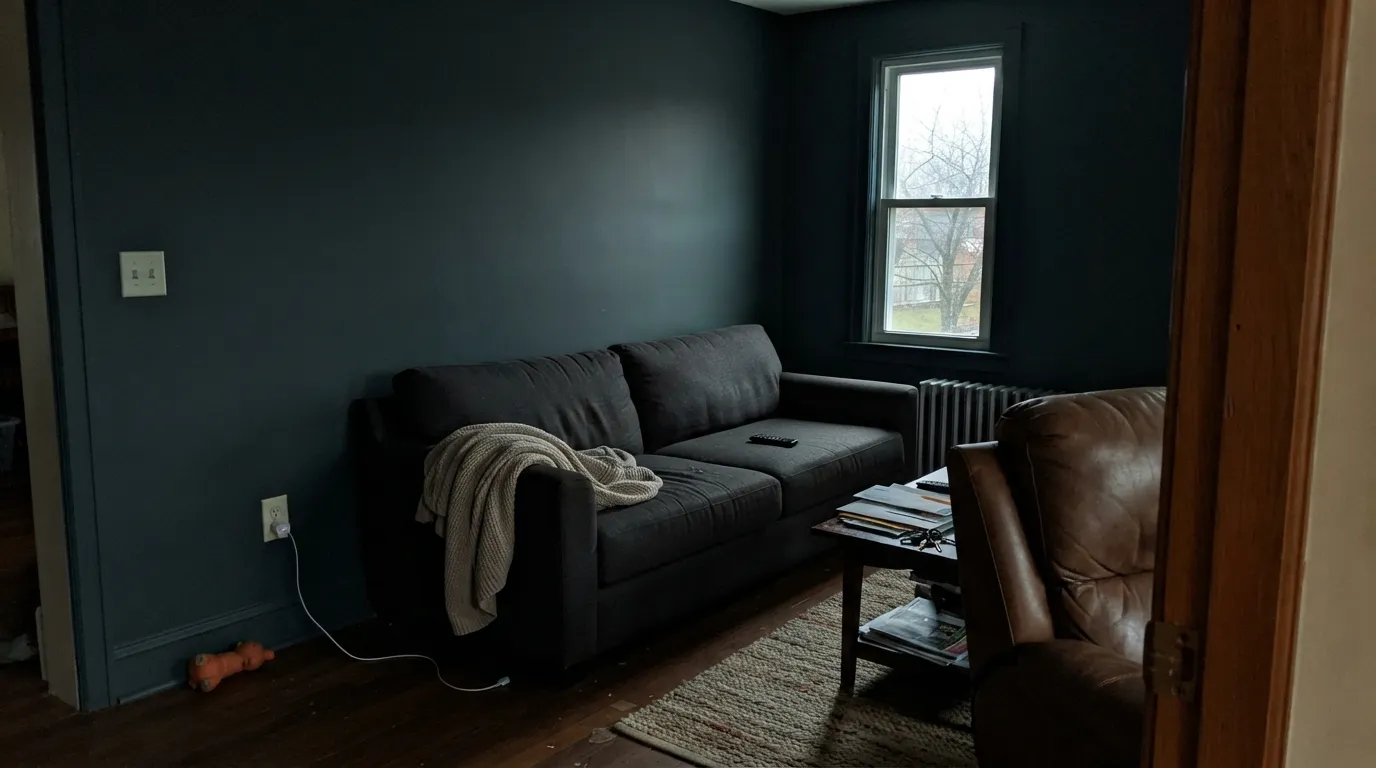
- Goes flat, near-black in any room without a real light source
- Fights honey oak and golden wood tones directly
- Buyers hoping for a true neutral gray get an unmistakable blue-green instead
- LRV 16 makes it a demanding color for whole rooms, not just surfaces
What Color Is Knoxville Gray, Really?
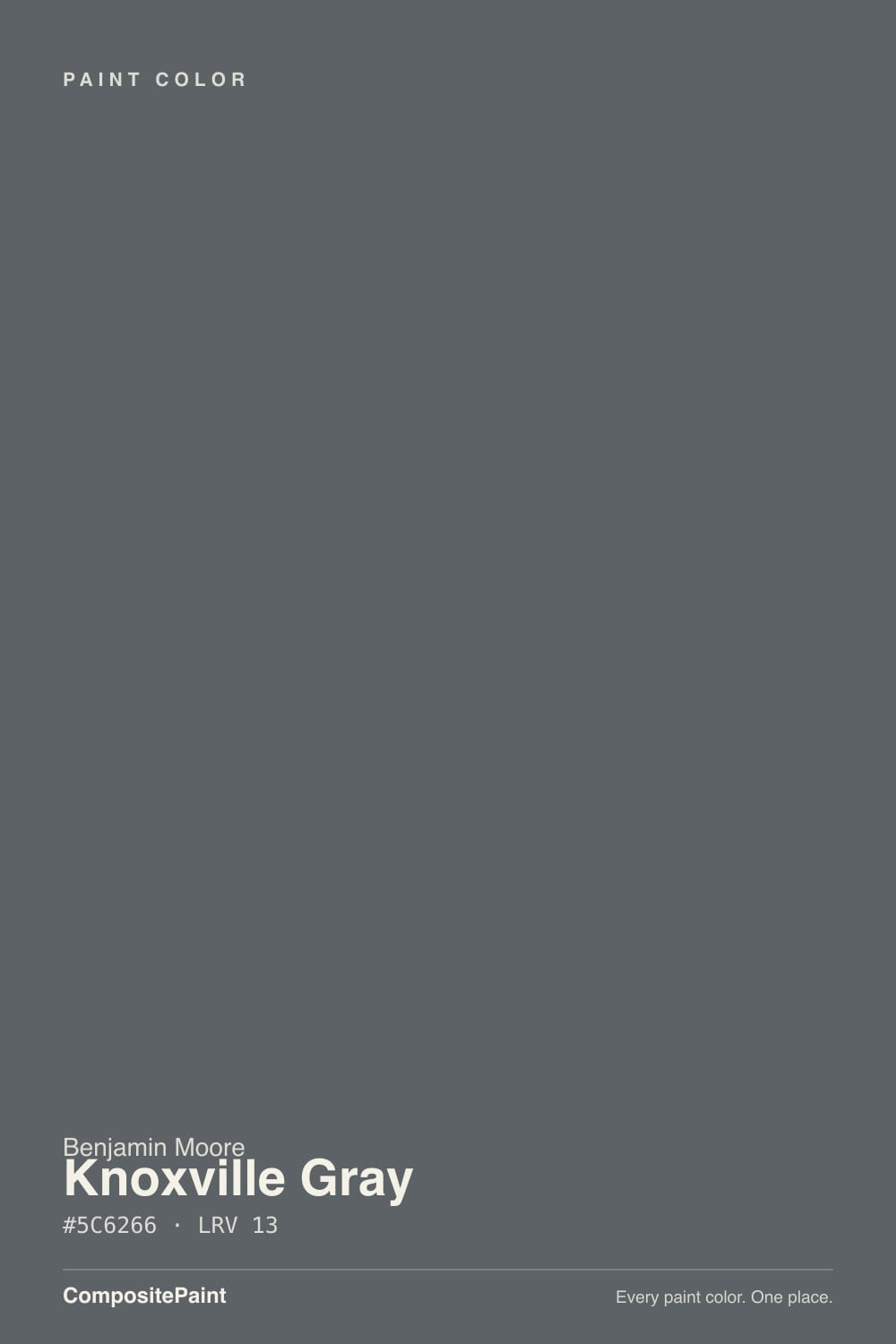
Knoxville Gray carries the HC prefix — Benjamin Moore's Historical Colors collection, pulled from preserved architecture rather than invented for a trend cycle — and it wears that pedigree well. It is not a pure gray: underneath the low-chroma surface sits a genuine blue-green, the kind of undertone that shows up clearly at swatch size and gets easy to mistake for plain charcoal once it is rolled across a wall or a cabinet box. That ambiguity is the whole appeal. From across a room it reads as a sophisticated dark neutral; up close, in good light, the color declares itself.
At LRV 16 it sits in true dark-color territory — the same depth band as Benjamin Moore's own Kendall Charcoal and Sherwin-Williams' Pewter Green. A color this dark absorbs almost all the light that hits it, which is the mechanism behind both its best trick and its worst complaint: with a real light source in the room it holds a rich, layered blue-green; without one it simply reads black, and the undertone that made people buy it in the first place disappears entirely.
Undertone in one line: blue-green, and genuinely undecided about which one wins — bright, cool light pulls it toward slate blue, warm or low light pushes it toward teal-green. If your sample looks flat charcoal with no color at all, that is not a trick of the paint; it means the room does not have enough light to show either undertone, and this is a color that needs the light to work with it.
Where It Shines
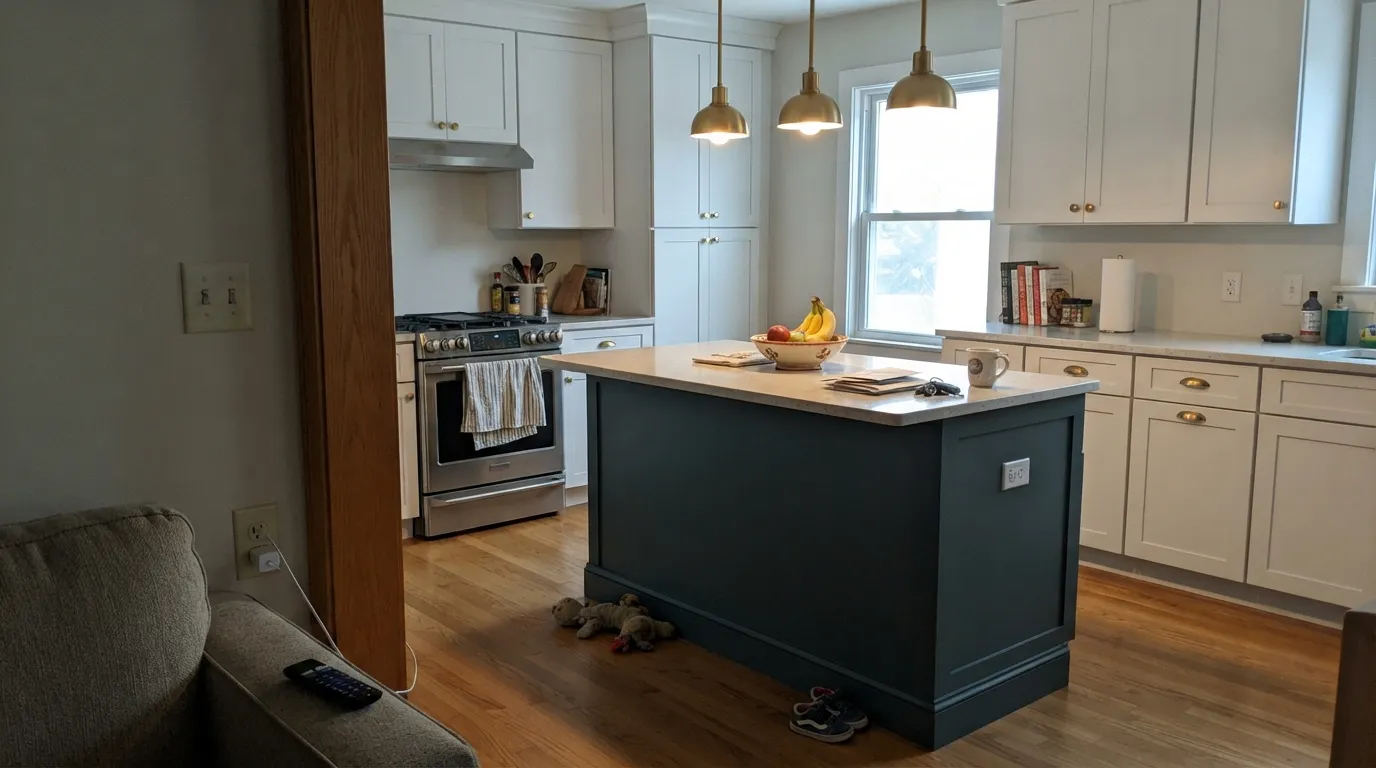
Give it a real light source — daylight, a task lamp, an under-cabinet strip — and Knoxville Gray does something flat black cannot: it holds visible color from across the room. That is why it has become a favorite on kitchen islands and front doors, the small, well-lit surfaces where a dark color gets noticed rather than swallowed. Against white cabinetry, brass hardware and a light stone counter, the blue-green reads as intentional and expensive rather than simply dark.
Where It Fails
The complaints about Knoxville Gray cluster around one honest theme: people ask a dark, light-hungry color to do a bright color's job, or a neutral's job, and it cannot. None of these are the paint failing — they are predictable outcomes of the depth and the undertone, and they are worth knowing before the gallon is mixed.
At LRV 16 the color needs real light to show its blue-green; without it, it just reads dark. One real review sums it up: "Beautiful color but too dark for me." That is not a defect — it is what a low-LRV color does in a room with nothing to reflect. Add a lamp before you write it off, or pick something several LRV points lighter.
Yellow-orange sits opposite blue-green on the color wheel, so a golden floor and this wall color argue: the floor looks more orange, the wall looks flatter and darker. Walnut, espresso, or gray-washed floors are the fix — or keep the color to cabinets and doors and let the flooring stay out of it.
It photographs and swatch-tests like a sophisticated gray, and plenty of buyers pick it hoping for exactly that. On four walls the blue-green is unmistakable, especially under daylight. If you actually want a color that never shifts, this is the wrong pick — that is the whole personality of the color, not a flaw in one can.
Room by Room
The single most-repeated use for this color, and for good reason: a contained surface with task lighting and under-cabinet strips is exactly the light this color needs. Satin cabinet enamel against Simply White or Cloud White perimeter cabinets and brass pulls is the classic result.
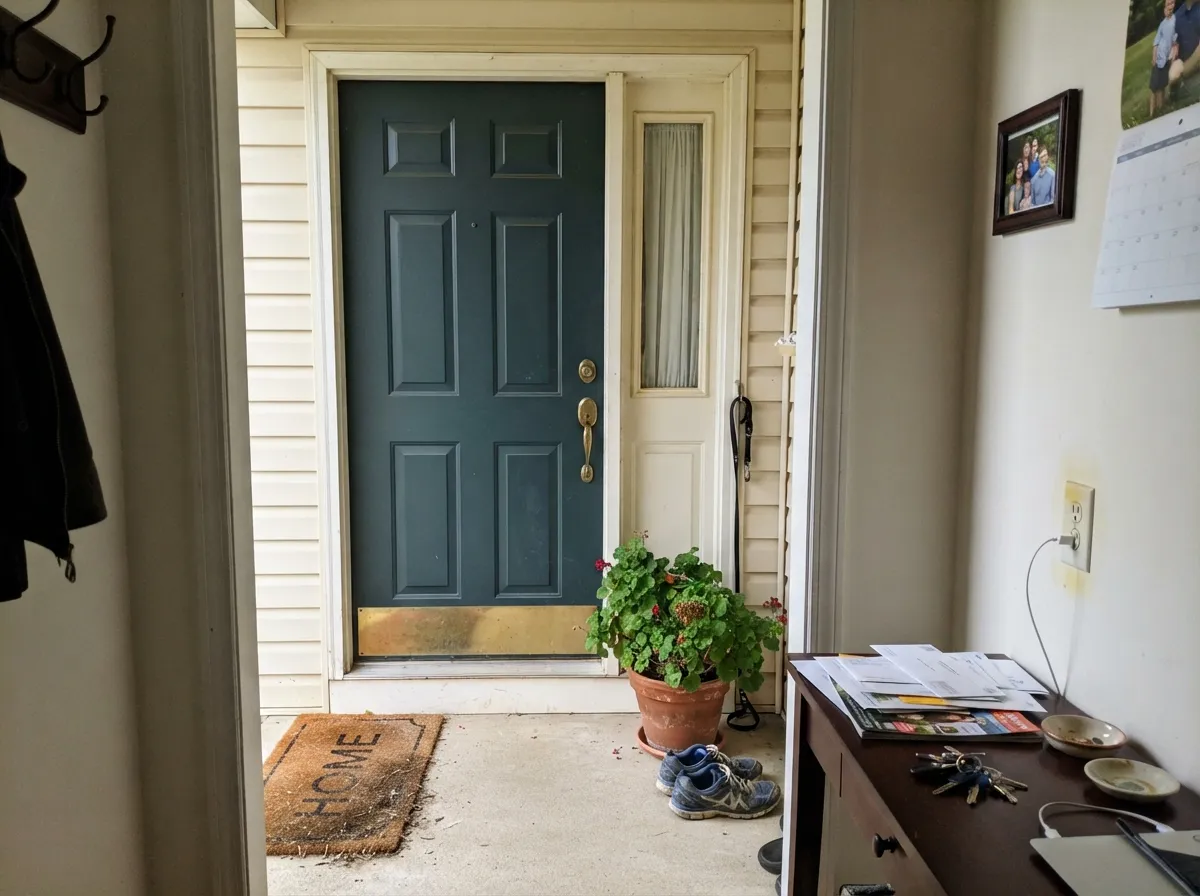
Full daylight is the most forgiving light this color gets, and a single door surface reads as a deliberate, moody statement rather than a dark wall of it. Semi-gloss holds up to weather and shows the color's depth from the street.
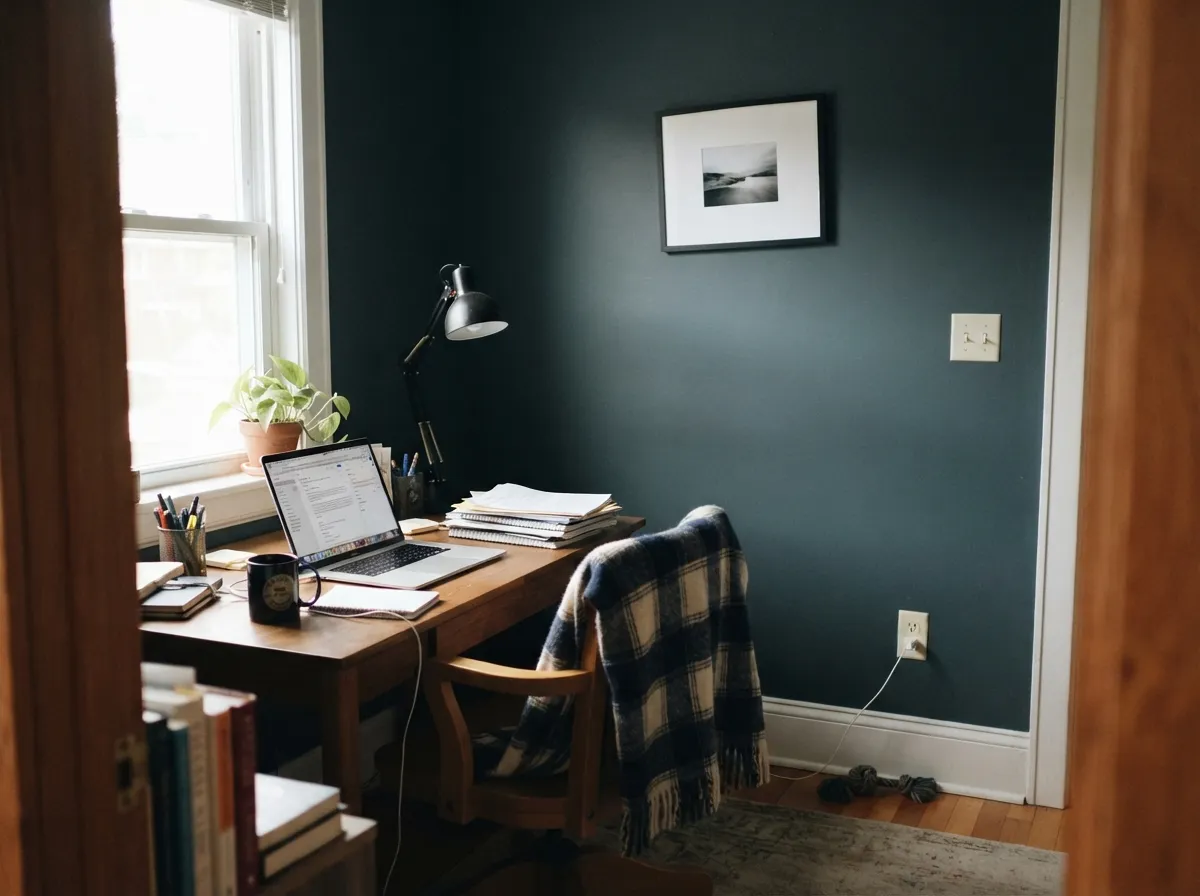
A daytime workspace with a window earns the payoff: the color reads calm and focused rather than gloomy. In a windowless or north-lit den, add a warm floor lamp before committing to four walls.
Same logic as the kitchen island — a contained surface under a vanity light, paired with a light stone or quartz top, shows the blue-green without asking a whole small room to go dark.
In a bright, south- or west-facing room with big windows it is genuinely striking. In anything dimmer, it reads as a flat dark wall rather than the layered color in the fan deck — sample a large board and watch it at different times of day before painting four walls.
A dark, light-dependent color and a room people use mostly at night and in low light are a poor match on four walls. It works far better here as a headboard-wall accent under a real reading lamp than as the whole room.
Your Light Is the Risk
Full sun or a big south/west window is where the blue-green actually shows instead of just reading dark. This is the light the color needs to be worth the can.
Without a real light source, LRV 16 does what low LRV does: it just goes dark. The color disappears and you're left with a flat near-black wall — the exact complaint behind every "too dark" review.
Cooler, bluer daylight pulls it toward slate blue; warmer or lower light pushes it toward teal-green. Neither read is wrong — it is genuinely a chameleon, not an inconsistency.
Warm 2700K bulbs settle it into a cozy teal-charcoal at night. Cool white LEDs keep it colder and closer to black — swap the bulb before you swap the paint.
Most complaints about Knoxville Gray are a light mismatch. Upload a photo of your actual room and see it on your walls — then ask for the same wall in north light or evening lamps before you buy a single sample.
Need It From Another Brand?
Any paint counter can custom-tint Benjamin Moore HC-160 directly. If you would rather stay in one brand's own deck, these are the closest stock matches, measured as ΔE2000. Under 2 is a difference you will not see on the wall.
| Brand | Closest color | ΔE | LRV | |
|---|---|---|---|---|
| Sherwin-Williams | Mountain PassSW 9655 · Sherwin-Williams | 0.8 | 14 | Color page → |
| Behr | Unreal TealECC-58-3 · Behr | 1.7 | 15 | Color page → |
| Valspar | Bottlenose Dolphin8006-7E · Valspar | 5.0 | 14 | Color page → |
| PPG / Glidden | Juniper BerryPPG1145-6 · PPG / Glidden | 2.8 | 14 | Color page → |
| Glidden | Juniper BerryPPG1145-6 · Glidden | 2.4 | 14 | Color page → |
| Dutch Boy | Zinc-ed426-7DB · Dutch Boy | 3.5 | 15 | Color page → |
Similar Benjamin Moore Colors
The nearest shades to Knoxville Gray within Benjamin Moore's own range, ranked by perceptual color distance — useful when you want the same look a touch lighter, darker, or warmer.
WCAG 2.1: AA is 4.5 : 1 for normal text, 3 : 1 for large text, AAA is 7 : 1.
Knoxville Gray vs the Colors You're Also Considering
Every Knoxville Gray sample board has the same rivals on it. The numbers show the real lightness gap — then it comes down to which risk you would rather live with.
Pick this when you want the chameleon: Knoxville Gray shifts blue and green on purpose, Kendall Charcoal never does.
Benjamin Moore HC-166 · LRV 13Kendall CharcoalPick this if you want the same depth with no color argument — Kendall Charcoal is a true neutral dark gray at the exact same LRV.
Pick this for the cooler, bluer edge — Pewter Green leans warmer and more olive at the same near-black depth.
Sherwin-Williams SW 6208 · LRV 12Pewter GreenPick this if you want the same cabinet-darling depth pulled warmer, toward olive-green instead of blue-green.
Pick this for the softer, grayer version of the same mood — Knoxville Gray reads as a neutral dark from across the room; Hale Navy reads as navy.
Benjamin Moore HC-154 · LRV 6Hale NavyPick this when you want an unmistakable navy with zero green — Hale Navy commits to blue every time it gets enough light to show any color at all.
Pick this for restraint — Peacock Blue is a statement color, Knoxville Gray reads almost neutral from across the room.
Benjamin Moore 2049-40 · LRV 35Peacock BluePick this if you want the same blue-green family turned up — brighter, more saturated, an actual jewel tone rather than a grayed-down mood.
Anchor Gray 2126-30 at #5C6167 and LRV 14 is the closest Benjamin Moore neighbor, one point lighter and effectively the same on a wall. Powell Gray CW-665 at #5A656C and LRV 13 carries more blue, so it edges toward slate. Nocturnal Gray 2135-30 at #55656B and LRV 14 is bluer still with a green tilt that shows in daylight. Stormy Sky 1616 at #626568 and LRV 14 is a touch lighter and softer. City Shadow CSP-60 at #626463 and LRV 13 is the neutral version, with the blue removed.
Across brands, Rodda Ash Bed CA209 at deltaE 0.6, Dutch Boy Steely Expression 435-6DB at 0.64, and Valspar Carriage Wheel M330 at 0.84 are the same color for practical purposes. Behr Blue Metal HDC-AC-25 at 1.38 and Sherwin-Williams Grays Harbor SW 6236 at 1.8 are visually identical in normal room light. Dunn-Edwards Sheet Metal DE6356 at 2.08 is very close, worth sampling first. Farrow & Ball Down Pipe No. 26 at 3.84 gets named as an equivalent often, but at #626664 it is greener and visibly different side by side.
Knoxville Gray Coordinating Colors
The rule for coordinating with Knoxville Gray is simple: keep the partners light enough to bounce back the light this color needs, and keep the undertones cool-to-neutral rather than golden. It pairs cleanly with soft and crisp whites alike, and with other charcoal-depth colors when you want the near-black without repeating the exact same blue-green. These are the partners that keep showing up in rooms that work:
A Quiet Entry in the Historical Colors Line
Knoxville Gray has never had a headline moment. It is not a Color of the Year, it is not tied to a specific TV renovation, and it does not show up in trend forecasts — it simply sits in Benjamin Moore's Historical Colors collection, the HC-prefixed group pulled from preserved architecture rather than invented for a season. That kind of obscurity is not a knock against it; it is closer to why designers keep reaching for it. One parade-of-homes visitor called it "the star of the show" in a house over 10,000 square feet — not because it was the biggest gesture in the room, but because a dark, light-responsive color on a contained surface reads as considered in a way a flat black rarely does.
That same quietness is why the honest complaints about it are so consistent: buyers who pick it from a small chip, expecting a safe charcoal, sometimes get more color and more darkness than they bargained for on four walls. It is a reliable, well-liked color for the people who understand what they're buying — a light-dependent blue-green, not a neutral — and a genuine mismatch for anyone who wanted the opposite.
Knoxville Gray With Wood Tones and Floors
Dark, cool-leaning wood is this color's best company: walnut, espresso, and ebony-stained oak all sit close enough in value that the blue-green reads as part of the same palette rather than an interruption. Gray-washed and pale white oak floors work well too, since neither one introduces the golden cast that fights the undertone.
Golden, honey-toned wood is the one combination to avoid. Yellow-orange sits opposite blue-green on the color wheel, so a honey oak floor under Knoxville Gray cabinets or millwork pushes both sides in the wrong direction — the floor reads more orange, the color reads flatter and darker than it should. If the golden floor is staying, keep this color to a door or a single piece of furniture rather than a full run of cabinetry.
Metals are forgiving either direction: brass and matte black both look intentional against it, and because the undertone is cool rather than warm, polished chrome and nickel work here in a way they would fight a warmer dark color.
Three Ready Palettes Built on Knoxville Gray
A color is never alone on the wall. These are complete combinations in the 60-30-10 pattern, with the reason each one holds together. Every one opens in the visualizer.
A bright white kitchen with one dark, light-hungry island: the surrounding white cabinetry bounces enough light onto the island for the blue-green to actually show, instead of asking a whole room to go dark. White Dove trim keeps the edges soft against the crisper Simply White.
Try this palette in your roomA soft cream body lets the door carry all the color weight, and full daylight on the porch is the color's best possible light. Wrought Iron shutters are close enough in depth to feel deliberate rather than competing with the door for attention.
Try this palette in your roomFor the rare den bright enough to earn four walls of this color: Cloud White trim is warm enough not to fight the blue-green, and Pale Oak in the hallway outside gives the eye a lighter, quieter room to step into next — both colors need real daylight to look their best, same as the den itself.
Try this palette in your roomKnoxville Gray FAQ
Is Knoxville Gray blue or green?
Both, depending on the light — that shift is the actual character of the color, not an inconsistency. Bright, cool daylight pulls it toward slate blue; warmer or dimmer light pushes it toward teal-green. In genuinely low light it can lose the color altogether and read close to black.
Is it too dark for walls?
At LRV 16 it is a real dark color, and it needs a room with real light to earn its keep — one honest review calls it "beautiful color but too dark for me." It is more forgiving on a contained surface (island, door, vanity) than on four walls of a dim room.
Is it good for kitchen cabinets or an island?
It is arguably the color's best-known use. Task lighting and under-cabinet strips give it exactly the light it's hungry for, and against white perimeter cabinets and brass hardware it reads as a deliberate, expensive dark rather than simply dark.
What trim goes with Knoxville Gray?
A soft warm white — Cloud White or White Dove — keeps the edges gentle against the blue-green. A crisper white like Simply White works too and reads more modern; avoid a stark, blue-based white, which can make the undertone shift feel colder.
Does it work on a front door or exterior?
Yes — the front door is one of its strongest uses. Full outdoor daylight is the most forgiving light it gets, and a single door surface lets the color read as intentional and moody rather than asking a whole facade to carry a dark, light-hungry color.
Does it work with honey oak floors?
Not well. Golden, orange-leaning wood sits opposite blue-green on the color wheel, so the two amplify each other's weaknesses — the floor looks more orange, the wall looks flatter. Walnut, espresso, or gray-washed floors are a much better match.
Have you painted with Knoxville Gray?
Rate it — one tap helps the next reader decide.
Ask a Question