Rainy Afternoon
The quiet mossy green-gray Benjamin Moore built for cabinets and doors, reviewed honestly: the light it needs, the room where it goes flat, and what to pick instead.

Jessica has spec'd whites and neutrals for more than 300 rooms and keeps a sample wall of painted drawdowns in her studio. Every color review is checked against real reader rooms in the comments and re-tested when a formula changes. About the testing process →
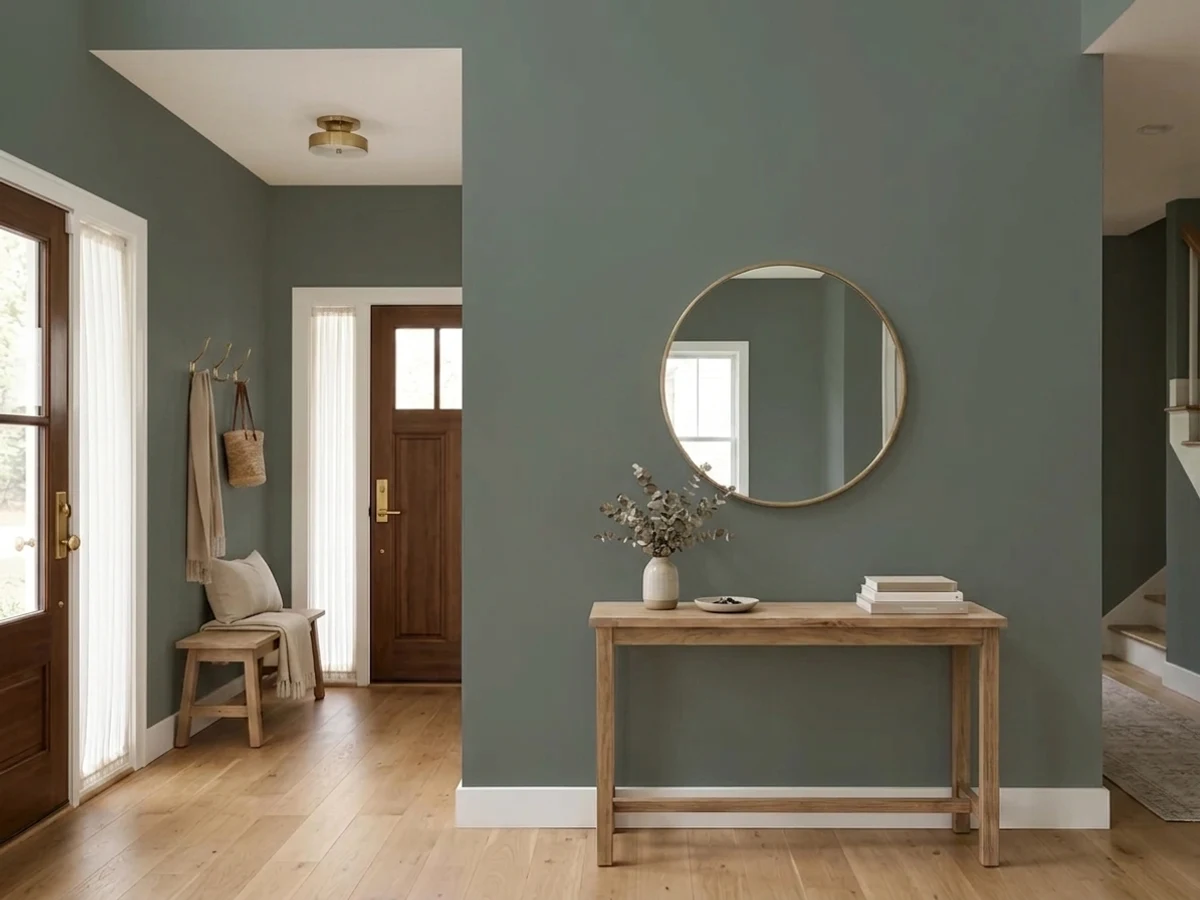
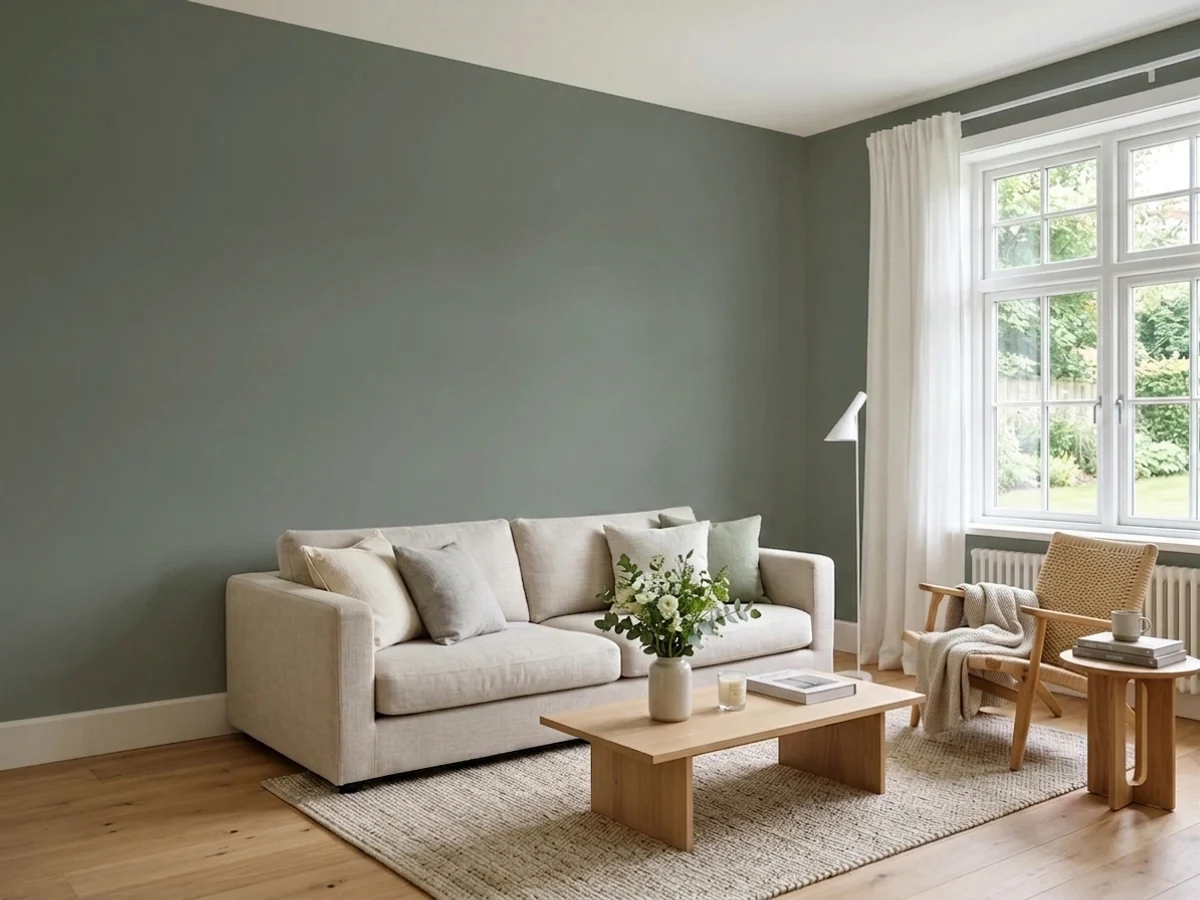
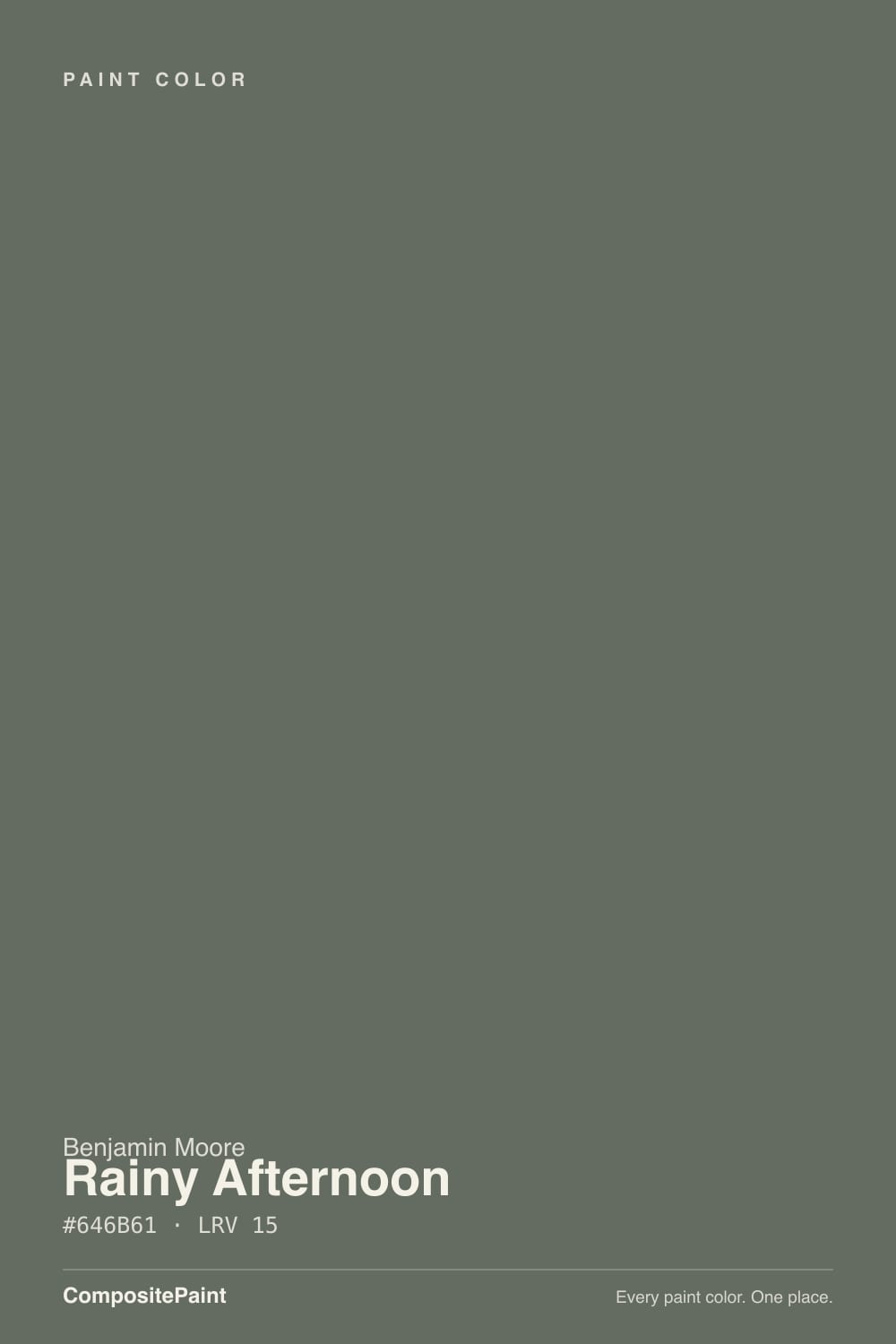
- 1Black Emerald1
- 2Essex Green6
- 3Rainy Afternoon15
- 4Sage Green22
- 5Evergreen Fog30
The Fast Verdict
Rainy Afternoon is an olive green pulled almost all the way down to neutral by gray — no Color of the Year moment, no viral room, just a Benjamin Moore Classics color that quietly does one job well: a deep, mossy neutral for cabinets, doors, and vanities that reads sophisticated instead of black. Give it real light and the green comes forward; starve it of light and it goes flat charcoal. That trade is the whole review.
Kitchen cabinets and bathroom vanities · interior doors and mudrooms with a window nearby · exterior trim and doors (BM Advance covers both) · anyone who wants a green-gray, not a plain gray
Your room has no window or dedicated light source · you actually want a neutral gray or black · you're pairing with cool blue-gray stone or tile · you want a color with a documented track record to copy from
- A genuine mossy green-gray, not a green pretending to be a neutral
- Reads sophisticated on cabinets and doors without committing a whole green room
- Deep enough (LRV 15) to anchor a kitchen or vanity without going flat black
- Same can works indoors and on exterior trim (BM Advance)
- A quiet Classics-collection color with no trend clock running on it
- Needs real daylight or task lighting or it goes flat, characterless charcoal
- Not a true gray or black substitute — the green shows the moment light hits it
- Fights cool-toned stone and blue-gray tile
- Thin real-world documentation next to the deck's famous names — fewer sample rooms to check your plan against
What Color Is Rainy Afternoon, Really?
Rainy Afternoon is an olive green pulled almost all the way down to neutral by gray — file it next to Sleepy Hollow and Cinnamon Slate in Benjamin Moore's Classics collection: colors that have sat quietly in the deck for years, waiting for a cabinet or door project to find them rather than chasing a trend. There is no famous room and no award behind this one. The honest story is a workhorse doing a workhorse's job well.
At LRV 15 it sits in the same depth range as the deck's near-blacks — Wrought Iron (LRV 6) and Kendall Charcoal (LRV 13) are only a shade darker — but it is unmistakably green the instant real daylight or a warm bulb reaches it. That is the useful part and the trap in the same breath. Under cabinet lighting or a sunny window, the moss comes forward and the color reads deliberate and expensive. In a windowless corner or a shaded spot, the same depth swallows the green and it goes flat, characterless charcoal — no different from a plain dark gray.
Undertone in one line: olive green first, cool gray second — never blue, never brown. If your sample looks swampy or too green, that is warm afternoon sun or a 2700K bulb doing exactly what this paint is built to do. If it looks like flat, personality-less charcoal, the room is too dim for the green to show its hand.
Where It Shines
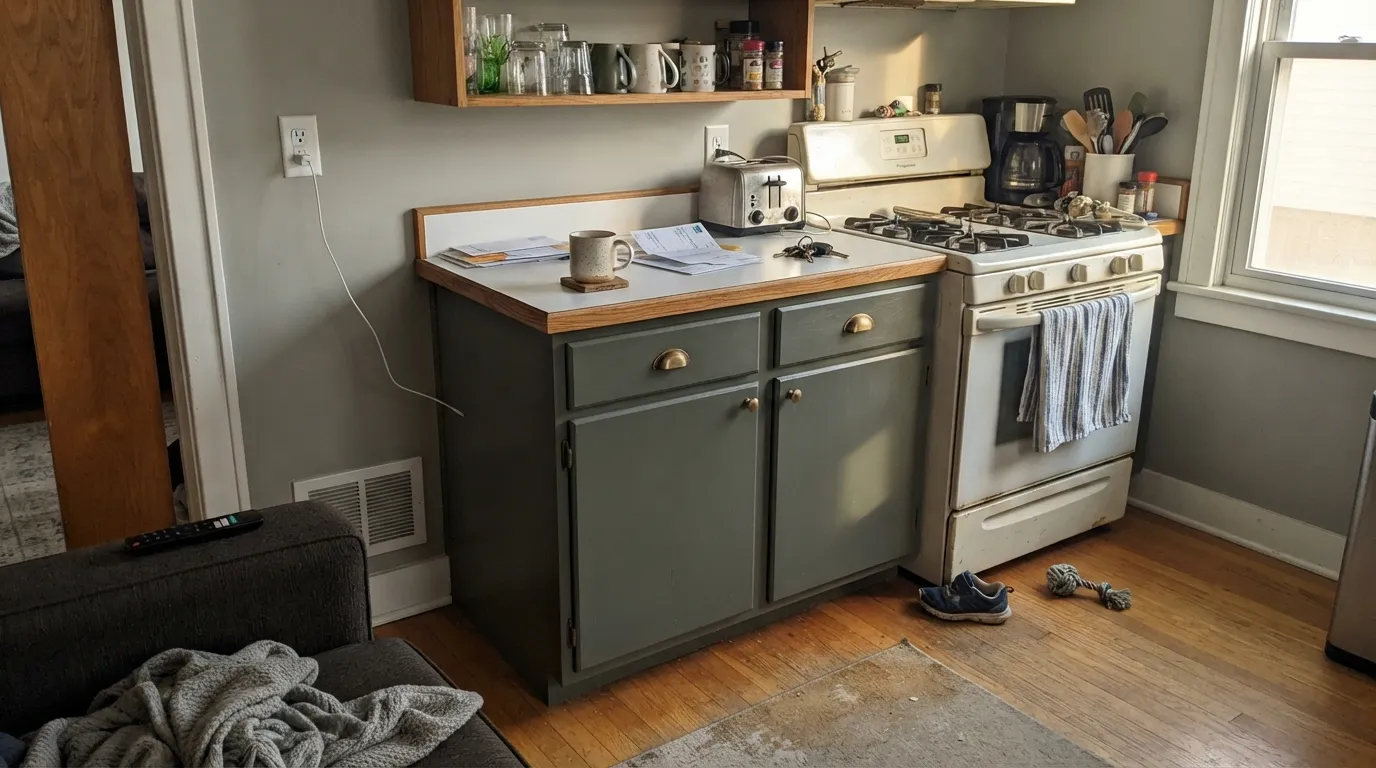
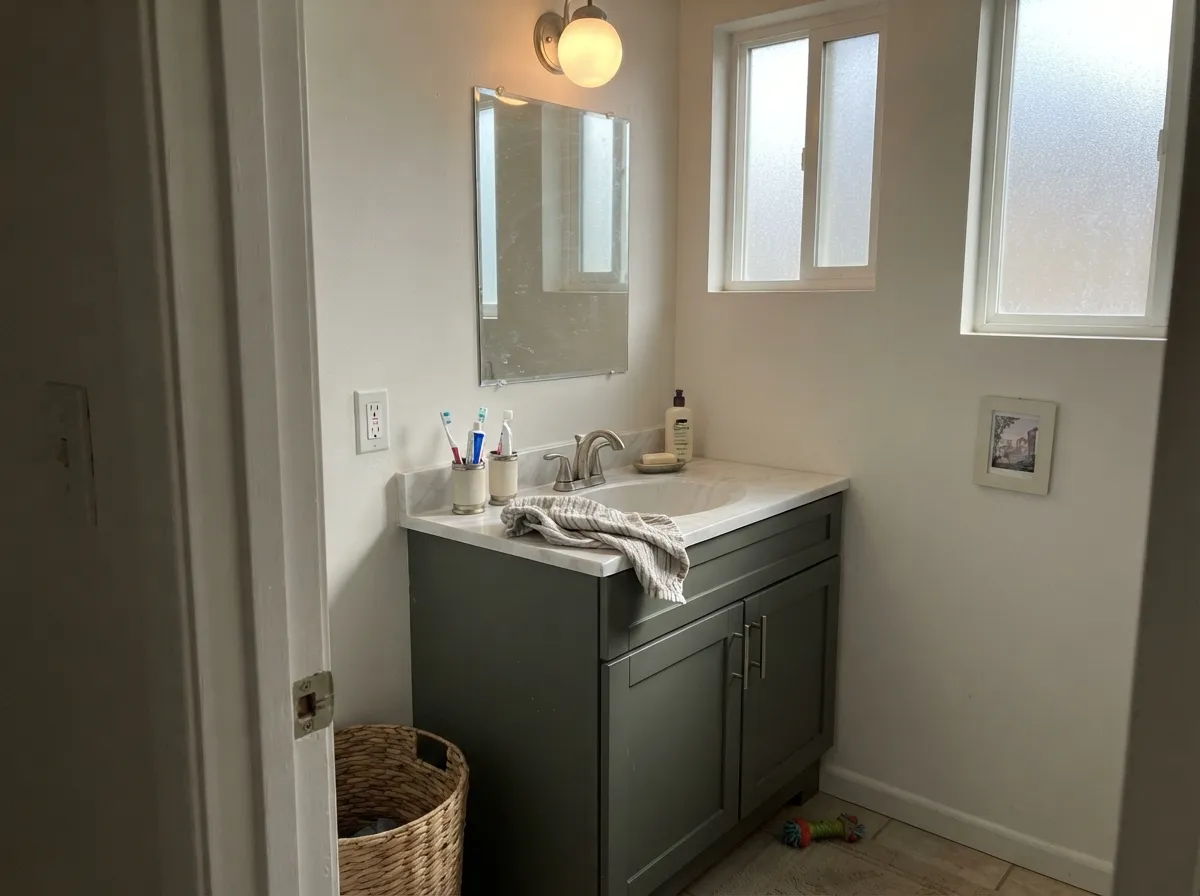
Give it cabinets, a door, or a vanity with real daylight or a dedicated fixture nearby, and the mossy green comes forward without tipping into a color you have to explain to guests. Benjamin Moore sells Rainy Afternoon in its Advance line — a washable, high-gloss enamel built for exactly this: cabinets, doors, and trim that need a durable, deep neutral. Warm wood, brass, and butcher block are its natural company; against them the green settles down and reads intentional rather than themed.
Where It Fails
The regret stories about Rainy Afternoon fall into one of three patterns, and none of them are the paint being unpredictable — they're an LRV 15 green-gray doing exactly what that depth does in the wrong conditions.
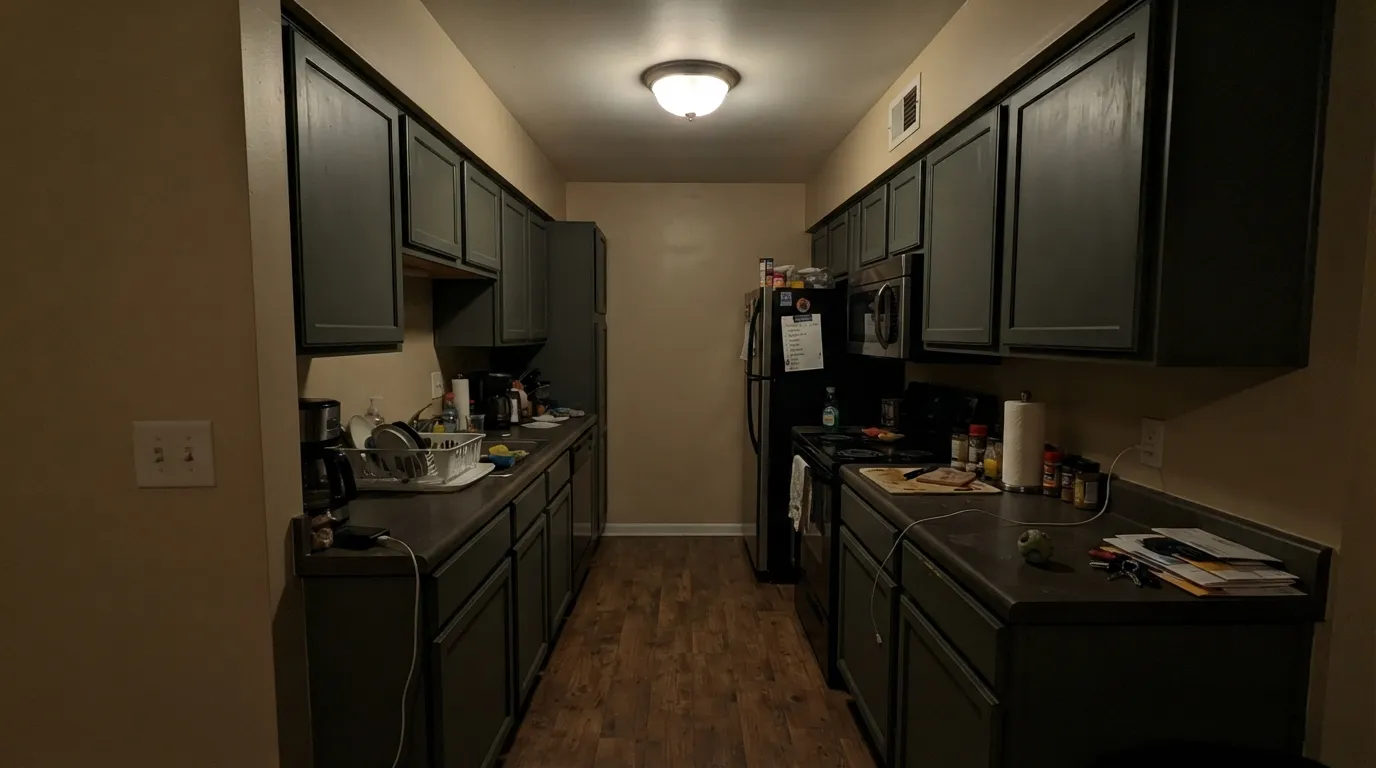
This is already one of the deck's darker colors. Without a nearby window or task lighting, the green disappears entirely and it reads as flat, characterless charcoal — the whole reason to pick a green-gray instead of a plain gray is lost. Add under-cabinet lighting or a sconce before committing a full vanity or wall to it.
The olive is not subtle once real light hits it — on four walls or a full run of cabinets it reads as green, not as a neutral gray or soft black. If gray or black is the actual goal, Kendall Charcoal or Wrought Iron get you there without the green surprise.
Like most sage and olive cabinet colors, Rainy Afternoon wants warm company. Icy quartz, blue-gray marble, and cool white subway tile all fight its warmth and push it toward a muddy, indecisive gray-green. Pair it with warm stone, butcher block, or brass instead.
Room by Room
Owners who've used it here describe exactly what Benjamin Moore built it for: a deep neutral that reads sophisticated instead of black, with the green showing up only when the light does. Satin, or BM's Advance high-gloss enamel, wipes clean around handles.
The real-world use case that shows up most often. Against a light counter and brass or nickel hardware it reads custom, not risky, and a small vanity takes the depth well without overwhelming the room.
A durable, forgiving color for the room that takes the most abuse, as long as there's a window or a real fixture nearby to keep the green from going flat and dark.
Evening-lamp company suits a color built for low, warm light. Treat it like any deep dining color: real wattage from table height, not just an overhead.
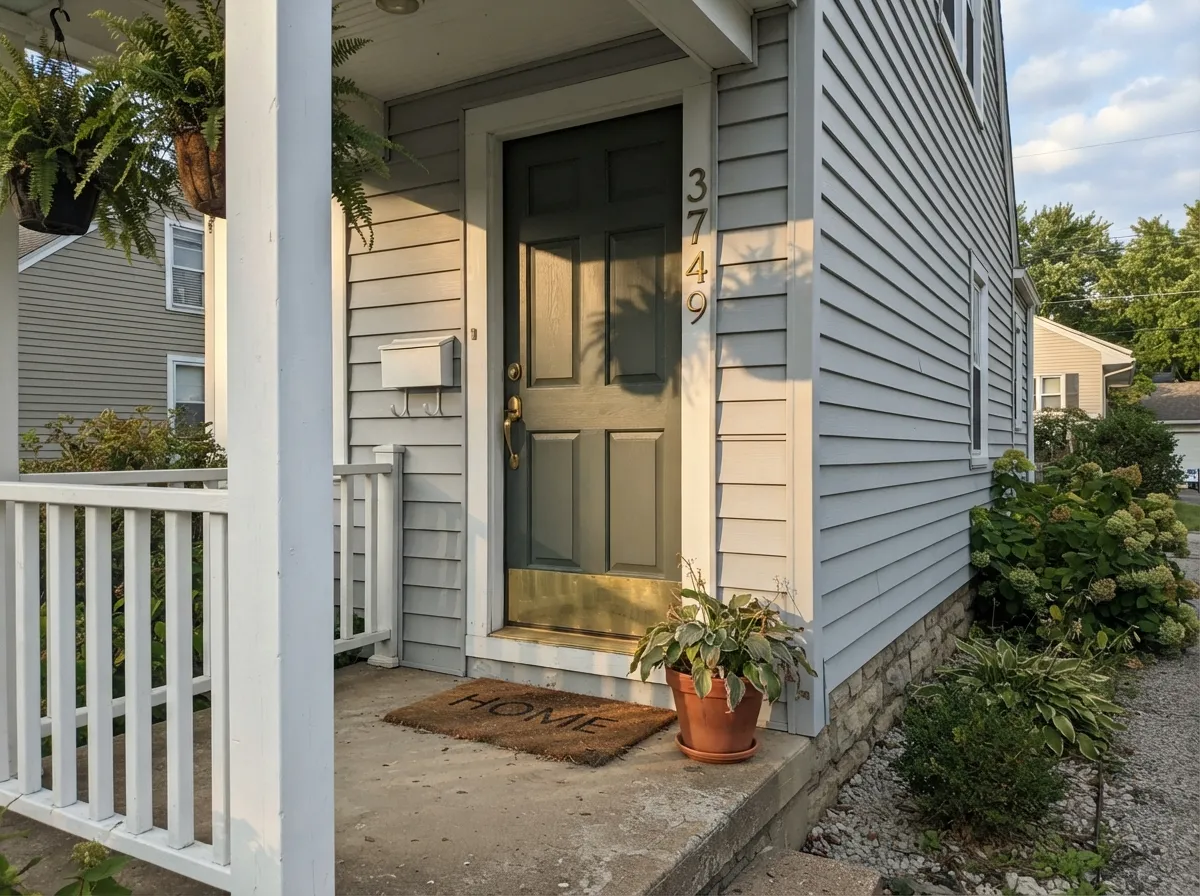
Benjamin Moore sells it in an interior/exterior Advance formula for exactly this. Full sun reads it more clearly green than indoor light does; pair with a lighter body color for contrast rather than stacking two darks.
On four full walls it needs a genuinely bright room to avoid the flat, near-black problem above. In a dim or north-facing living room, treat it as a cabinet or door color instead and keep the walls lighter.
Your Light Is the Risk
Under-cabinet lighting, a vanity sconce, or a sunny kitchen window brings the moss forward and the color reads deliberate. This is the light it was built for.
Without a dedicated light source, LRV 15 is dark enough that the green disappears and it reads as flat charcoal — no personality left to justify the pick.
Cooler and more gray in flat morning light, distinctly mossy-green once warm afternoon sun or task lighting comes on.
Warm bulbs pull the green forward and add depth at night; cool white LEDs flatten it toward plain charcoal — choose warm bulbs on purpose for this color.
Most complaints about Rainy Afternoon are a light mismatch. Upload a photo of your actual room and see it on your walls — then ask for the same wall in north light or evening lamps before you buy a single sample.
Need It From Another Brand?
Any paint counter can custom-tint Benjamin Moore 1575 directly. If you would rather stay in one brand's own deck, these are the closest stock matches, measured as ΔE2000. Under 2 is a difference you will not see on the wall.
| Brand | Closest color | ΔE | LRV | |
|---|---|---|---|---|
| Sherwin-Williams | SucculentSW 9650 · Sherwin-Williams | 2.0 | 14 | Color page → |
| Behr | Gray OwlBNC-37 · Behr | 0.6 | 14 | Color page → |
| Valspar | Brandenburg Gate8004-27F · Valspar | 4.3 | 15 | Color page → |
| PPG / Glidden | Gunmetal GrayPPG1033-6 · PPG / Glidden | 1.2 | 15 | Color page → |
| Glidden | Gunmetal GrayPPG1033-6 · Glidden | 1.1 | 14 | Color page → |
| Dutch Boy | Antiquated Olive424-6DB · Dutch Boy | 1.8 | 14 | Color page → |
Similar Benjamin Moore Colors
The nearest shades to Rainy Afternoon within Benjamin Moore's own range, ranked by perceptual color distance — useful when you want the same look a touch lighter, darker, or warmer.
WCAG 2.1: AA is 4.5 : 1 for normal text, 3 : 1 for large text, AAA is 7 : 1.
Rainy Afternoon vs the Colors You're Also Considering
Every Rainy Afternoon sample board has the same rivals on it. The numbers show the real lightness gap — then it comes down to which risk you would rather live with.
Pick this for more depth and a cooler, more gray-leaning cast on the same cabinet job.
Sherwin-Williams SW 6186 · LRV 21Dried ThymePick this for a lighter, more forgiving cabinet green that holds its color in an average room, not just under task light.
Pick this for a touch more lift — Rainy Afternoon holds a little more visible green before it reads near-black.
Sherwin-Williams SW 6208 · LRV 12Pewter GreenPick this for an even deeper, near-black gray-green on cabinets — barely any daylight needed to read intentional.
Behr Gray Owl BNC-37 at #646C62 and LRV 14 has a deltaE of 0.55 from Rainy Afternoon, which means it is the same color for practical purposes. Dunn-Edwards Velvet Clover DE6293 at #656D63 and LRV 14 is nearly as close at 0.83. Glidden Gunmetal Gray PPG1033-6 at #646C64 and LRV 14 sits at 1.1 and Sherwin-Williams Succulent SW 9650 at #616C64 and LRV 14 at 1.97, so both are visually identical in normal room light.
Farrow and Ball Douter No. 318 at #636F68 and LRV 15 is 2.82 away, so it is very close but worth sampling first, as it carries a little more green. Valspar Brandenburg Gate 8004-27F at #6D6C62 and LRV 15, at 4.27, is close but visibly different side by side and reads warmer.
Inside the Benjamin Moore deck, Enchanted Forest 700 at #606E63 and LRV 15 is the same darkness with a clearer green pull. Benjamin Moore sells through independent dealers, so availability depends on your local store.
Rainy Afternoon Coordinating Colors
The rule for coordinating with Rainy Afternoon: warm whites and warm neutrals do the heavy lifting, and one near-black gives the scheme its edge. It pairs best with cream over stark white, and with brass and warm wood over anything icy. These are the partners that keep showing up in real projects:
Rainy Afternoon on Cabinets and Exteriors
The real-world use case for this color is narrower than the marketing photos suggest, and that's exactly why it works: it shows up most often as a cabinet, vanity, or door color rather than a full room. Owners who've painted bathroom cabinets or a kitchen island in it describe the same thing — a deep, sophisticated neutral that reads green rather than black once the light is right, without the commitment of four full green walls.
Benjamin Moore backs that use case directly: Rainy Afternoon is sold in the Advance line, a waterborne alkyd enamel built for cabinets, doors, and trim, in a high-gloss finish rated for repeated washing, and it's also available in an interior/exterior formula for trim, shutters, and doors. Outside, expect full sun to push it more clearly green than most indoor light does — plan the trim and body pairing with that in mind rather than assuming it will look exactly like the chip.
Rainy Afternoon With Wood Tones and Floors
Warm wood is this color's best company. Oak, walnut, and butcher block all sit comfortably next to Rainy Afternoon because the olive in the paint and the warmth in the wood meet in the middle — the same reason it turns up so often on kitchen islands and cabinet runs. Brass and unlacquered nickel hardware read as an upgrade against it, not an accident.
The pairing to test first is anything cool: icy quartz counters, blue-gray marble, gray-washed floors. None of them are a hard no, but they pull the green toward a muddy, indecisive gray rather than the clean moss the color shows against warm materials. If the cool surface is staying, sample a large board of Rainy Afternoon against it before committing a full run of cabinets.
Three Ready Palettes Built on Rainy Afternoon
A color is never alone on the wall. These are complete combinations in the 60-30-10 pattern, with the reason each one holds together. Every one opens in the visualizer.
Swiss Coffee keeps the kitchen bright enough for the cabinets to hold their green under daylight; White Dove trim shares the same warm base so the handoff from wall to woodwork stays quiet, not competing.
Try this palette in your roomA warm off-white keeps a small windowless bath from feeling like a cave while the vanity carries the color; a near-black frame gives the room one deliberate dark note instead of two competing ones.
Try this palette in your roomA classic dark-body, white-trim exterior scheme: the trim keeps the house from reading like one flat mass, and the near-black door is the single decisive note against the mossy body.
Try this palette in your roomRainy Afternoon FAQ
Is Rainy Afternoon green or gray?
Green — quietly, but unmistakably once real light reaches it. In dim rooms it can read as a plain dark gray, but on cabinets or a door under real light, the olive is clearly visible. If you want gray with no green at all, look at Kendall Charcoal instead.
Is it too dark for a whole room?
At LRV 15 it needs real daylight to work on four full walls. It is far more forgiving — and far more common in real projects — as a cabinet, door, or vanity color, where a window or fixture nearby does the work of keeping the green visible.
What white goes with Rainy Afternoon cabinets?
A warm white or off-white — White Dove or Swiss Coffee — keeps the kitchen bright without fighting the green's warmth. A stark bright white will make the cabinets look duller than they are by comparison.
Does it work on exterior trim or siding?
Yes. Benjamin Moore sells it in the interior/exterior Advance formula specifically for trim and doors. Full sun reads it more clearly green than most indoor light does, so pair it with a lighter body color for contrast.
What's the difference between Rainy Afternoon and Kendall Charcoal or Pewter Green?
Kendall Charcoal is the true-gray option at nearly the same depth with no green cast. Pewter Green sits a shade darker and reads even more near-black before the green shows. Rainy Afternoon is the middle path: unmistakably green, but only once real light hits it.
Does it work with oak floors and wood tones?
Warm woods — oak, walnut, butcher block — are its best company, along with brass and nickel hardware. It is the cool-toned stone and blue-gray tile combinations that fight it, not warm wood.
Have you painted with Rainy Afternoon?
Rate it — one tap helps the next reader decide.
Ask a Question