Grays Harbor
The stormy deep blue-gray with a misleading name, reviewed honestly: where the blue shows up, why LRV 12 is the whole story, and the rooms that can actually carry it.

Jessica has spec'd whites and neutrals for more than 300 rooms and keeps a sample wall of painted drawdowns in her studio. Every color review is checked against real reader rooms in the comments and re-tested when a formula changes. About the testing process →
The Fast Verdict
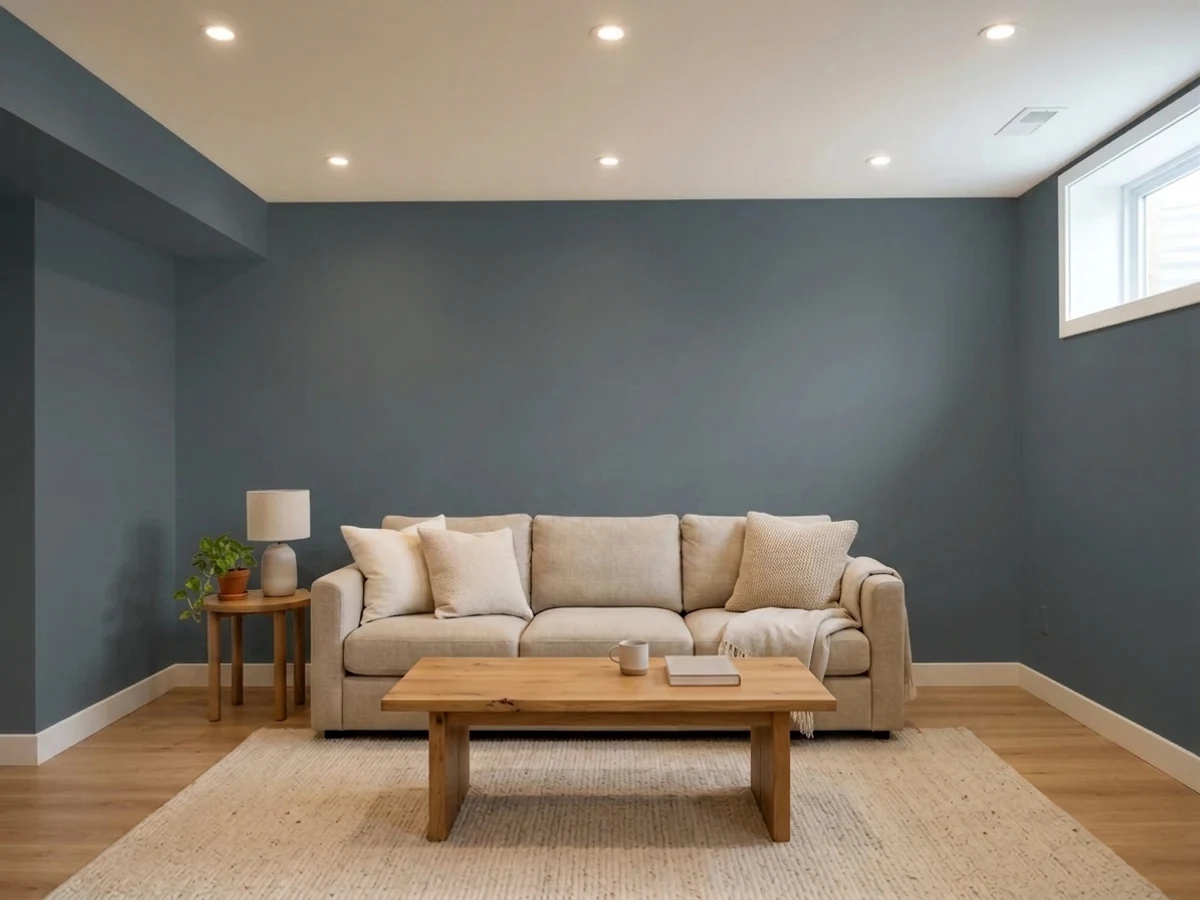
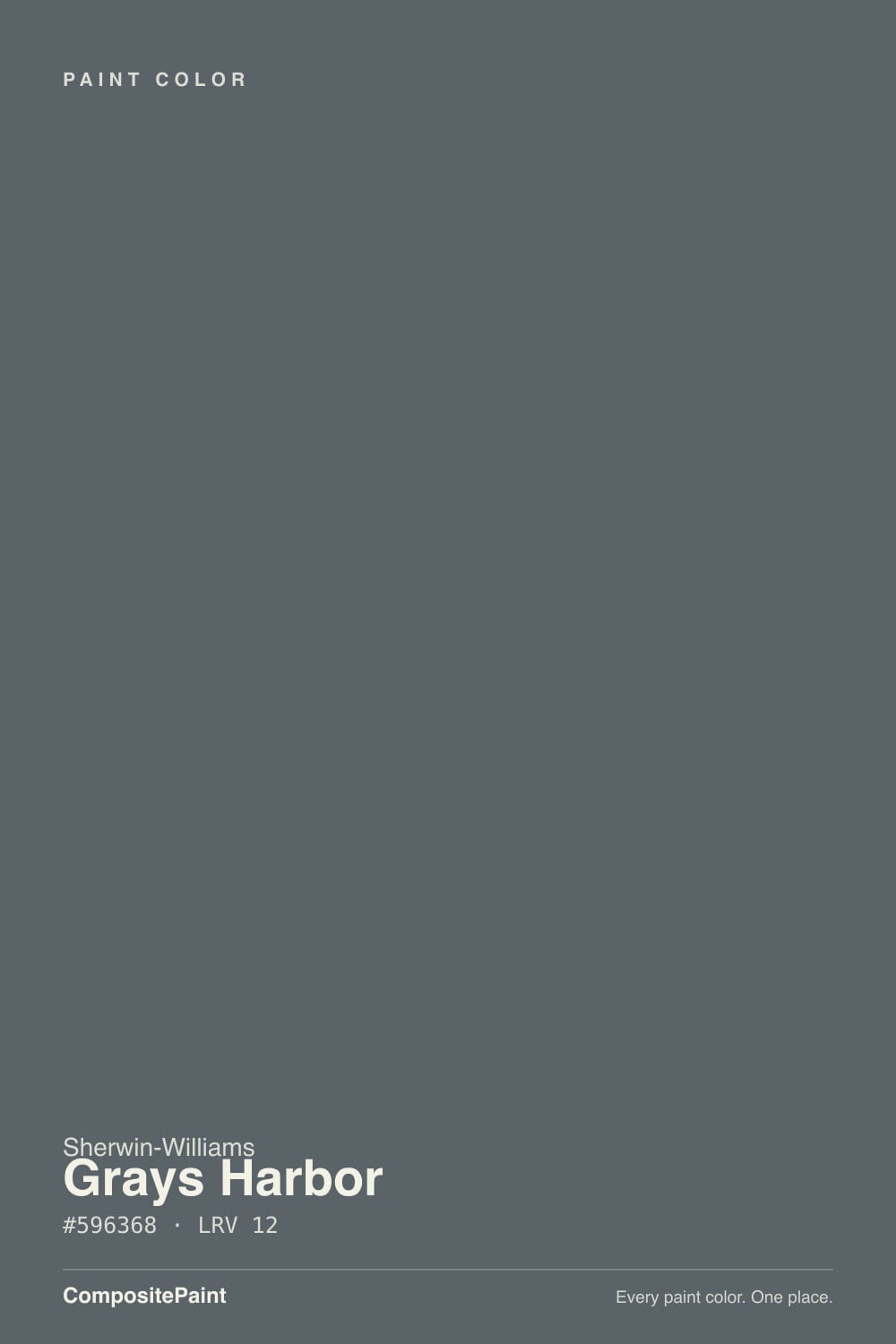
Grays Harbor is a deep, desaturated blue-gray with a real green thread running under it — the color of the Pacific coast on a gray day. Sherwin-Williams files it under blue, not gray, and on four walls the deck is right: the name is the single biggest source of disappointment with this color. At LRV 12 it is dark paint, and it repays light generously and punishes the absence of it. Give it a window, warm lamps and white trim and it turns into one of the most grown-up dark colors SW makes.
Basement feature walls, built-ins and wet bars · home offices and dens · lamplit bedrooms that should feel like a hotel · kitchen islands, vanities and mudroom lockers · exteriors and front doors on cool-toned houses
You want a true gray with no blue in it · the room is dark and you refuse to add lamps · your floors are honey oak or your fireplace is orange brick · you need the room to feel bigger than it is
- Deep enough to ground a room full of mismatched finishes
- Blue-gray with a green thread — no purple flash, no muddy brown
- Outstanding on islands, vanities and lockers where the dose is small
- One of the better dark exterior body colors: holds its color on gray days
- Hides scuffs and handprints in basements, offices and mudrooms
- The name says gray and the wall says blue — the number-one complaint
- LRV 12 needs a lighting plan; without one it reads as a dark shadow, not a color
- Fights honey oak, orange brick and golden-toned floors
- Cool LEDs plus cool flooring tip the whole room clinical
What Color Is Grays Harbor, Really?
A deep slate blue-gray with a green thread in it. The mix reads exactly the way the numbers do: blue is the strongest channel, green sits just behind it, red trails last. That order is what separates a slate from a navy — there is no purple in it, no black-brown warmth, just a cold marine gray-blue. Sherwin-Williams does not file it with the grays at all; it lives in the blue family on their site, which is the most useful thing the brand tells you about it. It shares its name with Grays Harbor, the wide estuary on the Washington coast, and it looks like it: sea water under cloud.
LRV 12 is the other half of the story, and it decides most outcomes. That is dark paint — it absorbs the large majority of the light that hits it. For scale, it sits a hair deeper than Waterloo at LRV 13 and just below Peppercorn at 11, and well above the near-blacks: Cyberspace is 7, Hale Navy 6. What LRV 12 means in practice is that the color only exists where there is light to reveal it. In a bright room it separates into a clear blue-gray with depth; in a dim one it collapses into an anonymous dark slate that could be any of a dozen colors.
Undertone in one line: blue first, green second, never warm. If your sample board reads like a plain charcoal, your light is warm or thin. If it reads distinctly blue, your light is cool and plentiful. Both are the same paint telling the truth about the room — and the chip in the store, lit by cool fluorescent light on a white card, always shows you the bluest, lightest version you will ever see.
Where It Shines
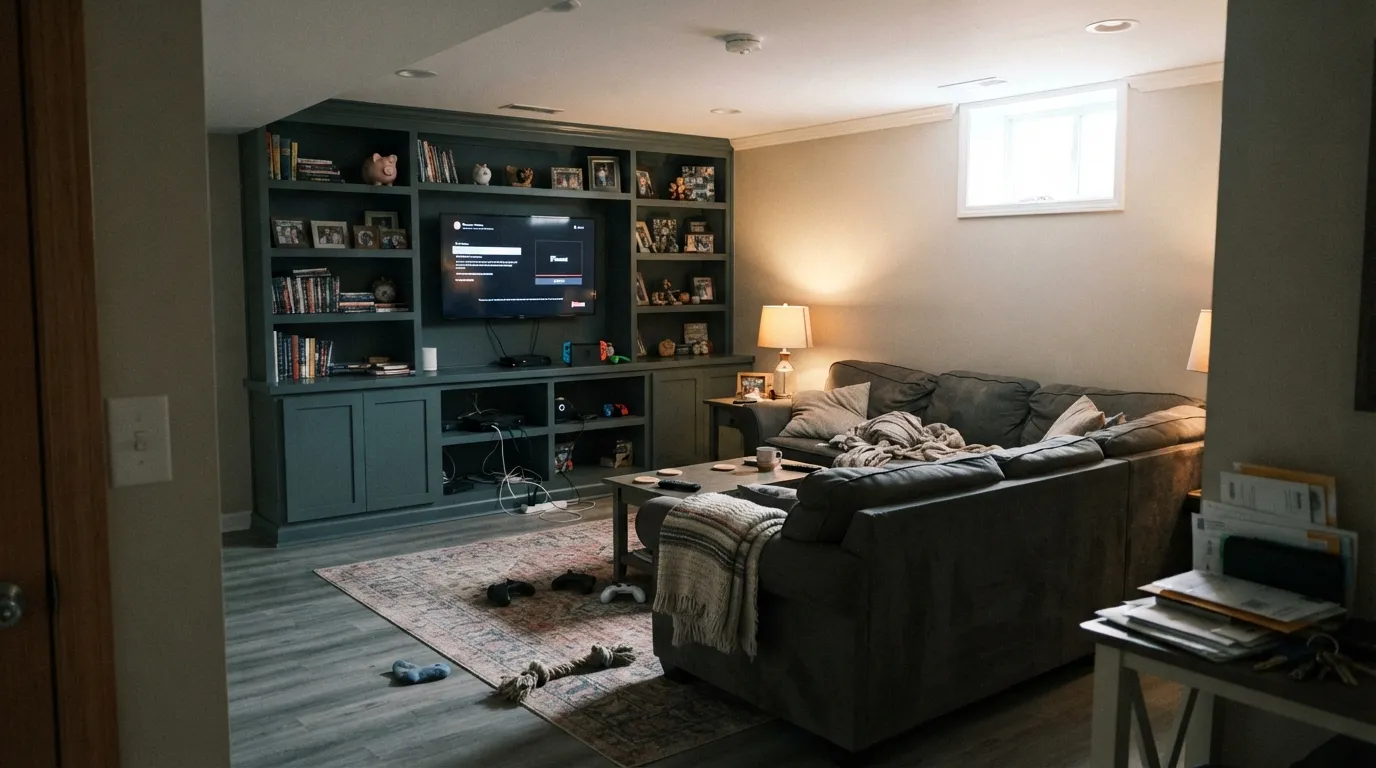
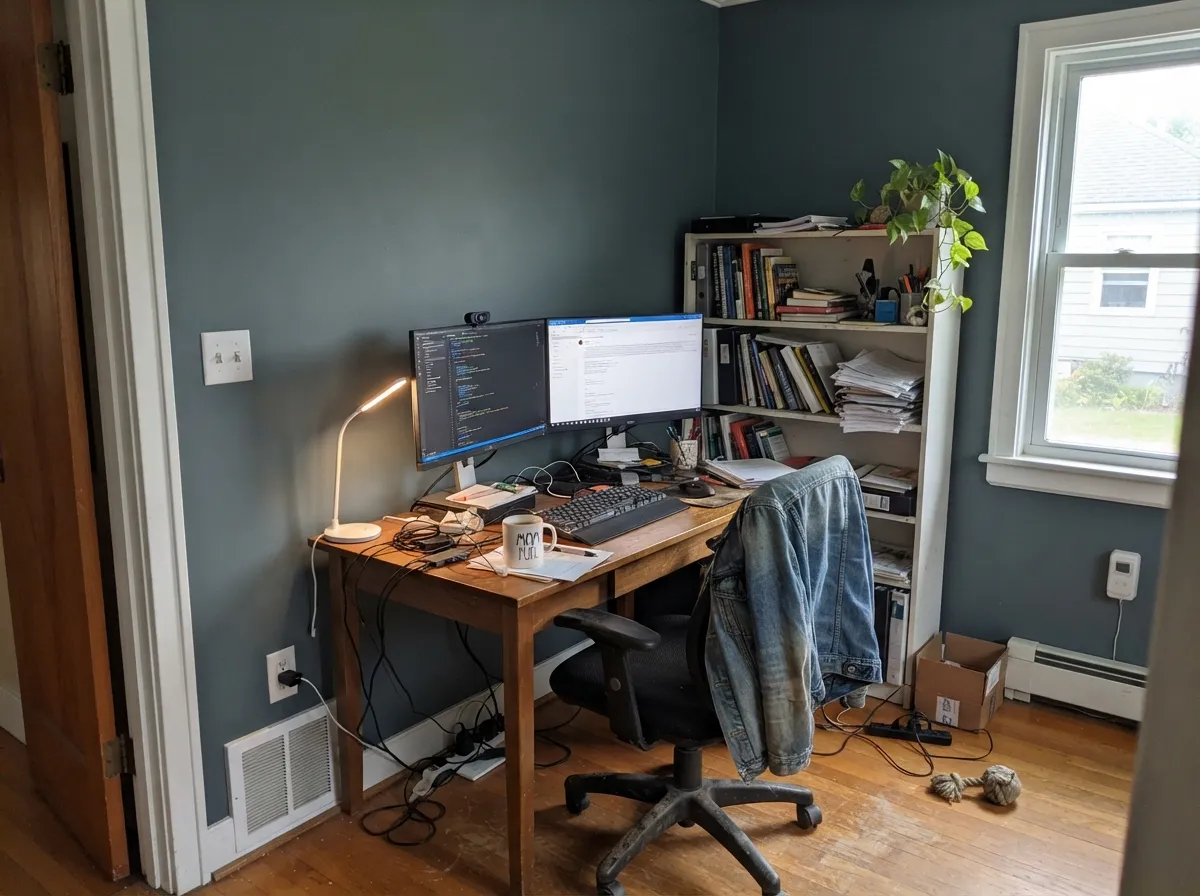
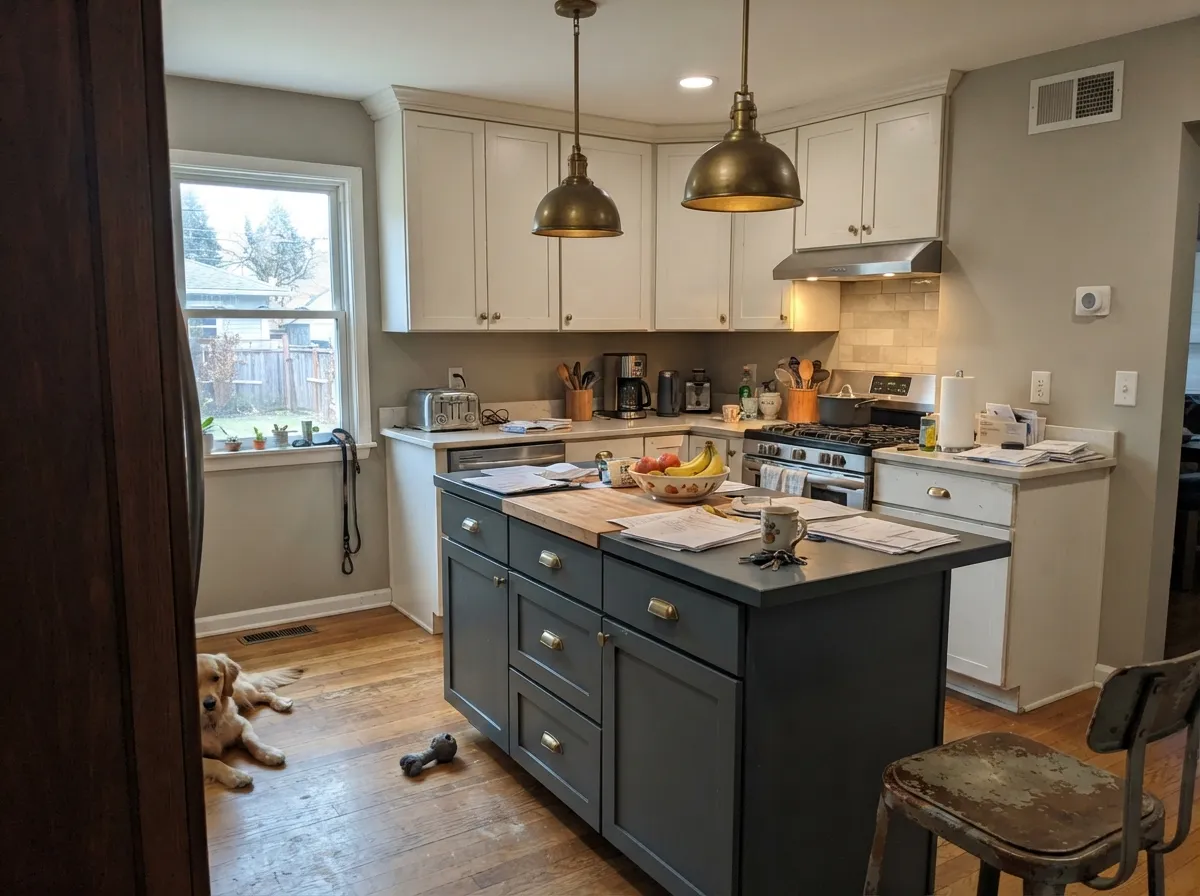
This color is at its best doing a specific job: grounding a room that has too many finishes going on. That is why it keeps turning up in finished basements — on the wall behind the TV, on built-in shelving, on a wet-bar cabinet run — where it pulls a mix of carpet, LVP, stone and trim into one deliberate scheme. Its second home is the working room: a home office or den where dark walls actually help, and where you were going to have lamps on anyway. And it is quietly excellent on cabinetry — an island, a vanity, mudroom lockers — where the surface is small, the lighting is close, and the blue reads intentional instead of accidental.
Where It Fails
Nearly every complaint about Grays Harbor comes from one of three places, and all three are visible before you open the can. None of them mean the paint is bad. They mean the room, the floor or the expectation was wrong — and a bigger sample will confirm it rather than fix it.
This is the number-one regret and the name causes it. On a two-inch chip it passes for a moody charcoal. On four walls next to white trim the blue is obvious to everyone who walks in — depth multiplies undertone, and at LRV 12 there is a lot of depth to multiply. If you want this weight with no blue in it, Peppercorn at LRV 11 is the same darkness and borrows its undertone from your room instead of announcing one.
LRV 12 in a windowless basement corner or a small north bedroom with one overhead fixture does not read as a beautiful blue-gray. It reads as dark. You paid for a color and got a shadow. This paint needs either real daylight or a real plan: two or three warm lamps at different heights, or a lit built-in, not a single ceiling can. If the answer is one bulb, pick something two or three times lighter.
Orange sits opposite blue on the wheel, so golden oak floors, orange-stained trim and a red-orange brick fireplace all push Grays Harbor bluer while the walls push them more orange. Everyone loses. Walnut, white oak, black-stained wood and true gray or greige floors are all fine. The other quiet mismatch is cold gray LVP: cool floor plus cool wall plus cool LED and the room reads like a dentist office.
Room by Room
Basements are where this color earns its reputation. Deep blue-gray hides scuffs, absorbs the harsh bounce of overhead cans, and pulls carpet, LVP and stone into one scheme instead of three. The condition is light: use it on the media wall, the built-ins or the bar run and keep the rest of the walls light, or commit to all four walls only if you have egress windows plus lamps. Eggshell over matte down here — basements get wiped.
Dark walls behind a monitor are genuinely easier on the eyes than a bright white box, and this is a color that reads serious on video calls without looking like a cave. Bookshelves, a leather chair and a desk lamp are the natural company. Eggshell, and put the light behind you rather than only overhead.
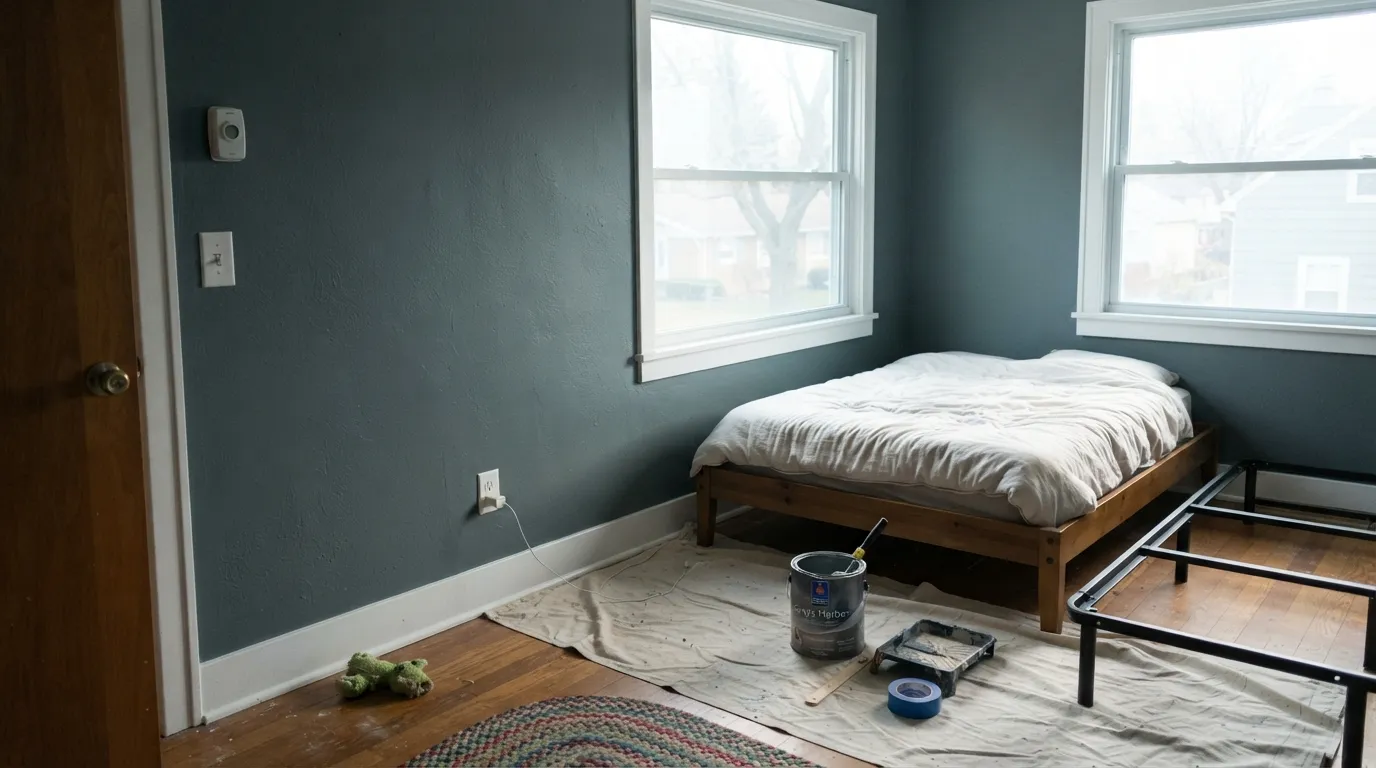
In a bedroom the color does what a good hotel room does: the walls recede and the bed becomes the room. It needs warm 2700K bedside lamps, white or cream bedding to push against, and ideally a window. Matte on the walls hides drywall texture that dark paint otherwise advertises. In a small north bedroom with no lamps, do the headboard wall only.
This is the easiest way to own this color. A Grays Harbor island under warm white perimeter cabinets, a blue-gray vanity under a light stone top, mudroom lockers in satin enamel — all read custom, and none of them commit a whole room. Brass and unlacquered bronze hardware warm it; polished chrome leaves it cold. Use a proper urethane-fortified cabinet enamel, not wall paint.
A dining room is used at night, which is exactly when this color is flattering, so color-drenching walls, trim and ceiling is a real option here and it looks expensive. Half measures look unfinished: one dark accent wall in a dining room usually reads like a decision someone abandoned. Candles, warm dimmers, and something warm on the table — wood, brass or terracotta.
Outside it behaves better than most dark interiors colors do, because full daylight is exactly what it wants. On siding it reads as a stately storm-gray with clear blue in it and holds that read on overcast days rather than going flat. It suits Craftsman, ranch and coastal-transitional houses, with a crisp white trim and a black or warm wood door. Satin sheen, and expect it to run hot in full southern sun — a dark body color always does.
Your Light Is the Risk
Give it a decent window and the color separates: clear blue-gray with a green depth underneath and visible variation across the wall. This is the light that makes it worth painting.
A basement corner or an interior room with one ceiling fixture drains the color out entirely. It stops reading as blue-gray and starts reading as generic dark. The fix is lamps, not more coats.
Cool morning light from an east or north window brings the blue and the green forward; afternoon and golden-hour sun mutes both and lets it settle toward a plain charcoal-slate. Overcast days are steadier than you would expect — it keeps its blue instead of going flat.
Warm 2700K bulbs pull the blue back and the walls read as a soft, warm-edged charcoal — the cozy version, and the one to aim for indoors. Cool 4000K and higher LEDs do the opposite: they push the blue-green forward and the room can turn steely and cold. Pick your bulbs before you judge your sample.
Most complaints about Grays Harbor are a light mismatch. Upload a photo of your actual room and see it on your walls — then ask for the same wall in north light or evening lamps before you buy a single sample.
Need It From Another Brand?
Any paint counter can custom-tint Sherwin-Williams SW 6236 directly. If you would rather stay in one brand's own deck, these are the closest stock matches, measured as ΔE2000. Under 2 is a difference you will not see on the wall.
| Brand | Closest color | ΔE | LRV | |
|---|---|---|---|---|
| Behr | Blue MetalHDC-AC-25 · Behr | 0.6 | 12 | Color page → |
| Benjamin Moore | Anchor Gray2126-30 · Benjamin Moore | 2.8 | 14 | Color page → |
| Valspar | Carriage WheelM330 · Valspar | 2.4 | 11.5 | Color page → |
| PPG / Glidden | Glazed GranitePPG1011-6 · PPG / Glidden | 3.6 | 11 | Color page → |
| Glidden | Glazed GranitePPG1011-6 · Glidden | 3.6 | 11 | Color page → |
| Dutch Boy | Steely Expression435-6DB · Dutch Boy | 2.3 | 12 | Color page → |
Similar Sherwin-Williams Colors
The nearest shades to Grays Harbor within Sherwin-Williams's own range, ranked by perceptual color distance — useful when you want the same look a touch lighter, darker, or warmer.
WCAG 2.1: AA is 4.5 : 1 for normal text, 3 : 1 for large text, AAA is 7 : 1.
Grays Harbor vs the Colors You're Also Considering
Every Grays Harbor sample board has the same rivals on it. The numbers show the real lightness gap — then it comes down to which risk you would rather live with.
Pick this when you want that mood dialed back far enough that half the room calls it gray.
Sherwin-Williams SW 9141 · LRV 13WaterlooPick this if you want the blue to be the point — Waterloo is the same depth but reads as a slate blue, not a gray.
Pick this when you want the dark to have a temperature of its own instead of borrowing one.
Sherwin-Williams SW 7674 · LRV 11PeppercornPick this if you actually wanted dark gray — same weight, none of the blue, and it takes its undertone from whatever is around it.
Outerspace SW 6251 at LRV 12 and hex #586168 is a near twin, a fraction lower in the red channel and effectively the same on a wall. Rain Cloud SW 9639 at LRV 11 is bluer, and Needlepoint Navy SW 32 at LRV 13 more so again. In the other direction, Web Gray SW 7075 at LRV 13 is a quieter, more neutral gray, and Cloak Gray SW 6278 at LRV 11 leans faintly purple.
Two brands sell an Anchor Gray and both land near this color. Dunn-Edwards Anchor Gray DE6328 at LRV 11 has a deltaE of 2.07, and Benjamin Moore Anchor Gray 2126-30 at LRV 14 a deltaE of 2.76, so both are very close but worth sampling first. Farrow & Ball Inchyra Blue No. 289 at LRV 13, deltaE 3.83, is close but visibly different side by side, carrying more green.
Grays Harbor Coordinating Colors
The rule with Grays Harbor is simple: it is a cool color at a dark depth, so almost everything it touches should either be clean and light, or warm enough to push back. Crisp whites give it the edge it needs; warm neutrals stop the room going clinical; one clay or terracotta note makes the blue look chosen. These are the partners that keep showing up in rooms that work:
Grays Harbor Outside: Siding, Doors and Shutters
Dark interior colors and dark exterior colors are judged by different rules, and this is one of the colors that scores much better outside than in. The reason is light volume: even an overcast sky throws more light at a wall than any room lamp, so the blue and the green in it stay visible instead of collapsing into a flat dark. Owners in the Pacific Northwest have been putting it on siding for years for exactly that reason — it looks like the weather there, and it does not go dead on a gray afternoon.
The dependable exterior formula is a crisp white trim, a black or natural-wood front door, and warm-toned stone or brick if you have any. On a smaller house, the safer version is to keep the body light and put Grays Harbor on the shutters, the garage door or the front door alone; a dark door on a pale house reads sharp from the street without committing the whole envelope.
Two practical notes. A dark body color absorbs more heat than a light one, which matters on south and west elevations and on older wood siding — use a quality exterior acrylic and follow the brand's coverage spec rather than stretching a gallon. And dark colors show chalking and fading sooner than mid-tones, so plan the repaint cycle a little shorter than you would for a beige.
Grays Harbor With Wood Tones and Floors
The floor decides this one before the paint does. Walnut, black-stained oak and pale unstained white oak are all excellent — the first two match its weight, the third gives the room somewhere to breathe. True gray and greige hard flooring works, and so does a mid-tone wool rug. Cream or oatmeal carpet in a bedroom or basement is a good foil, because the warmth stops the blue from turning cold.
The honest no is anything golden. Honey oak floors, orange-stained trim, red-orange brick fireplaces and yellow-beige builder carpet all sit opposite blue on the wheel, so each side exaggerates the other: the floor looks more orange, the walls look more blue, and no number of coats changes the geometry. If the golden floor is staying, either cover most of it with a rug or choose a dark that has some warmth of its own.
The other pairing worth watching is cold gray LVP, which is everywhere in finished basements. Cool floor plus cool wall plus 4000K ceiling cans is three cold things in a row, and the room reads institutional. The fix costs almost nothing: change the bulbs to 2700K and add something warm at eye level — wood shelving, a leather chair, a clay-toned throw.
Three Ready Palettes Built on Grays Harbor
A color is never alone on the wall. These are complete combinations in the 60-30-10 pattern, with the reason each one holds together. Every one opens in the visualizer.
This is the basement scheme that actually survives low light: one dark wall for weight, a warm neutral on the rest so the room does not close in, and a soft white overhead to keep the ceiling from pressing down. Accessible Beige is doing real work here — it warms up the cool blue-gray — but it goes drab under cool light, so keep the basement bulbs at 2700K and it stays warm.
Try this palette in your roomCool walls need one warm thing to push against or the room reads clinical. Redend Point is close to the opposite side of the wheel from a blue-gray, so a clay-toned door, chair or rug makes the walls look deliberate rather than cold. Pure White keeps the trim crisp without the icy edge a brighter white would add.
Try this palette in your roomThe two-tone kitchen only works when the white has some warmth in it — a stark bright white above a cool blue-gray island makes the whole kitchen feel refrigerated. Greek Villa keeps the uppers soft, Drift of Mist bridges warm cabinets and cool island on the walls, and brass pulls finish the argument.
Try this palette in your roomGrays Harbor FAQ
Is Grays Harbor blue or gray?
Blue — quietly, but on four walls unmistakably. Sherwin-Williams itself lists it in the blue family, not the grays. It is heavily desaturated, so in warm or dim light it can pass for a charcoal, but next to white trim in daylight the blue shows and there is a green thread under it too. If you are hoping for a neutral dark gray, this is the wrong chip and that mismatch is behind most of its bad reviews.
Is Grays Harbor too dark for a basement?
It depends entirely on whether you are lighting the basement. At LRV 12 it needs light to look like a color instead of a shadow. On a media wall, on built-ins or on a bar run — with lighter walls around it and a couple of lamps — it is genuinely one of the better basement colors, because it grounds mismatched flooring and hides scuffs. All four walls of a windowless basement with one row of ceiling cans is where the regret stories come from.
What trim white goes with Grays Harbor?
A clean, slightly warm white gives you the crisp edge without an icy one — Pure White at LRV 84 is the default, Alabaster at 82 if your floors and wood are warm. Avoid the brightest, coolest whites here: at this depth the contrast is already dramatic, and a stark white can tip the whole room cold. Semi-gloss on trim, matte or eggshell on the walls.
Grays Harbor or Cyberspace — which should I use?
Cyberspace is a full step deeper: LRV 7 against Grays Harbor at 12, and it reads near-black in anything less than good light. Use Cyberspace when you want drama and have the windows to pay for it. Use Grays Harbor when the room is average — a basement, an office, a north bedroom — and you want the color to still be readable as blue-gray at the end of the day.
Can I paint kitchen cabinets Grays Harbor?
Yes, and it is arguably the best way to use the color. It is most convincing in doses: the island, the lower run, a vanity, mudroom lockers — under warm white uppers and light stone. Two things matter: use a real urethane-fortified cabinet enamel rather than wall paint, and pick warm hardware. Brass and bronze warm the blue; polished chrome leaves it cold.
Is Grays Harbor a good exterior color?
It is one of its strongest uses. Full daylight is exactly the condition this color wants, so outside it stays a readable storm blue-gray instead of collapsing into dark, and it holds that read on overcast days. Pair it with white trim and a black or natural wood door, use a satin exterior sheen, and remember that any dark body color absorbs more heat and shows chalking sooner in relentless southern sun.
Have you painted with Grays Harbor?
Rate it — one tap helps the next reader decide.
Ask a Question