Black Fox
The soft black everyone picks instead of true black, reviewed honestly: when the brown actually shows up, when it just looks black, and what to pick instead.

Jessica has spec'd whites and neutrals for more than 300 rooms and keeps a sample wall of painted drawdowns in her studio. Every color review is checked against real reader rooms in the comments and re-tested when a formula changes. About the testing process →
- 1Black Fox7
- 2Pewter Green12
- 3Retreat21
The Fast Verdict
Black Fox is what people reach for when true black feels too hard. On an island, a door, or a whole exterior it lands with the same weight as black but softens next to wood, leather, and brass.
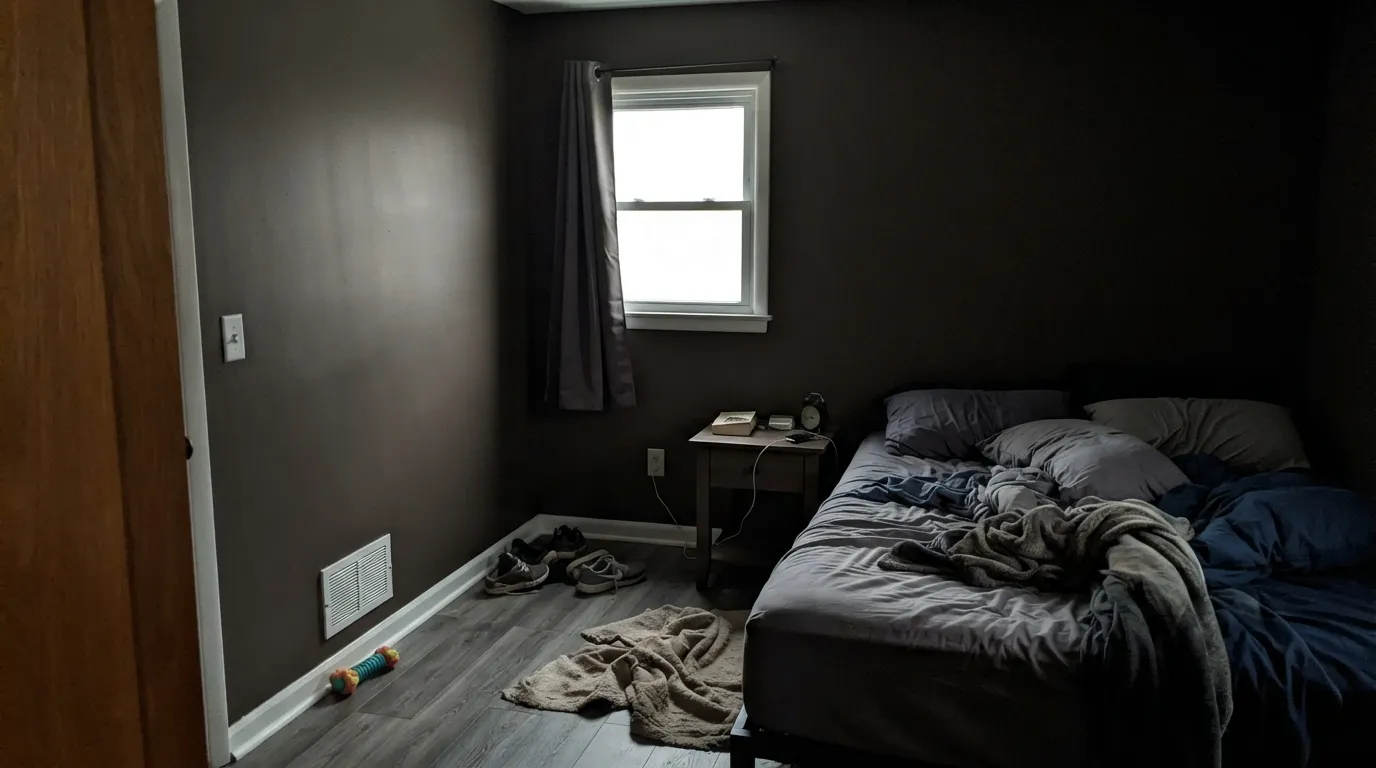
The catch is honest and worth knowing before you buy: the brown that sold you on it only shows in good light, and in a dim room it collapses into a plain soft black. Buy it for the near-black weight and treat the brown as a bonus, and you will love it.
Kitchen islands and lower cabinets · interior doors, sashes and built-ins · modern-farmhouse exteriors and front doors · studies and powder rooms with real lamps
Your room faces north and stays dim · you are buying it because you want visible brown · your floors and counters are cool gray · you hate touching up dark paint
- Near-black weight without the harsh, cut-out look of true black
- Sits comfortably with oak, walnut, leather, brass and aged bronze
- One of the best island and lower-cabinet colors Sherwin-Williams makes
- Excellent modern-farmhouse exterior body and front-door color
- Warm enough to soften a scheme, dark enough to still be dramatic
- Reads as plain black in north light, shade, and under cool bulbs
- Goes muddy next to cool gray floors and blue-white trim
- Shows dust, fingerprints and touch-up patches on any large surface
- Deep base needs a tinted primer and usually three coats
What Color Is Black Fox, Really?
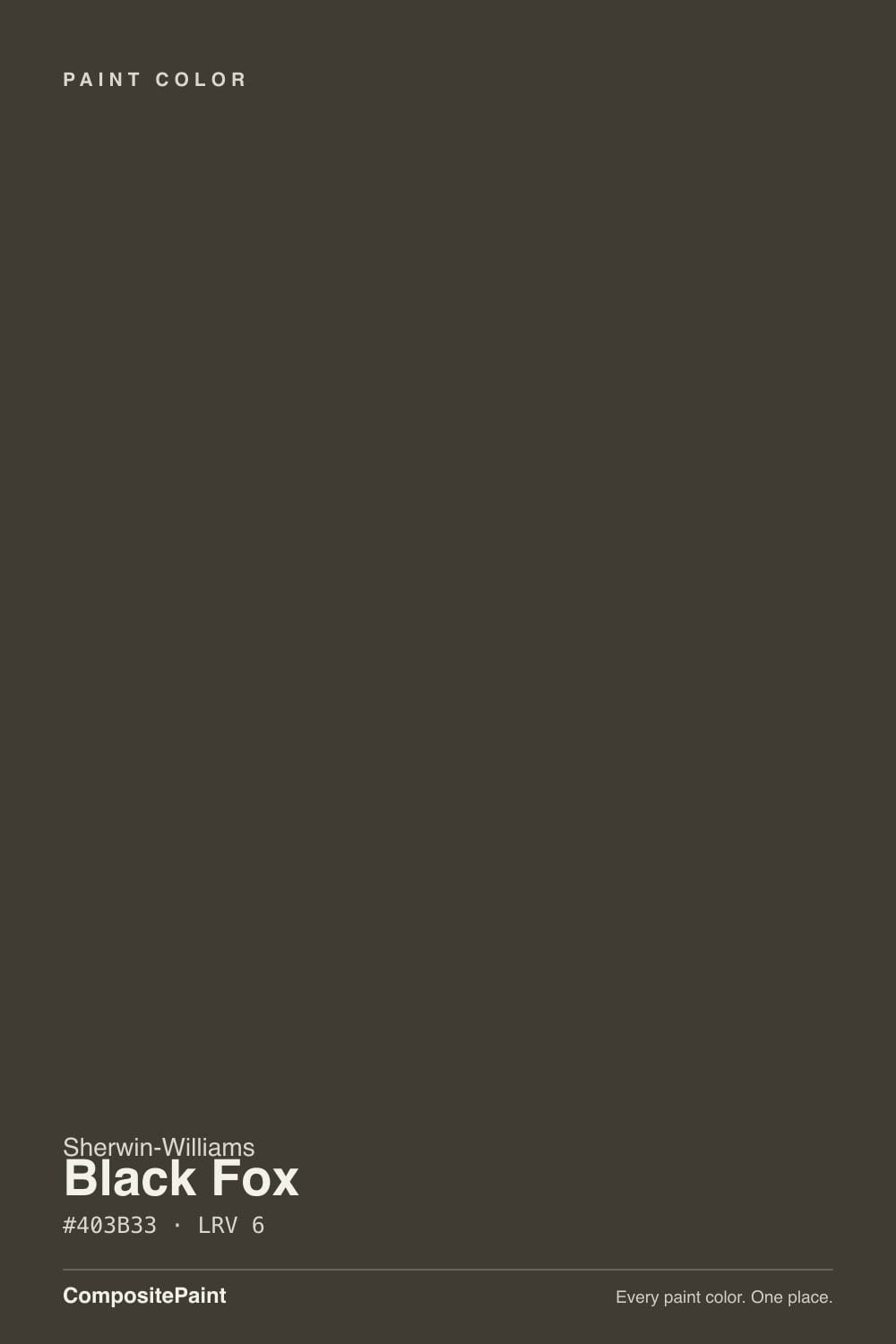
It belongs to the small group painters call soft blacks: colors that behave like black but are mixed on a colored base instead of a neutral one. Black Fox sits on a red-orange base, so what you get is a black with brown underneath rather than a black with blue or green underneath. That is why it looks calm against oak, walnut, leather, and brass, and why it never gets that cut-out, hole-in-the-wall look a true black can give a cabinet run.
The LRV number is the part people misread. At 6, Black Fox is exactly as dark as Iron Ore SW 7069 — same amount of light coming back, opposite temperature. Tricorn Black SW 6258 at LRV 3 is only three points darker and most people cannot tell those apart across a room. The real ladder is upward: Urbane Bronze SW 7048 at LRV 8 is barely lighter on paper but looks like a different color in ordinary light, because it has just enough reflectance left to show its hue. Black Fox does not. Below about LRV 8, a color stops being a color and starts being a shade.
Undertone in one line: warm brown-black — never blue, never green. If your sample looks flat and colorless, that is not a bad batch and not a mistint; that is the light in the room refusing to give the brown back to you.
Where It Shines
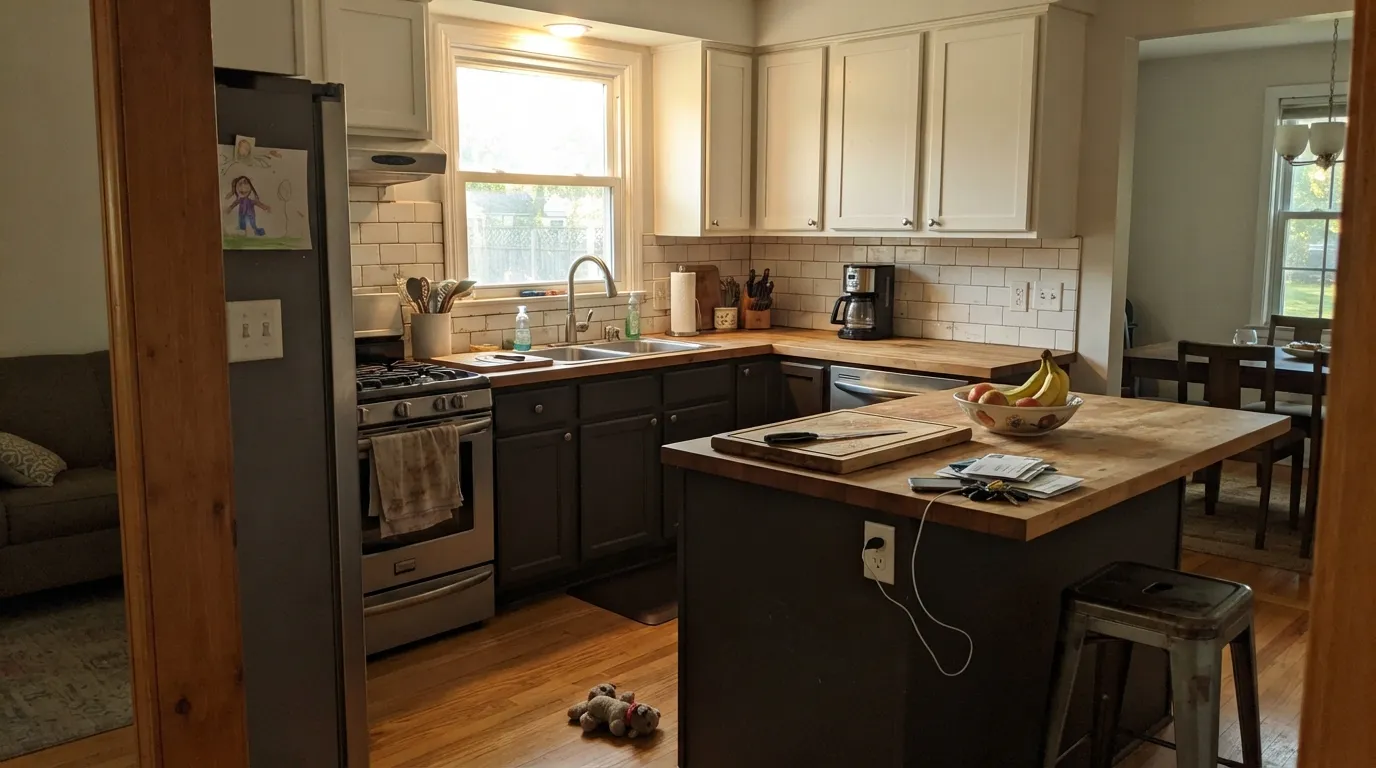
Give it a light source and something warm to sit against, and it is one of the best near-blacks in the deck. Cabinets, islands, doors, and exteriors are where it earns its reputation, because on those surfaces it catches direct light at some angle and the brown finally shows.
Where It Fails
The bad stories about Black Fox are remarkably consistent, and none of them are about the paint being wrong. They are about buying it for the brown and then putting it somewhere the brown cannot survive.
Cool, low daylight kills the red-orange base and you are left with a plain soft black. This is the number one regret story: someone chose it over black specifically for the warmth and cannot find the warmth anywhere. If you need the hue visible in weak light, step up to Urbane Bronze SW 7048.
Gray LVP, gray-washed oak, and blue-white trim all sit at the opposite temperature, and they push Black Fox's brown forward until it reads muddy — people describe it as looking dirty or slightly purple-brown next to the floor. In a cool gray house, Iron Ore SW 7069 is the near-black that belongs there.
At LRV 7 every scuff, every dusty handprint, and every touch-up patch shows, and flat paint burnishes to a shiny mark the moment you wipe it. Use satin and expect to keep a jar for touch-ups. If a whole room has to survive kids and dogs, put Black Fox on the cabinets and take the walls to Urbane Bronze SW 7048 instead.
Room by Room
Satin on the doors and drawers, with Alabaster SW 7008 uppers and brass or aged bronze pulls. The under-cabinet lighting and the window over the sink are what make the brown appear, so this is the one place it shows up daily. Dark cabinets do collect dust and fingerprints — plan on a microfiber cloth in the drawer.
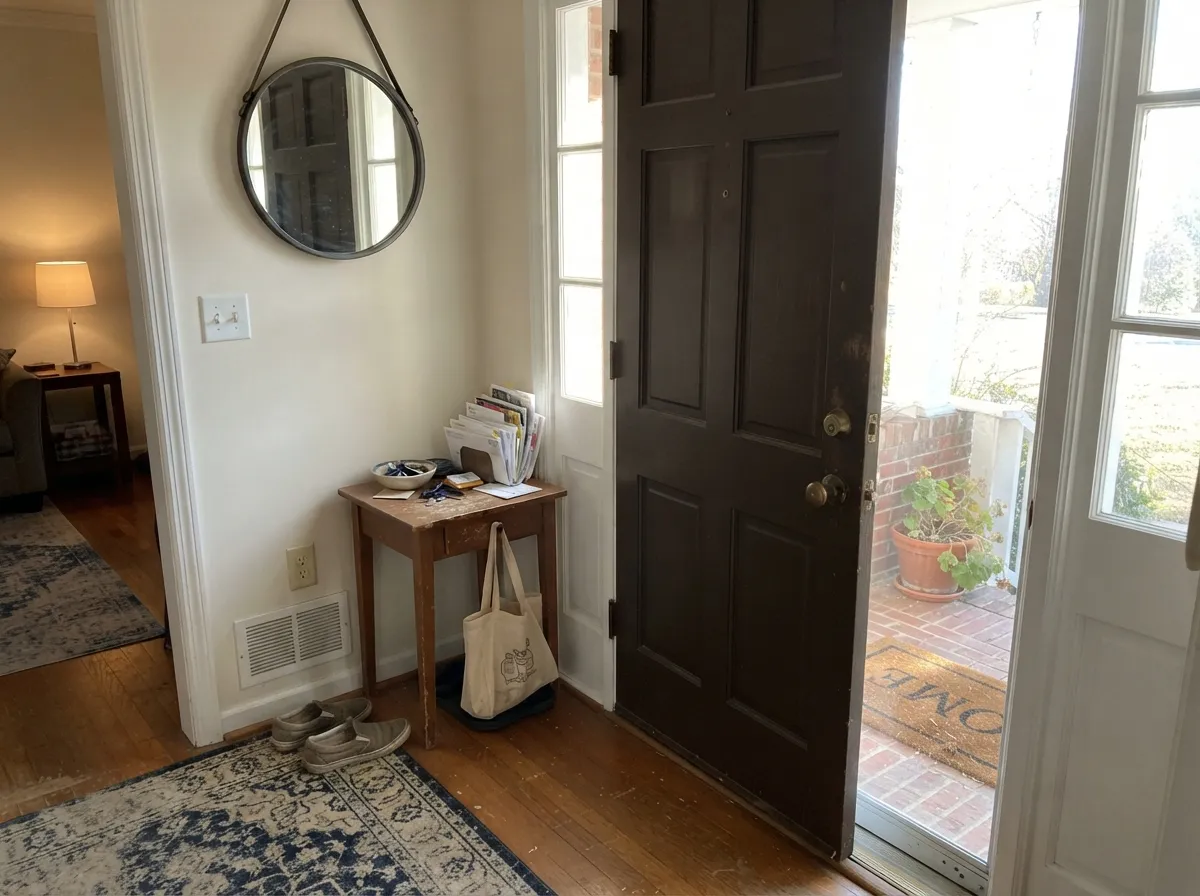
Semi-gloss on doors, satin on shelving. Against warm white walls like Shoji White SW 7042 the doors read as a deliberate design move instead of a mistake. The gloss catches light from more angles, which is exactly what this color needs.
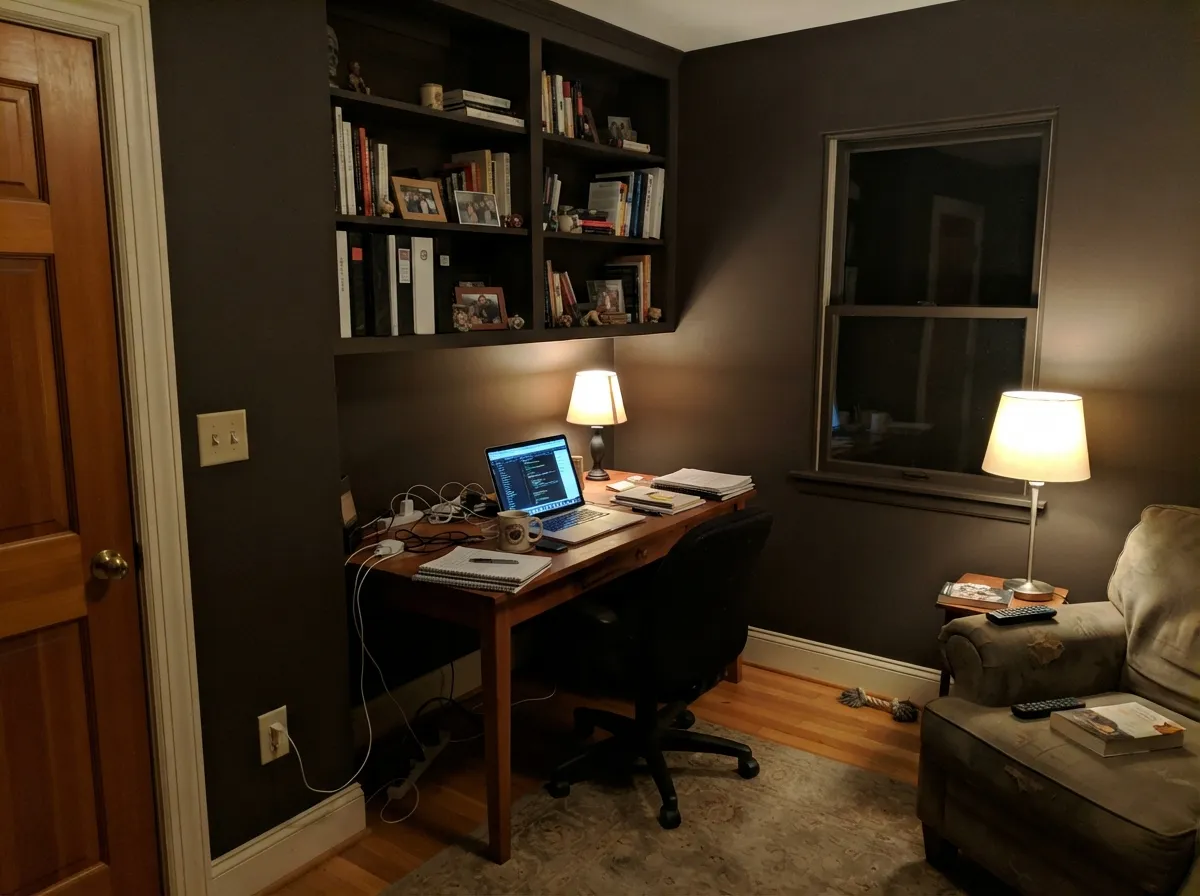
Matte walls, ceiling included, and two or three warm 2700K lamps rather than one overhead fixture. Trim in Alabaster SW 7008 keeps the whole scheme on the warm side. Do not attempt this in a room whose only light is a north window.
No natural light means no expectation of light, so the cave effect stops being a problem and becomes the point. Satin so it wipes, a warm bulb over the mirror, brass fixtures. Small rooms are also the cheapest way to find out if you actually like living with it.
A whole living room at LRV 7 absorbs nearly everything, so you need multiple windows or a lot of lamps to stop it feeling closed in. A single fireplace wall is the safer version of the same idea, with Accessible Beige SW 7036 on the rest.
This is where the color swings hardest and looks best, because full sun brings the brown out clearly. Pair with Pure White SW 7005 or Alabaster SW 7008 trim. Details, heat, and the vinyl siding warning are in the exterior section below.
Your Light Is the Risk
Direct sun pulls the red-orange base forward — this is the color you thought you bought.
Cool daylight strips the warmth out and it settles into a plain soft black.
Brown while the sun is on that wall, black the rest of the day. Expect the switch.
2700K makes it rich and brown. 4000K LEDs flatten it to black — change bulbs, not paint.
Most complaints about Black Fox are a light mismatch. Upload a photo of your actual room and see it on your walls — then ask for the same wall in north light or evening lamps before you buy a single sample.
Need It From Another Brand?
Any paint counter can custom-tint Sherwin-Williams SW 7020 directly. If you would rather stay in one brand's own deck, these are the closest stock matches, measured as ΔE2000. Under 2 is a difference you will not see on the wall.
| Brand | Closest color | ΔE | LRV | |
|---|---|---|---|---|
| Behr | Tribal DrumT12-13 · Behr | 1.5 | 7 | Color page → |
| Benjamin Moore | Midsummer Night2134-20 · Benjamin Moore | 0.9 | 7 | Color page → |
| Valspar | Moon RockT501 · Valspar | 1.9 | 6.7 | Color page → |
| PPG / Glidden | Dark GranitePPG1005-7 · PPG / Glidden | 1.9 | 6 | Color page → |
| Glidden | Deepest Earth Green30YY 07/041 · Glidden | 1.3 | 7 | Color page → |
| Dutch Boy | Blackened Kettle439-7DB · Dutch Boy | 0.0 | 7 | Color page → |
Similar Sherwin-Williams Colors
The nearest shades to Black Fox within Sherwin-Williams's own range, ranked by perceptual color distance — useful when you want the same look a touch lighter, darker, or warmer.
WCAG 2.1: AA is 4.5 : 1 for normal text, 3 : 1 for large text, AAA is 7 : 1.
Black Fox vs the Colors You're Also Considering
Every Black Fox sample board has the same rivals on it. The numbers show the real lightness gap — then it comes down to which risk you would rather live with.
Pick this for warmth — Iron Ore is the cooler, harder version of the same darkness.
Sherwin-Williams SW 7069 · LRV 6Iron OrePick this if your floors, counters and trim all lean cool gray.
Pick this when you want near-black weight, not an obvious brown.
Sherwin-Williams SW 7048 · LRV 8Urbane BronzePick this when you want the hue to still show in weak light.
Side-by-side comparison →Urbane Bronze SW 7048 at LRV 8 is the closest comparison people actually make. Two points of LRV is small, but Urbane Bronze is visibly lighter and greener in feel, reading as a deep warm gray-brown that still shows its color in normal light. Black Fox reads as black more of the time. Choose Urbane Bronze when you want the color to be obvious and Black Fox when you want near-black with warmth underneath.
Within the family, Cracked Pepper SW 9580 at LRV 5 and Clove SW 9605 at LRV 5 are close relatives, while Greenblack SW 6994 at LRV 4 swaps the warm base for a cool green one.
Across brands, Behr Havana Coffee N210-7 at LRV 5 is an exact color match on the numbers. Valspar Magpie 8005-1G at LRV 5 is very close, so sample first. Farrow & Ball Pitch Black No. 256 at LRV 5 is close but visibly different side by side.
Black Fox Coordinating Colors
Coordinating with Black Fox comes down to one rule: stay warm. Because the base is red-orange, warm whites and warm neutrals read as one family with it, while cool blue-whites and gray-blues make it look brown by contrast rather than deep. These are the partners that keep showing up in real schemes:
Black Fox on Exteriors
Outside is where this color makes the most sense, and where the brown is easiest to see. Sunlight is stronger and less filtered than anything indoors, so a wall in full sun reads clearly warm while the same wall in shade reads black. Most people like that swing on a facade — it gives a big dark house some life instead of a flat silhouette. Walk the whole house with a large sample before committing, because the north elevation will look like a different color from the south one all year.
Two practical points decide whether this ends well. First, substrate: fine on wood, fiber cement, brick, and stucco, but never on vinyl siding, where a color at LRV 7 can absorb enough heat to warp the panels and void the warranty. Second, product: dark exterior colors need a coating formulated to hold deep pigment, and they fade faster than mid-tones on sun-blasted southern and western walls, so budget for a repaint sooner than you would with a light body color.
For trim, Pure White SW 7005 gives the sharp modern-farmhouse contrast and Alabaster SW 7008 gives a softer, more traditional version. Both work; the white you already have on the windows usually decides it for you.
Black Fox on Cabinets and Islands
Cabinets are the most common reason people buy this color, and the most common place it succeeds. An island or a run of lowers is close to task lighting, close to a window, and close to warm materials — butcher block, oak floors, brass pulls, leather stools — so the brown gets every chance to appear. It also solves a specific problem: a black island in a warm kitchen can look like a piece of borrowed furniture, and Black Fox does not.
Two honest warnings. Dark cabinets show dust, water spots, and fingerprints far more than white ones, particularly around handles and the trash pull-out, so a satin finish and a cloth in the drawer are not optional. And a whole kitchen of Black Fox uppers and lowers is a much bigger commitment than the photos suggest — the room loses most of its bounced light. Keep the uppers in Alabaster SW 7008 or leave them open shelving unless you have a genuinely bright room.
Three Ready Palettes Built on Black Fox
A color is never alone on the wall. These are complete combinations in the 60-30-10 pattern, with the reason each one holds together. Every one opens in the visualizer.
Black Fox takes the whole envelope so there are no contrast lines to shrink a small room, and Alabaster's creamy white keeps the trim on the same warm side of the fence. The muted green door adds the one note of actual color without cooling the scheme down.
Try this palette in your roomThe dark base cabinets carry the weight at eye level and below, the warm white uppers keep the room from closing in, and Accessible Beige bridges the two because it shares the same warm base. Brass hardware is the ten percent that ties all three together.
Try this palette in your roomA dark body with crisp white trim is the highest-contrast pairing available, and outdoor sun is the one condition where Black Fox reliably shows its brown. Urbane Bronze on the garage doors keeps that big blank surface from competing with the front entry.
Try this palette in your roomBlack Fox FAQ
Black Fox or Iron Ore — which should I use?
They are the same darkness, so this is purely a temperature choice. Pick Black Fox if your house has wood floors, warm whites, brass, and leather. Pick Iron Ore SW 7069 if your floors are gray, your trim is a cool white, and your metals are chrome or matte black. Putting the warm one in a cool house is the single most common Black Fox regret.
How many coats does it take?
Plan on a gray-tinted primer plus two to three finish coats. Deep-base colors carry less white pigment, so they cover poorly over anything light and show roller laps if you stretch the paint. Keep a wet edge and do not try to make two coats work over white cabinets.
What sheen should I use on cabinets?
Satin. Flat and matte look beautiful for about a week and then burnish into shiny patches everywhere hands touch. Satin on a urethane-fortified cabinet enamel wipes clean, and the extra light bounce is what lets you see the brown at all.
Will it look brown or purple next to gray floors?
Against cool gray flooring the red-orange base gets pushed forward and many people read it as muddy or slightly purple-brown. It is a real effect, not your eyes. Tape a large sample directly against the floor before you commit, or switch to Iron Ore SW 7069.
Is Black Fox a good front door color?
One of the best. A door is small, it usually catches direct light at some point in the day, and it sits next to wood or brick that flatters the warm base. Use an exterior satin or semi-gloss, and pair it with warm white trim like Alabaster SW 7008.
Can I use it on vinyl siding?
No. Any color this dark absorbs enough heat to warp vinyl, and painting vinyl outside the manufacturer's light-color range voids the siding warranty. On wood, fiber cement, brick, or stucco it is fine — just use a quality exterior coating rated for deep colors and expect a dark facade to run hot in full sun.
Have you painted with Black Fox?
Rate it — one tap helps the next reader decide.
Ask a Question