Cascades
A near-black teal from Sherwin-Williams, reviewed honestly: where the green-blue actually shows, the light that swallows it into plain black, and what to pick instead.

Jessica has spec'd whites and neutrals for more than 300 rooms and keeps a sample wall of painted drawdowns in her studio. Every color review is checked against real reader rooms in the comments and re-tested when a formula changes. About the testing process →
- 1Cascades4
- 2Hidden Gem14
- 3Van Courtland Blue31
The Fast Verdict
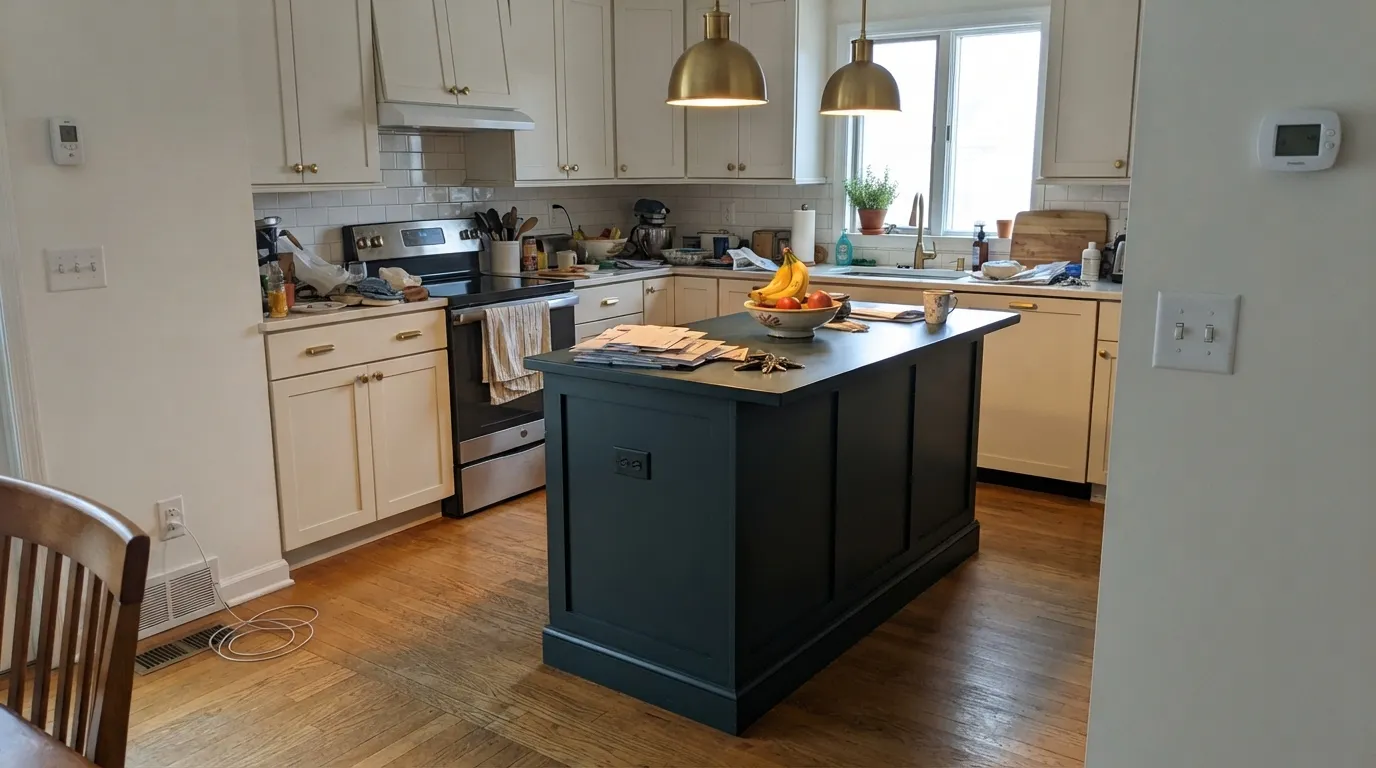
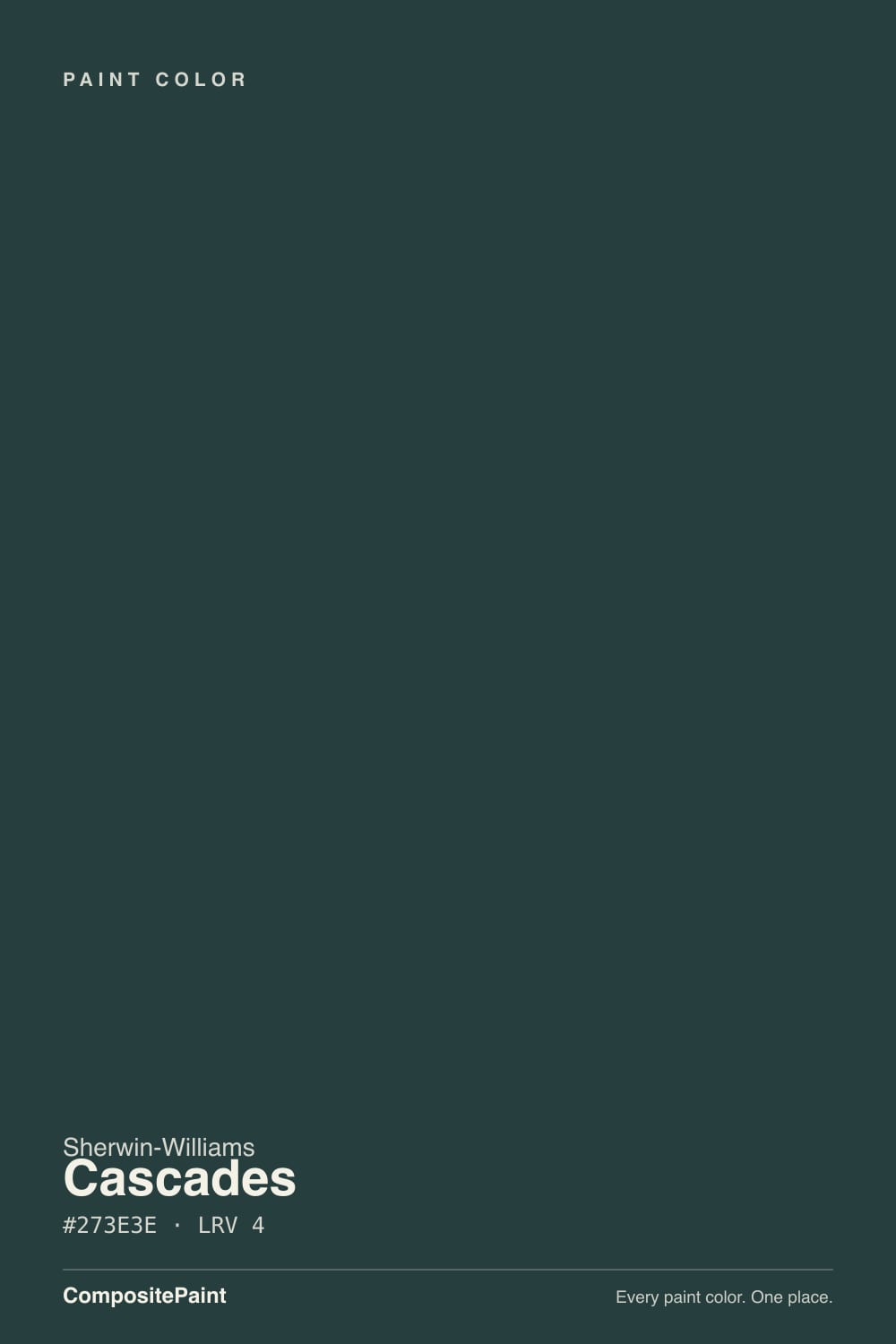
Cascades is a true teal — equal parts green and blue in the mix — pushed down to LRV 4, a hair above pure black. Point a strong light at it, or catch it in a satin sheen, and the blue-green comes forward, moody and rich. Leave it in ordinary room light and it mostly just reads as a very dark, cool-tinted black. Buy it for a black with a secret color hiding inside, not for a wall you expect to look visibly teal from across the room.
Kitchen islands and vanities under real task lighting · a front door or accent surface darker than navy · exterior trim and shutters · anyone who wants black's drama with a hidden color underneath
You want a wall that visibly reads teal or green at a glance · the room is dim with no lamps or task light · you're covering all four walls of a small room · you want a color that photographs as clearly colored in a phone snapshot
- A genuine teal hue hiding inside near-black depth — more interesting than flat black up close
- Reads as a distinctive alternative to the navy-or-black default on doors, islands, and exteriors
- At this depth it hides scuffs, fingerprints, and wear extremely well
- Pairs cleanly with brass, unlacquered hardware, and warm wood without fighting them
- Less common than Naval or Tricorn Black — a quieter way to stand out
- Reads as plain black in ordinary ambient indoor light — the color needs strong light to show
- No warmth reserve at all, so cool bulbs push it flatter and colder, not richer
- Too dark and too cool for a full small room without real natural light or task lighting
- Hard to judge from a chip or a screen — the difference between "teal" and "black" here is entirely about your actual light
What Color Is Cascades, Really?
The hex breaks it down cleanly: R39 / G62 / B62 — green and blue sit at the exact same value, which is the technical definition of a true teal, with no lean toward navy on one side or forest green on the other. Compare that to a color like Naval, which carries more blue than green, or Essex Green, which carries more green than blue: Cascades sits dead center between them, then gets pushed almost to black.
That push is the real story. LRV 4 means the paint reflects only about 4 percent of the light that hits it — a shade above true black (Sherwin-Williams' own Tricorn Black sits at LRV 3). At that depth, hue becomes secondary to darkness: the eye reads "very dark" long before it reads "teal." It takes strong, direct light — a task light under a cabinet, full sun on an exterior door, a glossy sheen catching a window — to pull the blue-green out of the black. In flat, ambient indoor light, most people will call this color black, not teal, and they won't be wrong to.
Undertone in one line: cool and blue-green, with zero warmth reserve. There is no yellow, no red, nothing to soften it — which is exactly why it needs light and sheen to do the work that undertone does for lighter colors.
Where It Shines
This color earns its keep on small, well-lit, often-glossy surfaces rather than open walls. A kitchen island under can lights or pendant fixtures, a front door in direct sun, cabinet doors that catch a window's reflection, exterior shutters and trim against daylight — all of these give Cascades the light it needs to show the teal instead of just the black. It is also a genuinely useful alternative to the now-common navy-or-black binary: darker and cooler than Hale Navy, less flatly neutral than Tricorn Black, with a green-blue identity that most guests will clock as "an interesting black" rather than name outright.
Where It Fails
Almost every disappointed review of a color at this depth follows one of three scripts, and Cascades is no exception. None of them are a defect in the paint — they are what LRV 4 always does when the room doesn't cooperate.
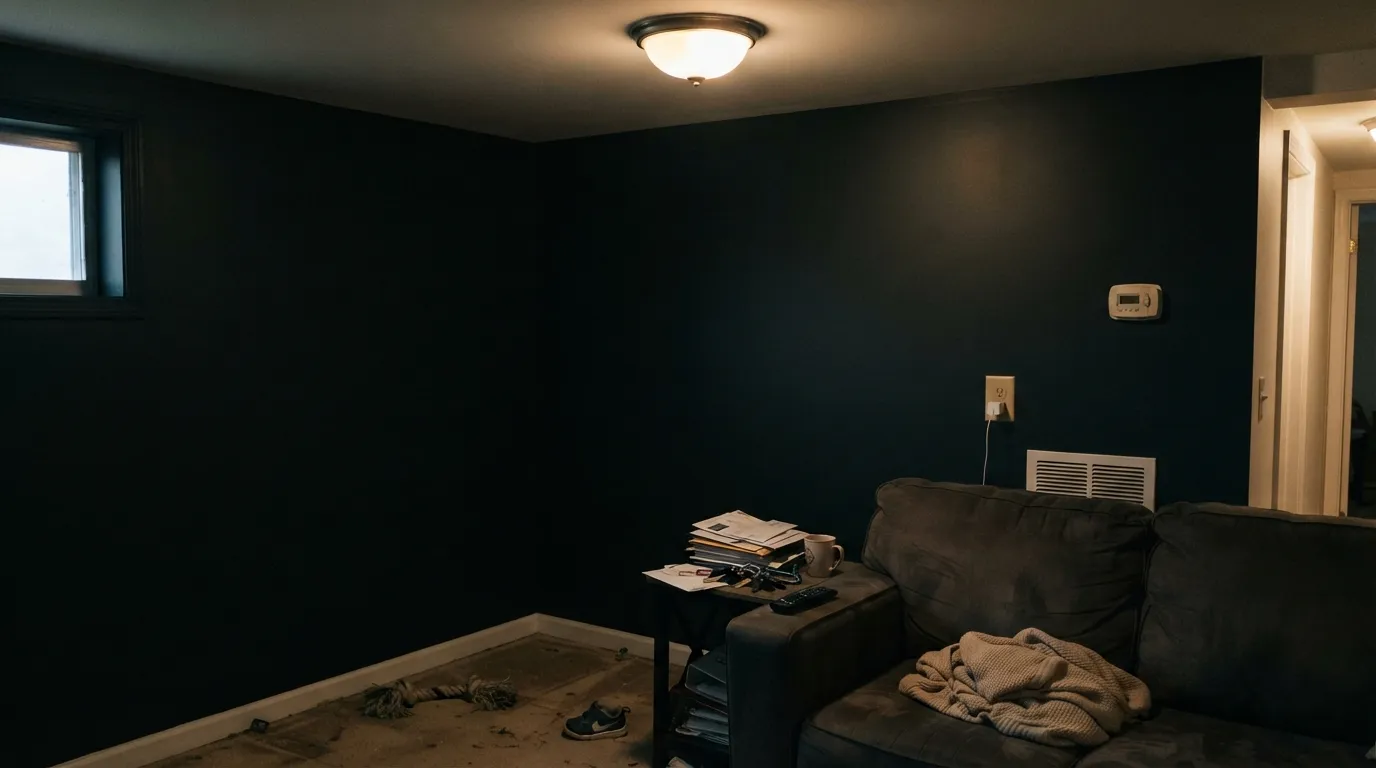
At LRV 4 in a matte finish under ordinary ceiling light, this color reads as black, full stop — the green-blue only shows up when direct light or a glossier sheen catches it. If the goal is a wall that visibly says "teal" from across the room, this is too dark to deliver that; look at a color with real reflectance, like Behr Hidden Gem at LRV 14, instead.
A color that reflects only 4 percent of the light absorbs almost everything else, and a small room with no natural light source can start to feel like a closet rather than a moody retreat. This is an accent-surface and well-lit-room color, not a default for a windowless guest bath.
The color already has zero warmth built in. Add cool white LEDs on top and there is nothing left to soften it — the result reads flat, cold, almost blue-black, with none of the moody warmth the color is capable of. A warm 2700K bulb or two is doing real work here, not just ambience.
Room by Room
Under pendant lights or can lights, an island in Cascades reads as a deep, sophisticated teal-black against lighter perimeter cabinets. Satin sheen and brass or unlacquered hardware bring out the color; keep the surrounding cabinetry light so the island has contrast to work against.
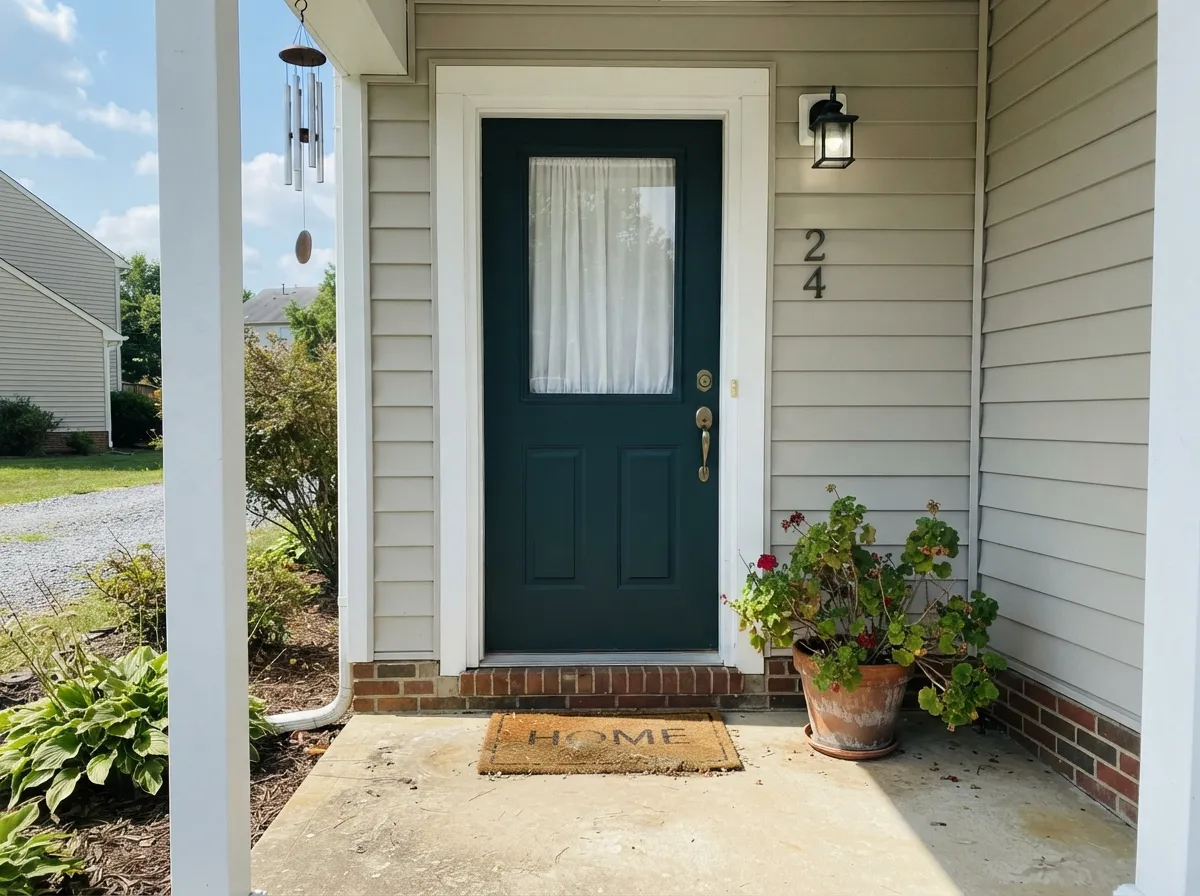
Full sun does exactly what indoor ambient light can't: it reveals the blue-green. On a shaded north-facing door it will read close to black, which is still a good look, just a different one — sample it on the actual door before committing.
Daylight is generous with this color in a way most interiors aren't. Against a lighter siding it reads as a crisp, dark accent that avoids the starkness of true black without giving up any of the drama.
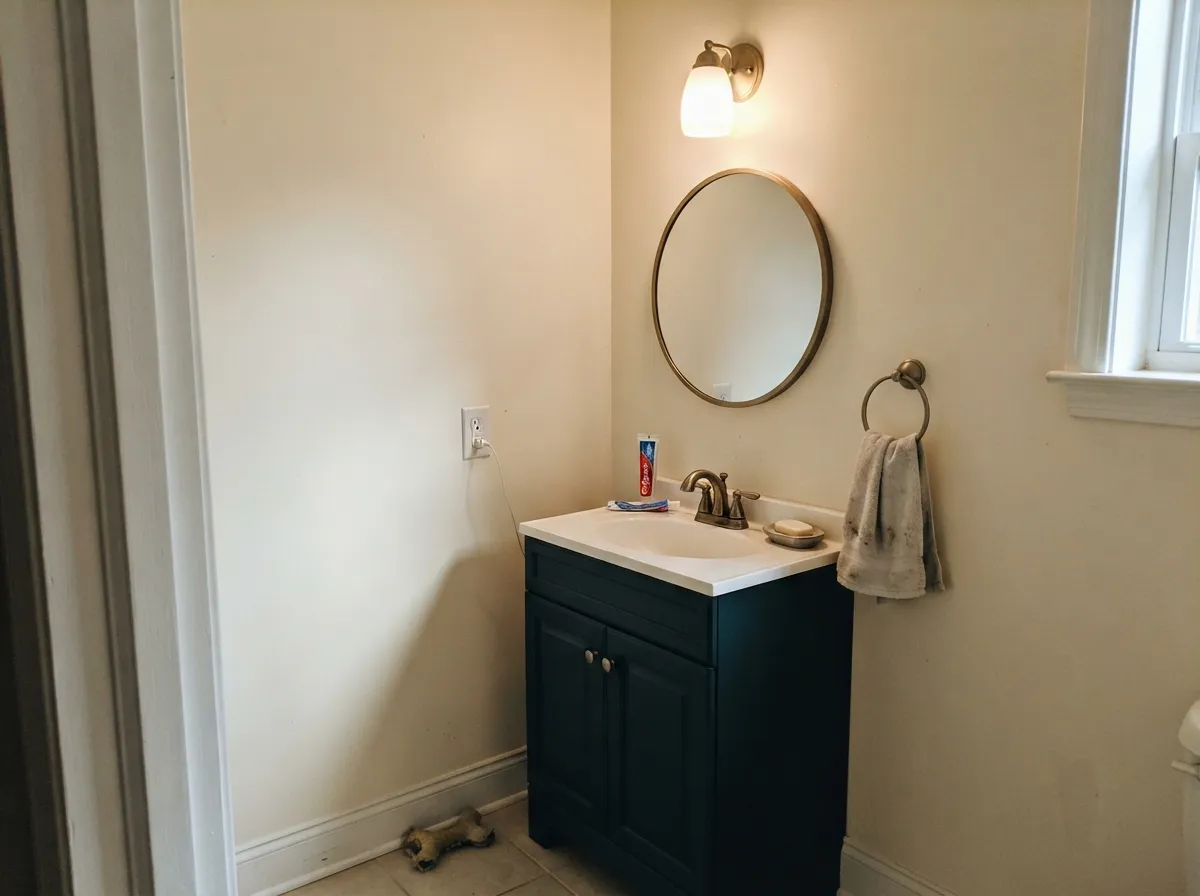
A vanity or powder-room accent wall works well if there's a sconce or overhead fixture doing real work; skip it in a windowless half-bath lit by a single dim bulb, where it will just look like an odd choice of black.
One wall behind a desk or built-in shelving, with a lamp nearby, gives the color a job it's good at. A full room of Cascades with only overhead lighting will feel heavier than intended.
Board-and-batten, a fireplace surround, or a single accent wall let this color do its near-black-with-a-secret trick without committing an entire open-plan space to a color that needs consistent strong light to read as anything but black.
Your Light Is the Risk
Full exterior sun on a door, or a can light and pendant over an island, pulls the blue-green forward out of the near-black. This is the light the color needs to prove it isn't just dark paint.
Ordinary overhead lighting in a matte finish leaves this color reading as plain black. If you specifically want visible teal, this is the light that will disappoint you.
On an exterior surface it moves from near-black in shadow to a clear dark teal in direct sun, then back to black-ish as the light fades — expect real day-to-day variation outdoors.
Warm 2700K bulbs give it the best chance of reading as color rather than void. Cool white LEDs flatten it toward a cold, featureless black — the least flattering combination for this paint.
Most complaints about Cascades are a light mismatch. Upload a photo of your actual room and see it on your walls — then ask for the same wall in north light or evening lamps before you buy a single sample.
Need It From Another Brand?
Any paint counter can custom-tint Sherwin-Williams SW 7623 directly. If you would rather stay in one brand's own deck, these are the closest stock matches, measured as ΔE2000. Under 2 is a difference you will not see on the wall.
| Brand | Closest color | ΔE | LRV | |
|---|---|---|---|---|
| Behr | Black Sable730F-7 · Behr | 1.6 | 5 | Color page → |
| Benjamin Moore | Pacific Sea Teal2049-10 · Benjamin Moore | 1.8 | 5 | Color page → |
| Valspar | Deep River Green5010-3 · Valspar | 1.4 | 4.4 | Color page → |
| Dutch Boy | Shaded Aspen331-7DB · Dutch Boy | 0.0 | 4 | Color page → |
| Hirshfield's | Atlantic Waves0473 · Hirshfield's | 1.8 | 7 | Color page → |
| C2 Paint | MediterraneanC2-709 · C2 Paint | 3.4 | 5 | Color page → |
Similar Sherwin-Williams Colors
The nearest shades to Cascades within Sherwin-Williams's own range, ranked by perceptual color distance — useful when you want the same look a touch lighter, darker, or warmer.
WCAG 2.1: AA is 4.5 : 1 for normal text, 3 : 1 for large text, AAA is 7 : 1.
Cascades vs the Colors You're Also Considering
Every Cascades sample board has the same rivals on it. The numbers show the real lightness gap — then it comes down to which risk you would rather live with.
Pick this for the cooler, more ambiguous depth — Cascades hides its color until the light finds it.
Sherwin-Williams SW 6244 · LRV 4NavalPick this if you want the near-black to read unmistakably blue instead of blue-green — Naval keeps its navy identity even in dim light.
Pick this for the blue-green middle ground between a true green-black and a true navy.
Benjamin Moore PM-22 · LRV 4Essex GreenPick this for the same near-black depth pushed toward green — a proven exterior classic with decades behind it.
Westhaven SW 9675 at LRV 5 and hex #2A4442 is the closest match in the line, a touch lighter and slightly greener. Dark Night SW 6237 at LRV 4 and hex #23383F takes the same darkness in the other direction, clearly bluer and less green. Roycroft Bottle Green SW 2847 at LRV 5 and hex #324038 is the green option, and Greenblack SW 6994 at LRV 4 and hex #373A3A is the closest to a plain near-black.
Across brands, Dutch Boy Shaded Aspen 331-7DB shares the exact same hex at deltaE 0, so it is an identical color. Valspar Deep River Green 5010-3 at deltaE 1.44, Behr Black Sable 730F-7 at deltaE 1.57, Kompozit and Hirshfield's Atlantic Waves 0473 at deltaE 1.77, and Benjamin Moore Pacific Sea Teal 2049-10 at deltaE 1.81 are all visually identical in normal room light.
C2 Paint Mediterranean C2-709 at deltaE 3.44 is very close, so sample first. Its hex #344444 is a shade lighter and grayer, which shows up most in direct sun.
Cascades Coordinating Colors
The rule for coordinating with Cascades is straightforward: give it a bright, warm neutral to sit against so the eye has contrast to work with, and keep the metals warm — unlacquered brass and aged bronze suit it far better than chrome. It's a color that needs a partner more than most, since on its own in low light it can simply disappear into shadow.
Where Cascades Sits Among Sherwin-Williams' Darkest Colors
Sherwin-Williams has several colors clustered at the very bottom of the LRV scale — Tricorn Black (LRV 3) and Iron Ore (LRV 6) as true and near-neutrals, Naval (LRV 4) as the reference navy, and Cascades sitting alongside them as the deck's quiet blue-green option. It doesn't carry a Color of the Year title or a famous designer moment behind it the way Naval or Sea Salt do — it's a workhorse dark color that most homeowners find by searching for "dark teal" rather than by seeing it in a magazine.
That obscurity is honestly part of the appeal. A near-black teal is unusual enough that most guests won't immediately name the color the way they might with Naval or Tricorn Black — they'll just register it as a distinctive dark, and the ones who look closely in the right light will find the green-blue underneath.
Cascades With Wood Tones and Metals
Warm woods are this color's best friend: walnut, white oak, and butcher block all sit comfortably against it because their warmth is exactly what a cold, near-black teal needs nearby. Honey oak works too, more so than it does with lighter cool colors, since the depth of Cascades doesn't leave much undertone to clash with.
Metals matter more here than with most colors, because there's so little warmth in the paint itself to carry the room. Unlacquered brass, aged bronze, and matte black hardware all read as intentional and rich against it; polished chrome or stainless steel tend to look cold paired with an already-cold color, doubling down on the chill instead of balancing it.
Three Ready Palettes Built on Cascades
A color is never alone on the wall. These are complete combinations in the 60-30-10 pattern, with the reason each one holds together. Every one opens in the visualizer.
Two warm light neutrals give the island enough contrast to read as intentional, not just dark. Under pendant lighting the island's teal shows clearly against the soft warmth of Alabaster and Edgecomb Gray; brass hardware ties the whole kitchen together.
Try this palette in your roomCrisp white trim frames the door and gives the eye a bright edge to bounce off before it reaches the near-black. In full sun the door reads as a genuine dark teal against the neutral greige siding; in shade it settles into a handsome near-black — either way it works.
Try this palette in your roomA cream wall keeps the small room from feeling like a cave, so the vanity gets to carry all the color — with a sconce over the mirror, the teal reads clearly instead of vanishing into black. Wrought Iron on the mirror frame and door keeps the near-black in the room without repeating the exact same surface twice.
Try this palette in your roomCascades FAQ
Is Cascades teal or black?
Technically teal — the hex shows equal green and blue, the definition of the hue — but at LRV 4 it behaves like a near-black in most rooms. It needs direct light, a satin or semi-gloss sheen, or both to show visibly as teal rather than plain black.
What sheen should I use?
Matte or eggshell on walls if you're using it as an accent, semi-gloss on doors and trim (gloss also helps the color read, since it reflects more light), and satin on cabinets or an island for durability and a bit more shine to catch the teal.
Does it work on a front door?
Yes, and it's one of the better uses for this color. Full sun brings out the blue-green clearly; a shaded or north-facing door will read closer to black, which is still handsome but is a different look — sample it on the actual door in your actual light before ordering the can.
Is it good for kitchen cabinets?
Very good on an island or a run of lower cabinets, especially with can lights or pendants overhead and lighter perimeter cabinets for contrast. A full kitchen of cabinets in this color, with no task lighting, will read as a very dark, fairly flat black.
Will it look too dark in a small room?
On all four walls of a small room with limited natural light, yes — LRV 4 absorbs almost everything and can make a small space feel closed-in rather than moody. Use it as a single accent wall, a vanity, or trim in a small room instead, and give it a lamp or sconce.
What's the difference between Cascades, Naval, and Tricorn Black?
All three sit at nearly the same depth (LRV 3–4), but the hue differs: Naval leans blue and reads as navy even in dim light, Tricorn Black is Sherwin-Williams' true neutral black with no color cast to manage, and Cascades sits in between as a genuine blue-green that mostly hides until strong light finds it.
Have you painted with Cascades?
Rate it — one tap helps the next reader decide.
Ask a Question