Hidden Gem
Behr's 2026 Color of the Year, reviewed honestly: what it actually looks like on a wall, the three rooms where it falls apart, and what to pick instead.

Jessica has spec'd whites and neutrals for more than 300 rooms and keeps a sample wall of painted drawdowns in her studio. Every color review is checked against real reader rooms in the comments and re-tested when a formula changes. About the testing process →
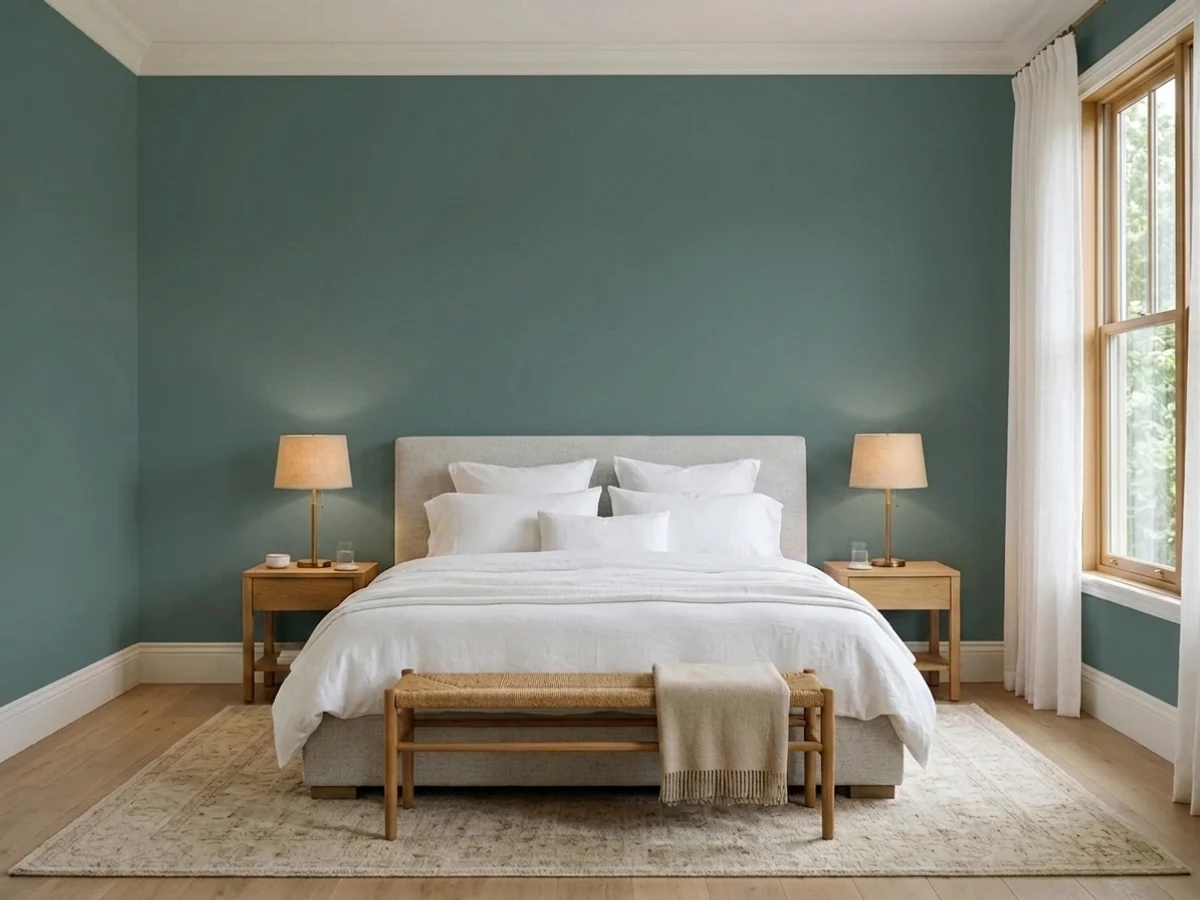
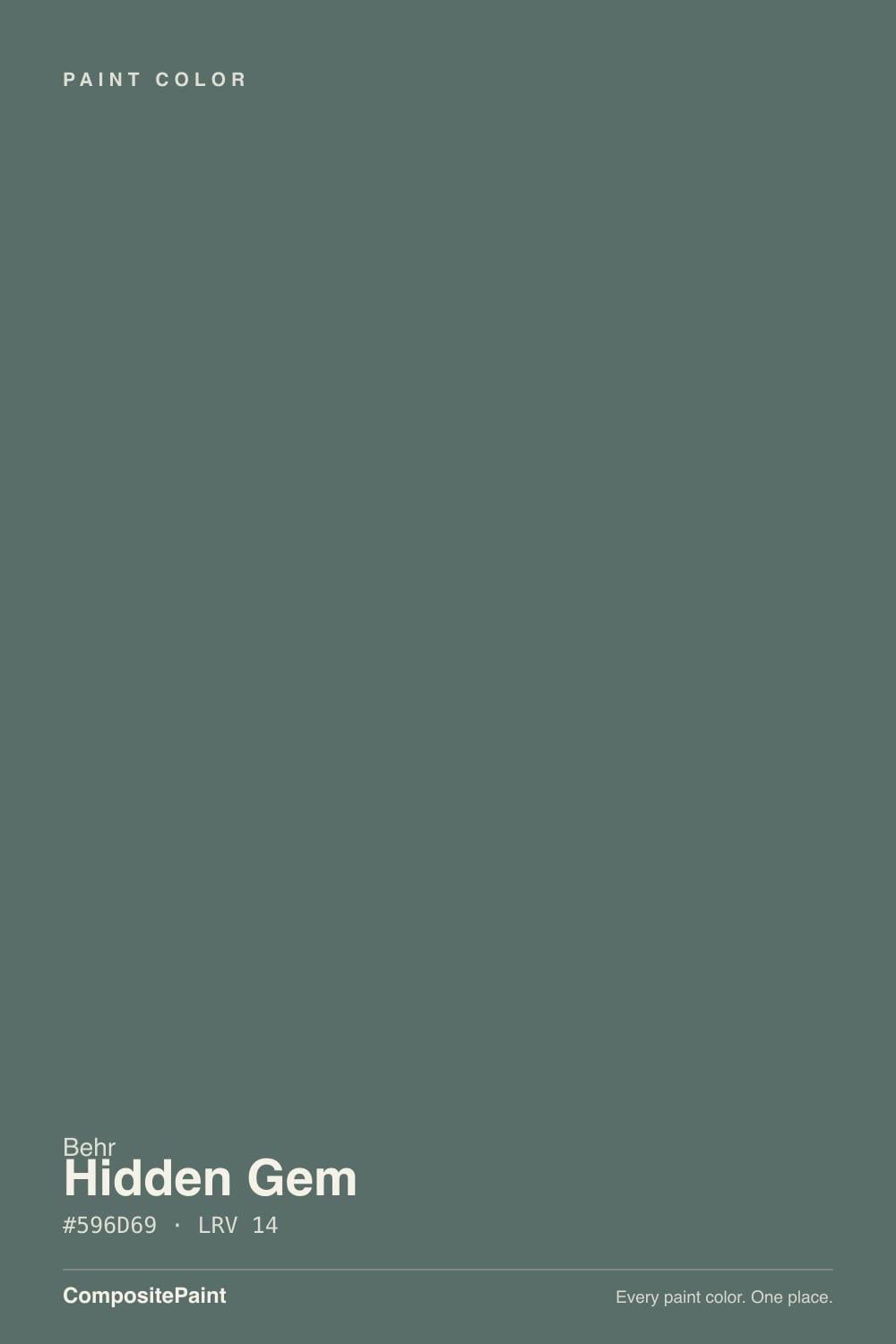
- 1Salamander6
- 2Hidden Gem14
- 3Adirondack Blue22
- 4Van Courtland Blue31
The Fast Verdict
Hidden Gem is Behr's 2026 Color of the Year, and it earns the title — a deep, smoky jade that gives a room the weight of black without the coldness. It is at its best on one drenched room, on cabinets, or on siding, where the green-blue has enough surface to actually show. It is not a whole-house color and it is not a rescue color for a dark room. Get the light right and it looks expensive; get it wrong and it looks like dark gray you paid extra for.
A color-drenched study, den or dining room · kitchen islands and lower cabinets with honey oak · exteriors, especially red brick · front doors and shutters
Your room faces north and stays dim · you want one color for the whole house · your trim is a creamy off-white · your walls are old and wavy
- Gives a room the weight of black without the hardness
- One of the few dark colors that genuinely flatters honey oak and maple
- Muted enough that it does not wash out or go neon in full sun outside
- Sold at every Home Depot, in Marquee, Dynasty, Ultra and cabinet enamel
- Works with brick, stone, leather, brass and wicker without a fight
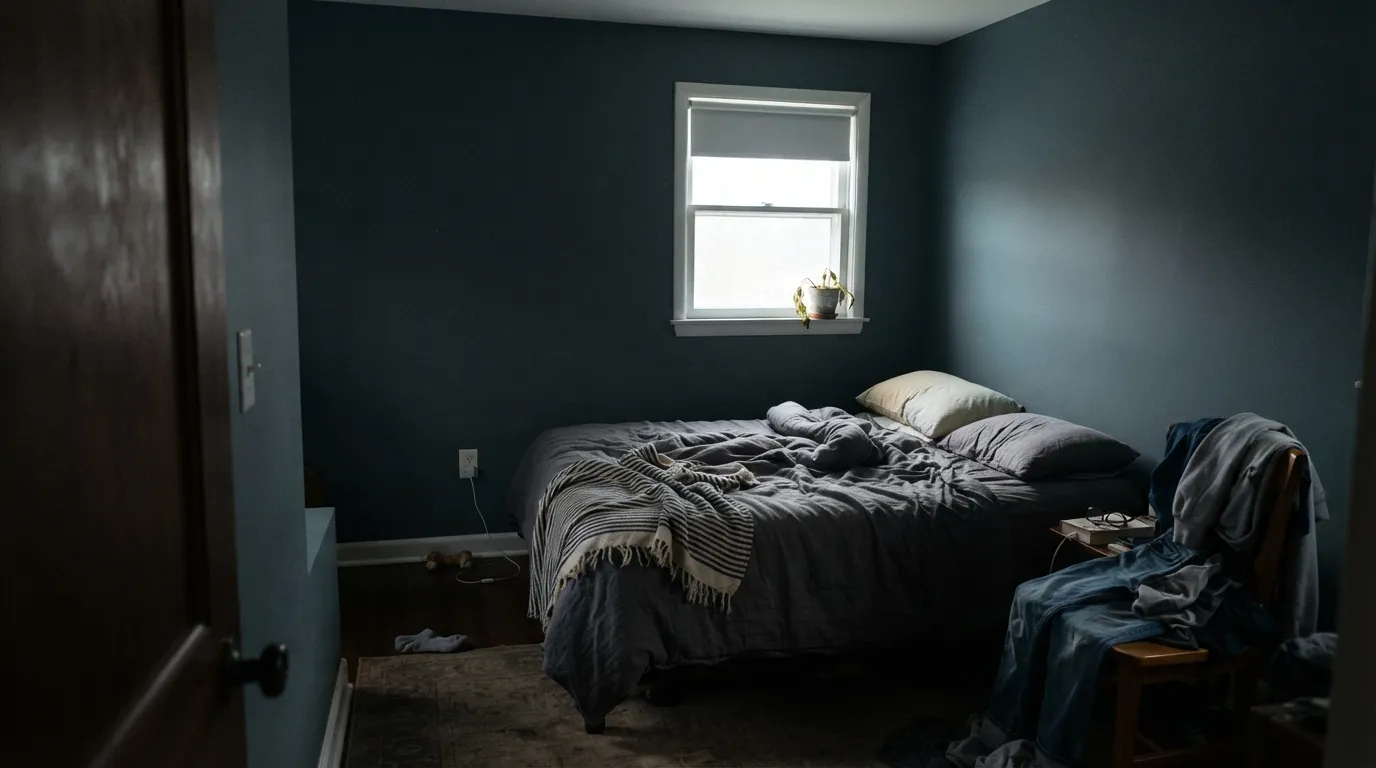
- In dim north light the green vanishes and it reads as dark gray
- Too heavy for whole-house or large open-plan use
- Makes creamy off-white trim look yellowed
- At LRV 14 it shows every roller lap, patch and wavy wall
What Color Is Hidden Gem, Really?
The first thing to settle is what family it is in, because nobody agrees. Behr files Hidden Gem under blue and markets it as a smoky jade. Color designers who have swatched it call it a green with cool blue undertones and say flatly that it is not a teal. On the wall, most people see a grayed spruce — green first, blue underneath, gray holding both down. The number behind the argument is saturation: about 10 percent. That is very little color, which is why the same paint can read jade in one room and charcoal in another, and why two honest people can look at the same wall and describe it differently.
At LRV 14 it is a dark color, but it is not the near-black some people expect from the chip. Put it beside Black Evergreen MQ6-44, the darkest color on its own Behr strip at LRV 8, and Hidden Gem suddenly looks alive — you can clearly see the green. Put it beside a mid-tone like Greige PPU24-11 at LRV 46 and it goes back to being the dark one in the room. That in-between position is the whole appeal: dark enough to feel enveloping, light enough that the color survives.
Undertone in one line: muted green with a cool blue underneath and a lot of gray on top — never a bright teal, never a warm forest green. If your sample looks like plain dark gray, the room is not giving it enough light to work with.
Where It Shines
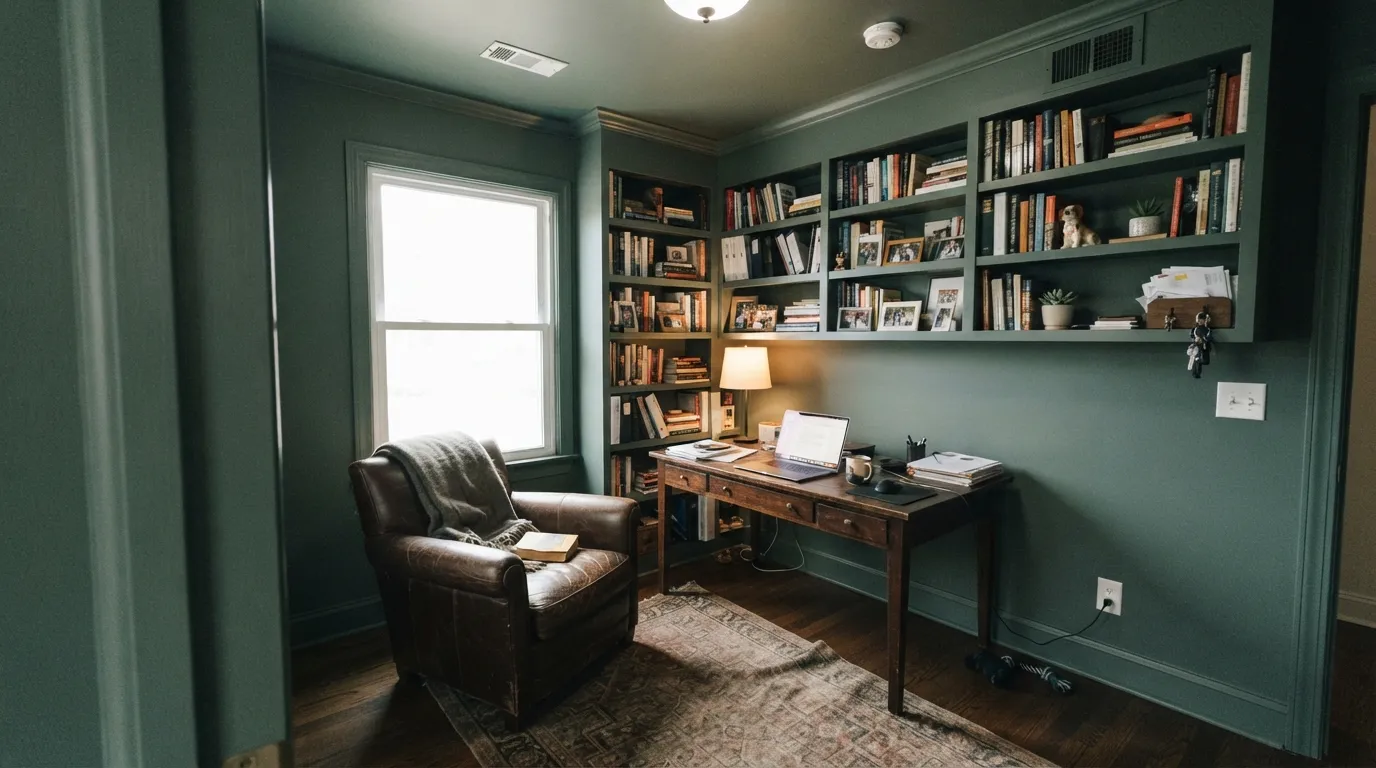
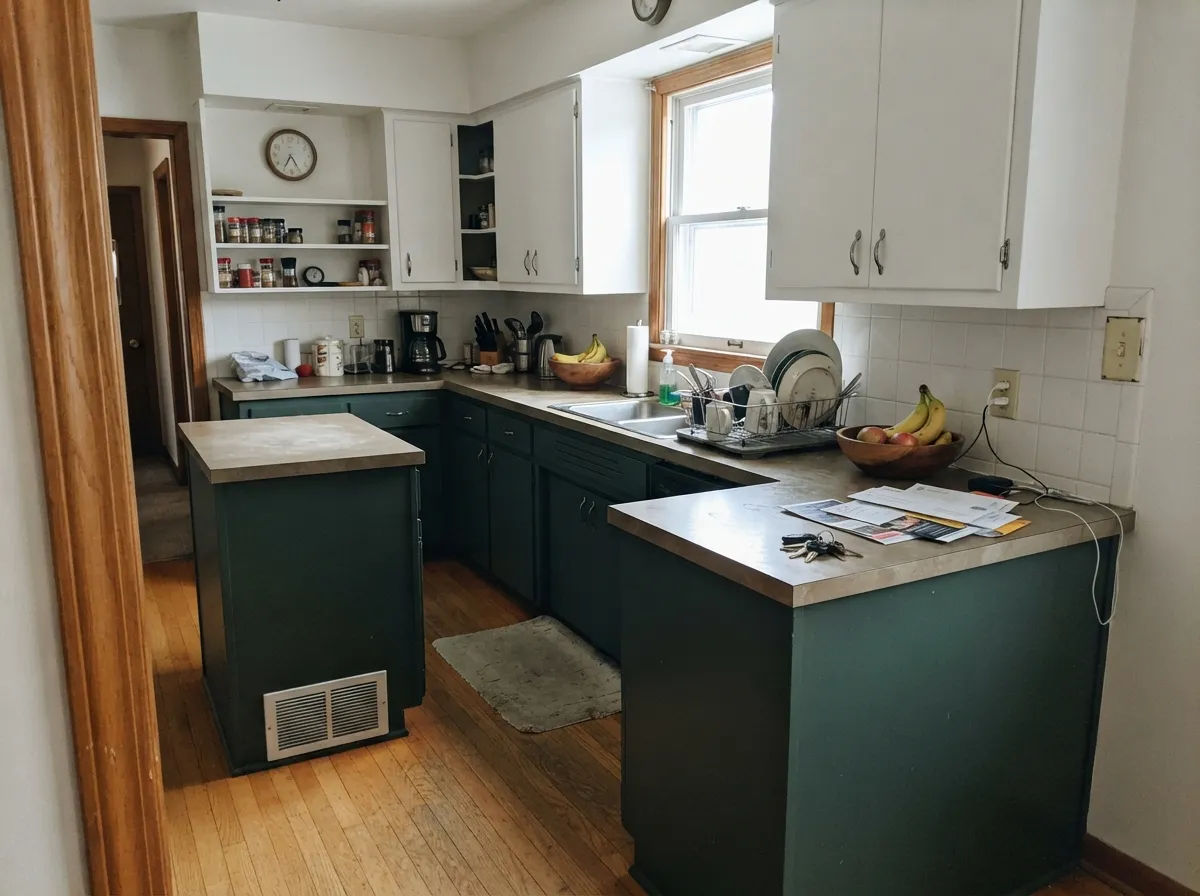
Give it one whole room and real daylight and it stops being paint and starts being architecture. Drenched studies and dining rooms are where it does its best work, cabinets and islands are the safest place to try it, and outside it may be the most reliable use of all — muted colors do not wash out in full sun the way saturated ones do.
Where It Fails
Almost every disappointed story about a color this dark comes from one of three situations, and all three are predictable before you open the can. None are the paint's fault. But if your room matches one, buy a different color.
North light is cool and flat, and at 10 percent saturation there is not much color to survive it. The green drains out and you are left with a dark, slightly blue charcoal — the exact color you did not pay for. If you want green to still read in low light, go lighter and greener: Behr Aspen Valley N430-5 at LRV 22 sits on the same strip and keeps its color where Hidden Gem gives up.
Color designers are consistent on this: a dark, prominent tone used over large areas stops feeling cozy and starts feeling oppressive, especially in a great room with tall walls. Hidden Gem is an accent-room color, not a flow-through-the-house color. Use Behr Greige PPU24-11 at LRV 46 for the open areas and save Hidden Gem for one room with a door on it.
The cool blue underneath Hidden Gem pulls yellow forward in any warm white next to it, so soft cream trim starts to look dingy against the walls. Use a cleaner white instead: Behr Cameo White MQ3-32 at LRV 79 for a soft break, or Whisper White HDC-MD-08 at LRV 90 for a crisp one.
Room by Room
Walls, trim, built-ins and ceiling all in Hidden Gem, matte finish. The single sheen keeps the corners from cutting the room into pieces, and bookshelf backs in this color make books and art look staged. Brass lamps and warm 2700K bulbs are not optional here.
A dark dining room only has to work at night, which removes the biggest risk. Matte on the walls, and pair it with a warm neutral like Behr Smoked Tan HDC-NT-14 in the adjoining room so the handoff is not a slap. Candles and gold fixtures do a lot of the work.
This is where to try it if you are nervous. On lowers or an island in satin it does what black does but softer, and it genuinely flatters honey oak and maple — the cool green sits against the orange in the wood instead of fighting it. Keep uppers and walls light.
In a bedroom with good daylight it is restful and grown-up. In a dim bedroom it turns into a cave by 4 p.m. Test a big sample on the wall opposite the window before you commit, and plan on lamps, not one ceiling fixture.
Small windowless rooms are the one place where dark is always the right answer, because there is no daylight to disappoint you. Drench it, use Behr Whisper White HDC-MD-08 on the ceiling if you want a lid, and let the mirror and fixtures carry the shine.
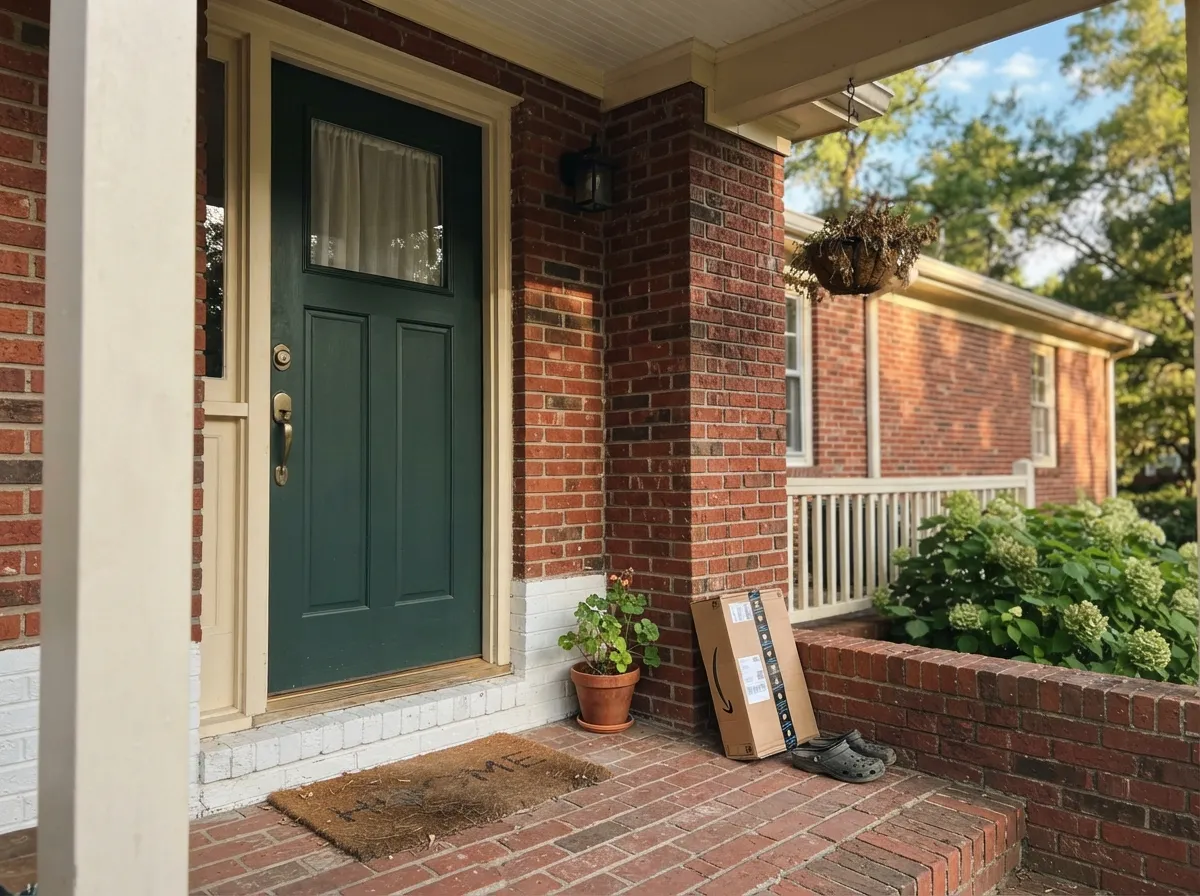
Colors read lighter and brighter outdoors, and muted ones like this do not go neon in full sun. On siding it makes red brick glow; on a front door or shutters it reads deliberate rather than trendy. Full pairings in the exterior section below.
Your Light Is the Risk
The warmth and intensity bring the jade forward. This is the room where you actually see what you bought.
Cool flat daylight strips the green out and leaves a dark blue-charcoal. The most common regret.
Warm 2700K bulbs push it toward spruce. Cool 4000K LEDs flatten it to gray. Change bulbs, not paint.
Reads a full step lighter and richer than indoors, and the low saturation keeps it from going loud.
Most complaints about Hidden Gem are a light mismatch. Upload a photo of your actual room and see it on your walls — then ask for the same wall in north light or evening lamps before you buy a single sample.
Need It From Another Brand?
Any paint counter can custom-tint Behr N430-6A directly. If you would rather stay in one brand's own deck, these are the closest stock matches, measured as ΔE2000. Under 2 is a difference you will not see on the wall.
| Brand | Closest color | ΔE | LRV | |
|---|---|---|---|---|
| Sherwin-Williams | Mountain PassSW 9655 · Sherwin-Williams | 3.5 | 14 | Color page → |
| Benjamin Moore | Knoxville GrayHC-160 · Benjamin Moore | 3.5 | 16 | Color page → |
| Valspar | September SeaM322 · Valspar | 2.7 | 15.1 | Color page → |
| PPG / Glidden | Juniper BerryPPG1145-6 · PPG / Glidden | 2.2 | 14 | Color page → |
| Glidden | Juniper BerryPPG1145-6 · Glidden | 2.3 | 14 | Color page → |
| Dutch Boy | Luscious Spruce331-6DB · Dutch Boy | 2.9 | 14 | Color page → |
Similar Behr Colors
The nearest shades to Hidden Gem within Behr's own range, ranked by perceptual color distance — useful when you want the same look a touch lighter, darker, or warmer.
WCAG 2.1: AA is 4.5 : 1 for normal text, 3 : 1 for large text, AAA is 7 : 1.
Hidden Gem vs the Colors You're Also Considering
Every Hidden Gem sample board has the same rivals on it. The numbers show the real lightness gap — then it comes down to which risk you would rather live with.
Pick this for weight and drama — Aspen Valley cannot anchor a room.
Behr N430-5 · LRV 22Aspen ValleyPick this for a dim room — at LRV 22 the green survives.
Pick this when you still want to see green, not just darkness.
Behr MQ6-44 · LRV 8Black EvergreenPick this for a near-black at LRV 8 that greens only in sun.
Within Behr's deck the neighbors are close enough that you should sample rather than guess. Dark Granite 780F-6 (#5A6B68, LRV 14) is essentially the same depth with a hair less green. Dark Ash 770F-5 (#576C6E, LRV 14) leans blue. Chelsea Garden MQ6-39 (#556F6A, LRV 14) is the greener option, and Mountain Pine PPU12-19 (#626E6C, LRV 15) is a touch lighter and grayer.
Across brands, Micropolis 0472 from Kompozit (LRV 14, deltaE 1.65) and Green Pasture HGSW 3292 from HGTV Home by Sherwin-Williams (LRV 15, deltaE 1.70) are visually identical in normal room light. Artistic Stone DE6307 from Dunn-Edwards (LRV 13, deltaE 2.05), Juniper Berry PPG1145-6 (LRV 14, deltaE 2.22), and September Sea M322 from Valspar (LRV 15.1, deltaE 2.68) are very close, but sample first. Knoxville Gray HC-160 from Benjamin Moore (LRV 16, deltaE 3.50) and Mountain Pass SW 9655 from Sherwin-Williams (LRV 14, deltaE 3.53) are close but visibly different side by side.
Hidden Gem Coordinating Colors
The rule with Hidden Gem is to stay warm and stay quiet. It is already the loudest thing in the room, so its partners should be neutrals that give your eye somewhere to rest, plus one small warm accent to keep the scheme from going somber. The trap is warm creams: the cool blue underneath Hidden Gem pulls the yellow forward in them, so a cream that looked lovely on its own can look dingy on the trim.
These are the partners worth sampling first — two whites, two warm neutrals, a charcoal for a moodier scheme, and a golden yellow for the 10 percent accent.
Hidden Gem on Exteriors
If you only use this color once, use it outside. Paint reads a full step lighter and brighter in daylight, which is why saturated colors look cartoonish on a house and muted ones look expensive. Hidden Gem is muted, so it holds its character in full sun instead of going washed out or neon — and at LRV 14 it still gives a facade the dark, grounded look people are asking for.
Its best trick is red brick. Green sits opposite red on the color wheel, so a Hidden Gem body next to existing red or orange brick makes the brick look rich rather than dated — the cheapest possible fix for a house you cannot afford to reclad. It also behaves on shutters, a garage door you want to disappear, and a front door on a light-bodied house.
The trim choice sets the mood. Warm off-white trim reads classic, near-black trim reads modern, and bronze or dark trim reads rustic. Whatever you pick, walk a large sample around the house before you commit — the shaded north wall will read noticeably grayer than the sunny south wall, and on a whole exterior that difference is expensive to discover late.
Hidden Gem on Cabinets and Islands
Cabinets are the lowest-risk way to live with this color. A cabinet run is a smaller, closer surface than a wall, usually lit by task lighting rather than by whatever the window is doing, so the green stays visible in rooms where it would go gray on the walls. It is also the use that survives a change of heart cheapest — an island is a weekend, a whole room is not.
Use a satin cabinet and trim enamel, not wall paint. At LRV 14 every fingerprint around a handle shows on a flat finish, and dark cabinets get touched more than light ones because the hardware is harder to see. Prime dark, spray or roll thin coats, and expect the color to look several shades deeper on doors than it did on the chip.
Pair it down, not sideways. Light uppers and a light wall keep the kitchen from closing in — Whisper White HDC-MD-08 above, Doeskin Gray N200-2 on the walls. Hardware in antique brass or matte black both work; polished chrome makes it look cold and flat.
Three Ready Palettes Built on Hidden Gem
A color is never alone on the wall. These are complete combinations in the 60-30-10 pattern, with the reason each one holds together. Every one opens in the visualizer.
One color over every surface removes the contrast lines that make a small dark room feel chopped up, so the walls read as depth instead of as paint. Cameo White outside the door resets your eye, and the golden Beehive accent is the 10 percent that stops the scheme going gloomy.
Try this palette in your roomThis is the palette for a kitchen you are not gutting: dark cabinets below, light above, and a taupe-gray wall at LRV 61 that keeps the room from splitting into two hard halves. Doeskin Gray is deliberately not creamy, because cream is what turns yellow next to Hidden Gem.
Try this palette in your roomGreen sits opposite red on the color wheel, so Hidden Gem siding makes existing red brick look richer instead of dated — the single best reason to use this color outside. Confident White at LRV 79 is warm enough to soften the whole thing, and the red door ties the paint back to the brick.
Try this palette in your roomHidden Gem FAQ
Is Hidden Gem green, blue, or teal?
Behr files it in the blue family and calls it a smoky jade, but on a real wall it reads green first, with a cool blue underneath. It is not a bright teal — saturation is only about 10 percent, so the color is always muted. In bright rooms you will call it green; in dim rooms you will call it gray-blue.
Is Hidden Gem too dark for a whole room?
For one room with normal daylight, no — drenching a study, dining room or powder room is exactly what it is good at. For a whole house or a big open great room, yes. Dark colors over huge wall areas stop feeling cozy and start feeling heavy, and LRV 14 gives you nothing back in return.
What white trim goes with Hidden Gem?
Skip creamy off-whites — the blue in Hidden Gem makes them look yellowed. Behr Cameo White MQ3-32 at LRV 79 gives a soft, expensive-looking break, and Whisper White HDC-MD-08 at LRV 90 gives a crisp modern one. If you are drenching the room, paint the trim Hidden Gem too and change the sheen instead.
Hidden Gem or Sherwin-Williams Rocky River?
They are close enough that most people could not pick them out of a lineup. Rocky River SW 6215 sits at LRV 15 and is a hair lighter and slightly less saturated; Hidden Gem is a touch deeper and moodier. Choose by store: Hidden Gem if you buy at Home Depot, Rocky River if your painter works in Sherwin-Williams. Do not have one brand color-matched into the other.
Does Hidden Gem work with honey oak cabinets and floors?
Yes, and it is one of the better answers for 1990s oak. The cool green sits across from the orange in the wood, which reads as an intentional contrast rather than a clash. Put it on an island or lower cabinets, keep the walls a light taupe like Behr Doeskin Gray N200-2, and use antique brass or matte black hardware.
What sheen should I use?
Matte or flat on walls. At LRV 14 a shiny finish bounces light straight back at you, which both hides the color and highlights every patch and roller lap on the wall. Cabinets and doors are the exception — use a satin cabinet enamel there so it can be wiped down.
Have you painted with Hidden Gem?
Rate it — one tap helps the next reader decide.
Ask a Question