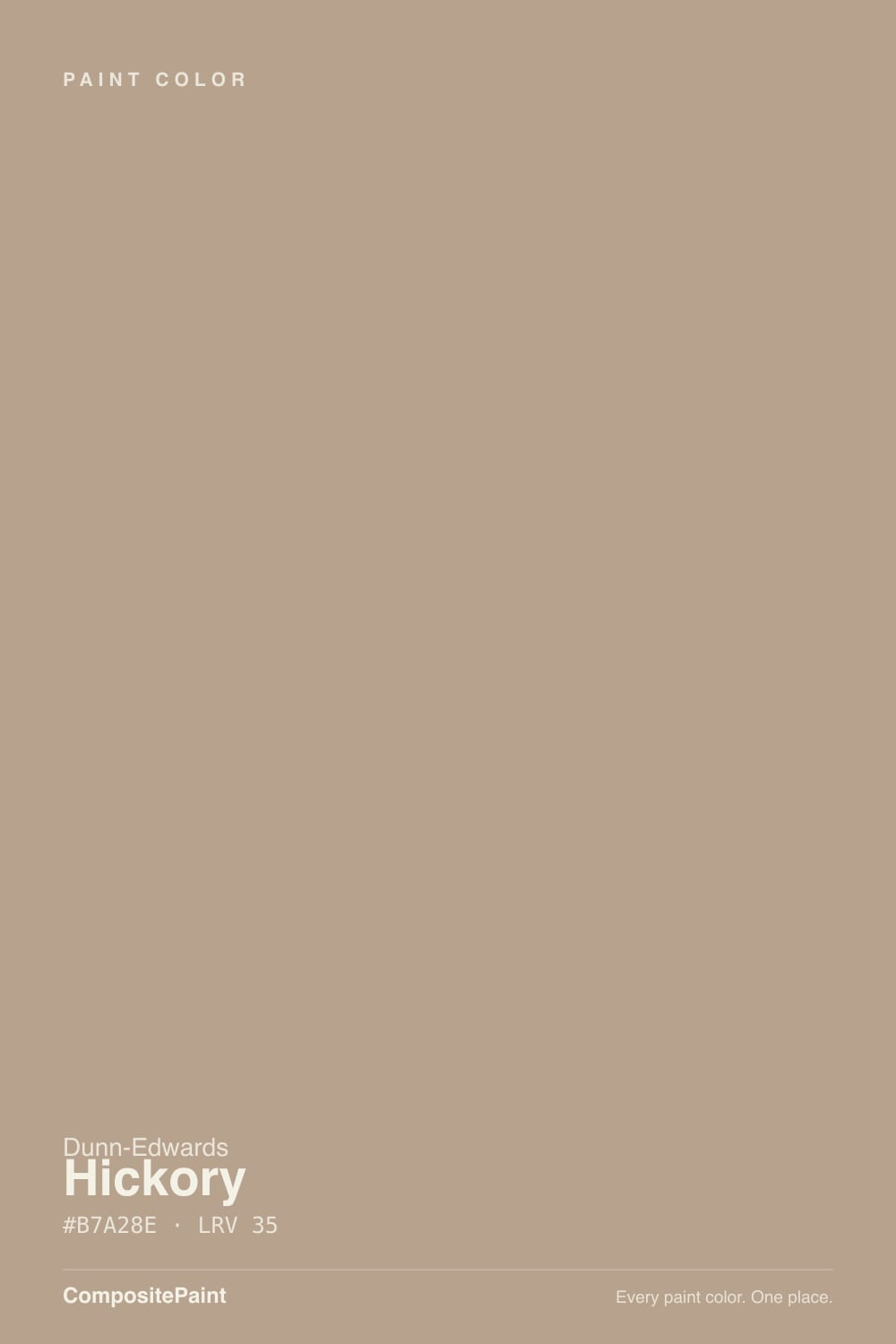
Hickory
The Southwest wood-beige that HOAs actually list, reviewed honestly: where the brown stays muted, the interiors that go muddy, and what to pick instead.

Jessica has spec'd whites and neutrals for more than 300 rooms and keeps a sample wall of painted drawdowns in her studio. Every color review is checked against real reader rooms in the comments and re-tested when a formula changes. About the testing process →
- 1Anonymous20
- 2Felted Wool28
- 3Hickory35
- 4Revere Pewter55
- 5Agreeable Gray60
The Fast Verdict
Hickory is a muted wood beige, not a greige and not a living-room tan. At LRV 35 it sits in the same depth band as Mega Greige, which means desert sun on stucco looks like warm earth; four interior walls look like taupe-brown. Dunn-Edwards keeps it in the Classics range, and Color-Ark HOA books across Arizona and California keep putting it on body and fascia lists. If you wanted beige, this is too dark. If you wanted the house to look like it grew from the dirt, this is the paint.
Southwest stucco body and fascia · sunlit dining rooms and dens · walnut, oak, and stone interiors · anyone who wants beige that actually reads like wood
You wanted a light beige · the room faces north or stays dim · your floors are cool gray · you need one interior color for the whole house
- Reads like wood, not like a paint trend
- Holds color on sun-baked stucco instead of bleaching out
- Muted enough that the brown does not go orange
- Flatters oak, walnut, stone, and brass
- HOA Color-Ark regular — the beige many Southwest books already allow
- Too dark for typical interior walls — beige on the chip, brown on the wall
- Cool gray floors and north light turn it dirty khaki
- Not a greige: buyers expecting gray-beige see brown
- A regional workhorse, not a designer default outside the Southwest
What Color Is Hickory, Really?
A wood beige with the yellow-red warmth of nutwood, then grayed down so it never goes pumpkin. The name is the instruction: think hickory grain, not greige, not builder tan. Dunn-Edwards files it in the Classics (DEC) range — DEC759, RL 694 — which is the quiet tell that this is a regional workhorse, not a trend chip. It shows up in the brand's fall palettes and, more usefully, on Color-Ark HOA scheme sheets from Scottsdale to the Inland Empire as a body, fascia, and pop-out color.
At LRV 35 it is a genuine mid-tone. That is the number people miss on the fan deck. A chip of Hickory looks like a polite beige; a room of it reads a full step darker and browner, in the same depth neighborhood as Mega Greige (LRV 37) and Dorian Gray (LRV 39). On a sun-baked stucco wall that depth is the point — it holds color instead of bleaching out. On an average interior wall it is the trap: you bought beige and you got brown.
Undertone in one line: muted brown with a yellow-red wood warmth — never pink, never green, never gray-first. If the sample goes dirty khaki, the light is cool. If it goes honey-nut, the bulbs are warm. Both are the same paint telling the truth about the room.
Where It Shines
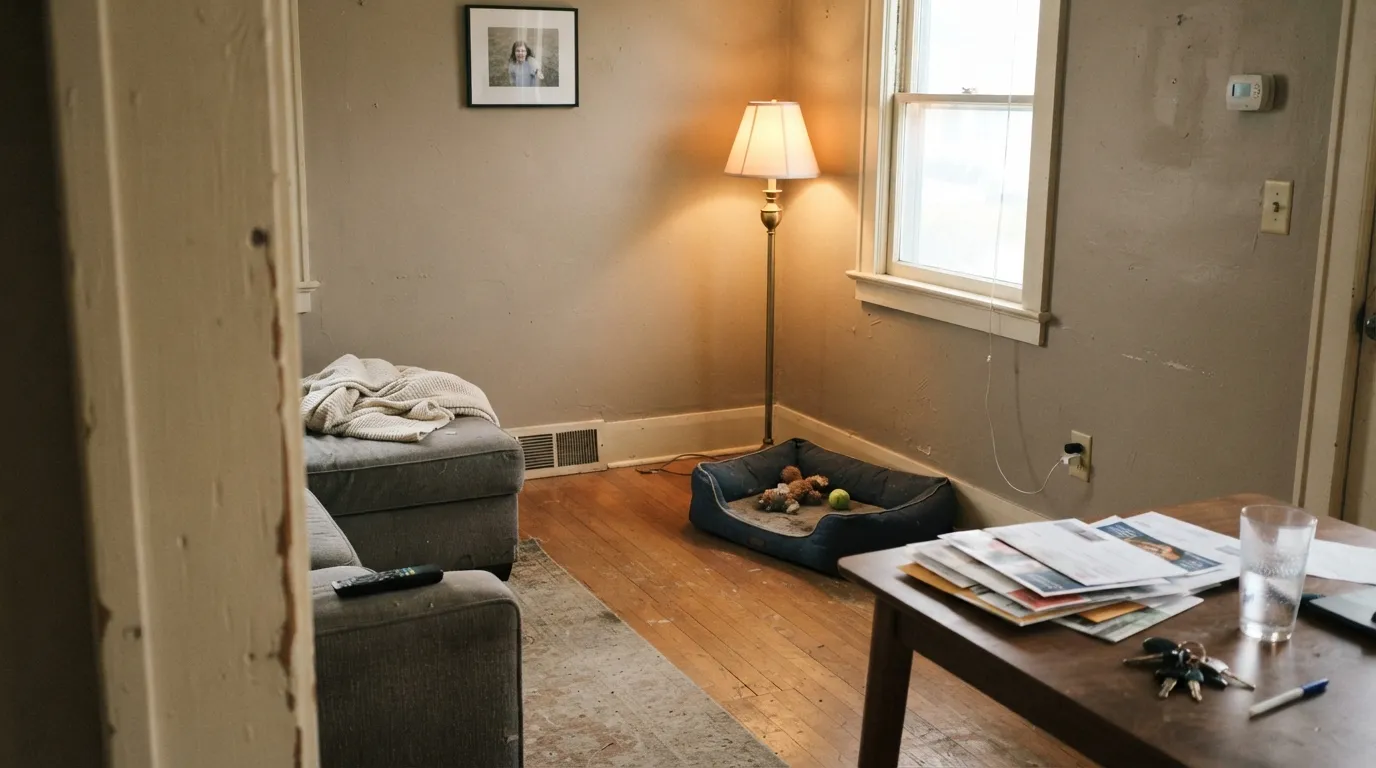
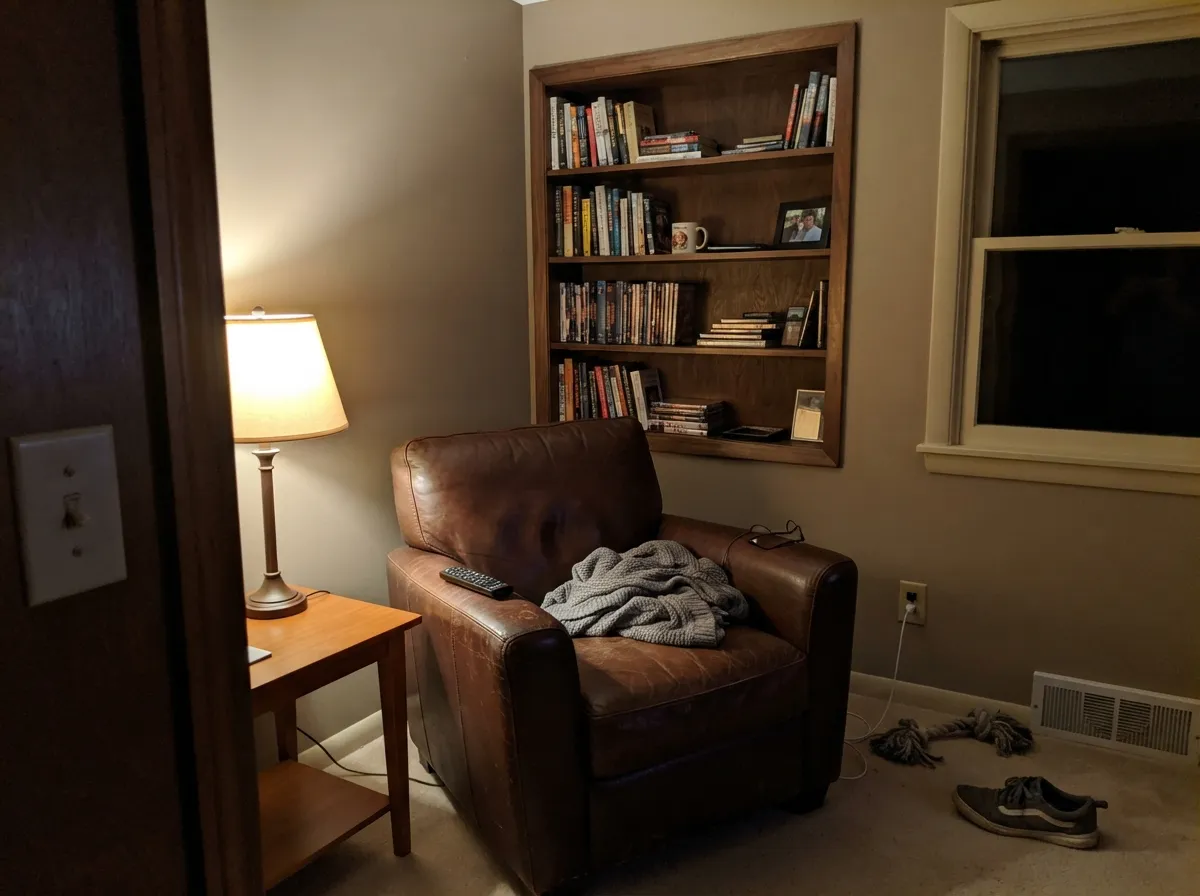
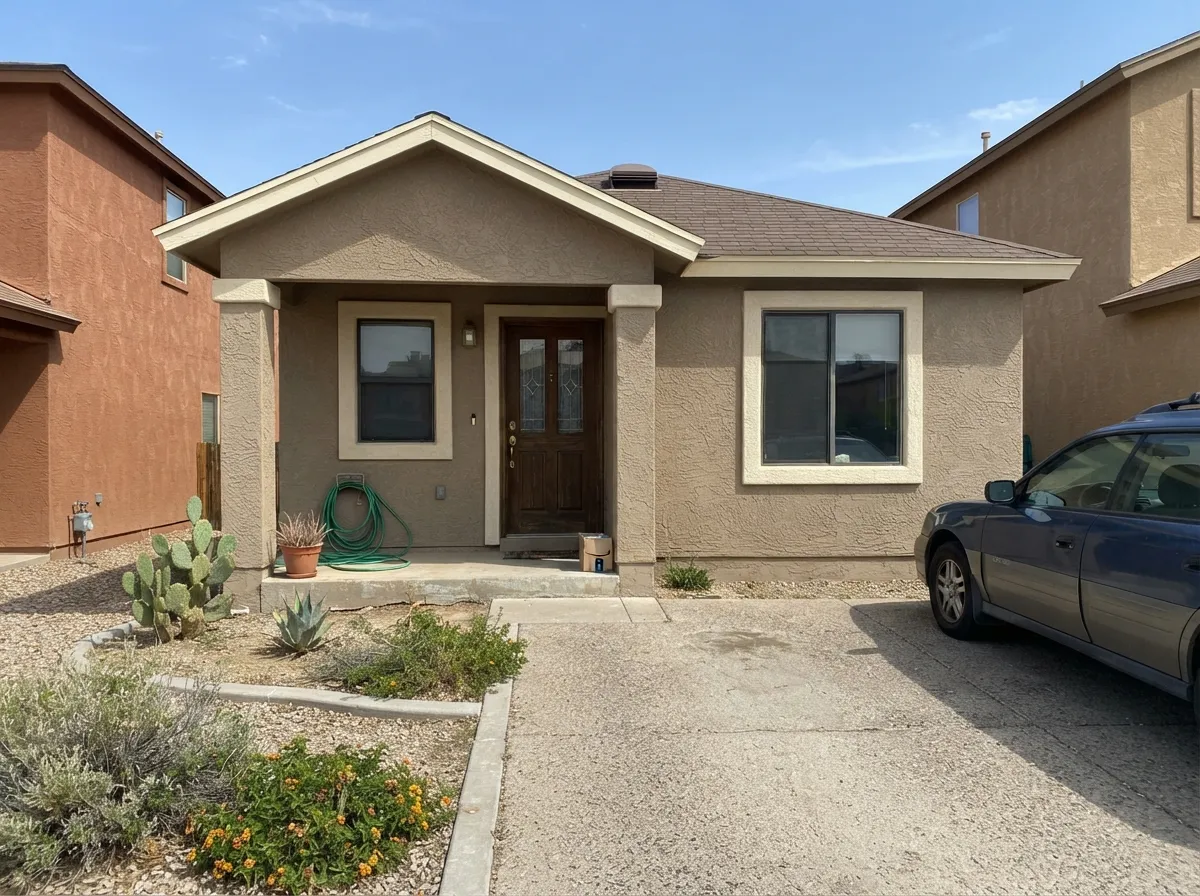
Give it desert sun and warm materials and it behaves. Exterior stucco is the job it was hired for: Color-Ark books list it as a main body and as fascia / pop-out trim, and in full Southwest light the brown stays muted instead of turning orange. Indoors it needs real daylight and wood — a west dining room, a den with walnut, a bedroom that actually sees sun — plus a warm white on the trim so the walls do not look like unpainted plaster.
Where It Fails
Almost every regret about Hickory is a depth or temperature mismatch, and both are visible on the chip if you know what you are looking at. None of them are the paint's fault — but if your room matches one, this is not your beige, and a bigger sample will only confirm it.
On the strip it passes for a soft tan. On four interior walls LRV 35 is a mid-tone wood taupe, and readers who expected Accessible Beige depth will call it brown. If the goal is a livable interior beige, go up twenty points of light — Accessible Beige (LRV 58) or Balanced Beige (LRV 47) — and leave Hickory for the house shell.
Gray LVP, gray quartz, and cool north daylight strip the wood warmth and leave a dirty khaki. The brown has nowhere to sit, so the wall looks dusty instead of nutty. Hickory wants oak, walnut, terracotta, and sun. Cool gray neighbors are how a wood beige starts looking dirty.
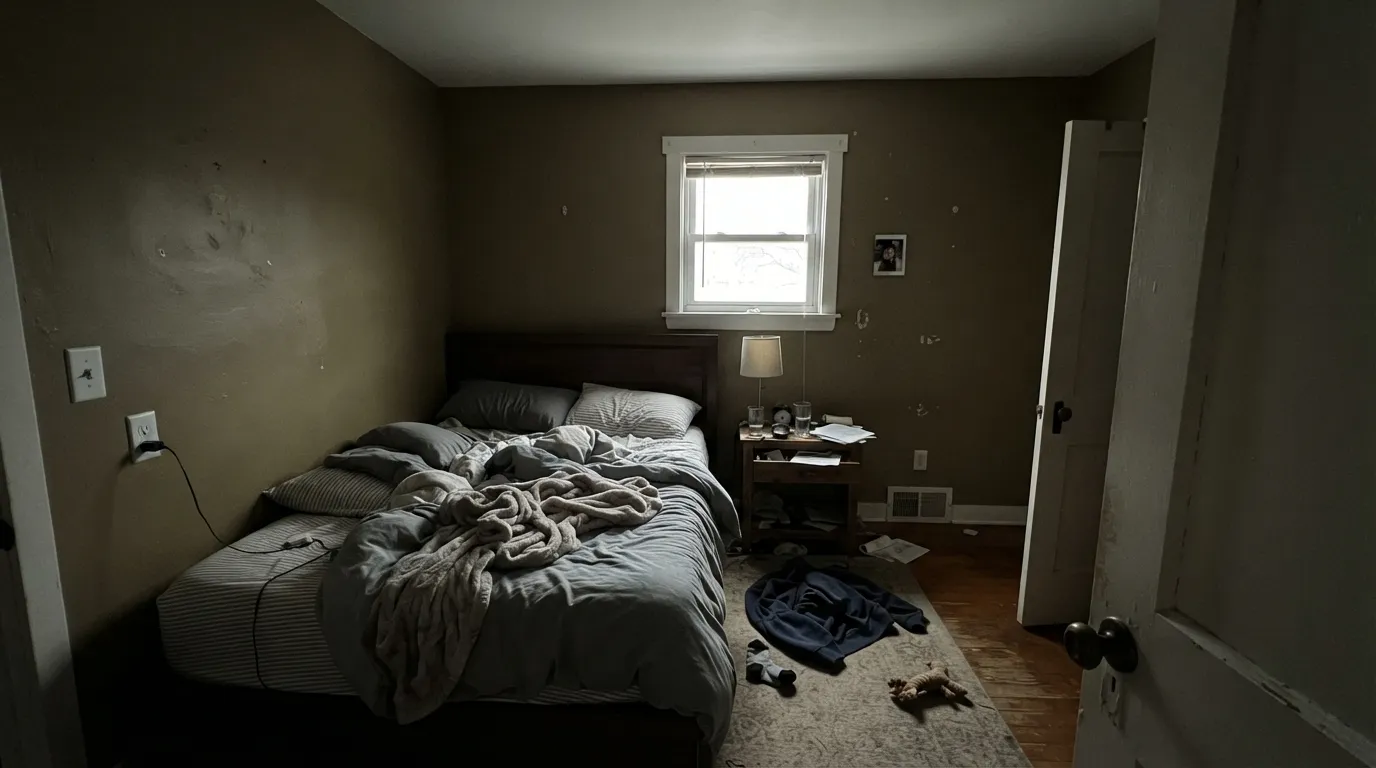
At LRV 35 this color eats light. A north bedroom, a hallway, a basement den with one window — the walls go cave-brown by late afternoon. Warm 2700K lamps are part of the paint job if you use it inside. If you refuse lamps, pick a color that reflects more than a third of the light that hits it.
Room by Room
Body color, fascia, pop-outs: this is where Hickory earns the HOA slot. Full sun keeps the brown muted; the shaded north elevation will read a step deeper, so walk the house with a sample before you commit the whole envelope. Pair with a warm white trim and a near-black door.
West or south light, walnut or oak table, brass, a warm white on the trim: the wood beige looks intentional instead of muddy. Eggshell on the walls. This is the interior room that actually suits the depth.
An open, sunlit living room with wood floors can carry it. An average living room with one north window cannot. If the adjacent kitchen is cool-gray quartz, the handoff will argue. Test a big board on the darkest wall before you roll.
A sunny bedroom goes cozy and wood-warm at night under 2700K lamps. A north bedroom goes brown and tired. Matte or eggshell; White Dove or Dunn-Edwards Swiss Coffee on the trim, never a stark cool white.
A full kitchen of Hickory walls will feel closed-in unless the room is all glass. An island or a hutch in satin, under a much lighter beige or cream, is the dose that works. Cool gray counters are a hard no; butcher block and warm stone are the company it wants.
Low-light circulation spaces turn this color into a tunnel. It is not a whole-house interior. Keep it on the envelope, on a sunlit dining room, or on one committed accent wall — and let a lighter beige run the rest of the floor.
Your Light Is the Risk
Desert daylight is the light this color was mixed for. The brown stays muted, the wood warmth comes forward, and stucco looks like earth instead of paint.
Cool gray daylight kills the wood and leaves khaki-brown. In a dim north room it just looks dirty. Test here before you buy a gallon.
Quieter taupe in morning shade, warmer nutwood through afternoon and golden hour. The shift is real; most people who picked it for wood like the warmer end.
2700K lamps pull the honey-brown and make interiors livable. Cool white LEDs gray it toward dirty khaki — swap the bulbs before you blame the paint.
Most complaints about Hickory are a light mismatch. Upload a photo of your actual room and see it on your walls — then ask for the same wall in north light or evening lamps before you buy a single sample.
Need It From Another Brand?
Any paint counter can custom-tint Dunn-Edwards DEC759 directly. If you would rather stay in one brand's own deck, these are the closest stock matches, measured as ΔE2000. Under 2 is a difference you will not see on the wall.
| Brand | Closest color | ΔE | LRV | |
|---|---|---|---|---|
| Sherwin-Williams | Stone LionSW 7507 · Sherwin-Williams | 2.7 | 38 | Color page → |
| Behr | Wild RyeECC-53-2 · Behr | 2.3 | 38 | Color page → |
| Benjamin Moore | Broken Arrow1026 · Benjamin Moore | 0.8 | 37 | Color page → |
| Valspar | Fashion DistrictV132-4 · Valspar | 1.8 | 39.4 | Color page → |
| PPG / Glidden | AntelopePPG15-09 · PPG / Glidden | 3.2 | 39 | Color page → |
| Glidden | Palm Springs Tan20YY 39/130 · Glidden | 2.3 | 39 | Color page → |
Similar Dunn-Edwards Colors
The nearest shades to Hickory within Dunn-Edwards's own range, ranked by perceptual color distance — useful when you want the same look a touch lighter, darker, or warmer.
WCAG 2.1: AA is 4.5 : 1 for normal text, 3 : 1 for large text, AAA is 7 : 1.
Hickory vs the Colors You're Also Considering
Every Hickory sample board has the same rivals on it. The numbers show the real lightness gap — then it comes down to which risk you would rather live with.
Pick this when you want wood-beige, not greige — Hickory is browner and warmer at almost the same LRV.
Sherwin-Williams SW 7031 · LRV 37Mega GreigePick this if you want the same exterior depth with gray in the mix — Mega Greige is the national-brand greige built for the outside of the house.
Pick this when the job is stucco, fascia, or a sunlit dining room that can take real depth.
Sherwin-Williams SW 7036 · LRV 58Accessible BeigePick this for interior walls that still need to feel beige — twenty-plus points of light keep a room airy where Hickory goes brown.
Hickory Coordinating Colors
Stay on the warm side of the fence: creams, espresso near-blacks, muted sage, and navy. Cool gallery whites and cool grays are how this beige starts looking dirty. These are the partners that keep showing up next to it on houses that work:
Hickory on Southwest Exteriors
This is not a designer Instagram color. It is the beige on the HOA sheet. Dunn-Edwards Color-Ark Pro lists DEC759 as a main body at communities such as Fairview Meadows and Mountain Vistas, as house-and-trim at St. Tropez at Painted Desert, and as fascia trim at Summerlane's Avalon scheme. Painters also run it on stucco pop-outs and fascia when the body is a lighter cream — Instagram and contractor posts keep showing it in that supporting role.
Full sun is kind to it: the chroma is low enough that it does not flash orange the way cheaper tans do, and the LRV is low enough that it does not chalk-white by July. Walk the shaded side before you sign. North and overhang-dark elevations read a full step browner, which is fine if you planned for it and a surprise if you only sampled the south wall at noon. Trim in Dunn-Edwards Swiss Coffee or another warm cream; door in Espresso Macchiato or a true near-black. Cool gray stone wainscot is the exterior version of the interior gray-floor problem — sample that junction.
Hickory With Wood Tones and Floors
Named for a nutwood, it behaves like one. Walnut, espresso, and medium oak are the easy yes — the wall and the floor share a yellow-red family, so neither one has to shout. Unstained or light white oak is quieter and still compatible. Butcher block, cedar, and terracotta tile all sit in the same warmth.
Cool gray LVP and gray-washed wood are the honest no: they pull the brown into relief and the wall reads khaki-dirty. If the gray floor is staying, Hickory is the wrong beige; look at a lighter, grayer greige instead of forcing a wood color against a gray floor. Honey oak is not a clash here the way it is with violets and cool grays — this paint was mixed to live next to yellow-red wood. Keep extra orange out of the rugs and you will be fine.
Metals: unlacquered brass, oil-rubbed bronze, and matte black. Polished chrome is the one that leans cold against it.
Three Ready Palettes Built on Hickory
A color is never alone on the wall. These are complete combinations in the 60-30-10 pattern, with the reason each one holds together. Every one opens in the visualizer.
This is the Southwest envelope that Color-Ark books keep reprinting: wood-beige body, the region's default cream on trim, espresso near-black on the door. Warm white matters — a cool bright trim would push Hickory toward dirty yellow.
Try this palette in your roomA sunlit dining room is the interior Hickory can actually finish. White Dove keeps the edges soft and warm; Hale Navy is one dark note so the wood beige does not float. Walnut table, brass, 2700K bulbs — that is the room.
Try this palette in your roomIf you like the wood beige but four walls would go brown, put Hickory on the headboard wall only and let Swiss Coffee carry the light. Evergreen Fog is a muted sage at almost the same depth, so the furniture note stays earthy instead of cute.
Try this palette in your roomHickory FAQ
Is Hickory beige or brown?
Both, depending on the job. On sunlit stucco it reads as a muted wood beige. On four interior walls at LRV 35 it reads brown — a taupe-nutwood, not a tan. If beige is what you actually wanted inside, this is the wrong depth; that mismatch is the whole review.
Is it good for interior walls?
Only in rooms with real sun: a west dining room, a bright den, a south bedroom. Hallways, north rooms, and whole-house interiors are a no. The safer interior move is Hickory on one wall and Dunn-Edwards Swiss Coffee or White Dove on the rest.
What trim white goes with Hickory?
A warm cream, not a gallery white. Dunn-Edwards Swiss Coffee (DEW341) is the Southwest default and the trim already sitting next to Hickory on a lot of Color-Ark sheets. White Dove is the interior equivalent. A cool bright white makes the walls look dingy and yellow-brown.
Does Hickory work with oak floors?
Warm oak, walnut, and terracotta are the point of this color — the wood beige meets the floor halfway. Pale white oak is fine. The honest no is cool gray LVP or gray-washed wood, which strips the warmth and leaves khaki. Honey oak is compatible, not a clash; just do not add more orange in the textiles.
Can I use it on an exterior?
That is its best use. Dunn-Edwards Color-Ark books list DEC759 as a stucco body and as fascia / pop-out trim in multiple Southwest HOAs. Expect the north elevation to read a step deeper than the south. Pair with warm white trim and a dark brown or near-black door; Hometalk owners have also run it with reds, greens, and blues on shutters.
Hickory or Mega Greige?
Same depth, different blood type. Mega Greige (LRV 37) is a greige built for exteriors — gray in the mix. Hickory is wood-beige with muted brown. If the house should look like earth and oak, pick Hickory. If it should look like a warm gray stucco, pick Mega Greige.
Have you painted with Hickory?
Rate it — one tap helps the next reader decide.
Ask a Question