Baked Potato
The potato-skin beige California actually paints, reviewed honestly: the stucco it was mixed for, the LRV 34 that closes a room, and the trim white that makes it look dirty.

Jessica has spec'd whites and neutrals for more than 300 rooms and keeps a sample wall of painted drawdowns in her studio. Every color review is checked against real reader rooms in the comments and re-tested when a formula changes. About the testing process →
- 1Anonymous20
- 2Felted Wool28
- 3Baked Potato34
- 4Revere Pewter55
- 5Agreeable Gray60
The Fast Verdict
Baked Potato is not the light beige the name suggests. It is a yellow-red tan at LRV 34 — potato skin, kraft paper, pecan — sitting in Dunn-Edwards' Classics collection with enough chroma to look like a color, not a greige. California homeowners have put it on stucco with Swiss Coffee trim, and HOAs still list it as an approved body color next to clay-tile roofs. It is not famous, and it is not a Color of the Year. Give it hard Western sun, oak, and a cream trim and it behaves. Sample it as a light whole-house beige and you have a brown room.
Southwest stucco with cream trim · daylit living rooms with oak and leather · dining rooms that run on lamps · anyone who wants potato-tan, not greige
You wanted a light beige or a whole-house greige · the room faces north and stays dim · trim is staying a bright true white · floors and counters are cool gray
- Potato-skin tan that actually reads beige-brown, not greige
- LRV 34 holds as a real body color on Western stucco in hard sun
- Classics collection workhorse — no trend timestamp
- Flatters oak, walnut, terracotta tile, leather, and unlacquered brass
- The documented pairing already exists: Swiss Coffee trim on California stucco
- Not a light beige — LRV 34 closes small and dim rooms
- Looks dingy, even dirty-brown, next to a bright true-white trim
- Cool north light strips the gold and leaves muddy khaki
- Cool gray floors and quartz shove the yellow-red forward into orange-potato
What Color Is Baked Potato, Really?
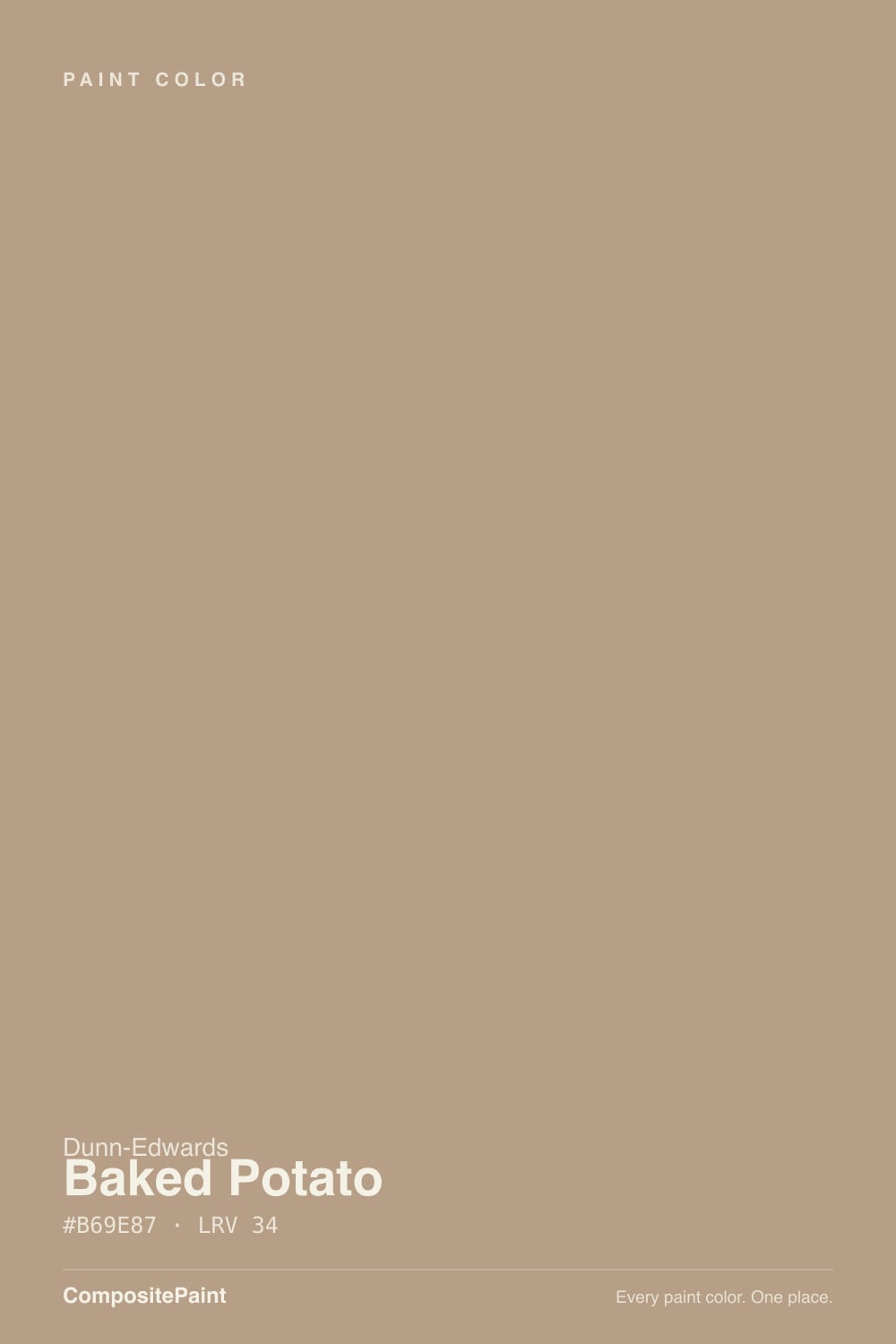
A yellow-red tan with the gray left out — potato skin, not taupe, not greige. Dunn-Edwards files DEC717 in the Classics collection and measures it at Munsell 8.56YR, value 6.3, chroma 2.4: yellow-red, mid value, enough pigment that four walls look like a color instead of a dusty neutral. That YR hue is the whole personality. Fine Grain, the brand's greige workhorse, sits in the same neighborhood on a fan deck and still reads gray-beige; Baked Potato never will. The name is not cute once it is on a wall. It is the color of a baked potato's skin, and the chip is honest about it. It has sat in the Perfect Palette since the mid-2000s. It has never been a Color of the Year — Dunn-Edwards does not run that program — and it has no viral room. The documented life is quieter: California stucco, HOA decks, a Houzz thread where the homeowner simply wrote that they used Baked Potato on the body and Swiss Coffee on the trim.
At LRV 34 it is a genuine mid-tone, and that number is the plot. Accessible Beige sits at 58. Stucco Tan, the West's sandy whole-house beige, is at 68. Balanced Beige is 47. Perfect Greige is 42. Dorian Gray is 39. Hickory, the Classics neighbor Dunn-Edwards lists as similar, is 35. Baked Potato is the deep end of that tan family — twenty-four points darker than Accessible Beige, a full thirty-four points darker than Stucco Tan. On a 2-inch chip in a store it can pass for a friendly warm beige. On four walls it has the same weight as a sage cabinet color. Plan for the field to read a step deeper, a step browner, and a step more golden than the chip. Every mid-chroma yellow-red does this, and it is the number-one surprise if you bought it thinking beige.
Undertone in one line: yellow-red tan first, golden-brown second — never gray in the can, never pink, never green. If your sample looks like potato gold, that is west sun or 2700K lamps doing it. If it looks khaki, muddy, or slightly dirty, your light is cold. Both versions are the same gallon being honest about the room. Chroma 2.4 is the reason it will not pass for greige once the afternoon hits: there is enough yellow-red in it that depth multiplies into tan, then into brown.
Where It Shines
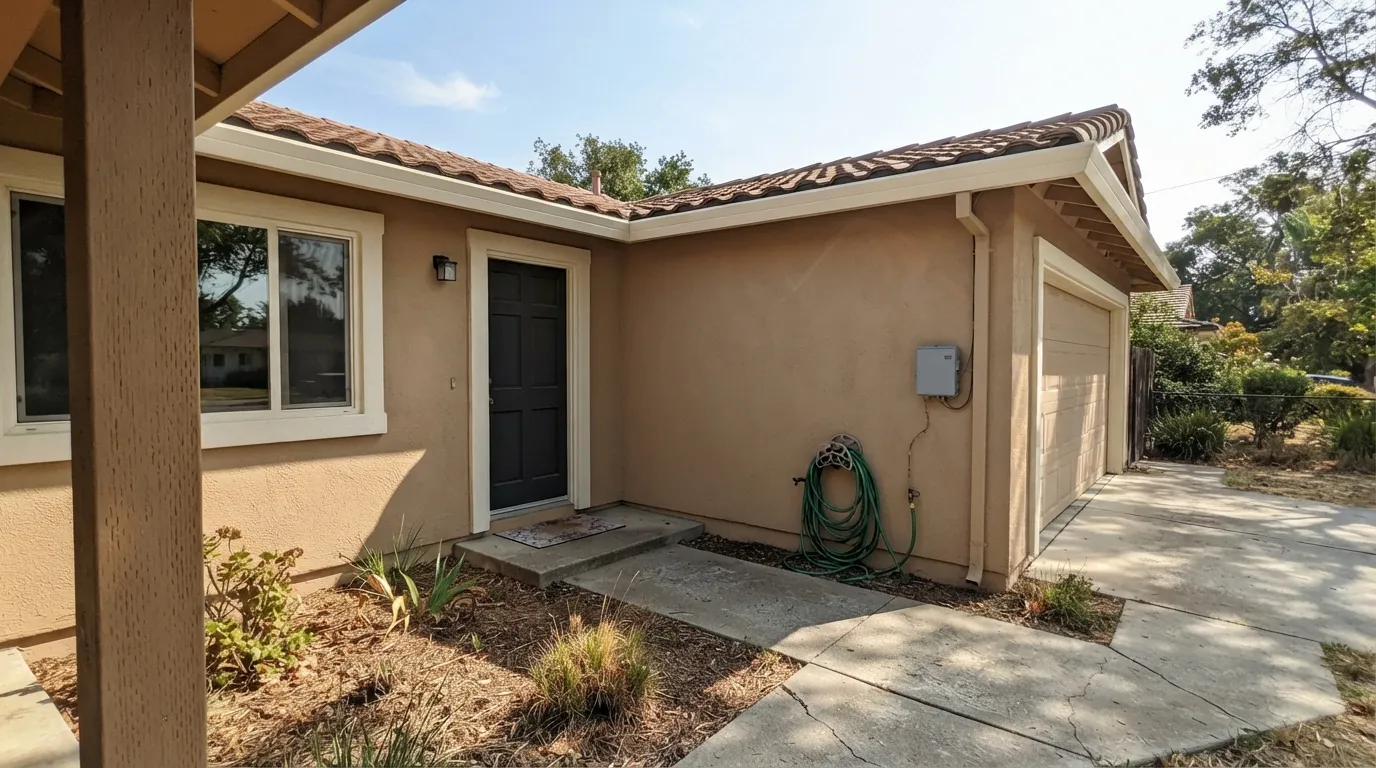
Its real job is Western stucco. At LRV 34 it holds as a decided tan from the street in hard sun instead of washing to cream, which is why California HOAs keep it on the approved list and why Houzz still reaches for it on clay-tile ranches. Pair it with Dunn-Edwards Swiss Coffee on the trim — that is the pairing a real house already ran — and a dark door so the body color does not float. Indoors, the same depth is a gift in rooms you use at night: a south living room with oak and leather, a dining room on 2700K lamps, a bedroom that should feel held. Cream trim, not a paper-white. Eggshell on the walls; flat on the stucco.
Where It Fails
Almost every regret about Baked Potato is a depth problem wearing a beige name. The chip looks friendly. The wall is a mid-brown tan. If your room matches one of the three situations below, a second coat will not fix it.
On the chip it passes for a warm, easy beige. On four walls at LRV 34 it is potato-skin tan — the same depth band as Dorian Gray (LRV 39) and Perfect Greige (LRV 42), only browner. People who sampled it next to Accessible Beige (LRV 58) or Stucco Tan (LRV 68) and assumed it was in that family get a room that feels held, then brown. If light and open is the goal, this is the wrong can. Stucco Tan is the sandy whole-house beige; Balanced Beige (LRV 47) is the lighter real beige. Sample a poster-size board, not a fan chip, and believe the depth.
The most common pairing mistake, and Dunn-Edwards walks you toward it every time someone grabs Warm White (DEW380, LRV 93) because the name says warm. Warm White is a true white wearing a warm name. Next to Baked Potato the brighter white wins, and the walls look dingy, even dirty-brown, by comparison. Chantilly Lace (LRV 90) does the same trick from the BM side. The fix is the trim, not a second coat — Dunn-Edwards Swiss Coffee (LRV 83) or Whisper (LRV 87) keeps the tan reading deliberate. If the bright builder white has to stay, do not use this beige.
Gray LVP, gray-washed wood, and cool-veined quartz sit on the blue side of neutral. Next to them the yellow-red in Baked Potato shoves forward until the wall reads orange-potato, and the floor looks colder. Cool north daylight does the opposite trick: it strips the gold and leaves a flat, slightly khaki brown that readers will call muddy. Warm 2700K lamps help after dark and do nothing at 2 p.m. If the hard finishes are cool, or the room stays dim, pick a greige — Fine Grain (LRV 59) is the Dunn-Edwards version — or a lighter beige.
Room by Room
This is the room the color actually lives in. California stucco, clay-tile roofs, a cream trim: Houzz has already run the scheme, and HOA decks still list DEC717 as an approved body color. Full Western sun keeps it potato-tan and present from the street; the shaded north elevation goes a step flatter and muddier. Pair it with Swiss Coffee or Whisper trim and a dark door — Iron Ore, Hale Navy, Dark Engine — so the body does not float. Walk around the house with a sample. Flat or a low sheen on stucco; satin on the woodwork.
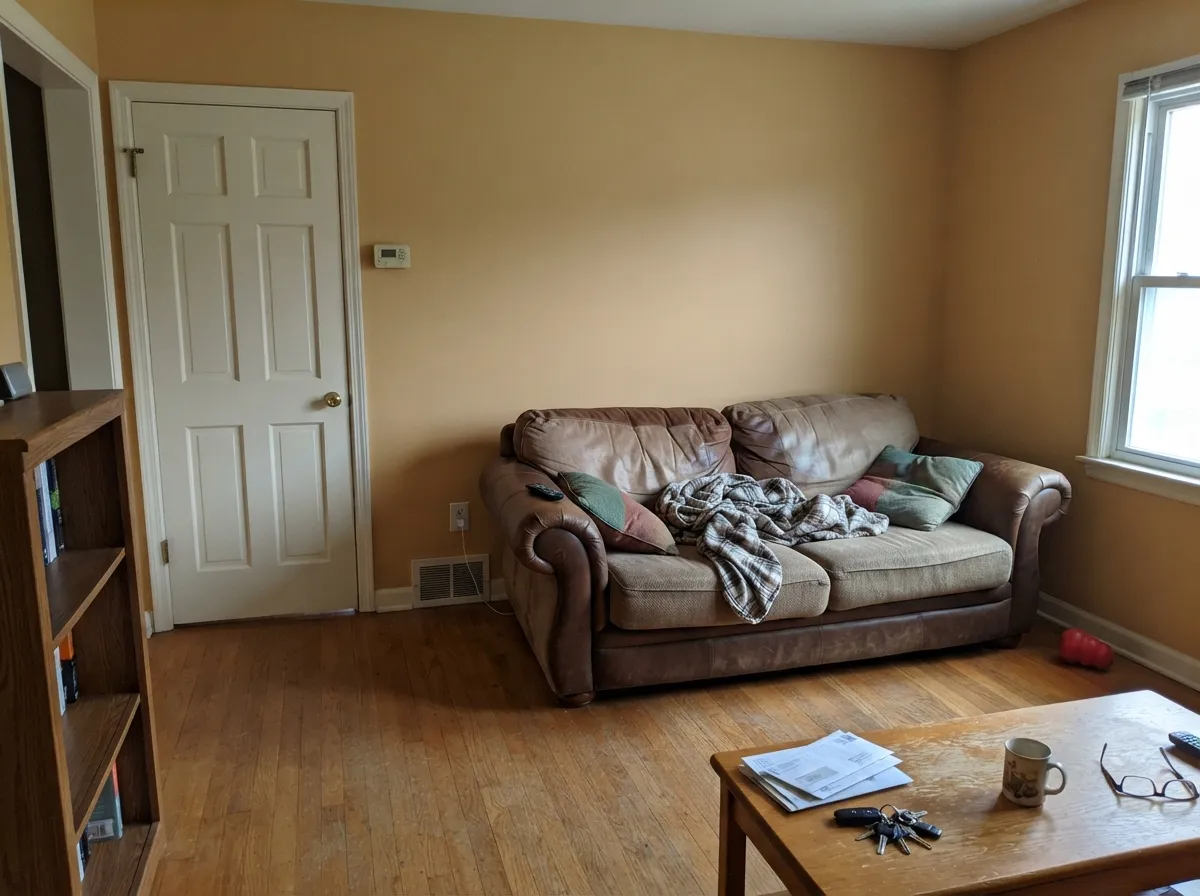
In south or west daylight it is the calm potato tan that makes oak, leather, and brass look chosen. Eggshell on the walls; Swiss Coffee or Whisper on the trim in semi-gloss. A large, bright living room can carry LRV 34. A closed north parlor with one small window cannot — the gold drops out and the room goes cave-brown. Check the west wall at 4 p.m. before you commit.
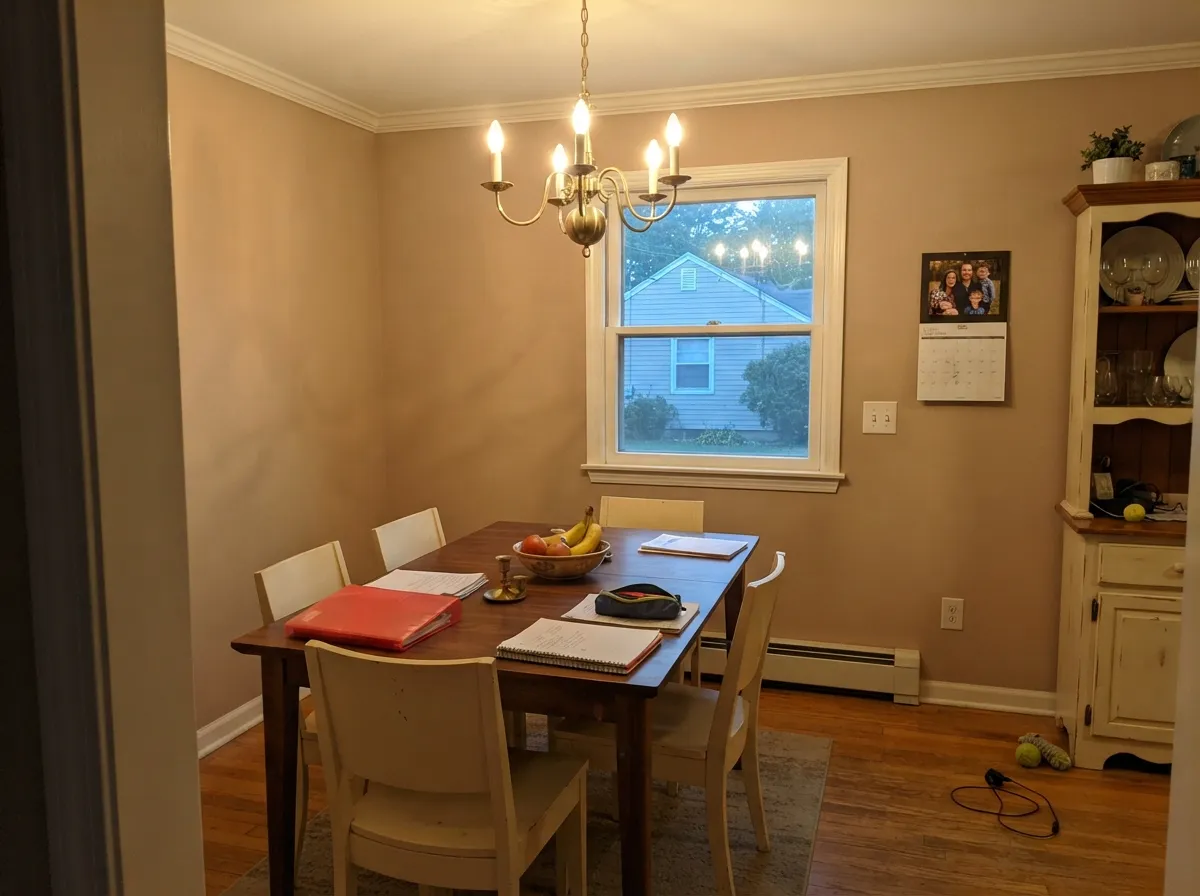
Dining rooms run on lamps, and 2700K bulbs make Baked Potato look like pecan and linen rather than mud. At this depth the walls hold the room without a chandelier having to do all the work. Eggshell; the same cream trim as the rest of the floor so the handoff does not flash. A lamp-only dining room with cool LEDs is the khaki version — swap the bulbs first.
Soft, restful, held — not a color you wake up to if the room has real daylight and 2700K lamps. Matte or eggshell; cream bedding rather than gray, which goes blue against the tan. A north cave with one window and cool bulbs is the dingy-brown version. If you still want warmth without the depth, Sherwin-Williams Natural Linen (LRV 67) keeps more cream in cool light.
Warm counters, oak or walnut, brass, cream cabinets: the tan sits behind them and behaves. Keep it on the walls and let Whisper or Swiss Coffee take the boxes. A whole kitchen of potato-tan cabinets is a 1970s bet most people are not making on purpose. Cool gray quartz is the one argument — it will pull orange. Satin on any painted millwork.
At LRV 34 a windowless hall is a tunnel. The common fix is Baked Potato in the daylit rooms and a lighter sandy beige — Stucco Tan at LRV 68 — through the halls and stair. A hall that borrows light from rooms at both ends can carry it, and then the tan does the connecting job without a color change. Do not run this can whole-house without sampling the darkest pass-through first.
Your Light Is the Risk
Warm sun all day keeps the potato tan present without tipping orange. This is the light the color was mixed for — Western stucco at noon and south living rooms that can actually carry LRV 34.
Cool gray daylight kills the gold and leaves a muddy, slightly khaki brown. Fine if you half-wanted a dark greige; disappointing if you wanted beige. Test on an overcast morning before you roll the floor.
Morning light reads dustier and a step quieter; west afternoon and golden hour pull the yellow-red forward until it looks like potato skin in the sun. Sample the west wall at 4 p.m. — that is when the tan is loudest.
2700K lamps: creamier, more clearly pecan-tan, the dining-room glow. Cool LEDs above 3500K flatten it toward dingy khaki-brown — swap bulbs, not paint.
Most complaints about Baked Potato are a light mismatch. Upload a photo of your actual room and see it on your walls — then ask for the same wall in north light or evening lamps before you buy a single sample.
Need It From Another Brand?
Any paint counter can custom-tint Dunn-Edwards DEC717 directly. If you would rather stay in one brand's own deck, these are the closest stock matches, measured as ΔE2000. Under 2 is a difference you will not see on the wall.
| Brand | Closest color | ΔE | LRV | |
|---|---|---|---|---|
| Sherwin-Williams | Trusty TanSW 6087 · Sherwin-Williams | 2.8 | 37 | Color page → |
| Behr | MidtownMQ2-47 · Behr | 1.6 | 36 | Color page → |
| Benjamin Moore | Dellwood Sand1019 · Benjamin Moore | 1.3 | 36 | Color page → |
| Valspar | Faint Maple2008-9C · Valspar | 0.8 | 35.8 | Color page → |
| PPG / Glidden | Weathered WoodPPG1077-4 · PPG / Glidden | 1.8 | 35 | Color page → |
| Glidden | Weathered WoodPPG1077-4 · Glidden | 1.4 | 35 | Color page → |
Similar Dunn-Edwards Colors
The nearest shades to Baked Potato within Dunn-Edwards's own range, ranked by perceptual color distance — useful when you want the same look a touch lighter, darker, or warmer.
WCAG 2.1: AA is 4.5 : 1 for normal text, 3 : 1 for large text, AAA is 7 : 1.
Baked Potato vs the Colors You're Also Considering
Every Baked Potato sample board has the same rivals on it. The numbers show the real lightness gap — then it comes down to which risk you would rather live with.
Pick this when Balanced Beige felt washed and you want the same yellow-red beige with potato-skin body.
Sherwin-Williams SW 7037 · LRV 47Balanced BeigePick this if you want a real beige with more air — thirteen LRV points lighter, still tan, the famous one every painter already knows.
Pick this when Perfect Greige felt too gray and you want the yellow-red tan, not a fence-sitting greige.
Sherwin-Williams SW 6073 · LRV 42Perfect GreigePick this if you actually wanted greige at this depth — the original greige, deeper and warmer than the copies, without the potato gold.
Baked Potato Coordinating Colors
The rule for coordinating with Baked Potato: stay on the warm side of the fence. Cream trim, dusty taupes, sage, and near-blacks — and keep cool gray and paper-white at arm's length. It pairs with Swiss Coffee far better than with a bright true white, loves oak and brass, and layers cleanly with the lighter sands in its own family. These are the partners that keep showing up in rooms that work:
Baked Potato On Exteriors
Inside, Baked Potato is a committed living-room tan. Outside, it is a Western body color, and that is the honest pedigree. Dunn-Edwards keeps it in Classics next to Mesa Tan and Hickory; California HOAs still print DEC717 on the approved-body list; a Houzz homeowner in a clay-tile house used it on stucco with Swiss Coffee trim and moved on with their life. It has never been a launch. At LRV 34 it has enough depth to read as a color from the street in Phoenix or Pasadena sun, and enough yellow-red to sit next to terracotta roofs, stone, and weathered wood without looking like a rental beige.
The pairing decides the result. Cream trim — Swiss Coffee or Whisper — keeps the body potato instead of dirty. A dusty mid-taupe like Metal Fringe, or a near-black like Iron Ore or Dark Engine, on the door and shutters gives the elevation a shadow line so the tan does not float. What to avoid: cool blue-gray accents, which make the gold look orange by comparison, and a paper-white fascia, which does the same trick from the other side. Walk around the house. The shaded north wall will read a full step flatter and muddier than the sunny south wall, and that is the sample that should decide the gallon.
Baked Potato With Wood Tones And Floors
This decision gets made at the floor, not the paint store. Walnut, pecan, and medium oak are the color's best friends — the yellow-red in the wall meets the yellow-red in the wood, and both sides look chosen. Pale white oak is safe and goes a little more Scandinavian-ranch. Terracotta tile and saltillo are the exterior logic brought indoors, and they are why the color keeps showing up on clay-roof houses.
The one honest no is cool gray: gray LVP, gray-washed oak, blue-gray stone. Blue sits across the wheel from yellow-red, so each side exaggerates the other — the floor reads colder, the wall reads more orange-potato, and no amount of coats fixes geometry. Honey-orange builder oak is the other sample-first: it can work, or it can push the whole room toward pumpkin at 4 p.m. A large rug between a problem floor and this paint is a patch, not a plan.
Metals are the easy part: unlacquered brass, antique bronze, and matte black all work; polished chrome is the only one that leans cold against it.
Three Ready Palettes Built on Baked Potato
A color is never alone on the wall. These are complete combinations in the 60-30-10 pattern, with the reason each one holds together. Every one opens in the visualizer.
This is the scheme a Houzz house already ran, with a darker door so the tan does not float. Swiss Coffee is the Southwest's default cream — warm enough that Baked Potato still reads potato, not dirty. Iron Ore is the near-black that respects LRV 6 on a door without going blue; clay tile and brass finish the argument. Walk the north wall with a sample.
Try this palette in your roomCream and potato tan is the pairing that keeps LRV 34 deliberate instead of cave-like. Swiss Coffee is warm enough that the walls still read tan, not yellowed. Hale Navy is the safest navy as long as the room has light — one dark note so the floor does not go monotone. Oak, leather, and 2700K lamps finish it.
Try this palette in your roomWhisper is Dunn-Edwards' White Dove analog, so the cabinet boxes stay soft instead of gallery-bright against the tan walls. Evergreen Fog is the sage that loves brass and warm beige without going mint; satin on the island, eggshell on the walls. Skip this palette over gray quartz — the potato gold will argue with the stone.
Try this palette in your roomBaked Potato FAQ
Is Baked Potato beige or brown?
Both, which is the trap. On the chip it passes as a warm beige. On four walls at LRV 34 it is potato-skin tan — yellow-red first, brown second. Nobody standing in the finished room will call it greige. If a light beige is what you actually want, Stucco Tan or Balanced Beige is the can; this one is a mid-tone.
What trim white goes with Baked Potato?
A warm, soft white — Dunn-Edwards Swiss Coffee is the documented pairing on California stucco, Whisper if you want the White Dove analog. A stark bright white (Warm White, Chantilly Lace) makes the walls read dirty-brown next to the crisp edge. Semi-gloss on the trim, eggshell on the walls, flat on stucco.
Can I use it whole-house?
Almost never. LRV 34 is a mid-tone body color, not a hallway-and-every-room lightener — that job belongs to Stucco Tan at LRV 68. Living rooms, dining rooms, and bedrooms with real windows can take it. Windowless halls and north caves cannot. If the house has to be one can, sample the darkest hallway first, and believe the brown it names.
Does Baked Potato work on exteriors?
Yes — that is its best job. California homeowners have used it on stucco with Swiss Coffee trim, and HOA decks still list it as an approved body color next to clay-tile roofs. At LRV 34 it holds as potato-tan in hard Western sun instead of washing to cream. Expect the north wall to read flatter and muddier than the south. Flat on stucco, satin on woodwork; cream trim, a dark door.
Does it work with oak floors?
Warm oak, walnut, and weathered wood are its best company — the yellow-red tan meets them halfway. Honey-orange builder oak can push both sides toward pumpkin, so sample a large board against the actual floor at 4 p.m. Cool gray LVP is the honest no: the floor goes bluer and the wall goes more orange-potato. A large rug helps; changing the paint helps more.
Will it look too dark on interior walls?
In a dim or north room, yes. LRV 34 is the same depth band as a sage cabinet color, and depth multiplies on four walls. South living rooms, lamp-lit dining rooms, and bedrooms with 2700K bulbs can carry it. A small hallway or a basement office cannot. Poster-size samples on the darkest wall, viewed morning and at 4 p.m., before anyone opens a gallon.
Have you painted with Baked Potato?
Rate it — one tap helps the next reader decide.
Ask a Question