Feather Gray
The seagull gray Benjamin Moore quietly files under blue, reviewed honestly: the stairwells and halls it was built for, and the rooms where it turns cold.

Jessica has spec'd whites and neutrals for more than 300 rooms and keeps a sample wall of painted drawdowns in her studio. Every color review is checked against real reader rooms in the comments and re-tested when a formula changes. About the testing process →
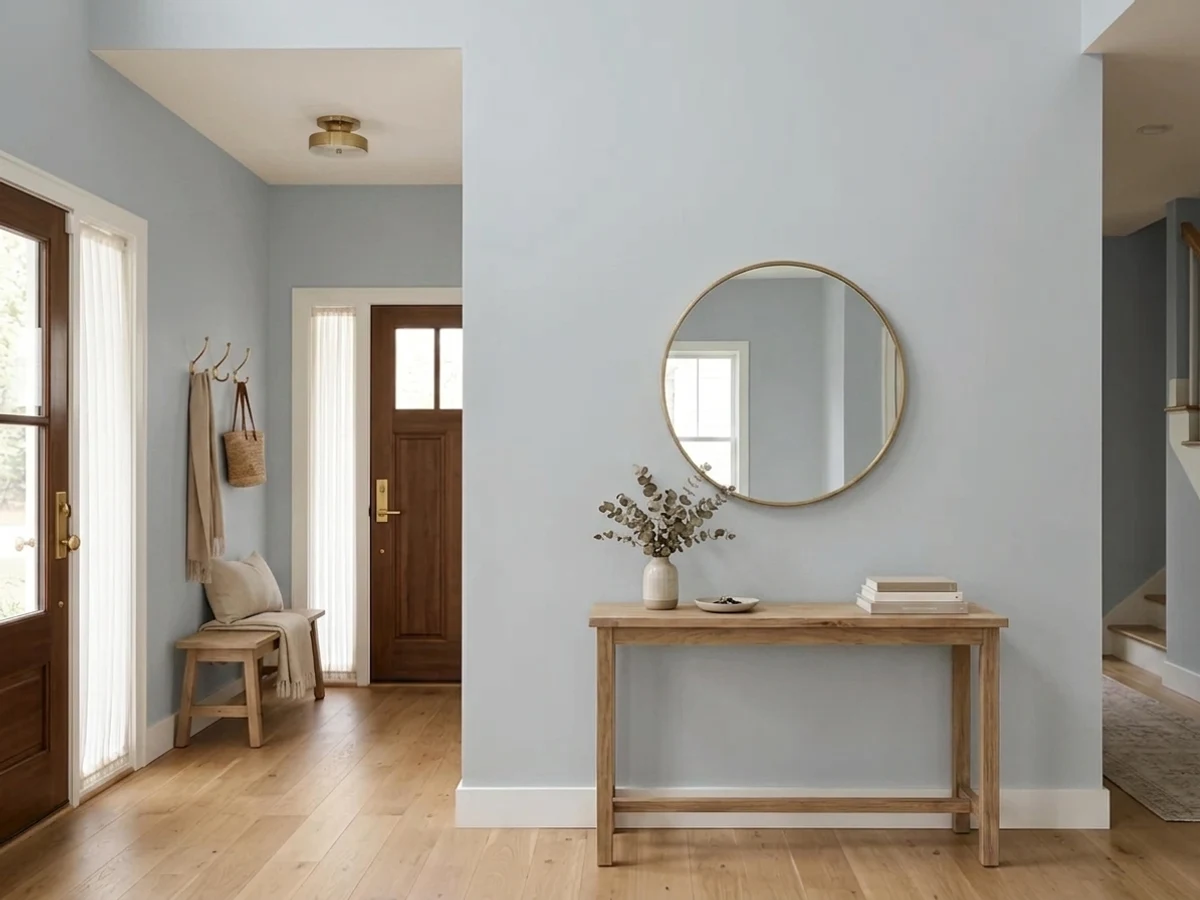
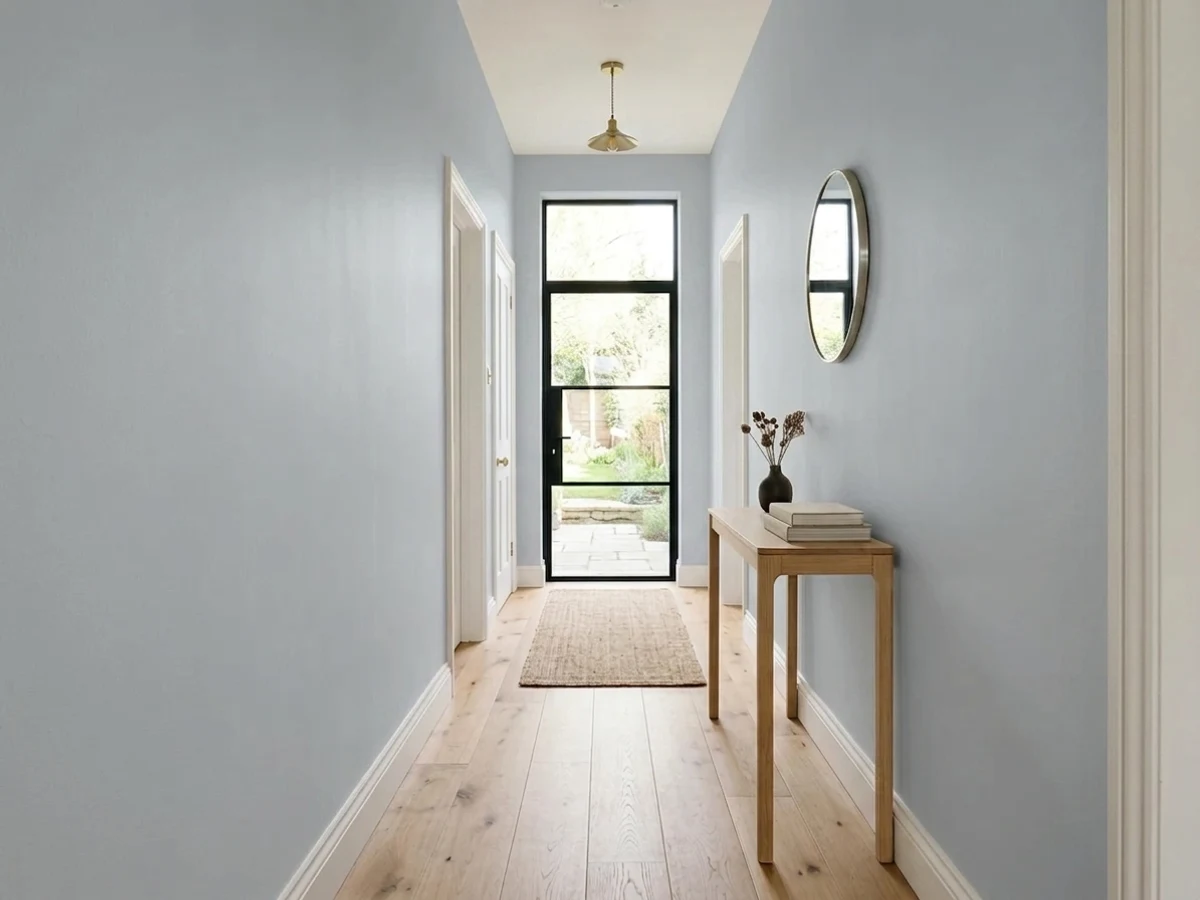
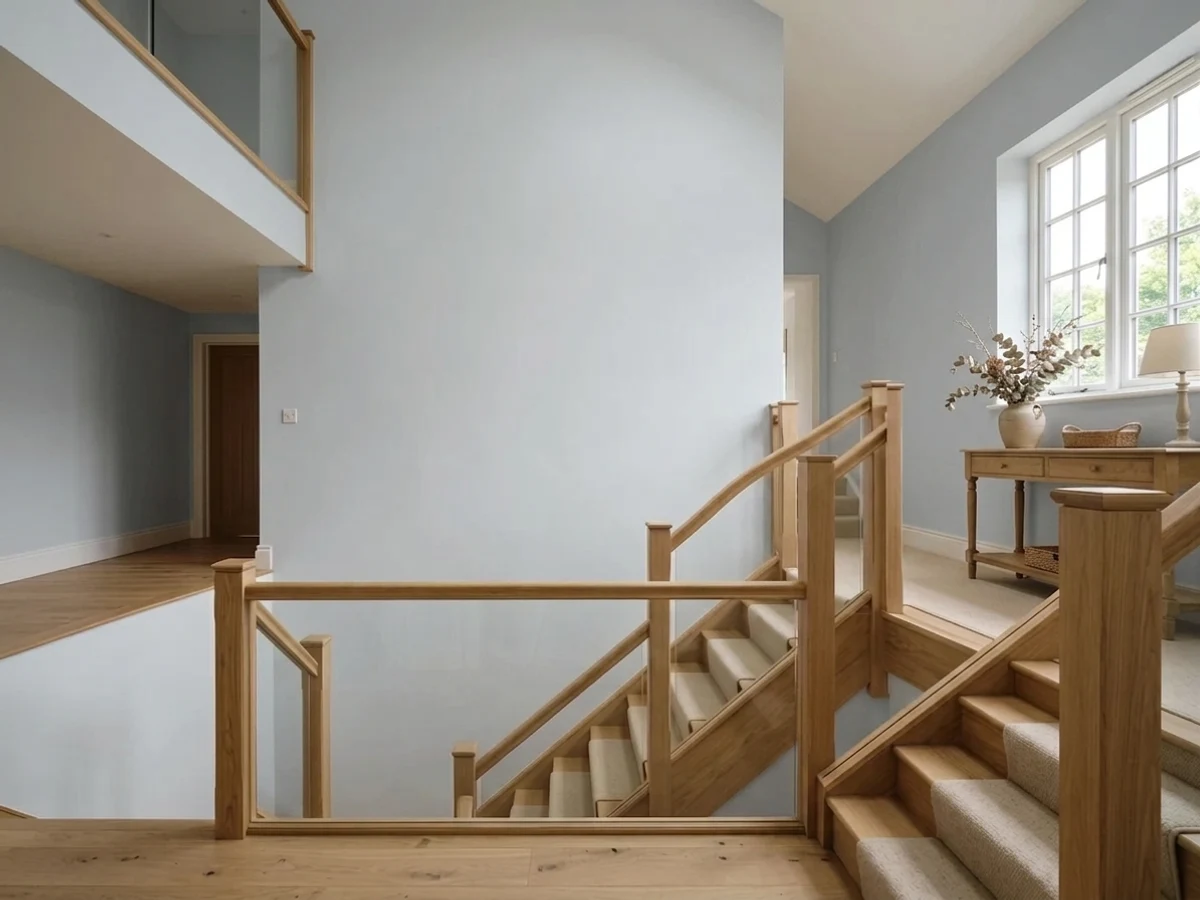
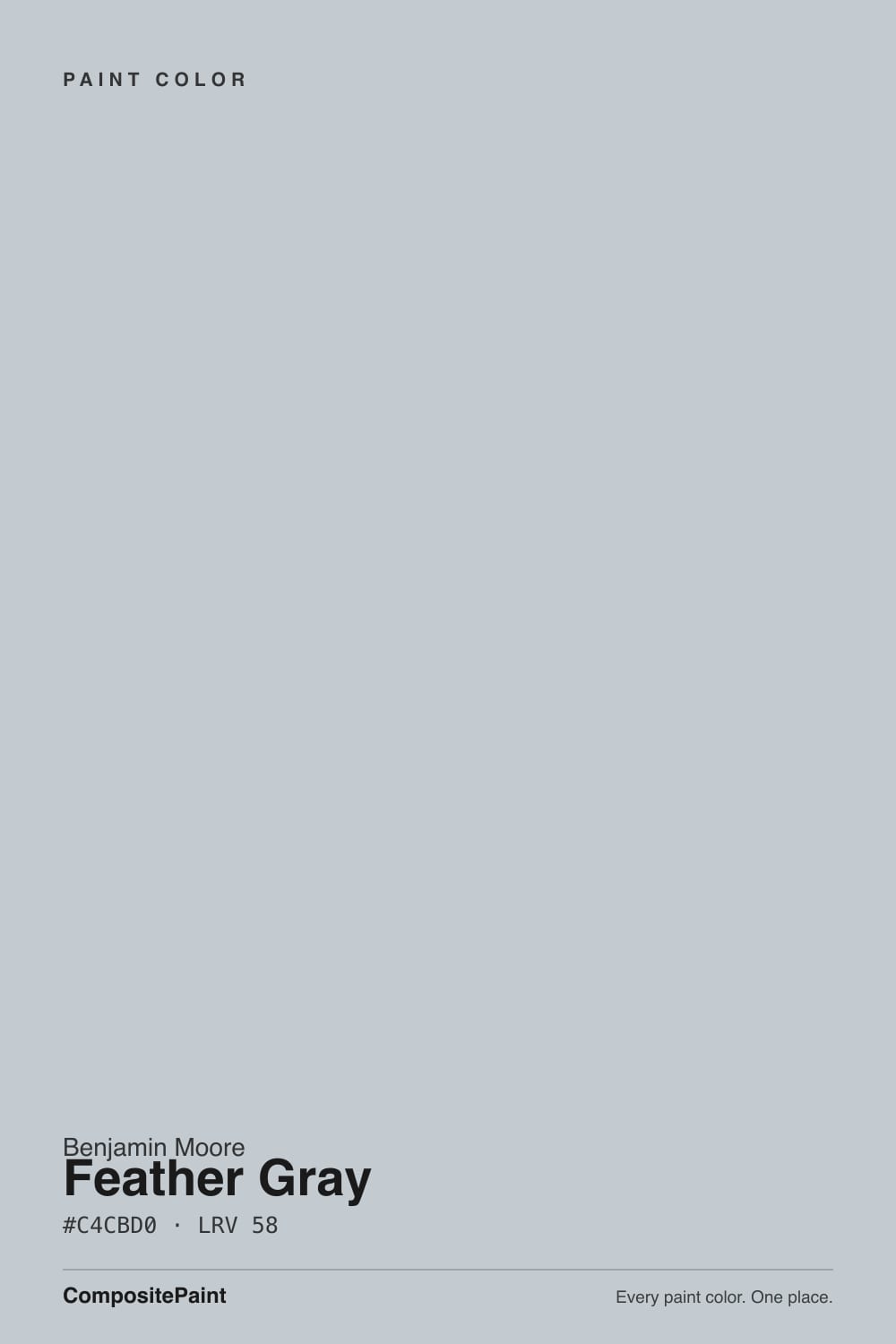
- 1Stardew43
- 2Quietude48
- 3Feather Gray58
- 4Sea Salt63
- 5Wickham Gray68
The Fast Verdict
Feather Gray is a blue with the volume turned almost all the way down. Benjamin Moore describes it as a cool, airy blue-gray and the retail decks file the sample under light blue, not gray — which tells you more than the name does. At LRV 58 it lifts a dark stairwell or a windowless hall without going white, and it stays visibly cool the whole time. That coolness is the whole product. If your house runs on cream trim and honey oak, it is also the whole problem.
Stairwells, halls and entries that need light without warmth · bedrooms and baths you want calm and cool · cabinets and vanities under white counters · anyone who likes blue but does not want a blue room
Your trim and cabinets are a cream white · your floors, treads or railings are honey oak · the room is dim, north-facing and lit only by warm lamps · you actually wanted a neutral gray
- Solves the borrowed-light stairwell and hallway better than white or greige
- Cool and clean without going icy — LRV 58 keeps it soft
- Reads as a color from some angles and a neutral from others, so it carries a whole floor
- Excellent on vanities, laundry cabinets and cool kitchens under white counters
- Layers tonally with the rest of its 2127 strip for risers, doors and accents
- Filed as light blue for a reason — buyers hoping for gray see blue by the second wall
- Cream trim and warm whites make it look dingy
- Honey oak treads, railings and floors turn the blue loud
- Warm 2700K bulbs cancel the color and leave flat cool mud
What Color Is Feather Gray, Really?
A very pale blue-gray with the color drained most of the way out. On The Color Strategist wheel it sits in the 1 PB (purple-blue) family at a chroma of roughly 1.1 — that number is the honest description of this paint. Chroma near 1 means there is real blue in the can, but so little of it that a two-inch chip in a paint store looks like a plain light gray. Roll it across four walls and the small amount multiplies: what you get is unmistakably cool, faintly blue, and never neutral. Benjamin Moore puts it in the Color Preview collection and sells the sample under light blue, so the deck has been telling the truth all along.
At LRV 58 it is a genuine mid-light color, which is why it keeps showing up in the parts of the house nobody knows what to do with. A stairwell or an interior hallway usually has no window of its own and borrows whatever light leaks in from the rooms on either side. A white there looks scuffed and institutional; a greige goes muddy. Feather Gray at 58 bounces enough light to keep the space open and holds enough color to read as a decision. Benjamin Moore's own stair project uses it exactly this way — hallway walls carried onto the stair risers, alternating with Pike's Peak Gray 2127-50 one step deeper on the same strip, with white treads and trim.
Undertone in one line: blue with a violet lean, no green, no warmth anywhere. If your sample reads flat gray, you are looking at it next to something warm that is cancelling it. If it reads periwinkle, your light is cool or your floor is orange — both are the paint being honest.
Where It Shines
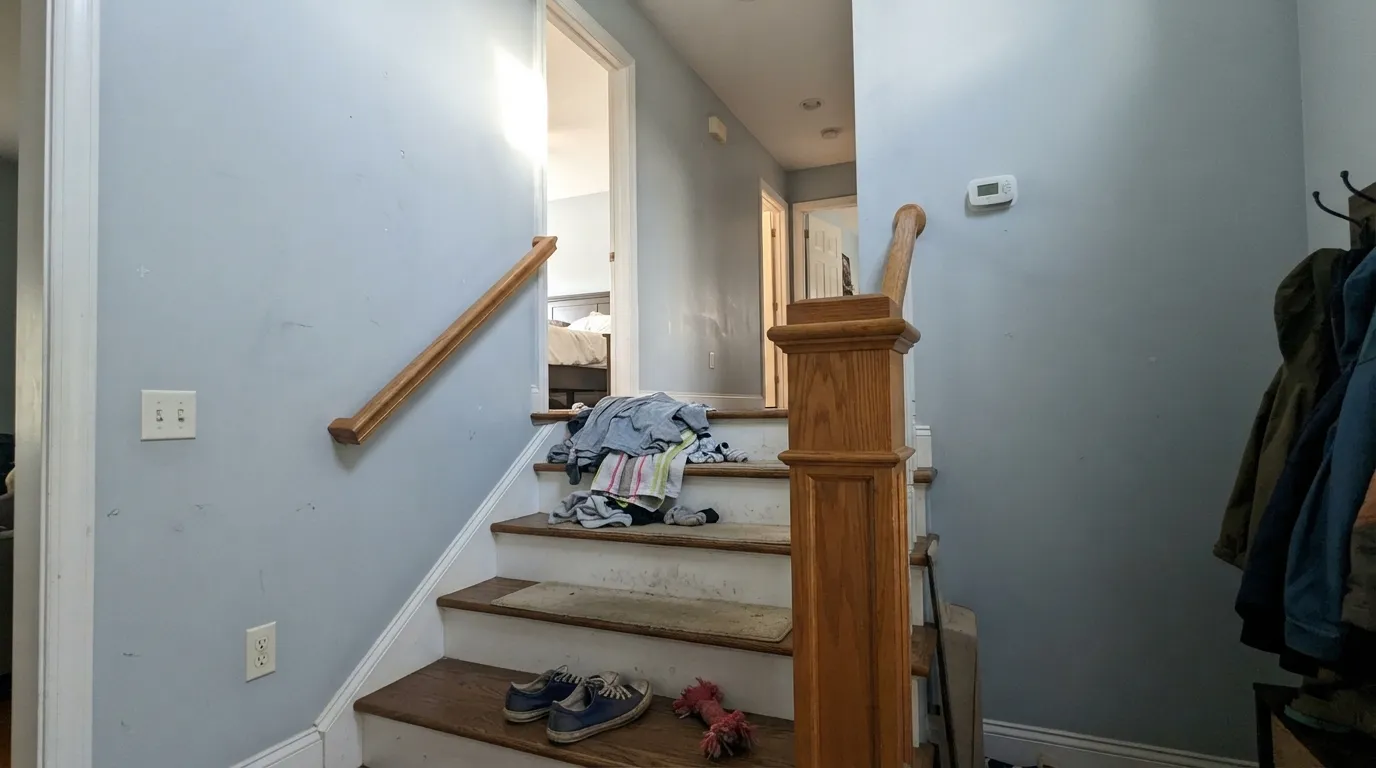
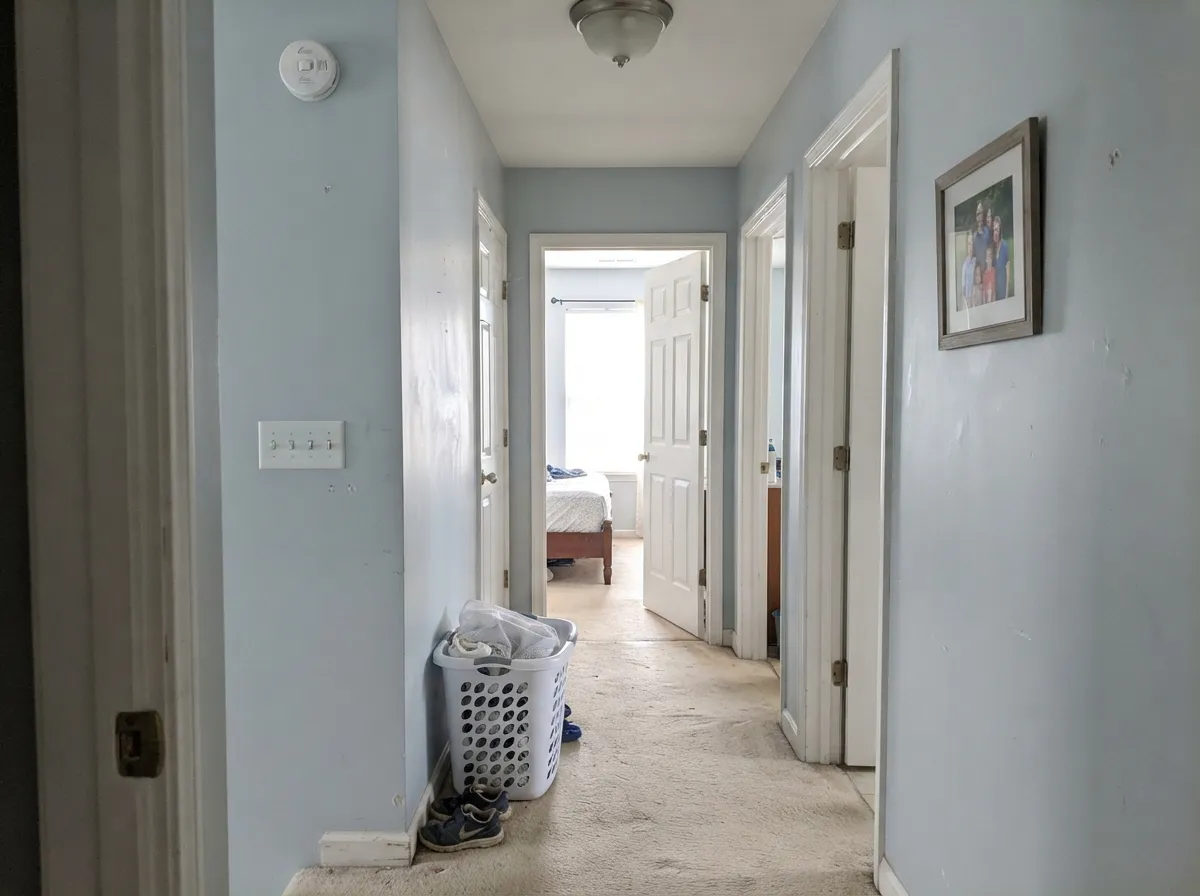
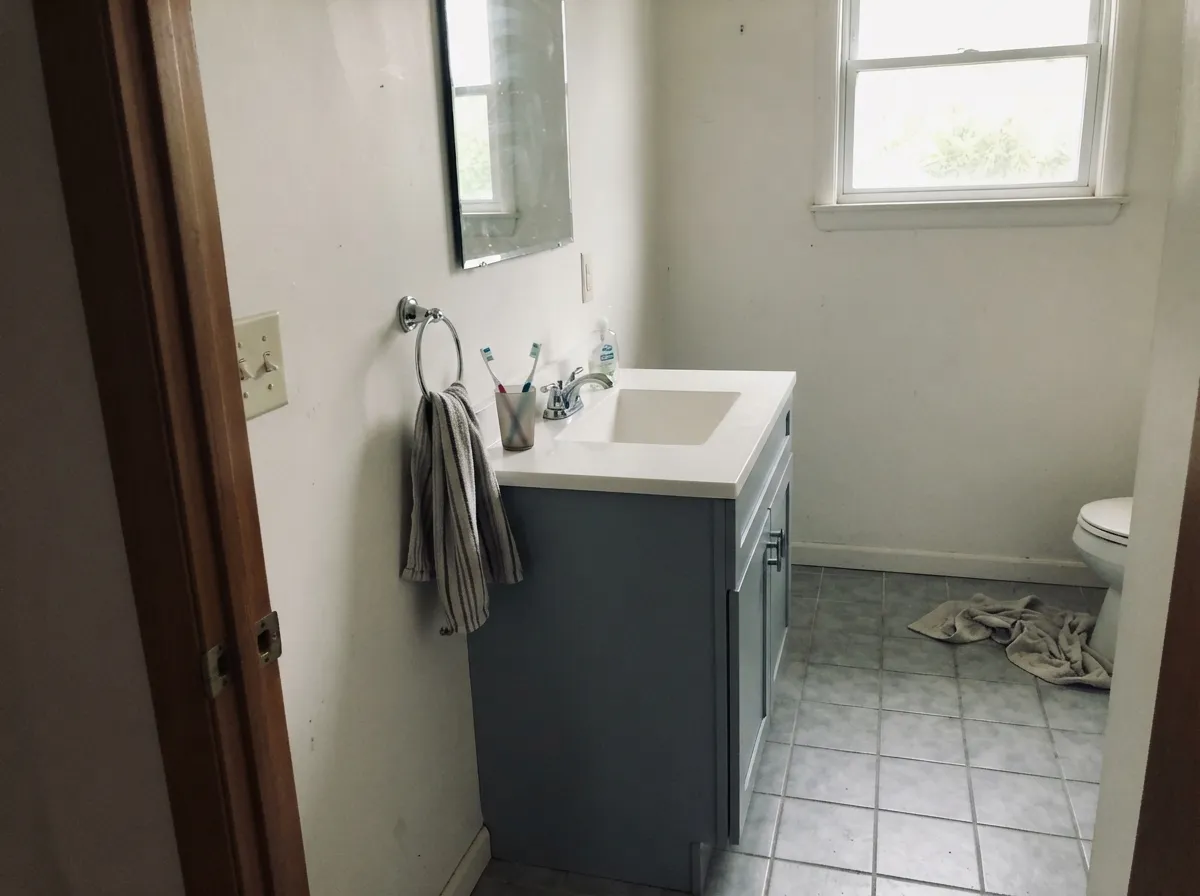
This color earns its money in circulation space. Stairwells, upstairs landings, hallways and entries are the rooms with the worst light and the least furniture, and Feather Gray handles both: it is light enough to open them up, cool enough to look intentional against white trim, and quiet enough that you can carry it past four doorways without it fighting whatever is behind them. Its second home is anything that wants to feel clean — a bath with white porcelain and polished nickel, a laundry with white cabinets, a bedroom you want cool rather than cozy.
Where It Fails
Nearly every disappointed story about Feather Gray traces back to one of three situations, and all three are visible before you open the can. None of them are the paint's fault — but if your house matches one, this is not your color, and a bigger sample will only prove it faster.
This is the big one, and the deck warns you: Benjamin Moore sells this chip under light blue. On a chip it passes for a soft gray. On four walls, especially a tall stairwell where you see the color from three floors at once, the blue is obvious and a few people read it as baby blue. If you want gray with no argument, Stonington Gray (LRV 59) is nearly the same brightness with none of the blue.
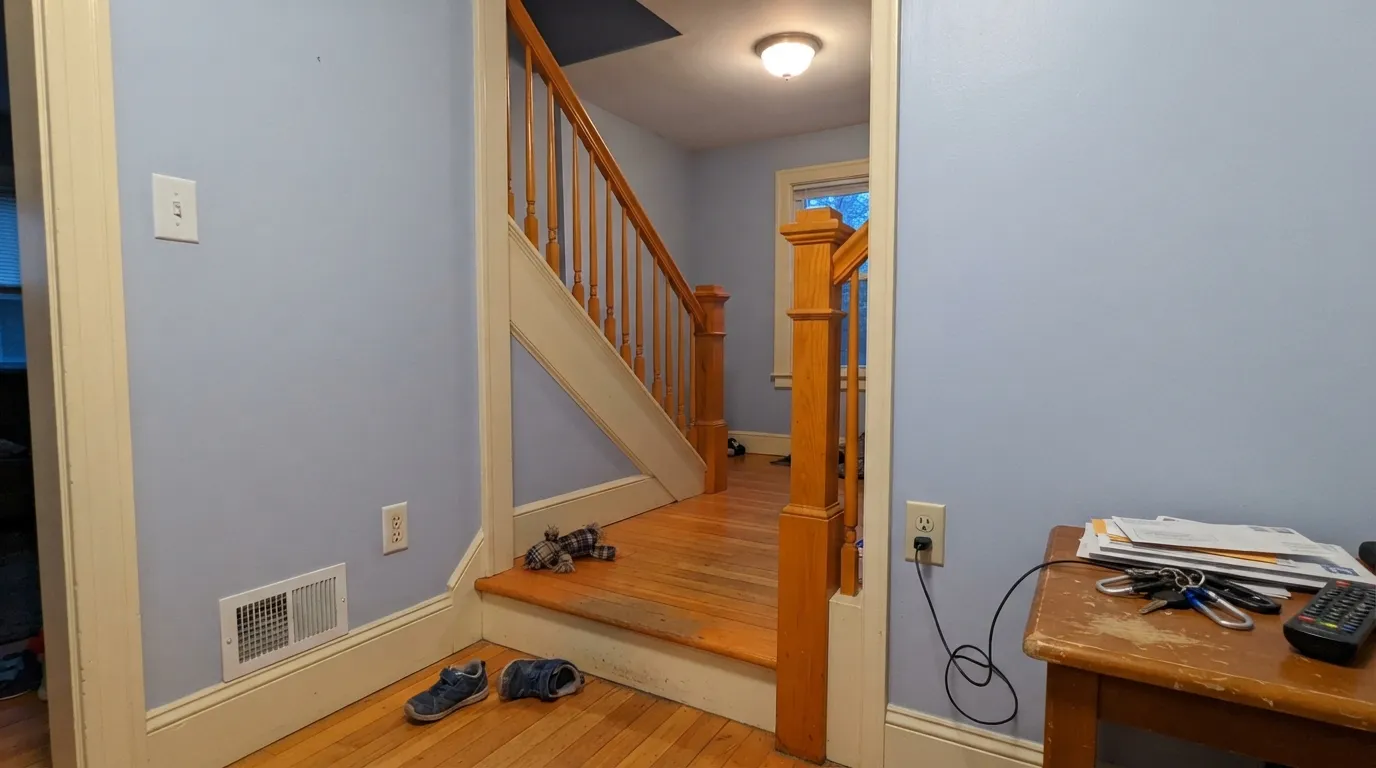
Cool blue sitting next to warm cream is the fastest way to make both look wrong: the trim yellows, the wall goes dingy and slightly dirty-blue. Same story with honey oak treads, orange-stained handrails and golden builder carpet — warm orange is what makes a faint blue look loud. Feather Gray needs a cool white on the trim (Chantilly Lace, White Heron) and wood that is walnut, gray-washed or pale white oak.
The rooms people most want to paint this — interior stairwells, windowless halls — are also the rooms most likely to be lit by a single 2700K bulb. Warm light cancels the blue and leaves a flat, slightly muddy cool-gray with no life in it. The fix is cheap: move those fixtures to 3000K and add a second light source. If you refuse to touch the bulbs, step lighter to Horizon (LRV 73) and let brightness do the work instead of color.
Room by Room
The use Benjamin Moore itself demonstrates, and it holds up. LRV 58 lifts a borrowed-light stairwell without the scuffed look a flat white gets there, and cool blue-gray reads deliberate against white risers and trim. The designer version is tonal: Feather Gray on the walls, the next step down the same 2127 strip on the risers, white treads. Eggshell or satin — stairwell walls take hands and vacuum knocks.
An entry is judged in three seconds and usually has one door's worth of light. This gives it a cool, clean first impression instead of a beige one. Carry the same color straight down the hall so the two spaces read as one. Keep the door casings and the front door interior in a cool white — a cream casing here is the mistake that makes it look dingy.
Cool blue-gray is genuinely restful, and at LRV 58 it stays soft rather than icy. Match the bedding to the walls' temperature: white and gray linens are perfect, cream and beige are the pairing that makes the room look tired. Matte or eggshell, and keep at least one warm lamp so the room does not go clinical after dark.
Its natural company is white porcelain, chrome or polished nickel, and gray tile — a spa look that costs one gallon. On a vanity in satin under a white or marble top it looks specified rather than picked. Laundry rooms get the same benefit: cool walls, white cabinets, and the room looks clean even when it is not.
Benjamin Moore lists this for cabinets and it earns it, but only if the rest of the kitchen agrees: white or gray counters, nickel or matte black hardware, no honey oak floor. Against warm butcher block and brass it goes cold and out of place. Urethane-fortified satin cabinet enamel, always.
Full sun bleaches the little chroma it has, so from the street it usually reads as an off-white with a cold cast rather than a blue-gray. It can work on a coastal shingle or cottage exterior with crisp white trim and a dark roof, where washed-out is the point. On a house with warm stone, brick or cedar it just looks unfinished — pick a deeper blue-gray like Boothbay Gray (LRV 36) instead.
Your Light Is the Risk
A south or east room with plenty of bounced light is where it looks airy and expensive — the blue reads as a soft haze, not a color.
Cold, weak daylight strips the softness and leaves it looking clinical and slightly gray-blue, like a waiting room. Sample here first.
Low warm sun neutralizes the blue for an hour and it passes for a plain gray, then swings back cool the moment the sun drops.
This one is backwards from most colors: 2700K lamps mute it to a dull gray, while 3000K to 3500K keeps it crisp and blue. Pick the bulb with the paint.
Most complaints about Feather Gray are a light mismatch. Upload a photo of your actual room and see it on your walls — then ask for the same wall in north light or evening lamps before you buy a single sample.
Need It From Another Brand?
Any paint counter can custom-tint Benjamin Moore 2127-60 directly. If you would rather stay in one brand's own deck, these are the closest stock matches, measured as ΔE2000. Under 2 is a difference you will not see on the wall.
| Brand | Closest color | ΔE | LRV | |
|---|---|---|---|---|
| Sherwin-Williams | Gray ScreenSW 7071 · Sherwin-Williams | 2.6 | 59 | Color page → |
| Behr | Alice WhiteMQ3-58 · Behr | 2.0 | 58 | Color page → |
| Valspar | Misty HarborV137-2 · Valspar | 1.0 | 59.5 | Color page → |
| PPG / Glidden | KeepsakesPPG1040-2 · PPG / Glidden | 3.1 | 60 | Color page → |
| Glidden | KeepsakesPPG1040-2 · Glidden | 2.8 | 60 | Color page → |
| Dutch Boy | Silvery Gray436-2DB · Dutch Boy | 2.1 | 59 | Color page → |
Similar Benjamin Moore Colors
The nearest shades to Feather Gray within Benjamin Moore's own range, ranked by perceptual color distance — useful when you want the same look a touch lighter, darker, or warmer.
WCAG 2.1: AA is 4.5 : 1 for normal text, 3 : 1 for large text, AAA is 7 : 1.
Feather Gray vs the Colors You're Also Considering
Every Feather Gray sample board has the same rivals on it. The numbers show the real lightness gap — then it comes down to which risk you would rather live with.
Pick this when you want the hall or stairwell to read cool and a little watery on purpose.
Benjamin Moore HC-170 · LRV 59Stonington GrayPick this if you actually want gray — almost the same brightness, without the blue showing up on wall two.
Pick this for the quieter version — Feather Gray hints where Smoke declares.
Benjamin Moore 2122-40 · LRV 56SmokePick this if you want the blue to be a real color and do not mind a green tilt in some light.
Feather Gray Coordinating Colors
The rule for coordinating with Feather Gray is one line long: everything stays on the cool side. It layers beautifully with crisp whites, deeper blue-grays and true navies, and it argues with every cream, every beige and every warm white. Benjamin Moore's own coordinating list for this chip leans the same way — White Heron and Chantilly Lace are both on it. These are the partners worth sampling next to it:
The Seagull Gray: Why It Keeps Turning Up on Stairs
Feather Gray has never been a Color of the Year and it has never trended. It sits in the Color Preview collection, which is Benjamin Moore's big general-purpose fan deck, on the 2127 strip between Pike's Peak Gray one step down and Wolf Gray two steps down. Benjamin Moore's own description reaches for a seagull's plumage, which is a fair picture of a cool, airy blue-gray with almost no color left in it. The retail sample is categorized as light blue, not gray, and that single filing decision explains almost every review of this color ever written.
What gave it a small, durable following is a room problem, not a trend. Stairwells, landings and interior halls have no window of their own, get judged from several angles at once, and are the one place a builder white looks worst. Benjamin Moore's own painted-stairs guide uses Feather Gray on the adjacent hallway walls and repeats it on the risers, alternating with Pike's Peak Gray 2127-50 and finishing the treads and trim in white. That tonal riser trick is the reason designers keep the chip in their pocket: the color is quiet enough to run through a whole circulation zone and specific enough that the zone stops looking like leftover space.
One practical note that follows from all of this: because it lives on a strip, sampling is easier than usual. Paint a foot of the wall in Feather Gray and a foot in the shade below it. If the pair looks like one idea getting darker, you have your stair scheme. If the lighter one disappears into your trim, you need the deeper one on the walls instead.
Feather Gray With Wood Tones and Floors
This color is decided at the floor and the handrail, not at the paint counter. Pale white oak, gray-washed plank, cool LVP and walnut all sit comfortably with it — walnut especially, because the dark red-brown gives the cool walls something to push against without going orange. Cool gray tile and white porcelain are effortless. Cream carpet is fine; true gray carpet is better.
The honest no is golden. Honey oak floors, orange-stained treads, a varnished oak handrail, yellow-beige carpet: warm orange sits opposite blue, so each side exaggerates the other. The wall reads more periwinkle, the wood reads more orange, and every extra coat makes it worse rather than better. In a stairwell this matters more than in any other room, because the treads and the railing are directly in your eye line the whole time you are on the stairs. A runner over the treads and a painted handrail solve it. If the oak is staying bare, choose a warmer light neutral and keep the blue for a bathroom.
Metals follow the same logic: chrome, polished nickel, brushed nickel and matte black all look correct against it. Unlacquered brass and antique bronze are the ones that fight, and if you want brass in the room, put it somewhere the blue-gray is not directly behind it.
Three Ready Palettes Built on Feather Gray
A color is never alone on the wall. These are complete combinations in the 60-30-10 pattern, with the reason each one holds together. Every one opens in the visualizer.
This is the tonal stair scheme Benjamin Moore keeps demonstrating, built from one strip. Chantilly Lace is the right white here precisely because it is crisp and cool-blooded — a cream trim would make the walls look dingy. Wolf Gray on the handrail gives the run a dark line to follow, which a stairwell needs more than any wall color.
Try this palette in your roomBenjamin Moore lists White Heron as one of Feather Gray's own coordinating colors, and it works because it is clean without being surgical. Newburyport Blue on the vanity is the deliberate choice over a grayed navy: a true blue keeps the scheme reading blue instead of muddying into gray. Polished nickel or chrome, white porcelain, and stop there.
Try this palette in your roomThree steps of the same cool family: a near-white wall at LRV 74, cabinets at 58, an island at 6. Paper White matters here because a cream wall would fight the cabinets — it stays on the cool side of the line. Hale Navy anchors the room and is the one place in this scheme where brass hardware is allowed to show up.
Try this palette in your roomFeather Gray FAQ
Is Feather Gray blue or gray?
Blue — quietly, but the deck agrees. Benjamin Moore describes it as a cool, airy blue-gray and sells the sample under light blue. On a chip it passes for gray; on four walls the blue is clear, especially next to anything warm. If you want a light color with no blue in it, Stonington Gray is the swap.
What trim white goes with Feather Gray?
A cool one. Chantilly Lace is the sharpest option and the usual answer; White Heron is the softer version and is on Benjamin Moore's own coordinating list for this color. What to avoid is any cream white on the trim — a warm casing next to a cool wall makes the wall look dirty and the trim look yellow. Semi-gloss on the trim, eggshell on the walls.
Is Feather Gray good for a stairway or hallway?
It is the use it is best known for. Benjamin Moore's own painted-stairs project runs it on hallway walls and repeats it on the risers, alternating with the next shade down the same strip and white treads. At LRV 58 it brightens a stairwell that has no window of its own without looking like scuffed builder white. Just make sure the bulbs in that stairwell are not 2700K, or the color goes flat.
Does it work with oak floors?
Depends on the oak, and this is the decision that sinks most Feather Gray jobs. Pale white oak, gray-washed floors and walnut all look good against it. Honey oak, orange-stained treads and golden handrails are a genuine clash — warm orange is what makes a faint blue look loud, and the floor goes more orange in return. Refinishing or a runner is the fix; more coats is not.
Is it too cold for a bedroom?
Only if you fight it. It is a cool color and it will make the room feel calm rather than cozy, which is exactly why people pick it for sleeping. Keep the bedding white or gray instead of cream, add one warm lamp for evening, and it lands restful. If you want a bedroom that feels warm, this is the wrong end of the deck.
What sheen should I use in a stairwell?
Eggshell for most houses, satin if the stairs are a main traffic route with kids, pets or a vacuum going up and down. Stairwell walls get touched more than any other wall in the house and are the hardest to touch up because of the height, so buy the extra scrub resistance. Keep the trim, risers and treads in semi-gloss so the two planes separate.
Have you painted with Feather Gray?
Rate it — one tap helps the next reader decide.
Ask a Question