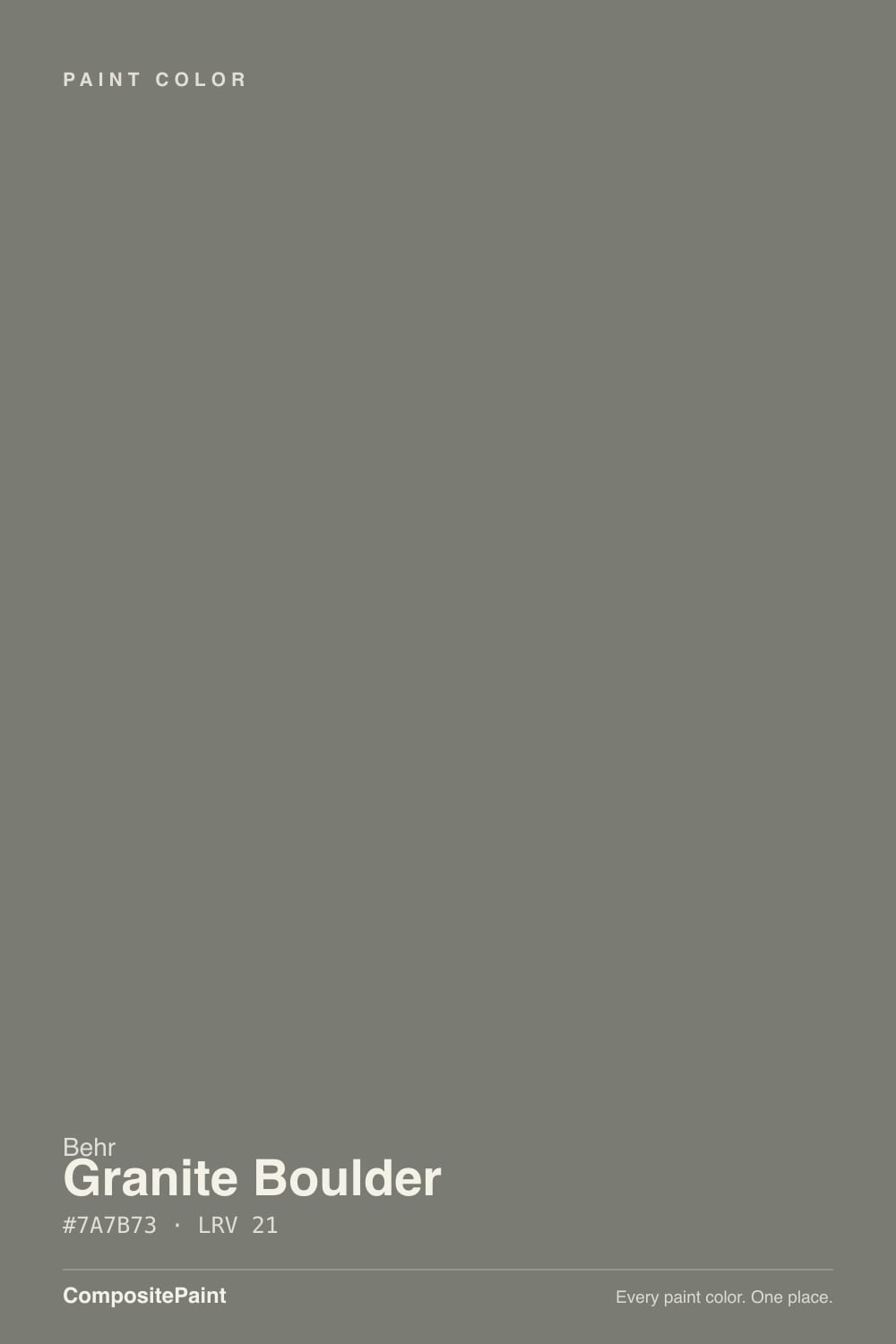
Granite Boulder
Behr's mid stone gray, reviewed honestly: the siding it actually earns, the green-olive flash in cool light, and why the chip looks lighter than the wall.

Jessica has spec'd whites and neutrals for more than 300 rooms and keeps a sample wall of painted drawdowns in her studio. Every color review is checked against real reader rooms in the comments and re-tested when a formula changes. About the testing process →
- 1Anonymous20
- 2Fawn Brindle36
- 3Granite Boulder42
- 4Agreeable Gray60
- 5Pale Oak69
The Fast Verdict
Granite Boulder is the gray you pull when Dolphin Fin looked too pale and a true greige looked too beige. At LRV 43 it is a real mid-tone: solid gray on the chip, a quiet green-olive in the mix, taupe-beige after dark. Full sun on siding is its best job — the color mutes into granite and stops looking like a sample card. Inside a dim north room it can go drab olive or, to some eyes, a baby-blue gray. Sample it on the actual wall at noon and at night before you buy five gallons.
Exterior siding in real sun · daylit living rooms and family rooms · hallways that see a window · Home Depot shoppers who wanted Dorian Gray
The room faces north and stays dim · you wanted a light gray · your trim is staying a creamy white · your floors are orange honey oak
- Real mid stone gray at LRV 43 — body on siding, not a washed greige
- Full sun mutes the green and the house reads granite from the street
- Same 790 strip as Dolphin Fin — the step down when the lighter chip washed out
- Hides scuffs better than the pale grays everyone samples first
- South light and 2700K lamps hold a warm stone-taupe that never goes beige
- Darker than the chip — LRV 43 is not a whole-house light gray
- North light and cool LEDs pull olive, drab, or a baby-blue gray
- Creamy whites and orange honey oak push the green and both sides lose
- Too enclosed for basements, north dens, and lamp-free halls
What Color Is Granite Boulder, Really?
A muted mid gray with a green-olive edge — stone, not greige. Behr files 790D-4 in the Gray family and is frank about the green: this is the granite that has lichen in the cracks, not a taupe that happens to be gray. It sits one step down the same 790 strip as Silver Drop and Dolphin Fin, which is how most people find it: the lighter cousins looked washed, and this chip finally had body. It is not a Color of the Year and it is not a viral interior. It is the gallon Home Depot shoppers keep taking home for siding because it looks like real rock in the parking lot.
The number people miss is LRV 43. Dolphin Fin, the famous chameleon on the same strip, sits at 59. Mindful Gray is 48. Dorian Gray, the closest Sherwin-Williams cousin, is 39. Pashmina is 44. On four walls the chip's polite stone becomes a genuine mid: enough color to hide scuffs, enough gray to read as gray, and enough depth that a dim room will feel held — or, if you forget lamps, enclosed. Plan for it to read a half-step deeper, and slightly greener, than the card. That is not a bad batch. That is every low-chroma mid-gray doing the same thing.
Undertone in one line: gray first, green-olive second, taupe-beige only when the light is warm. Bright daylight keeps it a light-warm stone gray. Evening lamps and west sun pull a subtle taupe. Cool north light and 4000K LEDs strip the beige and leave the green — drab olive, or, in one honest bedroom-repaint story, a baby-blue gray the owner painted over the same day. If your sample looks beige, the room is warm. If it looks green or blue, the light is cool. Both versions are the same gallon being honest about the room.
Where It Shines
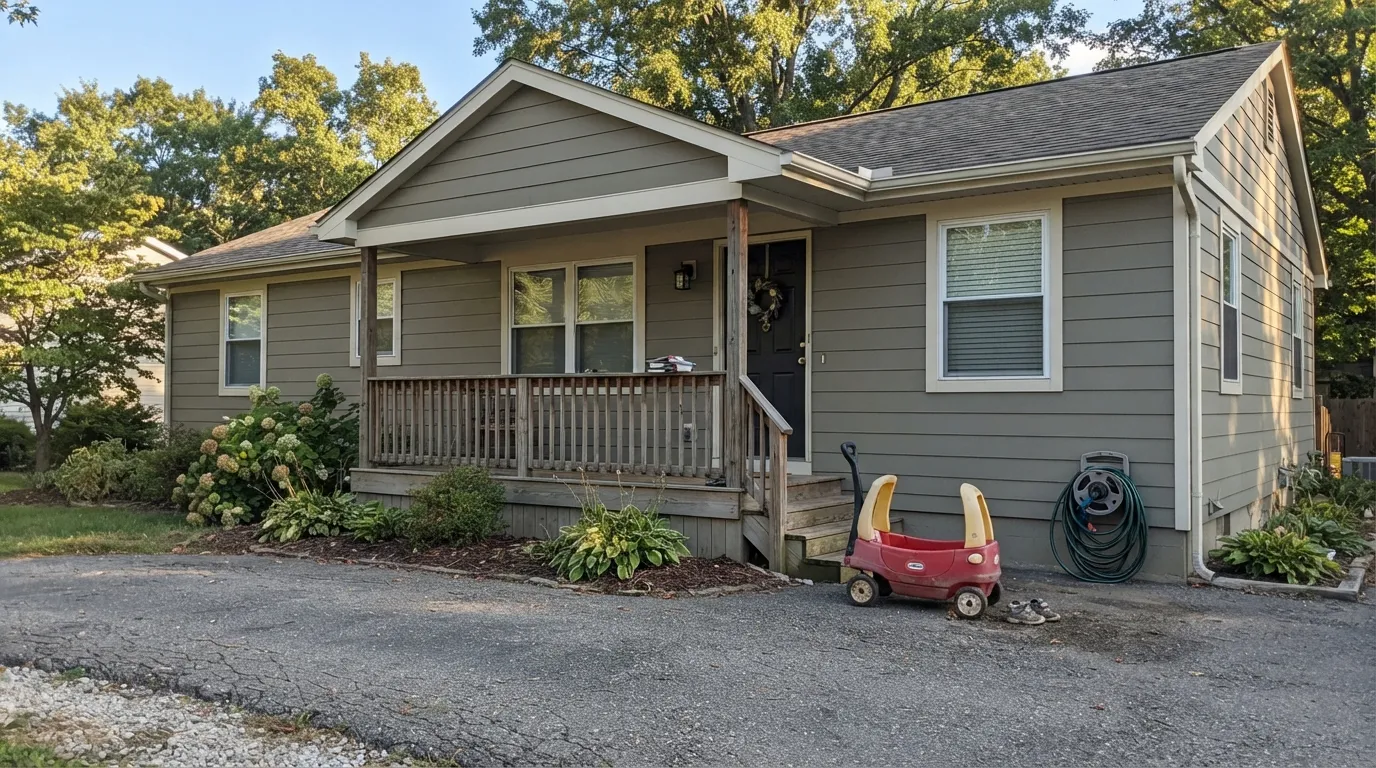
Give it real sun, a clean white trim, and a dark door and Granite Boulder does the job mid stone grays are supposed to do: the house looks like it was always this color. Exterior siding is the use that earned its volume — full sun mutes the green and the body reads granite from the street. Inside, south- and west-facing living rooms with oak or walnut, linen, and brass are the second home. Polar Bear or Pure White on the trim keeps the gray looking gray instead of dirty. It is a body color, not a whole-house light greige.
Where It Fails
Almost every regret about Granite Boulder follows one of three scripts, and all three are visible before the first coat. None of them are a bad batch — but if your room matches one, this is not your color, and a bigger sample will only confirm it.
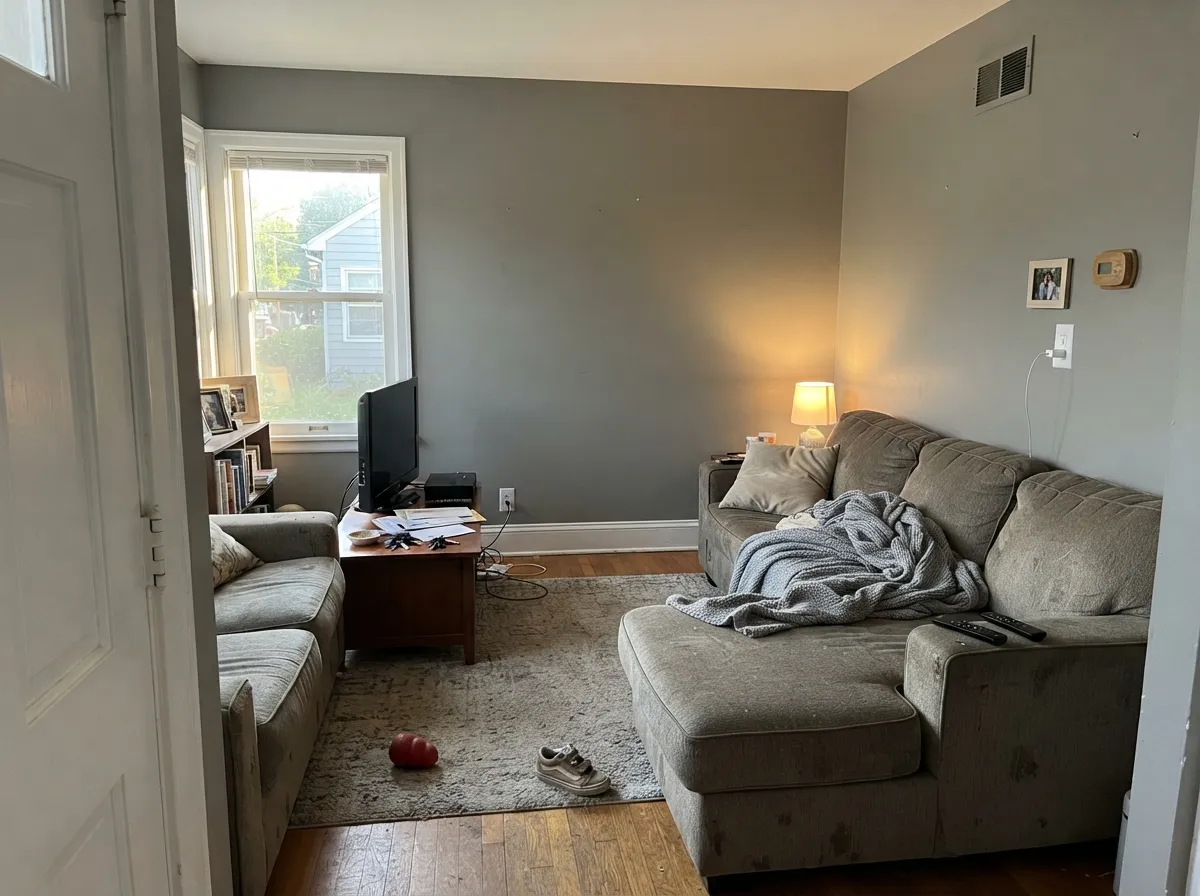
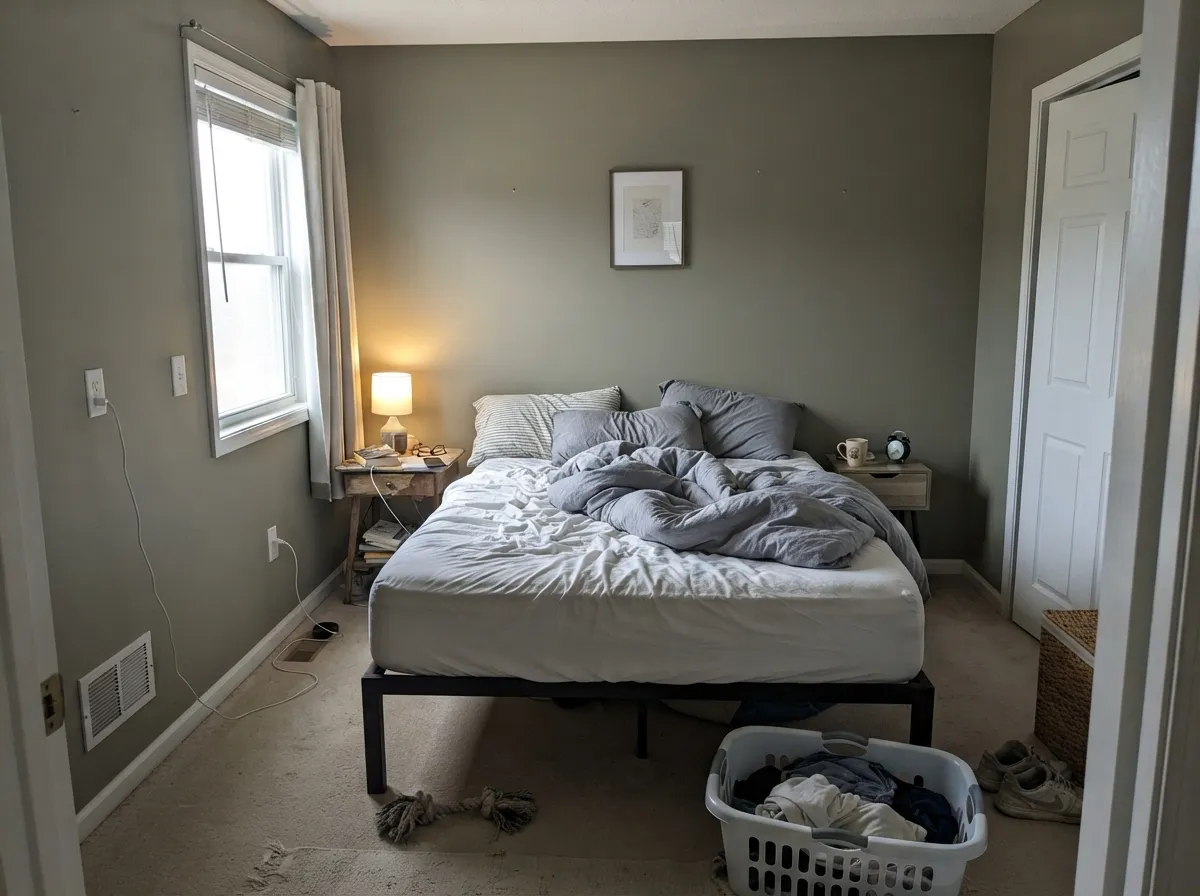
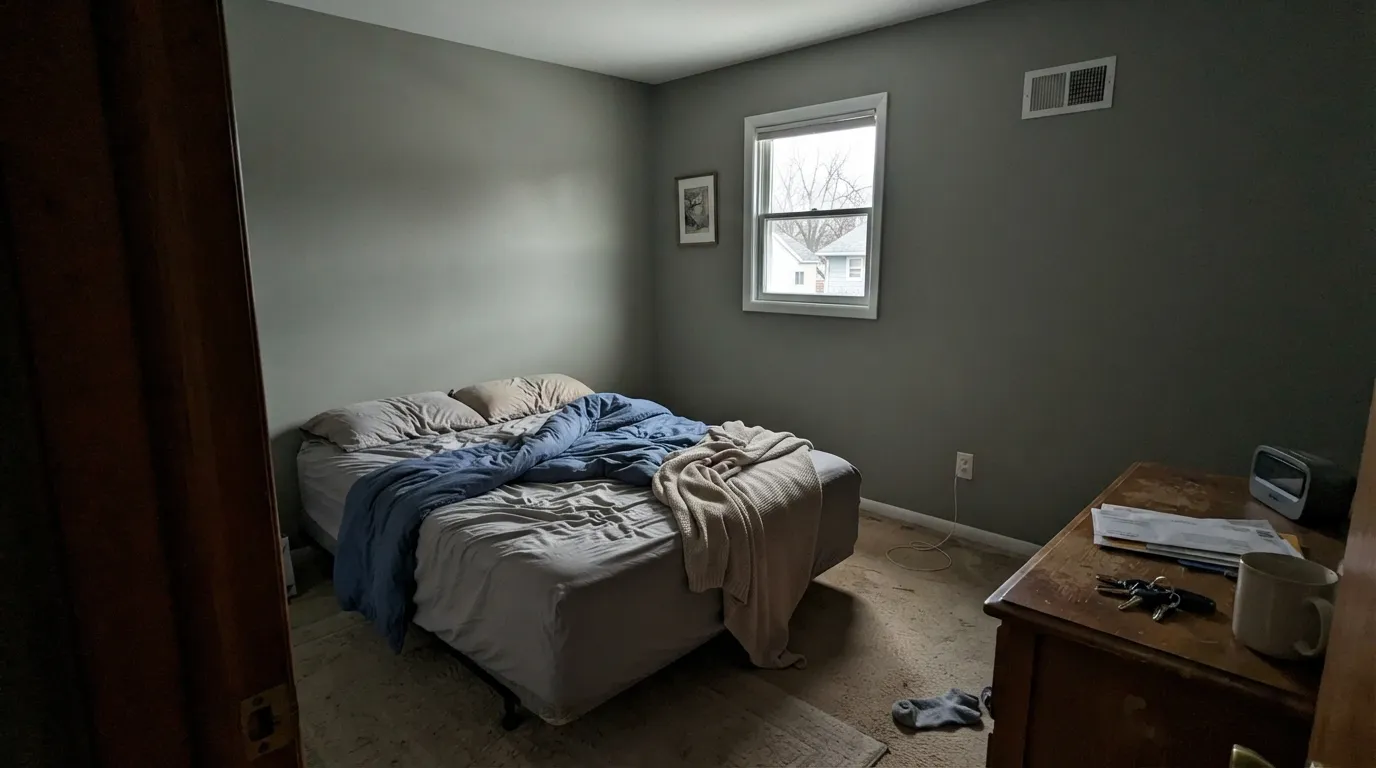
This is the one-star room. Cool, flat daylight kills the taupe and leaves a drab olive-gray — or, in one owner's bedroom, a baby-blue gray she hated enough to paint over the same afternoon. At LRV 43 that cool read is dingy, not stone-pretty, and the corners go cave. The paint did not fail; the light did. Step up to Dolphin Fin (LRV 59) or Mindful Gray (LRV 48), or commit to 2700K lamps before you commit to the gallon.
On the chip it can pass for a polite warm gray. On four walls the depth is unmistakable — LRV 43 is a mid, not the airy gray people sample next to Agreeable Gray (LRV 60). If your goal is a light whole-house gray, this is too much stone. Look at Dolphin Fin on the same Behr strip, or Repose Gray (LRV 58) if you want the famous lighter greige. Granite Boulder lives in the granite.
Swiss Coffee, Alabaster, and other creamy whites sit on the warm side of this color and push the wall green-gray — the walls look dirty next to the cream. Orange honey oak does the other half of the fight: yellow-orange sits near the complement of an olive-gray, so the floor goes more orange and the walls go more green. Use a cleaner white (Pure White or Polar Bear) and keep golden oak behind a rug, or pick a sandier greige that meets the floor halfway.
Room by Room
Satin siding in full sun is why this chip leaves the store. The green mutes, the body reads granite, and Polar Bear or Pure White trim keeps the edge crisp. Pair a dark door — Hale Navy if the porch has light, Iron Ore if you want near-black. Walk a large sample around every elevation: the shaded north side will read a step greener than the sunny south side. That shift is the color, not a bad batch.
South or west light holds the stone and the taupe in the same frame. Eggshell on the walls; Pure White or Polar Bear on the trim in semi-gloss. One small north window and no lamps? This is not the living-room color — go lighter, to Dolphin Fin or Mindful Gray.
At LRV 43 it wraps the room instead of bouncing around, and under 2700K bulbs the taupe comes forward so it feels restful rather than olive. Matte or eggshell; keep a lamp on each side of the bed so corners do not drain cool. A closed north bedroom is the exact room one owner called baby blue and painted over before dinner.
An entry that sees the front door's sidelight, or a hall that borrows living-room light, carries the mid-tone well and hides fingerprints. Windowless interior halls still want a lamp or they go tunnel-olive. Do not run this as a whole-house connector through a dark ranch.
Warm quartz, butcher block, oak, brass: it behaves in a daylit kitchen. Cool gray marble and 4000K under-cabinet strips will pull the green. Satin on an island or lowers under Polar Bear walls is the smaller, safer dose. A full kitchen of these walls in a closed galley is too much mid-gray.
A home office with a real south window can work. A basement, a windowless den, or a powder room with cool vanity bulbs is where the olive-drab reviews would come from. Use it in the rooms with sun and step lighter in the dark ones.
Your Light Is the Risk
Steady sun holds the gray and mutes the green. On siding it reads granite; on interior walls it reads warm stone, not beige, not office gray. This is the light the color was mixed for.
Cool, flat daylight strips the taupe and leaves drab olive-gray — or a baby-blue gray some owners cannot unsee. Fine if you half-wanted a cool gray; disappointing if you wanted stone.
Cooler and grayer in morning light; warmer, slightly taupe through west afternoon and golden hour. Sample it at 8am and at 6pm on the same wall before you buy.
2700K lamps pull the taupe-beige and it goes cozy stone. 4000K LEDs sharpen the green-gray and can look dingy — swap bulbs before you repaint.
Most complaints about Granite Boulder are a light mismatch. Upload a photo of your actual room and see it on your walls — then ask for the same wall in north light or evening lamps before you buy a single sample.
Need It From Another Brand?
Any paint counter can custom-tint Behr 790D-4 directly. If you would rather stay in one brand's own deck, these are the closest stock matches, measured as ΔE2000. Under 2 is a difference you will not see on the wall.
| Brand | Closest color | ΔE | LRV | |
|---|---|---|---|---|
| Sherwin-Williams | PussywillowSW 7643 · Sherwin-Williams | 2.0 | 42 | Color page → |
| Benjamin Moore | Smoke & MirrorsCSP-105 · Benjamin Moore | 0.8 | 42 | Color page → |
| PPG / Glidden | Boulder CreekPPG0999-3 · PPG / Glidden | 1.6 | 42 | Color page → |
| Glidden | Boulder CreekPPG0999-3 · Glidden | 0.8 | 42 | Color page → |
| Dutch Boy | Shale Ridge421-3DB · Dutch Boy | 2.0 | 41 | Color page → |
| HGTV Home by Sherwin-Williams | PussywillowHGSW 1494 · HGTV Home by Sherwin-Williams | 2.0 | 42 | Color page → |
Similar Behr Colors
The nearest shades to Granite Boulder within Behr's own range, ranked by perceptual color distance — useful when you want the same look a touch lighter, darker, or warmer.
WCAG 2.1: AA is 4.5 : 1 for normal text, 3 : 1 for large text, AAA is 7 : 1.
Granite Boulder vs the Colors You're Also Considering
Every Granite Boulder sample board has the same rivals on it. The numbers show the real lightness gap — then it comes down to which risk you would rather live with.
Pick this when you are already at Home Depot and want the slightly lighter, greener stone version of the same mid-depth.
Sherwin-Williams SW 7017 · LRV 39Dorian GrayPick this if you want the Sherwin-Williams cousin with more greige weight — a touch deeper, if the room has light.
Pick this when Dolphin Fin washed out and you wanted the next step down, with a real granite body.
Behr 790C-3 · LRV 59Dolphin FinPick this if you want the lighter chameleon on the same 790 strip — it will not commit to warm or cool, and it will not go mid-dark.
Behr Greyhound PPU24-21, LRV 20, is the closest sibling. It is one point darker and its lean tips slightly toward taupe rather than khaki, so on a wall it reads a touch browner and softer. Pick Greyhound if your fixed finishes run warm beige; pick Granite Boulder if you want a cleaner, stonier gray that holds up next to black accents.
Behr Eagle Ridge ECC-46-2, LRV 19, goes further in the warm direction. It is visibly more brown-gray, closer to weathered wood than to granite. It favors rustic and craftsman exteriors with earth-tone stone; Granite Boulder favors modern farmhouse and contemporary schemes.
Behr Smoky Trout MQ2-53 matches Granite Boulder's LRV of 21 almost exactly, so the difference is purely in cast: Smoky Trout carries a little more warmth and reads slightly softer in shade. If two elevations of your house sit in permanent shadow, Smoky Trout can look less severe there, while Granite Boulder keeps a truer gray in full sun.
Granite Boulder Coordinating Colors
The rule for coordinating with Granite Boulder: a clean white, one dark, and a muted sage only if you want the green to look chosen. Stay off creamy whites, orange oak, and cool blue-gray stone. These are the partners that keep showing up in rooms that work:
The 790 Strip: Why Granite Boulder Keeps Getting Sampled After Dolphin Fin
Most people do not start at Granite Boulder. They start two chips lighter. Silver Drop (790C-2, LRV 70) is the greige that reads different in every room. Dolphin Fin (790C-3, LRV 59) is the bestselling chameleon on the same strip — it will not commit to warm or cool, which is exactly why it sells. Granite Boulder is the next step down: 790D-4, LRV 43, the first chip in that family with a real granite body.
That is the honest Home Depot path, not a trend story. There is no Color of the Year attached to this paint. Behr's own neutrals writing groups it with other green-leaning grays rather than with orange greiges, which matches what the wall does. If Dolphin Fin looked washed on your siding, this is the chip. If Dolphin Fin looked right on your living-room walls, stay there — Granite Boulder is a different depth, not a tint of the same color.
Granite Boulder With Wood Tones and Floors
Walnut and espresso are the easy yes — the dark red-brown makes the green-olive read as stone instead of khaki. Pale white oak and gray-washed wood are safe and give a cooler, more modern cast. Medium oak with the orange knocked back is fine in a south room.
The honest no is golden honey oak, orange-stained trim, and yellow-beige carpet. Olive-gray and yellow-orange sit close to complements, so each side exaggerates the other: the floor goes more orange, the walls go more green, and no amount of coats fixes geometry. Cool gray LVP is the other no — it strips the taupe and leaves drab. If the golden floor is staying, put a large rug between it and this paint, or pick Mindful Gray or Accessible Beige and keep the warmth without the fight.
Metals are the easy part: unlacquered brass, antique bronze, and matte black all work; polished chrome is the one that leans cold against the green.
Three Ready Palettes Built on Granite Boulder
A color is never alone on the wall. These are complete combinations in the 60-30-10 pattern, with the reason each one holds together. Every one opens in the visualizer.
Polar Bear is Behr's dependable everyday white, not a creamy stand-in, so the siding stays stone instead of going dirty. Cracked Pepper is the chameleon black behind Behr's 2024 Color of the Year — one dark note so the scheme reads finished from the street. Walk the samples around the north elevation; that side will go greener.
Try this palette in your roomPure White is the default white that only fails when you pair it wrong — here the pairing is right: a clean trim white keeps Granite Boulder reading gray, not olive. Kendall Charcoal is the best-behaved dark gray in the BM deck and supplies one grounded note without going black. Keep the bulbs at 2700K so Kendall Charcoal's dim-room trap does not show up after dark.
Try this palette in your roomThe green in Granite Boulder is a whisper; Evergreen Fog is the best cabinet sage in the SW deck and makes that whisper look intentional instead of accidental. Polar Bear cabinets keep the mid-gray from feeling heavy. This is a daylit-kitchen scheme — cool under-cabinet LEDs will pull both colors toward olive, so warm the bulbs.
Try this palette in your roomGranite Boulder FAQ
Is Granite Boulder gray or greige?
Gray first — a mid stone gray with a green-olive edge, not a beige greige. In south sun it reads warm granite; in cool north light it reads olive or even a baby-blue gray. Evening lamps pull a subtle taupe-beige. If you actually want greige, pick Mindful Gray (LRV 48) or Dolphin Fin (LRV 59) on the same Behr strip. If you actually want gray that stays gray, this is closer than Agreeable Gray, with more green in the mix.
What trim white goes with Granite Boulder?
A cleaner white, not a creamy one. Polar Bear is the Behr everyday white and keeps the walls looking stone. Pure White is the Sherwin-Williams equivalent and is the pairing that saves a mid-gray from looking dirty. Creamy whites — Alabaster, Behr Swiss Coffee — sit on the warm side and push Granite Boulder green-gray. Ultra Pure White (LRV 97) is so bright the walls can look unwashed. Semi-gloss on the trim, eggshell on the walls, satin on siding.
Is it too dark for interior walls?
For a daylit living room or a south bedroom, no — LRV 43 is a mid, the same neighborhood as Pashmina (LRV 44) and a few points lighter than Dorian Gray (LRV 39). For a whole house that includes windowless halls, a north bedroom, and a basement, run it in the rooms with sun and step up to Dolphin Fin (LRV 59) in the dark connectors. It is not a light gray. The chip lies a little; four walls do not.
Does Granite Boulder work with oak floors?
Depends on the oak. Walnut, espresso, and pale unstained white oak are easy. Orange honey oak is the miss: the olive in this gray and the yellow-orange in the floor exaggerate each other, and both sides look worse. A large rug helps. Cool gray LVP is the other miss — it strips the taupe and the walls go drab. Put a big board over the actual floor in afternoon light before you roll.
Is it the same as Granite Dust or Dorian Gray?
No. Granite Dust (MQ3-06, LRV 63) is a lighter warm greige with a similar name and a different job — a whole-house light color, not siding stone. Dorian Gray (SW 7017, LRV 39) is the closest Sherwin-Williams cousin: a greige with real weight, a few points deeper, less green. If your painter works in Sherwin-Williams, Dorian Gray is the chip. If you are already at Home Depot, this is the chip.
Should I use it on the exterior?
Yes — that is the job it is best at. Full sun mutes the green and the body reads granite from the street. Pair Polar Bear or Pure White trim with a dark door (Hale Navy, Iron Ore, or Cracked Pepper). Always walk the sample around the house: the north elevation will read greener than the south, and that is expected. Satin exterior enamel; test against existing brick, because pink or orange masonry can make the green look muddy.
Have you painted with Granite Boulder?
Rate it — one tap helps the next reader decide.
Ask a Question