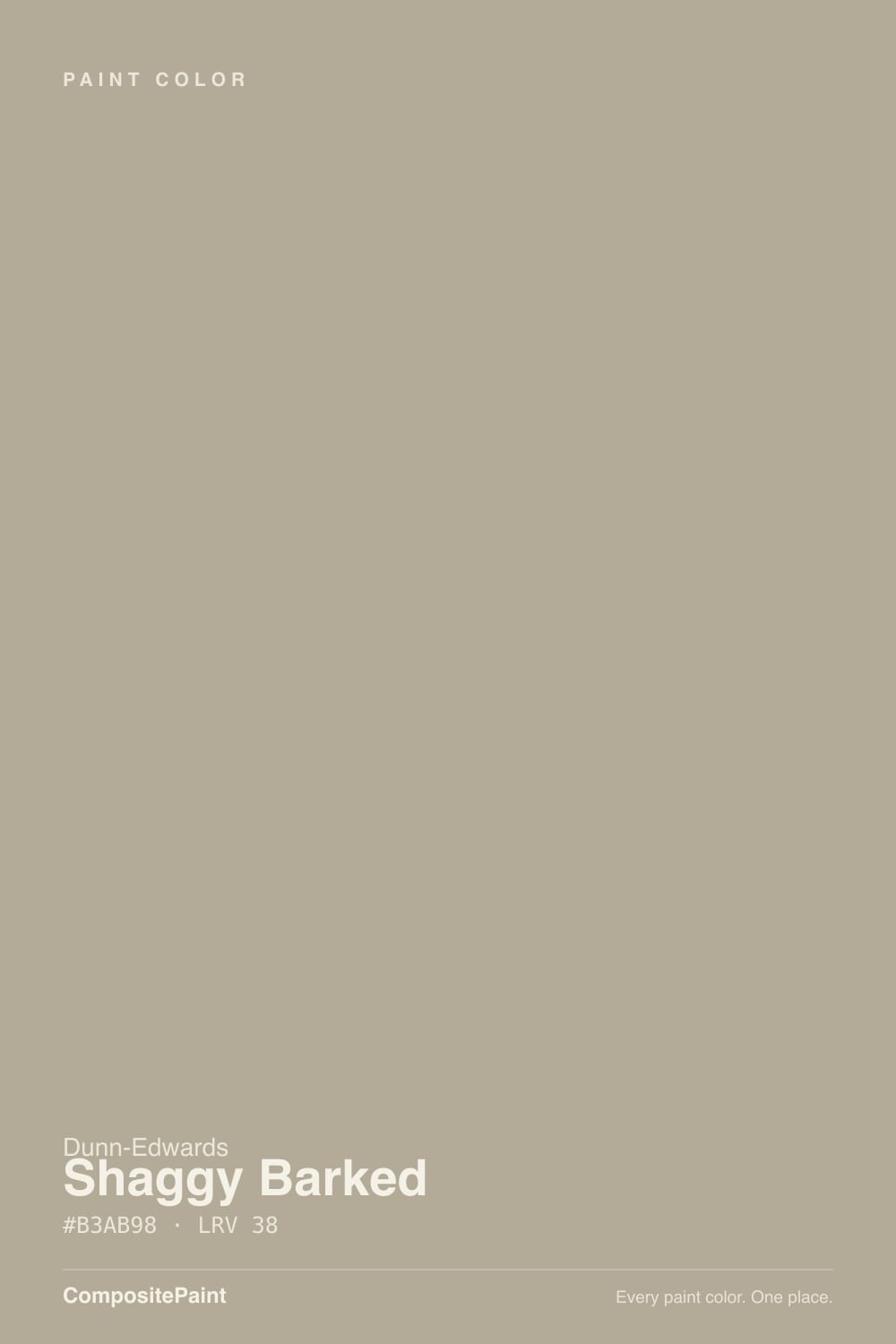
Shaggy Barked
A muted yellow-taupe from Dunn-Edwards' Classics, reviewed honestly: the Southwest exteriors it was built for, the interior rooms where it goes muddy, and what to pick instead.

Jessica has spec'd whites and neutrals for more than 300 rooms and keeps a sample wall of painted drawdowns in her studio. Every color review is checked against real reader rooms in the comments and re-tested when a formula changes. About the testing process →
- 1Anonymous20
- 2Felted Wool28
- 3Shaggy Barked38
- 4Agreeable Gray60
- 5Balboa Mist66
The Fast Verdict
Shaggy Barked is taupe, not greige and not gray. At LRV 38 it is a mid-depth, grayed yellow-brown that reads earthy and relaxed in real daylight — wood, linen, warm white trim — and heavier, muddier, almost khaki when the room goes dim. Dunn-Edwards parks it in the Classics collection and HOA decks across the Southwest keep using it as a stucco body color next to cream trim. If you wanted a light greige, this is the wrong chip. If you wanted bark, dust, and a house that sits in the landscape, it is a workhorse.
Southwest stucco exteriors · living and dining rooms with real daylight and wood · dens that should feel grounded · anyone who actually wants taupe, not greige
You wanted a light greige · the room faces north and stays dim · floors or stone are cool gray · you expected this to read gray on the wall
- True taupe — earthy yellow-brown, not a greige in disguise
- Holds on exteriors: LRV 38 does not bleach to beige in desert sun
- Already in HOA / Color-Ark decks, so the body-and-cream-trim combo is proven
- Flatters oak, walnut, linen, brass, and warm stone
- Quiet enough to recede; interesting enough not to look builder-beige
- Too deep and too brown for anyone who meant a light greige
- Dim north light turns it muddy khaki
- Fights cool gray floors, chrome, and blue-gray stone
- On four interior walls it reads heavier than the chip — always
What Color Is Shaggy Barked, Really?
A muted taupe built on a grayed yellow-brown, not a drop of pink and not a true gray. Most mid-taupes either go caramel in sun or go dirty in shade; Shaggy Barked is chroma-starved enough that the yellow stays quiet — earthy rather than gold, dusty rather than beige. Dunn-Edwards files it in the Classics collection, sitting next to Navajo White in the deck, which is the right company: this is a Western-utility neutral, not a trend color with a press cycle.
At LRV 38 it is a genuine mid-tone. That is the number that surprises people who sampled it as a 'neutral wall color' and then painted four interior walls. On a chip it looks like a soft greige. On a house body or a closed living room it holds as bark-taupe — a full step deeper and browner than the fan deck implied. The same depth is why it works outside: stucco at this LRV does not bleach to beige by August, and it does not read as a dark brown from the street.
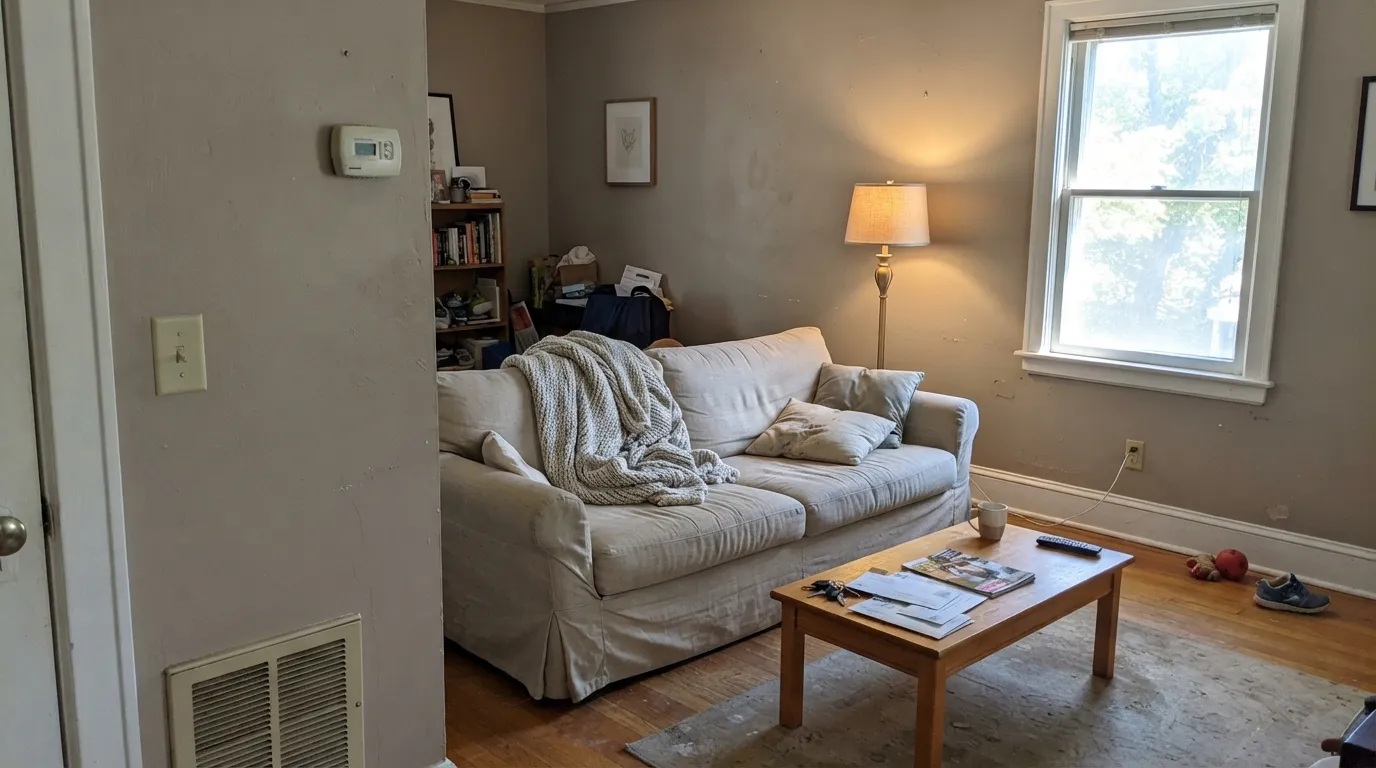
Undertone in one line: grayed yellow-taupe — earthy, never pink, never cool gray. In cool shade it can flash a dusty olive-khaki, which is the yellow going muddy, not a hidden green. If your sample looks caramel, that is west sun or honey oak bouncing; if it looks gray, your light is cold and the chroma has dropped out.
Where It Shines
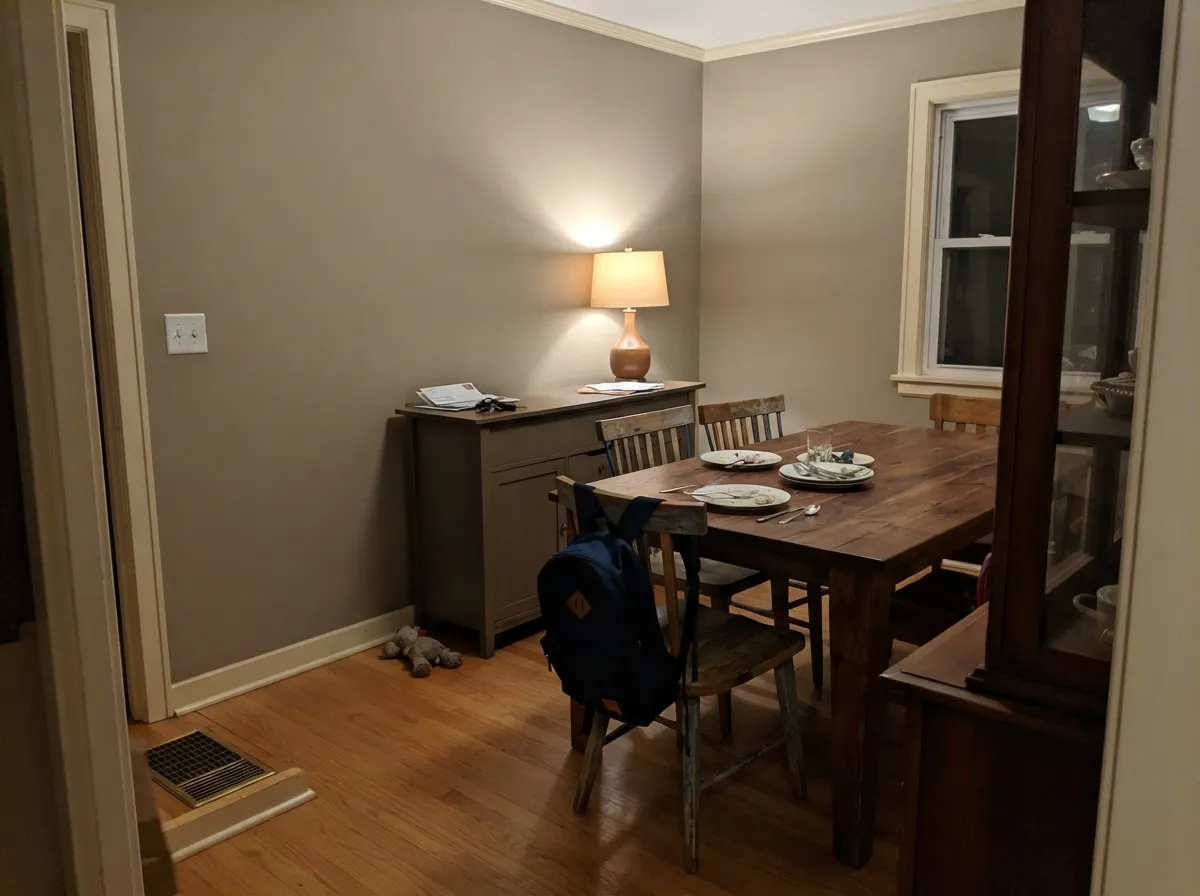
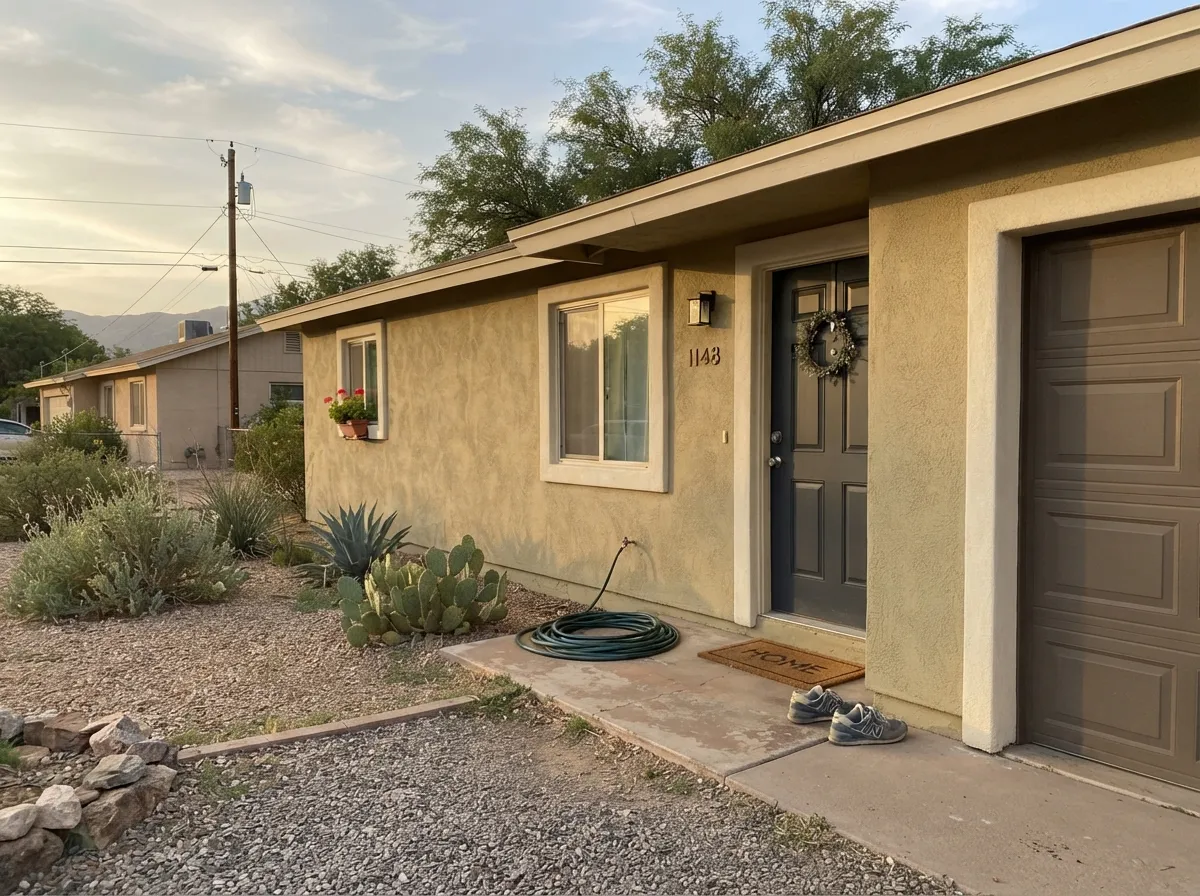
Give it sun, stucco, and warm wood and it looks like it belongs to the lot, not the paint store. Exterior body color is its real job — Color-Ark schemes pair it with cream trim and a dark garage, and that is the combination that keeps showing up on ranch and stucco houses from Arizona HOAs to older California streets. Indoors it earns a second life in living rooms and dining rooms that already have oak or walnut, linen, and lamps: the wall recedes into a warm dust-tone instead of announcing a color. Eggshell keeps it from looking like cardboard.
Where It Fails
Almost every regret with Shaggy Barked is a depth or temperature mistake, and both are visible on the sample wall if you look at the right hour. None of them are the paint's fault — but if your room matches one, this is not your taupe, and a bigger sample will only confirm it.
On the chip it passes for a soft, expensive taupe. On four interior walls at LRV 38 it is mid-depth and clearly brown-leaning. People who meant Agreeable Gray or Accessible Beige end up in a room that feels closed-in and earthy. If you wanted light and airy, this is too much color; step up twenty LRV points and stay there.
Cool gray daylight kills the yellow and leaves a muddy khaki that readers will call dirty. The color did not go green; the light stripped the warmth and the low chroma had nothing left. Warm 2700K bulbs rescue it. A north hall with a builder can light does not.
Gray LVP, blue-gray tile, and Carrara-type counters sit at the opposite temperature and push Shaggy Barked toward yellow-khaki. Both sides look worse. It wants oak, walnut, terracotta, cream stone, and brass — not a gray-and-chrome kitchen.
Room by Room
Stucco, ranch siding, and desert-light body color. Satin or low-luster so it does not glare; Dunn-Edwards Swiss Coffee on trim and a dark door or garage keeps it from reading as a brown box. Walk the shaded north wall before you commit — that elevation will read a step muddier than the sunny south.
In a south- or west-facing living room with wood floors it is calm and slightly rustic, the wall as backdrop for linen and walnut. Eggshell; cream trim, not a stark bright white. Open to a cool-gray kitchen, it will argue.
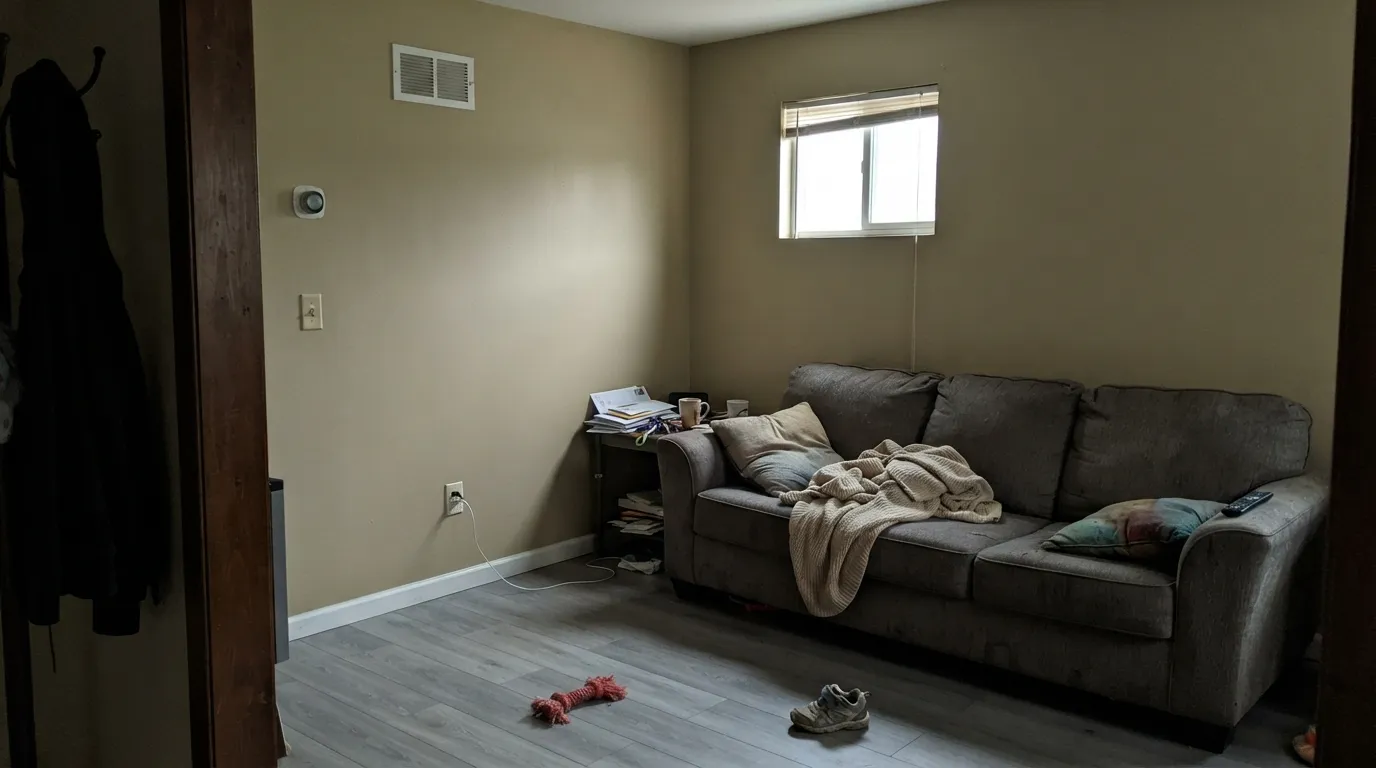
Rooms you use at night are kinder to LRV 38. Under 2700K lamps the yellow-brown comes forward and the walls feel like dust and wool, not mud. A closed den with one window can still work if the lamps are on; leave them off and it goes khaki.
Four walls of mid-taupe will sleep dark. Fine for a west-facing room with cream bedding and warm lamps; heavy for a small north bedroom. If you want the same family without the cave, Pashmina is the lighter move.
As a wall color next to cream cabinets and warm stone it can work. As the cabinet color it reads dated builder-brown, especially under cool LEDs and next to gray quartz. If the kitchen is gray-on-gray, pick a different room for this paint.
A daylit office with wood furniture is a yes. An interior hallway with no window is a no — this is the muddy-khaki trap at house scale. If the hall has to match, run the same color only where daylight reaches, or drop to a lighter greige for the corridor.
Your Light Is the Risk
The taupe stays earthy and even — yellow grayed out, not caramel. This is the light it was mixed for, indoors and on a sunny elevation.
Cool gray daylight strips the yellow and leaves khaki-mud. Shaded north stucco does the same thing from the street. Sample the dark side of the house, not just the chip in the driveway.
Quieter and slightly grayer in morning light; warmer and dustier by late afternoon. The shift is a temperature change, not a new color — still taupe, just more or less brown.
2700K lamps restore the yellow-brown and the walls go cozy. Cool white LEDs gray it toward dirty khaki — swap bulbs before you repaint.
Most complaints about Shaggy Barked are a light mismatch. Upload a photo of your actual room and see it on your walls — then ask for the same wall in north light or evening lamps before you buy a single sample.
Need It From Another Brand?
Any paint counter can custom-tint Dunn-Edwards DEC771 directly. If you would rather stay in one brand's own deck, these are the closest stock matches, measured as ΔE2000. Under 2 is a difference you will not see on the wall.
| Brand | Closest color | ΔE | LRV | |
|---|---|---|---|---|
| Sherwin-Williams | Svelte SageSW 6164 · Sherwin-Williams | 1.8 | 41 | Color page → |
| Behr | Mountain ShadeECC-47-1 · Behr | 1.1 | 41 | Color page → |
| Benjamin Moore | Kid GlovesCSP-175 · Benjamin Moore | 0.5 | 41 | Color page → |
| Valspar | Soothing Sage8004-23C · Valspar | 1.6 | 41 | Color page → |
| PPG / Glidden | Desert DunePPG1023-4 · PPG / Glidden | 3.1 | 41 | Color page → |
| Glidden | Desert DunePPG1023-4 · Glidden | 2.3 | 41 | Color page → |
Similar Dunn-Edwards Colors
The nearest shades to Shaggy Barked within Dunn-Edwards's own range, ranked by perceptual color distance — useful when you want the same look a touch lighter, darker, or warmer.
WCAG 2.1: AA is 4.5 : 1 for normal text, 3 : 1 for large text, AAA is 7 : 1.
Shaggy Barked vs the Colors You're Also Considering
Every Shaggy Barked sample board has the same rivals on it. The numbers show the real lightness gap — then it comes down to which risk you would rather live with.
Pick this when you want warmer, dustier taupe instead of greige, and your painter is already in Dunn-Edwards.
Sherwin-Williams SW 7031 · LRV 37Mega GreigePick this if you want the same mid-depth on an exterior but greiger and more nationally default — Mega Greige was built for the outside of the house.
Pick this when you want the browner, more earthy read and you are painting stucco, not a greige living room.
Sherwin-Williams SW 6073 · LRV 42Perfect GreigePick this for a slightly lighter, more classic greige — deeper and warmer than the copies, with a bit more air than Shaggy Barked.
Shaggy Barked Coordinating Colors
Stay warm and slightly dusty: cream trim, muted sage, navy, and near-blacks. Cool gray, chrome, and icy white are the combinations that make this taupe look dirty. These are the partners that actually sit next to it without a fight:
Shaggy Barked on Exteriors
This is where the color stops being obscure and starts being practical. Dunn-Edwards Color-Ark schemes use DEC771 as a main-body color — one documented lot pairs it with Swiss Coffee on fascia and trim and a near-black on garage doors — and the same chip shows up on approved palettes for Southwest HOAs. Ranch houses and stucco boxes are the natural customers: a mid-taupe body hides dust, sits against dry landscaping, and does not go pastel in high sun the way an LRV-60 greige does.
The pairing is not optional. Cream trim (Dunn-Edwards Swiss Coffee) keeps it from reading as a brown house; charcoal or navy on the door gives the elevation a dark punctuation mark. What to walk around before you buy: the north and shaded sides will look a step more khaki than the south elevation in the listing photo. That is the same north-light trap as indoors, just at house scale. Sample both sides of the building on the same afternoon.
Shaggy Barked With Wood Tones and Floors
Warm wood is the easy yes. Oak — white, red, even some honey — walnut, and butcher block all share the yellow-brown neighborhood, so the wall meets the floor halfway instead of picking a fight. Terracotta tile, cream stone, and unlacquered brass belong in the same sentence. That is why the color looks finished in a wood-floored living room and awkward in a gray-LVP open plan.
The floor that needs a sample first is cool gray: gray-washed oak, gray LVP, blue-gray tile. Those surfaces pull the yellow forward and the wall can go khaki-yellow against them. A large rug in cream or rust can buffer it; a whole-house gray floor usually cannot. Metals: brass, oil-rubbed bronze, and matte black. Polished chrome is the one that makes the taupe look dated.
Three Ready Palettes Built on Shaggy Barked
A color is never alone on the wall. These are complete combinations in the 60-30-10 pattern, with the reason each one holds together. Every one opens in the visualizer.
This is the HOA-proven split: mid-taupe body, the Southwest's default cream on trim, one dark note so the house does not read as a brown block. Dunn-Edwards Swiss Coffee is the warm cream this taupe was mixed to sit next to.
Try this palette in your roomWhite Dove keeps the edges soft instead of chalky; a brighter trim white would make the taupe look dirty. Evergreen Fog on a cabinet run is the muted sage that sits in the same dusty family without turning the room into a cabin.
Try this palette in your roomCream in the hall, taupe in the dining room, navy on one solid piece: the handoff stays warm and the navy keeps the scheme from looking like all-beige. Hale Navy needs light — a glass-front hutch or a lamp next to the door, not a windowless closet.
Try this palette in your roomShaggy Barked FAQ
Is Shaggy Barked gray or brown?
Taupe — grayed yellow-brown. It will not pass as gray on four walls. In cold light it can look khaki; in sun it looks like dusty bark. If gray is what you actually wanted, look at Dorian Gray or Mega Greige instead.
Is it better inside or outside?
Outside is the safer bet, and the documented one: HOA and Color-Ark schemes use it as a stucco body color with cream trim. Inside it works in daylit living and dining rooms with wood. It is a weak whole-house interior because LRV 38 closes smaller, darker rooms down.
What trim white goes with Shaggy Barked?
A warm cream, not a bright white. Dunn-Edwards Swiss Coffee is the pairing already on the Color-Ark cards; White Dove is the Benjamin Moore equivalent if your painter is in that deck. A stark gallery white makes the walls look dirty by comparison.
Does it work with oak floors?
Yes — that is its interior company. Walnut, white oak, and even some honey oak sit comfortably because the wall is already in the yellow-brown family and does not amplify orange the way a violet-gray would. Cool gray LVP is the floor that fights it.
Is LRV 38 too dark for walls?
For a bright, open, south-facing room, no. For a typical interior hallway, small north bedroom, or a kitchen with one window, yes — it will read as a mid-brown cave. Sample a large board on the darkest wall and look at it at 7am and 7pm before you buy gallons.
What sheen should I use?
Eggshell on interior walls so the taupe does not go flat-cardboard or shiny-builder. Satin or low-luster on exterior stucco. Semi-gloss on trim in whatever cream you chose. Skip high-gloss on the body; it turns a dusty taupe into plastic.
Have you painted with Shaggy Barked?
Rate it — one tap helps the next reader decide.
Ask a Question