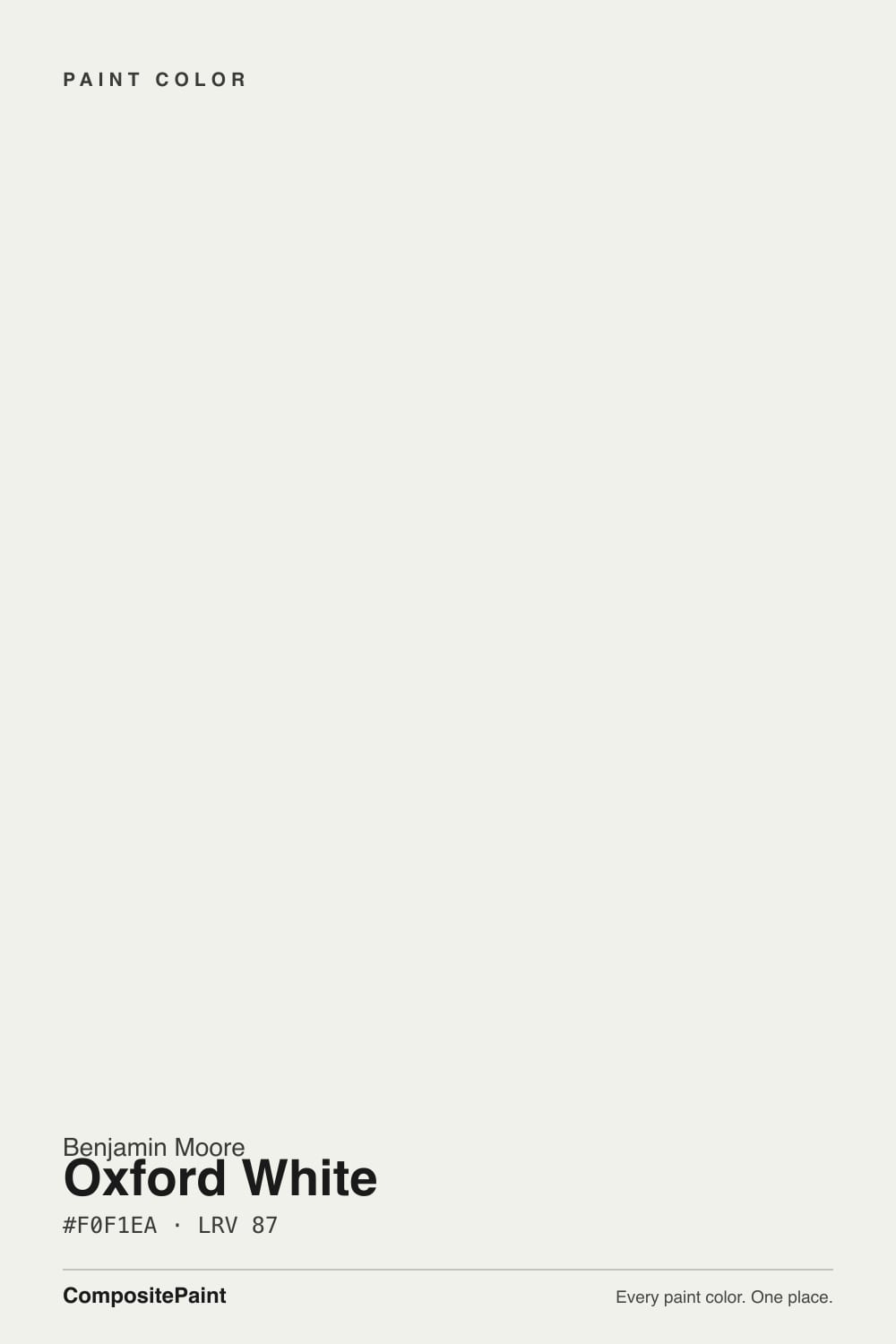
Oxford White
The bright, no-drama trim white Benjamin Moore never bothered to market, reviewed honestly: where it earns its keep, the light that flattens it, and what to pick instead.

Jessica has spec'd whites and neutrals for more than 300 rooms and keeps a sample wall of painted drawdowns in her studio. Every color review is checked against real reader rooms in the comments and re-tested when a formula changes. About the testing process →
- 1Classic Gray74
- 2Alabaster82
- 3Oxford White87
- 4Sleek White92
- 5Ultra Pure White97
The Fast Verdict
Oxford White is a plain-number BM color (869, not an OC-prefix), which tells you exactly what it is: not one of the brand's curated headline whites, just a genuinely good, high-reflectance near-white that painters keep reaching for anyway. At LRV 87 it is nearly as bright as Super White and Simply White, but its undertone is so tight and neutral that it barely tips warm or cool — it mostly reflects whatever color is already in the room. That makes it an excellent, disappear-into-the-background trim and whole-house white in good light, and a flat, slightly cold one in a dim room with no lamps.
Trim, doors and millwork under almost any wall color · whole-house neutral in rooms with real daylight · traditional and coastal exteriors with black or navy shutters · kitchens where you don't want the cabinet color competing with counters
Your room is north-facing and dim · you want the visible cream warmth of White Dove · you want the crisp, stark-white pop of Chantilly Lace · you're touching up years-old trim and don't have the exact can — BM's numbered-white lineup has several near-twins
- High LRV (87) — bright, reflective, genuinely functional as a trim and ceiling white
- Neutral enough to sit under almost any wall color without a fight
- Doesn't compete with countertops, backsplashes, or stone — a safe cabinet base
- Reads crisp and traditional on coastal and shingle-style exteriors
- Dependable, unfussy, cheaper to live with than a color that demands the right light
- Goes flat and slightly cold in a dim, north-facing room
- Lacks the visible cream warmth buyers expect from BM's famous whites
- Sits close enough to several other BM near-whites to confuse touch-up matching
- Not distinctive enough to be a "statement" wall color on its own
What Color Is Oxford White, Really?
Oxford White carries the number 869 in Benjamin Moore's standard deck, not an OC prefix — meaning it never made the cut into BM's own curated Off-White Collection alongside White Dove, Chantilly Lace, Simply White or Cloud White. That's not a knock on the paint; it's just why you've probably never heard of it even though contractors specify it constantly. It is a heritage color doing quiet, reliable work while the marketed whites get the blog posts.
At LRV 87 it sits almost exactly between Simply White (91) and Super White (87, essentially a tie) — genuinely bright, genuinely reflective, built for trim and ceilings more than for carrying a room on its own. What makes it different from those two is the undertone: the RGB channels sit within a few points of each other (240, 241, 234), the tightest spread of any BM white this site has reviewed. Practically, that means Oxford White has very little pigment personality of its own to defend itself with — it leans on whatever light and color are already in the room instead of asserting warmth or coolness the way White Dove or Chantilly Lace do.
Undertone in one line: barely-there, a whisper of green-gray, never a strong yellow and never an icy blue. If your sample looks warm, that's your wood floor or afternoon sun talking; if it looks cold, that's your north window or your LED bulbs — the paint itself is close to a blank slate.
Where It Shines
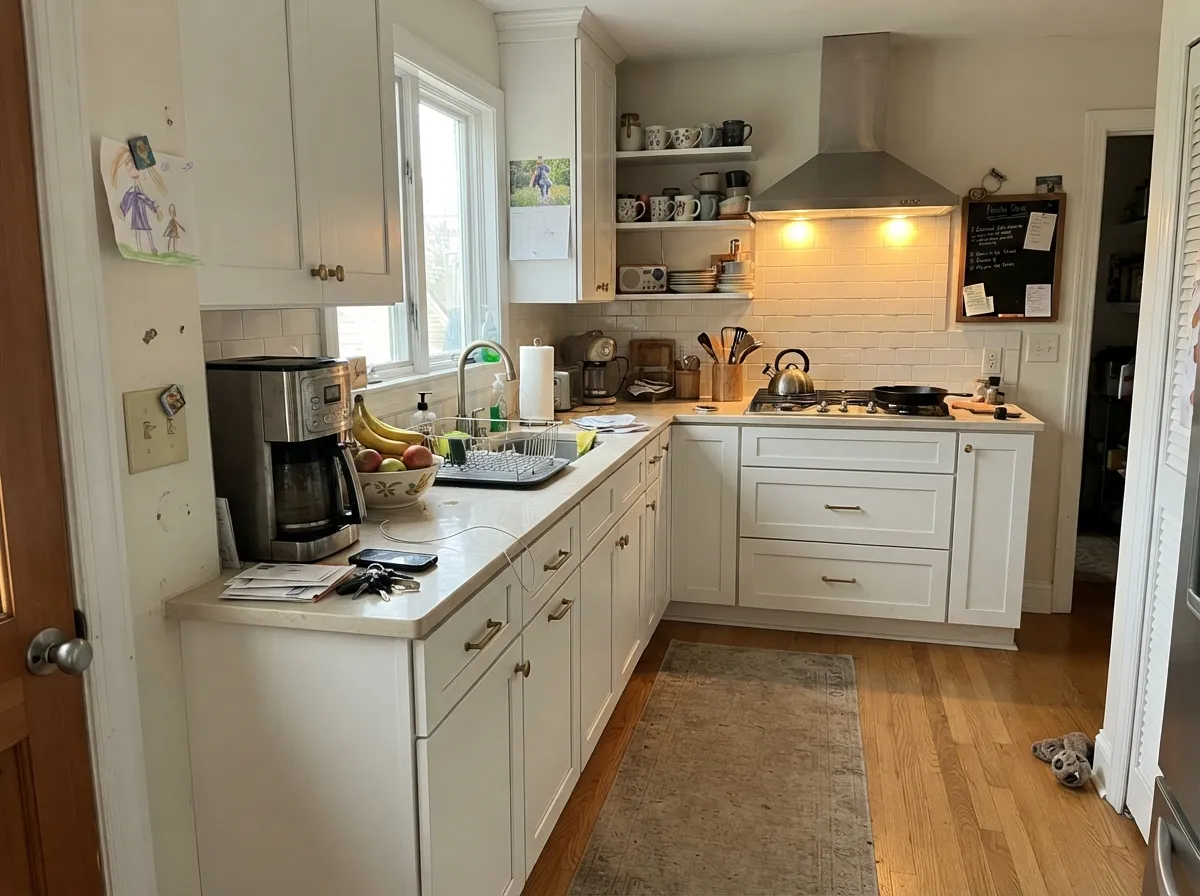
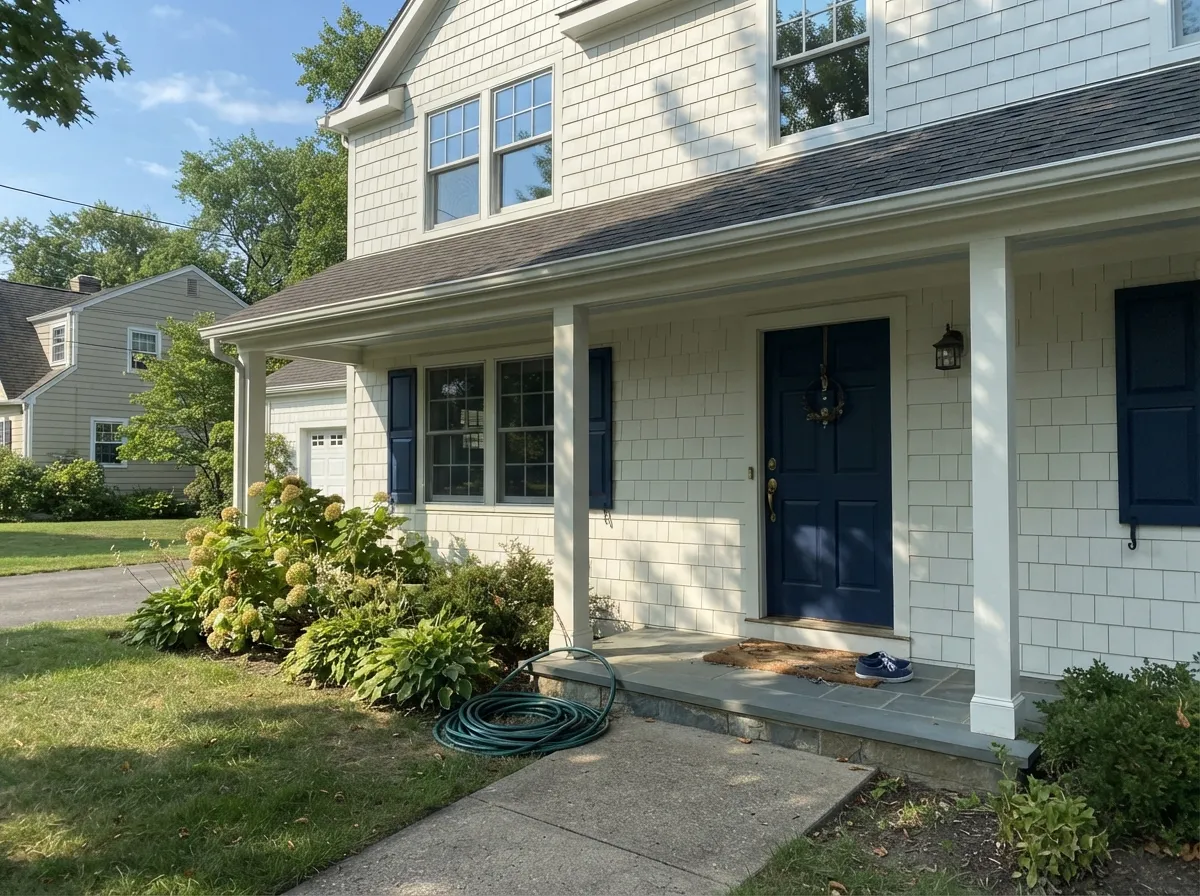
Put it on trim, doors, and millwork against almost any wall color and it does its job without ever becoming the story of the room — which is the whole point of a trim white. It is equally at home as a whole-house wall color in a bright, south-facing house, where its high LRV bounces light around without the visible cream of a warmer white. On kitchen cabinets it is a safe, quiet base that won't fight quartz, marble, or a bold backsplash for attention, and on New England shingle-style and Cape Cod exteriors, paired with black or navy shutters, it reads crisp and traditional in full sun.
Where It Fails
The complaints about Oxford White follow a pattern, and it's the same pattern you'd expect from a color built to have almost no opinion of its own: when the room has no light or warmth to borrow, it borrows nothing, and the wall goes flat. None of these are the paint's fault — but if your situation matches one, sample it big before you commit.
With so little undertone to fall back on, north light's cool cast reads straight through — the wall goes flat, slightly gray-blue, almost institutional. Readers describe it as "builder-white with no charm." Fix: add warm 2700K lamps, or move to a color with real warmth built in, like White Dove.
Some buyers pick Oxford White off the fan deck expecting the same soft creamy warmth as BM's famous whites, because it's in the same family and a similar LRV. It isn't — the RGB spread is nearly flat, so the color reads closer to a plain trim white than a cozy one. If warmth is the goal, this is the wrong can; go White Dove or Swiss Coffee instead.
Because it's a plain numbered color rather than one of BM's marketed off-whites, Oxford White sits close enough to several other BM near-whites that swatches can be hard to tell apart at a glance. Always match by the exact number — 869 — not by eye against an old wall or a competitor's chip.
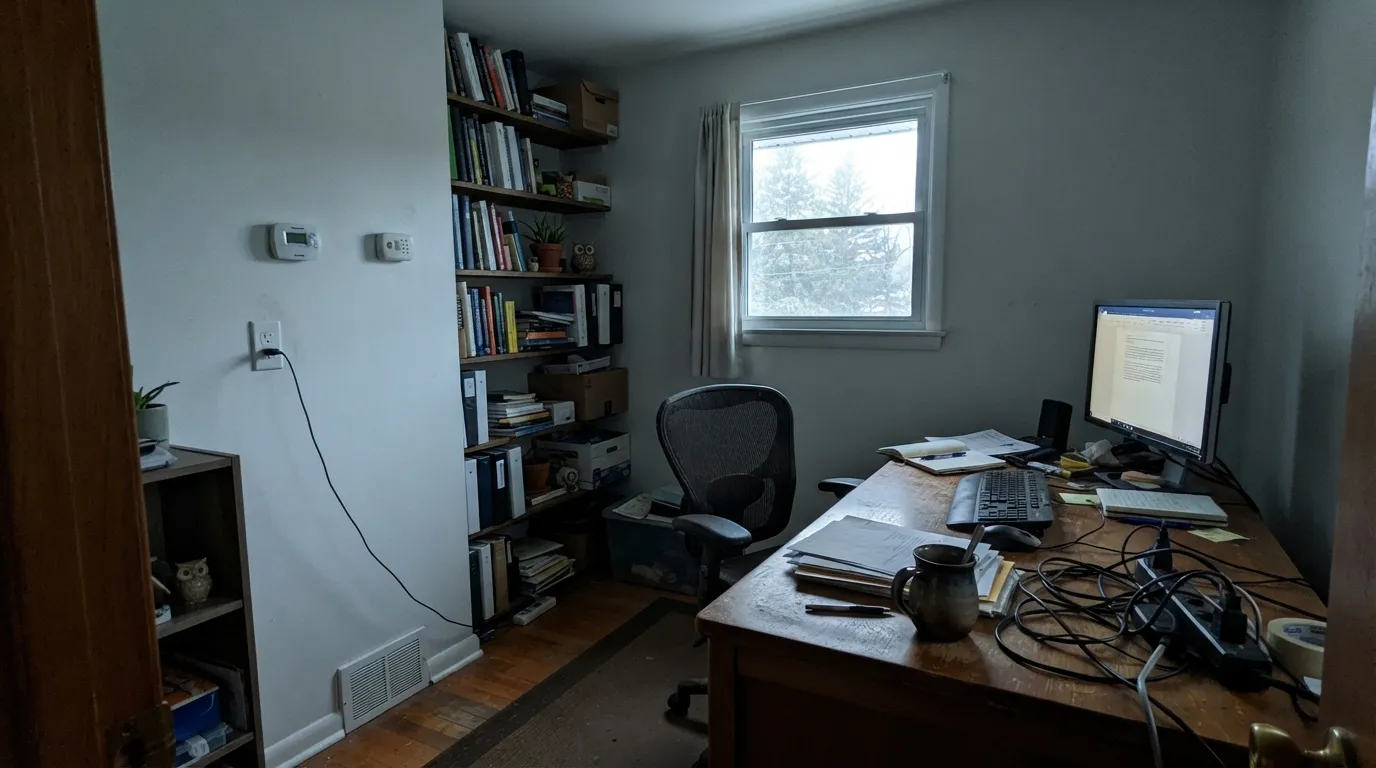
Room by Room
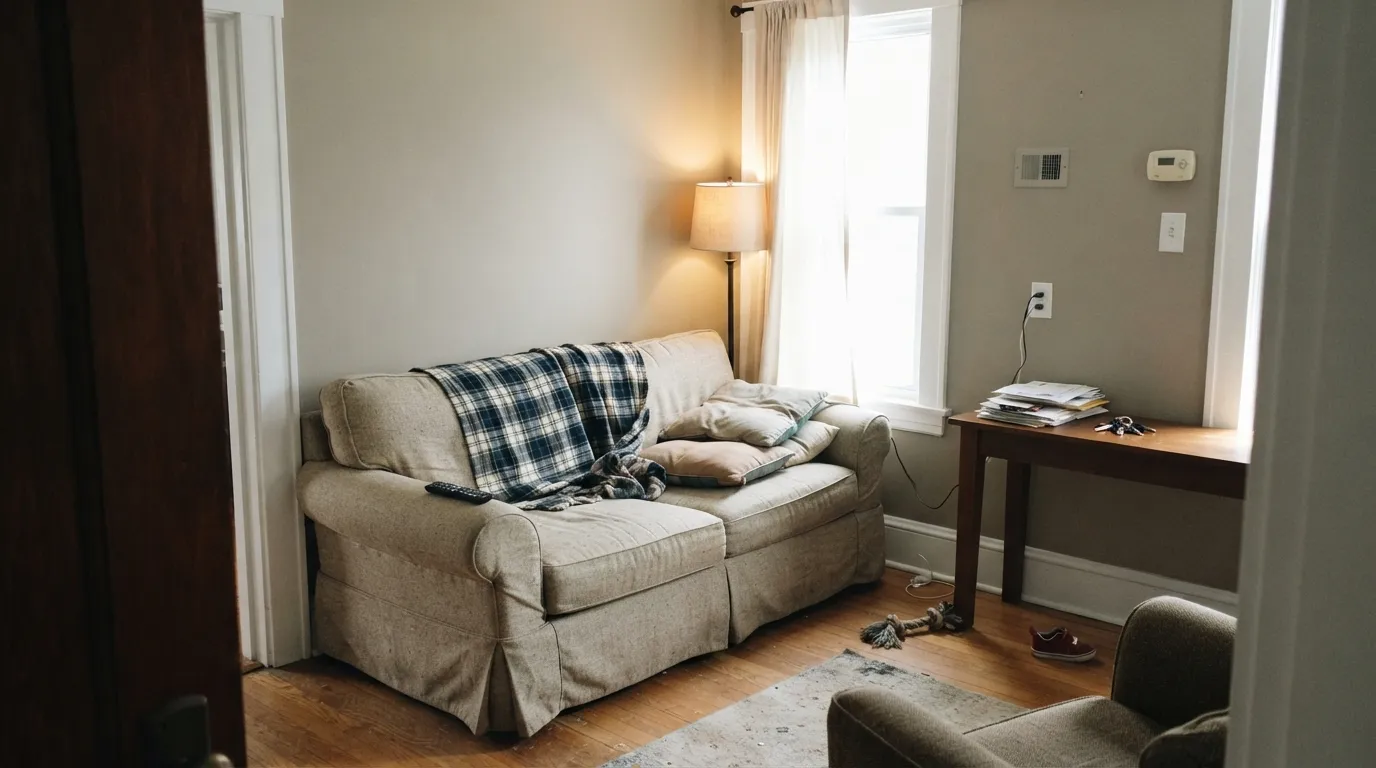
In a bright room it's a clean, quiet backdrop that lets furniture and art do the talking. Skip it if the room is dim and north-facing; White Dove will hold its warmth better there.
High LRV and a near-neutral undertone mean it won't clash with warm quartz, cool marble, or a colorful backsplash — it stays out of the way. Satin cabinet enamel wipes clean and hides fingerprints better than a starker white.
It doesn't glow the way a creamy white does under evening lamps, but 2700K bulbs give it enough warmth to feel calm rather than clinical. In a north-facing bedroom with cool LEDs, expect it to read flat.
Because it doesn't push hard toward warm or cool, it won't argue with either warm travertine or cool grey marble the way a more opinionated white can. A genuinely low-risk vanity and wall choice.
Semi-gloss Oxford White trim works under almost any wall color, from greige to navy to sage, without the visible warmth of White Dove trim or the stark pop of Chantilly Lace. The most "gets out of the way" trim white in the deck.
Full sun reads it bright and clean, and with black, navy, or dark green shutters it's a dependable shingle-style and Cape Cod white. Details and pairings in the exterior section below.
Your Light Is the Risk
Plenty of daylight to bounce around; the near-blank undertone reads clean and bright without going stark. Its best, most honest light.
With so little undertone of its own to fall back on, cool north daylight reads straight through — flat, faintly gray-blue, institutional. Test big before committing a whole room.
Slightly warm at the sun hours, close to true neutral the rest of the day. The shift is subtle — this color doesn't swing hard either direction.
2700K lamps add enough warmth to feel calm rather than clinical. Cool LEDs strip that away fast — swap bulbs before you blame the paint.
Most complaints about Oxford White are a light mismatch. Upload a photo of your actual room and see it on your walls — then ask for the same wall in north light or evening lamps before you buy a single sample.
Need It From Another Brand?
Any paint counter can custom-tint Benjamin Moore 869 directly. If you would rather stay in one brand's own deck, these are the closest stock matches, measured as ΔE2000. Under 2 is a difference you will not see on the wall.
| Brand | Closest color | ΔE | LRV | |
|---|---|---|---|---|
| Sherwin-Williams | SnowbeltSW 9623 · Sherwin-Williams | 1.2 | 87 | Color page → |
| Behr | Falling SnowPPU18-07 · Behr | 0.5 | 87 | Color page → |
| Valspar | Morning Breeze8007-5E · Valspar | 1.4 | 87 | Color page → |
| PPG / Glidden | Cotton TailPPG0998-1 · PPG / Glidden | 1.0 | 87 | Color page → |
| Glidden | Cotton TailPPG0998-1 · Glidden | 1.5 | 87 | Color page → |
| Dutch Boy | White003W · Dutch Boy | 1.0 | 86 | Color page → |
Similar Benjamin Moore Colors
The nearest shades to Oxford White within Benjamin Moore's own range, ranked by perceptual color distance — useful when you want the same look a touch lighter, darker, or warmer.
WCAG 2.1: AA is 4.5 : 1 for normal text, 3 : 1 for large text, AAA is 7 : 1.
Oxford White vs the Colors You're Also Considering
Every Oxford White sample board has the same rivals on it. The numbers show the real lightness gap — then it comes down to which risk you would rather live with.
Pick this if you want higher reflectance and a near-blank undertone that won't compete with wall color.
Benjamin Moore OC-17 · LRV 85White DovePick this if you want the visible, cozy cream warmth Oxford White doesn't have — the safest warm white in the BM deck.
Pick this for a slightly softer trim white that's easier to live with under warm bulbs and won't show every roller mark.
Benjamin Moore OC-65 · LRV 92Chantilly LacePick this for a genuinely crisp, cool-neutral, gallery-white pop on trim — Chantilly Lace is brighter and more assertive.
White Heron OC-57 is the closest neighbor by the numbers, matching Oxford White exactly at #F0F1EA and LRV 87. Frostine AF-5 at LRV 86 is one point lower and a fraction cooler in hex, which you will not see on a wall by itself. Gardenia AF-10 and Alabaster 876, both at LRV 85, are the ones you can actually tell apart, since each carries more yellow and reads visibly creamier side by side.
Cross-brand, Behr Falling Snow PPU18-07 at deltaE 0.51 and PPG Cotton Tail PPG0998-1 at deltaE 0.98, both LRV 87, are effectively the same color. Sherwin-Williams Snowbelt SW 9623 at deltaE 1.19 and LRV 87 is visually identical in normal room light.
Farrow and Ball Wimborne White No. 239 at LRV 89 and deltaE 2.04 is very close but worth sampling first, since it is brighter and carries a little more yellow than Oxford White does.
Oxford White Coordinating Colors
Because it carries almost no undertone of its own, Oxford White is one of the easiest BM whites to pair — it doesn't argue with warm greiges or cool grays the way a stronger-charactered white can. The one thing it needs from its partners is contrast, since it won't supply drama on its own. These are the combinations that keep it from reading generic:
Why Oxford White Isn't Famous — and Why That's Fine
Oxford White carries a plain number, 869, rather than an OC prefix — it was never folded into Benjamin Moore's curated Off-White Collection alongside White Dove, Chantilly Lace, Simply White, Cloud White or Super White. Those OC colors get the sample boxes, the designer-blog roundups, and the recognition. Oxford White gets specified anyway, quietly, by painters who already know it works.
That's the honest story here: this is not a Color of the Year, not a viral Pinterest find, not a color anyone picked for its personality. It is a dependable, high-LRV trim and whole-house white that does the job without asking for credit — the paint equivalent of a good pair of work boots. If you want a color with a story to tell your guests, look elsewhere in the deck; if you want trim that never becomes the topic of conversation, this is it.
Oxford White With Wood Tones and Floors
Because it has so little undertone of its own, Oxford White is unusually easy on wood. Honey oak, walnut, white oak and cherry all sit comfortably next to it — it won't push a warm floor toward orange the way a cooler white can, and it won't fight a gray-washed floor the way a strongly warm white sometimes does.
The one place to sample first is a very cool, gray-washed or LVP floor in a north-facing room: with no warmth of its own to soften the pairing, the wall and floor can both read a touch cold together. A warm rug and 2700K lighting fix it in most rooms without a repaint.
Three Ready Palettes Built on Oxford White
A color is never alone on the wall. These are complete combinations in the 60-30-10 pattern, with the reason each one holds together. Every one opens in the visualizer.
A neutral greige wall lets Oxford White trim do its real job — clean, bright edges that don't fight the wall color for attention. The navy door is the one dark note the scheme needs.
Try this palette in your roomOne bright white at two sheens, no undertone fighting itself, gives a shingle-style or Cape Cod house a crisp, unified read — the dark shutters and door supply all the contrast it needs.
Try this palette in your roomEdgecomb Gray's warm greige gives the room the coziness Oxford White doesn't supply on its own, while the cabinets stay neutral enough to let stone or a colorful backsplash lead. Kendall Charcoal grounds the island without going full black.
Try this palette in your roomOxford White FAQ
Is Oxford White warm or cool?
Neither, mostly — its RGB channels sit within a few points of each other, the tightest spread of any Benjamin Moore white on this site. It leans on the room's own light and colors rather than asserting warmth or coolness itself, which is exactly why it works as a trim white under almost anything.
What's the difference between Oxford White and White Dove?
White Dove (LRV 85) has a clearly warm, creamy undertone you can see even in flat light. Oxford White (LRV 87) is brighter and far more neutral — if you sample both side by side, White Dove will look distinctly warmer and softer, Oxford White cleaner and more reflective.
Is Oxford White the same as Super White?
Close enough that most painters treat them as interchangeable trim choices — both sit at LRV 87 with a near-neutral undertone. Super White (OC-152) is the newer, marketed version in BM's Off-White Collection; Oxford White (869) is the older, plain-numbered color that does the same job.
Is it good for kitchen cabinets?
Yes — its low-opinion undertone means it won't fight quartz, marble, or a bold backsplash for attention. Use a satin urethane-fortified cabinet enamel, not a wall paint, for durability around handles and the sink.
Does it work on exteriors?
Yes, especially on traditional and coastal shingle-style homes. Full sun reads it bright and clean, and black, navy, or dark green shutters give it the classic New England contrast. Details and pairings in the exterior section above.
How many coats does it need?
Two coats over any existing light color. Over a dark or saturated wall, prime first with a gray-tinted primer — bright, near-neutral whites like this one show through a dark base color faster than a warmer white would.
Have you painted with Oxford White?
Rate it — one tap helps the next reader decide.
Ask a Question