Granite Dust
Valspar's cool mid-gray, reviewed honestly: where it reads as granite, the light that turns it blue-green, and why it is not Mindful Gray in a Lowe's can.

Jessica has spec'd whites and neutrals for more than 300 rooms and keeps a sample wall of painted drawdowns in her studio. Every color review is checked against real reader rooms in the comments and re-tested when a formula changes. About the testing process →
The Fast Verdict
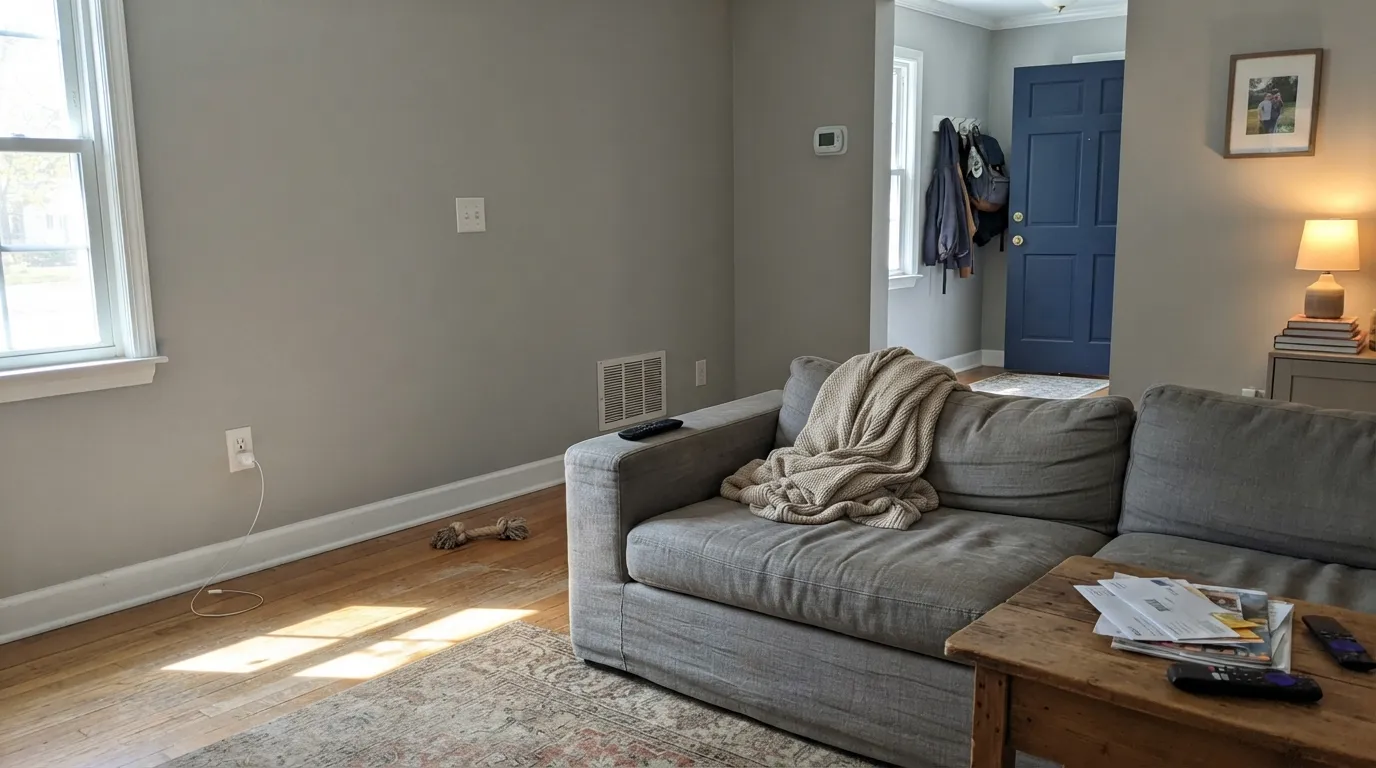
Granite Dust is the gray Valspar mixed for people who keep picking Mindful Gray and then complaining it went beige. Same mid-depth, different blood: a cool gray with a dusty yellow-green in it, not a greige. In real daylight it reads like the name — mineral, stone, quiet. In north light or under cool LEDs the yellow drops out and owners report blue. Buy it at Lowe's when you want a true gray. Do not buy it hoping for the warm, taupe version of this depth.
Daylit living rooms and offices · hallways that borrow light · Lowe's shoppers who wanted Mindful Gray without the greige · exterior siding in real sun
You actually wanted a warm greige · you thought LRV 48 was a light gray · the room faces north and stays dim · your floors are honey oak or your trim is staying cream
- True cool mid-gray at LRV 48.1 — stone, not a greige in disguise
- Same depth as Mindful Gray without the taupe-brown
- Hides scuffs better than the pale grays everyone samples first
- Reads as granite on sunlit siding, with a clean white trim
- The practical Lowe's path when you wanted gray and the Sherwin aisle kept handing you greige
- Darker than the chip — LRV 48.1 is a mid, not a light gray
- North light and cool LEDs flash blue; lawn light flashes sage
- Honey oak and cream trim push it khaki-olive
- Thin owner-review archive under this name — lean on a big sample, not a search
What Color Is Granite Dust, Really?
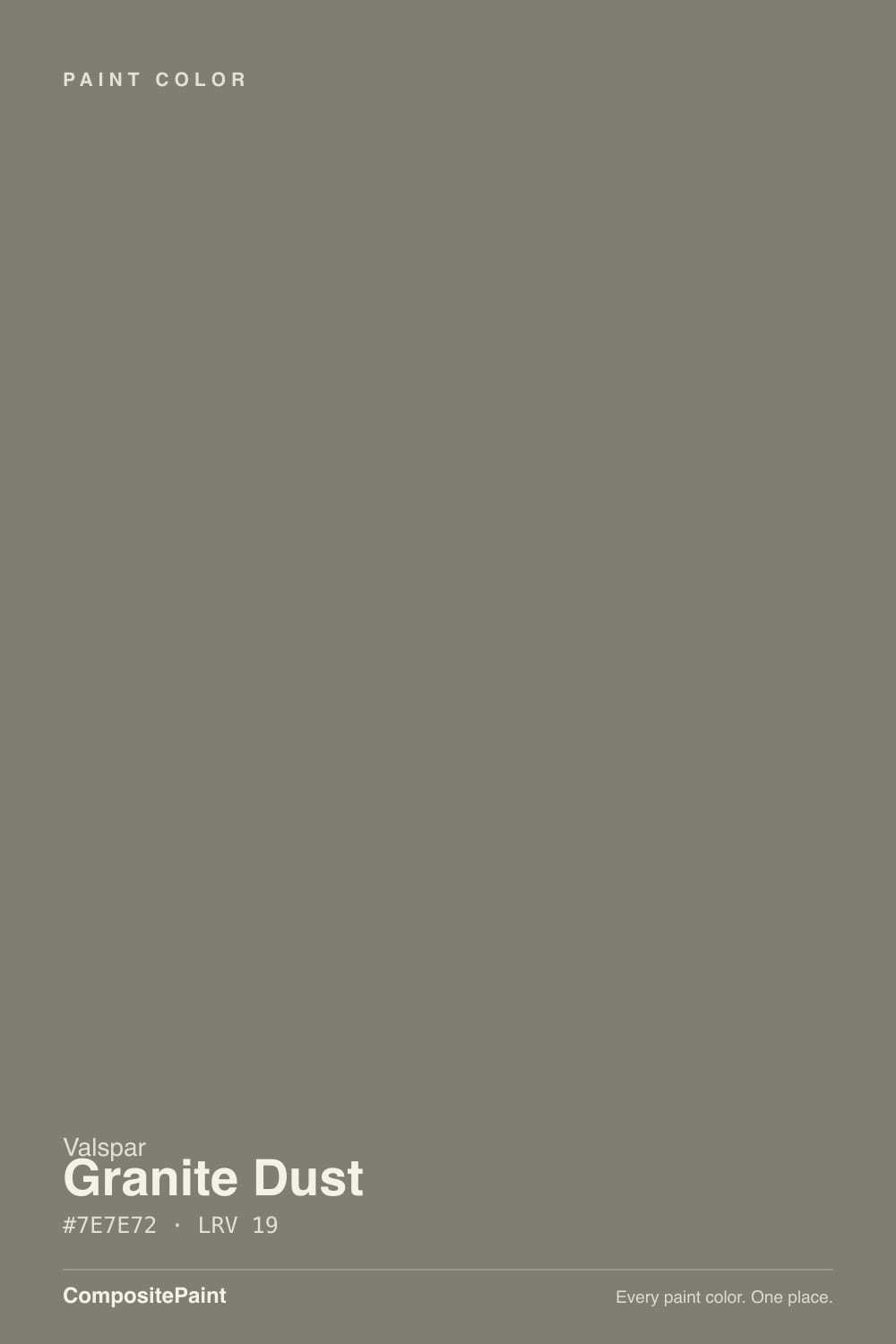
A cool gray with a dusty yellow-green in it — stone, not greige. Valspar's own chip copy is unusually frank: family Gray, undertone Cool, and the green is named. RGB 184, 185, 178 tells the same story: green is the high channel, but only by a point, and blue is the low one. Saturation is tiny. On a 2-inch chip it can pass for a plain mid-gray. On four walls the mineral edge becomes legible — a granite-dust cast, yellow-green like lichen in the cracks, never the taupe-brown that makes Mindful Gray a greige. That is the whole personality, and it is why this is not a Lowe's swap for the Sherwin-Williams color people actually typed into Google.
At LRV 48.1 it sits in the useful, easy-to-miss middle. Mindful Gray is 48. Repose Gray is 58. Dorian Gray, the next step down that Sherwin strip, is 39. Agreeable Gray is 60. On paper those numbers look close; on a wall, 48 is a full step deeper than the airy greiges people sample first. Granite Dust has body. It hides scuffs. It also closes a dim room. Valspar put it on the 2021 Colors of the Year card as one of twelve — not a singular Color of the Year — and sold it as interior and exterior. That is the most fame it has. There is no viral kitchen, no HGTV house. The wall behavior you can trust is the chip plus a handful of owner notes, not a decade of forum fights.
Undertone in one line: cool gray first, yellow-green second — never beige, and it will flash blue when the light goes cold. Warm south sun keeps it a dusty stone gray. Cool north light and 4000K LEDs strip the yellow and leave a flatter blue-gray, which is the exact shift one Houzz owner described after the walls had been up a while. If your sample looks sage, the room is handing it green. If it looks blue, the light is cool. Both versions are the same gallon being honest about the room.
Where It Shines
Give it daylight, a clean white trim, and wood that is not orange, and Granite Dust does the job mid-grays are supposed to do: the room looks finished, not decorated. Living rooms and offices with south or west windows are its best interiors — the yellow-green stays dust, not khaki, and furniture actually reads against the wall. Hallways that borrow light from a door or a stairwell carry it as a true-gray connector. Outside, satin siding in full sun is the use the name promises: it mutes toward granite from the street. Keep the bulbs warm and the trim from going cream, and it behaves.
Where It Fails
Almost every regret with this color is predictable from the chip, the light, or the floor. None of them are a bad batch — but if your room matches one, a bigger sample will only confirm it.
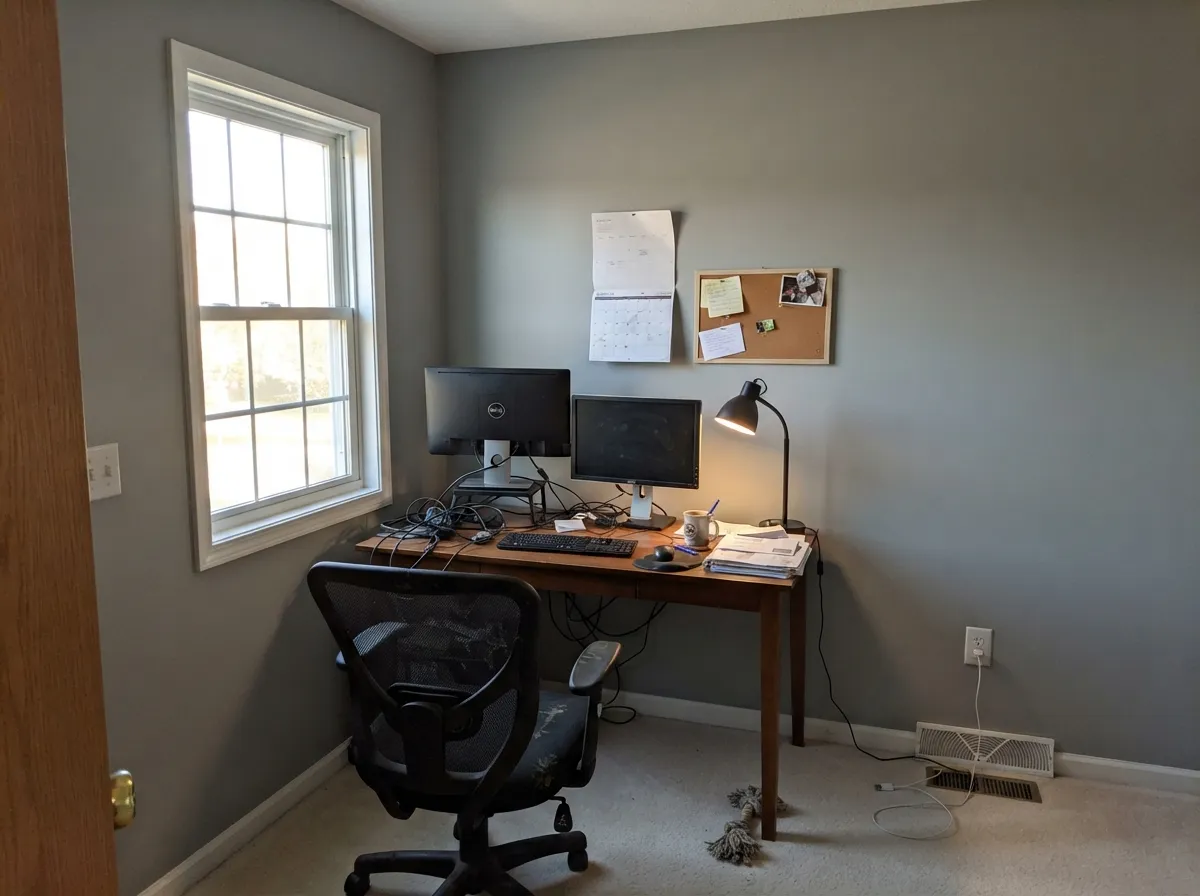
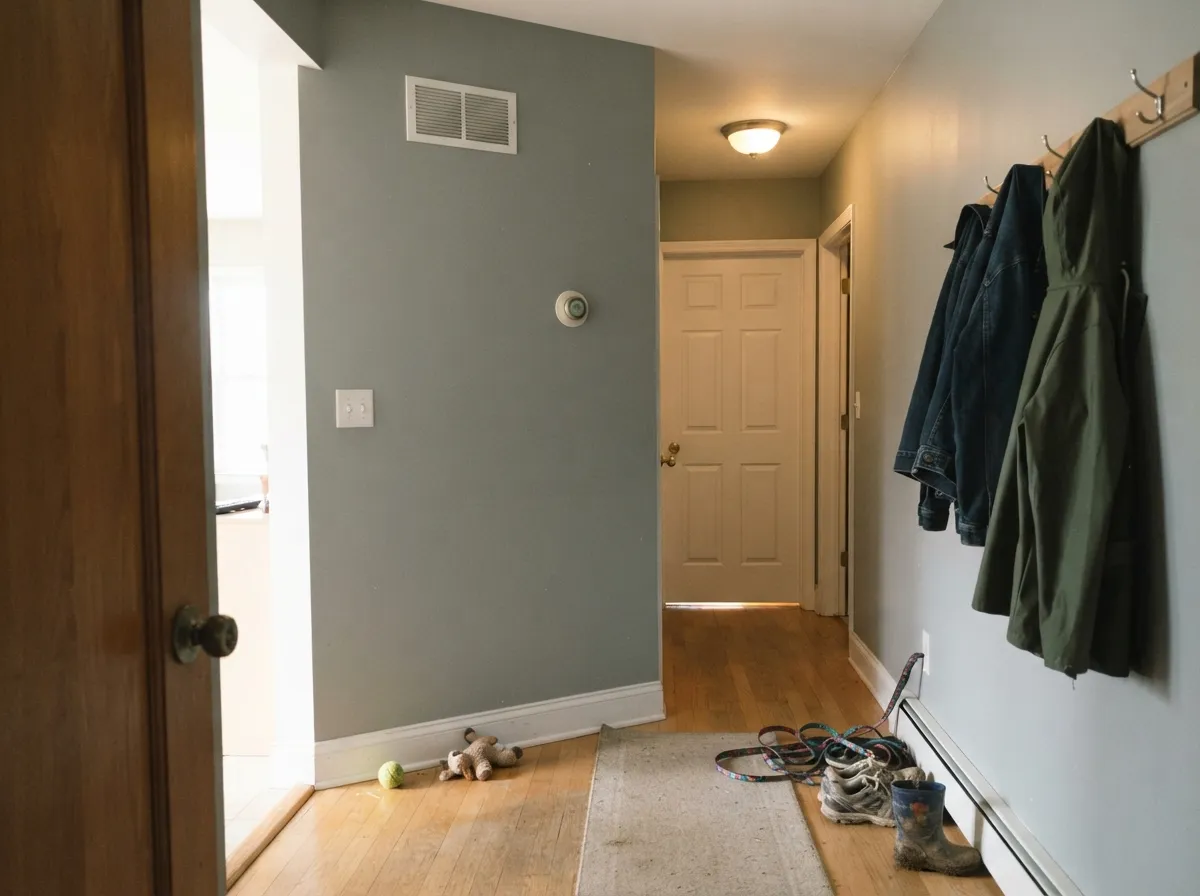
On the chip it is a polite cool gray. On four walls, in the wrong light, the yellow-green either shouts or vanishes. Cool north daylight and 4000K LEDs drop the yellow and leave a flatter blue-gray — a Houzz owner said it looked gray when it went up and more blue later; Pinterest posts of the same SKU get tagged kinda blue. A lawn or trees outside the window does the other trick: reflected green pushes the yellow-green into sage-dust. If what you wanted was a gray that stays gray, sample this in your actual light at noon and at night, or pick Light French Gray and live with its violet flash instead.
Same trap as Mindful Gray, same number: LRV 48.1 is a mid, not the airy gray on Instagram. A 2-inch chip at this depth always looks lighter than four walls. If your last gray was Repose Gray (LRV 58) or Agreeable Gray (LRV 60) and you wanted that openness with a cooler cast, Granite Dust will feel held, even heavy, in a small room. Step up to Repose Gray or Light French Gray (LRV 53). Granite Dust lives in the granite.
Yellow-orange sits next to this yellow-green on the wheel, so honey oak floors, orange-stained builder trim, and creamy whites (Cottage White, Alabaster, White Dove) all push the wall toward khaki-olive while the wood goes more orange. Neither side wins. A crisp trim white — Extra White or Chantilly Lace — keeps the gray looking gray. White oak, walnut, and gray-washed floors are the company it was mixed for.
Room by Room
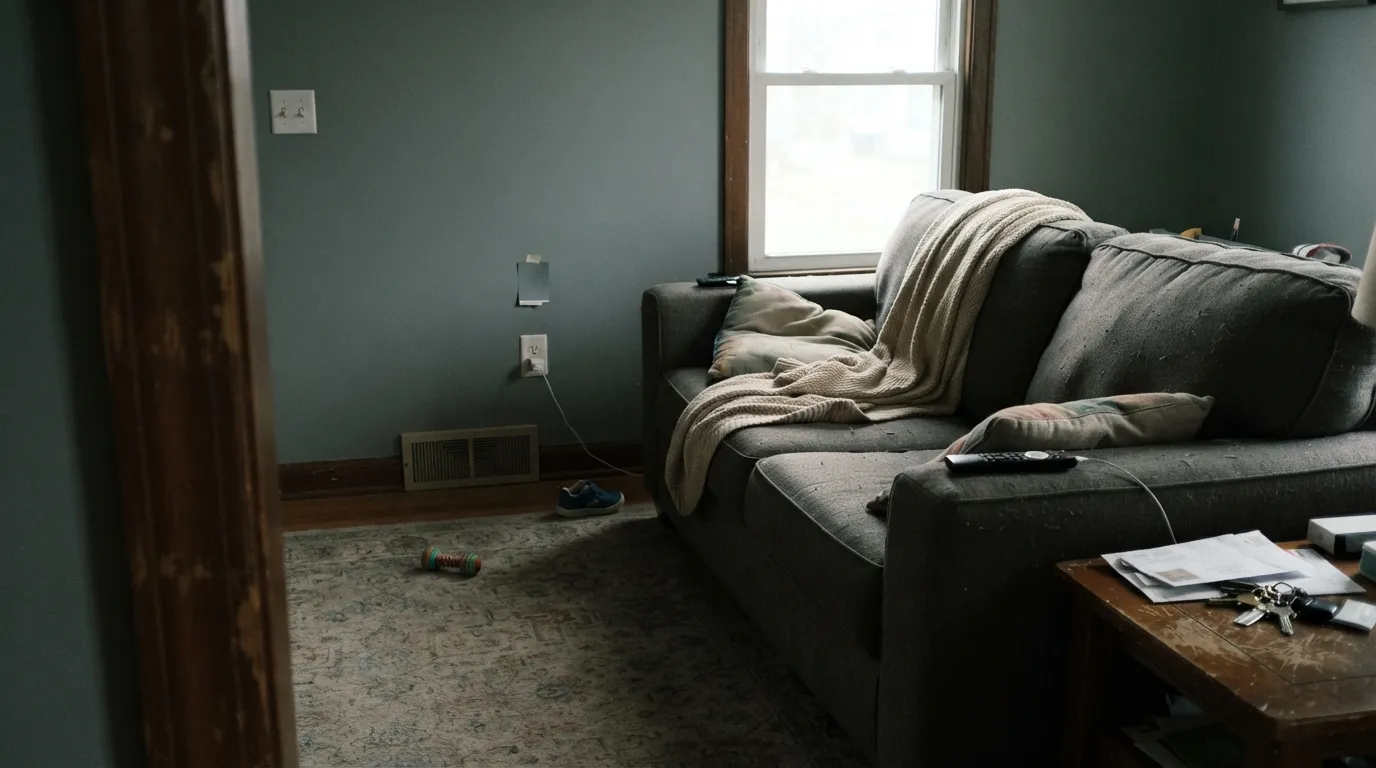
South or west windows keep it mineral instead of blue. Eggshell; Extra White or Pure White on trim in semi-gloss so the cool gray can show. One north window and no lamps is the blue-gray room described above — sample big, or go warmer and lighter.
Cool mid-gray is what offices actually want: enough depth to look decided, not so dark the Zoom background swallows you. A real window matters. Matte or eggshell; keep task lamps at 2700K so late-day work does not go clinical.
At this lightness it wraps the room without going moody. Under 2700K bulbs the yellow-green softens toward stone; under cool overhead LEDs it can go a step more blue-gray. Matte or eggshell. Skip a closed north bedroom unless you are willing to live with lamps on.
Works on walls with painted cabinets, quiet quartz, and nickel or matte black. Satin on an island is a low-risk dose. Honey oak cabinets and golden butcher block are the clash in the fails section — white oak, walnut, and painted lowers are safe. Extra White on the boxes keeps the gray from looking dirty.
True gray at LRV 48.1 carries room to room without the beige handoff a greige makes. An entry that sees a sidelight, or a hall that borrows living-room light, is fine. Windowless interior halls still want a lamp or they go tunnel-blue. Do not run this as a whole-house color through a dark ranch.
Valspar sells it as exterior for a reason. Full sun mutes the yellow-green and the body reads granite from the street; Extra White or Pure White trim keeps the edge crisp. Pair a dark door — Hale Navy if the porch has light, Iron Ore if you want near-black. Walk a large sample around every elevation: the shaded north side will read a step cooler and slightly bluer than the sunny south side. Not a front-door color — too light to read from the curb as anything but pale gray.
Your Light Is the Risk
Warm sun holds the gray and keeps the yellow-green at dust, not khaki. The wall reads mineral granite — the version the color is sold as.
Cool, indirect daylight drops the yellow and leaves a flatter blue-gray, or a drab olive if the room already leans green. Test here first if that is your exposure.
Morning east light keeps it cooler and more gray; late west sun pulls the yellow-green into a dusty olive-stone for an hour. The swing is real — sample at 8am and at 6pm.
2700K bulbs warm it toward stone and calm the green. Cool 4000K LEDs sharpen the blue-green edge — the clinical read owners call blue. Swap the bulbs before you repaint.
Most complaints about Granite Dust are a light mismatch. Upload a photo of your actual room and see it on your walls — then ask for the same wall in north light or evening lamps before you buy a single sample.
Need It From Another Brand?
Any paint counter can custom-tint Valspar 5006-1C directly. If you would rather stay in one brand's own deck, these are the closest stock matches, measured as ΔE2000. Under 2 is a difference you will not see on the wall.
| Brand | Closest color | ΔE | LRV | |
|---|---|---|---|---|
| Sherwin-Williams | Gray CloudsSW 7658 · Sherwin-Williams | 1.3 | 47 | Color page → |
| Behr | Classic SilverPPU18-11 · Behr | 1.7 | 48 | Color page → |
| Benjamin Moore | Bone BlackCW-715 · Benjamin Moore | 1.6 | 47 | Color page → |
| PPG / Glidden | Gray StonePPG1009-4 · PPG / Glidden | 1.6 | 48 | Color page → |
| Glidden | Gray StonePPG1009-4 · Glidden | 1.5 | 48 | Color page → |
| Dutch Boy | Fair-Minded Gray438-3DB · Dutch Boy | 1.5 | 49 | Color page → |
Similar Valspar Colors
The nearest shades to Granite Dust within Valspar's own range, ranked by perceptual color distance — useful when you want the same look a touch lighter, darker, or warmer.
WCAG 2.1: AA is 4.5 : 1 for normal text, 3 : 1 for large text, AAA is 7 : 1.
Granite Dust vs the Colors You're Also Considering
Every Granite Dust sample board has the same rivals on it. The numbers show the real lightness gap — then it comes down to which risk you would rather live with.
Pick this when greige feels too beige and you actually wanted a cool gray at this weight.
Sherwin-Williams SW 7016 · LRV 48Mindful GrayPick this if you wanted the famous mid-tone greige — same depth, taupe-brown instead of yellow-green, until the light goes cool.
Pick this when LRV 39 would close the room and you want gray, not a gray-brown.
Sherwin-Williams SW 7017 · LRV 39Dorian GrayPick this if the mid still looked washed and you want the greige with real weight — a full step deeper, warmer, and better on cabinets.
Pick this when Repose looked too pale and too taupe and you want a cooler mid that still has body.
Sherwin-Williams SW 7015 · LRV 58Repose GrayPick this for the lighter, airier greige — open in small rooms, with the famous violet flash in north light.
Pick this when you are already at Lowe's and want the stone-dust version of a true gray, a half-step deeper.
Sherwin-Williams SW 55 · LRV 53Light French GrayPick this if you want the truest gray in the Sherwin-Williams deck — slightly lighter, and it flashes violet in cool light instead of yellow-green.
Granite Dust sits in a tight cluster of Valspar mid-grays, and the differences are subtle but real once they are on the wall. Lead Cast 5007-2B, at LRV 21, is the closest neighbor: a touch lighter and a hair less yellow, so it reads slightly more neutral gray. Choose Lead Cast if Granite Dust looks a bit too warm or heavy for your light.
Warm Eucalyptus 8004-28F, also LRV 21, pushes further toward green. In a room with strong daylight it will show a clear sage cast where Granite Dust stays gray, making it the pick when you actually want a green-gray.
Mossy Aura 6002-2B, at LRV 20.7, is the warmest of the group, leaning browner and more greige. If you want a color that feels earthy and inviting rather than cool, Mossy Aura goes that direction while Granite Dust holds a more balanced gray.
Granite Dust Coordinating Colors
Stay on the cool-to-neutral side of the fence. Granite Dust wants crisp whites, deeper true grays, and a navy or near-black for contrast — not cream, not honey beige, not a warm greige on the next wall. These are the partners that keep the yellow-green at dust instead of khaki:
One of Twelve: the 2021 Palette and the Other Granite Dust
Valspar does not name a single Color of the Year the way Sherwin-Williams does. In 2021 it published a twelve-color well-being palette, and Granite Dust was the cool stone-gray on that card — Lowe's 5006-1C, independent dealers Gray-Green Linen V142-3. That is real, and it is also the ceiling of its fame. It is not Agreeable Gray. It is not a viral interior. Painters have recommended it as a fail-safe gray since at least 2016; the 2021 card just put a label on a chip Lowe's already stocked.
Two other traps live in the name. Behr sells a Granite Dust (MQ3-06) that is a lighter warm greige at LRV 63 — the opposite temperature and a full step paler. And Gray-Green Linen is this color, not a cousin. If a blog, a Pinterest pin, or a contractor text says Granite Dust and does not give a SKU, ask which brand. Ordering the wrong one is a whole-house mistake, not a close match.
Granite Dust With Wood Tones and Floors
Cool, pale, and dark-red woods are the easy yes. White oak, gray-washed oak, ash, and walnut all let the yellow-green read as stone dust instead of khaki. Painted floors and quiet gray LVP are fine. Brushed nickel, chrome, and matte black hardware sit comfortably; unlacquered brass works if the rest of the room is not already golden.
The honest no is yellow-orange wood: honey oak, golden pine, orange-stained builder cabinets, cherry that has gone red-orange. A yellow-green gray and orange wood exaggerate each other — the floor looks cheaper, the wall looks like leftover olive. If that floor is staying, put a large rug between it and this paint, or pick Mindful Gray and stay on the warm side of this depth.
Stone and tile: white marble, gray quartz, and classic white subway are the clean pairing. Beige travertine and gold-flecked granite pull the same khaki problem as honey oak. Sample the paint against the actual slab, not a phone photo of the slab.
Three Ready Palettes Built on Granite Dust
A color is never alone on the wall. These are complete combinations in the 60-30-10 pattern, with the reason each one holds together. Every one opens in the visualizer.
Extra White is the sharp trim this cool gray needs — creamier whites push the yellow-green into khaki. Hale Navy is the single dark note; it sits on the cool side of the wheel and does not fight Granite Dust's blue days.
Try this palette in your roomPainted uppers in Extra White keep the mid-gray walls from looking dirty; Iron Ore on the island is the near-black that grounds a cool kitchen without introducing a warm bronze. White oak or walnut floors only — not honey oak.
Try this palette in your roomThree true grays, no greige in the stack. Light French Gray is the slightly lighter true gray for halls or a connected room; Granite Dust holds the main floor; Kendall Charcoal is the well-behaved dark for a built-in or island so the house has a bottom note. Keep every trim white crisp.
Try this palette in your roomGranite Dust FAQ
Is Granite Dust warm or cool?
Cool. Valspar files it as a cool gray with subtle yellow-green undertones, and the RGB agrees. South sun and 2700K bulbs soften it toward dusty stone; north light and cool LEDs push it toward a flatter blue-gray. It never reads beige. If you wanted the warm, taupe version of this depth, that is Mindful Gray.
Is this just Mindful Gray at Lowe's?
No. Same lightness — Mindful Gray is LRV 48, Granite Dust is 48.1 — different color. Mindful is a mid-tone greige with a taupe-brown base. Granite Dust is a cool gray with yellow-green in it. Side by side on a wall, Mindful looks softer and slightly beige; Granite Dust looks more mineral and, in cool light, more blue. Sample both if you are deciding between the two aisles.
Is Valspar Granite Dust the same as Behr Granite Dust?
No. Same name, different brand, different color. This review is Valspar 5006-1C, a cool mid-gray at LRV 48.1. Behr Granite Dust (MQ3-06) is a lighter warm greige at LRV 63. Do not order one from a chip of the other.
What trim white goes with Granite Dust?
A crisp one. Extra White is the sharp Sherwin-Williams partner; Chantilly Lace if your painter is in Benjamin Moore; Pure White if you want the default SW trim white. Skip creamy whites — White Dove, Alabaster, Cottage White — which make the yellow-green shout and the walls look khaki next to the cream. Semi-gloss on the trim, eggshell on the walls.
Does it work with oak floors?
Depends on the oak. White oak, gray-washed oak, and walnut are excellent. Honey oak, golden pine, and orange-stained builder oak are the clash: the floor goes more orange, the wall goes more olive. A large rug is a patch, not a fix.
Is Gray-Green Linen the same color?
Yes — at independent Valspar retailers. Lowe's sells it as Granite Dust 5006-1C; the independent-dealer name on the 2021 Colors of the Year card was Gray-Green Linen V142-3. Same cool gray with the yellow-green named in the title. If a contractor text says Gray-Green Linen, this is the Lowe's chip.
Have you painted with Granite Dust?
Rate it — one tap helps the next reader decide.
Ask a Question