Acacia Haze
The sage cabinet color with no viral story, reviewed honestly: the kitchens it quietly wins, the light that flattens it, and what to pick instead.

Jessica has spec'd whites and neutrals for more than 300 rooms and keeps a sample wall of painted drawdowns in her studio. Every color review is checked against real reader rooms in the comments and re-tested when a formula changes. About the testing process →
- 1Black Fox7
- 2Pewter Green12
- 3Acacia Haze32
- 4Stardew43
- 5Palladian Blue60
The Fast Verdict
Acacia Haze never won Color of the Year and nobody built a Pinterest trend around its name — it just quietly became one of the most-used cabinet greens in the Sherwin-Williams deck. It is a muted, gray-cast sage with a yellow-green lean, deep enough at LRV 32 to hold real color on an island or a full run of cabinets, soft enough to sit next to almost any white without a fight. If you want the internet-famous version of this color, that is Evergreen Fog one door down; if you want the same idea gone a shade deeper and warmer, this is it.
Kitchen cabinets, especially with white quartz or butcher block · two-tone kitchens (Acacia Haze lowers, a warm white upper) · bathroom vanities · a front door or shutters on a white or cream house
You want a cooler, grayer sage — that is Retreat or Evergreen Fog, not this · your kitchen already has honey oak and busy-veined granite competing for attention · your only light is a dim north window with no lamps · you are chasing a trending, talked-about color rather than a quiet workhorse
- Deep enough (LRV 32) to hold real color on cabinets and islands
- Warm yellow-green undertone flatters brass, butcher block, and white quartz
- Reads as considered and vintage-cottage, never trendy or loud
- Pairs easily with almost any warm or neutral white
- No fame to live up to — a genuinely low-risk, low-drama color choice
- Goes flat and muddy in dim, north-facing rooms with no lamps
- Fights honey oak and gold-veined granite instead of grounding them
- Too muted for anyone picturing a saturated statement green
- Easy to underestimate on a small chip — reads noticeably darker on real cabinets
What Color Is Acacia Haze, Really?
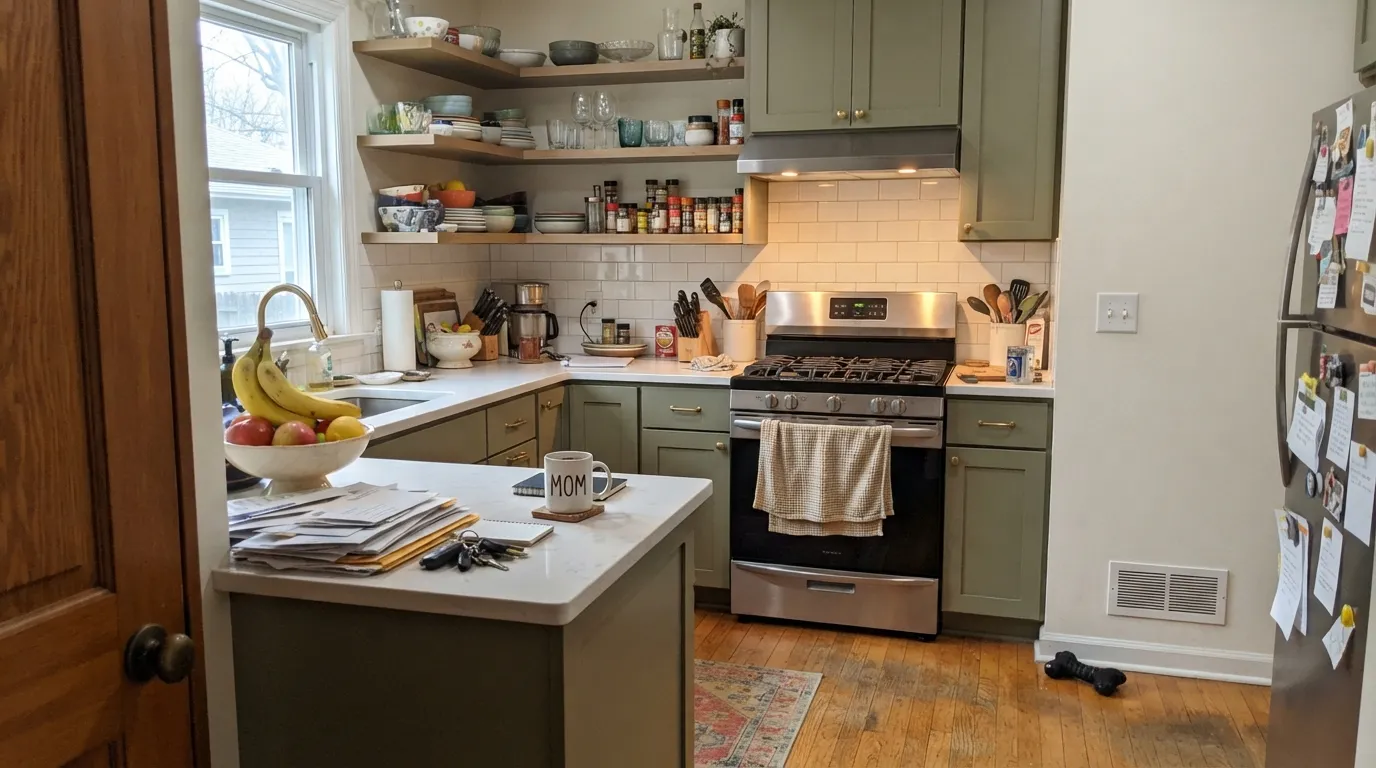
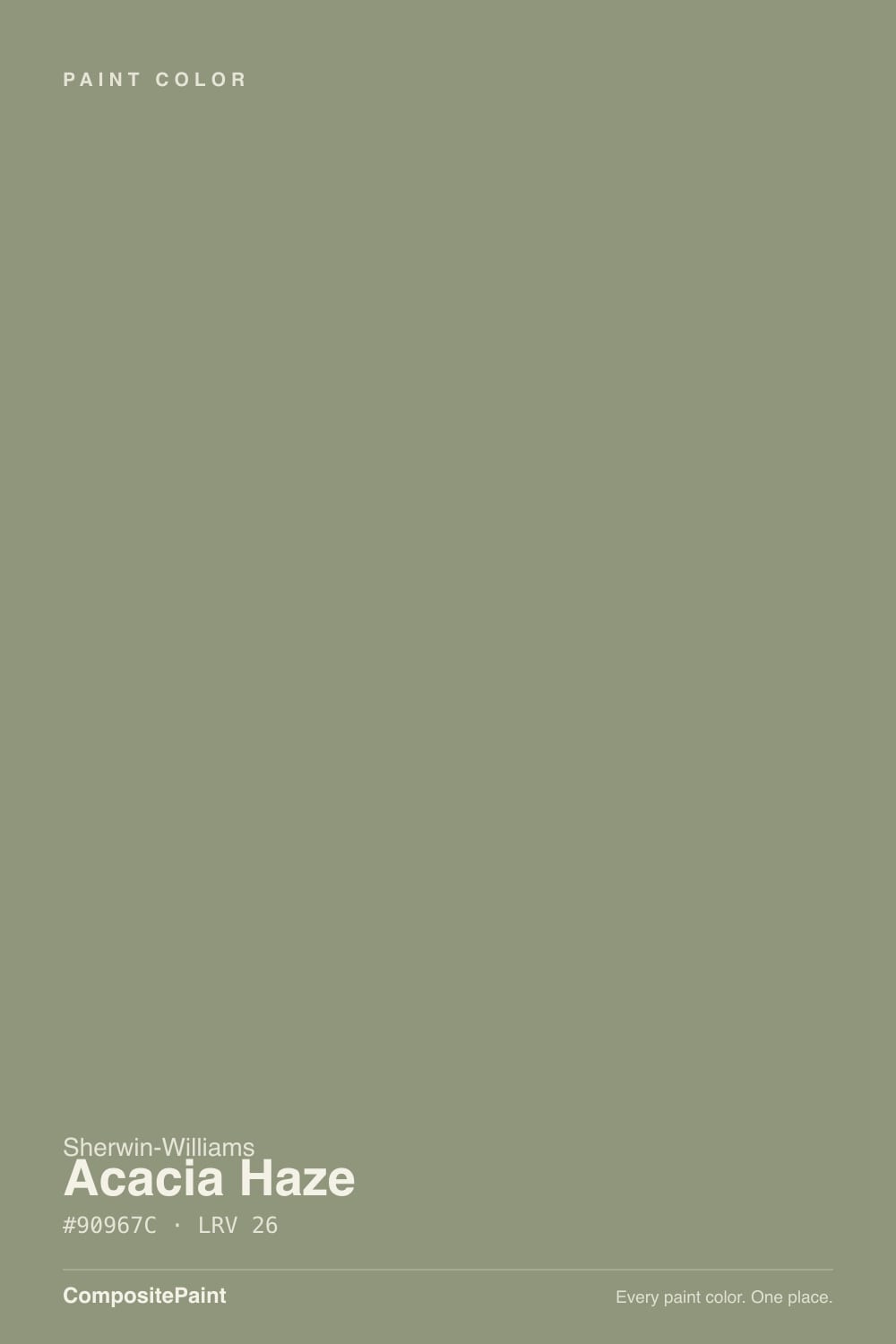
A muted sage with the yellow dialed up and the saturation dialed way down — this is an olive-green, not a blue-green, whatever a sample chip under cool light might suggest. It shares its numbering block with Evergreen Fog (SW 9130 was Sherwin-Williams' 2022 Color of the Year), and the family resemblance is real: same yellow-green lean, same gray cast keeping it out of "craft-store green" territory. Acacia Haze is simply the deeper, richer sibling — Evergreen Fog sits at LRV 30, Acacia Haze at LRV 32 — which is exactly why designers reach for it on cabinets and islands where Evergreen Fog can look a touch pale.
At LRV 32 it is a genuine mid-depth color, not a pastel sage. That depth is the whole point on cabinetry: a lighter sage can wash out under kitchen downlights, but Acacia Haze holds its green from three feet away and from across the room. It has become a favorite specifically for the English-cottage, slightly vintage kitchen look — the kind of room with brass pulls, white quartz, and a color that reads collected rather than trendy.
Undertone in one line: warm olive-sage, yellow-green before anything else — not the cool blue-green some color-visualizer swatches suggest under fluorescent light. If your sample reads grayish and flat, that is your light doing it, not a different paint; get it under a warm bulb or real daylight before deciding.
Where It Shines
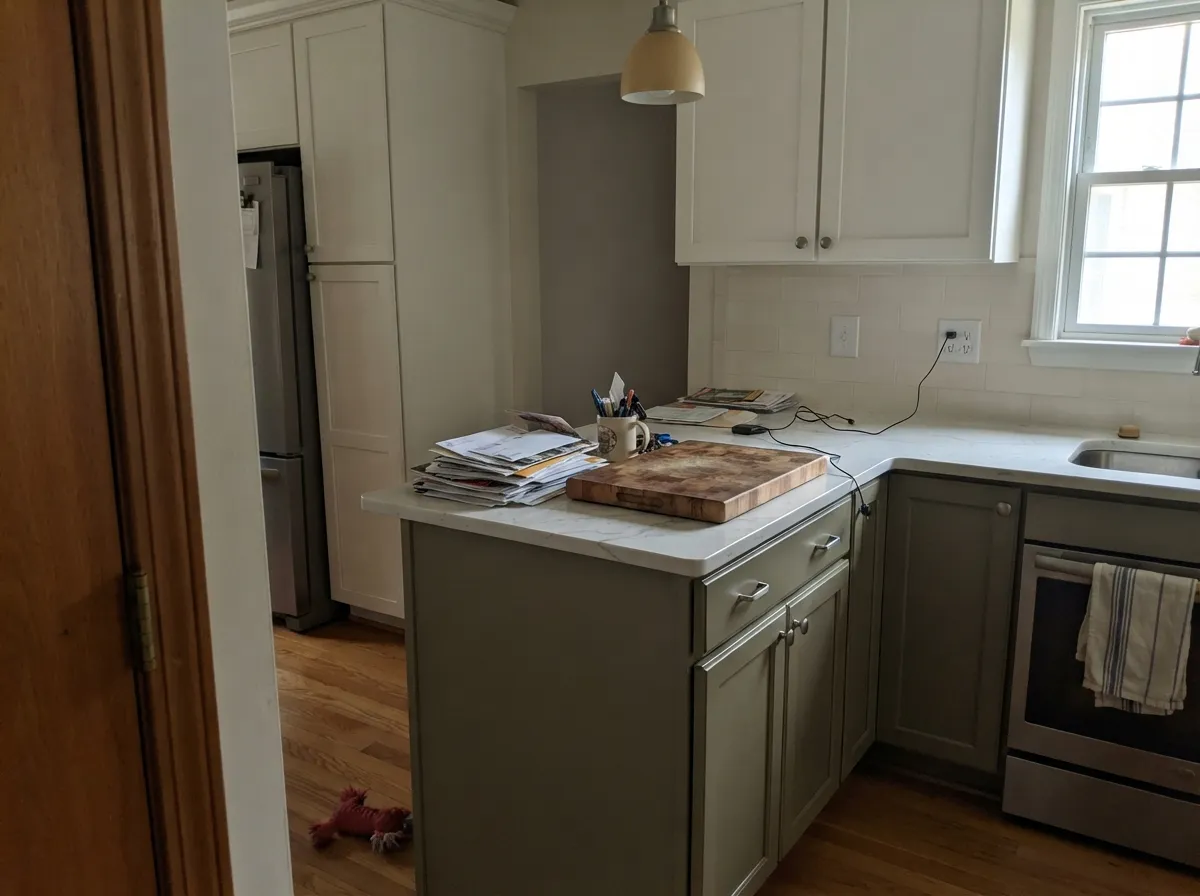
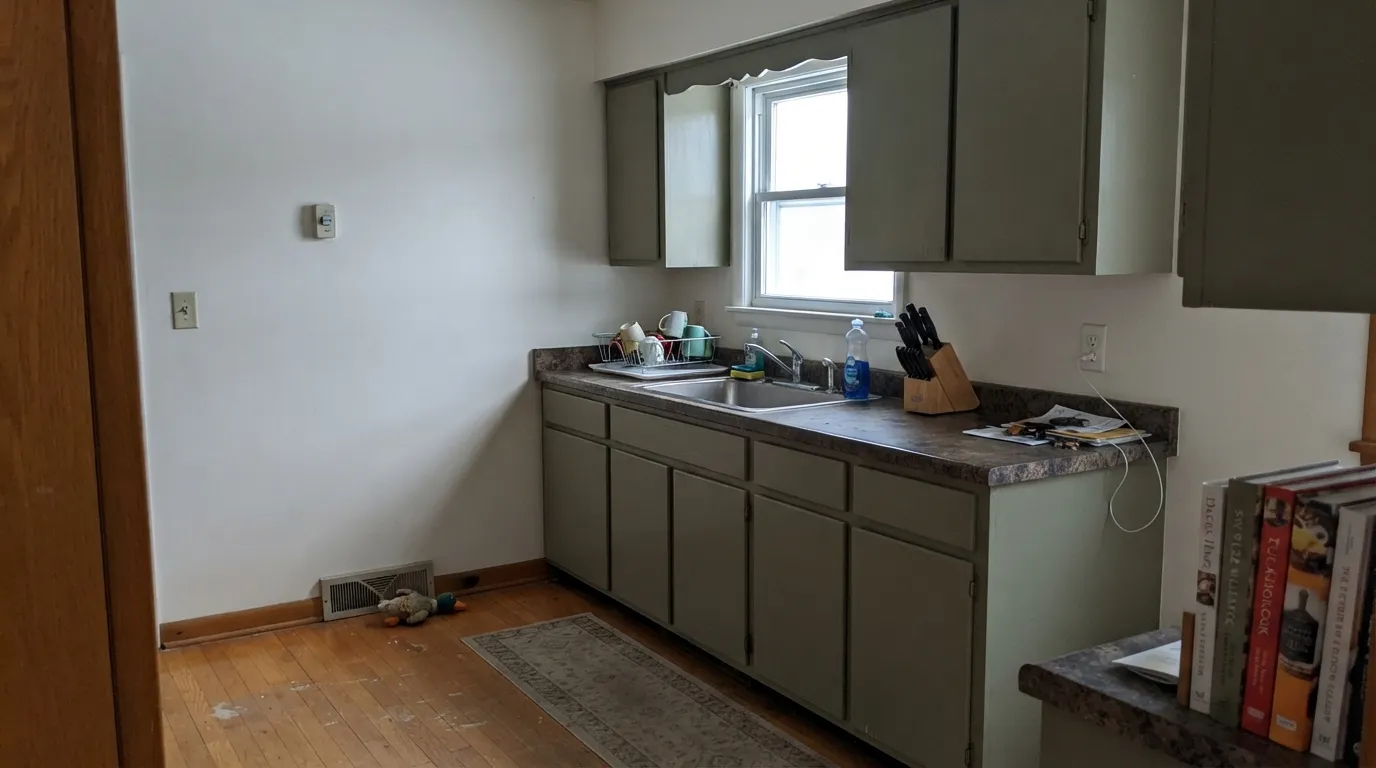
Give it a kitchen and real light and it does exactly what it is supposed to: reads as a considered, slightly vintage color choice rather than a statement. It is at its best on cabinetry and islands, where the depth holds up under task lighting and the yellow-green undertone pulls brass hardware and butcher block into the same warm family. Its second job is the two-tone kitchen — Acacia Haze on the lowers, a warm white like Alabaster or Greek Villa on the uppers — which is the single most common way homeowners actually use this color.
Where It Fails
Almost every disappointed review of Acacia Haze traces back to one of three situations, and none of them are the paint's fault — they are the color meeting a room it was never suited for.
Cool, low daylight flattens the yellow undertone and leaves a muddy, grayish olive that reads more like a stain than a paint color. This is the single most common complaint pattern with muted sage-olive greens generally, and Acacia Haze is no exception. Add warm 2700K lamps or pick a lighter partner — Clary Sage or Comfort Gray hold up better in dim rooms.
The undertone is yellow-green, and a strongly orange-yellow oak floor or a granite full of gold and brown veining amplifies it instead of grounding it — the cabinets and the countertop end up arguing over the same warm-yellow territory. White oak, walnut, or a plain white quartz counter give the color room to be the only warm note in the room.
Acacia Haze has never been marketed as a headline color, and it shows: it is gray-cast and quiet by design. Buyers coming from a Pinterest board of emerald or forest-green cabinets are consistently surprised by how muted it reads on the wall. If you want saturation, this is the wrong sage — look at a true green, not this family.
Room by Room
Satin finish holds up to grease and wiping. Against white quartz and brass it is the color's signature job — deep enough to feel intentional, muted enough to stay timeless rather than trendy.
Acacia Haze lower cabinets or island, a warm white (Alabaster, Greek Villa) on the uppers. This split is how most homeowners actually buy this color, and it keeps the kitchen light overall while giving the color real presence where it counts.
Same logic as cabinets, smaller commitment. Pairs cleanly with white or marble-look counters and brass or matte-black fixtures; satin or semi-gloss for wipeability.
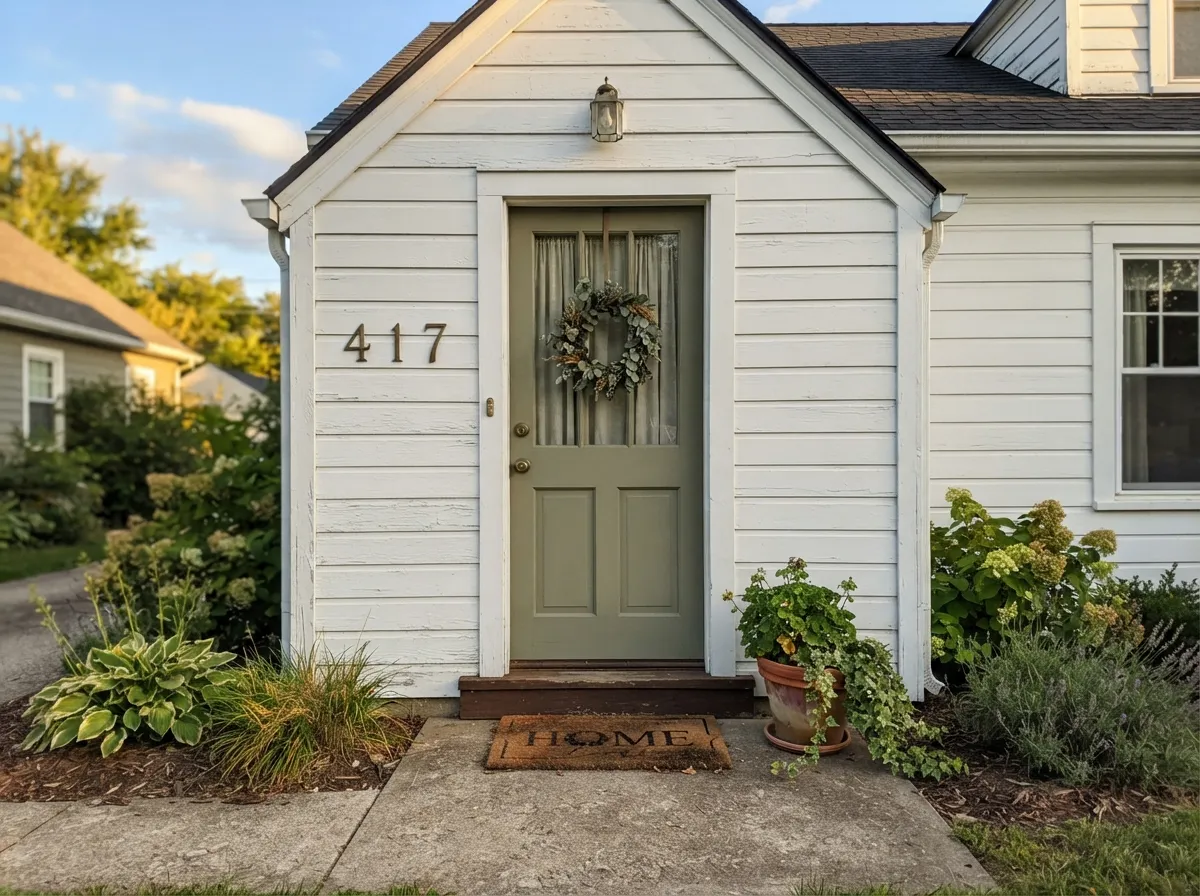
Against white, cream, or light-gray siding it reads as quiet, intentional color without the risk of a saturated green door. Full sun brightens it slightly; shaded porches keep it closer to its true depth.
A single wall in bright, indirect daylight reads as a considered olive-sage. Needs real light to stay convincing — this is not a color for a windowless room.
In a bright room with warm wood it works as a full-wall color. In a dim or north-facing room, four walls of it amplify the flattening problem that a single cabinet run never shows — sample big before committing to the whole room.
Your Light Is the Risk
East-facing or a big north window with real sky exposure keeps the olive-green true without washing it out or graying it down.
Low, cool daylight flattens the yellow undertone into a muddy, grayish olive. The color most likely to disappoint a buyer who skipped the sample.
Cooler and fresher in morning east light, warmer and more olive-brown as afternoon west sun comes in. Both are honest reads of the same paint.
2700K warm bulbs push it further into yellow-olive at night. Cool white LEDs hold it closer to a true gray-green — pick bulbs based on which you want.
Most complaints about Acacia Haze are a light mismatch. Upload a photo of your actual room and see it on your walls — then ask for the same wall in north light or evening lamps before you buy a single sample.
Need It From Another Brand?
Any paint counter can custom-tint Sherwin-Williams SW 9132 directly. If you would rather stay in one brand's own deck, these are the closest stock matches, measured as ΔE2000. Under 2 is a difference you will not see on the wall.
| Brand | Closest color | ΔE | LRV | |
|---|---|---|---|---|
| Behr | Laurel LeafPMD-56 · Behr | 2.6 | 32 | Color page → |
| Benjamin Moore | Arctic Shadows1559 · Benjamin Moore | 2.9 | 32 | Color page → |
| Valspar | Secret Moss5005-2A · Valspar | 1.1 | 32 | Color page → |
| PPG / Glidden | Green Tea LeafPPG1128-5 · PPG / Glidden | 2.8 | 31 | Color page → |
| Glidden | Greycliffe50GY 32/046 · Glidden | 1.6 | 32 | Color page → |
| Dutch Boy | Antiquated Pewter425-4DB · Dutch Boy | 1.3 | 34 | Color page → |
Similar Sherwin-Williams Colors
The nearest shades to Acacia Haze within Sherwin-Williams's own range, ranked by perceptual color distance — useful when you want the same look a touch lighter, darker, or warmer.
WCAG 2.1: AA is 4.5 : 1 for normal text, 3 : 1 for large text, AAA is 7 : 1.
Acacia Haze vs the Colors You're Also Considering
Every Acacia Haze sample board has the same rivals on it. The numbers show the real lightness gap — then it comes down to which risk you would rather live with.
Pick this if Evergreen Fog read a shade too pale on your cabinets — Acacia Haze holds the same undertone with more depth.
Sherwin-Williams SW 9130 · LRV 30Evergreen FogPick this if you want the deck's benchmark sage — lighter, a touch more mossy-warm, and the color everyone starts a green-cabinet search with.
Pick this for the warmer, more olive read — Retreat can slide toward gray-khaki in cool light, Acacia Haze holds its green better.
Sherwin-Williams SW 6207 · LRV 21RetreatPick this for a cooler, more neutral gray-green at nearly the same depth — Retreat drops the yellow that Acacia Haze keeps.
Pick this for real depth on cabinets or a door — Clary Sage can look washed out exactly where Acacia Haze holds its color.
Sherwin-Williams SW 6178 · LRV 41Clary SagePick this for a lighter, easier sage that reads calmer across four full walls and handles dim rooms better.
Pick this for interior cabinets, vanities, and doors, where Comfort Gray's pale exterior-bred cast looks thin.
Sherwin-Williams SW 6205 · LRV 47Comfort GrayPick this for exteriors — Comfort Gray is the pale, cool farmhouse workhorse; Acacia Haze reads too deep for most whole-house siding jobs.
Inside the Sherwin-Williams deck, Leaflet (SW 9674) at LRV 30 is the closest sibling and reads slightly lighter and a shade greener. Jade Dragon (SW 9129) at LRV 30 and Green Onyx (SW 9128) at LRV 31 both sit a few points brighter, which matters in a darker room. Featherstone (SW 9518) at LRV 29 and Canal Street (SW 9523) at LRV 29 drift toward taupe, so they lose some of the green Acacia Haze is chosen for. Across brands, Behr Autumn Sage (ECC-63-1) is the tightest match at a deltaE of 0.58, close enough to call the same color. Glidden Pine Forest Green (10GY 29/158) at 1.06, Benjamin Moore Mistletoe (474) at 1.14, and Dunn-Edwards Fair Spring (DE6264) at 1.24 are all visually identical in normal room light. Farrow and Ball Sutcliffe Green (No. 78) at 3.47 is close but visibly different side by side, reading a little deeper and greener.
Acacia Haze Coordinating Colors
The rule for coordinating with Acacia Haze: warm whites over cool whites, and keep it away from anything strongly orange-yellow it would have to compete with. It layers well with its own lighter cousins and takes one dark, near-black note better than a mid-tone gray. These are the partners that show up again and again in real kitchens:
The Cabinet Color With No Viral Story
Acacia Haze shares a numbering block with Evergreen Fog, Sherwin-Williams' 2022 Color of the Year, but it never got the same spotlight — no magazine trend piece, no headline moment. What it got instead is steady, unglamorous use: search results for it are dominated by kitchen-renovation blogs and real homeowner photo galleries rather than press coverage, and design-blog reviews describe it in practical terms — an easy, English-cottage-leaning sage that pairs with just about any white — rather than as a statement piece.
That is the honest read on this color: it is a workhorse, not a headline. If you are hoping a paint color will make your kitchen instantly recognizable as "that Pinterest kitchen," this is not that color. If you want a cabinet green that will look considered and current for a decade without anyone being able to name the exact trend it came from, Acacia Haze is a genuinely good, low-risk pick.
Acacia Haze With Wood Tones and Floors
White oak and walnut are the safest floors under Acacia Haze cabinets or walls — both sit neutral-to-cool enough that the sage's yellow-green undertone reads as the room's only warm note, which is exactly what makes the look feel intentional. Butcher block countertops are a natural match for the same reason.
Honey oak and other strongly orange-yellow floors are the real risk. The floor and the cabinets are both leaning yellow, and instead of complementing each other they compete — the floor can look more orange next to the sage, and the sage can look muddier next to the floor. If a honey-oak floor is staying, a large rug or a lighter cabinet color (Evergreen Fog or Clary Sage) will fight the clash less than Acacia Haze does at full depth.
Three Ready Palettes Built on Acacia Haze
A color is never alone on the wall. These are complete combinations in the 60-30-10 pattern, with the reason each one holds together. Every one opens in the visualizer.
Greek Villa's warm white keeps the room bright while Acacia Haze cabinets carry the vintage-cottage color; one near-black note on an island or hardware run keeps the palette from feeling too soft.
Try this palette in your roomThis is the most common real-world use of Acacia Haze: a soft white up top keeps the kitchen from feeling heavy, the sage carries the lower cabinets and island, and a quiet green-gray accent wall bridges the two without adding a third loud color.
Try this palette in your roomA warm white house keeps the facade classic and lets the door carry the only real color; Iron Ore shutters add one dark, grounding note without competing with the sage.
Try this palette in your roomAcacia Haze FAQ
Is Acacia Haze warm or cool?
Warm — it is a yellow-green olive sage with a gray cast, not a blue-green. Some online color-visualizer swatches render it cooler under fluorescent screen light, which is where the "cool" description comes from, but on an actual wall or cabinet the yellow lean is the dominant character.
Is Acacia Haze good for kitchen cabinets?
Yes — this is its best and most common use. LRV 32 gives it enough depth to hold color under kitchen lighting, and the warm undertone flatters brass hardware, butcher block, and white quartz. Use a satin urethane-fortified cabinet enamel, not a wall paint.
What white pairs best with Acacia Haze?
A warm white — Alabaster or Greek Villa — for the classic cottage look. A crisper white like Extra White or Pure White also works if you want more contrast, but a very cool, blue-white can make the sage look slightly dingy by comparison.
How is Acacia Haze different from Evergreen Fog?
Same family — both are yellow-green sages with a gray cast, and they share a numbering block. Evergreen Fog is lighter (LRV 30) and the more famous, most-searched name; Acacia Haze is deeper (LRV 32) and reads richer on cabinetry, where Evergreen Fog can look slightly pale.
Will it look muddy in a north-facing room?
It can. Dim, cool north light is the color's real weakness — it flattens the yellow undertone into a grayish, muddy olive. Warm 2700K lamps fix most of the problem; if the room stays dim all day, sample big before committing to full walls.
Does Acacia Haze work with honey oak floors?
Not well. Both the floor and the cabinets are pulling toward yellow, and they end up competing instead of complementing each other. It pairs far better with white oak, walnut, or a neutral floor where the sage can be the only warm note in the room.
Have you painted with Acacia Haze?
Rate it — one tap helps the next reader decide.
Ask a Question