Deep River
The green-black everyone mistakes for a plain dark charcoal, reviewed honestly: the light where the green shows up, the light where it just goes flat black, and where it actually earns its keep.

Jessica has spec'd whites and neutrals for more than 300 rooms and keeps a sample wall of painted drawdowns in her studio. Every color review is checked against real reader rooms in the comments and re-tested when a formula changes. About the testing process →
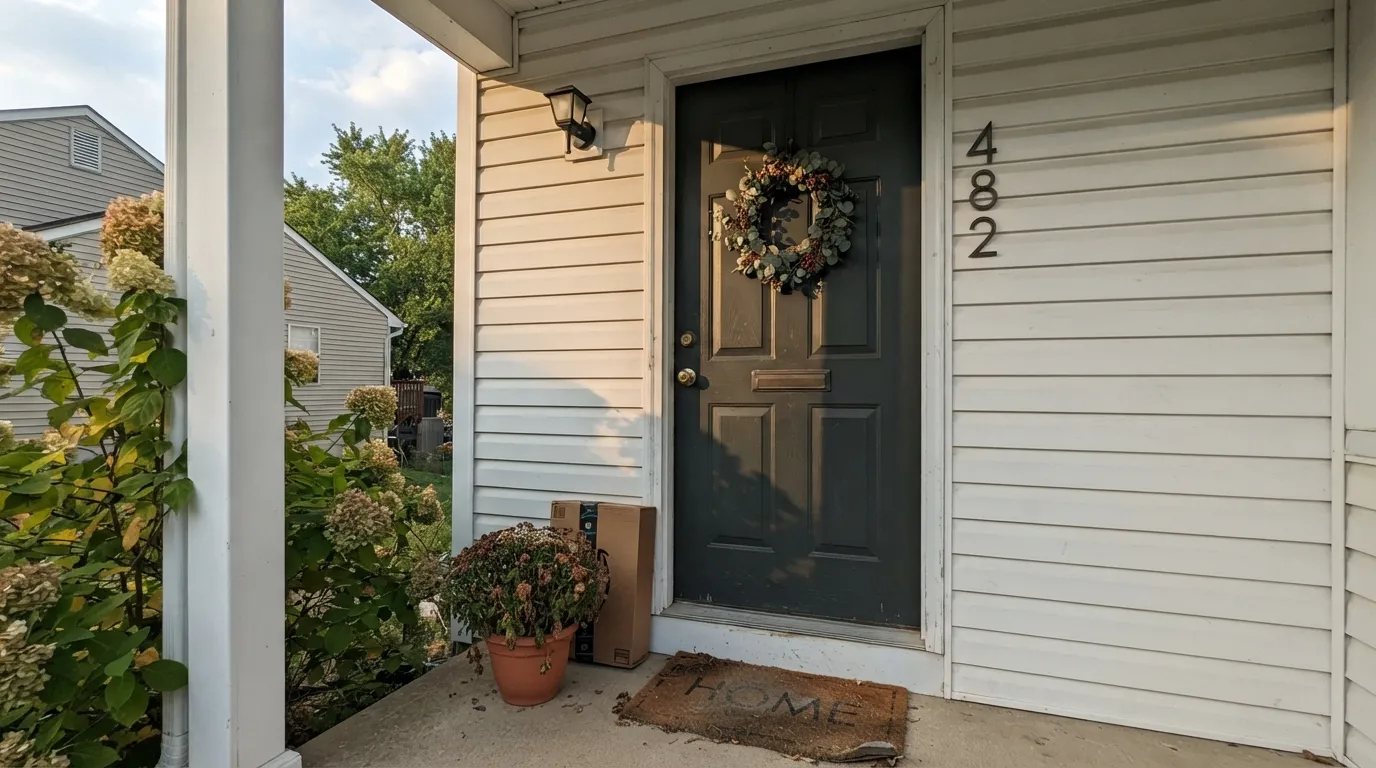
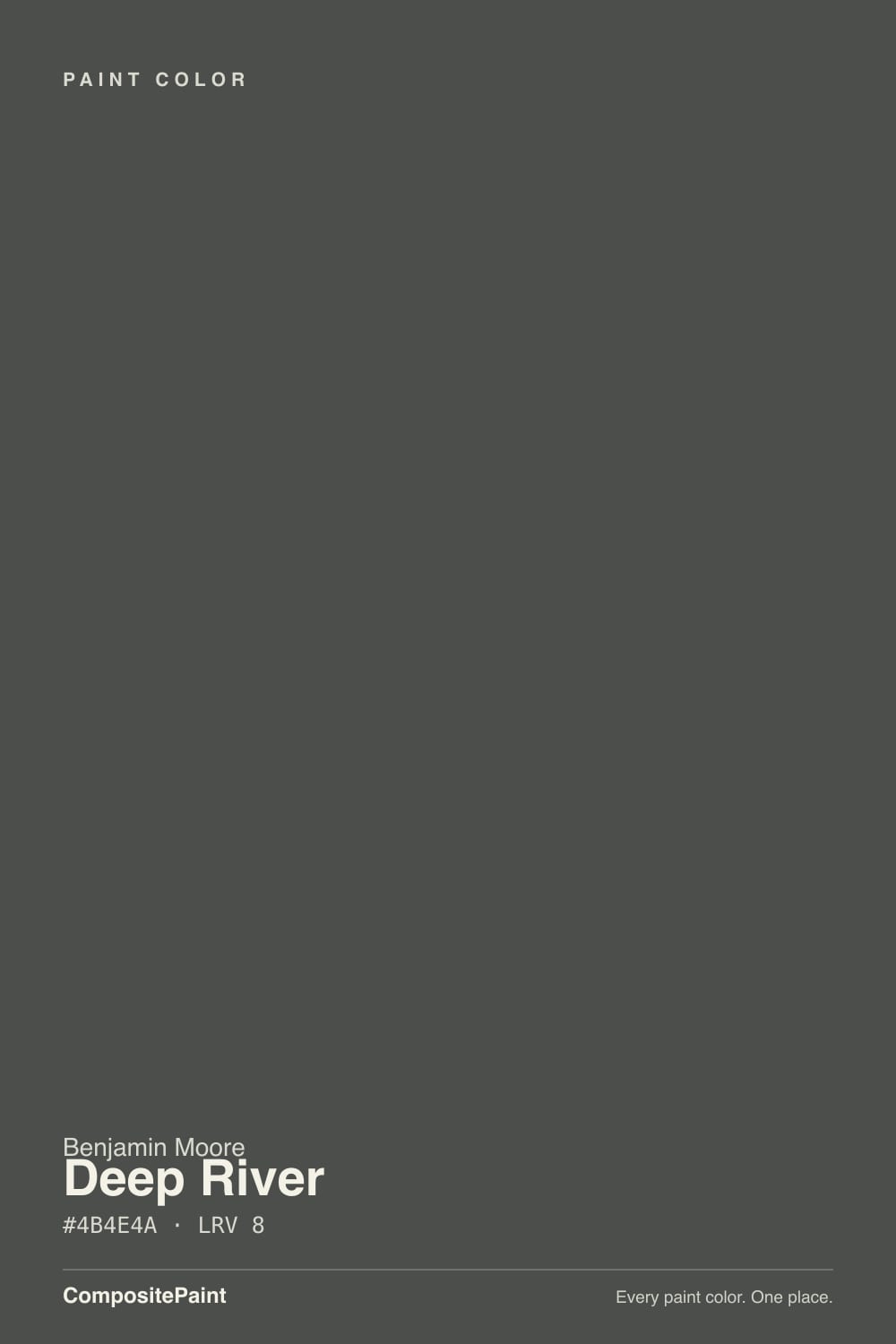
- 1Tricorn Black3
- 2Deep River8
The Fast Verdict
Deep River is Benjamin Moore's answer to "I want black, but not that flat": a low-saturation blend of green, gray and near-black that Benjamin Moore itself describes as evoking a jungle river. At LRV 8 it reads close to black most of the day, then opens up into a smoky charcoal-olive under warm light. It has sat in the Classics collection for years, quietly doing front doors, kitchen islands and library walls while flashier trend blacks came and went — proof it was never chasing a moment.
Front doors and shutters on a lighter-siding exterior · kitchen islands and cabinets · library, den or home-office walls with real lamp light · anyone who wants black's drama without true black's flatness
The room gets little daylight and you won't add warm lamps · you want a color you can call definitively black or definitively green, not both · your floors are strongly orange honey-oak · you're painting a small room that's already dim
- A genuine green-black blend that reads more alive than a flat, true black
- A long-standing Classics-collection color, not a chasing-the-trend pick
- Hides daily wear well on kitchen islands and cabinets
- An unexpected, sophisticated front-door and shutter accent against a light house
- Turns genuinely moody and rich in library or den lamplight
- Collapses to flat black with no visible green in a dim, unlit room
- Not a single, easily-identified color — some buyers expect a clean black or green
- Reads heavy and disconnected against strongly orange honey-oak floors
- Too dark and one-note for full exterior siding on most houses
What Color Is Deep River, Really?
A dark, low-chroma blend of green, gray and black — Benjamin Moore's own copy calls it a color that evokes the depth of a vast jungle river, and that description is more literal than most brand copy: it really does read as green-tinted black water rather than a clean single hue. The green is the whole personality here. Pull it next to a true neutral black like Iron Ore or Tricorn Black and Deep River suddenly looks warmer and more alive; pull it next to a true forest green like Essex Green and it suddenly looks much darker and much more gray. It lives in the gap between the two.
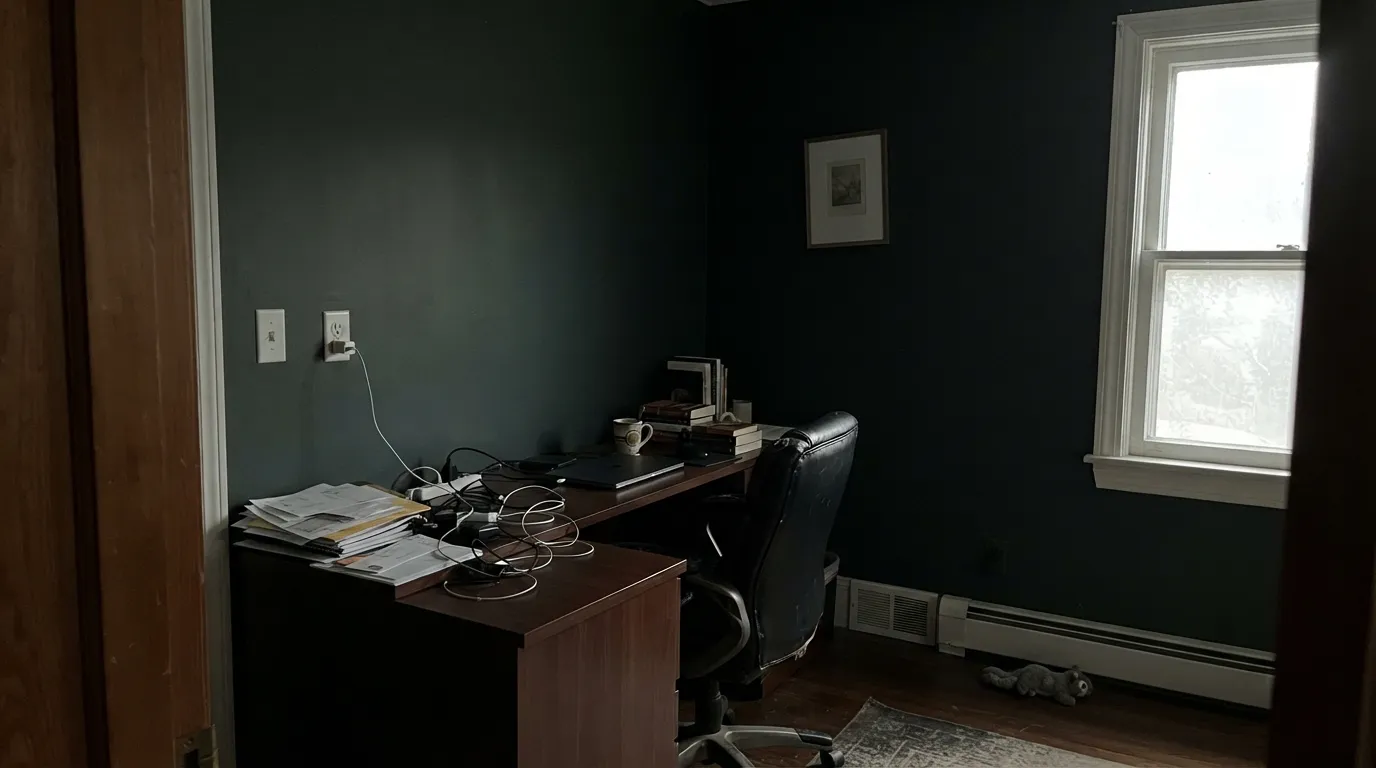
At LRV 8 it is functionally a near-black — deep enough that in low or indirect light it simply reads as black, full stop. That is the trade every buyer of a color like this makes: the more interesting, layered undertone only shows up when there is enough light hitting the wall to reveal it. In bright daylight it softens toward a blackened charcoal-gray; in dimmer, warmer light the green-gray comes forward and the color gets noticeably more textured and alive. Plan the room's light before you plan the paint.
Undertone in one line: green-gray first, black as the depth behind it — never a true blue-black. If your sample reads almost navy in the morning, that is cool north daylight flattening the green; if it reads olive by afternoon, that is warmer light doing its job. Both are the same paint, honestly reporting the light in your room.
Where It Shines
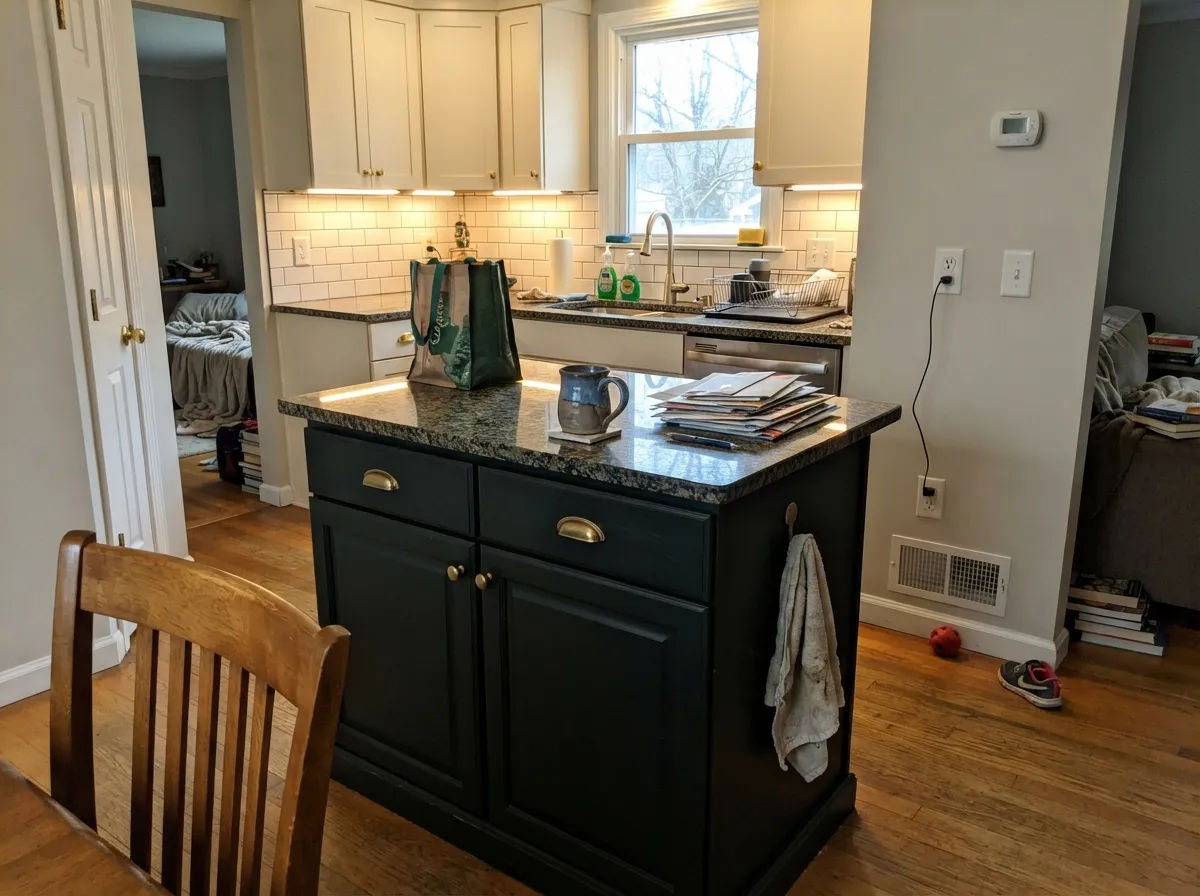
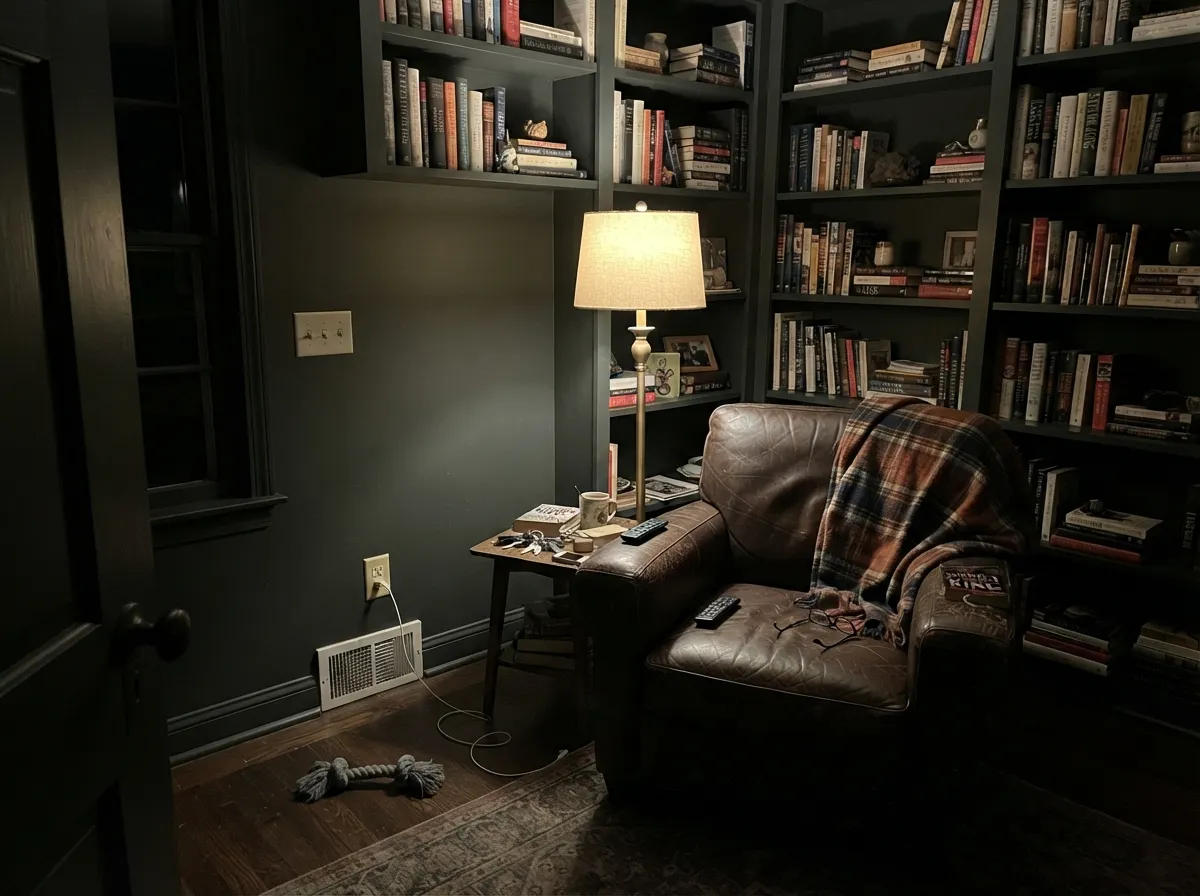
Give it a warm lamp and a real surface to sit on and Deep River stops being "a dark color" and starts being a specific one. On a front door against a lighter-colored house it reads as a considered, slightly unexpected alternative to black or navy — sophisticated without being predictable. On a kitchen island it holds up to the daily abuse of a high-traffic surface while still reading as a deliberate design choice next to granite with dark flecks or brass hardware. In a library, den or home office lit by lamps rather than overheads, the green comes forward at night and the room goes genuinely moody in the good sense.
Where It Fails
Almost every disappointed review of Deep River comes down to one of three mismatches, and all three are predictable before the first coat goes on. None of them are the paint's fault — but if your room matches one, this is not your color, and a bigger sample will only confirm it.
At LRV 8, a room that gets little daylight and has no warm lamps simply loses the green — Deep River collapses to a flat, featureless black wall with none of the depth that makes it worth choosing over a true black in the first place. If you can't add light, buy the plain black you actually wanted.
Deep River's green-gray undertone doesn't fight orange the way a true blue or violet would, but the contrast between a cool dark wall and a warm orange floor can read heavy and disconnected rather than intentional. It pairs far more naturally with walnut, espresso or pale white oak than with builder-grade honey oak.
Some buyers pick Deep River off a chip expecting either a clear black or a clear forest green and are unsettled when the wall commits to neither. That in-between quality is the entire point of the color — if you want certainty, choose Tricorn Black or Essex Green instead and skip the ambiguity.
Room by Room
Against a lighter-colored house (white, gray, pale greige siding) Deep River reads as a genuinely considered alternative to the default black or navy front door — dark enough to read as a strong statement, green enough to feel like it was chosen on purpose. Semi-gloss for durability and cleanability.
A dark, saturated color like this hides daily scuffs and handprints better than it looks like it should, and it plays well against granite or quartz with dark flecking. Satin, urethane-fortified cabinet enamel is the right call for anything that gets opened and closed daily.
Low, warm evening light is where this color is most itself. Built-ins, a full accent wall, or a lamplit reading nook all flatter it. Pair with walnut shelving and brass reading lamps rather than overhead fluorescents.
Works beautifully as a closed, evening-use living room with warm lamps and leather or wood furniture. In an open-plan space with mixed overhead lighting, it has to compete with cooler light from adjacent rooms and can read muddier than intended.
Small rooms take deep, saturated color well, and a powder room typically runs on warm sconce or vanity light rather than harsh daylight — exactly the condition Deep River wants. Satin on a vanity, matte or eggshell on the walls.
This is an accent color, not a body color. Full siding in a near-black green will read heavy on most homes and offers none of the light-and-shadow interest that makes it work as a door or shutter accent. Keep the body light and let Deep River do a smaller job.
Your Light Is the Risk
Warm 2700K light pulls the green-gray forward and the surface reads genuinely textured, not flat. This is the light the color was built for.
Without enough light hitting it, LRV 8 simply reads as black. The signature green undertone needs light to exist at all.
Cooler morning daylight can flatten it toward a blackened charcoal; by afternoon, warmer light lets the green-gray come forward. Sample it at both times before deciding.
2700K bulbs bring out the green and the depth. Cool white LEDs flatten it toward a plain, characterless black — swap the bulbs before you second-guess the paint.
Most complaints about Deep River are a light mismatch. Upload a photo of your actual room and see it on your walls — then ask for the same wall in north light or evening lamps before you buy a single sample.
Need It From Another Brand?
Any paint counter can custom-tint Benjamin Moore 1582 directly. If you would rather stay in one brand's own deck, these are the closest stock matches, measured as ΔE2000. Under 2 is a difference you will not see on the wall.
| Brand | Closest color | ΔE | LRV | |
|---|---|---|---|---|
| Sherwin-Williams | Rock BottomSW 7062 · Sherwin-Williams | 1.0 | 7 | Color page → |
| Behr | Forest FloorPPF-55 · Behr | 2.2 | 7 | Color page → |
| Valspar | Sable Calm5002-2C · Valspar | 1.3 | 7.3 | Color page → |
| PPG / Glidden | LicoricePPG1009-7 · PPG / Glidden | 1.9 | 8 | Color page → |
| Glidden | Enchanted Forest Green30GY 07/051 · Glidden | 1.7 | 7 | Color page → |
| Dutch Boy | Mertie Kay425-7DB · Dutch Boy | 4.6 | 7 | Color page → |
Similar Benjamin Moore Colors
The nearest shades to Deep River within Benjamin Moore's own range, ranked by perceptual color distance — useful when you want the same look a touch lighter, darker, or warmer.
WCAG 2.1: AA is 4.5 : 1 for normal text, 3 : 1 for large text, AAA is 7 : 1.
Deep River vs the Colors You're Also Considering
Every Deep River sample board has the same rivals on it. The numbers show the real lightness gap — then it comes down to which risk you would rather live with.
Pick this for the lighter, more gray-black balanced version of the same dark-green family.
Benjamin Moore PM-22 · LRV 4Essex GreenPick this if you want it to commit to green outright — an exterior classic that reads even darker and more forest-toned.
Pick this for the green-black option, once you've confirmed your light actually shows the green.
Benjamin Moore HC-154 · LRV 6Hale NavyPick this if you want the blue-black your sample flashed in cool morning light — a safe, unambiguous navy instead.
Deep River Coordinating Colors
The pattern with Deep River is simple: keep everything around it either clean and warm-white or cool and quiet, and let the wall carry the color. It leans on soft neutral whites for trim, cool grays for a calmer surrounding room, and its own darker green-black family for a tonal, layered look. These are the partners that keep showing up in rooms that work:
Deep River's Place in the Deck
Deep River has sat in Benjamin Moore's Classics collection for years without ever needing a Color of the Year moment to sell itself — it is the quiet, dependable alternative for buyers who find true black one-note and true green too committed. That is a narrower job than a trend color, but it is a stable one: unlike a saturated statement green or a name-brand black, Deep River doesn't date itself to a decade, because it was never chasing a look in the first place.
That also means it is a specialist color, not a whole-house neutral. It shows up again and again on the same short list of jobs — front doors, kitchen islands, library built-ins — because those are the places a small, dark, layered surface reads as intentional rather than overwhelming.
Deep River With Wood Tones and Floors
Walnut, espresso and pale or gray-washed white oak are the easiest partners — their cooler or neutral cast doesn't fight the green-gray in the paint, so the pairing reads deliberate and grounded. Cabinets or built-ins in Deep River look genuinely custom next to any of these.
Strongly orange honey-oak is the one combination worth sampling carefully first. It isn't a hard clash the way a true violet or blue would create, but the temperature gap between a cool dark wall and a warm orange floor can read disconnected rather than intentional in a full room. On an island or a single accent surface it's rarely a problem; across four walls with wall-to-wall honey oak, test a large sample before committing.
Three Ready Palettes Built on Deep River
A color is never alone on the wall. These are complete combinations in the 60-30-10 pattern, with the reason each one holds together. Every one opens in the visualizer.
White Dove keeps the house body warm and soft, Gray Owl on the shutters bridges to the door's cool green-gray, and Deep River gets to be the one genuinely dark, considered note on the whole facade.
Try this palette in your roomWhite Dove trim keeps the room from feeling like a cave in daylight, while Chelsea Gray in the connecting hallway steps down gradually instead of jumping straight from near-black to bright white.
Try this palette in your roomSwiss Coffee's warmth keeps the surrounding kitchen bright and forgiving of the one dark surface. Deep River on the island becomes the anchor piece it's meant to be, and Pale Oak gives a softer landing spot for a breakfast nook or built-in desk in the same room.
Try this palette in your roomDeep River FAQ
Is Deep River a green, a black, or a gray?
All three, in that order of importance. It's built as a green-gray with black depth — Benjamin Moore describes it as evoking the color of a jungle river. At LRV 8 it reads close to black most of the time, and the green only shows up clearly with real light on it.
Is Deep River good for a front door?
Yes — it's one of its best jobs. Against a lighter-colored house it reads as a deliberate, slightly unexpected alternative to the default black or navy door. Use a semi-gloss exterior enamel for durability.
What light does Deep River need to look right?
Real light, direct or warm-lamp. In a dim room with no lamps it just reads as black, losing the green entirely. Warm 2700K bulbs bring the color out at night; cool LEDs flatten it.
Can I use it on kitchen cabinets?
Yes, especially on an island. It holds up well against granite or quartz with dark flecking and hides daily scuffs better than you'd expect from a color this dark. Use a satin, urethane-fortified cabinet enamel — it takes daily opening and closing better than a standard wall paint.
How is Deep River different from a true black like Iron Ore or Wrought Iron?
Iron Ore is a neutral black with no real undertone story. Wrought Iron is a softer, lighter near-black. Deep River is the one with a genuine green-gray cast running through it — put them side by side and Deep River is visibly the warmer, more alive-looking one of the three.
How many coats does it take over a lighter wall?
Plan on a gray-tinted primer first, then two finish coats. Going straight over a light color without priming a very dark tone like this is the slow, expensive way to end up needing a third coat anyway.
Have you painted with Deep River?
Rate it — one tap helps the next reader decide.
Ask a Question