Ashwood Moss
A near-black moss-gray Benjamin Moore rarely puts in a headline, reviewed honestly: when the green actually shows, when it flattens to plain black, and what to pair it with.

Jessica has spec'd whites and neutrals for more than 300 rooms and keeps a sample wall of painted drawdowns in her studio. Every color review is checked against real reader rooms in the comments and re-tested when a formula changes. About the testing process →
- 1Fired Bronze5
- 2Ashwood Moss10
- 3Kendall Charcoal15
- 4Retreat21
The Fast Verdict
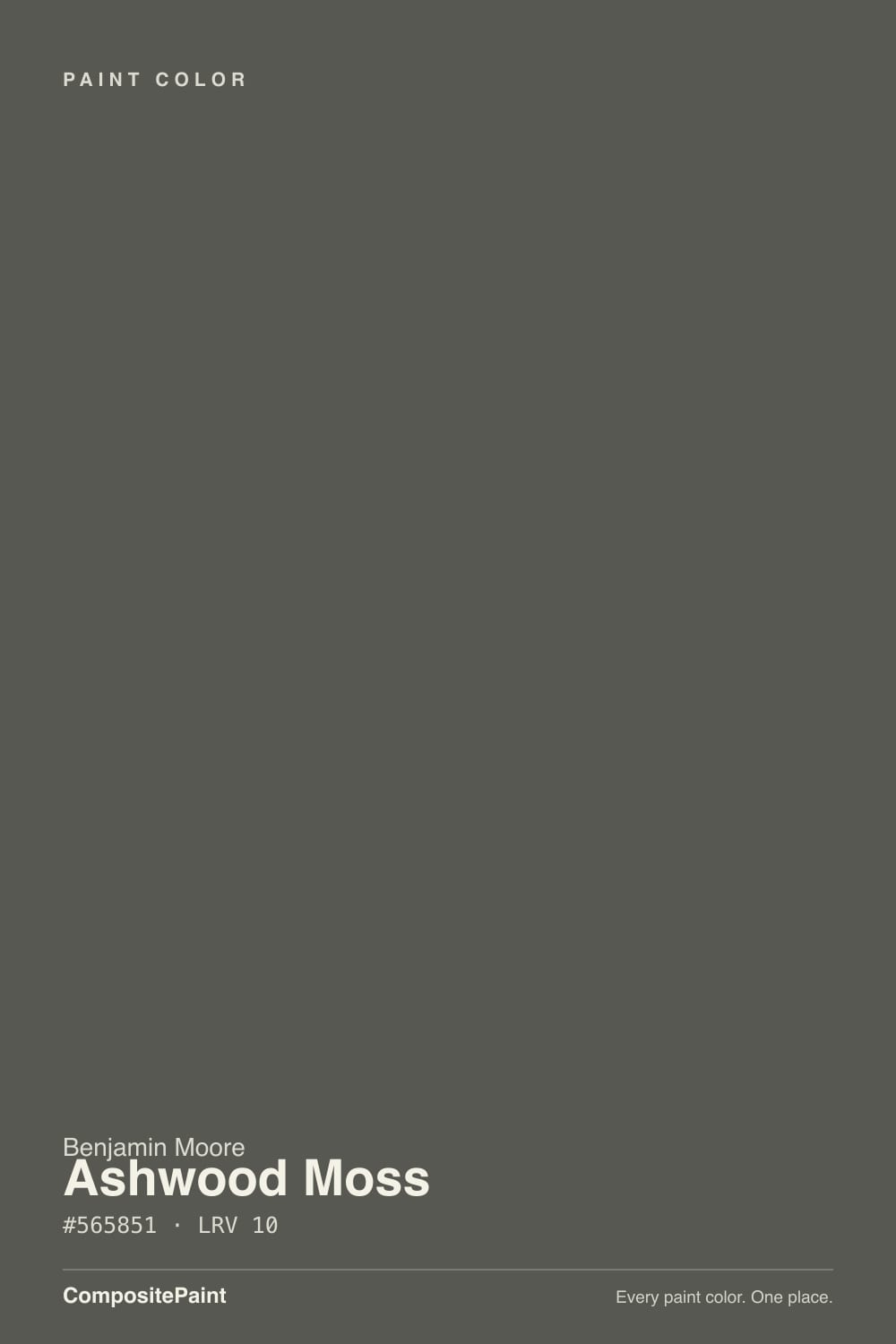
Ashwood Moss is what you get when a near-black picks up a whisper of green instead of staying purely neutral. At LRV 10 it sits in true dark-color territory — deep enough to read almost black in ordinary light, with just enough moss underneath to surprise you when the sun hits it right. It is not a color that performs for a camera on the chip rack; it is a color that rewards a front door, an island, or a set of built-ins with real light falling on them.
Front doors and exterior shutters · kitchen islands and built-ins · one accent wall with real daylight · anyone who wants a near-black with more depth than flat charcoal
You want the green to read clearly green indoors · your room stays dim or north-facing with no real light source · you're painting all four walls with nothing bouncing light back · you want true black with zero undertone guesswork
- Reads as a considered near-black with real depth, not flat charcoal
- Front doors and islands come alive under real light
- Dark enough (LRV 10) to hide scuffs and hold its color in bright rooms
- Pairs cleanly with warm whites, brass and walnut without a fight
- Quiet enough to skip trend risk — nobody mistakes it for a statement green
- The green is subtle to the point of invisible in flat or cool light
- Painted on all four walls in a dim room, it goes cave-dark fast
- Buyers hoping for a clearly green statement color will be disappointed
- Fewer public real-room photos than famous siblings like Kendall Charcoal or Wrought Iron — sample big before committing
What Color Is Ashwood Moss, Really?
Ashwood Moss pairs two ideas in its name — the grayness of ashwood, the green of moss — and the hex backs it up almost exactly: red 86, green 88, blue 81. The green channel edges out red and blue by only a few points, which is why our own color-matching engine files this one under Gray rather than Green — the softest possible whisper of a hue riding on top of a near-neutral charcoal. It is not a color that announces itself in a paint fan; you notice it only once it's on a real surface and the light hits it right.
At LRV 10 it sits in genuine near-black territory — darker than Kendall Charcoal (LRV 13), the same depth as Benjamin Moore's own Silhouette (LRV 10), and lighter only than true near-blacks like Wrought Iron (LRV 6). That depth is the whole story: a color this dark absorbs almost all the light that reaches it, so it needs a real source — sun through a window, a well-aimed sconce, a bright exterior — to give the green anything to reflect back. Without that light, it reads exactly like an ordinary black-brown, no moss in sight.
Undertone in one line: green first, buried under gray, never blue and never a true flat black. In strong daylight or warm lamplight the moss comes forward, soft rather than minty or forest-bright. In flat, shaded, or cool-LED light, expect it to read as plain dark charcoal — a perfectly good look, just not the one the name promises.
Where It Shines
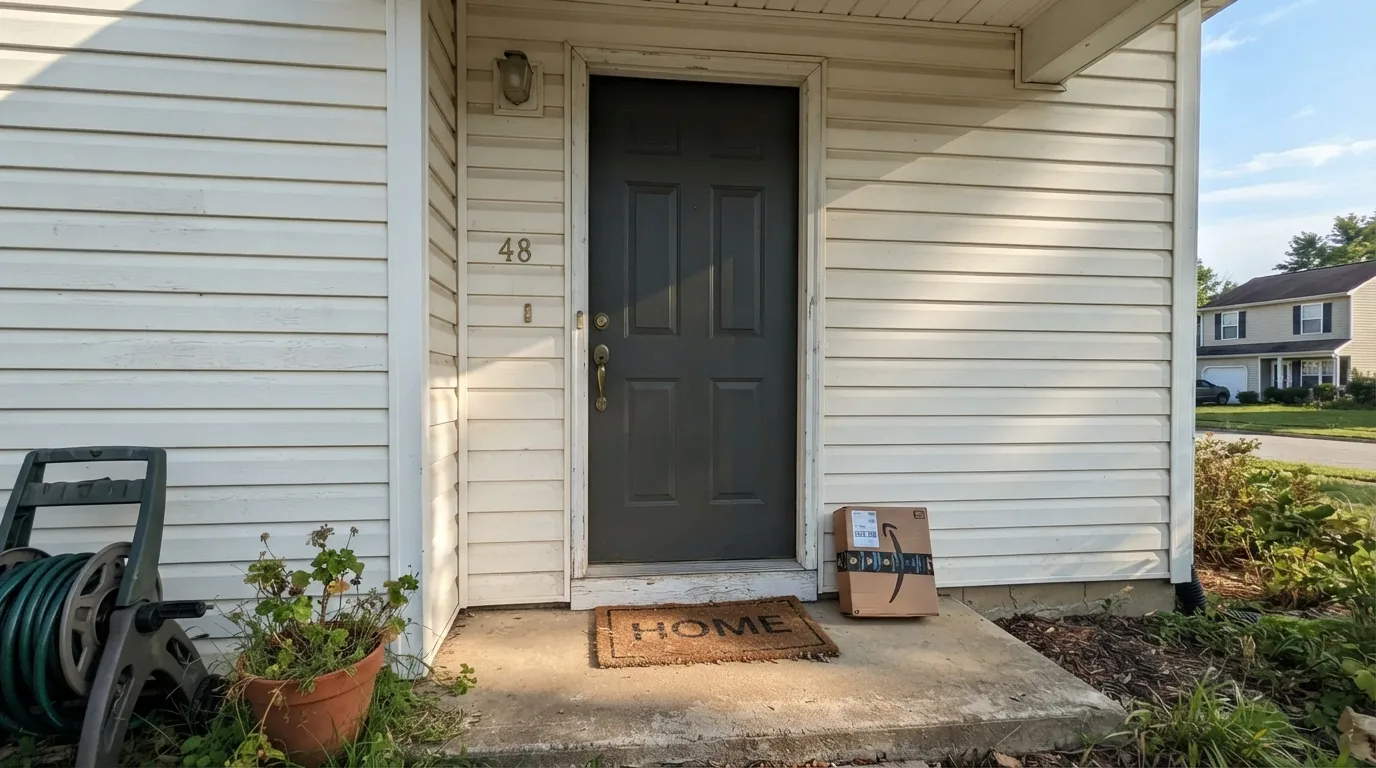
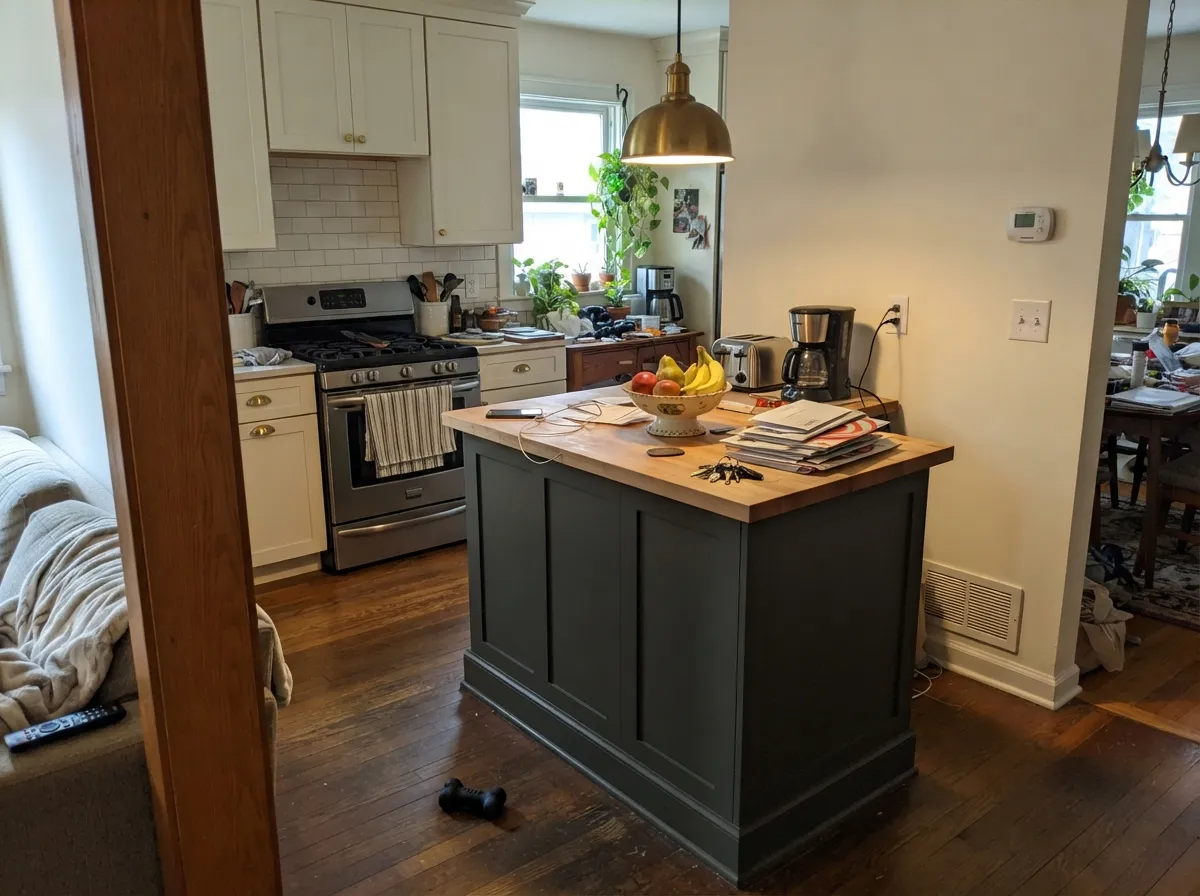
Give it real light and a surface that isn't trying to hide, and Ashwood Moss earns its keep. Front doors are its natural home — full sun brings the green forward against a white or greige siding without the flat starkness of true black. On a kitchen island under pendant light, or on built-ins that catch afternoon sun, it reads as a deep, considered neutral with just enough personality to make guests ask what color it actually is.
Where It Fails
Almost every disappointing story with a color this dark follows one of three scripts, and all three are predictable before the first coat. None of them are the paint's fault — but if your room or your light matches one, sample big before you commit past a door or a cabinet.
At this LRV the green is a whisper, not a statement — most people cannot see it unless the light is doing real work. If your goal is a flat, zero-ambiguity black, Wrought Iron gives you that without any undertone guessing; Ashwood Moss will always trade a little unpredictability for depth.
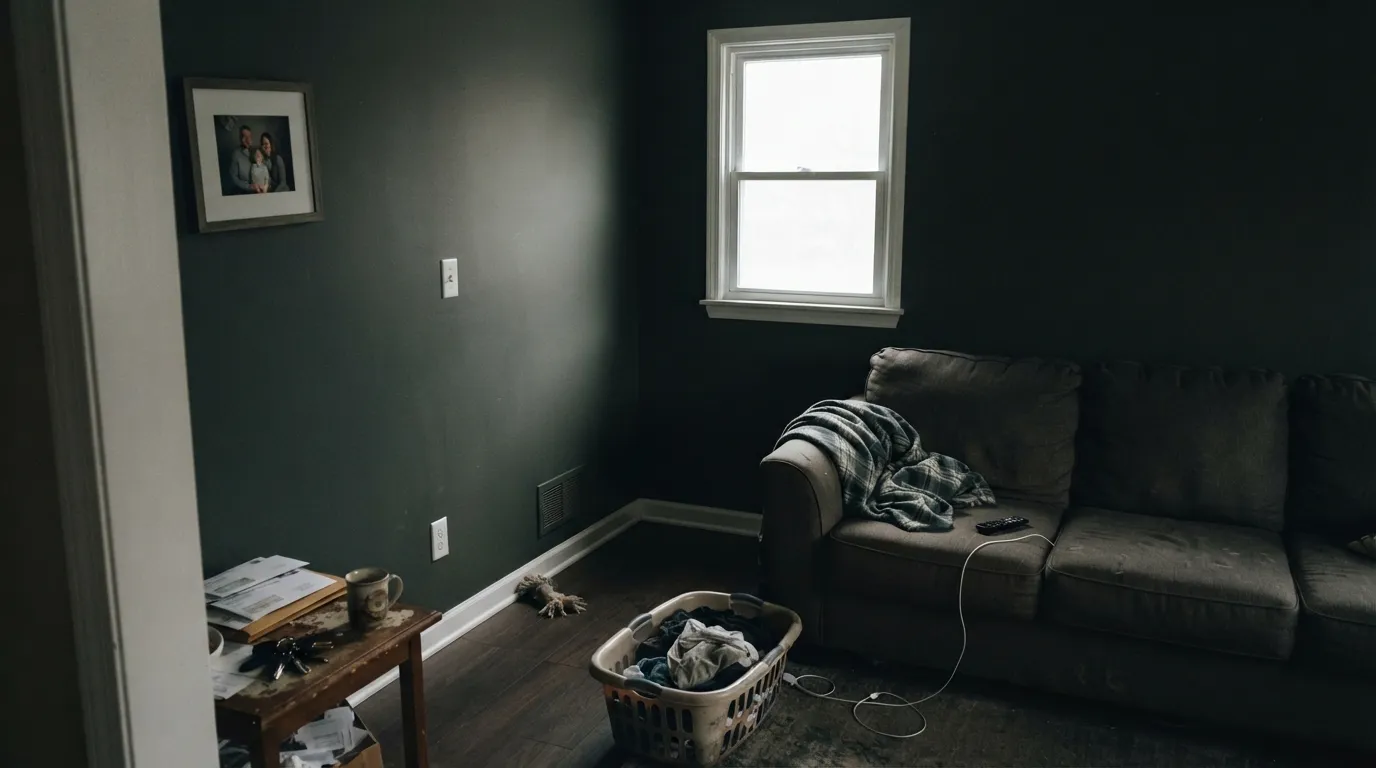
A near-black this deep needs light bouncing back at it. Painted floor-to-ceiling in a room with one small window, it goes cave-dark and flat fast — the same complaint every color at LRV 10 or below collects. Use it on one wall, on cabinetry, or on trim where the depth reads as intentional, not just dim.
Cold light strips out what little warmth the green carries and leaves a flat, slightly muddy near-black. On a shaded north wall or under a bluish porch light, expect it to look almost indistinguishable from a plain charcoal — swap to warm-toned exterior lighting before assuming the paint is wrong.
Room by Room
Semi-gloss Ashwood Moss under real sun reads sophisticated and just barely green against a warm or white siding. It photographs differently through the day, which is part of the appeal rather than a flaw.
Under a lighter perimeter (Swiss Coffee or White Dove) it anchors a kitchen without swallowing the room. Satin urethane-fortified enamel handles fingerprints and knife-block traffic better than a matte finish will.
Against light siding it reads as a considered dark neutral rather than a color decision. It sits close enough to Kendall Charcoal and Wrought Iron in depth to coordinate with either without matching exactly.
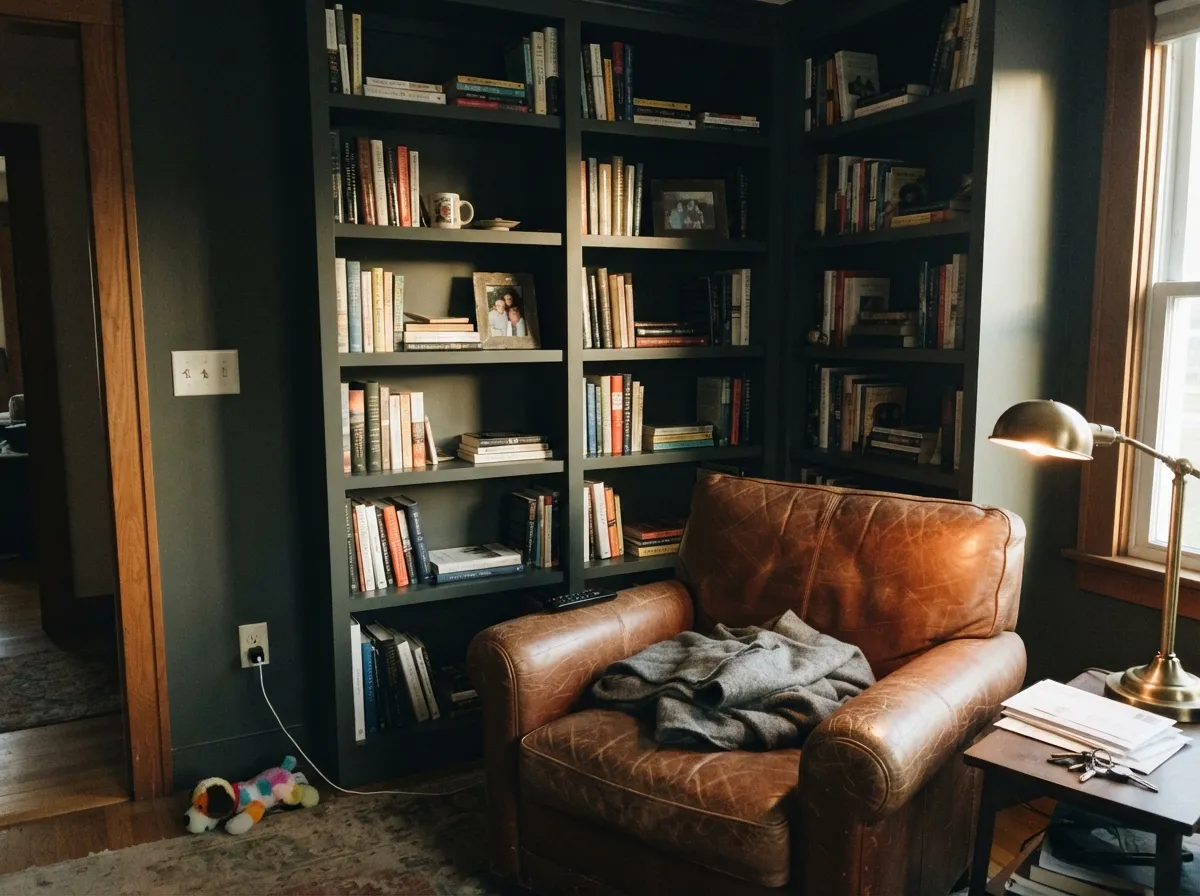
Bookshelves and cabinetry that catch real daylight show the moss best. Walnut, leather and brass hardware are natural company; eggshell on any adjoining trim keeps the edges soft.
A near-black this deep works well in a room you only pass through — drenching all four walls in a small powder room reads intentional in a way it might not in a bedroom you sit in all day.
Beautiful with a working lamp and warm wood nearby; disappointing as the only dark note in an otherwise dim, north-facing room. Test a large sample where the sun actually reaches before committing a full wall.
Your Light Is the Risk
Direct daylight — through a window or on a sunlit exterior — is what wakes the moss underneath the charcoal. This is the light the color needs to prove its name.
Cool, indirect light flattens it into a plain near-black with no visible green. Fine if you half-wanted black; disappointing if you bought it for the moss.
A distinct green-bronze flush at golden hour, settling back toward near-black the rest of the day. The shift is subtle but real — most owners notice it and like it.
2700K lamps keep a trace of the moss warmth alive after dark. Cool white LEDs erase it entirely and leave a flat, slightly cold black.
Most complaints about Ashwood Moss are a light mismatch. Upload a photo of your actual room and see it on your walls — then ask for the same wall in north light or evening lamps before you buy a single sample.
Need It From Another Brand?
Any paint counter can custom-tint Benjamin Moore 1484 directly. If you would rather stay in one brand's own deck, these are the closest stock matches, measured as ΔE2000. Under 2 is a difference you will not see on the wall.
| Brand | Closest color | ΔE | LRV | |
|---|---|---|---|---|
| Sherwin-Williams | PreludeSW 9620 · Sherwin-Williams | 4.2 | 9 | Color page → |
| Behr | Twilight ForestECC-47-3 · Behr | 0.9 | 9 | Color page → |
| Valspar | Sable Evening5006-2C · Valspar | 1.0 | 9.9 | Color page → |
| PPG / Glidden | Evergreen BoughsPPG1129-7 · PPG / Glidden | 3.6 | 9 | Color page → |
| Glidden | Forest Black30YY 10/038 · Glidden | 4.0 | 10 | Color page → |
| Dutch Boy | Ship's Anchor437-6DB · Dutch Boy | 4.6 | 10 | Color page → |
Similar Benjamin Moore Colors
The nearest shades to Ashwood Moss within Benjamin Moore's own range, ranked by perceptual color distance — useful when you want the same look a touch lighter, darker, or warmer.
WCAG 2.1: AA is 4.5 : 1 for normal text, 3 : 1 for large text, AAA is 7 : 1.
Ashwood Moss vs the Colors You're Also Considering
Every Ashwood Moss sample board has the same rivals on it. The numbers show the real lightness gap — then it comes down to which risk you would rather live with.
Pick this for the darker, quieter version — Ashwood Moss sits two LRV points lower and keeps the green better hidden.
Benjamin Moore 462 · LRV 12Vintage VoguePick this if you want almost the exact same green-charcoal with a fraction more brightness — the two read like siblings.
Pick this when you want the idea of a dark green without anyone quite agreeing what color it is.
Sherwin-Williams SW 6187 · LRV 12RosemaryPick this for a green that actually reads green in daylight — Rosemary keeps more chroma and less gray.
Within Benjamin Moore, Randolph Gray CW-85 at #58584E and LRV 10 is the closest neighbor and carries a touch more yellow. Iron Mountain 2134-30 at #575553 and LRV 9 is the more neutral, slightly cooler alternative if the olive worries you. Gray 2121-10 at #585858 and LRV 12 is straight neutral and marginally lighter. Aegean Olive 1491 at #5D594C and LRV 12 is the openly olive version, and Dakota Shadow 448 at #515D51 and LRV 12 is the openly green one.
Across brands, Behr Twilight Forest ECC-47-3 at LRV 9 is 0.95 away in color difference and Valspar Sable Evening 5006-2C at LRV 9.9 is 0.98, both effectively the same color. Magnolia Home Locally Grown JG-126 at LRV 10 is 1.27, which is visually identical in normal room light.
Dunn-Edwards Midnight Spruce DE6294 at 2.36 and Rodda Foundation at 2.29 are very close, so sample first. Sherwin-Williams Prelude SW 9620 at 4.22 and Farrow and Ball Reduced Green No. 313 at 4.07 are close but visibly different side by side.
Ashwood Moss Coordinating Colors
The rule for coordinating with Ashwood Moss is light before hue: pair it with something bright enough to bounce light back at it, or the green whisper disappears entirely. Warm whites and soft greiges do the most work here; brass and walnut read naturally against the near-black depth. These are the partners that keep the color legible instead of just dark:
An Honest, Under-the-Radar Deep Green
Ashwood Moss doesn't come with a design-blog origin story or a Color of the Year trophy — it is one of the quieter entries in Benjamin Moore's full color deck, the kind of near-black that shows up on a contractor's fan deck more often than in a magazine spread. That obscurity is not a flaw. Kendall Charcoal and Wrought Iron get most of the attention because they are safe and famous; Ashwood Moss offers nearly the same depth with a genuinely different, if subtle, undertone for anyone who has already painted a door Wrought Iron and wants the next house to look different without going lighter.
If there is a real risk here, it is the opposite of a trend problem: because far fewer people have painted a whole room in it, there is a smaller public record of how it behaves room to room compared with its famous siblings. Treat the sample-first advice in this review as doing more work than usual — test it in your own light before committing to more than a door or a cabinet.
Ashwood Moss With Wood Tones and Floors
Dark wood and this color merge rather than contrast — walnut trim or a walnut door frame next to an Ashwood Moss door can read as one continuous dark element, which some homeowners want and others don't. If you want the door to stand out as its own object, keep the surrounding wood lighter: natural cedar, white oak, or painted trim.
Golden honey oak floors are a milder version of the clash that plagues brighter greens: the near-black doesn't fight the orange the way a true green would, but it doesn't soften it either. Pale oak, walnut, or a painted floor all read cleaner next to it. Brass and aged bronze hardware are the easy win — both metals warm up against the green-charcoal instead of looking cold.
Three Ready Palettes Built on Ashwood Moss
A color is never alone on the wall. These are complete combinations in the 60-30-10 pattern, with the reason each one holds together. Every one opens in the visualizer.
White Dove keeps the siding warm and quiet so the door can carry the color; Kendall Charcoal on the shutters sits close enough in depth to feel coordinated without competing, and the small green whisper in the door is what makes people ask what color it actually is.
Try this palette in your roomSwiss Coffee keeps the perimeter light and warm so the kitchen doesn't go dark on top of a near-black island; Edgecomb Gray bridges the two without pulling toward either the cream or the charcoal, and brass hardware on the island finishes the look.
Try this palette in your roomBallet White keeps the room bright enough to feed light back to the dark built-ins, and Chelsea Gray on the fireplace surround adds one more step of gray-green between the two ends without introducing a new hue.
Try this palette in your roomAshwood Moss FAQ
Is Ashwood Moss black or green?
Officially green — just barely. At hex 565851 the green channel edges out red and blue by only a few points, and our own color engine files it under Gray rather than Green because the hue is so muted. In daylight or warm lamplight you'll see a soft moss cast; in flat or cool light it reads as a plain near-black. Both are honest readings of the same paint.
What's the undertone?
Green, cloaked in gray — never blue, never a truly flat black. It sits close to Benjamin Moore's own Vintage Vogue and Sherwin-Williams' Rosemary, just quieter than both. If your sample looks like flat charcoal with no hint of moss, that's your light, not a bad batch — test it somewhere the sun actually reaches.
Is it good for a front door?
Yes — this is its best job. In full sun the green comes forward against a warm or white siding, and the near-black depth (LRV 10) reads considered rather than heavy. Semi-gloss holds up to weather and shows the color's small shift through the day.
Can I use it on kitchen cabinets or an island?
Very well, especially on an island under a lighter perimeter — Swiss Coffee or White Dove keeps the room from going dark on top of a near-black anchor. Use a satin urethane-fortified cabinet enamel; it handles fingerprints and knife-block traffic better than matte.
Can I paint a whole room in it?
Only with real daylight or serious lamp wattage. At LRV 10 it swallows light rather than bouncing it back, so four walls in a dim or small room reads cave-dark fast. It is safer as a single wall, a set of built-ins, or trim against a lighter room — the same rule that governs every near-black this deep.
What white or trim goes with Ashwood Moss?
A warm off-white keeps the pairing soft — White Dove or Swiss Coffee both work, especially outdoors or on cabinetry. For more contrast, a brighter white like Chantilly Lace sharpens the edge, but expect the near-black to read a touch cooler and blacker next to it.
Have you painted with Ashwood Moss?
Rate it — one tap helps the next reader decide.
Ask a Question