Rainy Afternoon
The mid-depth sea green on Hidden Gem's strip, reviewed honestly: where it goes botanical, the light that turns it slate, and what to pick instead.

Jessica has spec'd whites and neutrals for more than 300 rooms and keeps a sample wall of painted drawdowns in her studio. Every color review is checked against real reader rooms in the comments and re-tested when a formula changes. About the testing process →
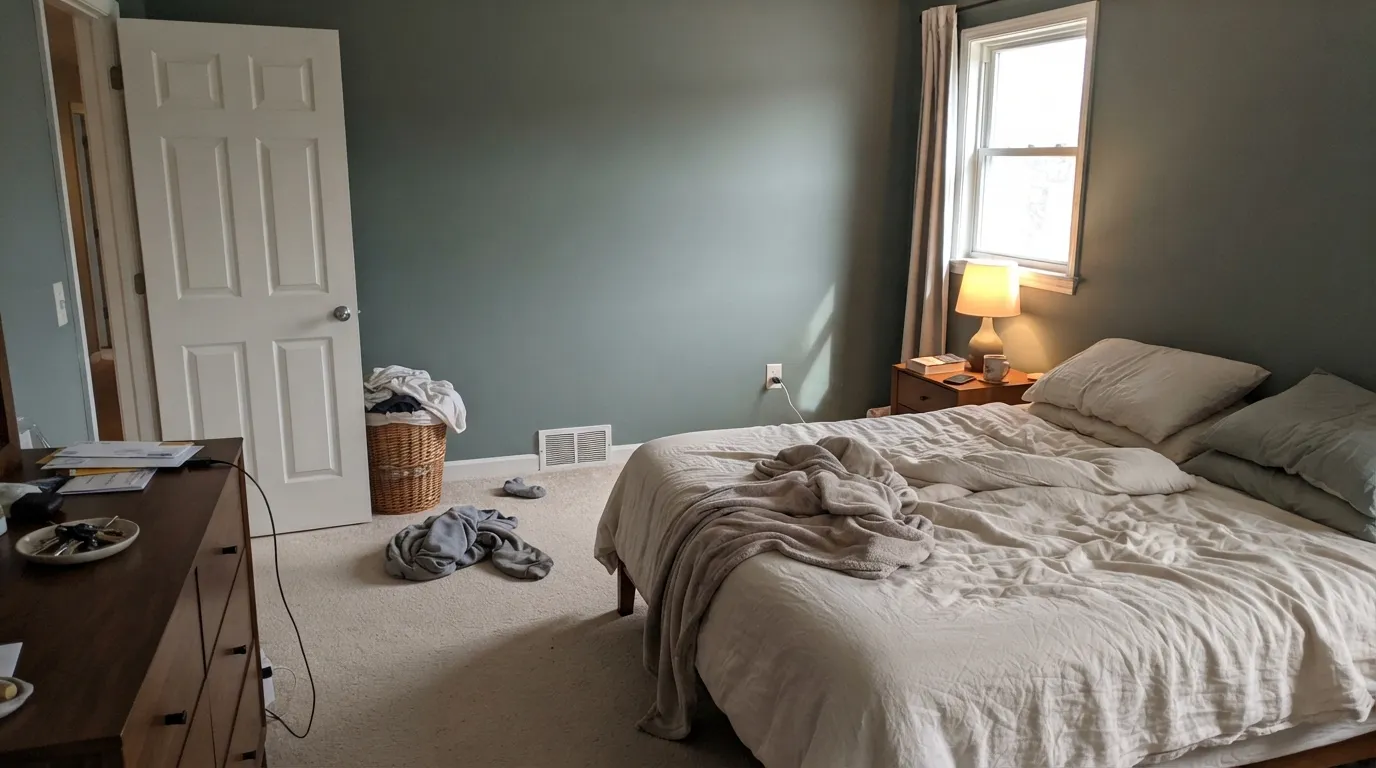
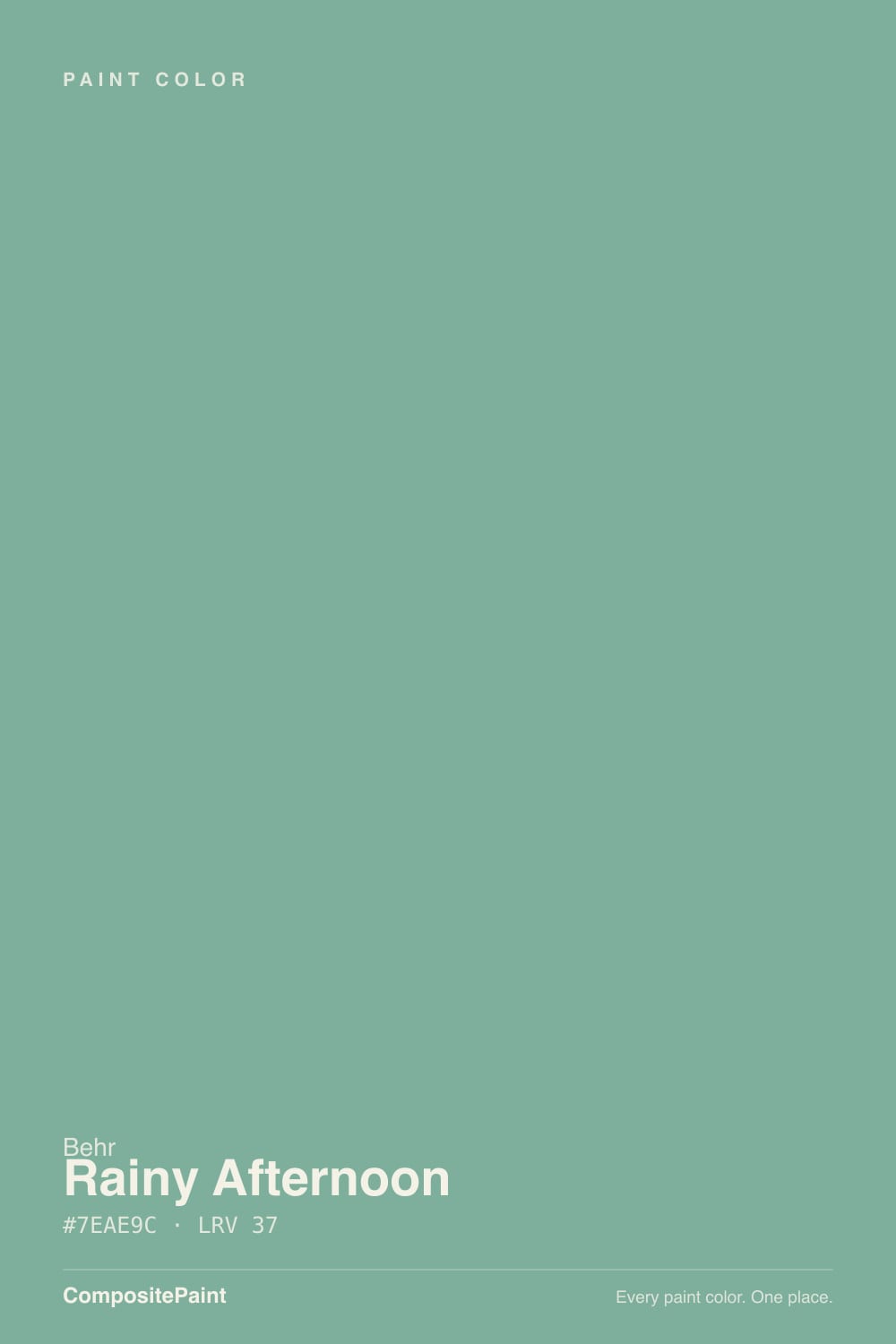
- 1Salamander6
- 2Hidden Gem14
- 3Rainy Afternoon31
- 4Green Meets Blue36
- 5Wythe Blue48
The Fast Verdict
Rainy Afternoon is a mid-depth muted sea green at LRV 31 — green enough to read botanical, gray and blue enough that people keep saving it as a bathroom gray. In south light it is a dusty weathered green; in a dim north room the green drops out and you are left with charcoal-slate. Buy it for bedrooms, baths, and cabinets that have real daylight. Do not buy it hoping for gray, and do not grab Benjamin Moore's darker Rainy Afternoon by mistake.
Daylit bedrooms and bathrooms · kitchen cabinets and vanities · one committed accent wall · anyone who wants muted sea green, not sage and not gray
The room faces north and stays dim · you actually wanted gray · your floors are cool gray LVP and the trim is icy white · the bath has no window · you meant Benjamin Moore 1575
- Muted sea green that still behaves like a colored neutral — botanical without mint
- Mid-tone at LRV 31: four walls and cabinets both work in daylight
- Same N430 strip as Hidden Gem, so a darker accent is already sitting next to it
- Flatters pale oak, walnut, cherry, brass, and brushed nickel
- Easy to sample and buy on a Saturday — a Home Depot mix, not a special-order mood
- Goes charcoal-slate in dim north rooms and windowless baths
- Not gray — buyers expecting gray see sea-green by the second wall
- Icy whites and cool gray floors flatten it to muddy slate
- Thinner public record than Evergreen Fog or Sea Salt — fewer owner photos to steal from
What Color Is Rainy Afternoon, Really?
A muted blue-green gray with the volume turned almost all the way down — sea glass after a storm, not a leafy sage and not a spa teal. The hex sits at 136-154-149: green a notch ahead of blue, almost no yellow in the mix, chroma so low the chip can pass for weathered stone. That is the whole personality. Behr files N430-4 in the green family. On a spectrophotometer it is a cool gray with a cyan-green nudge. Both are telling the truth: on the card it looks like a quiet gray-green; on four walls in daylight the sea-green is the first thing you notice, and the charcoal is what keeps it from going mint. It is not olive, not herb, not Hidden Gem's deeper jade. It is the mid step on that same N430 strip — the Home Depot color people grab when they want botanical without committing to a statement green.
At LRV 31 it is a genuine mid-tone, the useful middle of a moody green shelf. Evergreen Fog (SW 9130, LRV 30) is the same depth and a different plant: olive-sage, not sea. Natures Gift (N410-4, LRV 35) is a half-step lighter and a gray-built herb. Hidden Gem (N430-6A, LRV 14), Behr's 2026 Color of the Year and two steps down this strip, is the dark smoky jade people drench a study in. Sherwin-Williams Sea Salt (SW 6204, LRV 63) is the famous airy cousin — a full 32 points lighter, a wash where this is a wall. Plan for Rainy Afternoon to read a half-step deeper and slightly more blue-green on four walls than it does on the chip. Depth multiplies undertone on every muted green, and the number-one surprise is that the gray you sampled is not the gray you get.
Undertone in one line: cool sea-green first, charcoal and a whisper of blue second — never yellow-sage, never mint, never a true gray. If the sample reads dusty botanical green, that is south or west daylight doing its job. If it reads flat slate or blue-charcoal, the light is cool or the room is too dim. Under 2700K lamps the gray comes forward and the green recedes, which is why evening photos look stormier than noon photos. All three versions are the same paint being honest about the room.
Where It Shines
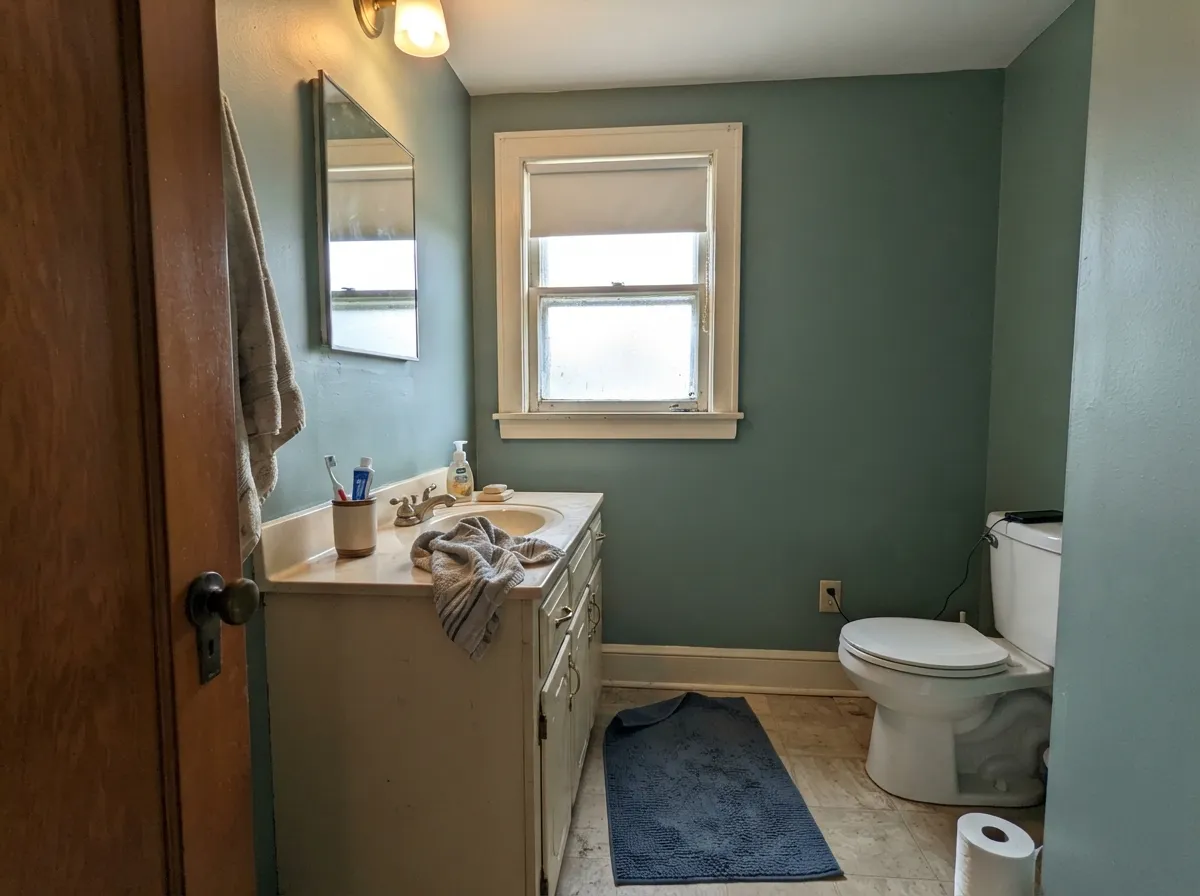
Give it real daylight, a warm white on the trim, and wood, and Rainy Afternoon does the quiet coastal-botanical thing people actually want from a gray-green: a room that feels settled and a little weathered without anyone naming teal. South- or west-facing bedrooms and bathrooms are where it earns the can; satin cabinets and vanities are the low-risk second home, because a smaller surface keeps the muted sea green looking intentional instead of weather-dependent. Pair it with White Dove or Alabaster, pale oak or walnut, brushed nickel or unlacquered brass, and it looks like it came with the house.
Where It Fails
Almost every regret story about Rainy Afternoon follows one of three scripts, and all three are visible on a big sample before you open a gallon. None of them are a coverage problem. If your room matches one, sampling bigger will only confirm it.
Cool, weak light kills the green and leaves a flat charcoal-slate that readers of every similar muted sea green call dingy, blue-gray, or just dark. At LRV 31 there is not enough bounce to rescue a room that already runs dark. You did not get a botanical wall; you got a storm-cloud gray. Windowless baths and interior halls are the worst version of this. Add 2700K lamps or pick a lighter gray-green that still reads as a color when the sun is gone.
On the chip it passes for a weathered gray with a hint of green. On four walls in decent light the sea-green is unmistakable — depth multiplies undertone, and this undertone is cyan-green, not greige. If your goal is a true gray with a little personality, this is too much personality. If your goal is sage, the blue-charcoal will bother you. Look at Repose Gray when you actually want gray, or Natures Gift when you want herb without the sea.
Stark gallery whites and cool gray LVP sit on the same cold side of the wheel and flatten Rainy Afternoon into muddy slate. Both sides lose. It wants a soft warm white on the trim — White Dove, Alabaster — and wood or stone with some warmth in it. Chantilly Lace on the casings is the pairing that makes the walls look tired. Save the crisp optical white for a different green.
Room by Room
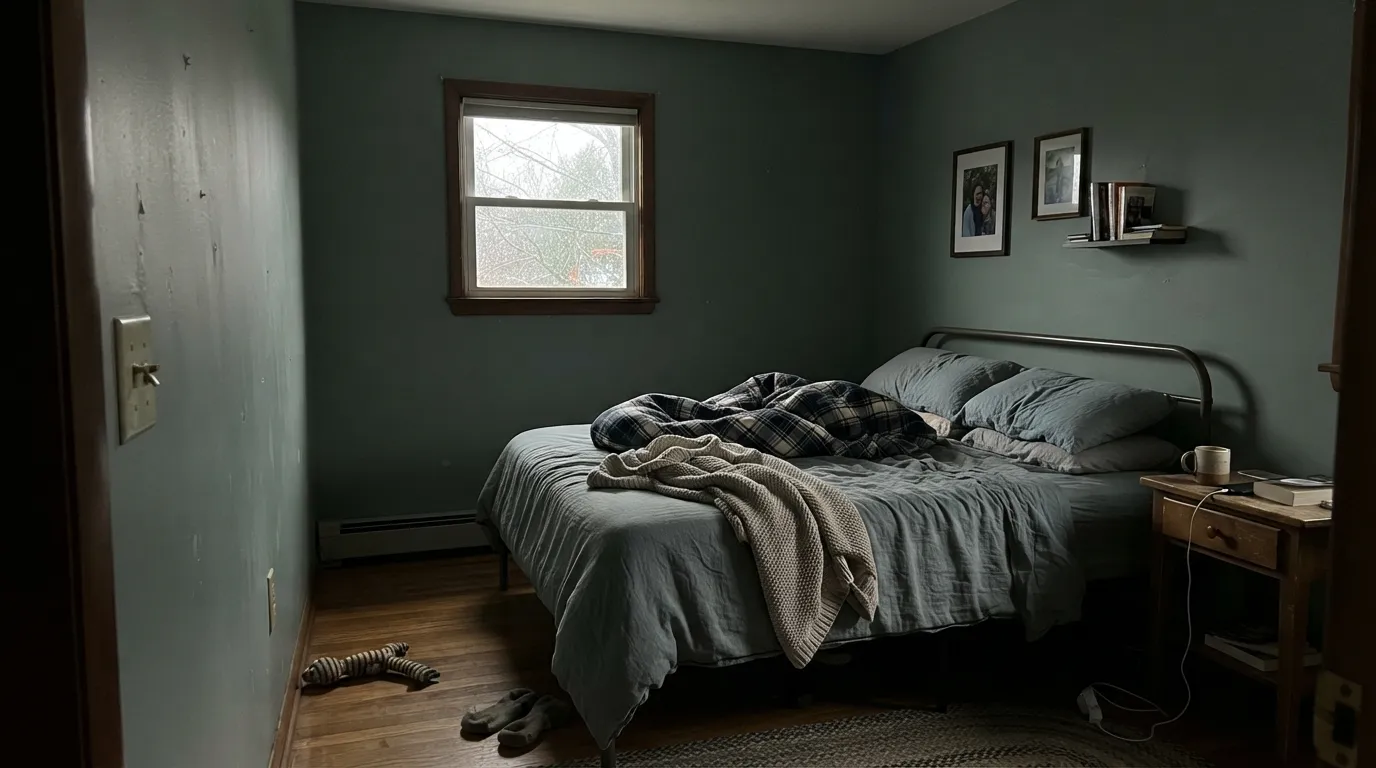
South or west windows keep the sea-green honest and the charcoal in check, so the room reads restful instead of cave. Eggshell; White Dove (PM-19) trim in semi-gloss so the edge stays soft. Cream or white bedding, 2700K lamps at night. A north bedroom with the blinds down is the slate version of this paint — test a big board before you commit four walls.
This is the Pinterest job, and it works when there is daylight to keep the green alive: eggshell or satin walls, a warm-white vanity or a Rainy Afternoon vanity under a cream stone top, brushed nickel or brass. A small powder room can take the color well because you control the bulbs. A windowless interior bath is the light-trap version — it will read as flat dark gray, not spa. Do not do that.
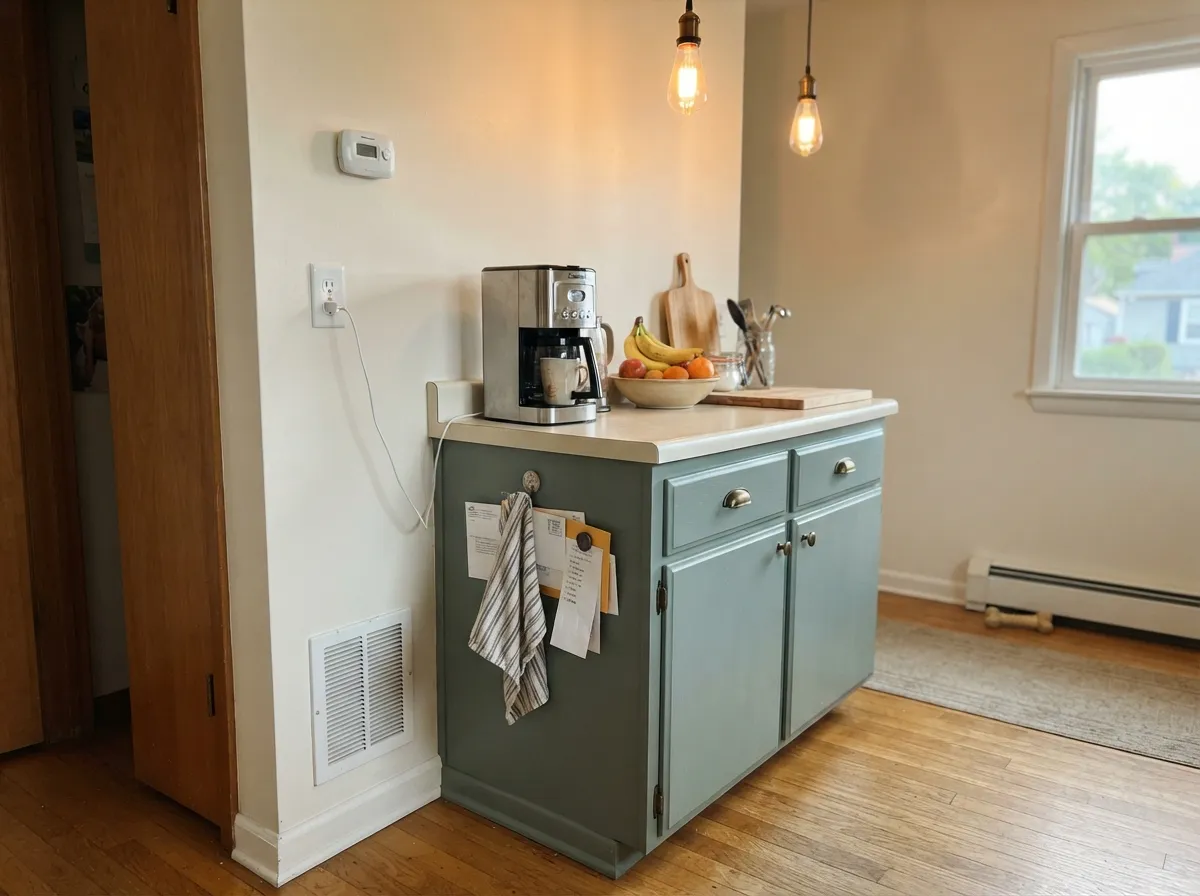
Satin on lowers or an island, Alabaster or White Dove on the walls, brass or aged-bronze pulls, warm counters. At LRV 31 the doors have enough depth to read as painted furniture, which is the whole point of a cabinet green. Home Depot even sells this code in cabinet enamel. A full kitchen of Rainy Afternoon boxes is a bigger bet than an island; sample a door first, and keep the bulbs at 2700K. Cool gray quartz is the pairing to refuse.
Beautiful in a closed, south- or west-facing living room with pale oak, walnut, and a cream sofa. Riskier in open plans, where the blue-green has to negotiate with kitchen wood tones and whatever greige the adjacent rooms wear. Pale Oak next door is a safer handoff than a cool gray. Skip four walls if this is a north room with one lamp.
A study is allowed to feel enclosed, and this depth delivers atmosphere without Hidden Gem's cave. Eggshell walls, White Dove trim, one lamp on the desk. South or west light keeps the green; a north office with a single window goes slate by mid-afternoon. Sample that wall at 4pm before committing.
As a body color it is a maybe on a shaded elevation and a muddy gray-green in full southern sun. Better as shutters, a porch ceiling, or trim against warm stone or brick, where the sea-green reads intentional from the street. Hidden Gem is the stronger N430 front-door and siding color. Walk the sample around the house at 4pm before you commit a facade.
Your Light Is the Risk
Warm sun pulls the organic green forward so the wall reads dusty sea-green, not gray. This is the light the color was mixed for — the version in every photo that made a weathered botanical wall look easy.
Cool gray daylight kills the green and leaves charcoal-slate with a blue cast. Fine if you half-wanted gray; disappointing if you painted to get away from it. Windowless rooms are the same trap with the lights off.
East mornings mute it toward cool gray-green; west afternoon and golden hour push a little more sea-green, then the gray comes back as the sun drops. Sample on two walls and look at both before noon and after four.
2700K bulbs bring the charcoal forward and the walls go stormier, which most people want from this name. Cool 4000K LEDs — including a lot of bath and under-cabinet strips — shove it toward blue-slate. Swap the bulbs before you blame the can.
Most complaints about Rainy Afternoon are a light mismatch. Upload a photo of your actual room and see it on your walls — then ask for the same wall in north light or evening lamps before you buy a single sample.
Need It From Another Brand?
Any paint counter can custom-tint Behr N430-4 directly. If you would rather stay in one brand's own deck, these are the closest stock matches, measured as ΔE2000. Under 2 is a difference you will not see on the wall.
| Brand | Closest color | ΔE | LRV | |
|---|---|---|---|---|
| Sherwin-Williams | Jasper StoneSW 9133 · Sherwin-Williams | 1.6 | 32 | Color page → |
| Benjamin Moore | AtmosphericAF-500 · Benjamin Moore | 1.6 | 32 | Color page → |
| Valspar | Blue Twilight5001-1C · Valspar | 4.3 | 30.1 | Color page → |
| PPG / Glidden | Paradise FoundPPG1135-5 · PPG / Glidden | 3.5 | 30 | Color page → |
| Glidden | Blue Grass Field70GG 32/067 · Glidden | 2.2 | 32 | Color page → |
| Dutch Boy | Grayed Foundry426-6DB · Dutch Boy | 3.3 | 29 | Color page → |
Similar Behr Colors
The nearest shades to Rainy Afternoon within Behr's own range, ranked by perceptual color distance — useful when you want the same look a touch lighter, darker, or warmer.
WCAG 2.1: AA is 4.5 : 1 for normal text, 3 : 1 for large text, AAA is 7 : 1.
Rainy Afternoon vs the Colors You're Also Considering
Every Rainy Afternoon sample board has the same rivals on it. The numbers show the real lightness gap — then it comes down to which risk you would rather live with.
Pick this for four walls that still breathe: same N430 family, mid-depth, the version that does not close a bedroom in.
Behr N430-6A · LRV 14Hidden GemPick this if you want the 2026 Color of the Year drench — a beautiful dark green-blue for one committed room, cabinets, or a front door, with two predictable failure modes.
Pick this when you want the blue-gray botanical version of that depth, or you are already in the Home Depot aisle.
Sherwin-Williams SW 9130 · LRV 30Evergreen FogPick this for the famous cabinet sage at almost the same LRV — olive-herb, not sea, and the better-tested Sherwin-Williams default as long as you give it daylight.
Pick this when Sea Salt looks too pale on your sample and you want a mid-depth sea green that actually shows.
Sherwin-Williams SW 6204 · LRV 63Sea SaltPick this for the airy spa green-gray everyone already knows — beautiful when the light agrees with it, a wash where Rainy Afternoon is a wall.
Pick this when you want the stormier, more clearly blue-green read, and the gray should feel like weather instead of stone.
Behr N410-4 · LRV 35Natures GiftPick this for the quieter gray-built sage at a similar Home Depot mix — herb, not sea, a half-step lighter, less blue.
Cloud Burst 490F-5 at LRV 37 is hex #7EAE9A against Rainy Afternoon's #7EAE9C. That is a two-point difference in the blue channel, which no one sees on a wall, so treat them as the same color under two names. Nature Green MQ6-12 at LRV 36 is #78AC93, a clearly greener and less blue take. Stone Fence 720F-4 at LRV 38 is #8AACA7, grayer and softer, closer to a green-tinted stone.
Across brands, Benjamin Moore Everglades 641 at LRV 37 has a deltaE of 1.85 and PPG Catnip PPG1139-4 at LRV 36 comes in at 1.97, so both are visually identical in normal room light. Farrow and Ball Arsenic No. 214 at LRV 40 is 2.34, very close but worth sampling first since it is a little lighter.
Sherwin-Williams Restful SW 6458 at LRV 39 is #91AF9D with a deltaE of 4.54, close but visibly different side by side, reading grayer and less teal.
Rainy Afternoon Coordinating Colors
The rule for coordinating with Rainy Afternoon: warm whites, one deeper green-blue from its own strip, and one navy or charcoal — and keep icy whites and cool gray stone at arm's length. It wants cream more than gallery white, pale oak or walnut more than gray LVP, and brass or brushed nickel more than chrome. These are the partners that keep the sea-green honest:
The N430 Strip: Rainy Afternoon Is Not Hidden Gem
Rainy Afternoon is not famous, and pretending otherwise would be a lie. What is famous is the color two steps darker on the same Behr strip: Hidden Gem (N430-6A), Behr's 2026 Color of the Year, a smoky jade at LRV 14 that designers reach for when a client wants one drenched room, an island, or a front door. Behr's own Hidden Gem palettes put Rainy Afternoon on the pairing slide. That is the useful fact, not a viral-room claim.
Here is why the mid-tone still earns a can: Hidden Gem is a beautiful dark green-blue with two predictable failure modes, and the first one is a dim room. Rainy Afternoon is the same family at a depth you can actually live with on four bedroom walls. You get the current mood — grayed sea-green, botanical, a little stormy — without betting the whole house on a Color of the Year. If the trend passes, a muted blue-green-gray ages the way sage does, not the way accent colors do. Shop N430-4. Do not grab Benjamin Moore 1575 because the names match.
Rainy Afternoon With Wood Tones and Floors
This decision gets made at the floor, not the paint store. Pale white oak, walnut, and cherry are the color's best friends — the green base sits across the wheel from red-brown woods, so cherry and mahogany look richer instead of orange, and pale oak keeps the room from going cave. Walnut and espresso make the sea-green read smoky and deliberate. Brushed nickel and unlacquered brass both work; polished chrome is the one that leans cold against it.
The honest no is cool gray: gray LVP, gray-washed wood with a blue cast, and gray tile. Cool gray pulls the charcoal and blue forward until the wall looks muddy and the floor looks colder. Honey oak is not automatic poison the way it is next to a yellow-sage — the cool green can sit against the orange instead of fighting it — but sample a big board over the actual plank. If the oak is loudly orange and you hate that fight, put a large rug between it and this paint, or keep the walls cream and put Rainy Afternoon on the cabinets only.
Three Ready Palettes Built on Rainy Afternoon
A color is never alone on the wall. These are complete combinations in the 60-30-10 pattern, with the reason each one holds together. Every one opens in the visualizer.
Two depths of the same N430 family, separated by the safest warm white in the Benjamin Moore deck. White Dove keeps the sea-green from looking dusty; Hidden Gem is the single dark green-blue note so the room reads layered instead of themed. Keep the bulbs at 2700K or both greens go charcoal after dark.
Try this palette in your roomAlabaster is a superb cabinet white and it is warm enough to keep the sea-green from going cold without tipping cream, so the doors stay the star. Hale Navy is the safest navy as long as the room has light — one deep note, used in a dose, not on four walls. Brass hardware and 2700K pendants are not optional.
Try this palette in your roomCream and sea-green is the pairing that keeps a small bath from going spa-cold. Behr Swiss Coffee is the warmest of the safe off-whites — and it shows, which is the point next to a cool wall. Kendall Charcoal is the best-behaved dark gray in the Benjamin Moore deck and gives one near-black note so the scheme reads deliberate; skip it if this bath is already dim.
Try this palette in your roomRainy Afternoon FAQ
Is Rainy Afternoon green or gray?
Green — quietly, but unmistakably, once it is on four walls. On the chip it can pass for a weathered gray-green, and in north light or under warm lamps the charcoal comes forward, but in decent daylight nobody will call it gray. If gray is what you actually want, this is the wrong color; that mismatch is behind most of its bad samples.
Is this the same as Benjamin Moore Rainy Afternoon?
No. Benjamin Moore Rainy Afternoon is 1575, a much deeper grayed green. Behr Rainy Afternoon is N430-4 at LRV 31. Shop by the code. The three words on the chip have been used by two brands for two different paints, and mixing them up is an expensive way to get a cave.
What trim white goes with Rainy Afternoon?
A soft warm white is the default — White Dove (PM-19) or Alabaster (SW 7008) — so the walls stay sea-green instead of going dusty. Behr Swiss Coffee (W-B-700) is the creamier Home Depot option; the warmth shows, which some baths want. A stark bright white (Chantilly Lace territory, or Ultra Pure White on a big wall) makes the color look muddy and tired next to the crisp edge. Semi-gloss on the trim, eggshell on the walls.
Is it good for kitchen cabinets?
Yes — that is one of its best jobs, and Home Depot lists this code for cabinets, doors, and trim. LRV 31 is the cabinet-green band: deep enough to look like furniture, light enough that a galley still feels open. Use satin, brass or aged bronze pulls, and 2700K bulbs. Cool gray quartz and leftover fluorescent tubes are the two ways to ruin it.
Will it look gray in a north-facing room?
Very likely. Cool, flat daylight is the color's weakest light, and a muted sea-green has almost no pigment in reserve. The wall goes charcoal-slate with a blue cast. Warm 2700K lamps help after dark but they will not fix a dim north room at 2pm. Sample a big board on the darkest wall for two full days before you buy gallons. If the point is to actually see green in weak light, step up to Clary Sage (SW 6178) at LRV 41, or pick a greige and stop asking a gray-green to work without light.
How is it different from Hidden Gem and Evergreen Fog?
Hidden Gem is two steps darker on the same N430 strip (LRV 14 vs 31) — a beautiful dark green-blue, Behr's 2026 Color of the Year, built for one drenched room or a front door, not four average walls. Evergreen Fog is almost the same depth (LRV 30) but olive-sage, the cabinet default in the Sherwin-Williams deck. Rainy Afternoon is the mid-depth sea-green in between: more blue-gray than Evergreen, airier than Hidden Gem, mixed at Home Depot.
Have you painted with Rainy Afternoon?
Rate it — one tap helps the next reader decide.
Ask a Question