Shades of White Paint: Every White Family, Explained
The whole white shelf sorted into families — true whites, warm whites, creamy whites, cool whites, and greige whites — with 19 famous picks from Benjamin Moore, Sherwin-Williams, Behr, Valspar, PPG and Farrow & Ball, plus the light each one needs.

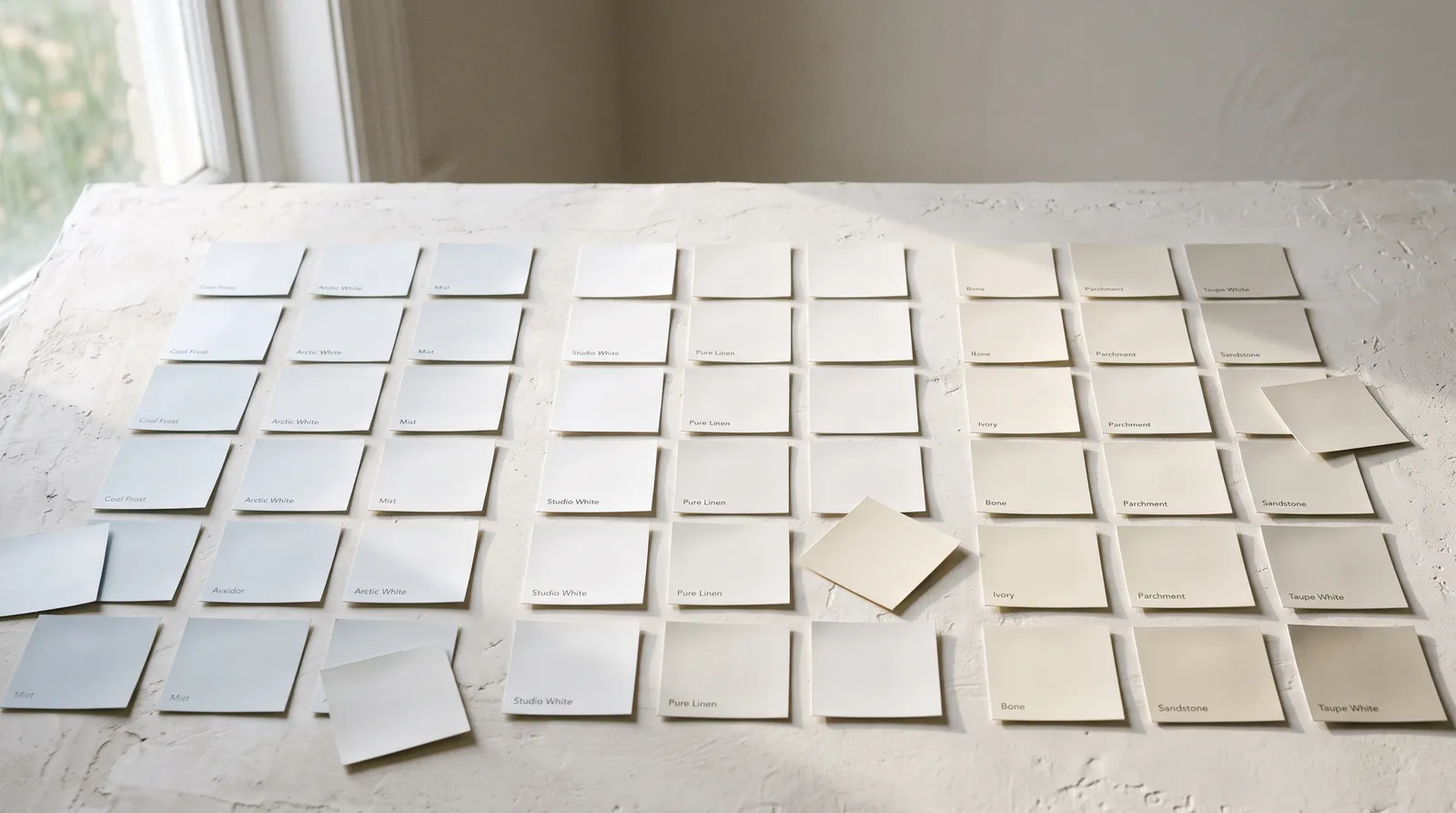
There is no such thing as one white. Every chip in that deck carries a hidden undertone — a whisper of yellow, grey, blue, pink, or taupe — and it only shows up at scale, in your light, on your wall.
So shop family by family, not chip by chip. There are five families: true whites, warm whites, creamy whites, cool whites, and greige whites. Every famous white belongs to one of them. Below is the whole shelf, sorted, with the light each family needs and the nineteen whites worth knowing by name. For the theory behind the undertones, white undertones explained is the deeper read; LRV explained covers the reflectance numbers.
The Five Families of White Paint
True whites have almost no undertone. They sit at the top of the LRV scale, usually 90 and above, and read as white in almost any light. That sounds like the safe choice and it is not — with nothing to soften them they go stark and clinical in a room without much sun.
Warm whites carry a soft yellow or cream cast — bright enough to lift a room, warm enough to keep it from going cold. Most of the whites people actually live with are here.
Creamy whites are warm whites with the volume up. The yellow is the point, not a hint. These belong in older houses, rooms with wood trim, and anywhere the light is thin.
Cool whites lean grey or blue. They keep their crispness in strong sun, which is exactly where warm whites turn buttery. In dim light they go flat fast.
Greige whites are built on a soft taupe base. They are the quietest of the group — barely white, not quite beige, and very hard to make look wrong next to wood, linen, and stone.
True Whites: The Cleanest Shades of White
These are the whites with nothing added. They want real light, and they are happiest on trim, on ceilings, in kitchens with big windows, and anywhere an edge should look sharp.
Benjamin Moore Chantilly Lace (OC-65)
Chantilly Lace is the true white most designers name first, and the reason is restraint. It has just enough of a cool trace to stop it going yellow in afternoon sun, but not enough to read blue in a north-facing room. That narrow middle is rare at this brightness, and on trim and cabinet doors it gives you a crisp edge that never looks icy. Where it struggles is a big matte wall in a dim room — at LRV 90 there is nothing to hold onto, and the wall goes slightly grey and empty.
Sherwin-Williams High Reflective White (SW 7757)
This is the brightest white in the Sherwin-Williams deck and it behaves like it. High Reflective White is a ceiling and trim color first — it bounces more light than anything else on the shelf, which is why it turns up in basements, hallways, and rooms with one small window. On four walls it is a lot: strong south light produces genuine glare, and it shows every roller lap and drywall seam. Use it where you want brightness, not atmosphere.
Behr Ultra Pure White (PPU18-06)
Ultra Pure White is almost certainly the most-painted white in America, because it is the untinted base at the Home Depot counter and the default on new construction — cheap, instantly available, completely neutral. For a rental refresh, a ceiling, or a garage it does the job with no thinking required. It is also the white that makes people say white paint looks cold: there is no undertone to catch the light, so a north-facing room goes flat and slightly blue.
Farrow & Ball All White (No. 2005)
All White is the purist’s white. Farrow & Ball make it with no added black pigment, and you can see it — a soft, open quality instead of the chalky flatness most bright whites have at this LRV. Drenched over walls, trim, and ceiling in a room with good windows it is genuinely beautiful. It is also unforgiving: with no black to steady it, it picks up whatever is nearby, and a green garden outside the window will land on the wall.
Warm Whites: The Ones Most People Actually Want
Most good white rooms live here. The yellow is soft enough that nobody would call the wall cream, but enough to keep skin tones, wood floors, and evening lamplight looking right. There are more in the best warm white paint colors.
Benjamin Moore White Dove (OC-17)
White Dove is the most reliable white I know, and I say that having tried hard to find a room it fails in. It carries enough warmth to feel gentle without tipping into custard, and at LRV 83 it is bright without glaring. Walls, trim, cabinets, or all three at once — it holds its warmth in north light and stays put in south light. The one honest caveat: in very bright afternoon sun it reads creamy rather than white.
Sherwin-Williams Alabaster (SW 7008)
Alabaster is White Dove’s more grounded cousin. The greige in the base keeps the warmth in check, so in strong sun it stays a white instead of drifting cream — and it is one of the few warm whites that looks correct next to a genuinely white appliance or a quartz counter. In a cold north-facing room the grey base comes forward and flattens it slightly. That is the one place White Dove wins.
Benjamin Moore Swiss Coffee (OC-45)
Swiss Coffee is the name everyone recognizes, and it earns it. A shade warmer than Alabaster and a shade steadier than a straight cream — the grey underneath stops the yellow taking over under lamplight, which is where most warm whites wobble at night. On plaster, panelling, and older trim it looks like the house came that way. Worth knowing: several brands sell a Swiss Coffee and they are not the same white. Match the code, not just the name.
Farrow & Ball Pointing (No. 2003)
Pointing is named after the lime mortar between old bricks, and it behaves like it — a warm white with a chalky depth flat modern whites cannot fake. At LRV 86 you get the lift of a near-true white with none of the coldness, and against dark walls it is the trim color that keeps a scheme from going icy. It leans distinctly yellow in evening light, so in a west-facing room expect cream rather than white.
Creamy White Paint Colors
When people search for creamy white paint colors they usually mean this family, not the warm whites above. Here the yellow is visible and intentional — for north-facing rooms, rooms with one small window, old houses with honey-toned wood, and anywhere a crisp white feels unkind.
Sherwin-Williams Creamy (SW 7012)
Creamy is exactly what the name says, with no games. At LRV 81 it stays bright, but the yellow is right there on the surface — in a dim room it reads as soft candlelight rather than paint. Very good against oak, walnut, and unlacquered brass, and it makes an old kitchen feel intentional instead of dated. Do not put it in a sun-blasted south room unless you want a yellow room.
Benjamin Moore Linen White (OC-146)
Linen White has been on ceilings and trim in American houses for forty years, and there is a reason. It is a cream that stays legible as a white — bright enough at LRV 83 to lift a low ceiling, warm enough that it never puts a cold line above a warm wall. If you have creamy walls and were about to use a pure white ceiling, use this instead. On four walls in a modern room it reads dated next to cool greys.
PPG Creamy White (PPG1105-1)
The PPG version leans a touch deeper into the yellow than the Sherwin-Williams one, which makes it the pick for a genuinely dark room — a hallway with no window, a north-facing bedroom, a basement conversion. It has enough body to stop those rooms reading grey, and it is easy to find through PPG and Glidden retailers. In good daylight it will read as a light beige to some eyes. That is the trade for the warmth.
Cool Whites: Grey and Blue Undertones
Cool whites are for bright rooms and modern schemes. They hold a crisp edge in sun that would turn a warm white yellow, and next to grey, black, chrome, and cool stone they look correct where a cream looks grubby. The best cool white paint colors has the full family.
Benjamin Moore Decorator’s White (OC-149)
Hex: #EBEDEA · LRV: 83 · Undertone: cool grey with a faint green trace
Decorator’s White is the trim white of choice in a lot of modern interiors, and it is cooler than it looks on the chip. The faint green in the undertone keeps it from going blue, so it reads clean rather than icy, and against grey walls, black windows, or a deep navy it draws the sharpest line of any white here. In a warm-toned room it looks grey and out of place, like the trim was primed and forgotten.
Sherwin-Williams Extra White (SW 7006)
Extra White is the standard-issue cool white — specified on new builds when the trim needs to be bright and unfussy. At LRV 86 it is genuinely bright, and the blue-grey undertone keeps it from warming up under lamplight the way a neutral white does at night. Kitchens, bathrooms, laundry rooms. It is a poor choice for a north-facing living room, where the blue comes forward and the room goes chilly.
PPG Delicate White (PPG1001-1)
Delicate White is the gentlest cool white here, which makes it the easiest to live with. It has the crispness you want against modern cabinetry, but the grey is soft enough that it does not turn hostile in a room that gets only a couple of hours of sun. As a ceiling above cool grey or blue walls it is close to perfect. Next to warm oak or a cream sofa it looks sterile.
Greige Whites: The Quietest Shade of White
The softest whites on the shelf — off-whites built on a taupe base rather than a yellow or grey one. They make a room look styled rather than painted, and they are the hardest whites to get wrong.
Sherwin-Williams Shoji White (SW 7042)
Shoji White sits half a step below a true white, and that half step is what makes it work. Warm without being cream, soft without being beige, and at LRV 74 it has enough depth that walls stop looking blank and start looking like a color someone chose. Against rattan, oak, unbleached linen, and matte black hardware it is hard to beat. It is not bright, though — in a dark room it reads as a light greige, not a white.
Benjamin Moore China White (OC-141)
China White is the quiet one. The faint green in the base stops it going pink under warm bulbs, which is the failure mode of nearly every soft off-white once the lamps come on. That stability is why it shows up so often in rooms with a lot of art — it steps back and lets everything else be the color. Against strong yellow-toned wood floors it can drift toward beige.
Farrow & Ball School House White (No. 291)
School House White is the deepest white here and the most atmospheric. It has real pigment depth, so it shifts through the day — soft stone in the morning, warm cream by late afternoon, almost putty under lamplight. In a hallway, a study, or a panelled bedroom it does what you actually want a white to do, which is make the room feel calm rather than empty. It is a color, not a blank.
Whites That Sit in the Middle
Two whites that refuse to pick a side, which is why people keep choosing them.
Sherwin-Williams Pure White (SW 7005)
Pure White is the safest white in the Sherwin-Williams deck and the one I recommend when someone cannot sample and has to commit. A trace of warmth so it never goes clinical, not enough to go cream in sun, and it works on walls, trim, and ceilings in any orientation. The trade is that it never does anything remarkable. It is a good default, not a statement.
Valspar Du Jour (7002-6)
Du Jour is Valspar’s version of that same balance, a half-step brighter. At LRV 86 it gives near-true-white brightness with just enough softness to kill the glare, and it is stocked at Lowe’s, which makes it the practical answer for a whole-house repaint on a budget. Walls, trim, ceiling, one color throughout. Like Pure White, it is deliberately unexciting. That is the job.
White Wall Paint: What Changes Once It Is on the Wall
A white chip and a white wall are different objects, and three things account for most of the surprise.
Scale multiplies the undertone. A cream that is a hint on a two-inch chip covers 400 square feet on a wall, all of it quietly bouncing yellow into the room. Whatever you can just barely see on the chip is what you will definitely see on the wall.
Sheen changes the color. The same white in flat, eggshell, and satin reads as three different whites — flat looks softest and deeper, satin brighter and cooler, because it reflects the light source instead of scattering it. Walls want flat or eggshell, trim wants satin. The sheen guide has the trade-offs.
Everything nearby tints it. A white wall picks up the floor, the sofa, the trees outside, and the color temperature of your bulbs. That is why a white that looked perfect in a friend’s house looks wrong in yours. Their oak floor was doing half the work.
For ceilings, one rule saves most rooms: never put a cooler white above a warmer wall. The ceiling will look grey and faintly dirty from every angle in the room. Same white, or a touch warmer, and it disappears the way a ceiling should. Best ceiling paint covers the products.
How to Choose Your White in Ten Minutes
Start with the light. If the room faces north, or has one small window, or gets most of its light from lamps, shop the warm and creamy families — White Dove, Alabaster, Swiss Coffee, Creamy, Linen White. If the room faces south or west and gets real sun, you can go cooler or truer without the room ever feeling cold — Chantilly Lace, Decorator’s White, Extra White, Delicate White.
Then decide what the white is for. Trim and ceilings want the brighter end, LRV 86 and up. Walls are happier between 80 and 86 — soft enough to hide texture, bright enough to lift the room. For calm rather than bright, drop to the greige whites at LRV 73 to 76 and accept that they read as a color.
Then test properly, because whites move more than anything else. Two coats on poster board, not on the wall — the old color underneath tints what you see and sends you down the wrong path. Prop the boards next to the floor and the trim and look at them at 9am, at 3pm, and at night with only the lamps on. The white that wins at 3pm often loses at 8pm, and you live in the room at both hours.
To skip a round of sample pots, upload a photo of the room to the visualizer and put the shortlist on your actual walls first. It catches the obvious misses before you spend anything.
Ask a Question