White Paint Undertones: Warm vs Cool
Why your white paint reads pink, yellow, or blue once it's on the wall. How to read white paint undertones and pick a warm or cool white for your light.

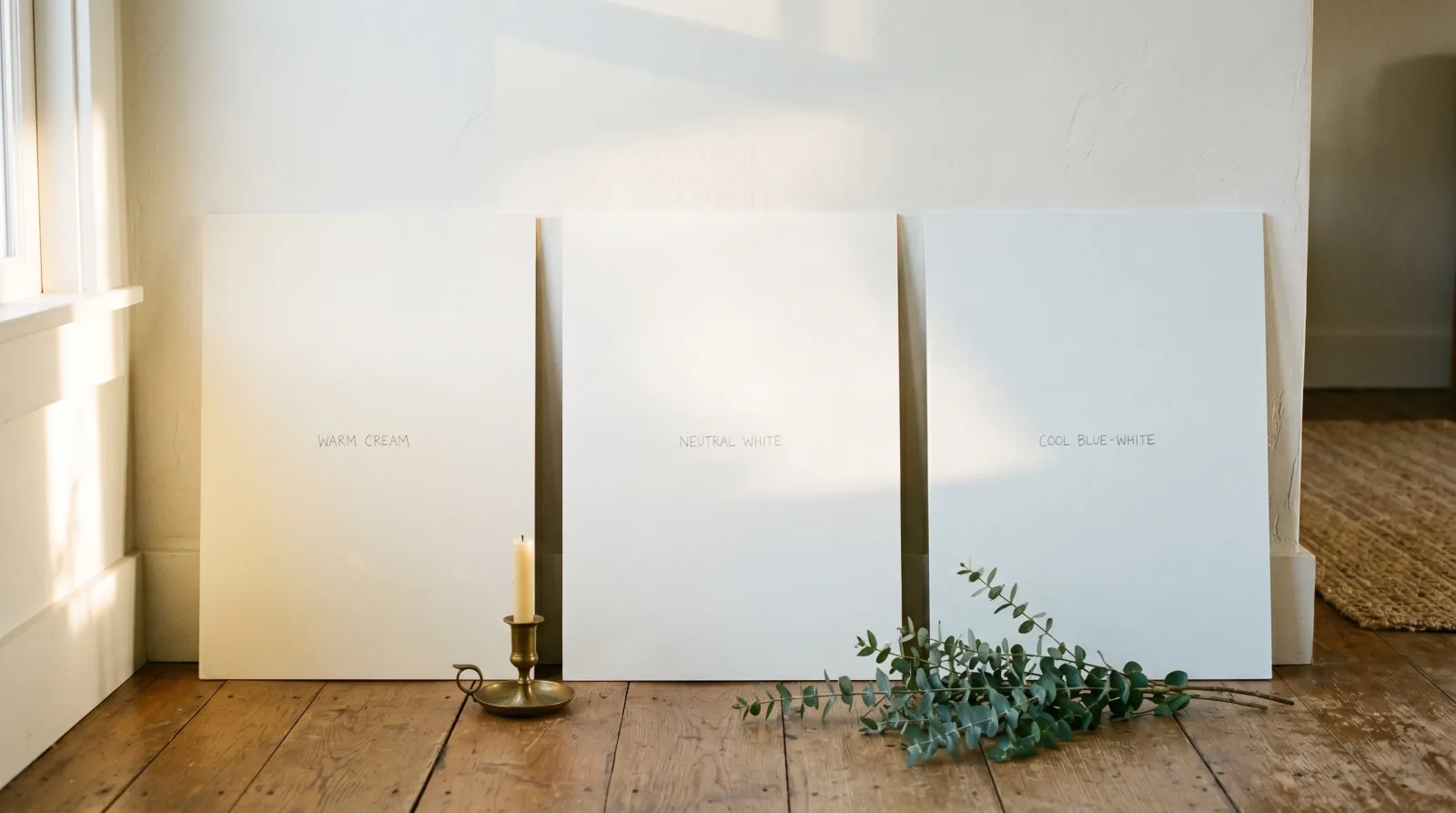
There is no such thing as a pure white wall paint, and that is the whole problem. Every white in the fan deck carries a touch of pigment, usually under 2% of the formula, to keep it from looking like a hospital wall. That trace of color is the undertone, and it reads warm (yellow, cream, pink) or cool (grey, blue, green) depending on what got mixed in. The same can looks different in a north-facing kitchen than in a west-facing one, because the light is doing half the work. LRV tells you how bright a white is; the undertone tells you which way it leans.
TL;DR
- No white is truly white. Each one carries a faint warm or cool undertone from a trace of added pigment.
- Warm whites lean yellow, cream, or pink and feel soft and inviting. Cool whites lean grey, blue, or green and feel crisp and clean.
- Light decides everything. North light cools a white down; west and incandescent light warm it up.
- Test the chip against plain printer paper to see the bias, then tape a large sample on the actual wall and watch it at the hour you use the room.
- Match your white to your fixed finishes (floors, trim, countertops) and to the room’s light, not to a chip under store fluorescents.
What a White Undertone Actually Is
A “white” base paint starts close to neutral, then the tinting machine adds a few drops of colorant to soften it. Add a whisper of yellow oxide and you get a creamy warm white. Add a touch of black and blue and you get a cool grey-white. The amount is tiny, often a fraction of an ounce per gallon, which is why you can stare at two whites on the chip and swear they are identical until they sit against each other on the wall.
The trap is that the undertone is invisible in isolation. A white only shows its hand next to something. Put a warm white beside a cool one and the warm one suddenly reads buttery. Put it on a wall next to bright trim and your floor, and the comparison is happening whether you planned it or not.
Warm Whites vs Cool Whites
Warm whites carry yellow, cream, beige, or a faint pink underneath. They feel soft, calm, and a little aged. They flatter wood floors, brass, linen, and incandescent light. In a north-facing room with flat cool daylight, a warm white quietly corrects the chill and keeps the space from feeling like a walk-in fridge. Benjamin Moore White Dove and Sherwin-Williams Alabaster are the workhorses here.
Cool whites carry grey, blue, or green underneath. They feel crisp, modern, and clean. They sit beautifully with chrome, marble, cool grey floors, and bright daylight. In a south-facing room flooded with warm afternoon sun, a cool white reads balanced rather than yellow. Push too far and a cool white goes clinical, the kind of white that makes a room feel like a dentist’s office. Benjamin Moore Chantilly Lace and Sherwin-Williams Extra White live in this camp.
Most popular whites actually sit in the middle, barely warm. They read as “just white” across the widest range of light, which is exactly why they sell.
How Light Changes a White
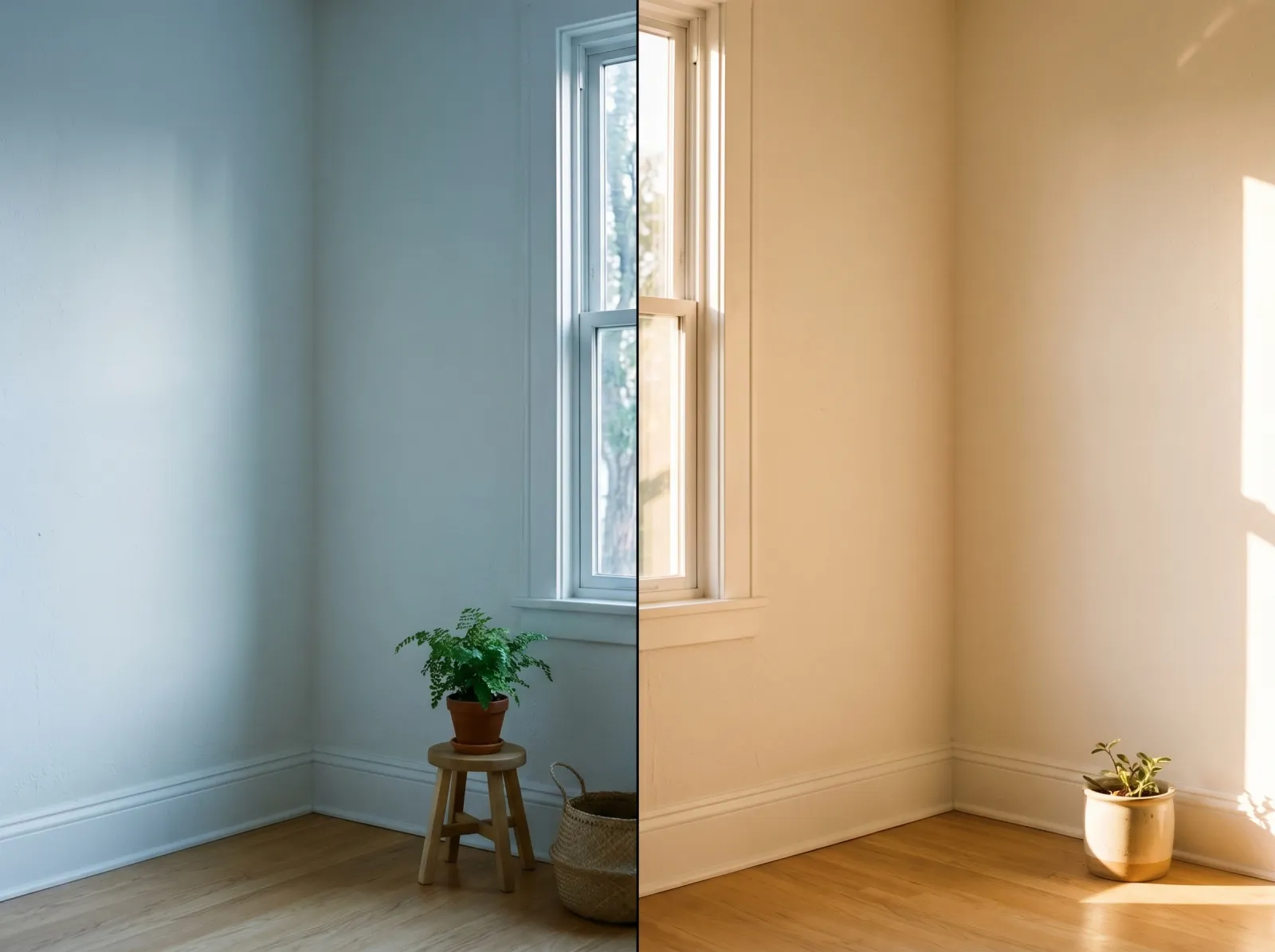 The same white, the same wall, two times of day. North-facing morning light pulls it cool; western afternoon light warms it to cream.
The single most useful thing to know about whites: the room’s light bends the undertone harder than the pigment does.
- North-facing rooms get cool, soft, even light all day. It mutes warm undertones and amplifies cool ones. A crisp cool white here can tip grey and joyless. Lean warmer than your instinct.
- South-facing rooms get strong, warm light for hours. It pushes warm undertones forward, so a cream white can read almost yellow by mid-afternoon. A cool or neutral white stays balanced.
- East-facing rooms are cool and bright in the morning, then go flat and dim by afternoon. Whites read coolest at breakfast.
- West-facing rooms are flat in the morning and glow golden-orange in the late afternoon. A neutral white can warm up dramatically at 5pm.
Then there is the bulb. Warm LED and old incandescent (around 2700K) push every white warmer at night. Cool daylight LED (4000K and up) sharpens cool undertones and can make a soft warm white look a little muddy after dark. The white you choose for a daytime kitchen behaves differently at dinner.
For why the brightness number is a separate question from the undertone, see what LRV means.
How Warm and Cool Whites Compare
| Warm white | Cool white | Neutral / barely-warm white | |
|---|---|---|---|
| Undertone | Yellow, cream, pink | Grey, blue, green | Faint warmth, near-neutral |
| Feels | Soft, cozy, aged | Crisp, modern, clean | Quiet, flexible |
| Best light | North-facing, dim, incandescent | South-facing, bright daylight | Most rooms |
| Pairs with | Wood, brass, linen, warm floors | Chrome, marble, grey floors | Almost anything |
| Risk | Goes yellow in strong sun | Goes clinical in flat light | Can read flat if light is poor |
| Example | BM White Dove, SW Alabaster | BM Chantilly Lace, SW Extra White | BM Simply White, SW Pure White |
How Do I Know if a White Is Warm or Cool?
The fastest test in the store costs nothing. Hold the chip against a sheet of standard printer paper, which is manufactured close to true white with optical brighteners. Against that bright neutral, the bias jumps out: a warm white looks creamy or pink, a cool white looks grey or blue. The chip that looked plain white on its own suddenly declares itself.
That tells you the direction. It does not tell you what the white will do in your room. For that, buy a sample pot, paint two coats on a large piece of poster board (a foot or two square, not a smear), and tape it to the wall you are deciding on. Move it from the brightest wall to the darkest corner. Look at it at breakfast and again at the hour you actually live in the room. A white that sings in afternoon light can go grey and tired at 8am.
If you are picking from an existing color, you can also browse whites organized by undertone to narrow the field before you buy samples.
Should Trim Be Warmer or Cooler Than the Walls?
Keep walls and trim in the same temperature family. The most common white-on-white mistake is pairing a cool blue-white wall with a warm cream trim, or the reverse. Side by side, one of them looks dirty, and you will never unsee it.
Two approaches that always sit right:
- One white, two sheens. Run the same white on walls and trim, eggshell on the wall and semi-gloss on the trim. The sheen difference does all the separating; the undertone never clashes. The sheen guide covers which finish goes where.
- Two whites, same family. Put a soft warm white on the walls and a crisper, brighter warm white on the trim. The trim pops without fighting the wall.
Ceilings are more forgiving. A ceiling reads in shadow and at a distance, so a slightly different white overhead rarely registers.
Common Mistakes
- Choosing a white from the chip alone, under store light. Retail fluorescents are wildly cool and flatten undertones. The chip lies. Sample on the wall or expect a surprise.
- Ignoring the floor and the trim. A white never stands alone. A warm white can look beautiful until it meets a cool grey floor, where it suddenly reads yellow. Pick the white against the finishes you cannot change.
- Putting a cool white in a north-facing room. This is the classic way to get a “clinical” or “cold” room. North light has no warmth to lend, so the cool undertone runs unchecked. Lean warm.
- Mismatching wall and trim temperature. A warm wall with a cool trim, or the reverse, reads as a mistake. Stay in one family.
- Forgetting the bulb. You pick the white in daylight, then live with it under warm LED at night, where it shifts. Test under your actual bulbs too.
Where to Start
If you want one safe answer and a north-facing or mixed-light room, start with a soft warm white like Benjamin Moore White Dove or Sherwin-Williams Alabaster. Both read as “white” in the most rooms and rarely go wrong. If your room takes strong direct sun and you want crisp and modern, move to a near-neutral like Sherwin-Williams Pure White or Benjamin Moore Simply White before you reach for an aggressively cool white.
Then buy the sample. Always buy the sample. Planning a full repaint of one room on a guess is how you end up repainting it twice.
FAQ
See the questions above in the page frontmatter for the answers most people search: how to tell warm from cool, why a white reads pink or yellow, and how to handle trim against walls.
Ask a Question