Pointing
Farrow & Ball's lime-pointing white, reviewed honestly: the traditional rooms it holds together, the brighter white that makes it look yellow, and what to pick instead.

Jessica has spec'd whites and neutrals for more than 300 rooms and keeps a sample wall of painted drawdowns in her studio. Every color review is checked against real reader rooms in the comments and re-tested when a formula changes. About the testing process →
- 1First Star69
- 2Classic Gray74
- 3Pointing86
- 4Chantilly Lace91
- 5Ultra Pure White97
The Fast Verdict
Pointing is the Farrow & Ball white you buy when the rest of the house is already speaking F&B. Named for the lime mortar between old bricks, it is a warm, red-cream off-white — not greyed like White Dove, not pigment-free like All White — and that faint red is why it sits so quietly under Hague Blue, Setting Plaster, and Elephant's Breath. On ceilings and woodwork it is the default. On four walls it is a finished cream. Next to leftover brilliant white, it is the yellow you did not mean to buy.
Traditional and cottage whole-house walls + trim · ceilings and woodwork under stronger F&B colors · kitchens with oak, brass, and warm stone · north rooms that need a white with actual warmth
You want a crisp gallery white · trim is staying All White or leftover brilliant white · a west wall bakes all afternoon · cool grey marble or grey LVP
- Warm red-cream that still reads as a white in even and north light
- The default F&B ceiling and woodwork white under traditional colors
- One-color rooms (walls + trim + ceiling) look finished, not painted
- Flatters oak, walnut, brick, brass, and the rest of the F&B traditional deck
- Kitchen cabinets hide scuffs better than All White or any gallery white
- Looks yellow and dirty next to All White, leftover brilliant white, or Chantilly Lace
- Hard west and south sun can pull a distinct yellow hour
- Too creamy for a crisp, modern, high-contrast look
- Clashes with cool grey marble, grey LVP, and cool stone
What Color Is Pointing, Really?
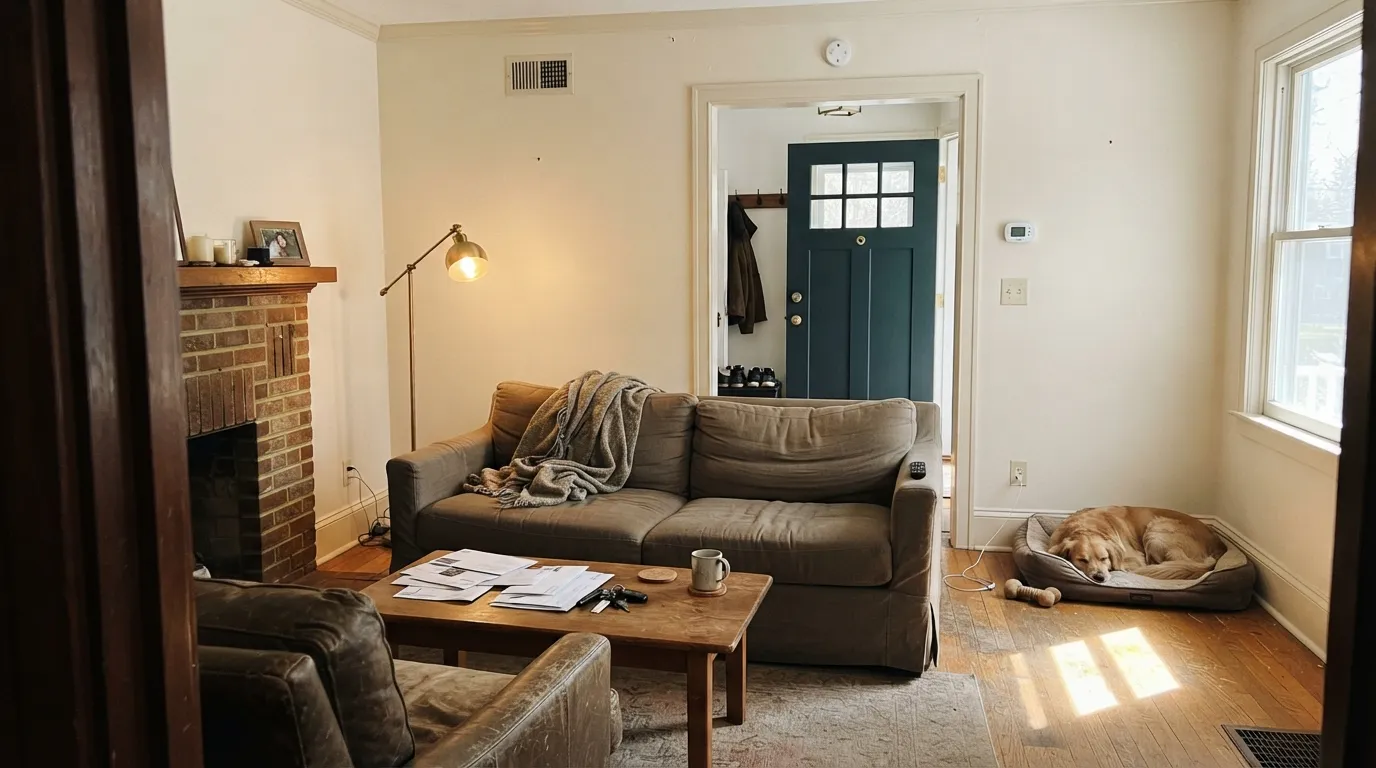
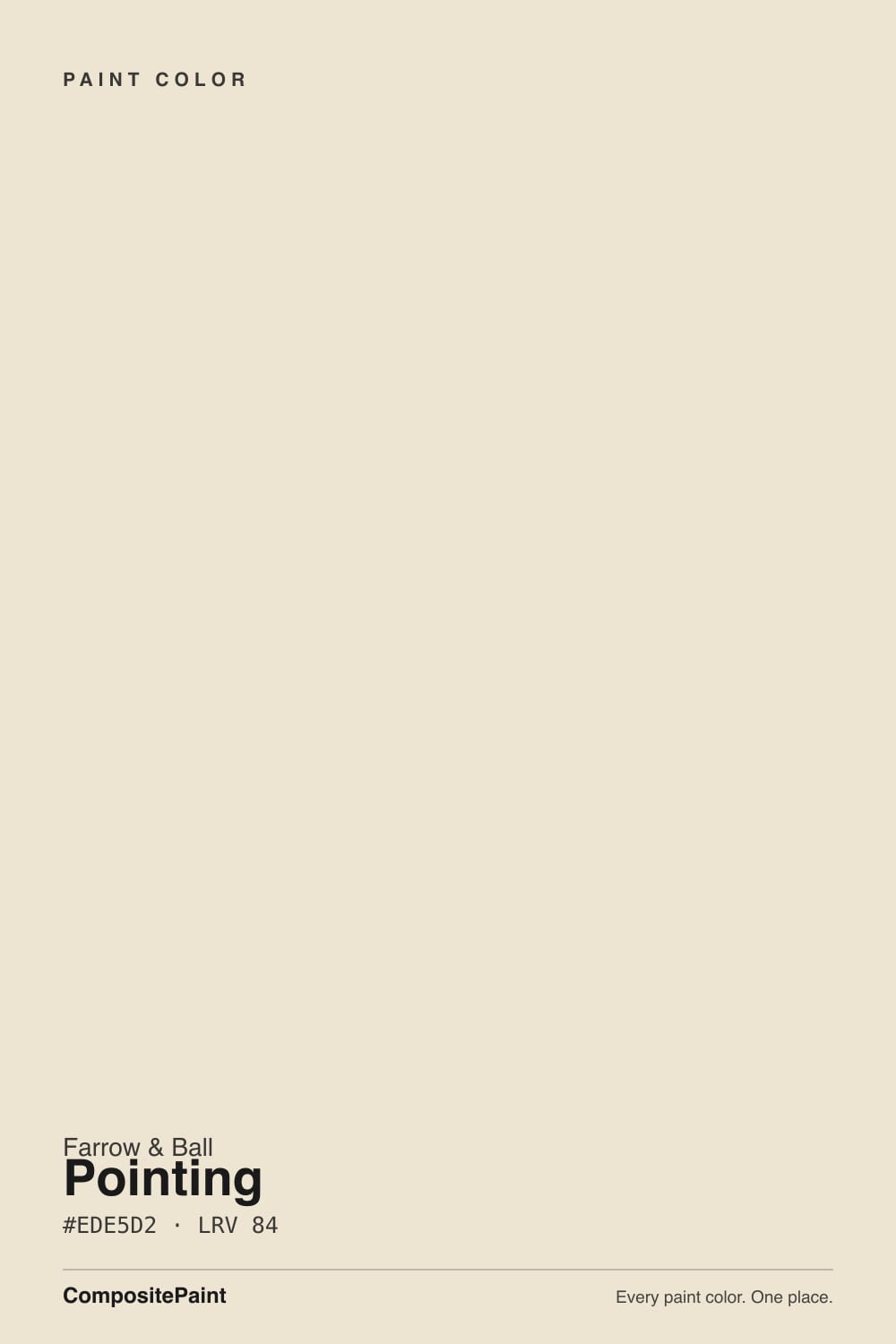
A warm off-white built on a palest red-cream, not on grey. Farrow & Ball named it for the color of lime pointing in traditional brickwork, files it with the Warm Neutrals, and still sells it in the same sample pack as All White — which tells you the job. It is the white that is supposed to soften a room full of stronger traditional colors, not compete with them. The red is not a pink wall. It is the reason Pointing reads as cream instead of chalk, and the reason designers keep putting it on ceilings, skirtings, and kitchen boxes while the saturated F&B colors get the magazine credits.
At LRV 86 it is bright enough to bounce light around a cottage, and clearly not a true white. Sit it next to All White (LRV 92) and Pointing suddenly has a name: cream. Sit it next to Wevet (LRV 83) and Wevet looks like the cooler, greyer sibling. White Dove (LRV 85) is the American cousin — a hair greyer, a hair quieter, the same brightness class. That LRV 86 is useful: enough pigment to hide scuffs a paper-white would broadcast, enough bounce to carry a north hallway, not enough to survive a brighter trim white without looking unwashed.
Undertone in one line: warm red-cream — never grey, never green. In even or north light it is a finished off-white. In hard west sun it goes distinctly yellow, which is the complaint Kate Watson-Smyth logged after doing a whole house in it, and the reason some owners call it very yellow upstairs. If your sample looks peach, that is the red meeting warm light. If it looks dirty, look at the trim white before you blame the gallon.
Where It Shines
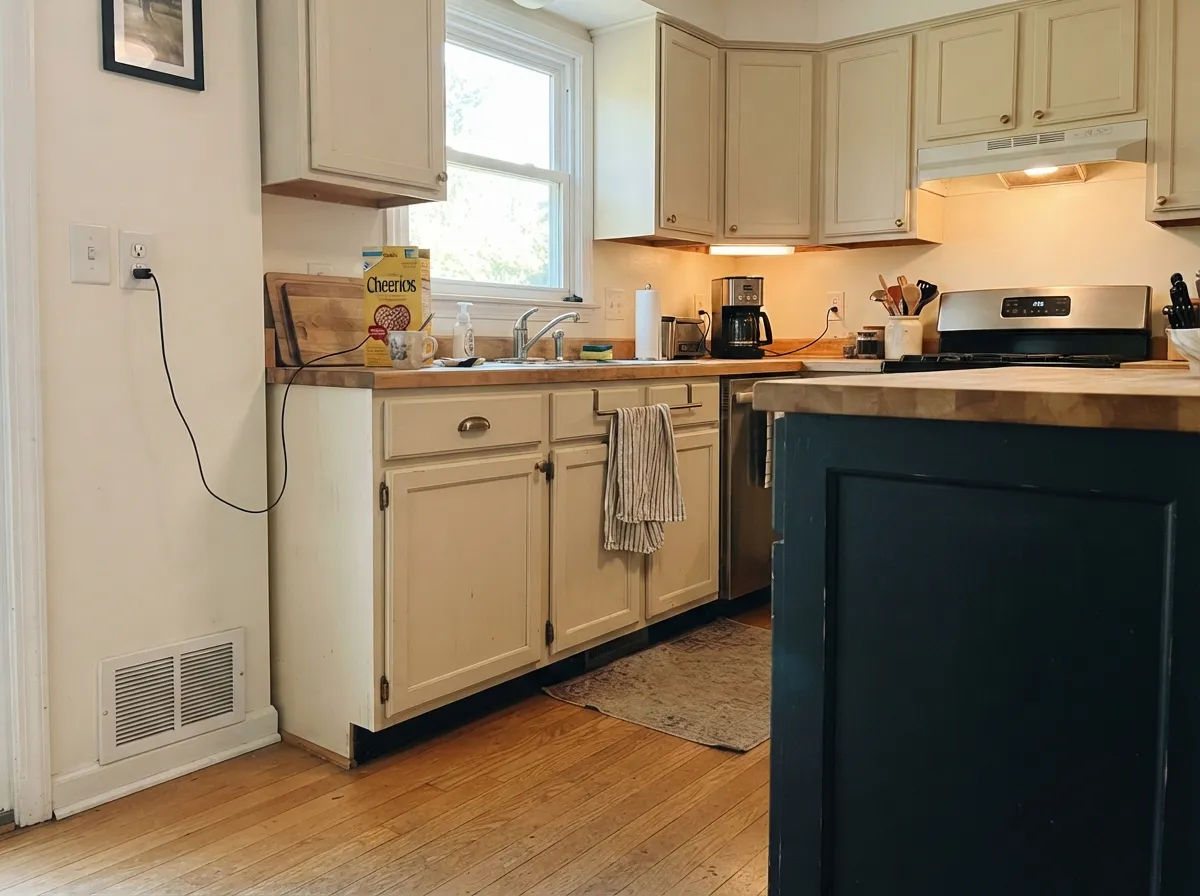
Give it traditional materials and no brighter white in the room, and it does the quiet job Farrow & Ball built it for. Ceilings and woodwork are the signature use — Patrick O'Donnell keeps sending it to the fifth wall because it kills the chilly blue of a generic ceiling white. Whole-house walls in a cottage or Georgian interior are the other home: one color at two sheens, oak floors, unlacquered brass, a dark F&B door. Kitchens with butcher block and warm stone take it on cabinets without the boxes reading builder-white. North rooms are a genuine strength here, not a warning — the red-cream counters cool daylight instead of going dingy grey the way a greyed white will.
Where It Fails
Almost every unhappy Pointing wall is a pairing story or a sun story. The paint is consistent. What changes is the neighbor color, or the hour the west window hits.
Farrow & Ball prints All White as the complementary white, and that pairing is the trap. All White is the purest white in this deck at LRV 92, still warm, still brighter. Against it, Pointing walls read yellow, creamy, even dirty — the same trick leftover builder enamel and Chantilly Lace (LRV 90) pull. The fix is the one-color rule: walls, trim, and ceiling all Pointing, sheen change only. Use All White on the ceiling alone if you must lift the plane, not as a snap of contrast on the woodwork.
The red-cream has nowhere to hide once a west window dumps warm light on a big field. On the chip it is a delicate off-white; at 4 p.m. it can read distinctly yellow — the exact reason one interiors writer left it for the next house. Sample a large board on that wall and look at it after 4. If you cannot live with the yellow hour, this is not your white.
Carrara-look stone and grey plank sit at the opposite temperature and shove the cream into the open. Cabinets that looked softly white on the chip read apricot next to cool quartz; walls above grey LVP pick up a faint peach cast. With cool floors and counters, pick Wevet or Strong White. Save Pointing for oak, terracotta, cream stone, and brass.
Room by Room
This is the use Farrow & Ball keeps photographing: Pointing on skirtings, doors, window frames, and the ceiling under a stronger wall color. Estate Eggshell on the joinery, a true flat on the ceiling. It kills the blue flash of a trade brilliant white without adding a cream that fights the wall. Do not then put All White on the same woodwork.
South or even light, oak or walnut, a dark F&B door, and Pointing on walls and trim is the quiet English living room people think they are buying. Modern Emulsion for wipe-down; Estate Emulsion only if nobody's shoulders touch the walls. A west glass wall is the 4 p.m. test, not a given.
Modern Eggshell on boxes against oak, butcher block, brass, and warm stone looks custom instead of builder. Designers keep specifying it for cabinetry because the cream is soft enough to live with every day. Cool grey quartz is the sample-first slab. Do not trim the boxes in All White.
North and east bedrooms stay a restful off-white; 2700K bulbs turn it a step creamier at night, which is the point of a bedroom white. A west bedroom with uncovered glass is the yellow-hour problem again. Stay on cream or oatmeal bedding — bright white linens will name the cream.
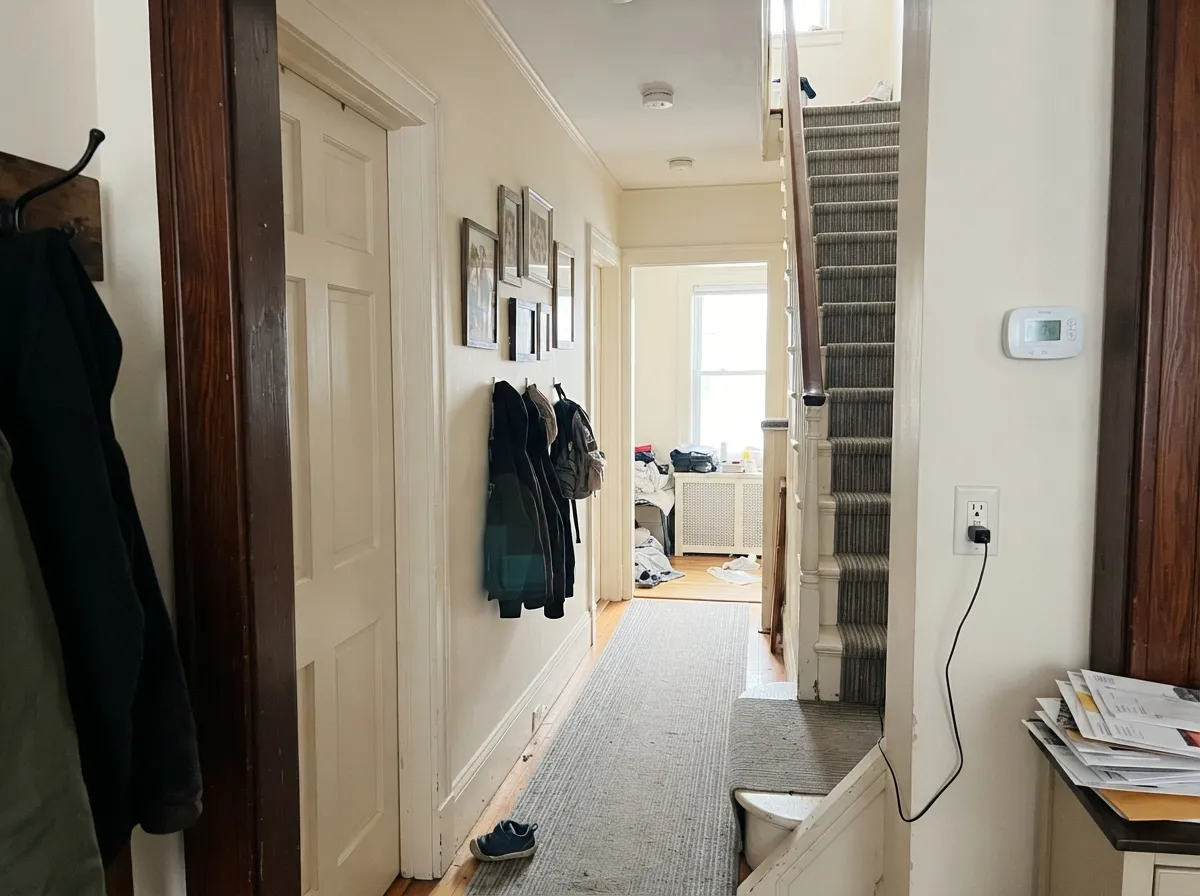
Borrowed light and north hallways are where the red-cream earns its keep: it stays warm instead of going grey. One color on walls, trim, and ceiling keeps a cottage flowing. A windowless hall under cool LEDs is a bulb problem, not a paint problem.
Warm stone, wood vanities, brass: settled. Grey porcelain, blue-grey subway, chrome-and-Carrara: it argues, and the peach comes forward. Modern Emulsion for steam; never Estate Emulsion in a bath.
Your Light Is the Risk
Cool, grey daylight is what this red-cream was mixed to counter. The wall stays a finished off-white instead of going dingy grey — the opposite of a greyed American white.
Direct warm sun pulls the cream all the way forward. On a west wall after 4 p.m. it can read distinctly yellow. Sample that wall at that hour.
East light is the quiet cream version in the morning. West light and golden hour flush a warmer, peachier read for an hour. Most owners like the shift; if yellow is the dealbreaker, test at 6 p.m.
2700K lamps: creamier and slightly peach, which is the cottage version. Cool white LEDs flatten the red and can leave a dingy ivory — swap bulbs before you swap paint.
Most complaints about Pointing are a light mismatch. Upload a photo of your actual room and see it on your walls — then ask for the same wall in north light or evening lamps before you buy a single sample.
Need It From Another Brand?
Any paint counter can custom-tint Farrow & Ball No. 2003 directly. If you would rather stay in one brand's own deck, these are the closest stock matches, measured as ΔE2000. Under 2 is a difference you will not see on the wall.
| Brand | Closest color | ΔE | LRV | |
|---|---|---|---|---|
| Sherwin-Williams | WhitetailSW 7103 · Sherwin-Williams | 0.8 | 86 | Color page → |
| Behr | Stonewashed PinkECC-61-2 · Behr | 1.5 | 86 | Color page → |
| Benjamin Moore | Paper MacheAF-25 · Benjamin Moore | 2.1 | 85 | Color page → |
| Valspar | Wings of an AngelV153 · Valspar | 0.5 | 85.7 | Color page → |
| PPG / Glidden | Crumb CookiePPG18-01 · PPG / Glidden | 1.4 | 87 | Color page → |
| Glidden | Mother Of PearlPPG1100-1 · Glidden | 1.1 | 86 | Color page → |
Similar Farrow & Ball Colors
The nearest shades to Pointing within Farrow & Ball's own range, ranked by perceptual color distance — useful when you want the same look a touch lighter, darker, or warmer.
WCAG 2.1: AA is 4.5 : 1 for normal text, 3 : 1 for large text, AAA is 7 : 1.
Pointing vs the Colors You're Also Considering
Every Pointing sample board has the same rivals on it. The numbers show the real lightness gap — then it comes down to which risk you would rather live with.
Pick this when you want visible cream body. All White next to these walls will make Pointing look yellow.
Farrow & Ball No. 2005 · LRV 92All WhitePick this for the purest white Farrow & Ball makes — still warm, six LRV points brighter, the ceiling-and-trim partner printed on the Pointing page.
Pick this when you want warmth. Wevet needs real south or east light and has none of Pointing's red-cream.
Farrow & Ball No. 273 · LRV 83WevetPick this for the coolest, most delicate white in this deck — grey-based, almost invisible, the one that will not clash with a cooler house.
Side-by-side comparison →Pick this when you are already in the F&B palette and want the red-cream that actually belongs under Hague Blue and Setting Plaster.
Benjamin Moore PM-19 · LRV 85White DovePick this for the safest warm white in the BM deck — greyed enough that it rarely goes yellow, and you can buy it this week.
Wevet (No. 273) shares Pointing's LRV of 84 but reads cooler and cleaner. Wevet is closer to a neutral soft white, so if Pointing feels too creamy for a modern room, Wevet keeps the brightness with less warmth.
White Tie (No. 2002), at LRV 82, is nearly as light but warmer and yellower than Pointing. White Tie leans creamier, while Pointing stays a touch fresher. Pick White Tie for maximum cozy warmth, Pointing when you want warmth that still feels light.
New White (No. 59), at LRV 79, is a slightly deeper, more traditional yellow-white. It has more color and sits a step down in brightness, so it feels older and richer than Pointing. Choose New White for a heritage room, and Pointing when you want the same warm character but a lighter, more open result.
Pointing Coordinating Colors
The rule for coordinating with Pointing is stay on the warm, traditional side of the Farrow & Ball card. It was mixed to sit under saturated heritage colors, not to snap against a cool grey. Cream, plaster-pink, warm greige, teal-navy, and near-black green are the partners that keep showing up in rooms that work. Cool greys and a brighter white in the same plane are the ones that name the cream.
Named For Lime Pointing — And Built For The Rest Of The Card
The name is literal: lime mortar between traditional bricks, the pale, warm joint that lets red clay read as architecture instead of a wall of color. That is also the decorating job. Pointing is not a celebrity white. Hague Blue, Railings, Elephant's Breath, and Setting Plaster get the photographs; Pointing is what those rooms are standing on — ceilings, skirtings, window frames, the fifth wall Patrick O'Donnell keeps specifying so a generic brilliant white does not flash blue overhead.
Farrow & Ball still ships it in a three-pot whites pack with All White, which is the honest shortlist: the pigment-free near-white, and this cream. There is no Farrow & Ball Color of the Year, and Pointing has never needed one. It has sat on the card as No. 2003 for decades because traditional houses keep needing a white that will not fight brick, oak, and a dark door. If you are buying one F&B white to hold a cottage together, this is the one. If you wanted the white to disappear, look at All White or Wevet instead.
Pointing With Wood Tones And Floors
Warm wood is the easy yes. Oak — pale, honey, even a bit orange — walnut, pine, and butcher block all sit comfortably against the red-cream, because the undertone meets them halfway instead of greying them out. Brick is the namesake pairing: Pointing was mixed to look like the mortar, so a brick fireplace or an exposed wall is the one neighbor that makes the color look inevitable. Unlacquered brass, antique bronze, and aged nickel all behave; polished chrome is the metal that leans cold against it.
The flooring that needs a sample first is cool grey LVP or grey-washed oak. Grey floors pull the cream into relief, and the wall can read peach-yellow against them. It is not always a dealbreaker — a large rug and brass lamps fix it in most living rooms — but test a big sample above the actual floor before you paint the whole house. Cream stone, terracotta, and honey oak do not need that conversation.
Three Ready Palettes Built on Pointing
A color is never alone on the wall. These are complete combinations in the 60-30-10 pattern, with the reason each one holds together. Every one opens in the visualizer.
One color at two sheens is how Pointing stops looking yellow: nothing brighter sits next to it. Hague Blue on the door is the teal-navy that changes all day, and it is the single dark note a cream cottage actually needs.
Try this palette in your roomElephant's Breath is the greige that reads beige, grey, or faintly pink depending on the hour — Pointing's red-cream is the trim white that does not fight any of those reads. Railings on the island is the blue-black that only shows its blue in real light, so the cream boxes stay cream.
Try this palette in your roomFarrow & Ball's own Pointing schemes keep landing on plaster-pinks, and Setting Plaster is the one that started the trend. The palest red in Pointing is why the handoff does not look like two different houses. Studio Green — the color of F&B's original studio — supplies the near-black green the scheme needs.
Try this palette in your roomPointing FAQ
Is Pointing warm or cool?
Warm — a red-cream off-white, not a greyed one. In north and even light it reads as a finished white. In hard west sun it can go distinctly yellow. It never reads icy. If your sample looks grey, you are looking at a different F&B white (Wevet or Strong White).
What trim color goes with Pointing walls?
Pointing itself, in Estate Eggshell. All White is the complementary white Farrow & Ball prints on the page, and against these walls it wins — Pointing then looks yellow. If you want contrast, go darker (Elephant's Breath, Railings), never brighter.
Is it good for kitchen cabinets?
Yes — it is one of the two jobs designers keep specifying, alongside ceilings. Modern Eggshell wipes clean and hides knuckle marks better than All White. Warm counters, brass, and oak are its company. Cool grey quartz is the slab to sample against before you commit the boxes.
Does Pointing work in a north-facing room?
Better than most warm whites, which is the point of the red-cream. Cool north light is what this undertone was mixed to counter, so the wall stays warm instead of going dingy grey. The rooms to worry about are west-facing ones with hard afternoon sun, not north ones.
How is it different from White Dove?
Same brightness class — White Dove is LRV 85, Pointing is 86 — but White Dove is greyed and Pointing is red-cream. White Dove is the safer American default and rarely goes yellow; Pointing is the one that actually belongs under Farrow & Ball's traditional colors. If you are not buying the rest of the F&B house, White Dove is the easier can.
Estate Emulsion or Modern Emulsion?
Modern Emulsion on anything hands or steam will touch — kitchens, halls, baths, kids' rooms. Estate Emulsion is the chalky 2-percent sheen people think of as Farrow & Ball, and it marks if you breathe on it. Two finish coats over the White and Light Tones primer; over a saturated wall, prime properly or you will buy a third.
Have you painted with Pointing?
Rate it — one tap helps the next reader decide.
Ask a Question