The Best Warm White Paint Colors
Nineteen warm whites sorted by the light they need — all-rounders, north-facing rescues, sun-proof brights, soft greige whites, and full creams — from Benjamin Moore, Sherwin-Williams, Behr, Valspar, PPG and Farrow & Ball, with hex, LRV and undertone.

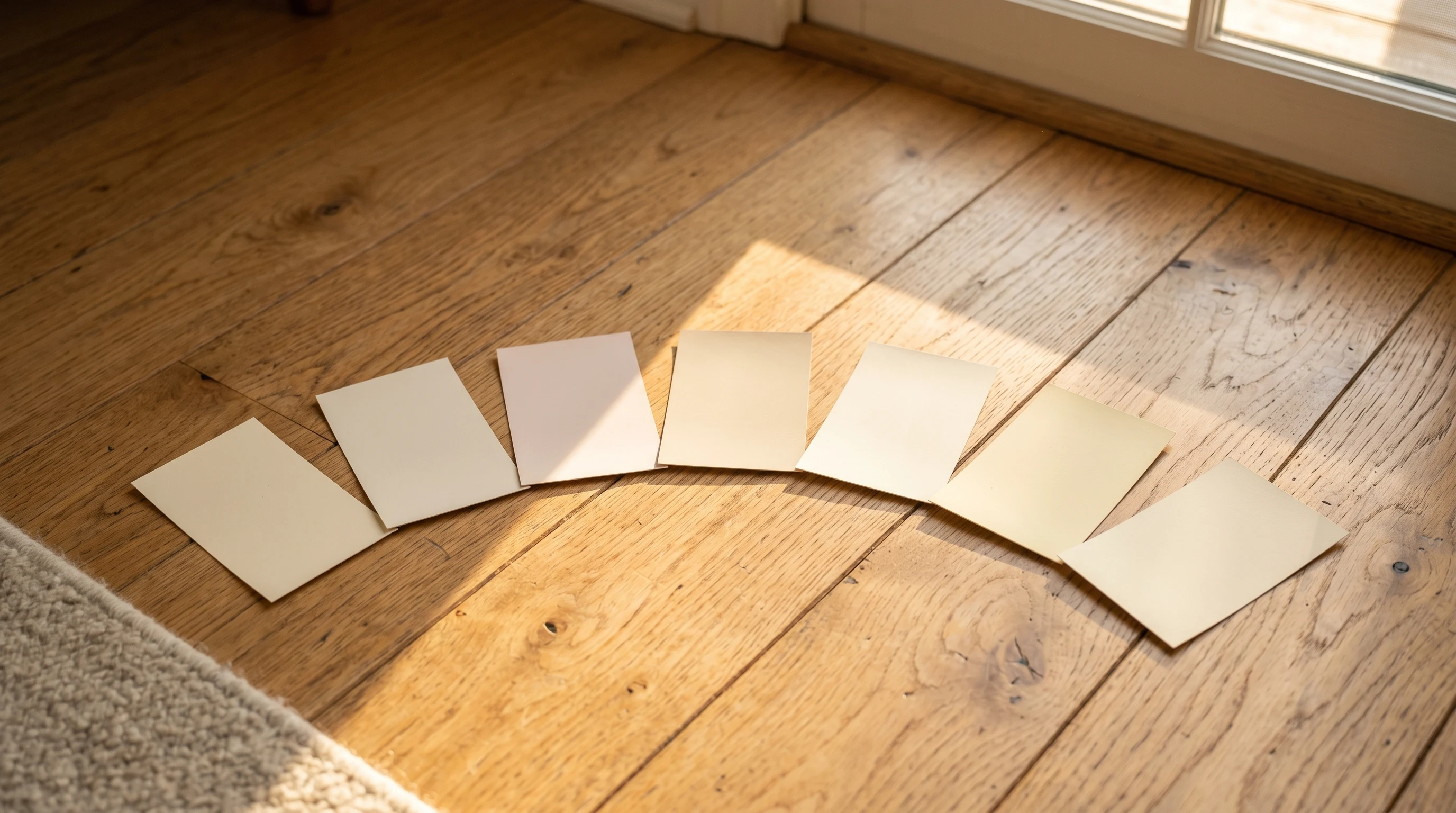
The trouble with whites is that they almost never look white. In a north-facing living room they go cool and a little blue. In late-afternoon western light they warm up and read almost cream. The same paint, the same wall, two different rooms.
That’s why a warm white round-up needs honesty about light before it gets to hex codes. Every white below is genuinely warm — it carries a yellow, cream, or soft pink undertone — but each one wants a particular room and a particular hour. So they’re grouped by the problem you’re solving, not by brand: the ones that behave anywhere, the ones that rescue a dark north-facing room, the ones that stay white in blazing sun, the soft greige-based whites, and the full creams for old houses.
Every color here is a real, buyable product. Any paint store will mix any of them into whatever line you want — flat for a ceiling, eggshell for walls, satin or semi-gloss for trim — so the brand on the chip decides the color, and the line you pick decides the finish and the price.
What Makes a White Read Warm
A warm white is a white with a small amount of yellow, gold, or red pigment holding it up from underneath. You can’t see it on a two-inch chip. You can absolutely see it across 400 square feet of wall, because scale multiplies undertone — whatever you can just barely detect on the chip is what you will definitely live with on the wall. White undertones explained walks through how to spot which way a white leans before you buy anything.
The second number that matters is LRV, or light reflectance value. A quick frame for the numbers in each profile below: anything above 88 reads as a true white on the wall and belongs mostly on trim and ceilings. The 80 to 86 band is where wall whites live — bright enough to lift the room, soft enough to hide roller marks and drywall texture. Drop into the 70s and you’ve left white behind for a soft off-white, which is its own conversation. LRV explained covers what the number does and does not tell you.
The third thing, and the one people skip: warm whites move more than any other color family. Between 9am daylight, 3pm sun, and a 2700K lamp at night, a warm white can travel from crisp to cream to almost butter. That isn’t a defect. It’s what you’re paying for.
Warm Whites That Work in Almost Any Light
These four are the low-risk picks — enough warmth to keep a room from going cold, not so much that strong sun turns them yellow. If you can only test one, test one of these.
Benjamin Moore White Dove (OC-17)
The warm white I recommend most often, and I have genuinely tried to find a room where it fails. It carries enough yellow to feel inviting in north-facing light without ever tipping into custard, and at LRV 83 it lifts a room without glaring back at you. White Dove sits beautifully against warm oak floors, brass fixtures, and unlacquered wood trim. Walls, trim, cabinets, or all three at once — it holds. The one honest caveat: in very bright western afternoon sun it reads creamy rather than white.
Sherwin-Williams Greek Villa (SW 7551)
Greek Villa is the Sherwin-Williams answer to White Dove, and in a lot of rooms it’s the better one. It’s a shade brighter and a shade creamier at the same time, which sounds contradictory until you see it — the extra LRV keeps it from feeling heavy, and the cream keeps it from feeling clinical. It’s a favourite for whole-house schemes because it doesn’t fight anything: warm wood, cool quartz, black hardware, brass. In a very dim room it can lose its warmth and drift toward plain. Give it at least a couple of hours of daylight.
Benjamin Moore Cloud White (OC-130)
Cloud White is the millwork white a lot of designers reach for when White Dove feels a touch too soft. There’s warmth in it, but it’s restrained — enough to keep a cold edge off the trim, not enough to read as cream against a white cabinet or a white appliance. On kitchen cabinetry it’s excellent, and it’s one of the few warm whites that still looks correct against a modern grey-veined counter. On four matte walls in a dark room it can go slightly flat, because there isn’t much pigment there to catch the light.
Valspar Cream Delight (7002-14)
Cream Delight is the practical answer for a whole-house repaint on a budget — Valspar stocks at Lowe’s, the coverage is good over builder beige, and the color itself is well behaved. It sits between Greek Villa and a true cream: soft enough to feel like a color, bright enough that a hallway with no window doesn’t go dim. It reads a little gold under warm bulbs, which is lovely in a living room and less lovely in a bathroom with cool overhead lighting. Test it under the bulbs you actually own.
Warm Whites for North-Facing and Low-Light Rooms
North light is cool, steady, and it strips warmth out of everything it touches. A white that looks creamy on the chip can go grey and slightly sad on a north wall. These four have enough pigment to survive it.
Benjamin Moore Swiss Coffee (OC-45)
Swiss Coffee is the cozy one, and the grey underneath is why it works where straight creams wobble. It’s noticeably warmer than White Dove and reads almost as a soft cream against bright white trim, but the grey backbone stops the yellow taking over once the lamps come on at night — which is exactly when most warm whites lose their nerve. On plaster, panelling, and older trim it looks like the house came that way. Gorgeous against natural linen, aged brass, and warm wood.
Sherwin-Williams Creamy (SW 7012)
Creamy is the warmest wall white in this group and it makes no apology for it. It reads as a soft cream, not as a white, and that’s the point. In a 1920s bungalow with original oak trim, in a north-facing bedroom that never gets direct sun, in any room where warmth should be the headline — Creamy delivers. It does not belong in a sun-blasted south room, where it will simply read yellow, and it fights cool greys rather than living with them. Pair it with warm materials and let it be what it is.
Benjamin Moore Linen White (OC-146)
Linen White has been on American ceilings and trim for forty years for a good reason: it’s a cream that still reads as a white. At LRV 83 it’s bright enough to lift a low ceiling, warm enough that it never puts a cold line above a warm wall. If you have creamy walls and were about to reach for a pure white ceiling, use this instead and the room will thank you. On four walls in a modern room with grey furniture it will read dated, so keep it to rooms with warm wood or warm walls.
PPG Creamy White (PPG1105-1)
The PPG version leans a touch further into the yellow than the Sherwin-Williams one, which makes it the pick for a genuinely dark space — a windowless hallway, a basement conversion, a north bedroom that only ever sees lamplight. It has enough body to stop those rooms reading grey, and it’s easy to find through PPG and Glidden retailers. In strong daylight some eyes will read it as a light beige. That’s the trade for the warmth, and in a dark room it’s a trade worth making.
Warm Whites That Hold Their Nerve in Strong Sun
South- and west-facing rooms do the opposite of north rooms: they pump warmth into everything, and a creamy white can turn frankly yellow by four o’clock. These four have their warmth dialled back just enough to survive it.
Benjamin Moore Simply White (OC-117)
Simply White is the warm white for people who think they want a cool white. It reads nearly neutral on a chip, but on the wall there’s just enough warmth to stop it going clinical under LEDs. It was Benjamin Moore’s color of the year for a reason — it flatters trim, cabinetry, and modern interiors without being precious about it. Best in south- and west-facing rooms with real daylight. In a dim north space it flattens out and loses its character entirely, and at LRV 90 it will show every wall flaw you have.
Farrow & Ball Wimborne White (No. 239)
Wimborne White is one step off a pure white with a quiet yellow warmth mixed in, and it’s the F&B white that behaves best in a bright room. Where a true white goes hard in strong sun, Wimborne stays open and slightly soft, and the pigment depth gives it a chalky quality flat modern whites can’t fake. It’s a superb trim and ceiling color above creamier walls, and it works full-drench in a hallway. It is expensive, and it needs light — in a dark room it just reads pale and empty.
Behr Swiss Coffee (W-B-700)
Behr’s Swiss Coffee is a near-cousin to Benjamin Moore’s, not a match — it runs lighter and a shade cleaner, which puts it in a different job entirely. That extra brightness is what makes it good in south and west rooms where the BM version would go cream. The Marquee formula covers in two coats over a mid-tone existing wall, which a lot of premium paints won’t, so for a whole-house repaint or a rental refresh it earns real money back. Buy a sample and check it against your trim before committing, because the gap between the two Swiss Coffees matters more than you’d guess.
Sherwin-Williams Westhighland White (SW 7566)
Westhighland White is the quiet overachiever in the Sherwin-Williams whites — brighter than Alabaster, warmer than Pure White, and steadier than either in changing light. The faint beige in the base is what keeps it from going yellow in afternoon sun, so it can take a south-facing wall of glass without turning buttery. It’s a strong choice for open-plan spaces where one wall gets blasted and another never sees the sun. Against cool grey stone it can read slightly sandy, so check it next to your countertop first.
Soft Warm Whites With a Greige or Pink Base
Not every warm white leans yellow. These lean pink or taupe instead, which makes them the softest whites on the shelf and the ones that flatter skin tones and photograph best. They read as a color, not as a blank.
Sherwin-Williams Alabaster (SW 7008)
Alabaster was Sherwin-Williams’ color of the year in 2016 and it’s still the warm white most painters reach for from that deck. The greige-pink underneath keeps the warmth in check, so in strong sun it stays a white instead of drifting cream, and it’s one of the few warm whites that looks correct next to a genuinely white appliance or a quartz counter. In a cold north-facing room the grey base steps forward and it goes slightly dusty. That’s the one place White Dove wins outright.
Benjamin Moore White Down (OC-131)
White Down sits half a step below a true white, and that half step is what makes rooms look styled rather than painted. It’s warm without being cream and soft without being beige, and at LRV 77 there’s enough depth that a big blank wall stops looking blank. Against rattan, oak, unbleached linen, and matte black hardware it’s very hard to beat. It is not a bright white, though — in a dark room it reads as a light greige, so if you need the room lifted, go up to Cloud White instead.
Behr Cotton Knit (PPU7-11)
Cotton Knit is the quietest color here and the easiest to live with. It’s barely white — more of a very pale putty — which is exactly why it works in rooms full of stuff: bookshelves, art, a busy sofa. It steps back and lets everything else be the color. In a bedroom it drapes beautifully under a single lamp. The catch is that at LRV 74 it will not brighten a dark room; treat it as a soft neutral rather than a white. Beige and greige undertones is worth a read before you commit to this end of the family.
Full-Cream Warm Whites for Older Houses
When the house has honey-toned wood, original millwork, or a lot of warm stone, a modern near-white looks like a mistake. These are the creams that look like they were always there.
Farrow & Ball Pointing (No. 2003)
Pointing is named after the lime mortar between old bricks, and it behaves like it — a warm white with a chalky depth the American whites don’t quite reach. At LRV 86 you get near-true-white lift with none of the coldness, and against dark walls it’s the trim color that keeps a scheme from going icy. It shifts gently through the day and flatters under candlelight, which is why it turns up in dining rooms, libraries, and panelled parlors. In a west-facing room at dusk, expect cream rather than white. It is genuinely expensive; the reward is a wall that does half the design work.
Farrow & Ball White Tie (No. 2002)
White Tie is Pointing with the warmth turned up and the brightness turned down — the F&B cream for rooms that want to feel candlelit rather than sunlit. The grey in the base is what stops it going custard, so it stays elegant where a straight cream would go sweet. It’s beautiful on panelling, in a north-facing dining room, and as a whole-room drench with the trim in the same color and a different sheen. In a very bright modern room it can read slightly beige and dated. It wants old bones.
Benjamin Moore Navajo White (OC-95)
Navajo White is the warmest entry in this round-up and one of the most-painted colors in American history — it was the builder default for decades, which is why it either reads instantly nostalgic or instantly dated depending on the room. In a 1970s ranch with wood beams, in a warm-toned dining room, or as a ceiling above cream walls, it’s genuinely lovely and very forgiving. Do not put it next to cool grey or crisp white trim, where it will look yellowed rather than warm. It needs company that agrees with it.
Sherwin-Williams Dover White (SW 6385)
Dover White is the cream that hides in plain sight on a lot of well-photographed kitchens. It’s brighter than Creamy and warmer than Greek Villa, and the faint green trace in the base gives it a slightly aged, plaster-like quality that keeps it from looking sugary. On cabinets it’s excellent, especially against unlacquered brass and a butcher-block or soapstone counter. Under 4000K LEDs the green can come forward and it reads slightly olive, so if your kitchen has cool overhead lighting, sample it there before you spray a single door.
Warm Whites for Trim, Cabinets, and Ceilings
Walls and millwork want different numbers. Trim and ceilings look best in the LRV 85 to 90 band — Cloud White, Simply White, Wimborne White, Pointing — because a crisper white draws the edge that makes the wall color look intentional. Walls are happier between 80 and 86, where the paint is soft enough to forgive a wavy old wall.
The rule that saves the most rooms: never put a cooler white above a warmer wall. A cool ceiling over a cream wall looks grey and faintly dirty from every angle, and no amount of lighting fixes it. Use the same white on the ceiling in flat, or go one step warmer. Best ceiling paint covers which products actually flow out flat enough to hide the roller.
On cabinets, the warm whites that hold up are the ones with a steady base — White Dove, Cloud White, Dover White, Alabaster. Straight creams like Navajo White and SW Creamy get overwhelmed by stainless and quartz. Best white cabinet paint and best kitchen cabinet paint go into the finishes, and the white kitchen hub shows the combinations in place.
For trim specifically, the question is usually how much contrast you want against the wall. Choosing paint color against trim walks the options, and best interior trim paint covers the products that level out on a mitre.
What to Pair a Warm White With
Warm whites are easy company, but they have preferences. Against red oak, honey oak, and warm walnut floors, almost anything in the cream families works — Swiss Coffee, Greek Villa, Dover White. Against white oak and pale engineered floors, go up in brightness: Cloud White, Simply White, Wimborne White, or the wall would look yellower than the floor.
Against cool grey stone, marble with grey veining, or stainless, stay in the restrained end — Alabaster, Cloud White, Westhighland White. A full cream next to grey marble looks like two different decisions.
For metals: brass and bronze love the creams, chrome and nickel prefer the brighter warm whites. And if you’re building a whole palette rather than picking one wall, the greige family is the natural partner for these whites on the next room over, while the cool whites are the ones to reach for if the room turns out to be brighter than you thought. For the whole picture across every white family, shades of white sorts the shelf.
Sheen Is the Other Half of the Decision
The same warm white in flat, eggshell, and satin reads as three different colors. Flat scatters the light and looks deeper and softer; satin reflects the light source and looks brighter and cooler. That’s why a warm white can look perfect on the wall in eggshell and slightly icy on the trim in semi-gloss — same paint, different behaviour.
Walls want flat or eggshell. Trim and doors want satin or semi-gloss. Ceilings want flat, always. The sheen guide has the durability trade-offs, but for warm whites there’s one extra rule: skip semi-gloss on walls entirely. It turns any cream undertone plasticky and lights up every drywall seam in the room.
Same Name, Different White
Three different brands sell a “Swiss Coffee” and none of them are the same color. Benjamin Moore’s OC-45 sits at LRV 82 with a grey backbone, Behr’s W-B-700 is brighter at 87, and Valspar’s 7002-16 lands somewhere near the Behr. Behr also sells a lovely warm white called Papier Blanc (HDC-NT-08) that gets confused with Swiss Coffee constantly. Antique White, Linen White, and Navajo White have the same problem across decks.
So always match the code, never the name — and if a painter or a blog gives you just a name, ask which brand. Every one of these colors can be mixed into any brand’s paint at the counter if you bring the formula, but the formula has to be the right one to start with.
How to Choose Between Them
Start with the direction the windows face. If the room faces north, or gets most of its light from lamps, shop the cream group — Swiss Coffee, SW Creamy, Linen White, PPG Creamy White. If it faces south or west and gets real sun, go to the sun-proof group: Simply White, Wimborne White, Behr Swiss Coffee, Westhighland White. East-facing rooms are bright in the morning and cool after lunch, which is where the all-rounders earn their keep — White Dove, Greek Villa, Cloud White, Cream Delight.
Then decide what the white is for. Walls: LRV 80 to 86. Trim and ceilings: 85 to 90. Rooms where you want calm rather than bright: drop to 74 to 79 and accept that White Down and Cotton Knit read as a soft color, not a white.
Then test properly, because warm whites move more than anything else on the shelf. Buy three sample pots, paint two coats on letter-sized poster board rather than directly on the wall — the existing color underneath tints what you see and sends you down the wrong path. Prop the boards against the wall you care about, next to the floor and the trim, and look at them at 9am, at 2pm, and at 7pm with only the lamps on. A warm white you chose at noon will surprise you at breakfast.
To skip a round of sample pots entirely, upload a photo of the room to the visualizer and put the shortlist on your actual walls first. It catches the obvious misses before you spend anything, and it’s faster than driving back to the store. If you’d rather see how these whites behave room by room, the living room, bedroom, and trim hubs show them in context, and best warm white paint covers which products to buy them in.
Ask a Question