The Best Cool White Paint Colors
Twenty cool whites that read crisp without going clinical — Chantilly Lace, Decorator's White, Pure White, Extra White, High Reflective White, Wevet, Silver Polish and more from Benjamin Moore, Sherwin-Williams, Behr, Valspar, PPG and Farrow & Ball, with hex, LRV, undertone warnings and the light each one needs.

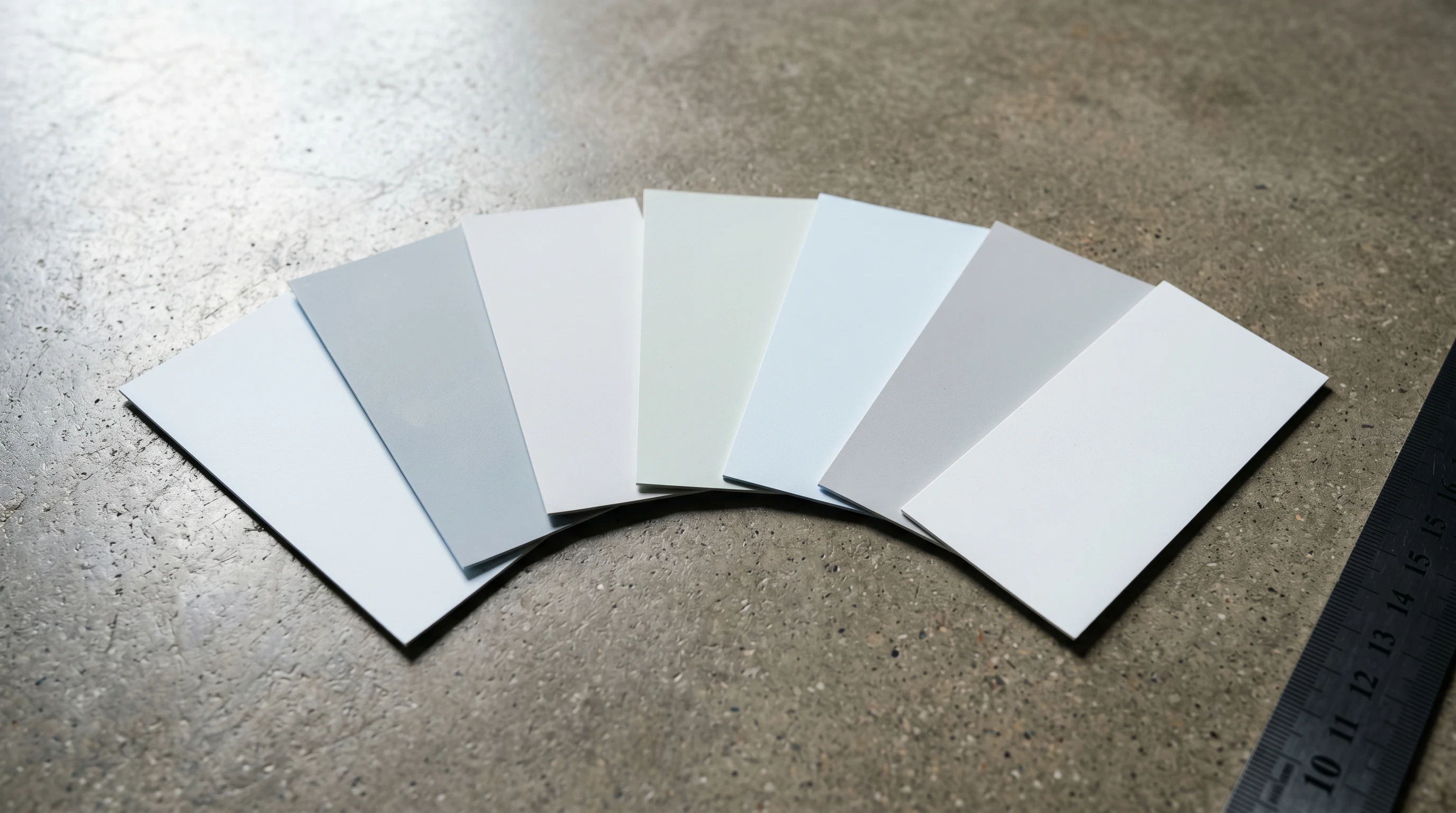
Cool whites are the ones people reach for and then panic about. The chip looks perfect under the store lights. Then it goes up on a north-facing wall and the homeowner stands in the doorway asking, quietly, why the room now feels like a dentist’s office.
A genuinely cool white is the right call when warm whites read yellow against your floors, when your LEDs are pushing everything cream, when there is a navy or a deep green on the next wall and you need the trim to actually punch. Every white below is honestly cool. What separates them is how cool, and how much light they need before they stop looking crisp and start looking cold.
I have sorted them by the problem you are solving rather than by brand, because that is how the decision actually gets made. If you want the wider map first — the warm, creamy, and greige families as well — shades of white paint covers the whole shelf, and white undertones explained is the theory underneath all of it.
What Makes a White Read Cool
Every white on the shelf has a hidden bias. A warm white has yellow or cream sitting under the surface; a cool white has grey, blue, or a whisper of green. The pigment load is tiny in both cases, which is why a chip tells you almost nothing and a wall tells you everything — 400 square feet of a faint undertone is no longer faint.
Two numbers help. LRV is how much light the paint bounces back: a crisp white sits in the high 80s to mid 90s, and below 85 a cool white starts drifting toward off-white-grey territory, which is a different decision entirely. LRV explained goes deeper, and the LRV checker will tell you where any color lands.
The second thing is your light direction. North light is cool and flat and will pull a cool white further toward grey. South and west light is warm and generous and will neutralize a cool white into something that just reads clean. Same paint, opposite outcomes — how light direction changes paint color has the full breakdown. Choose the white for the light you have, not the one in the photo you saved.
The Safe Cool Whites: Crisp in Almost Any Light
These four sit close enough to neutral that they behave in a north-facing bedroom and a south-facing kitchen alike. If you cannot sample, or you are painting a whole house one color, start here.
Benjamin Moore Chantilly Lace (OC-65)
The cool white I recommend most often, and the reason is restraint. Chantilly Lace reads as a true crisp white without ever going icy — there is just enough cool in it to stop the yellow shift in afternoon sun, and not enough to tip blue in a dim room. It sits beautifully against stainless, polished nickel, black window frames, and cool grey floors, and it is the default trim white in a huge number of modern houses for exactly that reason.
Where it struggles is a big matte wall in a dark room. At LRV 90 there is very little pigment holding the color together, so the wall can go slightly grey and empty. Give it daylight and it is close to flawless. Same color in satin on the trim, flat on the walls, and the scheme reads as one thing.
Sherwin-Williams Pure White (SW 7005)
Pure White is the most-specified white in the Sherwin-Williams line and the one I hand over when someone has to commit without sampling. It reads cool without being aggressive about it — a trace of warmth so it never goes clinical, not enough to drift cream in sun. Painters call it the no-fail white and they are mostly right.
It works on walls, trim, cabinets, and ceilings in any orientation, which makes it the practical whole-house answer. The honest trade is that it never does anything remarkable. It is a good default, not a statement, and in a room with beautiful light you may want something with more opinion.
PPG Delicate White (PPG1001-1)
Delicate White is the gentlest cool white in this group, which is what makes it easy to live with. It gives you the crispness you want against modern cabinetry and cool stone, but the grey is soft enough that it does not turn hostile in a room that only gets a couple of hours of real sun. As a ceiling above cool grey or pale blue walls it is close to perfect.
Next to warm white oak or a cream sofa it can look faintly sterile. It is a cool-scheme white, not a mixer. Easy to get through PPG and Glidden retailers, which matters more than people think when you need a second gallon in a hurry.
Benjamin Moore Ice Mist (OC-67)
Ice Mist is the underrated one on this list. It sits at the same brightness as Chantilly Lace but carries a slightly greener cool base, and green is the friendliest cool undertone there is — it stops a white going blue under LED and it makes wood floors look better rather than merely tolerated.
It is lovely in bathrooms, laundry rooms, and hallways where you want clean rather than clinical. On four walls in a heavily north-facing room it can flatten a touch. Pair it with a warmer trim white and it will look deliberate instead of accidental.
Cool Whites for North-Facing and Low-Light Rooms
North light removes whatever warmth a color has and hands back the cool. These four have enough pigment or enough near-neutrality to survive it. The very bright cool whites further down this page do not — they go grey.
Benjamin Moore Decorator’s White (OC-149)
Hex: #EBEDEA · LRV: 83 · Undertone: cool grey with a faint green trace
Decorator’s White is what designers reach for when they want a cool white that still has body. It sits several points below Chantilly Lace, which means it drapes instead of bouncing — the wall has presence instead of vanishing. The faint green in the base keeps it from going blue, so it reads clean rather than icy, and against grey walls, black windows, or a deep navy it draws the sharpest line of any white here.
It sings in modern and transitional rooms with mid-tone wood floors. In a warm-toned room full of honey oak and brass it can look grey and out of place, like the trim got primed and forgotten. Know which room you have.
Farrow & Ball Wevet (No. 273)
Wevet is named after a spider’s web, and that is roughly what it does — a soft, cool, almost weightless white with just enough grey to keep the walls from reading blank. In a north-facing room it holds its shape where a brighter cool white would go flat, and under lamplight at night it stays a white instead of turning cream.
It is the cool white I would put in a small bathroom or a low-ceilinged bedroom, because the small amount of pigment gives the walls edges. Farrow & Ball prices are what they are; if you love it and cannot spend it, Decorator’s White is the nearest everyday substitute.
Sherwin-Williams Snowbound (SW 7004)
Snowbound is the cool white for people who find most cool whites unfriendly. The grey in it is warmed by a very slight pink-taupe cast, which sounds alarming and is not — it just keeps the color from going cold in a room without much sun. On walls it reads as a soft, quiet white; on cabinets it looks expensive.
The caveat is that pink base. Next to a true grey with a blue undertone, or under strong afternoon sun, Snowbound can show its warmth and read faintly mauve. Sample it against your actual counters before you commit a kitchen to it.
PPG Moonlit Snow (PPG1041-1)
Moonlit Snow is the quiet workhorse of the group. It has the same near-neutral cool grey that makes Decorator’s White so reliable, with a slightly greener bias that keeps it steady when the lamps come on at night — the hour where a lot of cool whites wobble toward blue.
Very good in hallways, stairwells, and rooms with a single window, where a brighter white would just look empty. In a bright south-facing room it can read almost as a pale grey rather than a white. That is the trade for the body.
The Genuinely Cool Ones: Blue-Grey Whites for Bright Rooms
These are the cool whites that are unmistakably cool. They want real sun or strong modern lighting, and they belong in schemes built on grey, black, chrome, and cool stone. Put them in a dim north-facing room and they will punish you for it.
Sherwin-Williams Extra White (SW 7006)
Extra White is what you want when Pure White is not cool enough. The blue-grey undertone is genuinely visible on a wall, which makes it the right pick for sleek modern interiors, black-and-white kitchens, and rooms with polished concrete or cool grey floors. It also stays put under lamplight, where neutral whites warm up.
Best in bright south- and east-facing rooms where daylight balances the cool cast. In a dim or heavily north-facing space it pushes toward grey, and on a cloudy day it can read institutional. Against warm wood it looks like the wrong choice, because it is. Use it deliberately.
Benjamin Moore Super White (OC-152)
Super White is Benjamin Moore’s coolest white and it does not apologise for it. The faint blue-violet undertone reads as genuinely cool against almost anything else in the room. On trim against a warm yellow wall it pops as a true clean white; on a ceiling above warm walls it keeps the ceiling from drifting cream. You will also see it sold as PM-1 in the mixing line — same color, different label.
On walls it is a deliberate choice: modern white-on-white kitchens, contemporary baths, gallery hallways. In a traditional room with warm floors and brass fixtures it fights the materials rather than joining them.
Behr Silver Polish (BL-W13)
Silver Polish is the coolest white on this page that still behaves like a white rather than a pale grey. The green-grey base is obvious on a wall — this is not a subtle color — and it is beautiful in a bathroom with white tile, in a laundry room, or on cabinetry that wants to look like sea glass caught the light.
At LRV 82 it has enough pigment to hold a large wall without going flat, and it is easy to buy at any Home Depot paint counter, which makes it the accessible version of a designer cool white. Do not put it next to warm cream trim. Give it a bright white or a soft grey and it looks intentional.
Valspar Blue Kiss (7004-11)
The name oversells it — Blue Kiss is not a blue, it is a cool white with the faintest blue-grey lift, and it is one of the better-behaved cool whites at the Lowe’s counter. It gives you visible coolness without the institutional edge Extra White can have on a grey day, which makes it a friendly choice for a bright bedroom or a home office.
It needs decent daylight. In lamplight only, the blue can come forward and the walls read faintly cold. Pair it with warm wood and matte black hardware to keep the room human.
The Brightest Cool Whites: Trim, Ceilings, and Contrast
Above LRV 90 you are no longer choosing atmosphere, you are choosing brightness. These are trim colors, ceiling colors, and contrast colors first — and only wall colors in rooms with real light.
Sherwin-Williams High Reflective White (SW 7757)
This is the ceiling white. High Reflective White bounces more light than anything else in the Sherwin-Williams deck, which is why it turns up in basements, hallways, and rooms with one small window. Above a darker wall color it is the difference between a room that feels low and a room that feels lifted.
It is also the sharpest trim white here. Against a navy or charcoal wall, Chantilly Lace looks crisp and High Reflective White looks crisper. On four walls it is a lot — strong south light produces genuine glare, and it shows every roller lap and drywall seam you have.
Behr Ultra Pure White (PPU18-06)
Almost certainly the most-painted white in America, because it is the untinted base at the Home Depot counter and the default on new construction — cheap, instantly available, completely neutral. For a ceiling, a garage, a rental refresh, or a closet it does the job with zero thinking.
It is also the white that gives white paint its cold reputation. With no undertone to catch the light, a north-facing room goes flat and slightly blue. Use it where you want brightness rather than atmosphere, and pair it with the best ceiling paint formulas rather than putting it on four living-room walls.
Valspar Ultra White (7006-24)
Valspar’s equivalent, and the practical answer if you shop at Lowe’s. Same story: maximum brightness, no undertone, excellent on ceilings and utility spaces, and available in every sheen from flat to high-gloss enamel for doors and trim.
If you are painting trim throughout a house on a budget, this is the one that gets the job done without anybody noticing the paint — which, for trim, is usually the point. For the products themselves, best interior trim paint covers what actually holds an edge.
Benjamin Moore Oxford White (CC-30)
Oxford White is the trim white that a lot of designers quietly default to when Chantilly Lace feels too bright and Decorator’s White feels too grey. It sits between them — crisp, cool, unfussy, and it never fights the wall color it borders.
It is particularly good on doors and casings in a house with several different wall colors, because it stays neutral against all of them. In semi-gloss on a six-panel door it looks like joinery rather than paint. If you are working out how much contrast to put between wall and trim, choosing paint color against trim walks through it.
Sherwin-Williams Ceiling Bright White (SW 7007)
Not the brightest white in the room, and that is the whole idea. Ceiling Bright White is formulated for the fifth wall, where a very high-LRV white can bounce so much light back down that the ceiling calls attention to itself. This one sits a step quieter, so it reads as ceiling rather than as a lit surface.
Above cool white or grey walls it disappears exactly the way a ceiling should. Above warm cream walls it will look grey and slightly dirty — that is the one ceiling rule worth memorising, and painting the fifth wall covers the rest.
Cool Whites With Depth: When Bright White Feels Empty
Sometimes the problem is not temperature, it is emptiness. These whites carry real pigment, so the walls keep their shape in a dim room and shift beautifully through the day instead of sitting there.
Farrow & Ball All White (No. 2005)
All White is the purist’s white, made with no added black pigment, and you can see it. There is a soft, open quality instead of the chalky flatness most bright whites have at this brightness. It reads cool because the absence of any warming tint lets the room’s own light dictate the cast — cool and quiet in a north-facing parlour, gently warm in a south-facing kitchen.
It is also unforgiving. With no black to steady it, it picks up whatever is nearby, so a green garden outside the window will land on your wall. Give it good light, good millwork, and materials worth reflecting.
Farrow & Ball Strong White (No. 2001)
Strong White is the one people mean when they say they want a white with weight. At LRV 76 it is barely a white at all — in bright sun it reads as an off-white, in a dim hallway it reads as a very pale warm grey. That range is the point: the walls change through the day rather than sitting flat.
It is excellent under a brighter white ceiling and against dark joinery. If you want a white that looks like a decision rather than a default, this is it. Do not expect it to brighten a dark room, because it will not.
Farrow & Ball Blackened (No. 2011)
Blackened is a white with a drop of black in it, and it is the coolest color on this page by a distance. In a bright modern room it reads as a crisp pale grey-white with real presence; under a skylight it is genuinely beautiful. It makes bright white trim look brilliant instead of merely clean.
It is not a cure for a dark room — at LRV 71 there is not enough reflectance for that. Treat it as a pale cool grey that happens to be sold as a white, and it will not disappoint you.
Which Cool White for Which Room
Kitchens. Cool whites belong next to stainless, quartz, and cool-toned tile. Pure White or Chantilly Lace on the walls, a brighter cool white on the trim, and the cabinets in the same family. If the cabinets are the real decision, best kitchen colors and best white cabinet paint cover that side of it.
Bathrooms. This is where cool whites earn their keep — next to white tile and chrome, a warm white looks grubby and a cool white looks clean. Ice Mist, Silver Polish, and Wevet are all at home here. More options in best bathroom colors.
Bedrooms. Careful. A bedroom is used at 7am and 10pm, both low-light hours, and a strongly cool white in lamplight can feel unrestful. Snowbound, Wevet, or Strong White give you cool without cold. The bedroom color hub has the wider palette if a white alone is not enough.
Living rooms and open plans. Pick one white and carry it through, changing only sheen. Chantilly Lace and Pure White are the two that hold up across rooms facing different directions in the same house — see best living room colors for what to put beside them.
Small, dark rooms. The instinct is to reach for the brightest white on the shelf. Resist it. At LRV 93 with no pigment, a small dim room just goes flat. A cool white in the low 80s keeps the corners legible and the room feels larger, not smaller.
Trim, Ceilings, and Sheen
The single most common mistake with cool whites is mixing temperatures by accident. A cool white ceiling over a warm white wall reads grey and faintly dirty from every angle in the room — it is the thing people notice for years without being able to name. Keep the ceiling the same temperature as the walls, or a touch warmer, never cooler.
Trim is the opposite: contrast there is deliberate and welcome. If your walls are a cool white with body, like Decorator’s White or Wevet, put a brighter cool white on the trim — High Reflective White, Oxford White, Chantilly Lace — and the millwork gains an edge. If your walls are already at LRV 90, do not chase more contrast; use the same color in a higher sheen and let the light do the work.
Sheen changes the color itself. The same cool white in flat, eggshell, and satin reads as three whites: flat looks softest and slightly deeper, satin looks brighter and cooler because it reflects the light source instead of scattering it. Walls want flat or eggshell, trim wants satin or semi-gloss, and the sheen guide has the trade-offs in full.
One practical note: high-LRV whites cover badly. There is barely any pigment in them, so plan on two coats over another light color and a tinted primer under anything mid-tone or darker. Skipping that step is the usual reason a white wall still looks blotchy on coat three.
Cool White or Warm White? Deciding in Five Minutes
Stand in the room at the hour you actually use it and look at the floor. If the floor is a warm oak, a honey pine, or a red-toned tile, a cool white will sit against it as a contrast — sometimes lovely, sometimes fighting. If the floor is grey, white, concrete, black, or a cool-toned engineered wood, a cool white will read as a match and a warm white will read as slightly grubby.
Then look at your bulbs. 2700K lamps push everything warm and will neutralise a mild cool white into something pleasant. 3500K to 4000K bulbs will push a cool white further cool, sometimes past where you wanted it. And check your window direction: north and east want the near-neutral cool whites at the top of this page, south and west can take the genuinely blue-grey ones.
If the answer keeps coming out warm, go to the best warm white paint colors instead — there is no prize for choosing a temperature your room does not want.
How to Test a Cool White Properly
Paint two coats on letter-sized poster board, not straight onto the wall. The existing color underneath tints what you see and sends you toward the wrong answer more often than any other testing mistake.
Prop the boards against the wall you care about, low down, next to the floor and the trim. Then look three times: at 9am, at 3pm, and at night with only the lamps on. Whites shift more between those three moments than any other color family, and the cool white that wins at 3pm regularly loses at 8pm. The breakfast hour is the one you will notice for the next ten years, so weight it accordingly.
Every color on this page is mixed to order at a paint counter, so nothing here is exotic — bring the name and the code, ask for sample pots of your final two, and buy the gallons only after the poster boards have told you which one your room wants. To skip a round of sample pots entirely, upload a photo of the room to the visualizer and put the shortlist on your actual walls first. It catches the obvious misses before you spend anything.
Ask a Question