Granite
The mid-gray Pratt & Lambert actually mixes, reviewed honestly: where it stays stone, the rooms that turn it cave, and why it is not Chelsea Gray.

Jessica has spec'd whites and neutrals for more than 300 rooms and keeps a sample wall of painted drawdowns in her studio. Every color review is checked against real reader rooms in the comments and re-tested when a formula changes. About the testing process →
- 1Black Fox7
- 2Pewter Green12
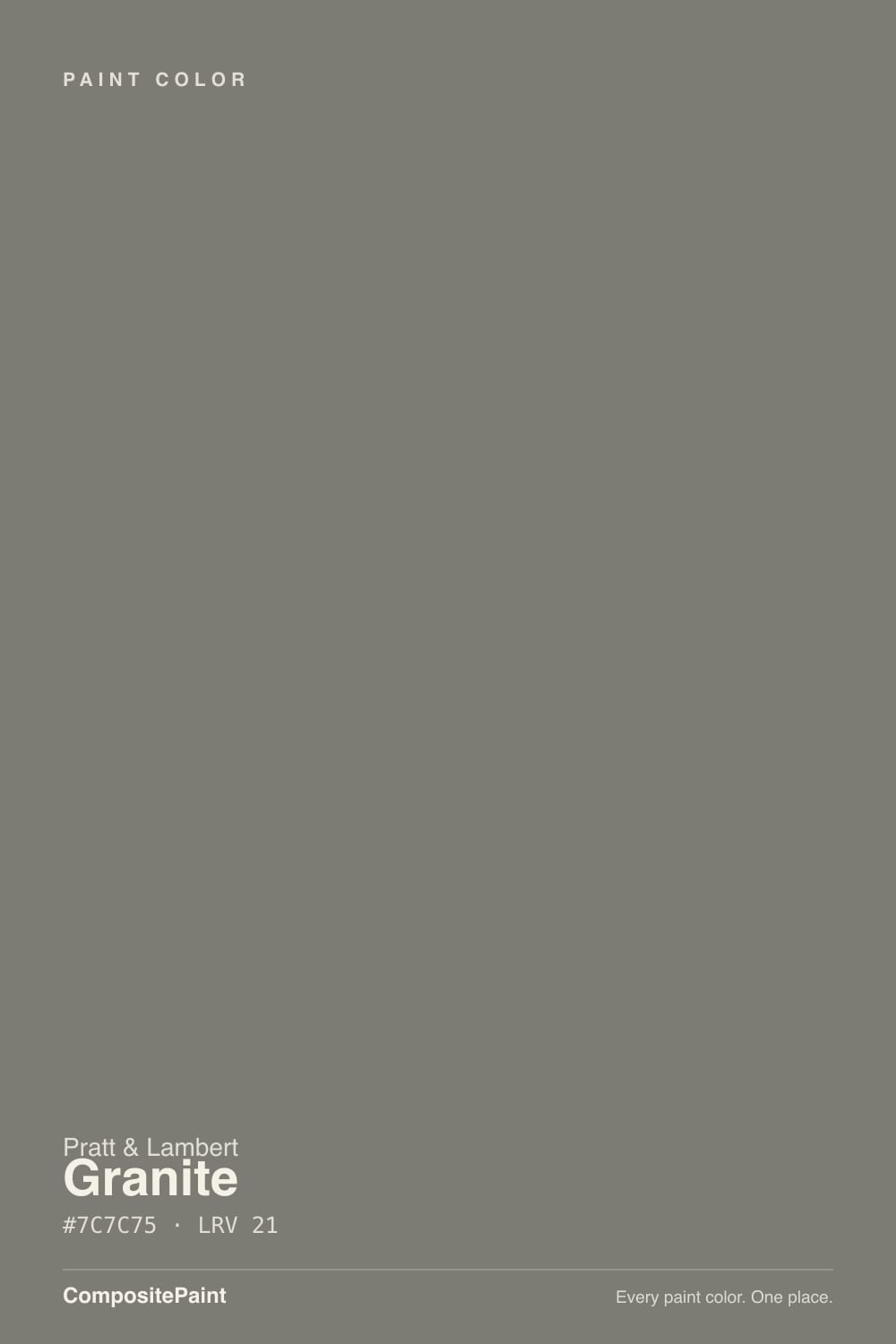
- 3Granite21
- 4Stardew43
- 5Quietude48
The Fast Verdict
Granite 32-19 is the mid-gray independent dealers mix when a spec says gray and nobody wants a greige. At LRV 21 it is a real dark: stone, architectural, almost no chroma. The hex is nearly even — a 3-percent yellow-green whisper most eyes read as pure gray, which is the whole point. Chelsea Gray (HC-168) at the same depth is a charcoal-greige that flashes brown-green. This one stays rock. Give it daylight or warm lamps and a job with edges — an island, a built-in, a door, an exterior — and it behaves. Drench a dim room with it and you did not get gray; you got a cave.
Kitchen islands and painted cabinets · lamplit offices and dens · a daylit dining room · exterior body or a front door that should look like stone, not greige
You are painting four dim interior walls · you wanted Chelsea Gray's warm greige · the room runs on cool white LEDs and no lamps · you need a gray a listing agent will name-drop
- A true stone gray — almost no chroma, no greige, no blue flash
- LRV 21 is the useful island and cabinet depth: dark, still a color
- The opposite of Chelsea Gray if you wanted gray that stays gray
- Flatters oak, walnut, brass, and a clean white trim
- The mid-gray P&L dealers already know how to mix
- Four dim walls go cave — this is not a whole-house interior gray
- No name recognition if you are painting for resale
- Cool LEDs and leftover cream trim make it look dirty
- People who wanted Chelsea Gray's warmth will call it flat
What Color Is Granite, Really?
A stone-true mid-gray with the personality stripped out of it. People look this one up because 32-19 sits in Pratt & Lambert spec sheets as the mid-gray, not because a blog made it famous. The measured hue sits in the yellow-green corner at about three percent saturation, so the wall is essentially a clean rock color with a faint warm-green breath — never blue, never violet, never the brown-greige that made Chelsea Gray a default island. Independent dealers have mixed it for decades as a contractor gray. You will not find it on a Color of the Year list or a designer roundup. What you will find is a fan deck where the word Granite is doing honest work: this is the color of cut stone, not of a mood board.
At LRV 21 it is a genuine dark. Chelsea Gray sits two points lighter at LRV 23 and still reads as a charcoal-greige; Dovetail (SW 7018) is five points lighter at LRV 26 and warmer; Kendall Charcoal (HC-166) drops to LRV 15 and is the next real step into charcoal. That number is the useful part and the trap. On an island, a cabinet run, a door, or a sunlit exterior, LRV 21 gives weight without going black. On four interior walls it soaks the room. Plan for any large surface to read a step deeper than the chip — every dark gray does this, and it is the number-one surprise once the tape comes off.
Undertone in one line: near-neutral gray first, a whisper of warm green second — never beige, never blue. If your sample looks earthier, that is a crisp white or a cool neighbor pulling the warmth into relief. If it looks cooler and stonier, you put it next to a greige. If it looks black, the room is too dim. All three are the same paint being honest about what sits beside it.
Where It Shines
This color is built for surfaces that should look architectural, not decorated: a kitchen island, a run of cabinets, a built-in, a front door, a house body. LRV 21 is the useful trick — dark enough to photograph as stone, light enough that hardware, wood grain, and shadow lines still show. Give it daylight or 2700K lamps, a clean white trim, and oak or walnut, and it reads like a custom millwork color you got at a dealer counter. Its second home is the closed, lamplit room — an office, a den, a dining room with a window — where the gray goes velvety after dark instead of disappearing.
Where It Fails
Almost every regret about a dark gray this quiet follows one of three scripts, and all three are visible on a sample board if you look at the right hour. None of them are a bad batch — but if your room matches one, this is not your gray, and more coats will not add the light the number already spent.
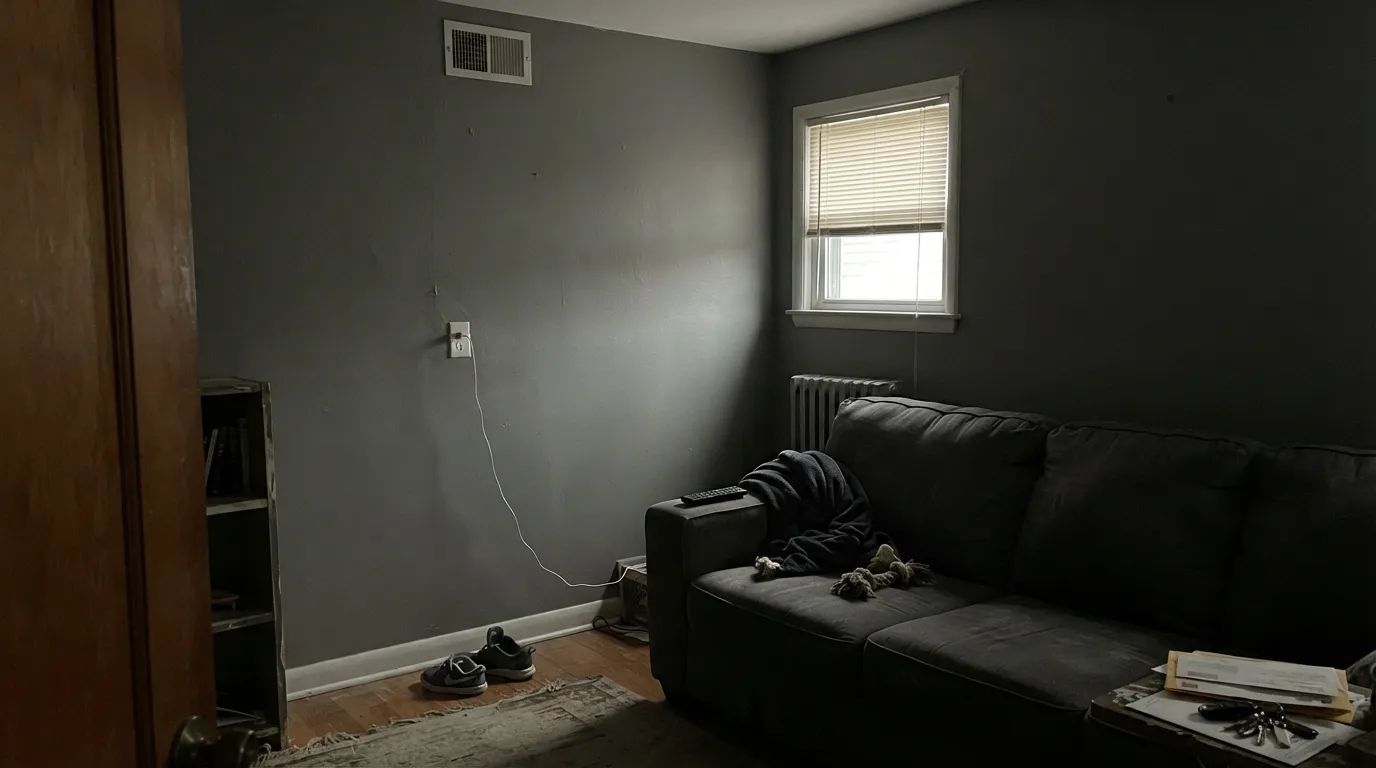
At LRV 21 Granite soaks light rather than bouncing it. In a north room, a basement, or any space that lives on one window and no lamps, four walls go heavy, shadowy, and slightly muddy — a cave, not a gray room. You did not get drama; you got less light. Keep it on an island, one accent wall, or a room with real daylight and 2700K lamps in the corners. If you still want four dark walls, Kendall Charcoal (HC-166, LRV 15) is the better-behaved charcoal, and it still has the same dim-room trap — respect the number.
Same depth band, opposite paint. Chelsea Gray (HC-168, LRV 23) is the go-to charcoal-greige for islands, exteriors, and accent walls — warmer, browner, with a green undertone that can flash in strong sun. Granite is the stone version: cleaner, quieter, almost no chroma. Set the two chips side by side and Chelsea looks like taupe-charcoal; Granite looks like rock. If you wanted that famous greige depth, this is the wrong can. If you wanted gray that stays gray, you are in the right aisle.
4000K LEDs flatten the faint warmth and leave a hard, slightly dirty slate. Leftover creamy builder casing next to it makes the walls look unwashed — the dark gray wins, the trim looks nicotine. Swap the bulbs to 2700K before you blame the paint, and recut the trim in a real white: White Dove (PM-19) for a soft edge, Chantilly Lace (OC-65) if you want the crisp architectural cut. Do not leave the old cream.
Room by Room
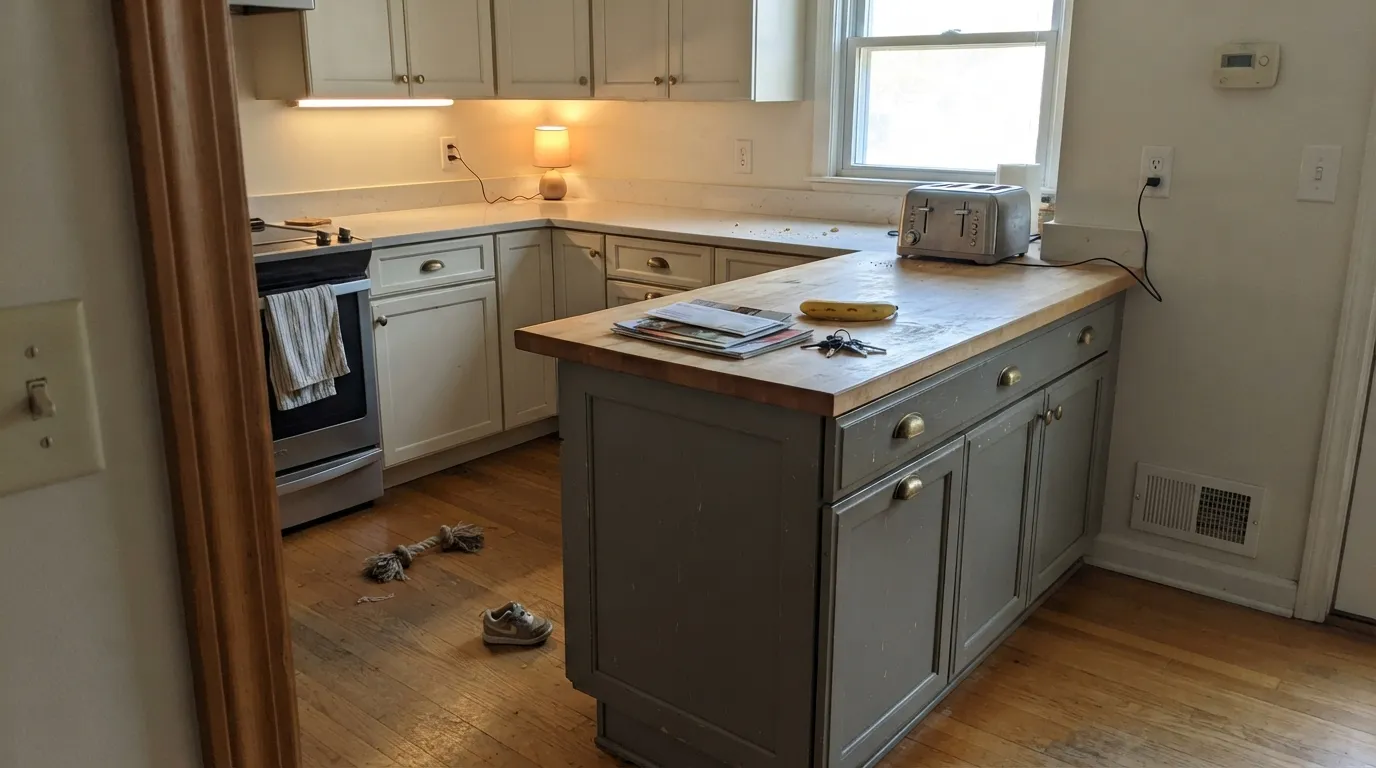
This is the use 32-19 was mixed for. Satin Granite on an island or a lower run, against Alabaster or White Dove perimeter doors, is the stone-gray version of the Chelsea Gray kitchen — depth without the greige, hardware that still shows. Oak, walnut, brass, and butcher block all sit comfortably. Cool gray quartz is the pairing to sample; it can make the doors look slightly green-warm by contrast.
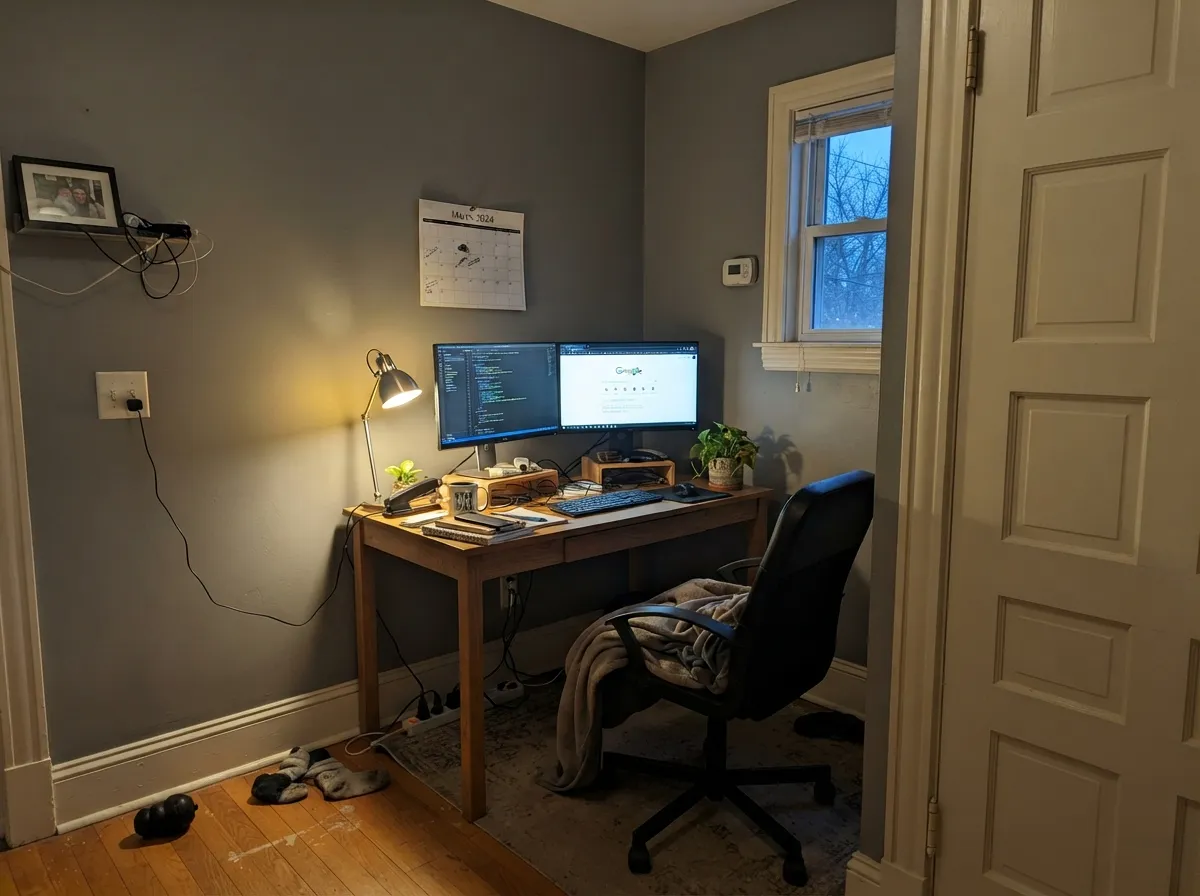
Low light is not the enemy if the lamps are on. Matte Granite on four walls of a closed office with 2700K bulbs, White Dove trim, and walnut shelves goes velvety after 5pm — a room that feels finished, not painted. A windowless den with one overhead LED is the cave version. Eggshell where chairs scuff.
A daylit dining room can carry this gray on all four walls because dinner happens under lamps anyway. White Dove trim, oak or walnut table, one dark note on a hutch or door. An interior dining room with no daylight will swallow the table after dark; plan the bulbs first, or keep Granite on the chairs and a built-in instead of the field.
One Granite wall behind the headboard against Light Grey (32-12) or a soft white is deliberate. Four Granite walls in a north bedroom is a cave you sleep in. If you want a dark bedroom, keep the lamps warm, the ceiling light, and a large sample on the darkest wall overnight before you commit.
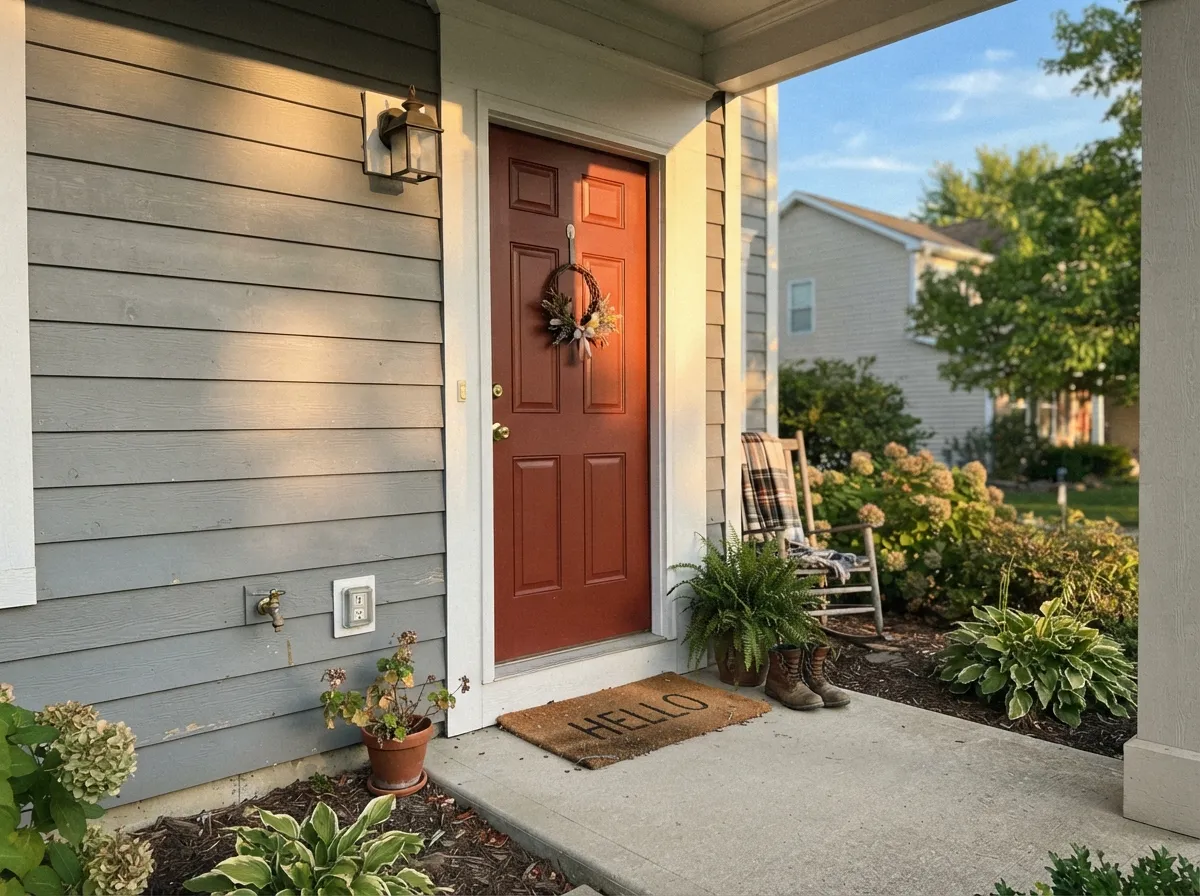
Full sun is the one condition that reliably keeps a dark gray honest, and Granite outdoors reads as stone siding rather than a mood color. White Dove or Chantilly Lace trim frames it; Brick Red (20-9) on the door is the oxblood pop this gray wants. A shaded north elevation will read a step deeper — walk the house with the sample before you bid the body.
A south-facing living room with lamps at night can wear it, especially in a closed plan. An open main floor that has to negotiate kitchen wood tones and a light hallway is a harder ask — Light Grey (32-12) on the field and Granite on the island or a fireplace wall is the safer handoff. Skip the dim family-room drench.
Your Light Is the Risk
Strong daylight opens it up and keeps it a true stone gray: the faint warmth stays a whisper, the wall looks architectural. This is the light the color was mixed for.
Cool, flat daylight strips the whisper of warmth and the LRV 21 has nothing left to bounce. Four walls go heavy, slate, and slightly muddy. Fine on an accent; disappointing as a drench.
Cooler and more slate in the off-sun hours, a touch earthier when the sun is in the room. Golden hour warms the green whisper for an hour without turning it greige. Sample at 8am and 4pm on the same wall.
2700K lamps: stony, slightly warm, the version you actually want at night. 4000K LEDs: hard, flat, slightly dirty slate. Swap the bulbs before you repaint.
Most complaints about Granite are a light mismatch. Upload a photo of your actual room and see it on your walls — then ask for the same wall in north light or evening lamps before you buy a single sample.
Need It From Another Brand?
Any paint counter can custom-tint Pratt & Lambert 32-19 directly. If you would rather stay in one brand's own deck, these are the closest stock matches, measured as ΔE2000. Under 2 is a difference you will not see on the wall.
| Brand | Closest color | ΔE | LRV | |
|---|---|---|---|---|
| Sherwin-Williams | Attitude GraySW 7060 · Sherwin-Williams | 0.9 | 20 | Color page → |
| Behr | GreyhoundPPU24-21 · Behr | 2.8 | 20 | Color page → |
| Benjamin Moore | AsphaltCC-548 · Benjamin Moore | 1.5 | 21 | Color page → |
| Valspar | Porcelain Shale5006-2B · Valspar | 0.7 | 19.6 | Color page → |
| PPG / Glidden | On The EdgePPG0998-6 · PPG / Glidden | 1.9 | 20 | Color page → |
| Glidden | On The EdgePPG0998-6 · Glidden | 2.3 | 20 | Color page → |
Contrast and Legibility
WCAG 2.1: AA is 4.5 : 1 for normal text, 3 : 1 for large text, AAA is 7 : 1.
Granite vs the Colors You're Also Considering
Every Granite sample board has the same rivals on it. The numbers show the real lightness gap — then it comes down to which risk you would rather live with.
Pick this when you want the same depth as stone, not greige — gray that stays gray.
Benjamin Moore HC-168 · LRV 23Chelsea GrayPick this if you want the famous charcoal-greige for islands, exteriors, and accent walls — warmer, browner, with a green flash in strong sun.
Pick this when LRV 21 is enough weight and you still want to see that it is gray in daylight.
Benjamin Moore HC-166 · LRV 15Kendall CharcoalPick this if you want it darker and still well-behaved — the best-behaved dark gray in the BM deck, with the same dim-room trap.
Pratt & Lambert does not list a close in-brand sibling for Granite, so the useful comparisons are the near-identical grays from other decks. Sherwin-Williams Attitude Gray (SW 7060) at LRV 20 is the closest famous match; on a wall the two are effectively the same stony mid-gray, and any difference is invisible once painted. If you already have Attitude Gray chips on hand, they will read as Granite.
Valspar Porcelain Shale (5006-2B), LRV 19.6, and Dunn-Edwards Stone Mason (DET615), LRV 20, are equally tight matches. All three are practical stand-ins, so your choice can come down to which store or product you prefer rather than the color itself.
Where Granite defines itself is in direction: it was cut to lean the opposite way from Benjamin Moore's Chelsea Gray. If you want a gray that stays neutral and stony instead of pulling to a warmer, browner charcoal, Granite is the honest pick.
Granite Coordinating Colors
The rule for coordinating with Granite is simple: give it a real white, one lighter gray from its own deck, and one dark or muted-green note — and keep leftover cream trim away from it. It flatters oak, walnut, brass, and matte black, and it argues with yellowed builder whites and cool gray stone that pulls the green whisper forward. These are the partners that keep showing up in rooms that work:
Opposite Chelsea Gray: A Spec-Sheet Gray, Not A Famous One
Granite 32-19 earns its searches the unglamorous way: it is the mid-gray on Pratt & Lambert spec sheets, mixed at independent dealers in Accolade, specified by painters who have been buying the brand for decades. It is not a Color of the Year. It is not the charcoal a listing agent will name-drop. Chelsea Gray got that job — islands, exteriors, accent walls, a brown-green greige the whole industry can picture. Granite is the other direction at the same depth: stone instead of taupe, quiet instead of famous.
That is also the limit. If you need the reassurance of a color the next buyer already knows, buy Chelsea Gray, Kendall Charcoal, or Dovetail. If your painter is already at the Pratt & Lambert counter and you want a gray that stays gray, 32-19 is the honest workhorse in that deck — just walk in knowing the can will never be the one on the blog.
Granite With Wood Tones, Floors, And Exteriors
Warm wood loves it, which is not true of every gray this dark. Oak — red, white, even honey — walnut, butcher block, and cedar all sit comfortably against Granite because there is so little chroma in the wall that it does not pick a fight. Honey oak, the floor that makes cool blue-grays look dingy, is one of the few pairings this color actually survives: the stone stays stone, the floor stays gold, and neither exaggerates the other.
The flooring that needs a sample first is cool gray LVP, gray-washed oak, and blue-gray tile. Those sit on the same temperature line and can make Granite look slightly green-warm by comparison, or just muddy. Tape a big board above the actual floor. Metals are easy: unlacquered brass, antique bronze, and matte black all work; polished chrome is the one that leans cold and makes the gray look a little tired.
Outside, Granite is often the better version of itself. Broad daylight is more honest than a room with one window, so the undertone stays put and the body reads as cut stone. White or near-white trim, a saturated door, black or charcoal sash — that is the scheme. Avoid pairing it with a gold cream like Antique White (1-1) on the trim; the cream will look yellow and the gray will look dirty, and both sides lose.
Three Ready Palettes Built on Granite
A color is never alone on the wall. These are complete combinations in the 60-30-10 pattern, with the reason each one holds together. Every one opens in the visualizer.
Light Grey on the field is the warm spec-sheet greige that keeps the kitchen from going cold; Alabaster is the cabinet white that loves oak and brass. Granite on the island is the stone-gray weight the room needs — the Chelsea Gray job without the greige.
Try this palette in your roomWhite Dove is the soft warm white that lets a dark gray read as stone instead of dirty; a stark gallery white would cut too hard in a closed office. Sage is one muted gray-green note from the same dealer deck, so the built-in feels like the same house getting quieter, not a color change. Keep every bulb at 2700K.
Try this palette in your roomChantilly Lace is the cleanest BM white — crisp, not creamy — so the stone-gray body gets a sharp architectural frame instead of a soft one. Brick Red is the professional oxide red built for doors, and it is the one warm pop a gray house actually needs. Walk the north side with a sample; shade will drop Granite a step.
Try this palette in your roomGranite FAQ
Is Granite warm or cool?
Neither, honestly. Saturation is about three percent, with a barely-there warm-green whisper most people read as pure gray. South sun and 2700K lamps tease the warmth forward; north light and cool LEDs leave a serious slate. It is not a blue-gray and not a greige. If you want the warm charcoal-greige at this depth, that is Chelsea Gray, not this.
What trim white goes with Granite?
A real white, not leftover builder cream. White Dove (PM-19, LRV 85) is the soft default — warm enough that the gray stays stone instead of dirty. Chantilly Lace (OC-65, LRV 90) is the crisp architectural cut if you want high contrast. A yellowed builder white makes Granite look unwashed. Semi-gloss on the trim, matte or eggshell on the walls.
Does Granite work on kitchen cabinets?
That is its best interior job. Satin on an island or a lower run gives you weight without going black; hardware and wood grain still show at LRV 21. A whole kitchen of Granite doors is a bigger bet and will read as a 2010s gray kitchen if the rest of the house is beige. Keep it on the island, or on the doors behind a light wall.
How is it different from Chelsea Gray?
Same depth band, opposite personality. Chelsea Gray (HC-168, LRV 23) is the famous charcoal-greige — warmer, browner, green undertone, the default island and exterior. Granite is the stone-true gray at LRV 21: almost no chroma, no greige, no green flash in west sun. Pick Chelsea when you want that known warmth. Pick Granite when you wanted gray and Chelsea looked too taupe.
Will it make a room too dark?
On four interior walls in a dim room, yes. LRV 21 reflects little light. On an island, a cabinet run, one accent wall, a daylit dining room, or an exterior, no — that is the depth it was mixed for. The test is simple: if the room already needs lamps at 3pm, do not drench it.
Does it work on exteriors?
Yes — full sun is the honest read, and Granite outdoors looks like stone rather than a trend gray. Pair it with a clean white trim and a saturated door (Brick Red is the in-deck answer). The shaded north elevation will read deeper than the south; bid the body only after you have walked the sample around the house.
Have you painted with Granite?
Rate it — one tap helps the next reader decide.
Ask a Question