Weathered Brown
Dunn-Edwards' grayed near-black brown, reviewed honestly: the exteriors where the brown actually shows, the rooms where it goes cave-black, and what to pick instead.

Jessica has spec'd whites and neutrals for more than 300 rooms and keeps a sample wall of painted drawdowns in her studio. Every color review is checked against real reader rooms in the comments and re-tested when a formula changes. About the testing process →
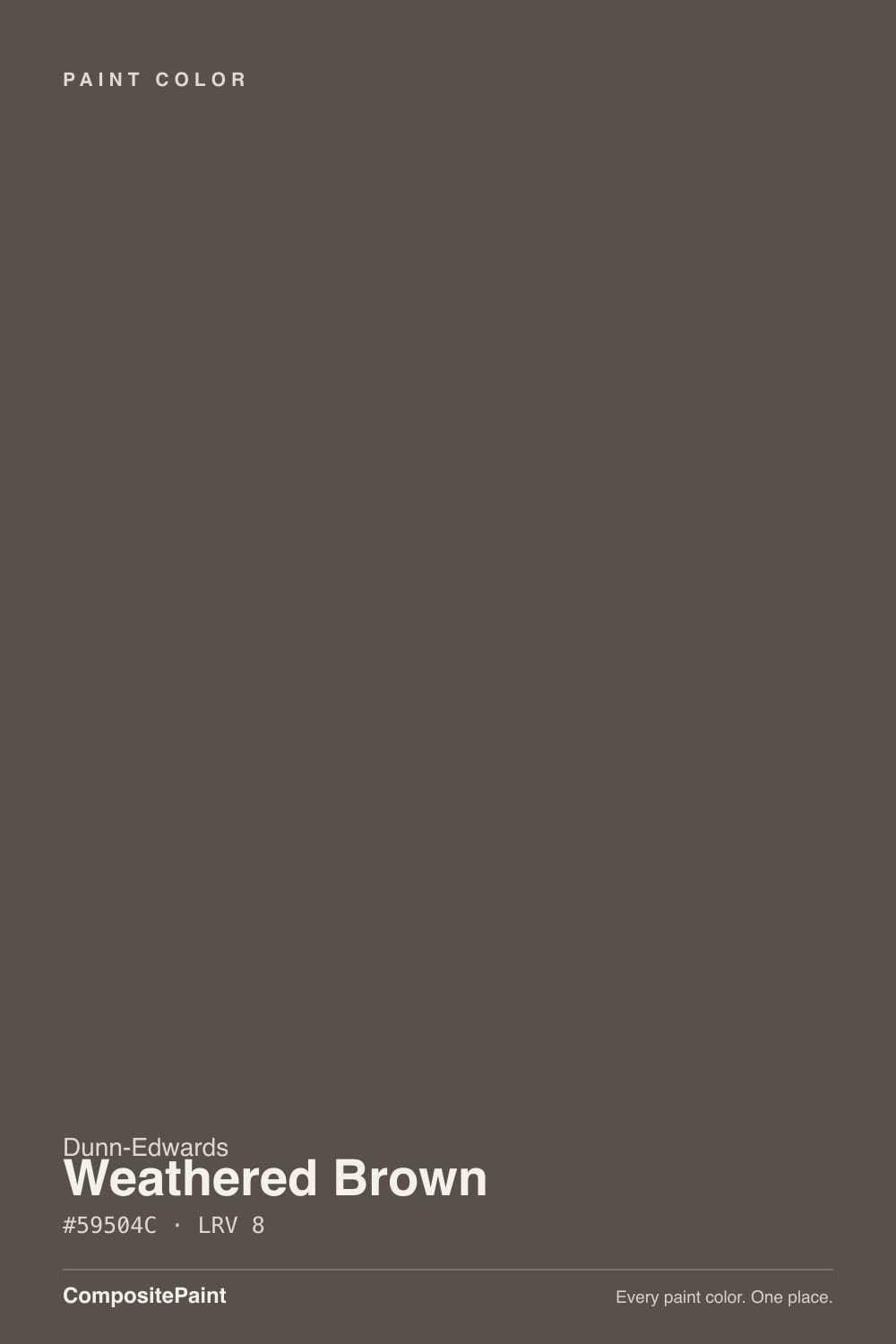
- 1Weathered Brown8
- 2Kendall Charcoal15
- 3Retreat21
The Fast Verdict
Weathered Brown is the dark you pick when black feels too hard and chocolate feels too sweet. Dunn-Edwards files DEC756 in Perfect Palette Classics with a Historic tag: Munsell 5.97YR at chroma 0.7 — a yellow-red so grayed it is almost charcoal. At LRV 8 it is Hale Navy dark. On a sunlit shutter, a Spanish door, or a mountain cabin it is a dusty weathered brown. In a north room with the lamps off it is a hole in the wall. It is not a Color of the Year. It is a Southwest trim-and-door workhorse that has sat in the Classics strip while Urbane Bronze got the national job.
Exterior trim, shutters, and front doors · Spanish and Mediterranean woodwork · mountain cabin bodies in real sun · kitchen islands and powder rooms with warm lamps
You wanted chocolate brown or true black · four walls in a small north room · trim is staying a bright true white · floors and counters are cool gray
- Grayed brown that reads expensive in sun, not chocolate-sweet
- Hides scuffs, water spots, and dirt on doors, shutters, and cabinets
- Classic Southwest trim and door color — Spanish woodwork, cream stucco
- Same LRV as Hale Navy and Urbane Bronze, with a dustier, quieter brown
- Holds as a real body color on mountain exteriors instead of washing out
- Four dim walls go cave-black — the brown you bought never shows
- Not chocolate: chroma 0.7 is charcoal with a memory of yellow-red
- Looks dingy next to a bright true-white trim
- Cool gray floors and cool LEDs strip the brown and leave flat charcoal
What Color Is Weathered Brown, Really?
A muted, medium-dark brown with the color almost wrung out of it. The official Munsell is 5.97YR at value 3.4 and chroma 0.7 — yellow-red hue, near-black value, almost no saturation. That last number is the whole trick. On a chip it can pass for charcoal, or for a quiet brown, depending on the light over the card. On a sunlit shutter the dusty yellow-red comes forward and you finally see why it is named brown. In shade it recedes into gray-black. Dunn-Edwards keeps it in Perfect Palette Classics, Historic, sitting next to other grayed earths, not in a chocolate-brown fashion strip. It is not Instant Designer, not a launch, not a Color of the Year. It is a regional workhorse: the dark-brown door on a Southern California HOA list, the trim color a Houzz thread floated with Whisper on a 1970s tract house.
At LRV 8 it reflects almost nothing — the same number as Hale Navy and Urbane Bronze, two points above Iron Ore (LRV 6), three below Peppercorn (LRV 11). Put it beside Tricorn Black (LRV 3) and Weathered Brown suddenly shows its body: softer, dustier, faintly brown instead of a hole. Put it beside Peppercorn and the gap runs the other way: Peppercorn still reads as a dark gray wall, Weathered Brown reads as almost-black. That is the useful part, and the trap. It will not wash out in Western sun the way a mid-brown does. It will close a windowless hall. Plan for the wall to read a step darker and more charcoal than the chip — every chroma-0.7 dark does this, and it is the number-one surprise if you bought it thinking chocolate.
Undertone in one line: dusty yellow-red brown first, charcoal-gray second — never blue, never purple, never a clear cocoa. If your sample looks brown, that is sun or 2700K lamps doing it. If it looks flat black, your light is cool or dim. Both versions are the same paint being honest about the room. The weathered name is earned: it is matte, grayed, and quiet in the right light, and it is still a brown — just barely.
Where It Shines
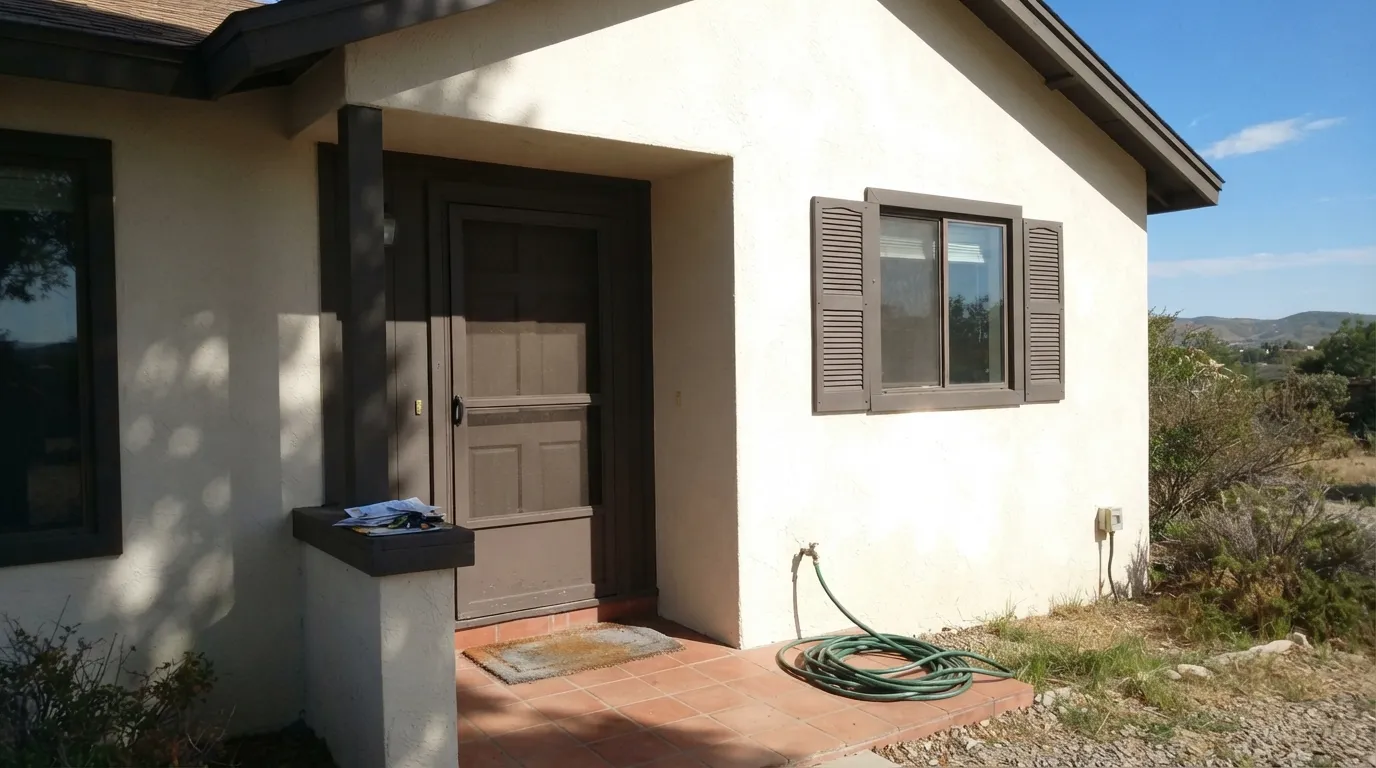
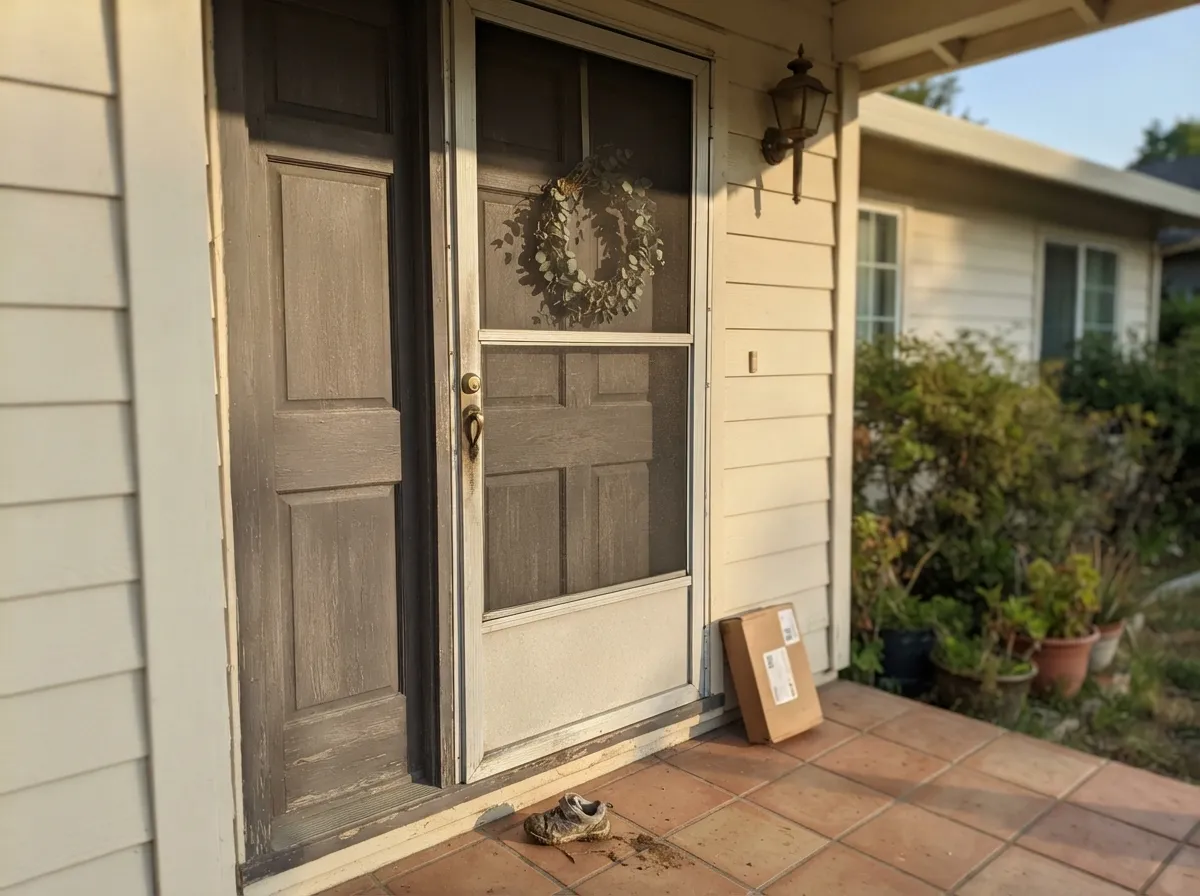
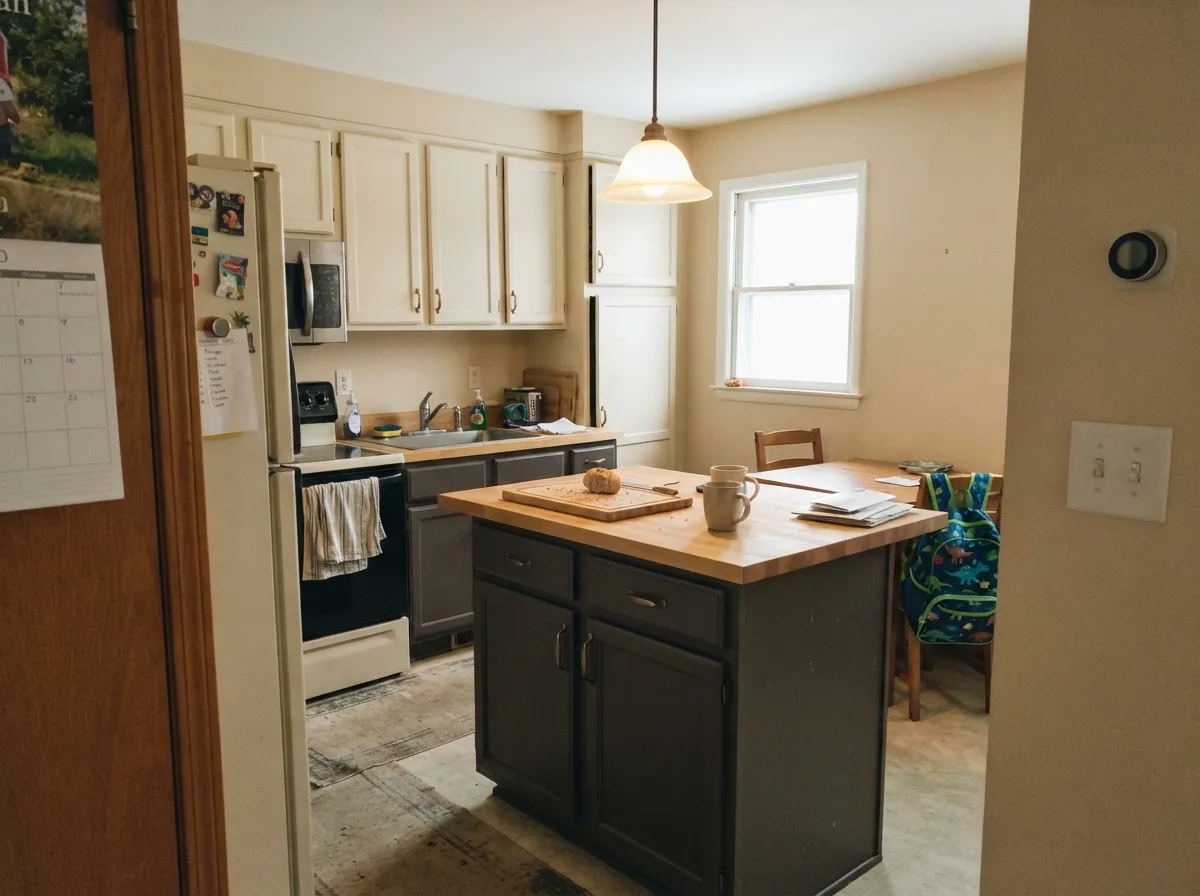
Give it real sun and a cream neighbor — Dunn-Edwards Whisper or Swiss Coffee, not a paper-white — and the brown you were promised actually shows up. Front doors on terracotta porches, wood trim on cream stucco, shutters on a Spanish elevation, a mountain cabin body in Idyllwild light: those are the jobs this color was mixed for. Indoors it earns a second life in doses — an island, a powder room, a lamp-lit dining wall — where the grayed brown reads custom instead of cave.
Where It Fails
Almost every regret about Weathered Brown is a light or a pairing problem, not a bad batch. The chip looks like a quiet brown. The wall, without sun, is charcoal. If your room matches one of the three situations below, a second coat will not fix it.
At LRV 8 there is almost no light left to bounce. North light, a small den, a windowless hall — the dusty brown drops out and the walls go cave-black, flat and heavy, the corners eaten. This is the single most common dark-paint regret, and chroma 0.7 makes it worse: there is not enough brown left to read as color in the shade. If you want dark but still want to see a wall, Peppercorn (LRV 11) or Kendall Charcoal (LRV 15) still read as gray. If you want this exact brown, keep it to one wall, a door, or a room that already runs on lamps.
The name says brown. The chip, in store light, can look like a muted cocoa. On a large surface the gray wins. Chroma 0.7 is charcoal with a memory of yellow-red, not a rich chocolate, not a walnut stain, not Urbane Bronze's warmer bronze. If you wanted a brown you can name from across the room, this is too gray. Urbane Bronze at the same LRV is the warmer national version; Cabin Fever (LRV 14) is the Dunn-Edwards mid-brown that still reads brown in shade. Sample in the actual room at noon and at 8 p.m. before you roll four walls.
The pairing mistake: Weathered Brown woodwork, a paper-white on the body or the sash. The brighter white wins and the brown looks dingy, almost dirty-black, by comparison. Cool gray LVP and gray-veined quartz do the same trick from the floor: they cancel the last of the yellow-red and leave charcoal. The fix is the company, not a second coat — Dunn-Edwards Whisper (LRV 87) or Dunn-Edwards Swiss Coffee (LRV 83) keeps the warmth reading deliberate. If the bright trim or the cool floor has to stay, this is not your dark.
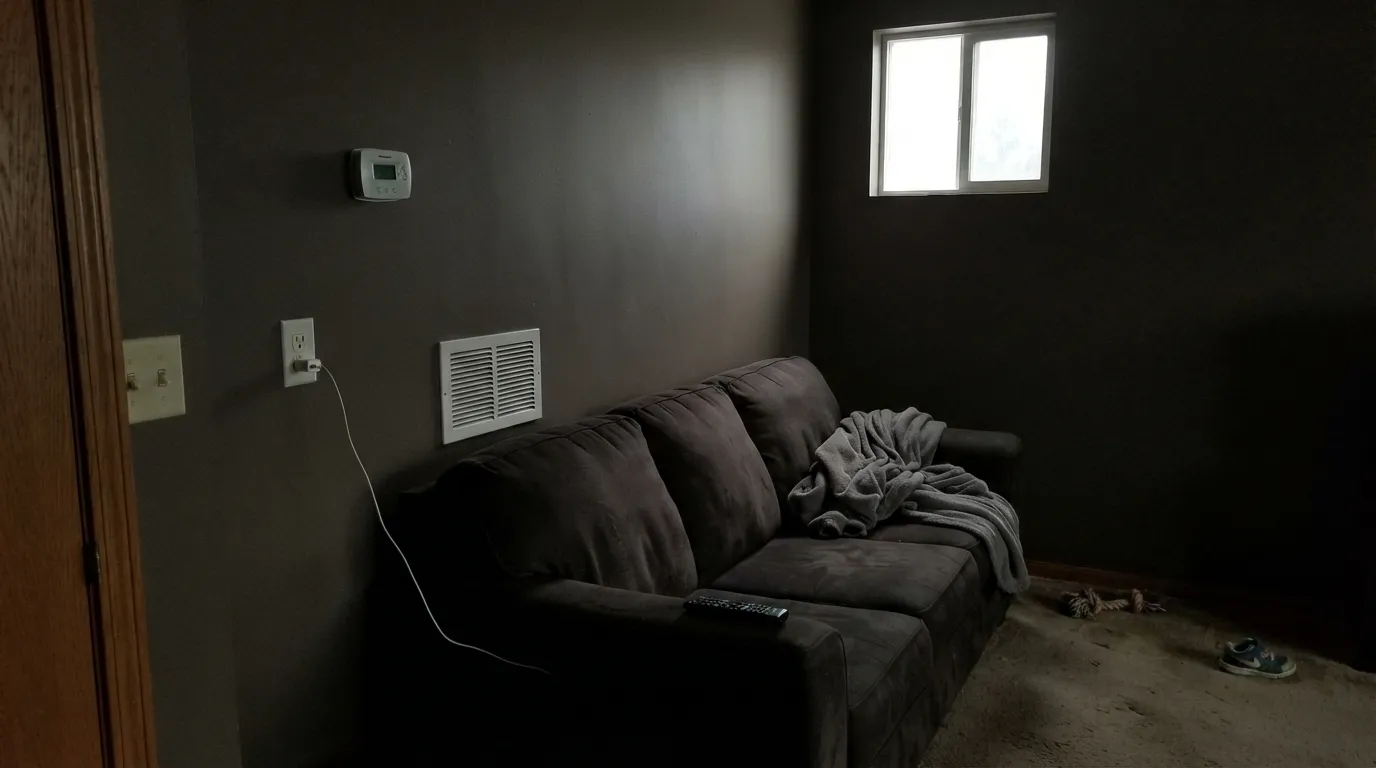
Room by Room
This is the use Houzz already argued: Weathered Brown versus Bone on a Southern California door, terracotta porch, cream interior, screen door painted to match. At LRV 8 it reads as a dark from the street and a dusty brown in afternoon sun. Satin exterior. Pair it with Whisper or Swiss Coffee siding, not a stark white. Direct west sun will fade any dark over years — that is chemistry, not a bad batch.
Dunn-Edwards has already shown DEC756 as a dark-brown body color: a mountain house in Idyllwild, CA, trees and stone around it. Full sun pulls the brown up so it reads warmer outside than it ever does indoors. It also soaks heat — fine in a high-elevation pine lot, a harder ask on a treeless desert ranch. Cream trim so the body does not float. Walk the shaded elevation with a sample; that wall will read a full step more charcoal than the sunny one.
On cream or sandy stucco this is the woodwork color: shutters, window trim, fascia, garage door if you want it to recede. A Houzz thread already floated Whisper on the body and Weathered Brown on the trim of a 1970s tract house, which is the right temperature split. Satin on wood, flat or low sheen on stucco. Keep the sash the same cream as the body if you do not want the windows to go heavy.
Satin on an island or the lowers hides water spots and knuckle marks better than any greige. Keep the uppers in Swiss Coffee or Whisper so the room still has light. A full kitchen of LRV 8 boxes in a small galley closes fast, and the brown disappears into the shadow under the wall cabinets. Brass or aged bronze pulls; cool chrome leans cold against it.
A windowless powder is one of the few interiors where reading near-black is a feature. Matte or eggshell walls, 2700K bulbs, a big mirror, cream or stone on the vanity. Skip it if the top is cool gray marble — the walls go brown-muddy beside the veining. Drenching all four walls works because the room is small and already lamp-lit.
One wall behind the sofa or around a fireplace gives you the dusty brown without dimming the whole floor. Keep the other three in Fine Grain, Stucco Tan, or Swiss Coffee so the handoff stays warm. Full four-wall use only if the room has big south or west windows and you will actually turn the lamps on at night. A north living room of this color is a cave with furniture in it.
Your Light Is the Risk
Direct sun pulls the dusty yellow-red right out. This is the brown you were sold — shutters, doors, and mountain siding at noon.
Cool gray daylight kills the brown and leaves a flat near-black cave. Fine if you half-wanted charcoal; disappointing if you wanted brown. Test on an overcast morning.
Morning light reads dustier and more charcoal; west afternoon and golden hour pull the brown forward until it looks almost walnut-gray. Sample the west wall at 4 p.m. — that is when the brown is loudest.
2700K lamps: the yellow-red comes back and the walls go dusty brown. Cool LEDs above 3500K flatten it toward charcoal-black — swap bulbs, not paint.
Most complaints about Weathered Brown are a light mismatch. Upload a photo of your actual room and see it on your walls — then ask for the same wall in north light or evening lamps before you buy a single sample.
Need It From Another Brand?
Any paint counter can custom-tint Dunn-Edwards DEC756 directly. If you would rather stay in one brand's own deck, these are the closest stock matches, measured as ΔE2000. Under 2 is a difference you will not see on the wall.
| Brand | Closest color | ΔE | LRV | |
|---|---|---|---|---|
| Sherwin-Williams | MetropolisSW 9575 · Sherwin-Williams | 1.8 | 8 | Color page → |
| Behr | Willow WoodECC-41-2 · Behr | 0.7 | 8 | Color page → |
| Benjamin Moore | SilhouetteAF-655 · Benjamin Moore | 1.1 | 10 | Color page → |
| Valspar | Semi-Sweet4003-2C · Valspar | 2.3 | 8.6 | Color page → |
| PPG / Glidden | SarsaparillaPPG1018-7 · PPG / Glidden | 3.3 | 8 | Color page → |
| Glidden | Burnt Bark30YY 08/082 · Glidden | 4.3 | 8 | Color page → |
Similar Dunn-Edwards Colors
The nearest shades to Weathered Brown within Dunn-Edwards's own range, ranked by perceptual color distance — useful when you want the same look a touch lighter, darker, or warmer.
WCAG 2.1: AA is 4.5 : 1 for normal text, 3 : 1 for large text, AAA is 7 : 1.
Weathered Brown vs the Colors You're Also Considering
Every Weathered Brown sample board has the same rivals on it. The numbers show the real lightness gap — then it comes down to which risk you would rather live with.
Pick this when Urbane Bronze felt too bronze and you want the dustier, grayer, more weathered version of the same depth.
Sherwin-Williams SW 7048 · LRV 8Urbane BronzePick this if you want the famous national warm dark at this exact LRV — bronzier, slightly more olive-risk, the one every painter already knows.
Pick this when Iron Ore felt too cold and you still want a dark that flashes dusty brown in the sun.
Sherwin-Williams SW 7069 · LRV 6Iron OrePick this if you want a true charcoal-black with no brown in it — two LRV points darker, the whole-house near-black if you respect the depth.
Weathered Brown Coordinating Colors
The rule for coordinating with Weathered Brown: cream, sandy beige, and warm greige — and keep paper-white and cool gray at arm's length. It pairs with Whisper and Swiss Coffee far better than with a bright true white, loves terracotta and walnut, and layers cleanly with other Dunn-Edwards darks. These are the partners that keep showing up in rooms that work:
Weathered Brown on Exteriors
Inside, Weathered Brown is a dose color. Outside, it is a workhorse. Dunn-Edwards put it on their 2021 dark-brown exterior list with a photographed mountain house in Idyllwild, CA, and listed it among twelve browns for Spanish-style architecture. A Houzz homeowner already weighed it against Bone for a Southern California front door on a terracotta porch. Another thread floated Whisper on a 1970s tract body with Weathered Brown on the trim. None of that is fame. It is the job the color actually has in the West: cream stucco, dark woodwork, a door that reads brown in the afternoon.
The pairing decides the result. Cream — Whisper or Swiss Coffee — keeps the dark reading brown instead of dirty. Hale Navy on the door gives one cooler dark so the brown trim does not have to do everything. What to avoid: a paper-white fascia, which makes the woodwork look sooty, and a full-body paint-out on a treeless desert lot, where LRV 8 soaks heat all afternoon. Walk around the house. The shaded north wall will read a full step more charcoal than the sunny south wall, and that is the sample that should decide the gallon. Satin on siding and doors; it washes.
Weathered Brown With Wood Tones and Floors
This decision gets made at the floor and the porch, not the paint store. Walnut, espresso, and weathered oak are the color's best friends — the dark red-brown depth makes the grayed brown read dusty and deliberate. Terracotta tile, Saltillo, and a clay-colored concrete porch are native company; that is the Southern California door argument in real materials. Pale unstained white oak is safe and gives the room a quieter ranch-modern cast.
The honest nos are cool and loud-orange. Cool gray LVP and gray-washed wood pull the last of the yellow-red out, and the wall goes charcoal beside them. Honey-orange builder oak is the sample-first case: a low-chroma yellow-red sitting over a loud yellow-red can go slightly muddy, the floor more orange, the paint more gray. If the orange oak is staying, put a large rug between it and this paint, or keep Weathered Brown on the door and pick Fine Grain for the walls.
Metals are the easy part: unlacquered brass, antique bronze, oil-rubbed bronze, and matte black all work; polished chrome is the one that leans cold against it. Wrought-iron railings on a Spanish elevation are the pairing the architecture already asked for.
Three Ready Palettes Built on Weathered Brown
A color is never alone on the wall. These are complete combinations in the 60-30-10 pattern, with the reason each one holds together. Every one opens in the visualizer.
This is the Houzz pairing made whole: Whisper on the body, Weathered Brown on the woodwork, one navy door so the brown trim does not have to do every dark job. Whisper is Dunn-Edwards' White Dove analog — warm enough that the brown reads deliberate instead of dirty. Sample the shaded elevation; the trim will look a step more charcoal there than on the sunny front.
Try this palette in your roomDunn-Edwards already photographed this color as a mountain-house body in Idyllwild. Swiss Coffee is the Southwest's default cream, warm enough to keep the dark siding from going black from the street. Black Bean, the official similar color one LRV point darker, takes the door so the body can stay the weathered brown instead of competing with a true black.
Try this palette in your roomFine Grain is the Dunn-Edwards workhorse greige, so the walls stay quiet and warm while the island carries the dark. Swiss Coffee uppers keep the room from closing; Weathered Brown on the boxes hides the scuffs. Brass hardware and a warm wood counter finish the argument — cool gray quartz is the one fight.
Try this palette in your roomWeathered Brown FAQ
Is Weathered Brown brown or gray?
Both, depending on the light. Dunn-Edwards names it brown and files it in Classics as a Historic earth; the Munsell is yellow-red at chroma 0.7, which is charcoal with a dusty brown left in it. In south sun and under 2700K lamps you see the brown. In north light or shade you see gray-black. If chocolate brown is what you actually want, this is the wrong color; that mismatch is the main indoor risk.
What trim white goes with Weathered Brown?
A warm, soft white — Whisper if you want Dunn-Edwards' White Dove analog, Swiss Coffee if you want the creamier Southwest default. A stark bright white makes the brown look dingy and almost dirty-black next to the crisp edge. Satin on the dark woodwork, semi-gloss on the cream if it is trim.
Is it good for a front door?
That is one of its real jobs. Homeowners already debate it against Bone on Southern California doors, and it sits on Dunn-Edwards' Spanish-architecture brown list. Use a satin exterior enamel, paint the screen door the same color, and keep the siding cream rather than paper-white. Direct west sun will fade any dark over years — budget a recut.
Can I paint four interior walls this color?
Only in a room that already has real daylight and lamps you will actually use. At LRV 8, a north bedroom or a windowless hall goes cave-black and the brown disappears. Powder rooms, lamp-lit dining rooms, and studies with a window can take the drench. Living rooms do better as one accent wall. If the room is small and dim, pick Peppercorn or Kendall Charcoal instead.
Does Weathered Brown work on exteriors as a body color?
Yes — Dunn-Edwards has shown it that way on a mountain house in Idyllwild, and it is on their Spanish-style brown list. Full sun is what makes the brown show; the shaded north wall will read more charcoal. It absorbs heat, so it is a better body color in trees or at elevation than on a treeless desert ranch. Cream trim, satin on the siding.
Does it work with oak floors?
Walnut, espresso, and weathered oak are its best friends — the dark red-brown depth makes the grayed brown read dusty and deliberate. Pale white oak is safe. Honey-orange builder oak is the sample-first case: yellow-red landing on a low-chroma yellow-red can go slightly muddy. Cool gray LVP is the honest no: the floor goes bluer and the wall goes charcoal. A large rug helps; changing the paint helps more.
Have you painted with Weathered Brown?
Rate it — one tap helps the next reader decide.
Ask a Question