Dark Engine
A cool near-black at LRV 5, reviewed honestly: the door-and-shutter workhorse, the rooms it swallows, and when to pick a true black instead.

Jessica has spec'd whites and neutrals for more than 300 rooms and keeps a sample wall of painted drawdowns in her studio. Every color review is checked against real reader rooms in the comments and re-tested when a formula changes. About the testing process →
- 1Cordovan Brown0
- 2Dark Engine5
The Fast Verdict
Dark Engine is the black you pick when you want definition, not a hole. Cool blue undertones keep it a steel-charcoal near-black instead of a warm espresso, and at LRV 5 it still reads as a surface in real daylight. It earns its keep on front doors, shutters, and high-contrast cabinets. On four living-room walls it will shrink the room — that is the color, not a bad batch.
Front doors and shutters · high-contrast kitchen cabinets · a daylight accent wall · a drenched powder room with strong lighting
You wanted four living-room walls · honey oak or orange wood is staying · you need a true void-black · the room is dim and north-facing
- Cool blue-steel near-black — defined, not inky
- Front doors and shutters look architectural against soft whites
- Satin cabinets take high contrast without reading costume-black
- LRV 5 still shows as a surface in real daylight
- Sits quietly in the DE deck since 2006 — no trend timestamp
- Four walls at LRV 5 shrink ordinary rooms
- Reads charcoal, not true black, next to Tricorn or Black Magic
- Fights honey oak, cherry, and orange-stained wood
- Dark exteriors show dust, pollen, and water spots
What Color Is Dark Engine, Really?
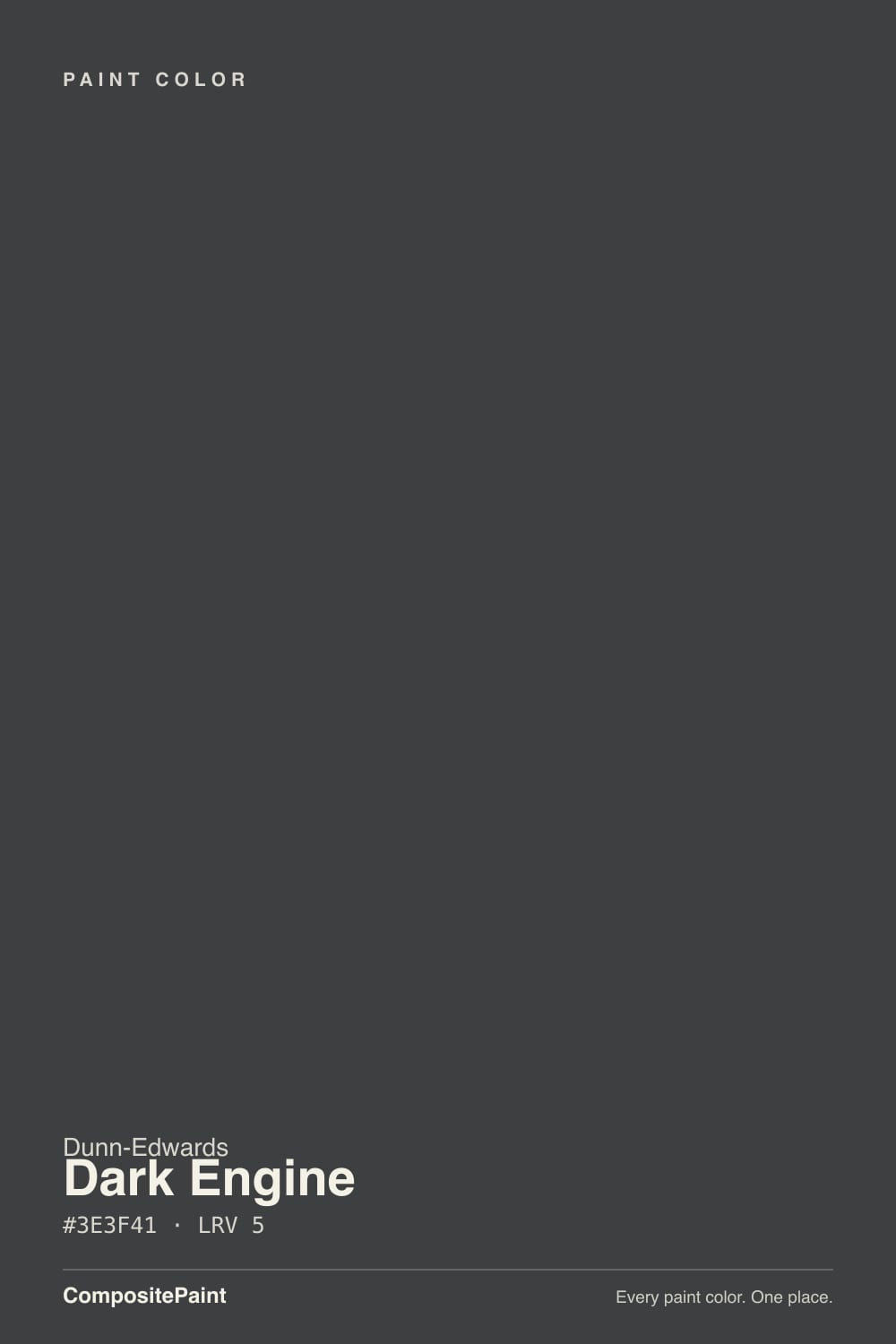
A near-black with a cool blue undertone — steel, not espresso. Dunn-Edwards has carried Dark Engine in the deck since 2006, and it still shows up in their front-door collections because that is the job it was built for: a dark frame that makes white siding and metal hardware look sharp. It is not a celebrity black. It is the one a West Coast painter reaches for when the spec says charcoal-black and the house already leans cool.
At LRV 5 it sits one step above the true voids. That single point of reflectance is the whole personality: in decent light you can still see it as a charcoal surface with a blue-steel edge; in a dim room it collapses into a black hole. Hex #3E3F41 is slightly blue-gray, not brown. Put a sample next to Sherwin-Williams Tricorn Black (LRV 3) and Dark Engine immediately shows its body — more graphite, less ink.
Undertone in one line: cool blue, never brown. If your sample looks green, that is lawn or a north overhang reflecting; if it looks warm, that is 2700K bulbs or orange wood bouncing back. The paint itself is cool. Metallic hardware and cool whites are its natural company; honey oak is not.
Where It Shines
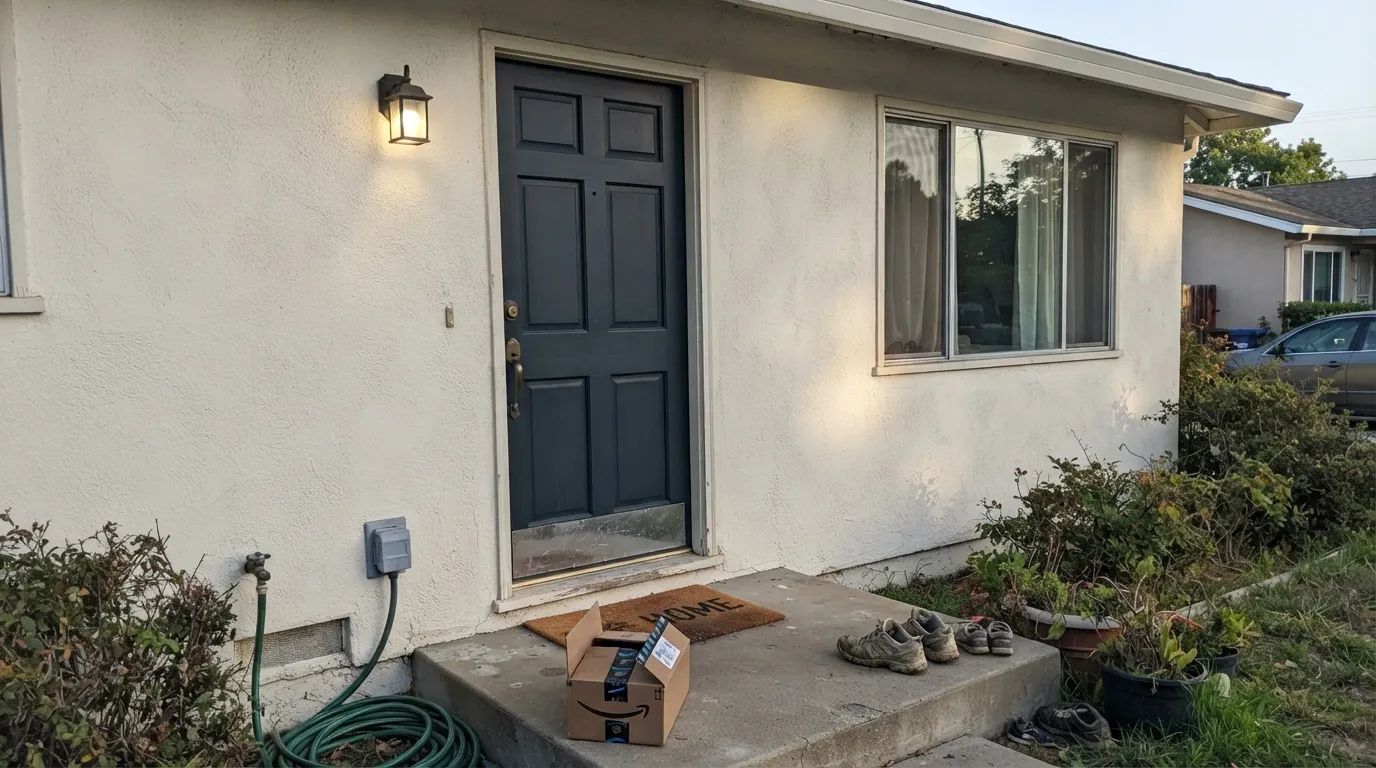
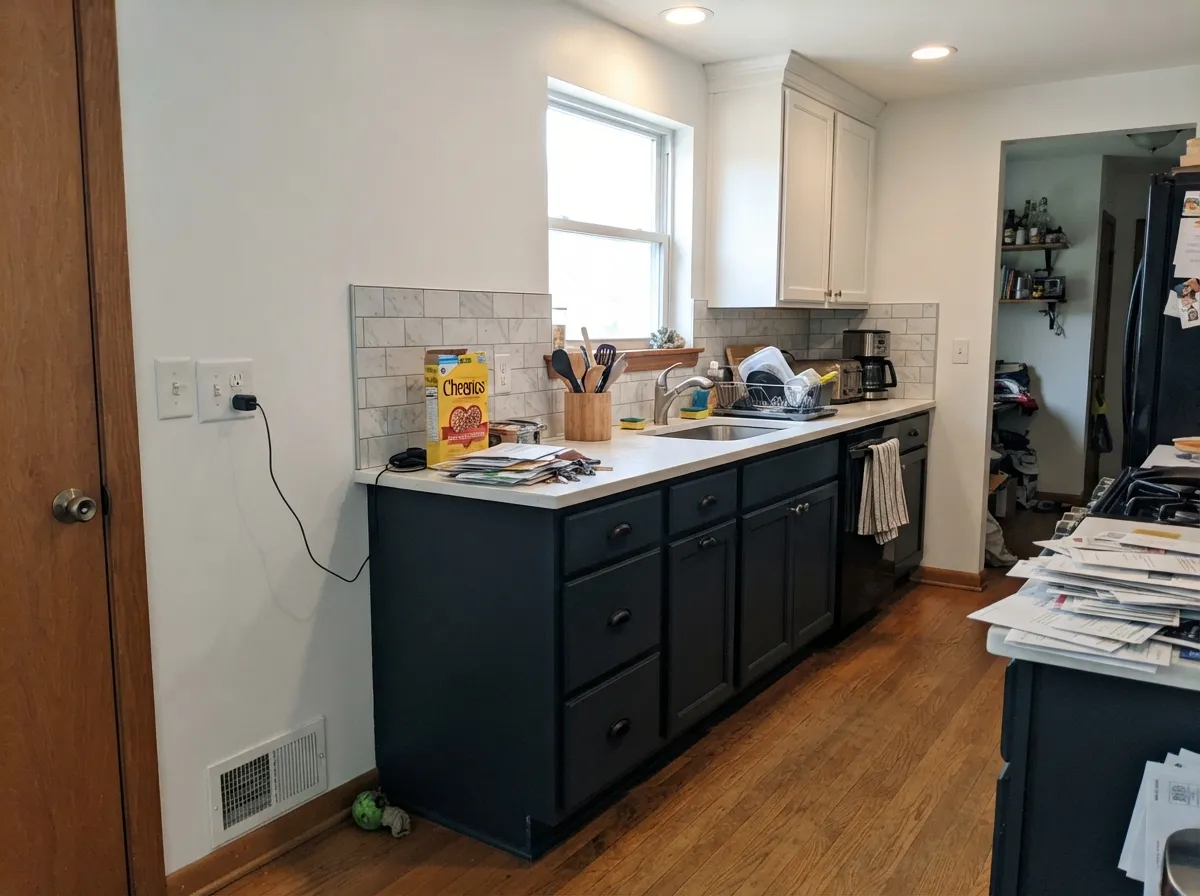
Give it full daylight and a limited job and it is excellent. On a front door or shutters against a soft white like Dunn-Edwards Whisper, the cool near-black reads as architecture, not paint. Satin cabinets in a bright kitchen do the same trick: Dark Engine frames white walls and stainless or chrome without going inky. A single accent wall next to a window works because the light keeps the charcoal visible. This is a highlighting color, not a wrapping color.
Where It Fails
Almost every regret with Dark Engine is a use-case mistake, not an undertone surprise. The chip looks like a well-behaved black. On four walls at LRV 5, or against golden wood, it is a different product. Check these three before you buy five gallons.
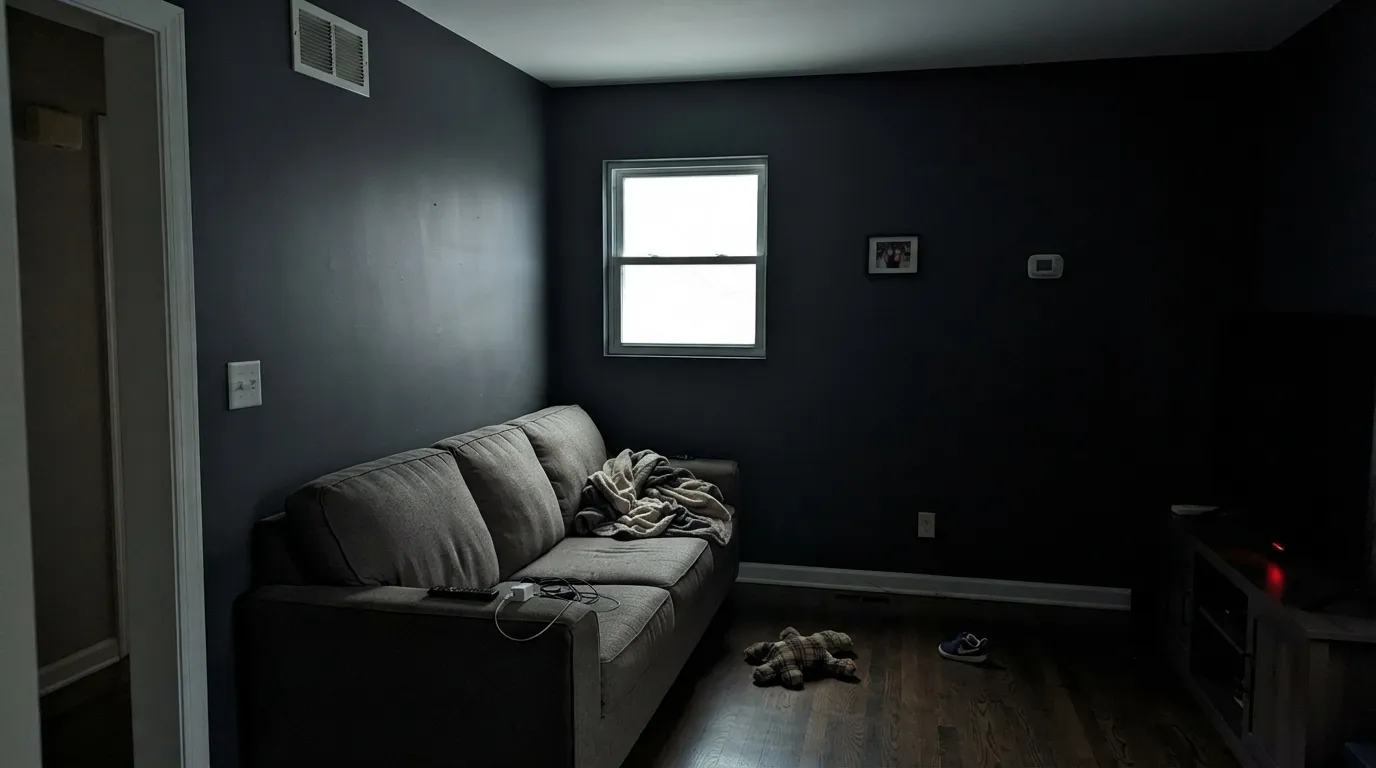
LRV 5 on every wall eats the light you have left. Corners go featureless, furniture silhouettes, and the room feels smaller by a third. This is the honest no for living rooms and bedrooms without big south or west glass. Keep it to a door, a cabinet run, or one wall that sees a window.
Blue-steel black sits opposite yellow-orange on the wheel. Golden builder oak, cherry, and orange-stained trim all push Dark Engine colder while the floor goes louder. Walnut, espresso, pale white oak, and gray LVP are fine. If the honey floor is staying, pick a warmer dark — Urbane Bronze (LRV 8) or skip black.
On the chip it passes for black. Next to Tricorn Black or Black Magic (both LRV 3) it reads charcoal with a blue-gray film. If the brief is a void — window sashes, a modern farmhouse outline, a piano-black door — go darker. Dark Engine is the restrained, cool version, and that is a feature only if you wanted it.
Room by Room
Satin or semi-gloss on a door in full sun is where Dark Engine looks expensive. The cool blue keeps it from going brown as it weathers, and it loves chrome, nickel, and matte-black hardware. Pair it with Whisper or another soft white siding. Two coats over a gray-tinted primer.
The classic white-house, dark-shutter move, with enough charcoal in it that it does not look like a sticker. A garage door in the same color ties the elevation together. Satin exterior; dark colors run hot on west and south faces, so this is trim and doors, not a full body color.
Satin Dark Engine lowers or a full cabinet run under Whisper or Pure White walls is sharp, modern, and wipeable. Keep counters and backsplash on the cool side — white quartz, gray stone, stainless. Honey butcher block will argue. Gray-tinted primer; blacks flash without it.
One wall that sees a window holds the charcoal instead of going dead. Behind a bed or a sofa, with white trim, it reads intentional. Do not accent a wall that already sits in shadow — you will paint a cave and then blame the brand.
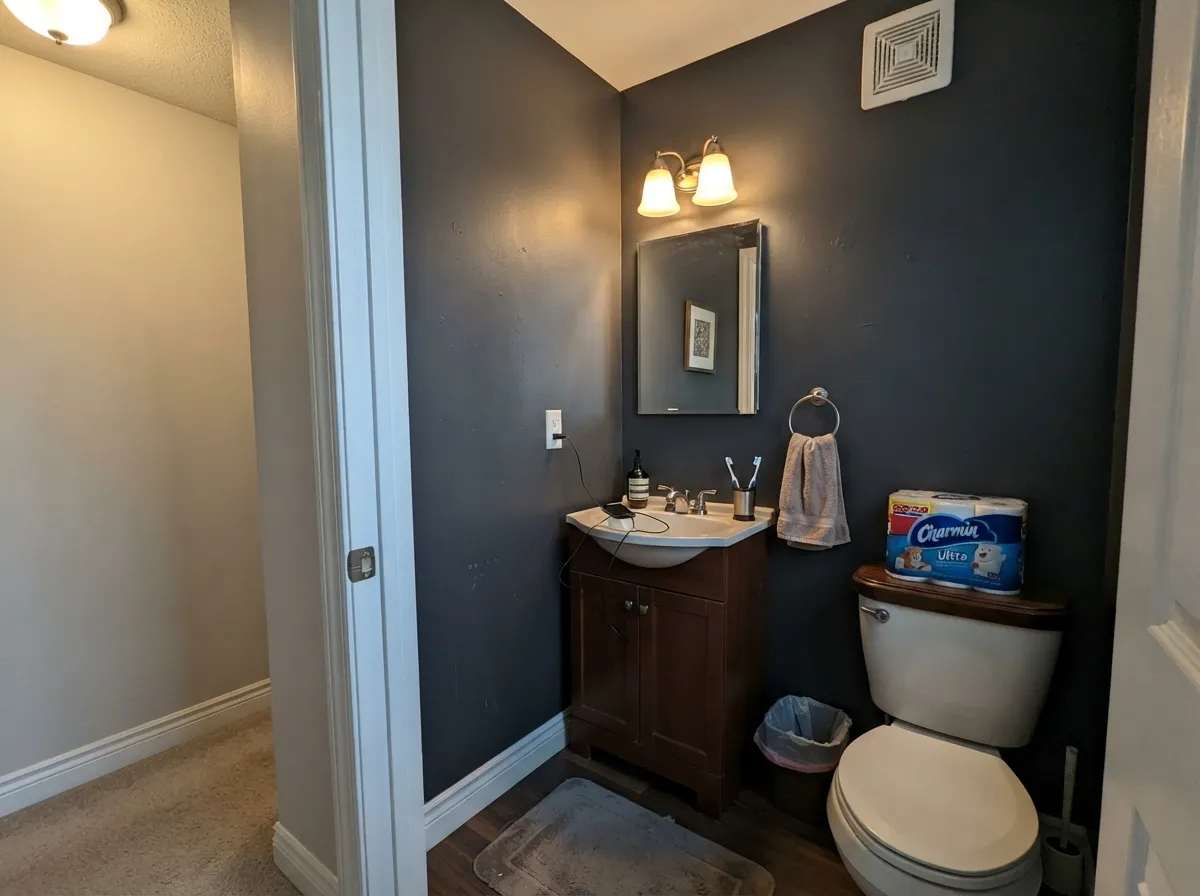
Small rooms take LRV 5 if you light them. Matte walls, Whisper or White Dove trim, a bright sconce, and the blue-steel black feels like a custom box. Skip this in a windowless powder that runs on one builder can light.
Four walls of LRV 5 is a media room or a very bright loft, not a typical American living room. Bedrooms go cave-like at night even if they looked dramatic at 2pm. If you want dark and livable, step up to Kendall Charcoal (LRV 15) or keep Dark Engine on the door and one wall.
Your Light Is the Risk
South light and open shade keep it a readable charcoal with a blue-steel edge. This is the light the front-door version was made for.
Cool, weak daylight plus LRV 5 equals a featureless hole. Corners disappear. Do not use it as a four-wall color in this light.
Morning it runs cooler and steeler; late west sun slightly softens the blue. The swing is small — there is not much hue to move.
2700K lamps pull a faint brown-charcoal and mute the blue. Cooler LEDs (3500–4000K) keep the steel. 5000K daylight bulbs make it inky and a little purple-blue — skip those.
Most complaints about Dark Engine are a light mismatch. Upload a photo of your actual room and see it on your walls — then ask for the same wall in north light or evening lamps before you buy a single sample.
Need It From Another Brand?
Any paint counter can custom-tint Dunn-Edwards DE6350 directly. If you would rather stay in one brand's own deck, these are the closest stock matches, measured as ΔE2000. Under 2 is a difference you will not see on the wall.
| Brand | Closest color | ΔE | LRV | |
|---|---|---|---|---|
| Sherwin-Williams | ArmorySW 9600 · Sherwin-Williams | 3.3 | 5 | Color page → |
| Behr | Totally BlackHDC-MD-04 · Behr | 0.0 | 5 | Color page → |
| Benjamin Moore | Black Panther2125-10 · Benjamin Moore | 1.1 | 5 | Color page → |
| Valspar | Chimney Smoke4010-1 · Valspar | 2.7 | 5 | Color page → |
| PPG / Glidden | Black MagicPPG1001-7 · PPG / Glidden | 1.4 | 5 | Color page → |
| Glidden | Black MagicPPG1001-7 · Glidden | 1.6 | 5 | Color page → |
Similar Dunn-Edwards Colors
The nearest shades to Dark Engine within Dunn-Edwards's own range, ranked by perceptual color distance — useful when you want the same look a touch lighter, darker, or warmer.
WCAG 2.1: AA is 4.5 : 1 for normal text, 3 : 1 for large text, AAA is 7 : 1.
Dark Engine vs the Colors You're Also Considering
Every Dark Engine sample board has the same rivals on it. The numbers show the real lightness gap — then it comes down to which risk you would rather live with.
Pick this when you want it cooler and a touch blacker, with a blue-steel edge Iron Ore does not have.
Sherwin-Williams SW 7069 · LRV 6Iron OrePick this if you want the slightly softer whole-house charcoal — LRV 6 is still dark, but it is the black that can do more than a door.
Pick this when you want charcoal definition instead of a hole; Dark Engine still reads as a color.
Sherwin-Williams SW 6258 · LRV 3Tricorn BlackPick this for a true void-black — window sashes, a piano-black door, the reference dark in the SW deck.
Dark Engine Coordinating Colors
Stay on the cool-to-neutral side. Dark Engine wants soft or clean whites, other cool darks, and metals — not cream-beige, not honey, not warm brown-blacks unless you want a temperature fight. These are the partners that keep the scheme coherent:
Dark Engine on Exteriors and Front Doors
This is the color's real job. Dunn-Edwards has listed it with front-door colors since it entered the deck in 2006, and the cool blue is an advantage outside: it is less likely to go chocolate-brown as it weathers than a warm black. Use it on the door, shutters, window sash, and garage door — not as a full body color. At LRV 5 a whole elevation will run hot in west and south sun, show every dust film, and read as a silhouette from the street.
Sheen matters more outside than the exact black. Satin hides more than semi-gloss but still washes; flat on a door will scuff at the handle in a month. Prime gray, two coats, and plan to rinse the south face. Pair with Whisper, Pure White, or White Dove on the body. Avoid cream-yellow siding, which will make the blue in Dark Engine look colder than it is.
Dark Engine With Wood Tones and Floors
Cool darks live or die at the floor. Walnut, espresso, smoked oak, pale unstained white oak, gray LVP, and concrete all sit comfortably against Dark Engine because they do not pull yellow. Black metal, chrome, brushed nickel, and stainless are the easy hardware matches — the same metallic company the color was built to sit next to.
The honest no is golden: honey oak, orange builder stain, yellow pine, cherry that has gone red-orange. Blue-steel black and yellow-orange wood make each other louder. Brass can work on a front door as a deliberate contrast; all-brass hardware in a Dark Engine kitchen next to honey floors is stacking fights. If the orange floor stays, do not use this paint — reach for a warmer dark or skip black.
Three Ready Palettes Built on Dark Engine
A color is never alone on the wall. These are complete combinations in the 60-30-10 pattern, with the reason each one holds together. Every one opens in the visualizer.
Whisper is Dunn-Edwards' White Dove analog, so the body stays a soft warm white while Dark Engine supplies the cool dark frame. Kendall Charcoal at LRV 15 is one step up, so a garage door or sash does not compete with the front door.
Try this palette in your roomPure White walls keep the cabinets crisp and cool; White Dove on ceiling and adjacent trim is the slightly warmer white so the kitchen does not go clinical. Dark Engine does the contrast. Stay off honey butcher block.
Try this palette in your roomTonal near-blacks keep the little room from looking like a theme: Dark Engine on the walls, Iron Ore a hair softer on the vanity, Whisper so the edges still read as trim. Bright the sconces — this scheme dies under one recessed can.
Try this palette in your roomDark Engine FAQ
Is Dark Engine black or gray?
Near-black — charcoal with a cool blue edge. In daylight on a door it reads black enough. Next to Tricorn Black (LRV 3) it is clearly a graphite. If you need a void, this is the wrong color; if you want a dark that still looks like a surface, it is the right one.
Is it a good front-door color?
Yes — that is its best use. Satin or semi-gloss, gray-tinted primer, two finish coats. It sits in Dunn-Edwards' front-door collections for a reason: cool near-black against white siding, with metal hardware. Expect dust and water spots to show; that is every dark exterior.
What white goes with Dark Engine?
A soft white if you want the house to stay calm — Whisper (DEW340) or White Dove (PM-19). Pure White if you want a cleaner, slightly cooler contrast. Chantilly Lace will go gallery-crisp and make the black look even cooler; use that only if high contrast is the point.
Can I paint a whole room Dark Engine?
Only if the room is small and well lit (powder) or you are committing to a media-cave. Four walls at LRV 5 in a normal living room or bedroom will shrink the space. An accent wall that sees a window is the safer interior bet.
Does it work with oak floors?
Pale white oak, walnut, and espresso are fine. Golden honey oak and orange builder stain are the clash: the blue undertone and the yellow-orange wood amplify each other. A large rug is a patch, not a fix. Warm darks like Urbane Bronze handle honey oak better.
How many coats does a near-black take?
Prime with a gray-tinted primer, then two finish coats. Skipping the primer is how blacks flash and look streaky, especially in satin on doors and cabinets. Going over an existing dark, you may still get away with two; over white or a bright color, do not.
Have you painted with Dark Engine?
Rate it — one tap helps the next reader decide.
Ask a Question