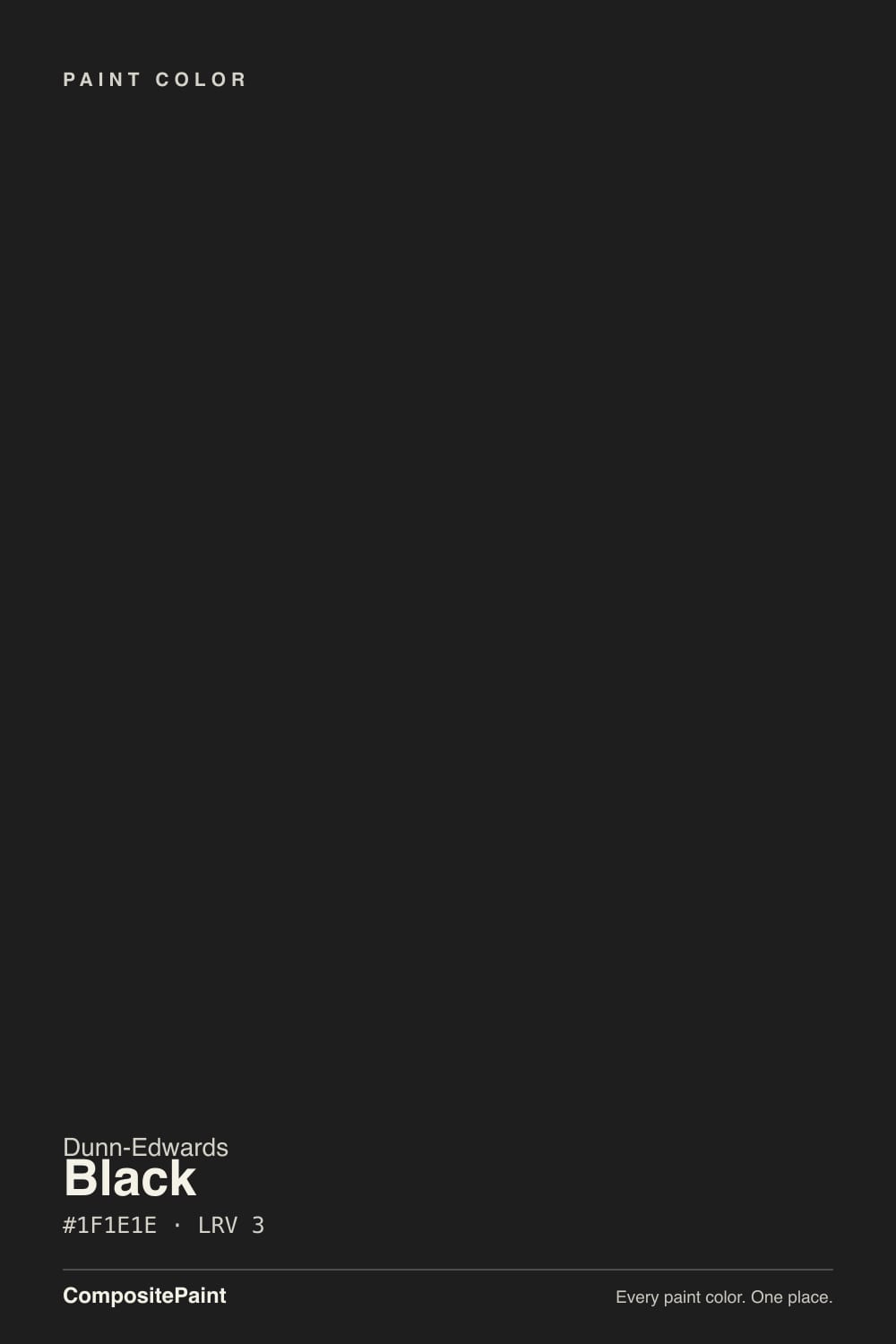
Black
Dunn-Edwards' flagship true black, reviewed honestly: the cabinets and doors that earn it, the rooms it swallows, and what to pick instead.

Jessica has spec'd whites and neutrals for more than 300 rooms and keeps a sample wall of painted drawdowns in her studio. Every color review is checked against real reader rooms in the comments and re-tested when a formula changes. About the testing process →
- 1Black4
- 2Oyster Catch9
The Fast Verdict
Dunn-Edwards Black is the black you pick when you do not want the paint to have an opinion. No brown, no navy, no charcoal softness — RGB 59, 58, 58, chroma almost zero — so it just reads black, which is why it is the default on West Coast islands, interior doors, window sash, and front doors. At LRV 4 it is genuinely dark: it swallows a dim room, shows every fingerprint, and punishes wavy drywall. Used as contrast it is close to perfect. Used to fill four walls with one window, it is the color people repaint.
Kitchen islands and cabinet bases · interior doors, trim and window sash · front doors on shaded or north entries · anyone who wants black with zero undertone
You are painting four walls of a small dim room · you wanted a soft charcoal that hides dust · the front door is wood and faces full south or west sun · you refuse satin on anything people touch
- A genuinely undertone-free black — it never turns brown, navy, or purple
- Holds the same depth from morning to dusk, indoors and out
- The default West Coast black for islands, doors, sash, and trim
- Reads clean against any white, any wood, any metal finish
- Small amounts do a lot: one door changes a whole elevation
- LRV 4 swallows a small or dim room whole
- Shows dust, fingerprints, and lap marks — especially in flat or matte
- Touch-ups flash; you almost always end up recoating the full panel
- Needs a gray-tinted primer and two full coats to look even
What Color Is Black, Really?
A black with no story, filed in Dunn-Edwards' Perfect Palette Accents under the least fancy name in the deck. Most near-blacks are a very dark something — espresso, graphite, navy, forest — and they show it the moment sun lands on them. This one does not. Its RGB sits at 59, 58, 58, and the chroma is essentially zero, which is what 'true black' actually means in numbers: no brown pulling it toward coffee, no blue waiting to flash at 5 p.m. West Coast painters reach for DEA002 the way everyone else reaches for Tricorn Black — as the frame, not the subject.
At LRV 4 it reflects almost nothing. The useful comparison is Iron Ore at LRV 6: on paper a small gap, in a room a big one. Iron Ore still has some charcoal life on a full wall; Black does not soften. It holds the same depth at noon and at dusk, which is the whole point on a door, an island, or a run of sash, and the whole problem on four walls of a dark room. Plan on a gray-tinted primer and two finish coats — rolling a true black over white drywall is how you end up buying a third gallon.
Undertone in one line: none, with the faintest warm lean that only shows next to a cooler black. If your sample looks blue, that is a cool LED or a bright white beside it; if it looks brown, that is a 2700K bulb or the wood next to it. Both are the same paint being honest about the room.
Where It Shines
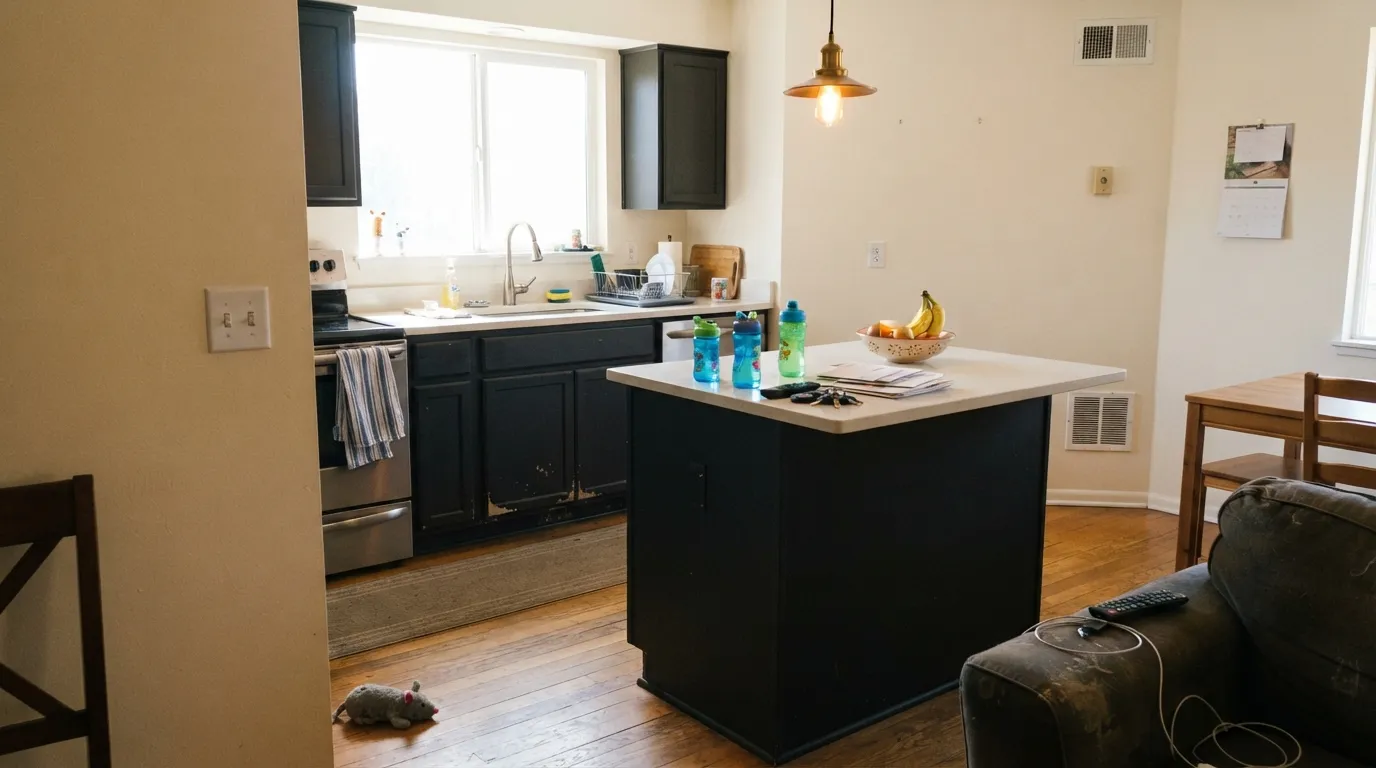
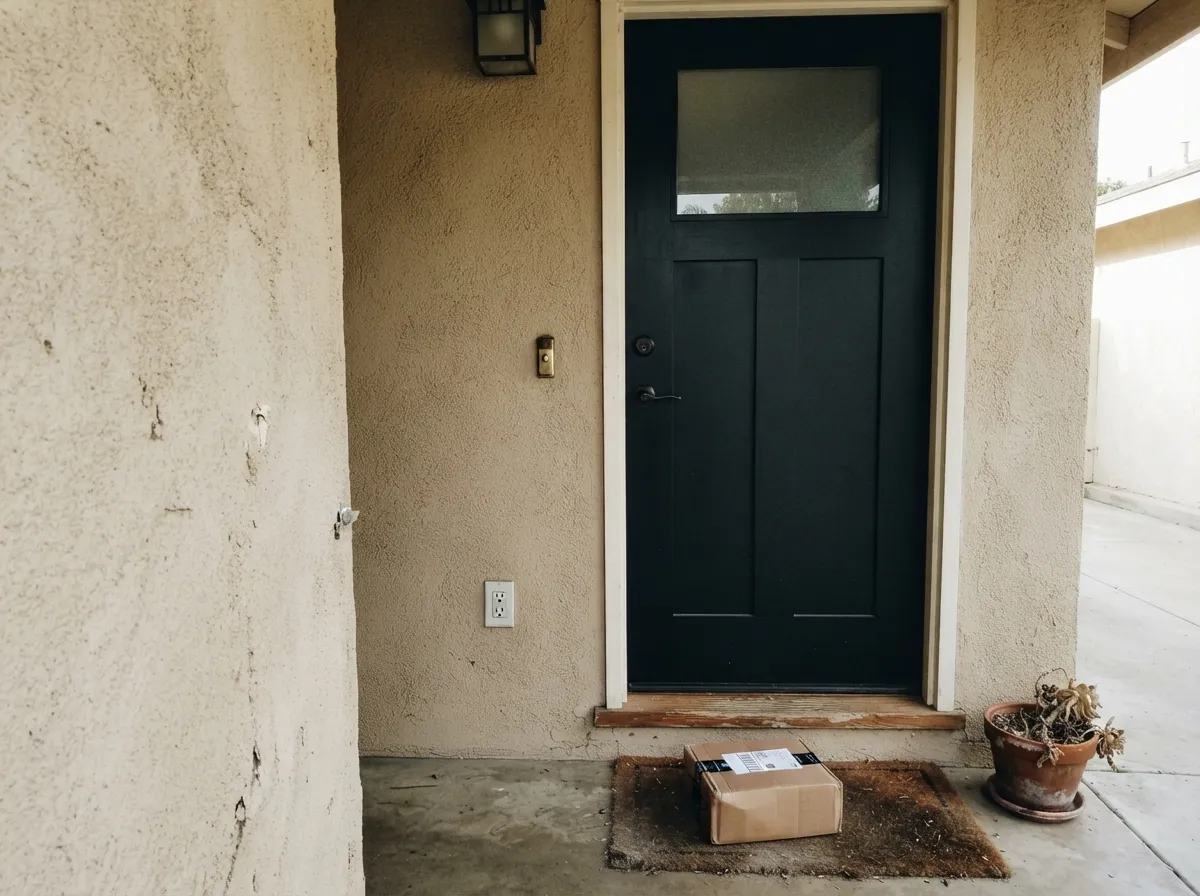
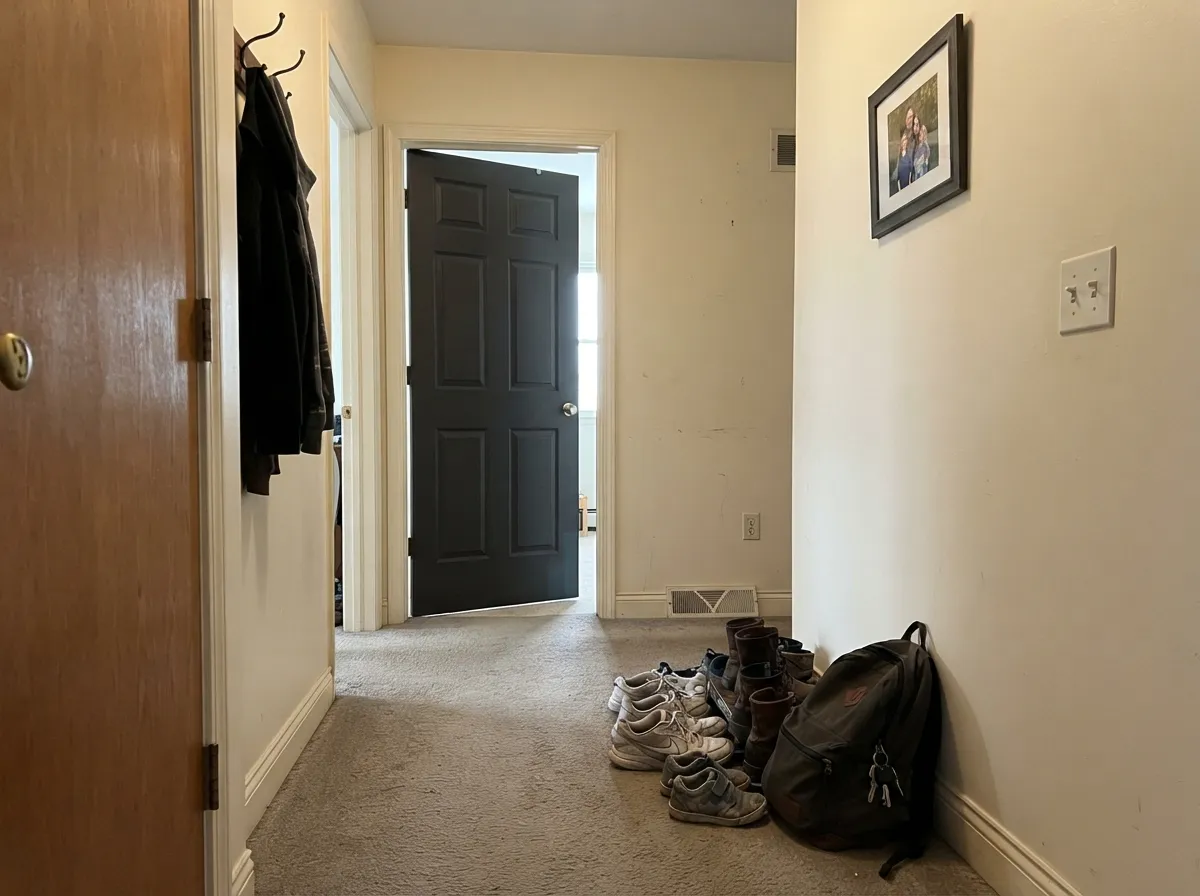
This color is at its best when it is the smallest amount of paint in the room. A kitchen island against Whisper walls, a run of interior doors in a cream hallway, black sash that turns windows into picture frames, a front door on a pale stucco house — the places where it draws a hard line and everything around it suddenly looks intentional. Give it satin on cabinets, semi-gloss on doors, and a white or warm-cream neighbor, and it does the expensive-looking job at a hardware-store price.
Where It Fails
Almost every regret story about a true black follows one of three scripts, and all three are visible before the first coat. None of them are the paint's fault — but if your project matches one, a softer charcoal will make you happier.
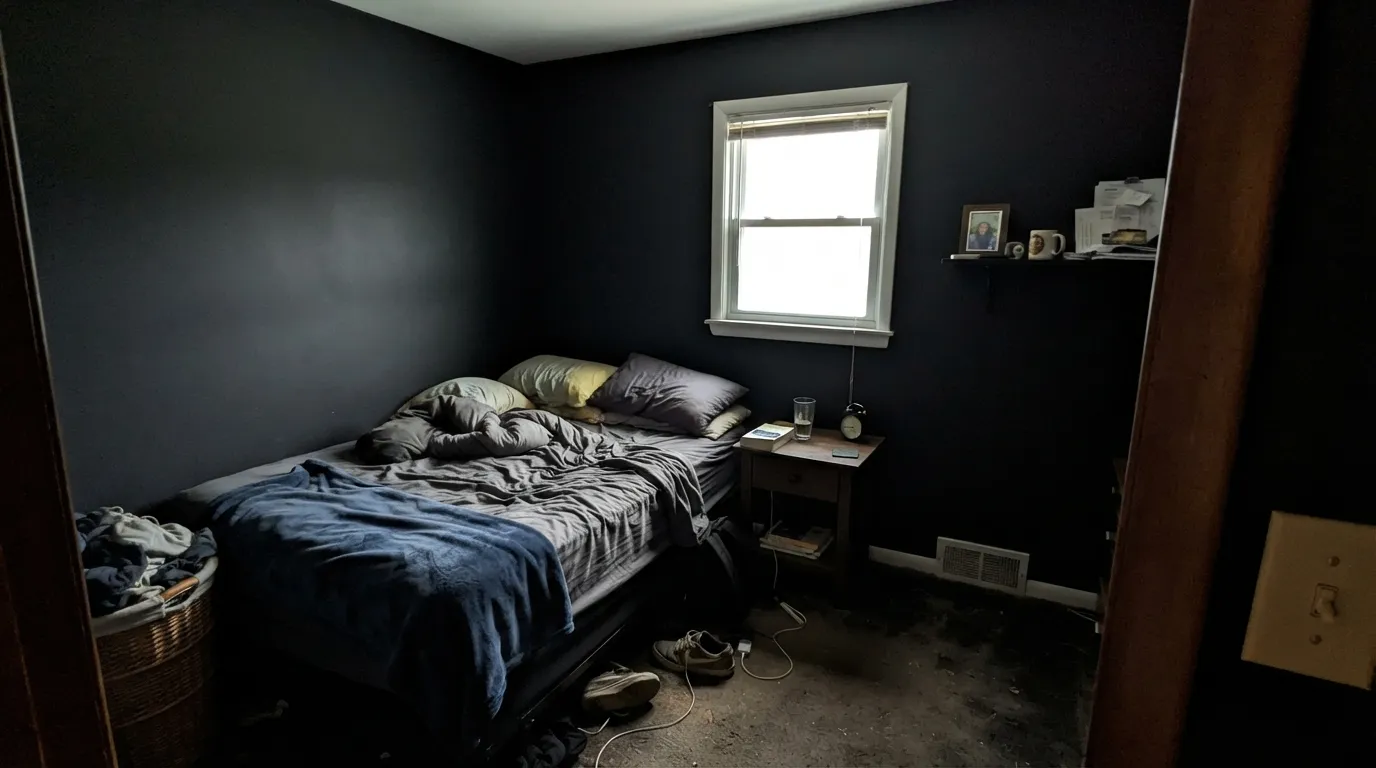
At LRV 4 there is nothing left to bounce. Corners go solid, the ceiling line disappears, and the room stops reading as moody and starts reading as unfinished. Black rooms that work have lamps, a window, and sheen. If you want dark and cozy with some life left in it, use Iron Ore or Espresso Macchiato instead.
Flat and matte black shows every fingerprint, dust film, and roller lap mark, and touch-ups flash a different sheen almost every time. That is the number-one complaint on black cabinets and black doors. Satin urethane enamel on cabinets, semi-gloss on doors — or pick a slightly grayer black that hides dust better.
Black absorbs nearly all the solar energy that hits it, and in Dunn-Edwards country that often means Arizona, Nevada, and Southern California sun. The surface gets hot enough to move a wood slab and stress the film — blistering, cracking, and warping follow, and many wood-door warranties exclude dark colors for exactly this reason. On a shaded or north entry it is fine. In full sun, use a fiberglass or steel slab, or step to a lighter charcoal.
Room by Room
High contrast against Whisper or Swiss Coffee perimeters is the reason this color earns its keep. Satin cabinet enamel, sprayed if you can — a brushed black door shows every stroke in raking window light. Expect to wipe the island edge more than you did when it was white. Black lowers; it does not hide a honey-oak floor.
Crisp against Whisper stucco, Stonish Beige, brick, or wood siding, and it never turns purple or navy the way softer blacks do. Satin holds up better than gloss in weather and hides small dents. Check the sun exposure first — see the wood-door note above.
Black doors against cream or greige walls look expensive for one quart per door. Semi-gloss. Black sash makes glass read as a picture frame across a whole elevation, which is why Dunn-Edwards keeps putting this color on doors in its own galleries. Prime with a gray-tinted primer or the white will keep grinning through the edges.
Black shelving frames books and objects instead of competing with them, and a black fireplace wall gives a room a center. Use matte or eggshell on the wall, satin on the shelves so you can dust them. Repeat the black in a lamp or a frame so it does not read as one lonely dark plane.
Tiny rooms take black better than big ones, because you are never far from the light source. Drench a powder room, add a mirror and one warm fixture, and the room reads custom. A single overhead and no mirror is the cave version. Satin on the vanity, matte on the walls.
A study or dining room with a window and warm bulbs can carry it. A dim bedroom with one small window cannot. Full exterior siding in true black is a heat and fade problem in Southwest sun; keep Black on the door, the sash, and the shutters, and let the body stay Whisper or a mid-tone beige.
Your Light Is the Risk
Strong daylight is when it looks like black instead of a hole — depth you can see, edges that stay sharp, no color agenda. This is the light that sells it on an island, a door, or sash.
Cool, weak daylight plus one overhead fixture leaves the corners as pure void. The room shrinks, the ceiling line disappears, and 'moody' becomes 'unfinished.' Lamps are not optional at LRV 4.
Midday it is dead-true black. Late west sun can lift a faint warm-charcoal edge for an hour — the extra red in the RGB showing up — then it drops back to ink after dusk. Sample the actual door at 4 p.m., not just at noon.
Warm 2700K bulbs keep it inky and slightly softer, which is what you want in a kitchen or hallway at night. Cool 4000K LEDs can flash a blue-black edge next to wood. Do not mix color temperatures in the same sightline.
Most complaints about Black are a light mismatch. Upload a photo of your actual room and see it on your walls — then ask for the same wall in north light or evening lamps before you buy a single sample.
Need It From Another Brand?
Any paint counter can custom-tint Dunn-Edwards DEA002 directly. If you would rather stay in one brand's own deck, these are the closest stock matches, measured as ΔE2000. Under 2 is a difference you will not see on the wall.
| Brand | Closest color | ΔE | LRV | |
|---|---|---|---|---|
| Sherwin-Williams | GreenblackSW 6994 · Sherwin-Williams | 2.6 | 4 | Color page → |
| Behr | Limousine LeatherMQ5-05 · Behr | 1.7 | 4 | Color page → |
| Benjamin Moore | Wire Frame Glasses2132-20 · Benjamin Moore | 2.0 | 6 | Color page → |
| Valspar | Black HeronV120-3 · Valspar | 1.9 | 4.5 | Color page → |
| PPG / Glidden | Starless SkyPPG0995-7 · PPG / Glidden | 1.6 | 5 | Color page → |
| Glidden | Onyx Black00NN 05/000 · Glidden | 0.8 | 5 | Color page → |
Similar Dunn-Edwards Colors
The nearest shades to Black within Dunn-Edwards's own range, ranked by perceptual color distance — useful when you want the same look a touch lighter, darker, or warmer.
WCAG 2.1: AA is 4.5 : 1 for normal text, 3 : 1 for large text, AAA is 7 : 1.
Black vs the Colors You're Also Considering
Every Black sample board has the same rivals on it. The numbers show the real lightness gap — then it comes down to which risk you would rather live with.
Pick this for the same no-opinion job at a Dunn-Edwards counter — LRV 4 instead of 3, still unmistakably black.
Sherwin-Williams SW 6258 · LRV 3Tricorn BlackPick this if you want the industry-default true black a hair darker, and you already paint in Sherwin-Williams.
Pick this when you actually want black on a door, an island, or sash, not a soft dark gray.
Sherwin-Williams SW 7069 · LRV 6Iron OrePick this for four walls, siding, or a whole house — it reads charcoal and still gives a room some light back.
The brand has a second color also named Black (DEA002) at LRV 4. It is noticeably lighter and softer than DEA187, reading closer to a very dark charcoal on the wall. Choose DEA002 if you want blackness with a little breathing room; choose DEA187 when you want the deepest, most saturated true black for cabinets or a door.
Carbonized Wood (DESS50) at LRV 5 is another near-black, but it leans slightly warmer and more brown-gray, which suits rustic or wood-heavy rooms. Old Mill (DEA185) at LRV 5 is the one to watch if you want a clean black, because it carries a real blue-slate cast and will read as very dark navy in good light.
So the practical order is simple. For the truest, most neutral black, DEA187 wins. For a softer black, step to DEA002. For a warm or blue mood, Carbonized Wood or Old Mill respectively.
Dunn-Edwards Black Coordinating Colors
The rule for coordinating with a true black: let the neighbors carry the temperature. Black has no undertone to clash with, which is the whole advantage — it sits next to warm cream, cool white, sage, beige stucco, and brass without picking a fight. Keep the black in the minority (door, island, sash) and the house stays calm. These are the partners that keep showing up in rooms that work:
Why This Black Lives on Cabinets, Not on Four Walls
Dunn-Edwards files Black in Perfect Palette Accents, which is the honest filing: it is a contrast color, not a wall color. The brand's own galleries put it on a front door against Whisper siding, on a bedroom accent against a pale wall, on sash — contrast, not the body of the house. That is not trend-chasing. A true black at LRV 4 has one job, and it has had that job for as long as the deck has had a chip named Black.
There is no Dunn-Edwards Color of the Year story here, and no viral room attached to the name. Painters in California, Arizona, Nevada, and Texas just keep reaching for DEA002 when a client says black and means black. If you wanted a softer, more forgiving dark, the same rack has Espresso Macchiato and Dark Engine. If you wanted this, you wanted the one with no undertone.
Black With Wood Tones, Floors, and Sheen
Walnut, espresso, and pale white oak all sit beautifully — black has no color to fight them, so the wood does the talking. Honey oak and orange-stained builder floors are the honest problem: black raises the contrast, so the floor reads louder and oranger than it did against beige. A large rug helps. Painted or dark-stained floors make the scheme look like it was designed.
Metals are easy because the paint has no temperature: unlacquered brass, antique bronze, matte black, and polished chrome all work. Matte black hardware disappears into the cabinet; brass is the one that photographs.
Finish is the decision that actually makes or breaks this color. Satin urethane enamel on cabinets so knuckle prints wipe off. Semi-gloss on doors and trim. Matte only on walls above chair height. Prime with a gray-tinted deep-base primer and plan on two finish coats — true black over white is how a weekend project becomes a third Saturday.
Three Ready Palettes Built on Black
A color is never alone on the wall. These are complete combinations in the 60-30-10 pattern, with the reason each one holds together. Every one opens in the visualizer.
Black on the bottom and a soft warm white on top is the two-tone layout that reads deliberate instead of dated, because the heavy color sits where your eye expects weight. Whisper is Dunn-Edwards' own trim partner for this black. Pewter Green on one door adds the ten percent of color the scheme needs without touching the cabinets.
Try this palette in your roomThis is the elevation Dunn-Edwards actually paints in its own galleries: a warm Southwest body, a quiet white trim, and a true-black door that does not flash green or brown against the stucco. Keep the black on the door and sash — full black siding in desert sun is a heat problem, not a color problem.
Try this palette in your roomBlack interior doors against a warm cream wall is the cheapest designer move in the deck — one quart per door, and a builder hallway looks considered. Whisper trim keeps the edges soft so the doors read as the contrast, not a fight between two whites. Semi-gloss on the doors so fingerprints wipe off.
Try this palette in your roomBlack FAQ
Is Dunn-Edwards Black a true black or a charcoal?
True black. At LRV 4 with almost no chroma, it does not soften into charcoal the way Iron Ore (LRV 6) or Wrought Iron (LRV 8) do. On a door or an island that is the point. On four walls it is the problem. If you wanted a dark gray that still gives a room some light back, this is the wrong chip.
What white goes with Dunn-Edwards Black?
Whisper is Dunn-Edwards' own pairing and the default — a warm, White Dove-like white that keeps the contrast from going graphic-cold. Swiss Coffee if you want a creamier wall behind black doors. A crisp cool white like Lighthouse makes the black look sharper and the white look colder; that is a look, not a mistake, but sample them together before you commit the whole house.
Can I paint a whole room Black?
Only with real light and real lamps. A dining room or powder room with a window, a chandelier, and 2700K bulbs can carry a drench. A dim bedroom with one overhead cannot — at LRV 4 the corners go void. If you are not adding lighting as part of this project, keep Black on the doors and pick Iron Ore or Espresso Macchiato for the walls.
Does it work on a front door in full sun?
On fiberglass or steel, yes — satin, and expect it to run hot. On a wood slab facing south or west in Arizona, Nevada, or Southern California, it is a warranty and warping risk: black paint absorbs almost all the solar energy that hits it. A shaded or north entry is the easy yes. Full sun on wood is the honest no.
How does it compare to Tricorn Black?
Same job, different store. Tricorn Black is LRV 3 and the national reference true black; Dunn-Edwards Black is LRV 4 and a hair less deep, with a faintly warmer RGB. Side by side you can see the gap. Across a room you cannot. If you already paint at Dunn-Edwards, there is no reason to special-order Tricorn for this.
What sheen should I use on cabinets?
Satin, in a urethane-fortified cabinet enamel, sprayed if you can. Matte black cabinets show every knuckle print within a week and flash at every touch-up. Semi-gloss on doors and trim. Matte is only for walls above chair height in rooms nobody touches.
Have you painted with Black?
Rate it — one tap helps the next reader decide.
Ask a Question