Shasta Lake
The deep lake blue Behr quietly sells for garage doors and front doors, reviewed honestly: where it stays blue, where it goes flat black, and what it does to warm brick.

Jessica has spec'd whites and neutrals for more than 300 rooms and keeps a sample wall of painted drawdowns in her studio. Every color review is checked against real reader rooms in the comments and re-tested when a formula changes. About the testing process →
- 1Naval4
- 2Shasta Lake10
- 3Smoky Blue15
- 4Wolf Gray21
The Fast Verdict
Shasta Lake is the deep, slightly green-leaning blue you land on when navy feels too corporate and teal feels too coastal. Behr's own copy calls it a deep teal grayed with rich neutrals, and the paint half-agrees: in real daylight it reads as a saturated lake blue with a faint green edge, and in shade it drops the green and goes almost black. At LRV 10 it is a depth color, not a room brightener. It is at its best on a surface the sun actually hits — a garage door, a front door, an island, a vanity — and at its worst on four walls of a dim room.
Garage doors and front doors on a light-bodied house · shutters and exterior trim · kitchen islands and cabinets · powder rooms and small baths that can take a drench · a lamplit office or den with a real window
The surface lives in permanent shade · your brick, stone or siding runs orange-tan · the door is south or west facing steel and you never plan to repaint · you wanted a soft, grayed blue rather than a saturated one
- Reads as a real blue from the curb where navies read black
- Deep enough to hide dents, handprints and garage-door reality
- Sold in exterior-rated door and trim enamels, not just wall paint
- Looks custom on an island or vanity next to warm white and brass
- Cheap way to make a plain builder facade look intentional
- At LRV 10 it goes flat near-black in shade and dim rooms
- Clashes hard with orange brick, terracotta roofs and honey oak
- Dark tone on sun-facing metal fades sooner than a mid-tone
- Saturated deep blues need a tinted primer and a patient second coat to avoid streaks
What Color Is Shasta Lake, Really?
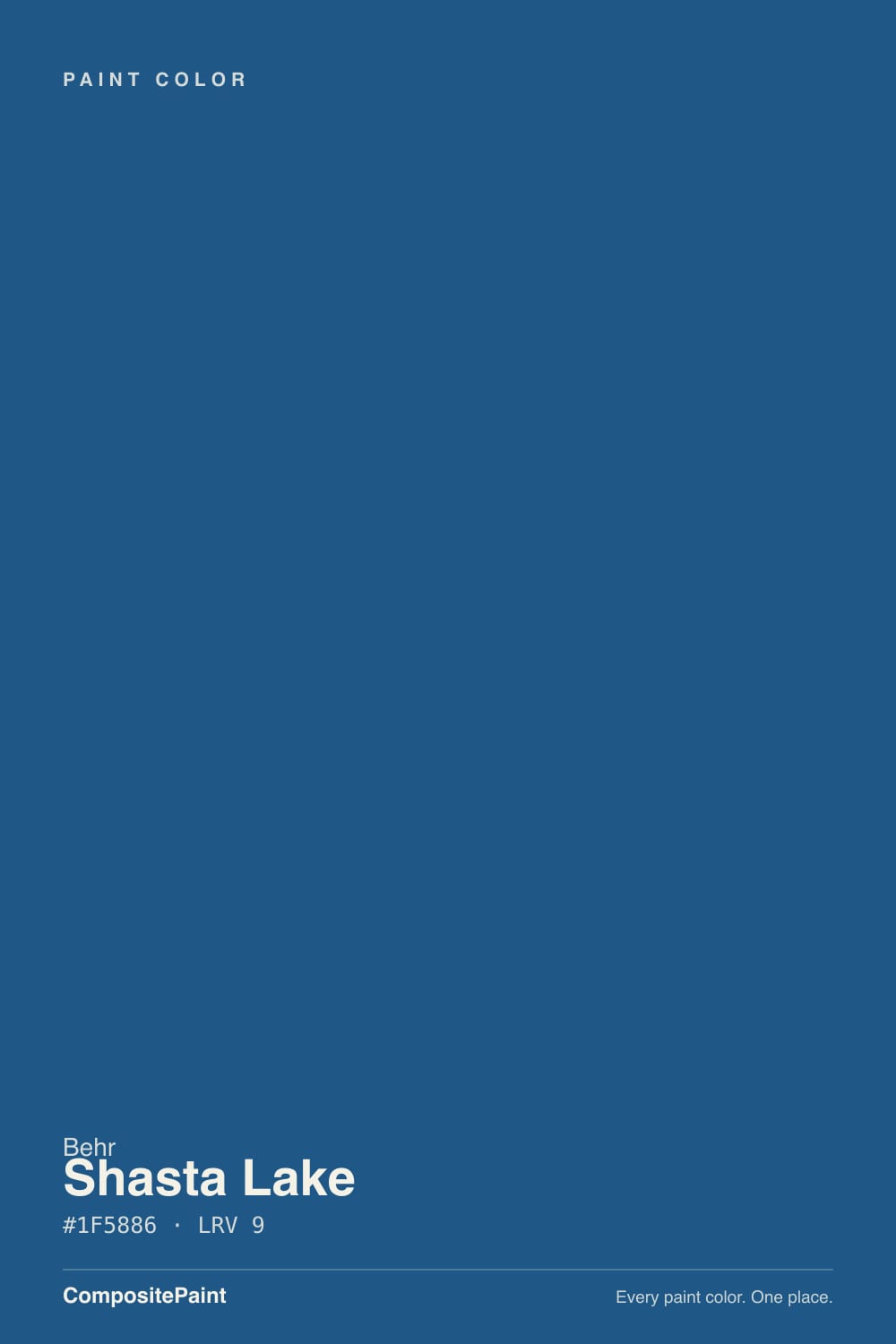
A saturated mid-dark blue with a green thread running through it. Behr files it as a deep teal calmed down with gray, and that is roughly what the chip does, but the mixed paint on a real surface leans further toward blue than the word teal makes you expect. Put it beside an actual teal like Ocean Abyss (LRV 8) and Shasta Lake is clearly the bluer of the two; put it beside a violet-leaning navy and the green edge shows up immediately. It sits in the family of colors people search for as lake blue, steel blue or petrol blue and never quite find a name for.
At LRV 10 it is a genuine depth color — the same territory as Behr Nocturne Blue (LRV 7) and one step lighter than Very Navy (LRV 4). What separates it from those two is chroma: Shasta Lake keeps more actual color in it, so it does not slide into the near-black category as fast. That is the whole argument for it. On a garage door in afternoon sun it reads unmistakably blue where a navy would read black-ish, and that difference from the street is why Behr keeps offering it in exterior door and trim enamels.
Undertone in one line: blue first, a green whisper second, no violet at all. If your sample looks flat and slate-gray, the light is doing it, not the paint — every low-LRV blue behaves this way. If it looks teal, you are seeing it in strong direct sun, which is the most flattering and least typical light it will ever get.
Where It Shines
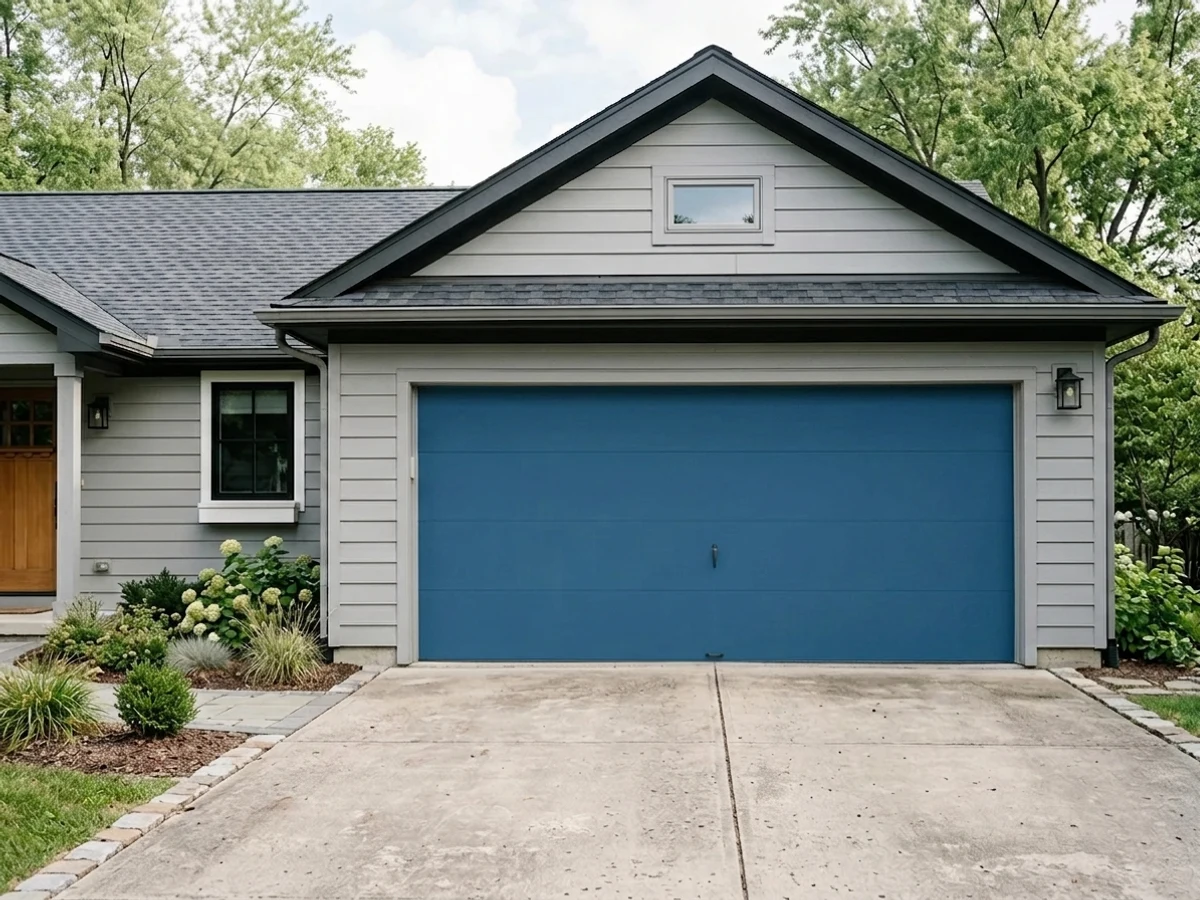
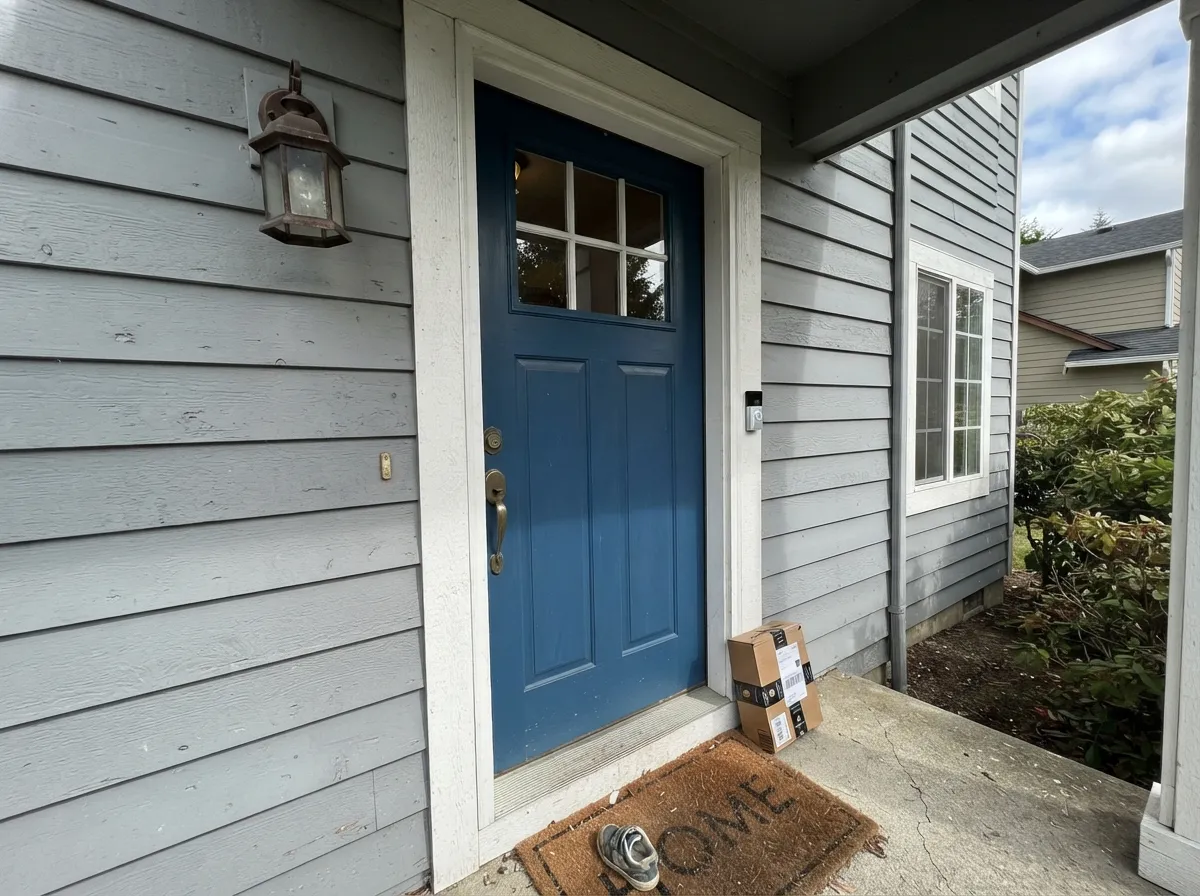
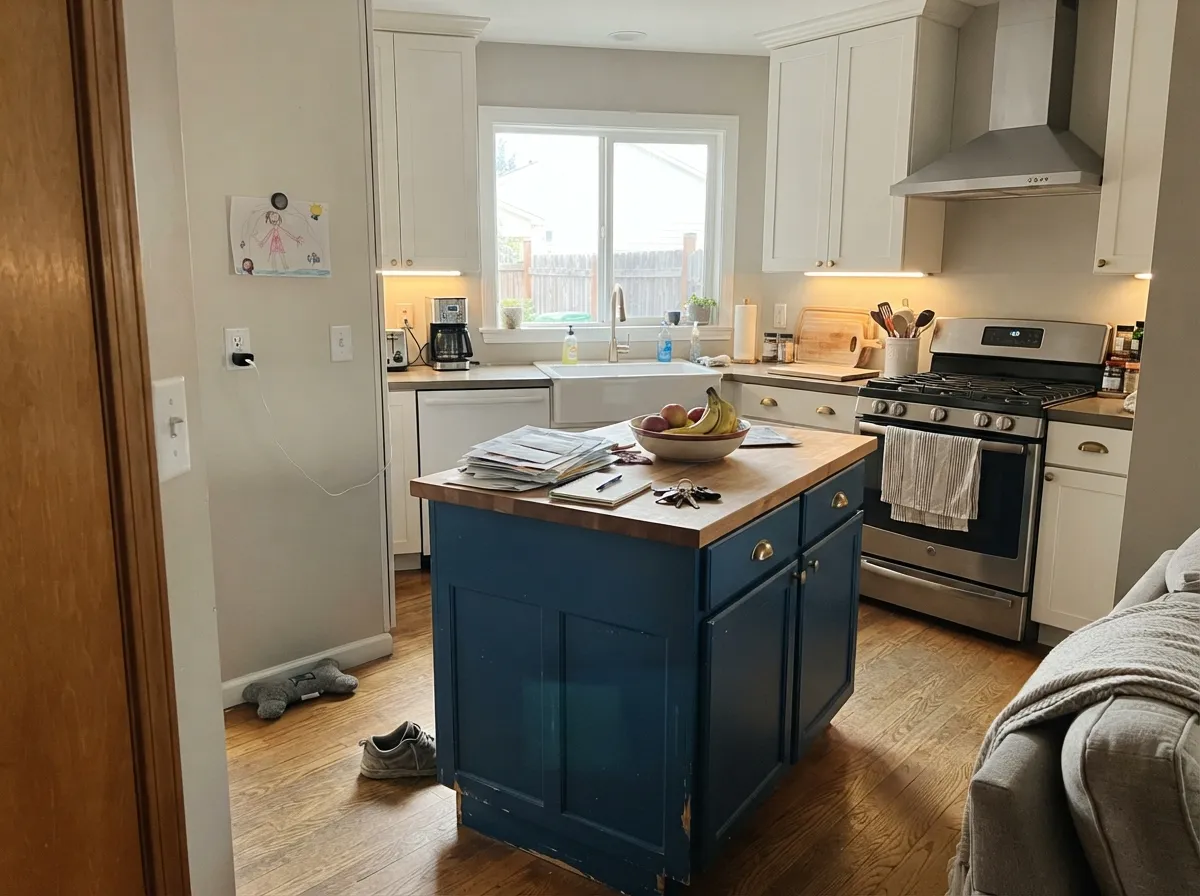
This color earns its keep on one surface at a time, outdoors, in daylight. A Shasta Lake garage door against a light gray or warm white house is the whole reason the color exists: enough saturation to read as a deliberate color choice from the curb, enough depth to hide handprints, dents and the general reality of a garage door. Indoors it does the same trick in miniature — an island, a vanity, a set of built-ins — where the color reads custom next to warm white and brass. Give it crisp white trim, unlacquered brass or oil-rubbed bronze, and pale wood, and it looks far more expensive than a Home Depot gallon.
Where It Fails
The complaints about deep blues on doors are remarkably consistent, and all three of the big ones are predictable before you open the can. If your house matches one of these, no amount of sampling will change the outcome.
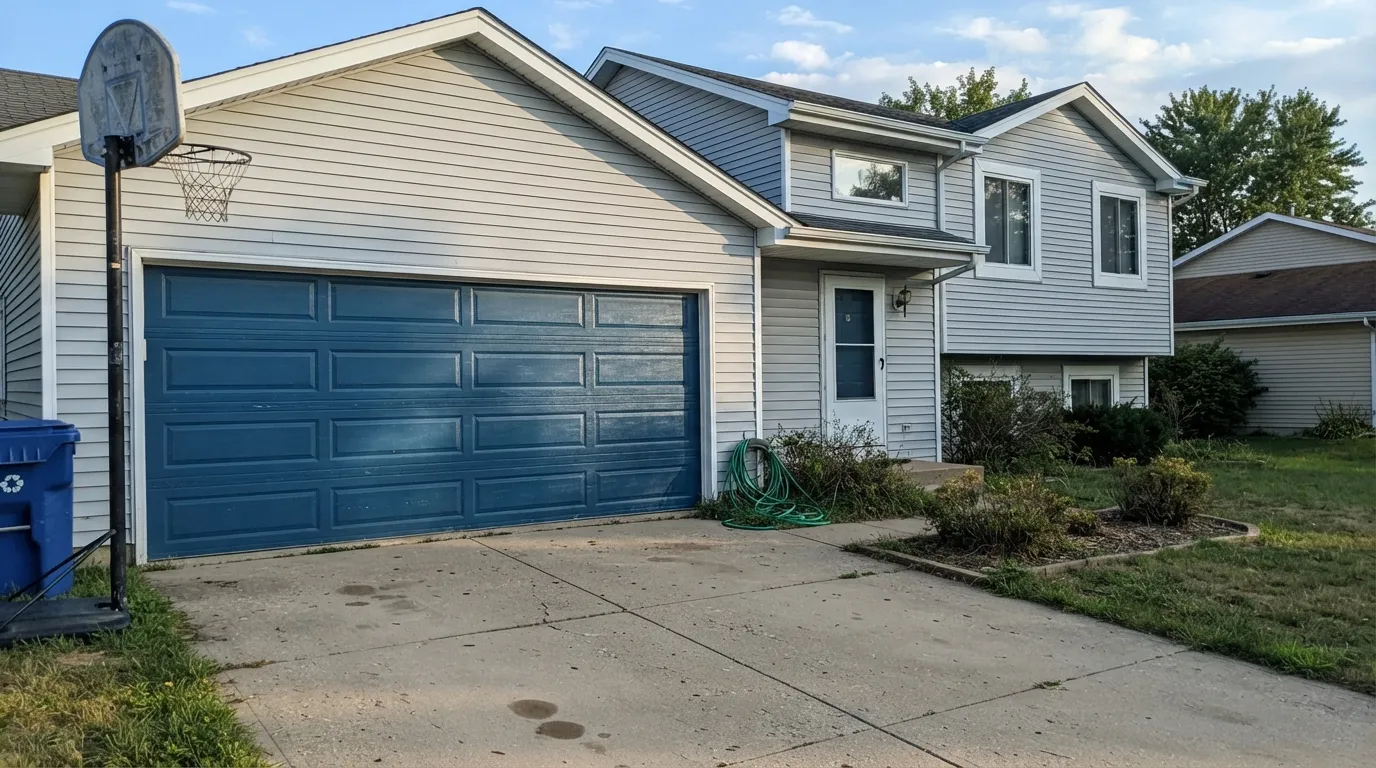
LRV 10 means the color has almost no light to give back. On a north-facing garage door, under a deep porch roof, or on a wall in a room with one small window, the green-blue collapses and you get a flat dark slate that most people simply read as black. Owners describe it as looking great for the two hours the sun hits and dull the rest of the day. Sample the actual door, at the actual hour you look at it, before you buy three gallons.
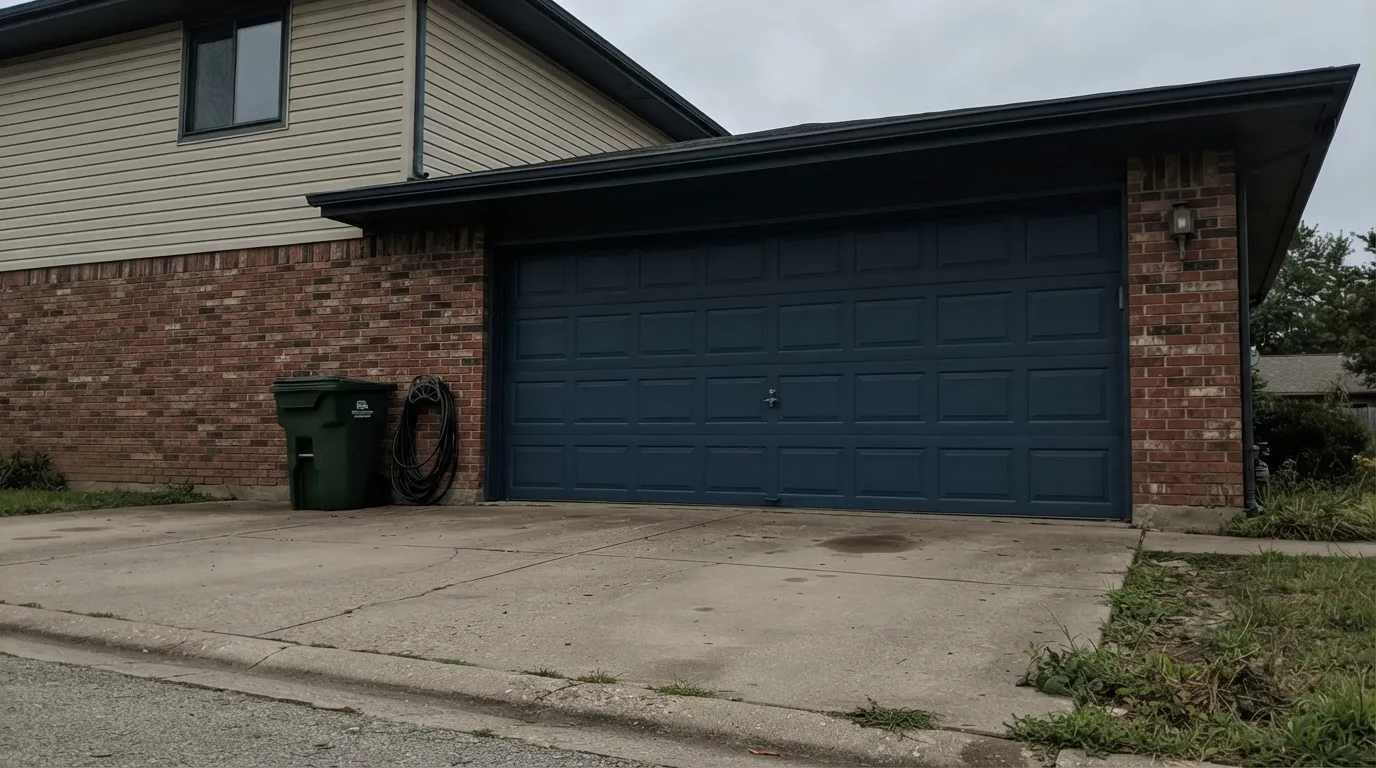
Orange sits directly opposite blue on the wheel, so a Shasta Lake door on a red-orange brick house, a terracotta-tile roof, or golden-tan vinyl makes both sides shout. The brick reads more orange, the door reads more electric, and the house looks like two decisions made on different days. This blue wants a cool or neutral body — light gray, greige, white, or a cool-toned stone. Indoors the same rule applies to honey oak floors and orange-stained trim.
Sun can push a metal garage door past 140°F, and dark colors absorb the most of it. On a south or west exposure, dark finishes are widely reported to show visible fade in roughly half the time a mid-tone does. That does not make it a bad idea — it makes it a repaint schedule. Use an exterior-rated line (Behr sells Shasta Lake in Marquee exterior semi-gloss and in the Premium interior/exterior cabinet, door and trim satin), scuff and prime bare steel properly, and accept that a south-facing door will want a refresh years before a shaded one.
Room by Room
The one surface where this color is close to unbeatable. Deep enough to hide the dings and dirt a garage door collects, saturated enough to read as blue rather than as a dark smudge from the sidewalk. Pair it with white trim and a light gray or warm white body. Satin or semi-gloss exterior enamel, and match the front door to it so the two big rectangles agree.
Same logic at smaller scale. On a white, gray or greige house it reads classic-with-a-twist; on orange brick it fights. Semi-gloss holds up to handles and weather and lets the green edge show in sun. If you only paint one thing, paint the door and live with it a season before committing the garage.
An island in Shasta Lake under warm white perimeter cabinets is the safest way to use it indoors: the color gets a spotlight, the room keeps its light. Satin urethane cabinet enamel, brass or bronze pulls, and a light counter. A whole kitchen of it needs a genuinely bright room, or the lowers will read black by 4pm.
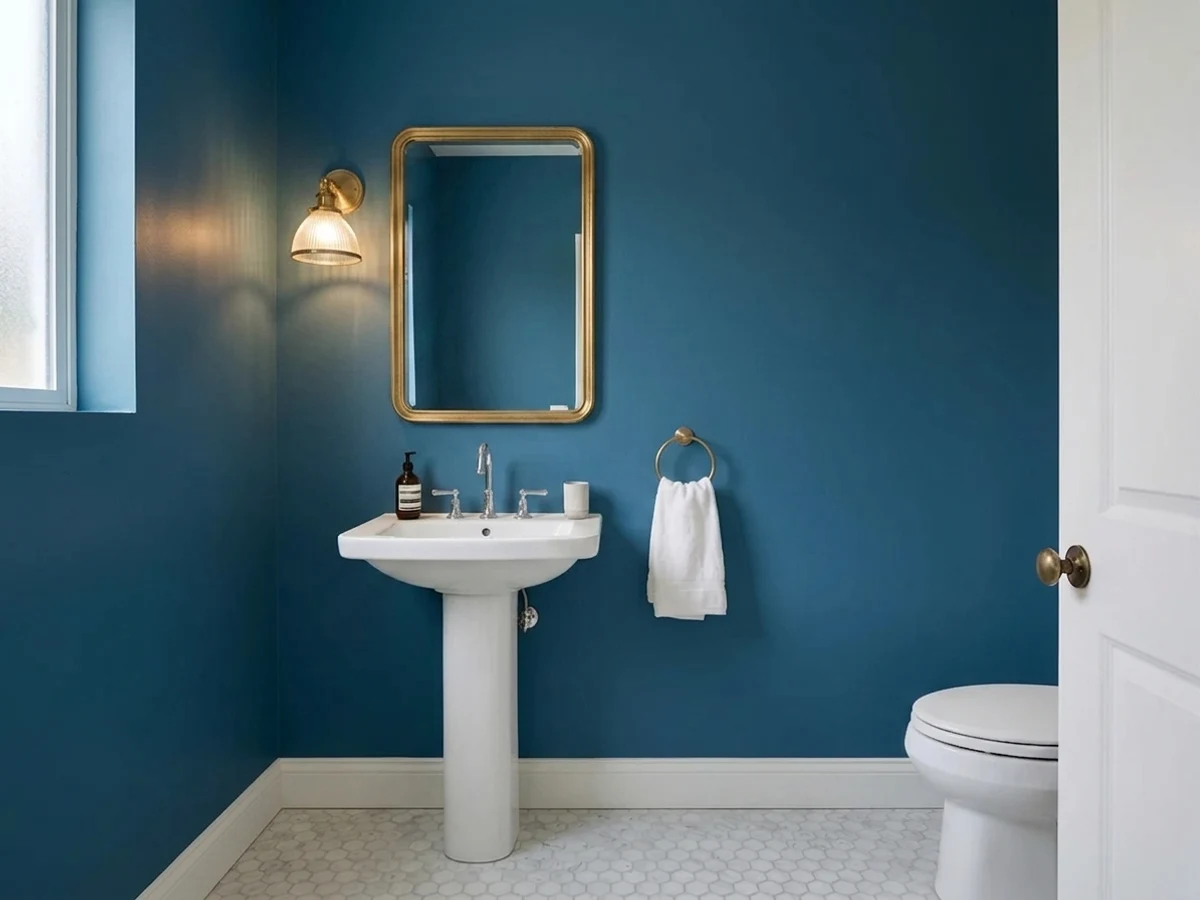
Small windowless rooms are the one place a deep color has nothing to lose, because nobody expected the powder room to be airy. Walls, trim and ceiling all in Shasta Lake, matte on the walls and satin on the trim, with a white sink and warm metal, is a fifteen-dollar-a-square-foot look for the price of a gallon.
Four walls of it in a study reads focused and slightly nautical, and it photographs well on video calls. The condition is real daylight or a lot of lamps: in a dim office it turns into a dark box. Eggshell for wipeability, warm white trim, and put the desk near the window.
A headboard wall or a fireplace wall in Shasta Lake is genuinely good. All four walls of a bedroom is a bigger bet than it looks on the chip, and in an open-plan living room the color has to negotiate with every wood tone and neighbor wall in sight. If you want the mood across a whole room, a lighter blue like Blueprint (LRV 19) does it with far less risk.
Your Light Is the Risk
Full sun is where the color pays off: the blue turns rich and the green thread becomes visible. A west-facing garage door catching late sun is the single most flattering situation it gets.
Cool, indirect light drains the chroma and the door or wall reads as a flat dark slate — close enough to black that guests describe it that way. This is the number-one disappointment with the color.
East morning light shows the cooler, greener side; by golden hour the warm low sun pulls it toward a softer, almost denim blue. The swing across a day is large for a color this dark — expect two different colors, not one.
Warm 2700K lamps mute it toward a smoky gray-teal and make an interior room feel cave-like unless you add lamps. Cooler 3500–4000K LEDs keep it crisply blue, which is why it looks better in a garage or office than in a bedroom at night.
Most complaints about Shasta Lake are a light mismatch. Upload a photo of your actual room and see it on your walls — then ask for the same wall in north light or evening lamps before you buy a single sample.
Need It From Another Brand?
Any paint counter can custom-tint Behr M490-7 directly. If you would rather stay in one brand's own deck, these are the closest stock matches, measured as ΔE2000. Under 2 is a difference you will not see on the wall.
| Brand | Closest color | ΔE | LRV | |
|---|---|---|---|---|
| Sherwin-Williams | Endless SeaSW 9150 · Sherwin-Williams | 1.6 | 9 | Color page → |
| Benjamin Moore | Blue Danube2062-30 · Benjamin Moore | 1.8 | 11 | Color page → |
| Valspar | Dragon's Lair8003-41F · Valspar | 3.8 | 10 | Color page → |
| PPG / Glidden | BrigadePPG1152-6 · PPG / Glidden | 1.3 | 10 | Color page → |
| Glidden | BrigadePPG1152-6 · Glidden | 1.0 | 10 | Color page → |
| Dutch Boy | Sailing Suzy336-6DB · Dutch Boy | 2.7 | 10 | Color page → |
Similar Behr Colors
The nearest shades to Shasta Lake within Behr's own range, ranked by perceptual color distance — useful when you want the same look a touch lighter, darker, or warmer.
WCAG 2.1: AA is 4.5 : 1 for normal text, 3 : 1 for large text, AAA is 7 : 1.
Shasta Lake vs the Colors You're Also Considering
Every Shasta Lake sample board has the same rivals on it. The numbers show the real lightness gap — then it comes down to which risk you would rather live with.
Pick this when navy looks black on your door and you want the blue to actually show up.
Behr M500-7 · LRV 4Very NavyPick this if you want a classic, unarguable navy — it is deeper (LRV 4) and reads as the traditional door color.
Pick this when you want saturation and contrast rather than a soft, livable blue-gray.
Behr S470-5 · LRV 19BlueprintPick this for the same family with room to breathe — at LRV 19 it works on four walls where Shasta Lake would close a room in.
Shasta Lake Coordinating Colors
The rule with a saturated deep blue is simple: keep everything around it cool or neutral, and let one warm metal do the softening. It pairs cleanly with grays, greiges and whites, layers well with lighter members of its own family, and takes a near-black as a punctuation mark. These are the partners that keep working in real houses:
Painting a Garage Door Shasta Lake: What Actually Holds Up
The garage door is usually the largest single surface on the front of an American house, which is why a color decision there changes the whole facade more than the front door does. Behr sells Shasta Lake in the product lines that matter for this job: Marquee exterior semi-gloss enamel for the door itself, and the Premium interior/exterior cabinet, door and trim satin enamel if you want the lower sheen. Both are rated for exterior use, which regular interior wall paint is not — a deep color on an unprotected door is where peeling stories start.
Prep decides how long it lasts. Wash off road film and exhaust grime, scuff the factory finish so the new paint has something to bite, spot-prime any bare or rusted steel, and paint panel by panel with the door closed and out of direct sun. Two thin coats beat one heavy one, especially with a saturated blue that wants to show every lap mark.
Then set expectations honestly. A dark door on a shaded or north-facing elevation can look the same for a decade. A dark door in full southern or western afternoon sun is a shorter-cycle finish — heat and UV work on it every day, and dark pigments give up first. If you love the color enough to touch it up before it is obviously tired, it is a great choice. If you want a paint-it-and-forget-it door, go lighter.
Shasta Lake With Wood, Stone and Metals
Blue and orange are opposites, and that single fact settles most of the decisions here. White oak, pale ash and gray-washed floors are excellent under it — they read neutral and let the blue be the color in the room. Walnut and dark stained wood work too, because the depth of the wood keeps up with the depth of the paint. Honey oak floors, orange-stained trim and golden pine are the honest no: each side exaggerates the other, and the room ends up looking like a color argument.
Outdoors the same test applies to your masonry. Cool gray stone, white or gray brick, black window frames and charcoal roofs all sit comfortably beside it. Red-orange brick, tan fieldstone and terracotta tile do not, and no trim color rescues that pairing — if that is your house, a green or a charcoal will serve the door better than any blue.
Metals are easy: unlacquered brass and antique bronze warm it up, matte black sharpens it, and brushed nickel disappears politely. Polished chrome is the only one that makes the blue look cold rather than deep.
Three Ready Palettes Built on Shasta Lake
A color is never alone on the wall. These are complete combinations in the 60-30-10 pattern, with the reason each one holds together. Every one opens in the visualizer.
A cool light body is what keeps the blue from fighting anything. Fast As The Wind is the unglamorous exterior gray that does this job all day, and bright white trim gives the door a hard edge to sit against — the contrast is what makes a garage door read as a design choice instead of a big blank panel.
Try this palette in your roomThe island carries all the color while the room stays light, which is the only reliable way to use an LRV 10 blue in a kitchen. Whisper White is warm enough to keep the scheme from going clinical, and Silver Drop is neutral enough that it does not pick a side between the warm cabinets and the cool island.
Try this palette in your roomTwo depths of the same blue family read as layered rather than themed — Adirondack Blue is the slate-blue workhorse that already shows up on cabinets and doors, so it makes an easy vanity partner. Keep the ceiling light with Polar Bear so the little room has somewhere to breathe, and put brass or bronze on the faucet.
Try this palette in your roomShasta Lake FAQ
Is Shasta Lake blue or teal?
Blue, with a green thread. Behr describes it as a deep teal grayed with neutrals, and in strong sun you can see why — but on a real door or wall, in average light, almost everyone calls it blue. If you specifically want teal, Ocean Abyss (LRV 8) is the genuinely green-blue choice in the same depth range.
Is it a good garage door color?
It is one of the better ones, for a specific kind of house. The depth hides dents and dirt, and the saturation means the door still reads as blue from the street instead of as a dark rectangle. The conditions: a cool or neutral body color, and honest expectations about fade on a south or west facing steel door.
Will a dark garage door fade or overheat?
It will run hotter — sun can drive a metal door past 140°F, and dark colors absorb the most. Fade follows the same rule: on a strong south or west exposure, dark finishes commonly show noticeable fade in roughly half the time a mid-tone does. Use an exterior-rated enamel, prime bare metal, and plan on refreshing a sun-baked door sooner than a shaded one.
What white goes with Shasta Lake?
Almost any clean white works, because the blue is doing all the talking. Ultra Pure White (LRV 102) is the crisp exterior trim answer. Indoors, Whisper White (LRV 100) or Polar Bear (LRV 86) keep the contrast without the surgical edge — useful when the blue is on cabinets rather than outdoors.
How many coats does it take?
Plan on two full coats over a gray-tinted primer, and three if you are going over a light or patchy surface. Saturated deep blues carry a lot of colorant and thin binder, which is exactly the recipe for roller-lap streaks. Keep a wet edge, do not overwork the second coat, and let it cure before you judge the finish.
Can I use it on interior walls?
Yes, if the room has light. An office, a den, a small bath or a powder room can carry it beautifully. A dim bedroom or a north-facing living room will turn it into a flat dark box — for whole-room blue in an average room, Blueprint (LRV 19) is the safer version of the same idea.
Have you painted with Shasta Lake?
Rate it — one tap helps the next reader decide.
Ask a Question