Dark Kettle Black
Valspar's most-tinted black, reviewed honestly: the doors, shutters and cabinets it was built for, the garage-door rule nobody mentions, and where a true black quietly ruins a room.

Jessica has spec'd whites and neutrals for more than 300 rooms and keeps a sample wall of painted drawdowns in her studio. Every color review is checked against real reader rooms in the comments and re-tested when a formula changes. About the testing process →
- 1Dark Kettle Black2.3
- 2Graphite8
The Fast Verdict
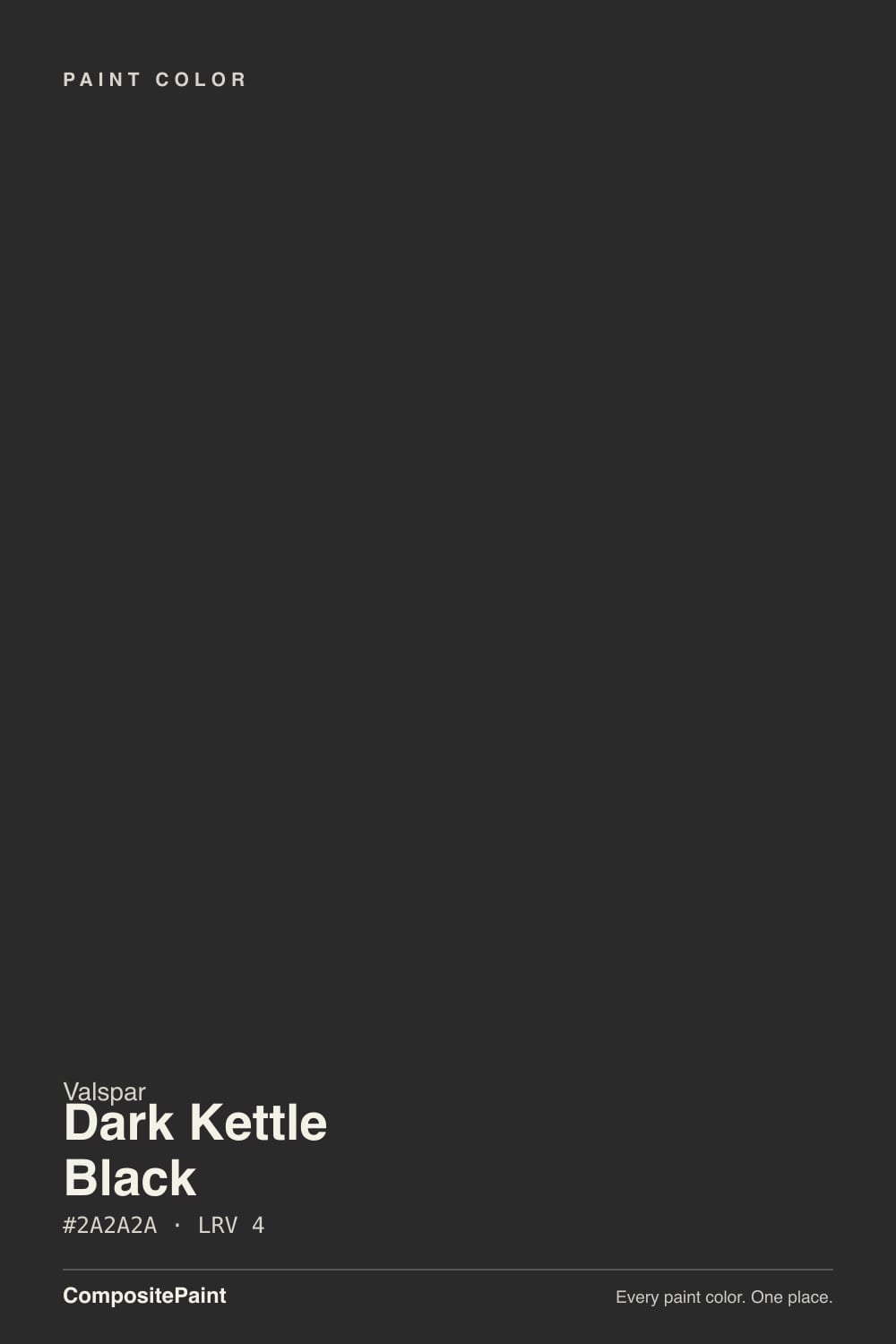
Dark Kettle Black is the black you buy when you want black and nothing else. No navy flash, no green cast, no charcoal softness hiding in the can — at LRV 4 it lands as an actual black, and Valspar files it in its Classic Collection with a cool undertone that only shows up when a warm black is standing next to it. It is the color under a huge share of America's black front doors, black shutters and black kitchen islands, mostly because it sits on the Lowe's shelf in an exterior can, an interior can and a cabinet enamel. Use it on the surfaces you want to disappear or dominate; do not use it on four dim walls and expect to like it.
Front doors and shutters · exterior trim, window sash and garage doors · kitchen islands and lower cabinets in satin enamel · black interior doors · powder rooms and small rooms you want to drench
The room is dim and windowless · your walls have bad drywall seams or old patches · you wanted a soft charcoal, not a true black · there is no Lowe's near you and you need touch-up paint in a hurry · your garage door is uninsulated steel facing full afternoon sun
- An actual black — no navy flash, no green or brown cast in daylight
- Sold in exterior, interior and cabinet-enamel products at one store
- Valspar's most-tinted black, which means it holds up as a resale-safe exterior choice
- Small surfaces — doors, shutters, sash, islands — look custom for the price of a quart
- Deep enough at LRV 4 that it never turns into an accidental charcoal
- LRV 4 gives back no light — dim rooms turn oppressive fast
- Shows every drywall flaw, roller mark and touch-up, especially in higher sheens
- Absorbs heat outdoors: real bowing and warranty risk on large steel or vinyl doors
- Lowe's-only in the US, so matching touch-up paint later depends on one retailer
What Color Is Dark Kettle Black, Really?
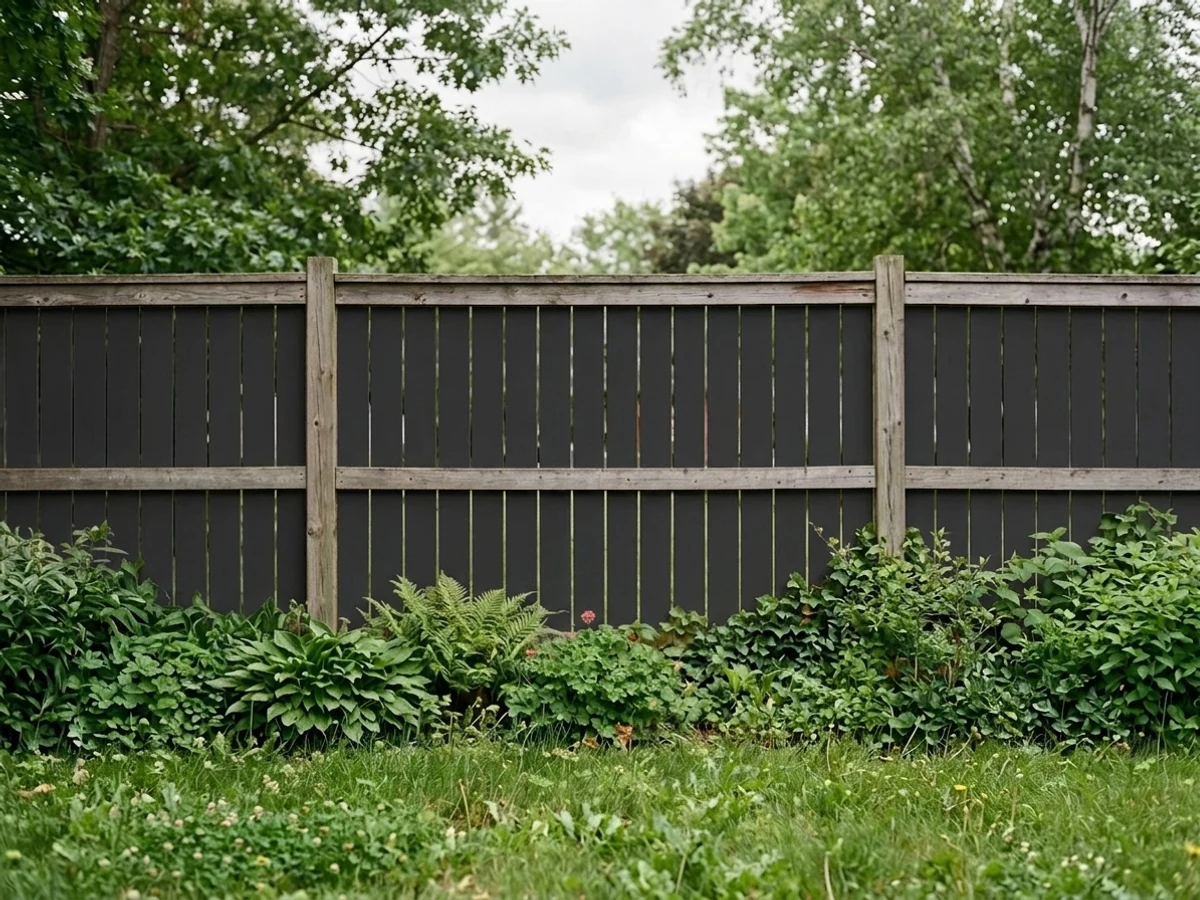
A true black with the undertone dialed almost to zero. That is the whole reason it has a following. Most decks make you choose between a black that flashes navy in daylight and a black that goes green or brown in the shade; Dark Kettle Black stays black, which is why designers who shop the Lowe's deck name it before anything else in Valspar's black lineup. Valspar itself files it in the Classic Collection and labels the undertone cool, and that is the fair read — cool by a hair, not by an inch. Next to a warm near-black it looks faintly graphite; on its own nobody can name a hue in it.
At LRV 4 this is not a soft charcoal pretending to be black. It absorbs nearly all the light that hits it, which changes what the paint job is actually about: color stops doing the work and sheen takes over. Matte reads as a flat hole in the wall, beautiful on a ceiling or a drenched powder room and merciless on a hallway that gets touched. Satin gives edges and panel profiles something to catch, which is why doors, shutters and cabinets are its home turf. Expect a deep tint base, expect two coats minimum and often three, and expect the first coat to look patchy and streaky in a way that panics people — blacks level out as they cure.
Availability is part of the review. Valspar is a Lowe's brand in the US, so this color is a Lowe's trip: interior paint, Duramax exterior, and a cabinet and furniture enamel that explains a lot of the black islands on Pinterest. Sample pints exist, which matters more for black than for anything else — you are sampling sheen and surface, not hue. If there is no Lowe's near you, Sherwin-Williams Tricorn Black at LRV 3 is the closest working twin in another deck.
Where It Shines
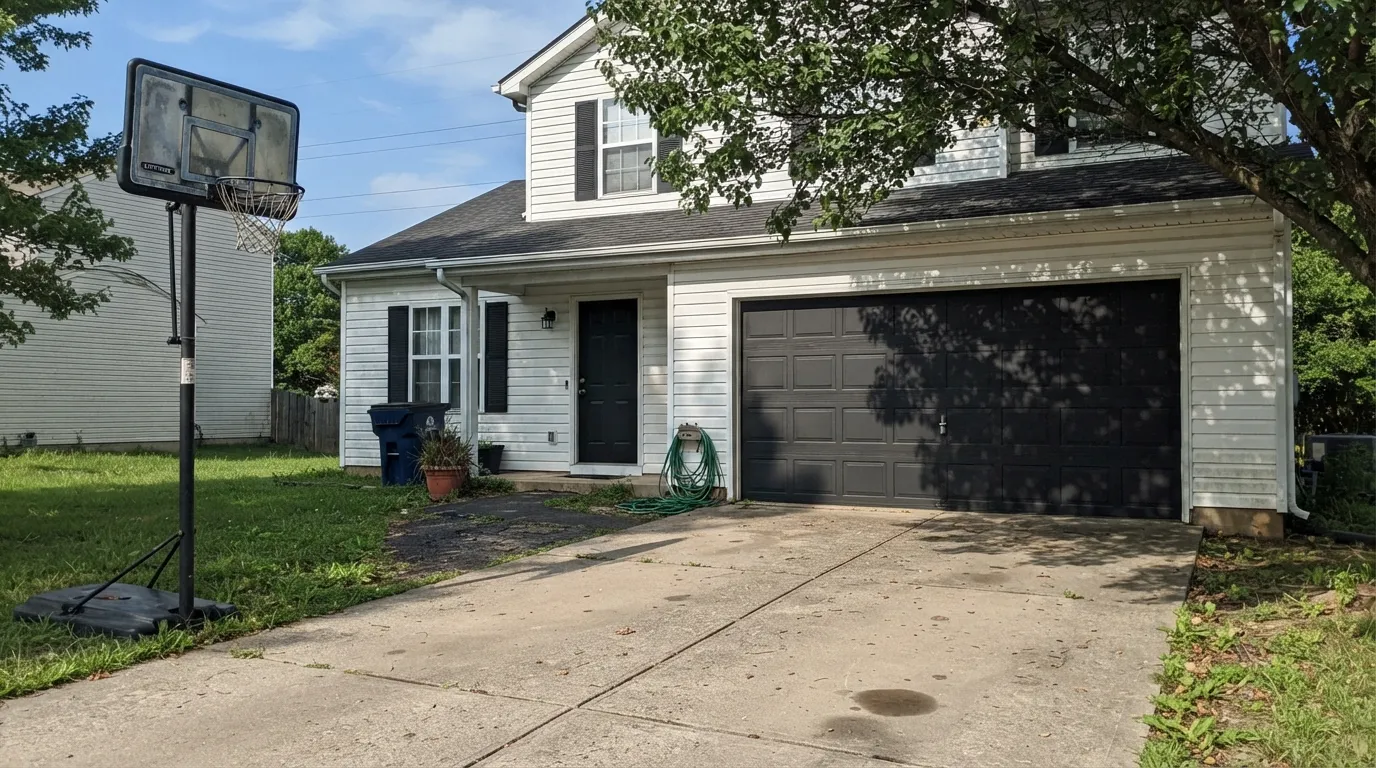
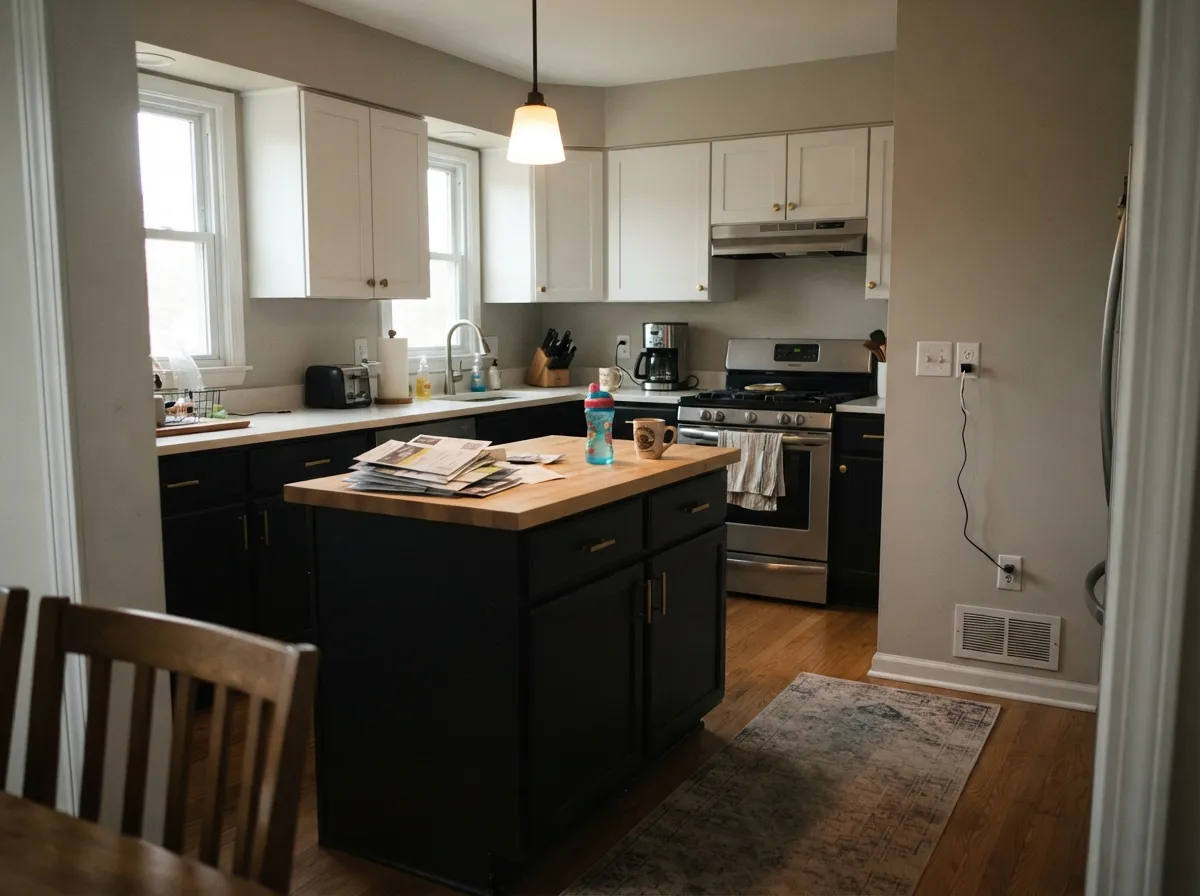
This color is at its best on the surfaces you look at rather than the ones you live inside. A black front door against a white or pale-gray house is the cheapest curb-appeal upgrade in the business, and Dark Kettle Black is the version that stays black through a whole day of moving sun. Shutters, window sash, exterior lanterns and garage doors follow the same logic — outside, the sun is strong enough that a real black reads as crisp architecture instead of a shadow. Indoors it earns its keep in satin enamel on an island, a run of lower cabinets, a set of interior doors, or every surface of a small windowless powder room where the point is drama, not brightness.
Where It Fails
The complaints about this paint almost never concern the color — it is black, and it delivers black. They concern the three situations below, and all three are predictable before you open the can. If your project matches one, no number of coats fixes it.
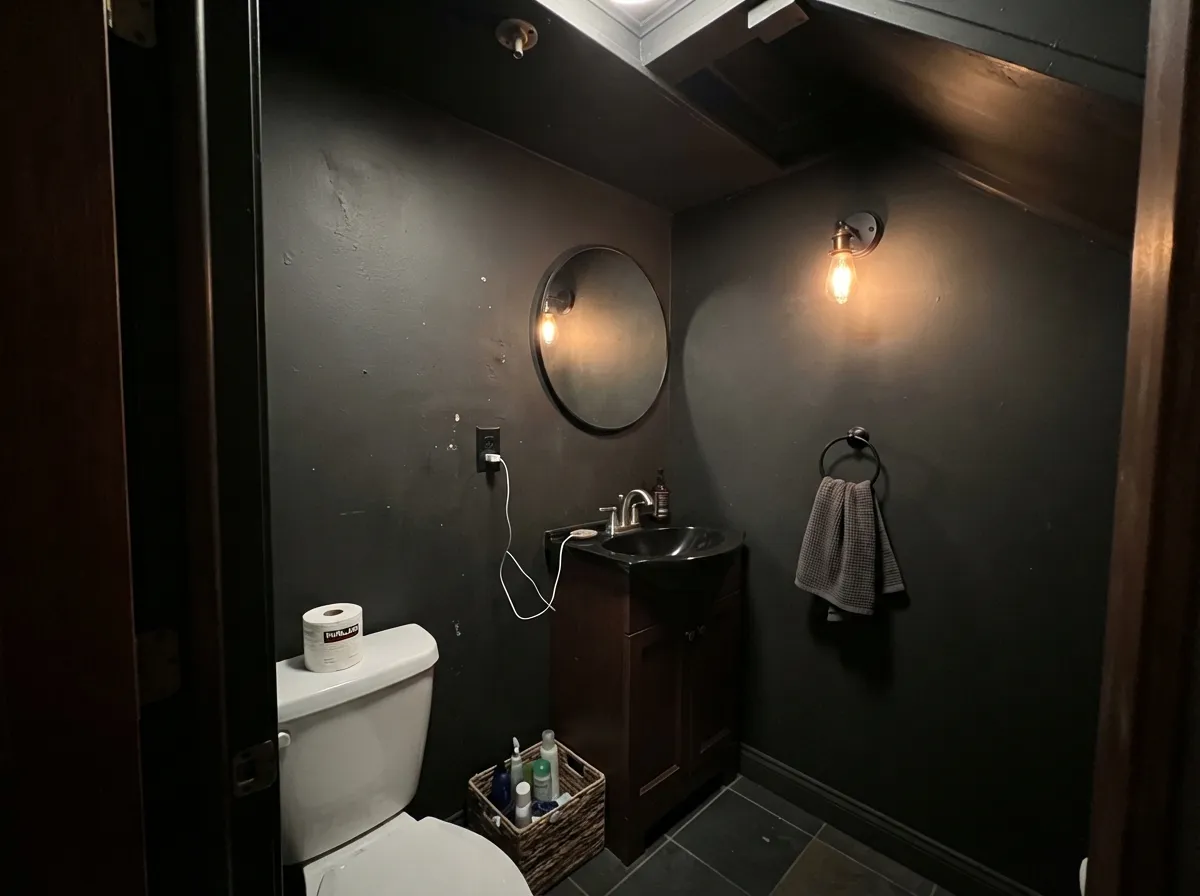
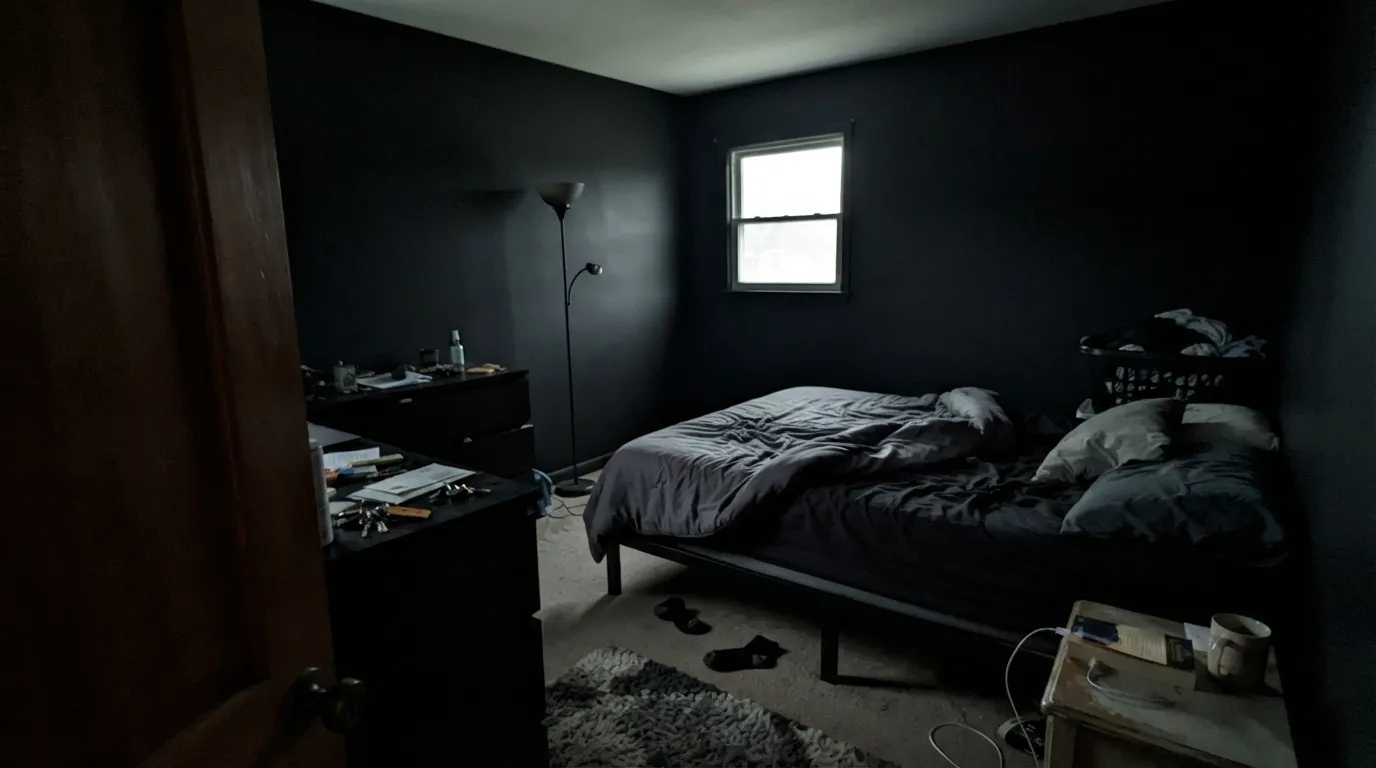
LRV 4 means the walls give nothing back. In a room with one small window or none, black stops reading as moody and starts reading as unlit — corners vanish, the ceiling line disappears, and everything in the room needs its own lamp. Drenched dark rooms in magazines are always full of light fixtures and always small. In a dim bedroom or a long hallway, this is the number-one regret. Iron Ore at LRV 6 is the softer bet, and even that one asks for real light.
Black absorbs heat, and a big south- or west-facing garage door absorbs a lot of it. Door manufacturers warn about it directly: dark paint on uninsulated or lightly insulated steel can cause bowing and panel distortion, can stress the insulation adhesive on sandwich-core doors, and repainting a factory finish can void the warranty on some models. Vinyl and vinyl-clad surfaces are worse candidates still. Check your door's paperwork before the color, not after.
Every drywall seam, old patch, roller stipple and lap mark shows through a true black in raking light, and semi-gloss doubles it. Touch-ups are the other half of the problem: a dab of black almost never disappears the way a dab of greige does, so plan on recoating a full panel or a full wall between breaks. Dust, lint and pet hair also show on black more than on any other color — real, and rarely mentioned before the second week.
Room by Room
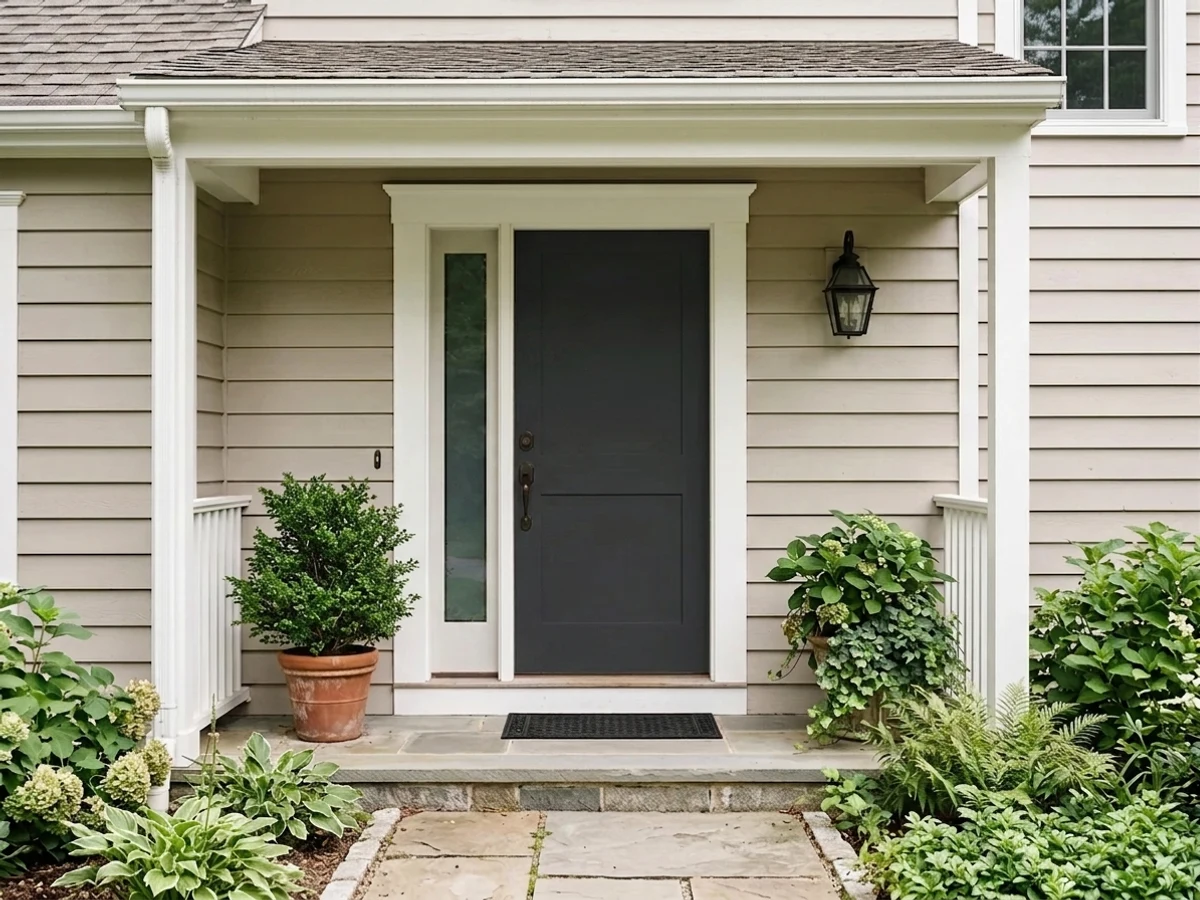
A black door on a white, pale-gray or brick house is the safest high-return color decision in exterior paint, and this one does it without flashing blue at noon. Satin is the modern default and hides the door's dents better; semi-gloss reads more traditional and more formal, and shows every ding. Paint the edges and the interior face too — a black door with a builder-white edge looks unfinished from the first day.
Small surfaces are where a true black does its cleanest work: shutters, window sash, porch rails, light fixtures, house numbers. It gives a plain elevation the black-window look without replacing any windows. Use an exterior-grade product rather than leftover interior paint — UV is what turns dark exterior coatings chalky, and the exterior line is the one built to resist it.
Black garage doors are one of the strongest exterior trends running, and this is a fitting color for one: it holds true black across a large flat panel instead of drifting blue. The rule is the door itself. Insulated steel in a mild climate or on a north or east elevation is a comfortable bet; uninsulated steel or wood in full afternoon sun in a hot climate is the one that bows, and vinyl is a no. Read the warranty, use exterior paint rated for the substrate, and accept that a black door needs a refresh sooner than a white one.
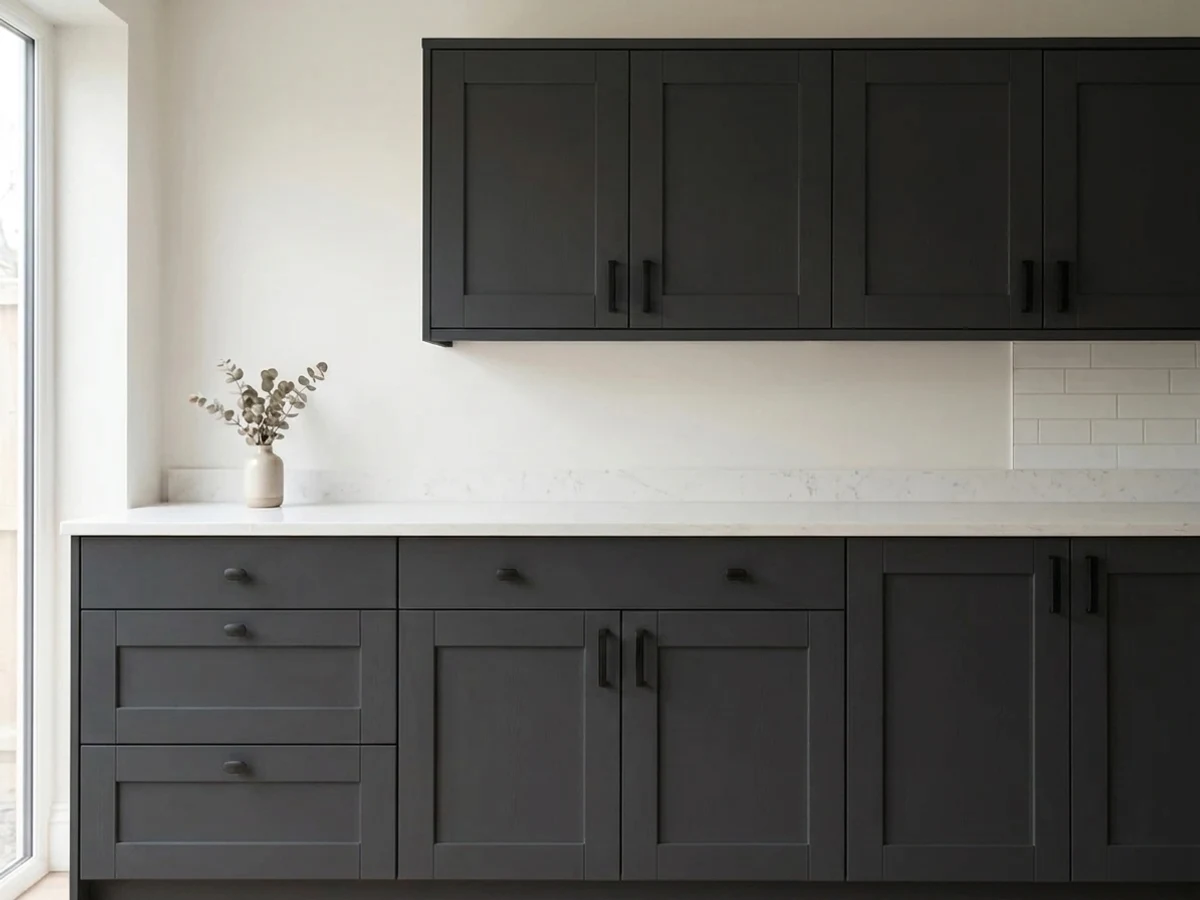
Black lowers under a light upper cabinet, or a black island under a warm white kitchen, is the most durable use of this color indoors. Valspar sells it in a cabinet and furniture enamel, which is the product to use — wall paint on cabinets scuffs and stays soft. Satin, not gloss: gloss on a big cabinet door shows every sanding scratch and every fingerprint. It sits well beside brass, butcher block and honed stone, and it makes cheap boxes look intentional.
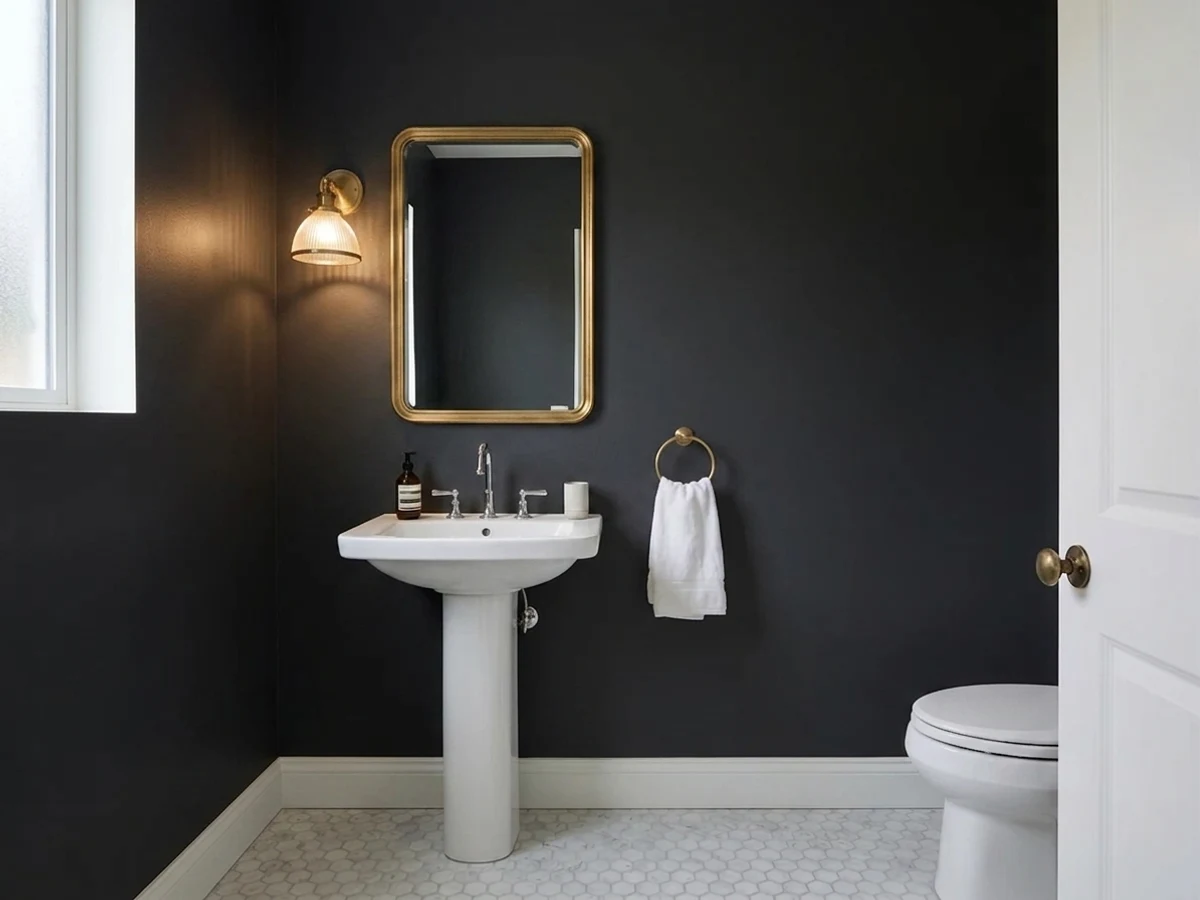
Small rooms take a true black better than big ones. Walls, ceiling and trim all in Dark Kettle Black, with one good light and a mirror, turns a windowless powder room into the best-looking three feet of the house. It is also a genuinely good bathroom ceiling color, which is where more than one designer blog first used it. Matte on the ceiling, satin on the vanity.
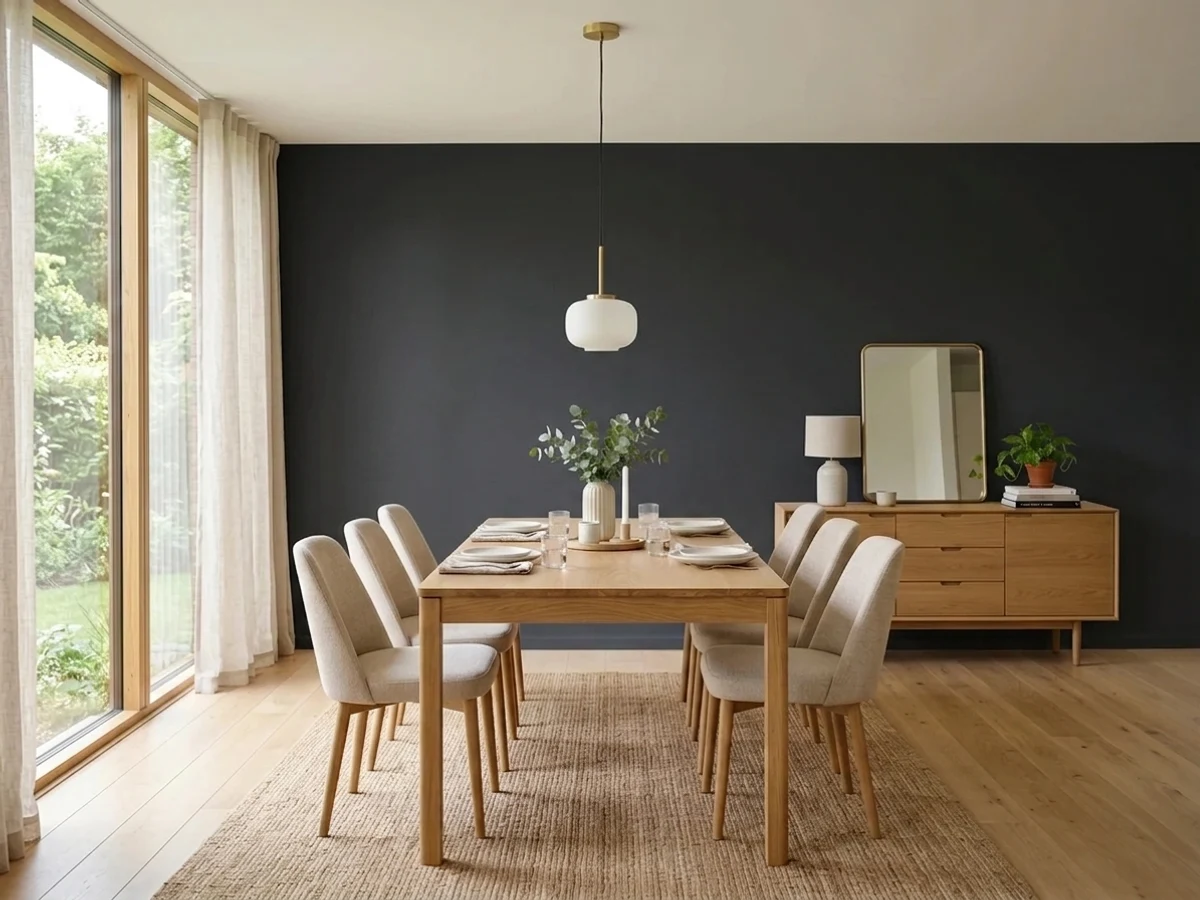
There is a version of this that works: a large room with big windows, an accent wall behind a bed or a fireplace, warm lamps in every corner. Outside those conditions, four black walls in a normal-size room read as a cave rather than a mood, and the ceiling and trim have to be resolved before you start. If you want the weight without the risk, use it on the doors and keep the walls light.
Your Light Is the Risk
Strong sun is the only light that makes a black look expensive: panel edges and shadow lines sharpen and the color stays a clean, flat black instead of drifting. This is why it belongs on a door.
With little light to absorb, it stops reading as a color at all. Surfaces flatten, corners disappear and the room feels smaller and later in the day than it is.
Raking morning or late-afternoon light is the honest hour: it lifts the black slightly toward gray and exposes every sheen streak, brush mark and dent. Whatever the surface looks like at 6pm is what it really looks like.
At 2700K it warms a shade and feels soft and leathery — the right choice for a drenched powder room. Cool 4000K LEDs pull out the cool side and it reads hard blue-graphite. Either way, budget more lumens than you think: black eats light.
Most complaints about Dark Kettle Black are a light mismatch. Upload a photo of your actual room and see it on your walls — then ask for the same wall in north light or evening lamps before you buy a single sample.
Need It From Another Brand?
Any paint counter can custom-tint Valspar 4011-2 directly. If you would rather stay in one brand's own deck, these are the closest stock matches, measured as ΔE2000. Under 2 is a difference you will not see on the wall.
| Brand | Closest color | ΔE | LRV | |
|---|---|---|---|---|
| Sherwin-Williams | Tricorn BlackSW 6258 · Sherwin-Williams | 2.1 | 3 | Color page → |
| Dutch Boy | True Black438-7DB · Dutch Boy | 2.1 | 3 | Color page → |
| HGTV Home by Sherwin-Williams | Tricorn BlackHGSW 1441 · HGTV Home by Sherwin-Williams | 2.1 | 3 | Color page → |
| Magnolia Home | BlackboardJG-05 · Magnolia Home | 3.6 | 3 | Color page → |
| Hirshfield's | Silent Sea0515 · Hirshfield's | 1.4 | 5 | Color page → |
| Portola Paints | Factory BlackFACTORY BLACK · Portola Paints | 3.1 | 2 | Color page → |
Similar Valspar Colors
The nearest shades to Dark Kettle Black within Valspar's own range, ranked by perceptual color distance — useful when you want the same look a touch lighter, darker, or warmer.
WCAG 2.1: AA is 4.5 : 1 for normal text, 3 : 1 for large text, AAA is 7 : 1.
Dark Kettle Black vs the Colors You're Also Considering
Every Dark Kettle Black sample board has the same rivals on it. The numbers show the real lightness gap — then it comes down to which risk you would rather live with.
Pick this if your paint comes home in a Lowe's cart, or you want it in Valspar's cabinet enamel.
Sherwin-Williams SW 6258 · LRV 3Tricorn BlackPick this if you shop Sherwin-Williams — it is the closest working twin, a touch more saturated and just as free of undertone.
Pick this when you want black to read as black, not as almost-black.
Sherwin-Williams SW 7069 · LRV 6Iron OrePick this for a black that is really a very dark charcoal — survivable on four walls, softer in a dim room.
Dark Kettle Black Coordinating Colors
Black does not need a color scheme so much as it needs a counterweight. The rule here: one clean white for the surfaces around it, one mid-tone so the jump is not a cliff, and nothing else fighting for attention. These are the partners that keep showing up in projects that work — outside on siding and trim, inside on walls and cabinets.
Black Outside: Doors, Shutters and the Garage-Door Question
Black is not having a moment outside so much as it has taken over. Valspar's own 2026 exterior color reporting puts Dark Kettle Black among the classics that keep dominating by tint volume, alongside Ultra White and Swiss Coffee — which is a polite way of saying that a very large share of America's black doors, shutters and window sash are this exact number. Black windows drove it: once dark sash became the default in new construction, everyone with older windows found they could buy the look for the price of a quart and a weekend.
Garage doors are the newest surface in that list and the one with actual rules. A garage door is the largest flat plane on most elevations, and painting it black changes the whole facade — for the better on a white or pale house, where the door stops shouting and starts matching the front door. But it is also the surface that gets the most direct sun. Door manufacturers are consistent on the risk: dark paint on uninsulated or thinly insulated steel can absorb enough heat to bow panels or stress the adhesive in sandwich-core doors, vinyl and vinyl-clad doors fade and distort, and repainting can void some factory finish warranties. None of that makes a black garage door a bad idea; it makes it a decision to check the paperwork on first.
The other exterior truth is maintenance. Dark exterior coatings take the most UV punishment, and when a black finally goes it does not peel first — it chalks, turning a soft washed-out gray that looks tired long before the film fails. Use the exterior line rather than leftover interior paint, prime bare metal, and plan on refreshing a sun-facing black door years before you would repaint the siding.
Dark Kettle Black With Wood, Metal and Floors
Because it carries almost no undertone, this black takes its personality from what you put beside it — which makes wood the real decision. White oak, walnut and butcher block warm it up and give a black kitchen the softness it needs; the grain reads as the color in the room and the cabinets become the frame. Honey oak, the color that ruins so many wall colors, is actually one of black's easier neighbors: black has no undertone to clash with orange, so it reads as deliberate contrast rather than a fight. Gray-washed and very cool floors are the one combination that can go cold, especially under 4000K bulbs.
Metals are wide open. Unlacquered and antique brass are the classic warm answer on a black island or a black front door; matte black hardware on black cabinets is the quiet, tonal version and looks best in satin, where the sheen difference does the work. Polished chrome and stainless both read crisp and modern against it. The one to avoid is builder-shine brass on a freshly blacked door — it is the detail that gives away a cheap update.
On stone, black lowers do their best work under something with visible movement: honed granite, soapstone, quartz with a warm vein. A pure flat white counter over black cabinets is a strong graphic look but an unforgiving one, and it shows dust on both halves.
Three Ready Palettes Built on Dark Kettle Black
A color is never alone on the wall. These are complete combinations in the 60-30-10 pattern, with the reason each one holds together. Every one opens in the visualizer.
The two colors Valspar tints most, doing the job they are famous for: a bright white body at LRV 92 with every opening blacked out. The third step is what keeps it from looking like a photograph — a mid charcoal-greige on the porch floor and foundation stops the black from floating and hides the dirt that a black floor would show.
Try this palette in your roomTwo-tone kitchens fail when the light half is too stark against the black. A soft warm white on the uppers and a greige wall keep the contrast rich rather than graphic, and the black stays at eye level and below where it takes the wear. Brass or aged bronze pulls; butcher block or honed stone on the island.
Try this palette in your roomThe low-risk way to own this color indoors. Keep the walls and trim doing their usual quiet job and let the doors carry all the weight — a weekend of work, no lighting problem to solve, and the whole floor plan reads more expensive. Black hinges and matte-black levers finish it; leaving builder-brass hardware on a black door undoes the effect.
Try this palette in your roomDark Kettle Black FAQ
Does Dark Kettle Black have blue or green undertones?
No — and that is the reason people keep coming back to it. Designers who work out of the Lowe's deck reach for it precisely because it stays a true black instead of flashing navy the way some of Valspar's other blacks do. Valspar's own listing calls the undertone cool, which is honest: beside a warm black it looks slightly graphite. On its own, on a door or a cabinet, it just reads black.
Is Dark Kettle Black the same as Tricorn Black?
They are close enough that most people could not pick them apart on a door, and cross-brand matching tools list them as each other's nearest neighbor. On our deck data Dark Kettle Black sits at LRV 4 and Tricorn Black at LRV 3, so Tricorn is a hair more saturated. The real difference is the shelf: one is a Lowe's trip, the other a Sherwin-Williams store. Do not mix them on the same elevation — side by side on adjacent surfaces the difference does show.
Can I paint my garage door this color?
Usually yes, with one check first. Black absorbs heat, and door makers warn that dark paint on uninsulated steel or wood can lead to bowed panels, stressed insulation and, on some models, a voided warranty; vinyl doors are the ones to leave alone. An insulated steel door, a moderate climate, or a north- or east-facing elevation makes it a comfortable choice. Use an exterior-grade product rated for the substrate, prime bare or chalky metal, and paint on a mild overcast day rather than in direct sun.
What sheen should I use on a black front door?
Satin is the modern default and the forgiving one — it holds shape without spotlighting dents, and it is what most current exterior work uses on dark doors. Semi-gloss looks more traditional and cleans a little better, but it broadcasts every ding and every touch-up. On cabinets use a satin cabinet enamel, never wall paint; on walls and ceilings go matte, because sheen on a large black surface shows every flaw in the drywall.
Why does my black paint look patchy and streaky?
Almost always coverage and cure, not a bad can. Black tints into a deep base with very little white pigment, so it hides poorly — two coats is the minimum and three is common over anything that was not primed gray or dark. Roller marks and lap lines look far worse while the film is still wet and keep improving for a couple of weeks as it cures. Keep a wet edge, work in full panels rather than patches, and do not judge it under a work light on day one.
Is a whole room in Dark Kettle Black too much?
It depends entirely on the room's size and light. A small powder room, a windowless bar or a study with good lamps takes a full drench beautifully — walls, ceiling and trim in the same black is a real designer move and small rooms wear it best. A normal bedroom with one window is where this goes wrong: at LRV 4 nothing bounces back, the room feels unlit at 4pm and every piece of furniture needs its own lamp. When in doubt, black the doors and keep the walls light.
Have you painted with Dark Kettle Black?
Rate it — one tap helps the next reader decide.
Ask a Question